Conversion Blitz vs Generect: Which Lead Tool Wins in 2026?
Conversion Blitz bundles 30+ marketing tools. Generect goes deep on LinkedIn-native B2B data. We compare accuracy, pricing, API access, and export limits to show which one actually earns a spot in your outbound stack.
TL;DR
- Conversion Blitz is a bundle: 30-ish small marketing and lead-gen tools (email finder, chatbot, review widget, daily leads feed, newsletter sender) sold under one subscription. Breadth is the pitch; depth is not.
- Generect is the opposite bet: a narrow, LinkedIn-native B2B data platform built around real-time lookups, Sales Navigator search import, and an API that engineers actually use.
- If you are a solo founder or an agency who wants a lot of cheap surface area, Conversion Blitz makes more sense. If you run outbound at volume and care about email deliverability, Generect is the stronger data layer.
- Neither is a great fit if you mainly need verified email addresses at predictable per-credit cost — that is where a focused finder/verifier like Tomba usually wins on cost-per-valid-contact.
- Decide with two numbers, not a feature list: cost per verified email and bounce rate on a 500-contact test send. Everything else is noise.
What is Conversion Blitz?#
Conversion Blitz is an all-in-one lead generation and marketing software suite. Instead of building one tool well, it packages a large collection of small tools behind a single login — an email finder-style search, an email verifier, a domain/company scraper, a daily leads feed, a chatbot widget, a review-collection widget, a social-proof notification bar, a newsletter sender, and a long tail of utilities.
It became well known through lifetime-deal marketplaces, which tells you a lot about the target buyer: solo operators, freelancers, small agencies, and people who want a large "tools included" number on the pricing page without adding five separate SaaS bills. You can check the current lineup on the Conversion Blitz site.
The trade-off is structural. When one team maintains 30 tools, no single tool gets the engineering attention that a dedicated vendor gives its one product. In practice that shows up as thinner data coverage, fewer verification signals, and an API that exists but is not the center of the product.
What is Generect?#
Generect is a B2B lead generation and data platform built around LinkedIn as the source of truth. Its core loop: you define an audience (often by pasting a LinkedIn Sales Navigator search URL), Generect resolves those profiles into contacts, and it finds and validates business emails in real time rather than serving them from a stale cached table.
The positioning is data-first and developer-friendly. Generect leans hard on API access, real-time lookups, and enrichment for teams that want to pipe contacts straight into a CRM or an outbound sequencer instead of clicking around a UI. You can see how the company frames it on the Generect homepage.
The trade-off here is also structural. You are buying a data layer, not a marketing suite. There is no chatbot, no review widget, no social-proof popup. If you expected an all-in-one growth stack, you will be disappointed — and if you expected a cheap self-serve tier, you should confirm current pricing directly, because the platform skews toward teams and API contracts rather than $19/mo hobbyists.
Wait — that image needs a real alt. Here it is properly:

Conversion Blitz vs Generect: how do they actually compare?#
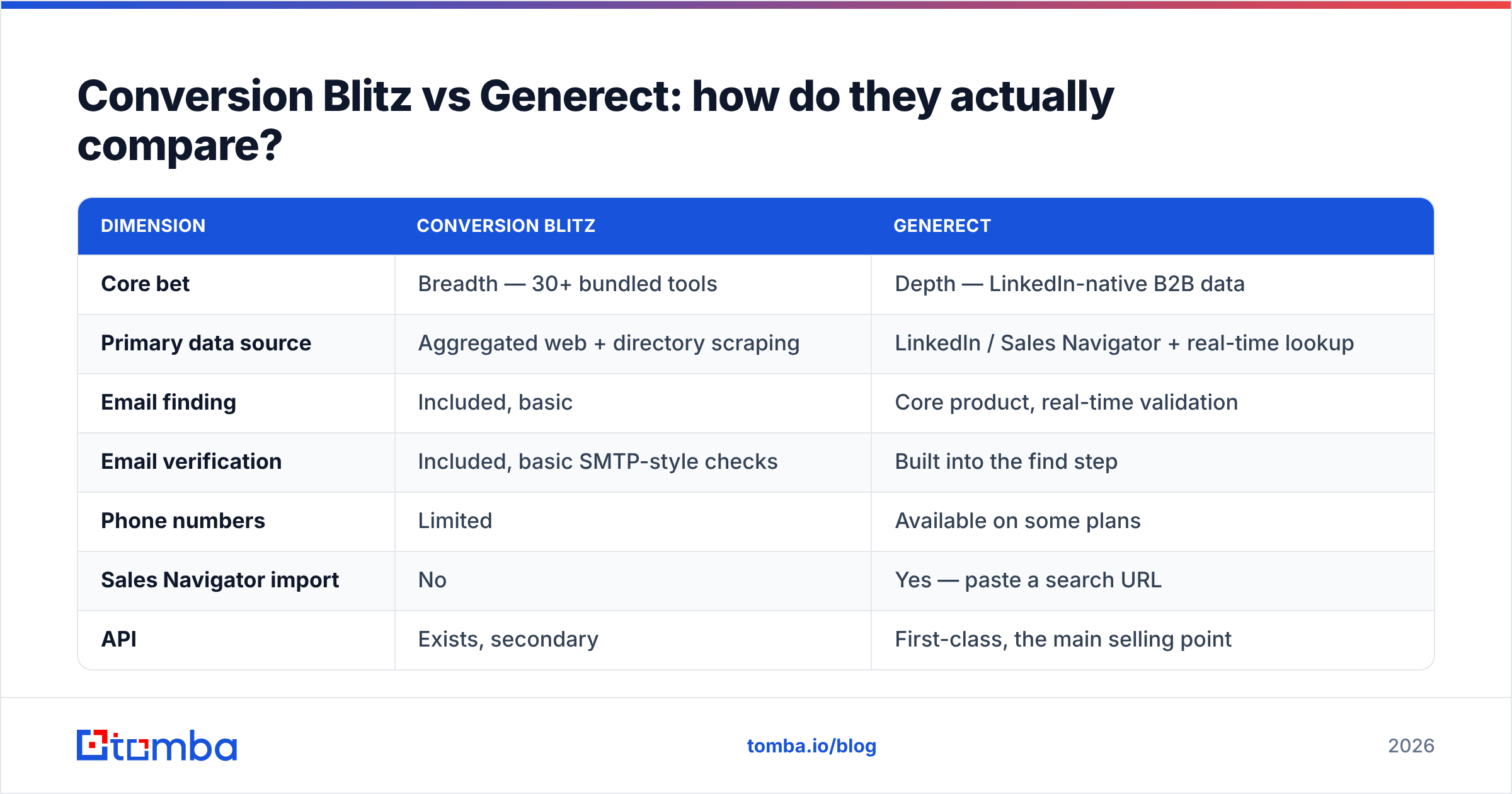
Here is the head-to-head. Treat pricing as a starting point and confirm on each vendor's page — lead-gen pricing moves quarterly.
| Dimension | Conversion Blitz | Generect |
|---|---|---|
| Core bet | Breadth — 30+ bundled tools | Depth — LinkedIn-native B2B data |
| Primary data source | Aggregated web + directory scraping | LinkedIn / Sales Navigator + real-time lookup |
| Email finding | Included, basic | Core product, real-time validation |
| Email verification | Included, basic SMTP-style checks | Built into the find step |
| Phone numbers | Limited | Available on some plans |
| Sales Navigator import | No | Yes — paste a search URL |
| API | Exists, secondary | First-class, the main selling point |
| Extras (chatbot, reviews, popups) | Yes — many | No |
| Typical buyer | Solo founder, freelancer, small agency | Outbound team, RevOps, dev-led GTM |
| Entry pricing | Low, often lifetime-deal driven | Higher, credit/seat or API contract |
| Biggest weakness | Shallow data, no single tool is best-in-class | Narrow scope, less self-serve |

The table makes the choice sound tidier than it is, so read it this way: Conversion Blitz reduces your tool count. Generect reduces your bounce rate. Those are different problems, and most teams only have one of them at a time.
Which one has better data accuracy?#
Generect, by a comfortable margin — and the reason is architectural rather than a matter of one vendor "trying harder."
Conversion Blitz finds emails the way most bundled suites do: pattern inference plus a light SMTP check. That works fine on firstname@company.com mid-market domains and falls apart on catch-all domains, on companies with multiple email formats, and on anyone whose mail server refuses to confirm recipients. You will get results. A meaningful share of them will be guesses wearing a confidence badge.
Generect validates at request time against live mail infrastructure, which is why it can honestly say a contact was verified today instead of sometime in the last 18 months. Real-time is not magic — catch-all domains are still hard for everyone — but it materially cuts the "the person left 14 months ago" failure mode that kills cold email reputation.

Here is the part vendors bury: accuracy is not a vendor property, it is a segment property. Any tool will look excellent on 500-person US SaaS companies and mediocre on 20-person European agencies. So do not trust anyone's marketing number, including this article's framing. Run the same 100 target accounts through both, then push the results through an independent email verifier and compare valid rates. That single afternoon of work will tell you more than every G2 badge combined. If you want third-party sentiment as a sanity check, both tools have profiles on G2.
A practical accuracy rule for 2026: if your bounce rate on a fresh list exceeds 3%, the list is the problem, not your copy. Google and Yahoo's bulk sender requirements made that threshold a hard ceiling rather than a nice-to-have — the Gmail sender guidelines spell out the consequences.
What does each one cost?#
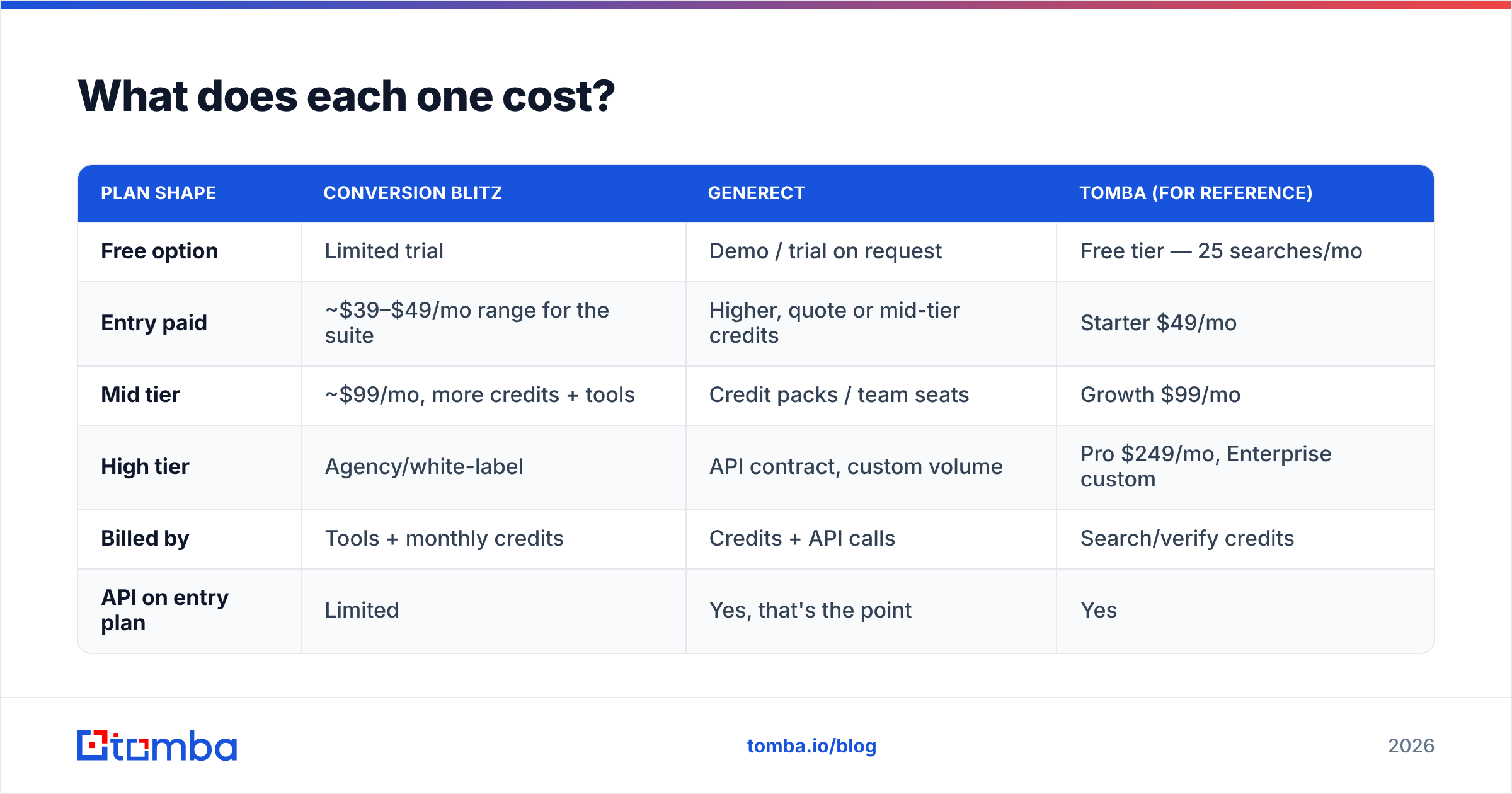
Approximate, and worth re-checking before you buy. Conversion Blitz's headline appeal is a low monthly (and historically, lifetime) price for the whole bundle. Generect prices like a data vendor: credits, seats, and API tiers.
| Plan shape | Conversion Blitz | Generect | Tomba (for reference) |
|---|---|---|---|
| Free option | Limited trial | Demo / trial on request | Free tier — 25 searches/mo |
| Entry paid | ~$39–$49/mo range for the suite | Higher, quote or mid-tier credits | Starter $49/mo |
| Mid tier | ~$99/mo, more credits + tools | Credit packs / team seats | Growth $99/mo |
| High tier | Agency/white-label | API contract, custom volume | Pro $249/mo, Enterprise custom |
| Billed by | Tools + monthly credits | Credits + API calls | Search/verify credits |
| API on entry plan | Limited | Yes, that's the point | Yes |
The number that matters is not the sticker price. It is cost per verified email. A $39/mo tool that returns 40% valid emails is more expensive than a $99/mo tool that returns 90% valid, once you count the deliverability damage. Compute it: (monthly price ÷ emails that survive verification). Do it for both. The winner is often not the one that looked cheap. You can benchmark against transparent per-credit Tomba pricing while you're at it.
Who should choose Conversion Blitz?#
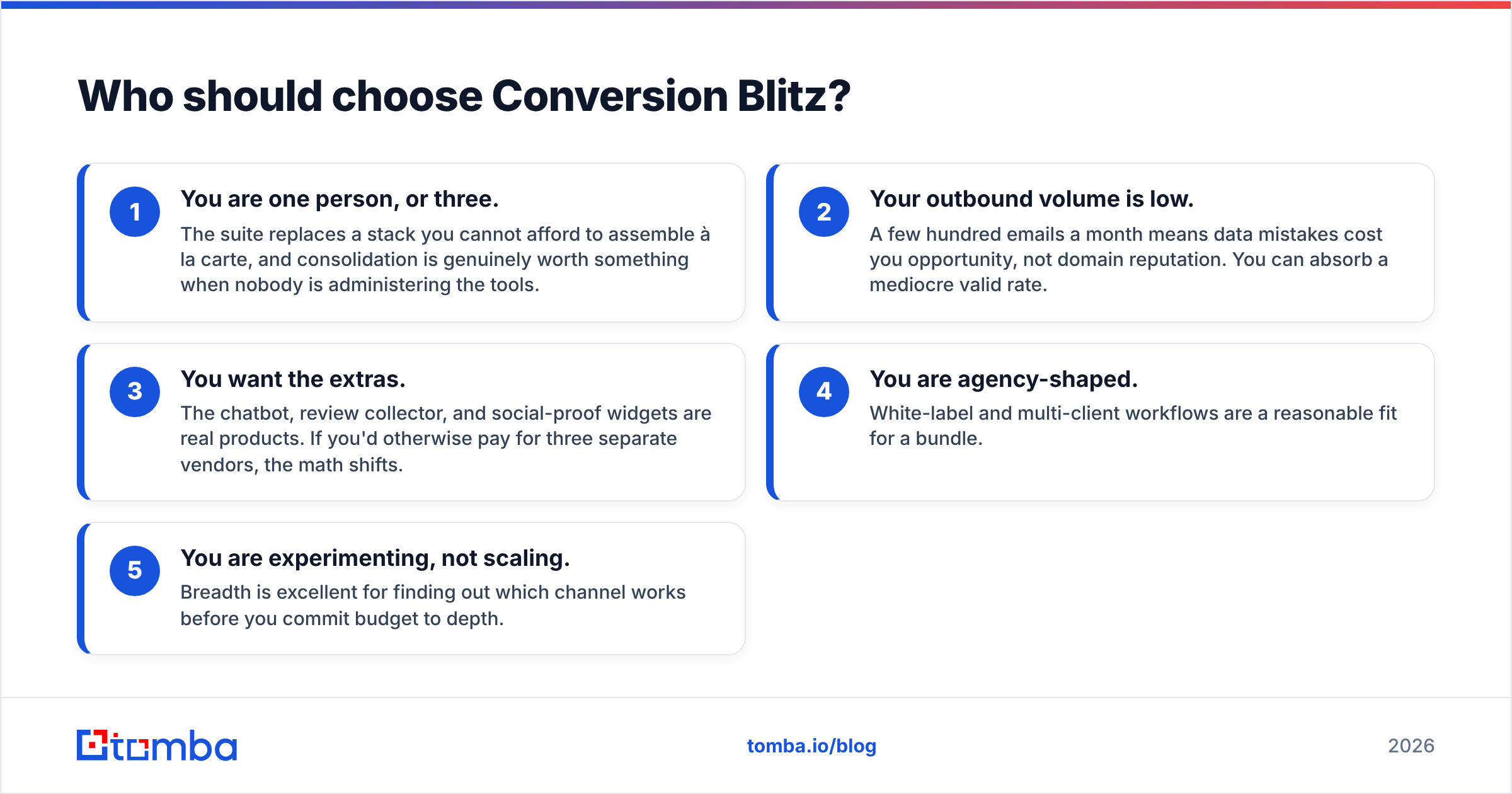
Pick Conversion Blitz if most of these are true:
- You are one person, or three. The suite replaces a stack you cannot afford to assemble à la carte, and consolidation is genuinely worth something when nobody is administering the tools.
- Your outbound volume is low. A few hundred emails a month means data mistakes cost you opportunity, not domain reputation. You can absorb a mediocre valid rate.
- You want the extras. The chatbot, review collector, and social-proof widgets are real products. If you'd otherwise pay for three separate vendors, the math shifts.
- You are agency-shaped. White-label and multi-client workflows are a reasonable fit for a bundle.
- You are experimenting, not scaling. Breadth is excellent for finding out which channel works before you commit budget to depth.
Do not pick it if your business depends on a clean sender reputation. A bundled email finder is not the tool you build a $2M pipeline on.
Who should choose Generect?#
Pick Generect if most of these are true:
- LinkedIn is your ICP source. If your targeting already lives in Sales Navigator, importing that search directly is a genuine workflow saver — no CSV gymnastics.
- You have engineers. The API-first design pays off when you are enriching inside your own systems rather than exporting spreadsheets.
- Deliverability is a board-level metric. Real-time verification at the point of retrieval is the right architecture for teams sending thousands of emails weekly.
- You need fresh data, not big data. Generect optimizes for "correct right now," which is different from "largest database."
- You accept a narrow tool. No chatbot, no widgets, no newsletter sender. You will assemble the rest of the stack yourself.

Where do both tools fall short?#
Neither is a complete answer, and being honest about that is more useful than picking a winner:
- Neither is a full sequencer. You still need Instantly, Smartlead, Lemlist, or similar to actually send. Budget for it.
- Catch-all domains remain unsolved. Every vendor waves at this problem; nobody has beaten it. If a meaningful share of your ICP runs catch-all mail servers, you need a dedicated catch-all verifier in the loop regardless of which platform you buy.
- Credit models are opaque. A "search" and a "verified email" are not the same unit, and vendors love to blur them. Ask exactly what consumes a credit — including failed lookups.
- Export and API limits bite at scale. Read the fine print on monthly caps before you design a workflow around either one.
- Compliance is your job. GDPR and CCPA obligations do not transfer to the vendor because you bought data from them. Keep your lawful-basis documentation current.
Is there a better option for teams that mainly need verified emails?#
Often, yes — and it is worth saying plainly rather than pretending the two-way comparison is the whole market.
If you strip the question down, most outbound teams do not need 30 tools or a LinkedIn-native platform. They need to turn a list of companies and names into email addresses that do not bounce, at a cost they can forecast. That is a narrower job, and narrow tools do it better and cheaper.
That is where Tomba sits. The core product is an email finder with verification attached, plus domain search for mapping an entire company's contactable people, bulk processing for list work, and a documented Tomba API if you'd rather do all of this from code. Pricing is a plain credit model — Free (25 searches/mo), Starter $49/mo, Growth $99/mo, Pro $249/mo — which makes the cost-per-verified-email calculation trivial instead of adversarial.
The honest framing: Tomba will not send your newsletter or run your chatbot, and it does not import Sales Navigator searches the way Generect does. If those are your requirements, buy the tool that has them. But if your requirement is "clean, verified B2B emails at a predictable price," a dedicated finder beats both a bundle and a platform.
How should you actually decide?#
Skip the feature matrices — including the one above. Run this test instead:
- Pick 100 real target accounts from your actual ICP, not a demo list of Fortune 500s.
- Run them through each tool. Note the hit rate (how many returned an email at all).
- Verify every result with an independent verifier. The vendor's own confidence score does not count as evidence.
- Calculate cost per valid email for each option.
- Send 500 emails from a warmed domain and measure the real bounce rate.
Whichever tool produces the lowest cost-per-valid-email at a sub-3% bounce rate wins. That is the only comparison that survives contact with your pipeline.
Try the focused option first#
If you're weighing Conversion Blitz against Generect, you have already accepted that data quality is worth paying for — you are just arguing about the wrapper. Before you commit to either subscription, spend twenty minutes running your real target list through the Tomba Email Finder. The free tier gives you 25 searches, no card, which is enough to see your own hit rate on your own ICP.
Then compare the numbers, not the pitch decks. If a focused finder returns more valid emails per dollar than a 30-tool bundle or a LinkedIn-native platform, that is your answer — and if it doesn't, you'll have real evidence for the tool you buy instead.
Related guides#
Ready to find emails that actually work?
Join 150,000+ professionals who stopped guessing and started sending. Free credits on signup — no credit card required.
Get the Tomba newsletter
Practical outbound tactics and product updates — once every two weeks.
About the author