Conversion Blitz vs GrowMeOrganic: Which Wins in 2026?
Two all-in-one prospecting suites, two very different bets. We break down data accuracy, sending limits, pricing and hidden costs — and name the setup that actually books meetings in 2026.
TL;DR
- Conversion Blitz is a bundle play: a dozen-plus micro-tools (email finder, verifier, chatbot, review manager, business-data scraper) under one login. Breadth is the product.
- GrowMeOrganic is a prospecting-to-sending engine: LinkedIn extraction, email finding, drip campaigns, and a lightweight CRM in one workflow. Depth on outbound is the product.
- Neither one is a data company. Both resell and stitch together contact data, and that is exactly where cold-email campaigns quietly die — on bounces you paid for twice.
- If you send under ~2,000 emails/month and want one bill, GrowMeOrganic is the tighter fit. If you want many small tools for one price, Conversion Blitz wins on surface area.
- The setup that consistently outperforms both: a dedicated data layer (a real email finder plus verification) feeding whichever sequencer you already like.
Most "Conversion Blitz vs GrowMeOrganic" comparisons are affiliate pages with a coupon code at the bottom. This one is not. Both tools are legitimate, both have real users, and both have a structural weakness that shows up on your bounce rate around week three. Here is the honest read.
What is Conversion Blitz?#
Conversion Blitz is an all-in-one lead-generation suite. Instead of one deep product, you get a large collection of small ones bundled behind a single subscription: a business-data search, an email finder, an email verifier, an unlimited email-sending module, a website chatbot, a review-collection widget, notification/social-proof popups, a domain finder, and a handful of AI writing helpers.
The pitch is arithmetic. Buy fifteen point solutions separately and you are paying $600+/month. Buy the bundle and you are paying a fraction of that. For a solo founder or a small agency that genuinely needs a chatbot, a popup tool, and a lead list, that math is not fake.
The trade-off is depth. Each module is roughly at the level of a competent free tool. The email finder is not a data company's email finder. The verifier is not a specialist verifier. The sender is not Instantly. Nothing is bad; nothing is best-in-class. You are buying convenience and a single invoice.
Who it fits: agencies and solopreneurs who want many small capabilities cheaply, who value one login over one great tool, and whose volume is low enough that data quality is a nuisance rather than a budget line.
What is GrowMeOrganic?#
GrowMeOrganic is a narrower, more opinionated product. It is built around a single motion: find people on LinkedIn (or in its B2B database), get their emails, drop them into a drip sequence, track replies in a built-in mini-CRM.
The Chrome extension is the heart of it. You run a LinkedIn or Sales Navigator search, extract the results, enrich them with emails, and push them straight into a campaign — without a CSV round trip. Higher tiers advertise unlimited email sending from your connected mailboxes, which is why it shows up so often in agency stacks: the cost per sent email trends toward zero as volume climbs.
The trade-off is the same one every scraper-plus-sequencer makes. Extraction volume is easy; extraction accuracy is not. When a LinkedIn profile has no public email — which is most of them — the tool falls back to pattern guessing and third-party enrichment. That is where invalid addresses enter your list, and they enter it silently.
Who it fits: outbound teams and lead-gen agencies whose prospecting starts on LinkedIn and who want prospecting and sending under one roof.

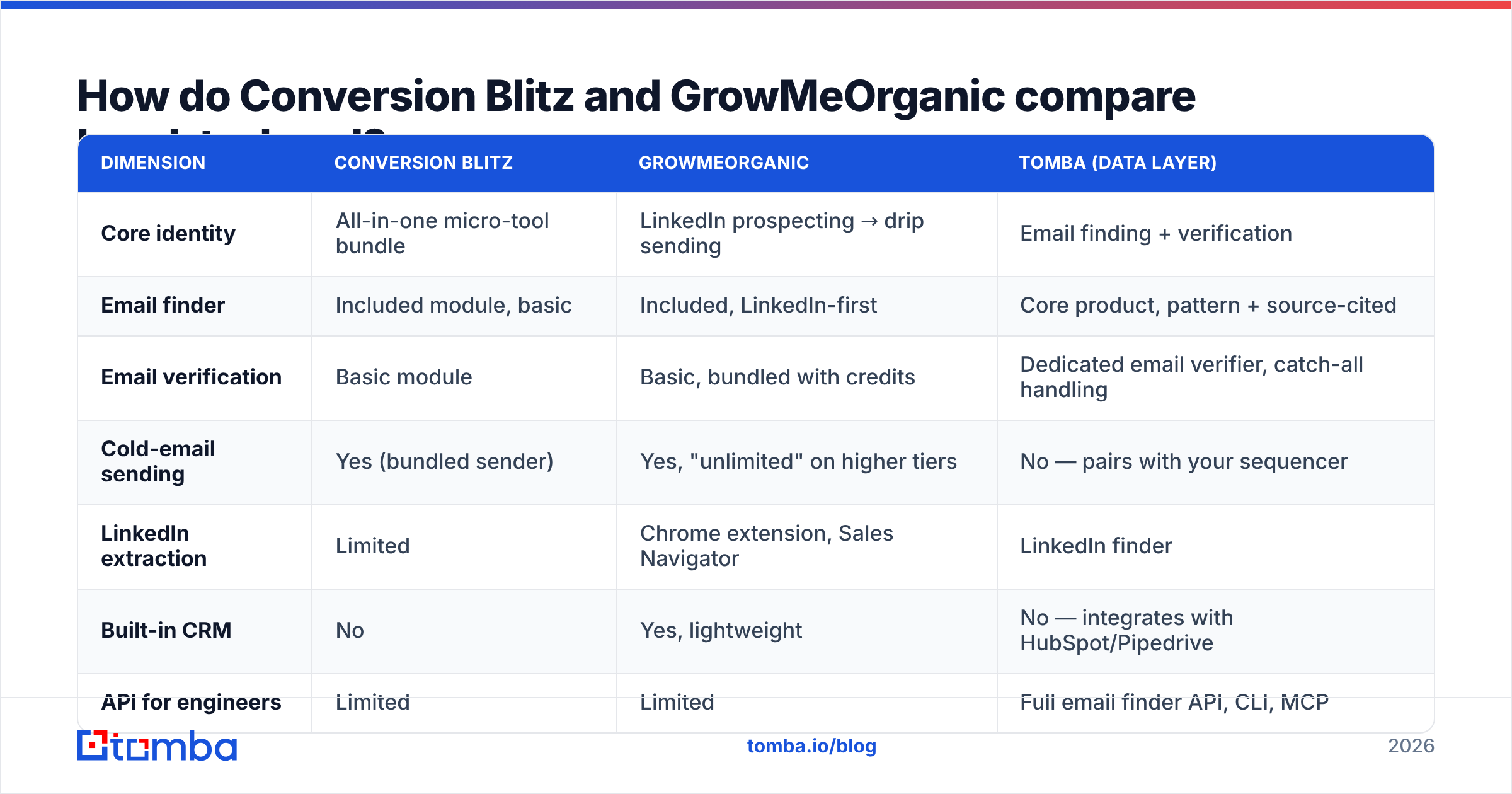
How do Conversion Blitz and GrowMeOrganic compare head-to-head?#
| Dimension | Conversion Blitz | GrowMeOrganic | Tomba (data layer) |
|---|---|---|---|
| Core identity | All-in-one micro-tool bundle | LinkedIn prospecting → drip sending | Email finding + verification |
| Email finder | Included module, basic | Included, LinkedIn-first | Core product, pattern + source-cited |
| Email verification | Basic module | Basic, bundled with credits | Dedicated email verifier, catch-all handling |
| Cold-email sending | Yes (bundled sender) | Yes, "unlimited" on higher tiers | No — pairs with your sequencer |
| LinkedIn extraction | Limited | Chrome extension, Sales Navigator | LinkedIn finder |
| Built-in CRM | No | Yes, lightweight | No — integrates with HubSpot/Pipedrive |
| API for engineers | Limited | Limited | Full email finder API, CLI, MCP |
| Entry price (list, at writing) | ~$39–$49/mo range | ~$49/mo range | Free tier, then $49/mo Starter |
| Free tier | Trial-based | Limited free credits | 25 searches/mo, no card |
| Best for | Many small tools, one bill | LinkedIn-led outbound | Accuracy-critical lists at any volume |
Pricing on both products moves — both have run lifetime deals, appsumo-style promos, and annual discounts that materially change the number. Always price them on the vendor's own page before committing, and check current user sentiment on G2 rather than on any blog, including this one.
Which one has better data accuracy?#
This is the question that actually decides your ROI, and it is the one both marketing pages skate past.
Neither Conversion Blitz nor GrowMeOrganic is primarily a data business. Both assemble contacts from a mix of scraping, licensed databases, and pattern inference (first.last@, f.last@, and so on). Pattern inference is not inherently wrong — a well-built finder uses it constantly — but it only works when it is backed by two things: a large corpus of observed addresses per domain to learn the pattern from, and an SMTP-level verification pass to confirm the guess before it reaches your sender.
Bundled tools tend to be thin on both. The observed-address corpus is smaller because email finding is one of fifteen features, not the whole company. And the verification step is frequently a light syntax-and-MX check rather than a real mailbox probe, which passes almost anything that is spelled correctly.

The practical consequence is a bounce rate that looks fine on day one and ugly by day twenty. Here is the sequence teams keep rediscovering:
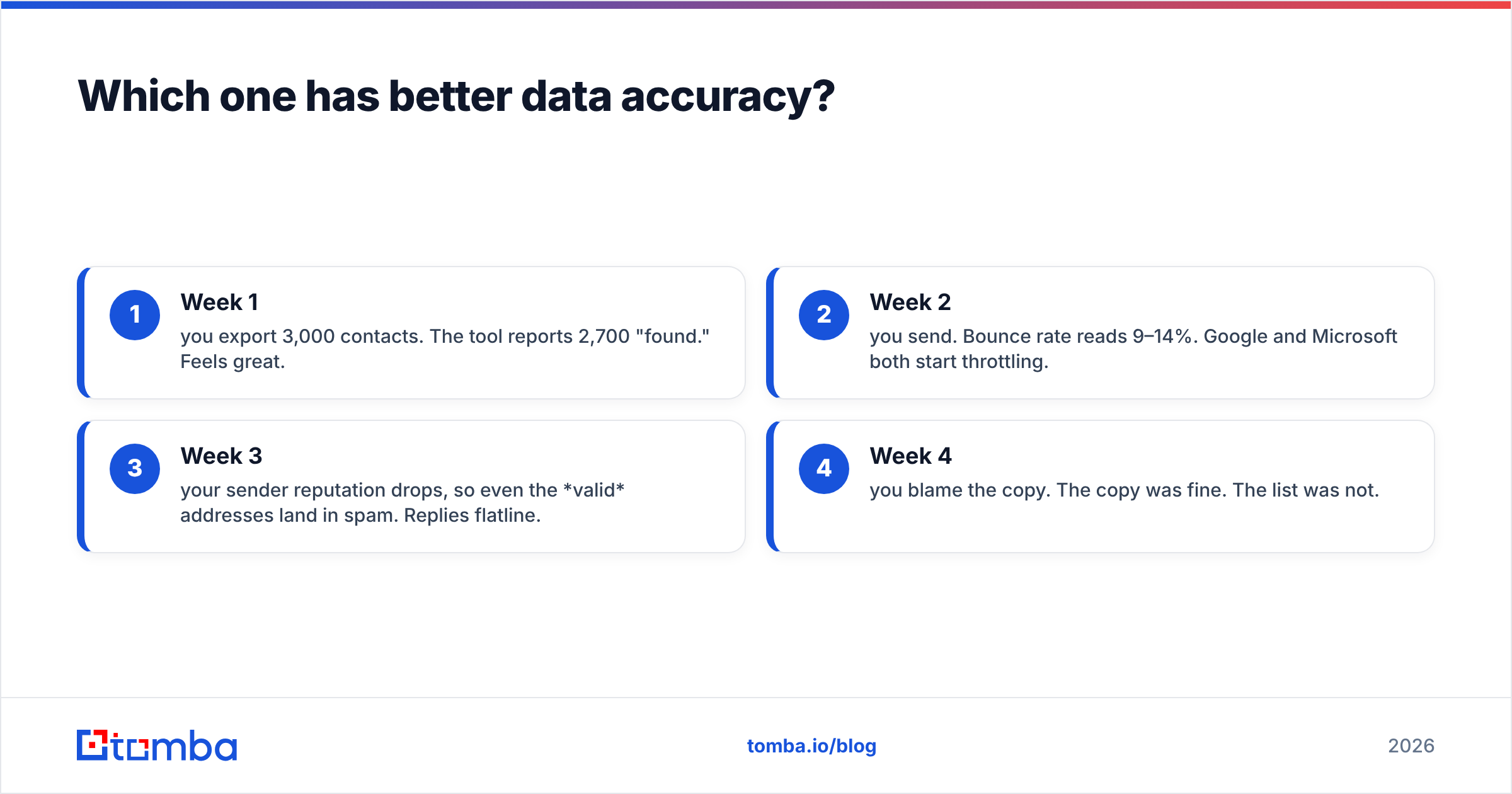
- Week 1 — you export 3,000 contacts. The tool reports 2,700 "found." Feels great.
- Week 2 — you send. Bounce rate reads 9–14%. Google and Microsoft both start throttling.
- Week 3 — your sender reputation drops, so even the valid addresses land in spam. Replies flatline.
- Week 4 — you blame the copy. The copy was fine. The list was not.
Anything above roughly 2% hard bounce is a reputation problem, not a rounding error. That threshold is not a vendor opinion — it is the number Google's own sender guidelines effectively enforce on bulk senders, and it is why a "free" bundled verifier can be the most expensive line item in your stack.
Is an all-in-one suite better than a specialist stack?#
Not usually — but it depends on what breaks first when you scale.
The all-in-one case (Conversion Blitz's argument): fewer vendors, fewer logins, fewer credit cards, no integration work. For a two-person agency running ten client campaigns at low volume, the overhead of stitching four best-in-class tools together genuinely costs more than the accuracy it buys.
The specialist case: every tool in a bundle is a compromise made by someone optimizing for feature count, not for your bounce rate. The moment your volume passes a few thousand sends a month, the cheap module becomes the bottleneck — and you end up buying the specialist tool anyway, on top of the bundle you already pay for.
The honest middle path, and what most teams that survive year two actually run:
- Data layer (specialist). Finding and verifying addresses is the one job you cannot afford to do at 80%. Own it with a dedicated provider that publishes its data sources and cites where each address came from.
- Sequencer (specialist or bundled). Instantly, Smartlead, Lemlist, GrowMeOrganic's own sender — pick whichever your team likes. This layer is genuinely commoditized.
- CRM (whatever you already have). HubSpot, Pipedrive, or a spreadsheet if you are early. Do not migrate your CRM to satisfy a prospecting tool.
- Everything else (bundled, happily). Chatbots, popups, review widgets. This is where Conversion Blitz's breadth is a genuine bargain — none of these touch your deliverability.
Split it that way and the "Conversion Blitz vs GrowMeOrganic" question stops being existential. It becomes: which one do I want for layers 2 and 4?
What about pricing and hidden costs?#
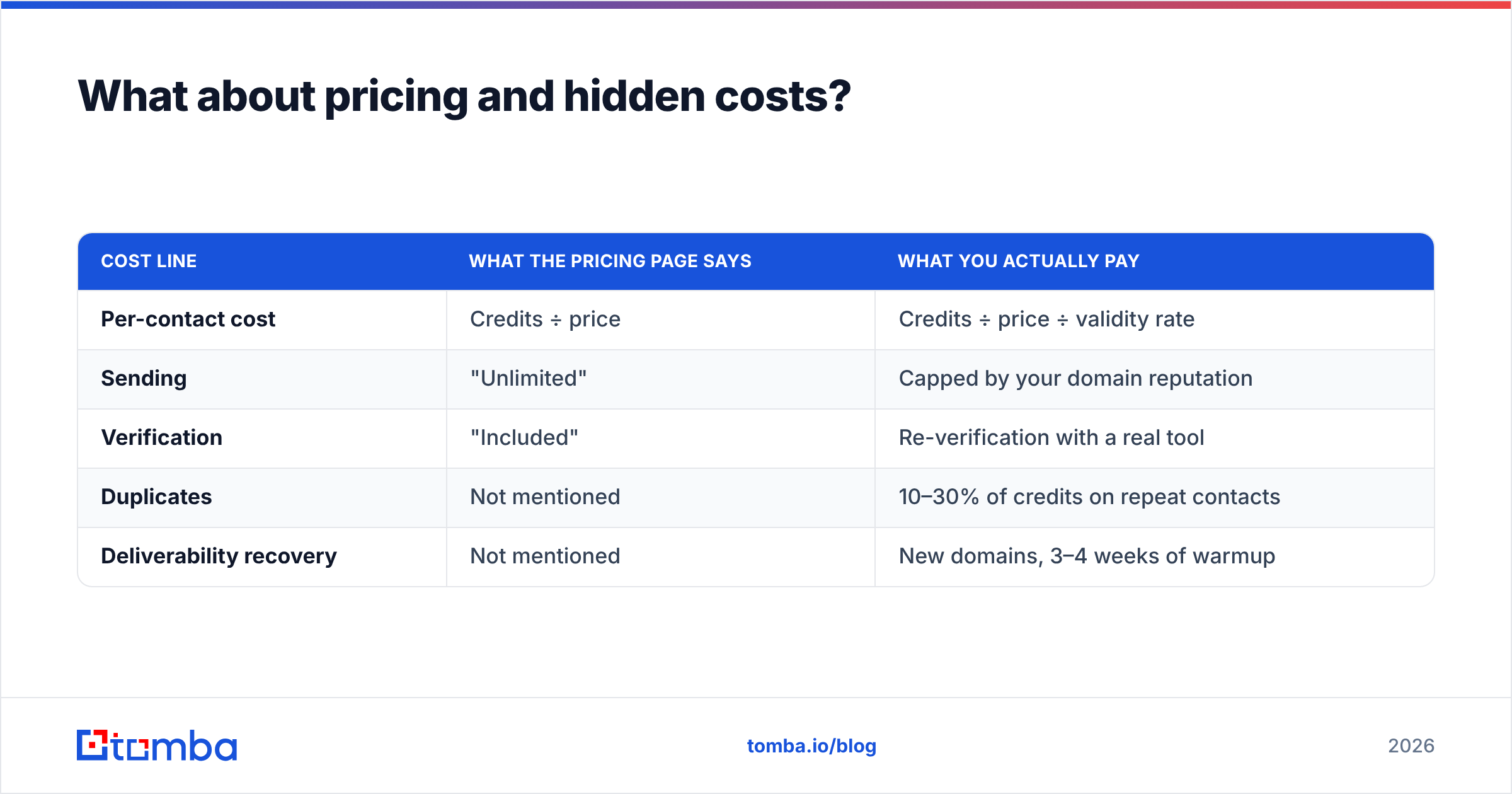
Published price is the least interesting number in this category. Three costs sit underneath it.
Credit burn on bad data. If a tool charges you a credit for every "found" address and 20% of them are invalid, your true cost per usable contact is 25% higher than the sticker. Tools that charge only for verified-deliverable results — or that give you a hard "do not send" verdict you can trust — are cheaper at the same list price.
Sending capacity you cannot use. "Unlimited emails" is a real feature and GrowMeOrganic markets it hard. But unlimited sending capacity does nothing for you if your domain reputation is torched. Volume is only valuable downstream of accuracy. Check your setup with an SPF checker and a spam checker before you go anywhere near a five-figure monthly send.
Re-buying the same contact. Bundled finders rarely dedupe well across campaigns and clients. Agencies routinely pay two or three times for the same person. A proper bulk email finder with dedupe built in kills that leak on day one.
| Cost line | What the pricing page says | What you actually pay |
|---|---|---|
| Per-contact cost | Credits ÷ price | Credits ÷ price ÷ validity rate |
| Sending | "Unlimited" | Capped by your domain reputation |
| Verification | "Included" | Re-verification with a real tool |
| Duplicates | Not mentioned | 10–30% of credits on repeat contacts |
| Deliverability recovery | Not mentioned | New domains, 3–4 weeks of warmup |
That last row is the killer. Burning a sending domain costs you weeks, not dollars. Nothing on either vendor's pricing page prepares you for it.
What are the best alternatives to both?#
Depends on what you are actually short of.
- You need accurate contacts, and you already have a sequencer. A specialist data layer. Tomba's email finder and domain search cover find-by-person and find-by-company, with a catch-all verifier for the domains that break other tools. Free tier is 25 searches/month, Starter is $49/mo, Growth $99/mo — see Tomba pricing for the full ladder.
- You need a prebuilt list, not a search tool. BookYourData is a solid option here — it sells verified B2B contact lists with filtering, which suits teams that would rather buy a segment than build one. Different job, done well.
- You need sequencing only. Instantly or Smartlead. Both do one thing properly.
- You need engineering-grade access. If prospecting lives inside your product or your data warehouse, neither Conversion Blitz nor GrowMeOrganic gives you much. A real email verification API, a CLI, and an MCP server do.

So which should you pick?#
Pick Conversion Blitz if you are a solo operator or small agency who genuinely uses more than three of its modules. The bundle economics are real when you would otherwise buy a chatbot, a popup tool, and a review widget separately. Treat its email finder and verifier as convenience features, not as your data foundation.
Pick GrowMeOrganic if your outbound starts on LinkedIn and you want extraction, enrichment, sending, and a light CRM in one workflow. It is the more coherent product of the two, and the unlimited-sending tiers make sense for agencies running many mailboxes.
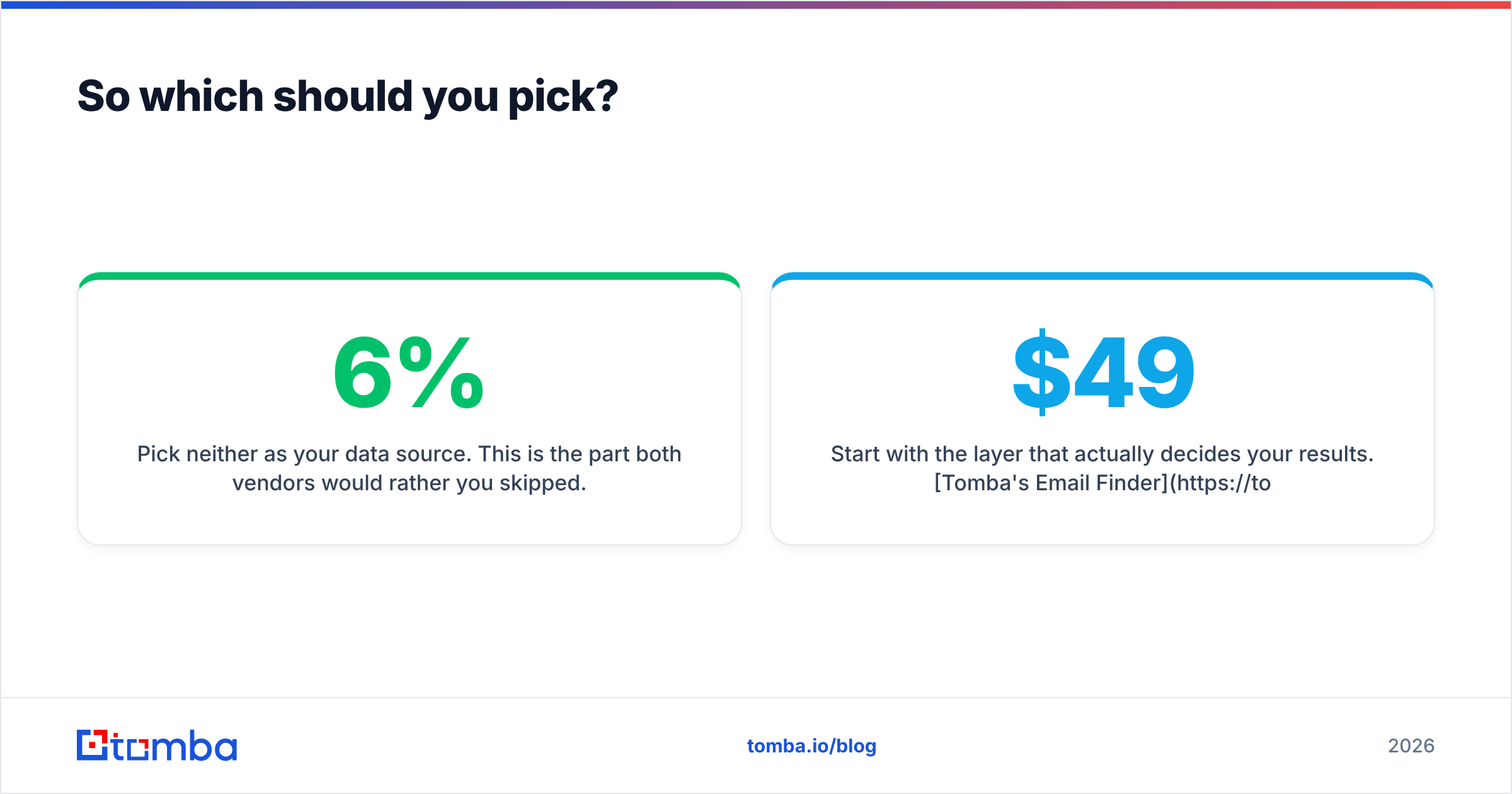
Pick neither as your data source. This is the part both vendors would rather you skipped. Whichever suite you run your campaigns through, run the list through a real finder and a real verifier first. That single change — not better subject lines, not more volume — is what moves a campaign from 6% replies to 12%.
The honest verdict on "Conversion Blitz vs GrowMeOrganic" is that they are competing for the wrong prize. The suite is not what determines whether your emails land. The list is.
Start with the layer that actually decides your results. Tomba's Email Finder finds professional addresses by domain, name, or company — with source citations, SMTP-level verification, and catch-all detection built in. Free tier gives you 25 searches a month with no card, and Starter is $49/mo when you outgrow it. Plug it in front of whichever suite you choose, and let your bounce rate tell you whether it was worth it.
Related guides#
Ready to find emails that actually work?
Join 150,000+ professionals who stopped guessing and started sending. Free credits on signup — no credit card required.
Get the Tomba newsletter
Practical outbound tactics and product updates — once every two weeks.
About the author