Convin Pricing Reviews Pros and Cons: A 2026 Buyer's Guide
Convin doesn't publish a price list, which makes budgeting a guessing game. Here's what quote-only pricing actually means, what reviewers praise and complain about, and when a cheaper stack does the job.
Convin pricing reviews pros and cons — all in one place, without sitting through a demo call. Convin hides its price list behind a quote. This guide breaks down what actually drives your number, what real users praise and complain about, and when a cheaper stack does the job.
TL;DR#
- Convin does not publish pricing. Every plan is quote-based and gated behind a demo. Directories list entry points near $30–$60 per user/month. Treat that as rumour, not a quote.
- You pay for volume, not just seats. Minutes transcribed and AI usage move the number. Two teams of the same size can get quotes that differ by 2–3x.
- Reviewers like the 100% call auditing, the coaching workflows, and the agent-assist prompts. They complain about transcription accuracy on accented calls, a dense reporting UI, and slow rollouts.
- Convin is a contact-center QA tool, not a prospecting tool. If you lack verified contacts to call, it will not fix that.
- Pick your lane first: are you buying quality assurance (Convin) or pipeline (a data tool)? Buying the wrong one costs more than either.
What is Convin, exactly?#
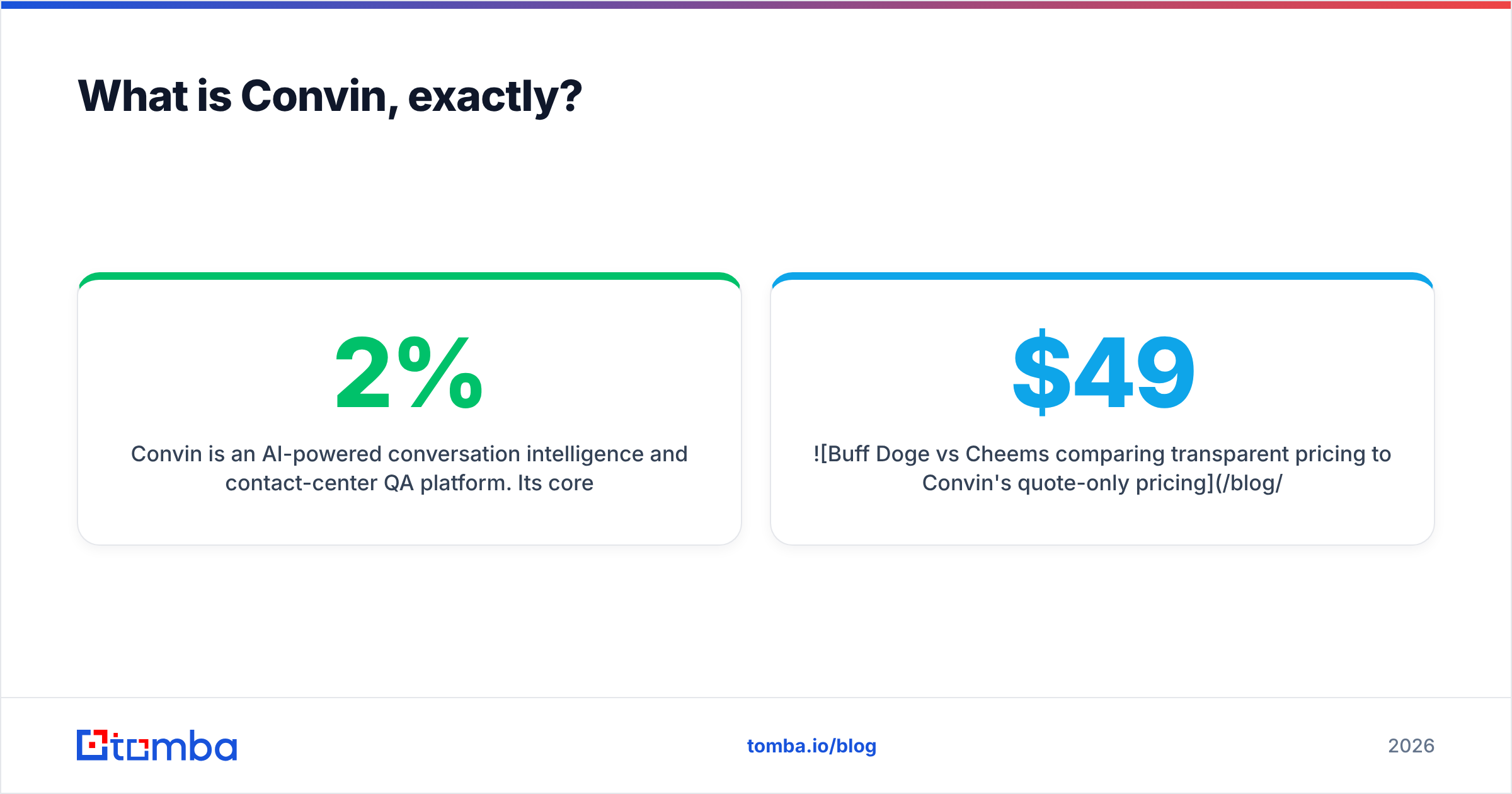
Convin is an AI-powered conversation intelligence and contact-center QA platform. Its core pitch: instead of a QA analyst spot-checking 2% of your calls, Convin's engine transcribes and scores 100% of them, then routes coaching to the reps who need it.
The product line stacks in layers:
- Conversation intelligence — transcription, topic and sentiment detection, talk/listen ratios, keyword tracking across calls, chats, and emails.
- Automated quality management — custom scorecards applied to every conversation, with auto-flagging for compliance breaches and script deviations.
- Agent assist — real-time prompts, battlecards, and objection-handling nudges shown to the rep mid-call.
- Coaching + LMS — auto-generated coaching tasks, peer-to-peer call libraries, and a learning module tied to scorecard gaps.
- AI phone calls — voice agents that run outbound and inbound flows without a human on the line.
That last layer has grown fastest, and it complicates pricing the most. It turns Convin from a per-seat SaaS purchase into a usage-metered one. You can see the current packaging on convin.ai.
One framing matters before you look at price. Convin sits after the contact exists. It grades and improves conversations you're already having. It does not find you people to talk to. That distinction drives half the buyer regret in this category.

How does Convin pricing actually work in 2026?#
Convin does not list prices on its site. There is no public tier table, and no "Starter/Pro/Enterprise" grid with dollar figures. You book a demo, you describe your setup, and you get a quote.
That's not automatically a red flag. Gong, Observe.AI, and most of the enterprise contact-center category do the same thing. But it does mean you need to understand the variables that move your number, because that's where the negotiation happens.
The five levers that decide your Convin quote:
- Seat count. Agents, supervisors, and admins are usually priced differently. Ask for the breakdown per role, not a blended average.
- Conversation volume. Minutes transcribed per month is the real meter. A 40-agent team on 6-hour talk days is a very different contract from a 40-agent team doing 90 minutes a day.
- Channel coverage. Voice-only is the base. Adding chat, email, and WhatsApp/omnichannel ingestion moves the price up.
- AI phone call minutes. Turn on voice agents and you're buying a usage product with per-minute economics on top of the platform fee. This is where quotes balloon.
- Language support. Multilingual transcription (Indic languages, Spanish, Arabic) is often an add-on. Confirm which languages are included at the quoted price.
Third-party listings on directories like G2 have put Convin's entry point somewhere in the $30–$60 per user/month range for the core tier. Treat that as directional folklore. The only number that matters is the one on your quote. In this category, published starting prices and signed contract values often differ by a factor of two once volume, channels, and AI minutes land.
Questions to ask on the pricing call — write these down:
- Is transcription metered, and what happens when we exceed the bundled minutes? (Overage rate, or hard stop?)
- Is the contract annual-only, or is there a monthly option at a premium?
- What's the minimum seat count? (Many contact-center tools have a floor of 10–25 seats that isn't advertised.)
- Is implementation/onboarding a separate one-time fee?
- Are scorecard configuration and integration setup included, or billed as professional services?
- What's the renewal uplift cap?
If a vendor won't answer #1 and #6 in writing, that's your real signal — not the sticker price.
What do Convin reviews actually say?#
Most Convin pricing reviews pros and cons threads on G2 and Capterra skew positive, and the praise clusters tightly around a few themes. So do the complaints. Here's the honest split.
What reviewers consistently praise:
- 100% audit coverage. The single most repeated benefit. Teams that were manually sampling 2–5% of calls suddenly see every call scored. For compliance-heavy operations (lending, insurance, healthcare), this alone justifies the line item.
- Coaching that's tied to evidence. Managers stop arguing about what a rep "usually" does and start pointing at timestamped clips. Reviewers call this the biggest change on their floor.
- Fast, responsive support. Convin's customer success gets called out repeatedly — a real differentiator against larger incumbents where you're a ticket number.
- Agent assist reduces ramp time. New hires with real-time prompts hit quota faster. Several reviews mention cutting onboarding from weeks to days.
What reviewers consistently complain about:
- Transcription accuracy on accents and code-switching. The most common criticism. If your reps switch languages mid-sentence, expect the transcript — and the auto-score — to degrade. Ask for an accuracy test on your recordings before signing.
- Reporting takes time to learn. The dashboards are dense. Supervisors need a real ramp period before they trust the numbers.
- Implementation is longer than the demo suggests. Scorecard setup, dialer/CRM integration, and calibrating AI scoring against human QA take weeks, not days.
- Occasional lag on large data pulls. Reported by bigger teams pulling long date ranges.
None of these are disqualifying. They're the normal friction of asking an AI to grade human judgement. But they should shape your rollout plan and your first-year ROI math.
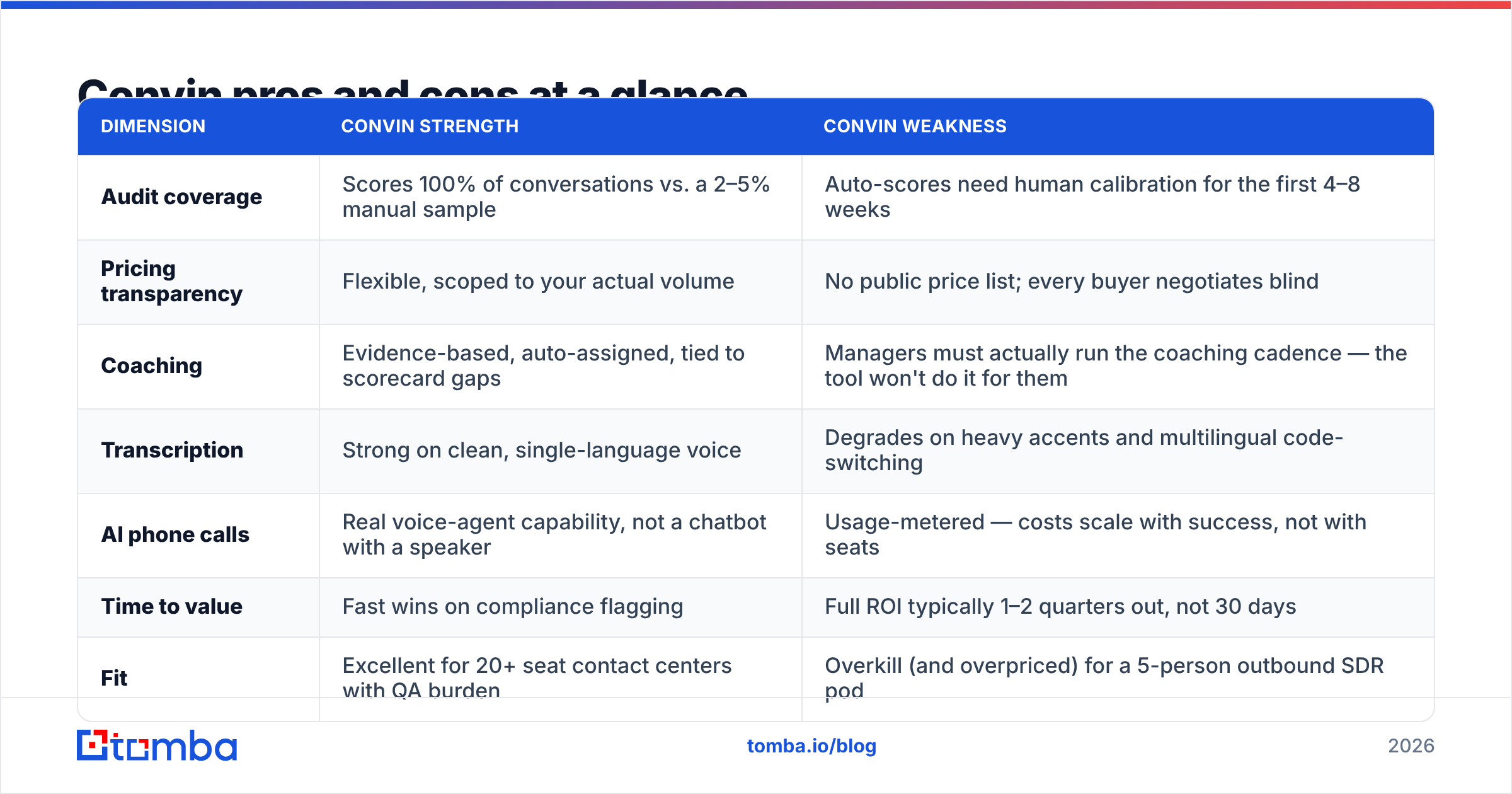
Convin pricing reviews pros and cons at a glance#
| Dimension | Convin strength | Convin weakness |
|---|---|---|
| Audit coverage | Scores 100% of conversations vs. a 2–5% manual sample | Auto-scores need human calibration for the first 4–8 weeks |
| Pricing transparency | Flexible, scoped to your actual volume | No public price list; every buyer negotiates blind |
| Coaching | Evidence-based, auto-assigned, tied to scorecard gaps | Managers must actually run the coaching cadence — the tool won't do it for them |
| Transcription | Strong on clean, single-language voice | Degrades on heavy accents and multilingual code-switching |
| AI phone calls | Real voice-agent capability, not a chatbot with a speaker | Usage-metered — costs scale with success, not with seats |
| Time to value | Fast wins on compliance flagging | Full ROI typically 1–2 quarters out, not 30 days |
| Fit | Excellent for 20+ seat contact centers with QA burden | Overkill (and overpriced) for a 5-person outbound SDR pod |
How does Convin compare to the alternatives?#
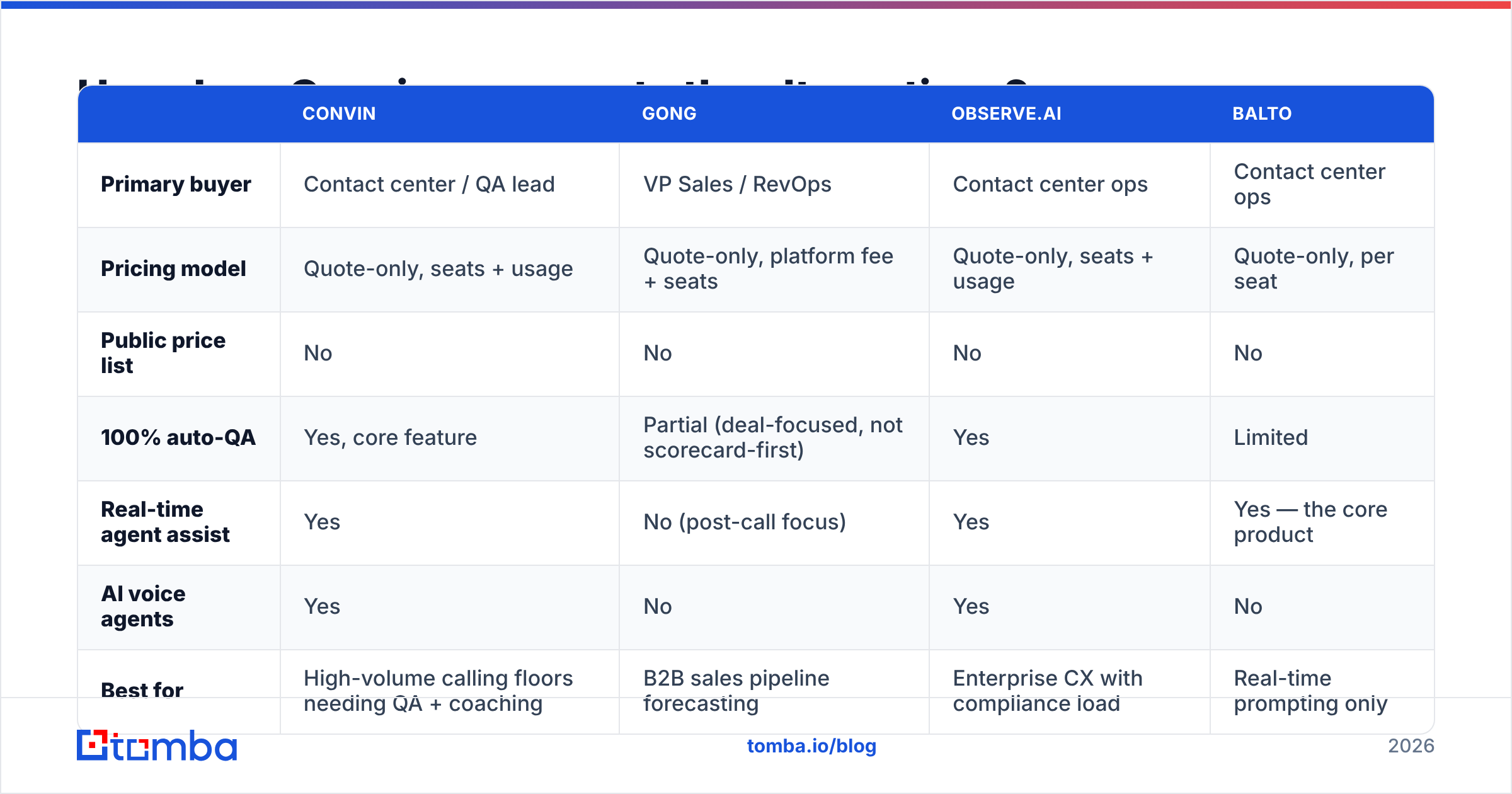
The competitive set splits into two camps. Revenue intelligence tools are built for B2B sales teams (Gong, Chorus). Contact-center intelligence tools are built for support, collections, and telesales floors (Convin, Observe.AI, Level AI, CallMiner). Convin lives in the second camp but markets into the first, which is why buyers get confused.
| Convin | Gong | Observe.AI | Balto | |
|---|---|---|---|---|
| Primary buyer | Contact center / QA lead | VP Sales / RevOps | Contact center ops | Contact center ops |
| Pricing model | Quote-only, seats + usage | Quote-only, platform fee + seats | Quote-only, seats + usage | Quote-only, per seat |
| Public price list | No | No | No | No |
| 100% auto-QA | Yes, core feature | Partial (deal-focused, not scorecard-first) | Yes | Limited |
| Real-time agent assist | Yes | No (post-call focus) | Yes | Yes — the core product |
| AI voice agents | Yes | No | Yes | No |
| Best for | High-volume calling floors needing QA + coaching | B2B sales pipeline forecasting | Enterprise CX with compliance load | Real-time prompting only |
| Typical annual commitment | Annual contract | Annual contract, often multi-year | Annual contract | Annual contract |
The pattern is obvious: nobody in this category publishes prices. So the real comparison isn't sticker vs sticker. It's which meter you're comfortable being billed on. Convin's meter is conversations. Gong's is seats plus a platform fee that surprises small teams. Balto's is the narrowest and usually the cheapest, because it does one thing.
For a broader view of how analysts frame this market, Gartner's peer reviews are a useful sanity check against vendor-supplied case studies.

Is Convin worth it — and who should skip it?#
Buy Convin if:
- You run 20+ agents on phones daily and your QA team is drowning in manual audits.
- You have a compliance obligation (financial services, healthcare, debt collection) where a missed disclosure is a fine, not an inconvenience.
- Your average handle time or CSAT is worse than benchmark and you can't explain why.
- You already have contact volume. Convin makes existing conversations better; it doesn't create them.
Skip Convin if:
- You're a sub-10-person SDR team. The per-seat economics and minimum commitments don't work. A cheaper call-recording tool plus a manager who listens to five calls a week gets you 70% of the value.
- Your calls are mostly inbound and already converting fine.
- Your real bottleneck is contacts, not conversations. This is the big one. If your reps burn half their day hunting for phone numbers and emails that turn out to be wrong, Convin will produce beautiful scorecards for a pipeline that was never going to close.
That last case is more common than vendors admit. Before you sign a five-figure QA contract, run the math. If your reps make 40 dials to reach 3 humans, the problem isn't how those 3 conversations went. It's the 37 that never happened.
What's the cheaper path if your problem is pipeline, not QA?#
Fix the input before you instrument the output. A calling floor with bad data doesn't need better coaching. It needs better numbers to dial and better addresses to email.
That stack looks completely different, and it costs an order of magnitude less:
- Verified contact data. Pull direct-dial B2B phone numbers and work emails for your ICP instead of scraping stale lists.
- Email that lands. Run every address through an email verifier before it hits a sequence, so your bounce rate doesn't torch your sending domain.
- Enrichment at the top. Use data enrichment to fill title, company size, and tech-stack fields so reps can prioritise instead of guessing.
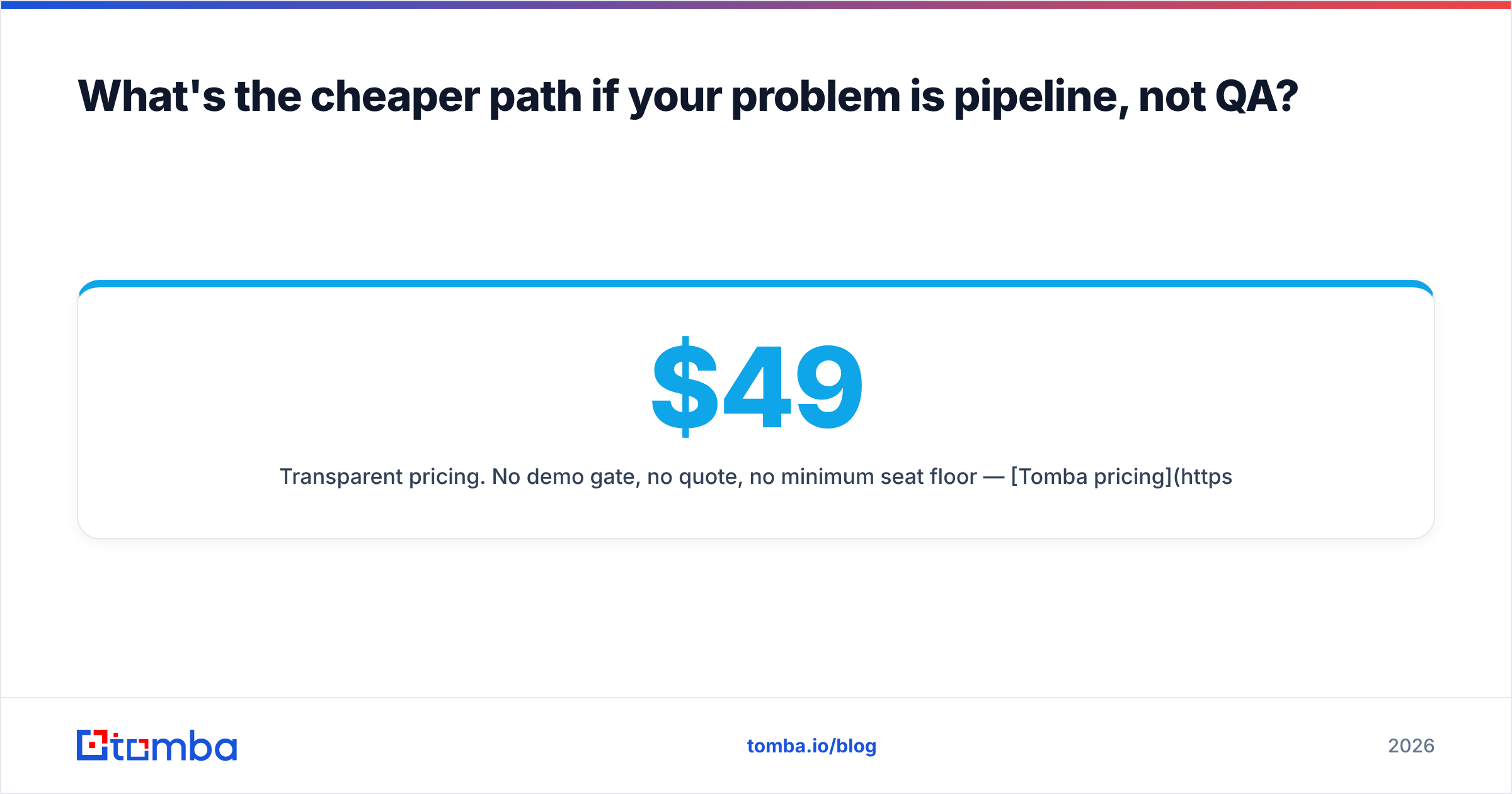
- Transparent pricing. No demo gate, no quote, no minimum seat floor — Tomba pricing starts free at 25 searches/month, then $49/mo (Starter), $99/mo (Growth), and $249/mo (Pro).
The honest framing: these tools solve different problems, and a mature revenue org eventually buys both. But the sequencing matters. Data first, conversations second, conversation analysis third. Buying #3 while #1 is broken is the most expensive mistake in this category. It's also the mistake a demo-gated quote makes easy, because nobody on the pricing call asks whether your list is any good.
Final verdict: Convin pricing reviews pros and cons#
Convin is a legitimate, well-reviewed contact-center intelligence platform. Its strength in 100% automated auditing and evidence-based coaching is real. So are the cons: opaque pricing, transcription friction on multilingual calls, and a longer rollout than the demo implies. Price those into your business case. Don't discover them in month three.
The quote-only model isn't a scam. It's category standard. But it shifts the burden onto you. Go into that call knowing your minutes, your channels, your seat mix by role, and your walk-away number. Get overage rates and renewal caps in writing. And test transcription on your own recordings, in your own languages, before you sign anything.
Then ask the harder question. Is the constraint on this team the quality of the conversations we're having, or the quantity of the right people we're reaching?
If it's the second one, start upstream. Tomba's Email Finder gives you verified work emails by name, domain, or company — free for your first 25 searches, $49/mo when you're ready to scale, and no demo call required to find out what it costs. Fill the top of the funnel first. Then go buy the tool that grades it.
Related guides#
Ready to find emails that actually work?
Join 150,000+ professionals who stopped guessing and started sending. Free credits on signup — no credit card required.
Get the Tomba newsletter
Practical outbound tactics and product updates — once every two weeks.
About the author