Copy.ai Pricing, Reviews, Pros and Cons: 2026 Breakdown
Copy.ai moved from a $49 writing tool to a GTM platform with credit-based workflows. Here's what the plans actually cost, where users hit limits, and when a cheaper stack wins.
Copy.ai pricing, reviews, pros and cons all circle one question: are you buying a writing tool or a GTM platform? In 2026 it is the second one. The plans, the credit meter, and the review complaints only make sense once you accept that. Here is what it really costs, and where teams get burned.
TL;DR#
- Copy.ai is no longer a writing app. It sells a "GTM AI Platform" now: workflows, agents, and a credit meter. That changes the price and the buyer.
- The entry point is free, then it jumps. A self-serve tier sits near $49/month, and real platform tiers run into four and five figures a year.
- Credits are the top complaint in reviews. Not output quality — credit burn. Workflow runs eat credits fast, and spend is hard to forecast.
- It is strong at multi-step GTM workflows (account research, enrichment, sequence drafting) and weak as a plain copy tool.
- If what you need is contact data, a dedicated email finder plus a cheap writing layer costs far less.
What is Copy.ai and who is it for in 2026?#
Copy.ai started in 2020 as a marketing copy generator — you typed a product description, it spat out ten headline variants. That product is effectively commoditized. ChatGPT, Claude, and Gemini all do it for free, and they do it well.
So Copy.ai pivoted. Today it markets itself as a GTM AI platform: a workflow builder where you chain data inputs (CRM records, scraped sites, uploaded lists) through AI steps (research, summarize, score, write) and push results back into HubSpot, Salesforce, or a sequencer. Think of it less like a word processor and more like Zapier where every step can reason.
That repositioning is the single most important fact about Copy.ai pricing. You are no longer paying for words. You are paying for credits consumed by workflow runs, plus seats, plus (at the top) a platform contract. Reviewers who judge it as "an AI writer that costs $49" misread what they are buying.
Who it fits:
- RevOps teams who already have data and want an orchestration layer that reasons over it.
- Mid-market sales orgs running personalized outbound at 1,000+ prospects/month with real CRM hygiene.
- Content teams inside enterprises that need brand voice enforcement, approvals, and audit trails — things raw LLM chat doesn't offer.
Who it doesn't fit: solo founders, small agencies, and anyone whose actual bottleneck is finding the right person to email rather than writing the email.

What does Copy.ai pricing actually look like?#
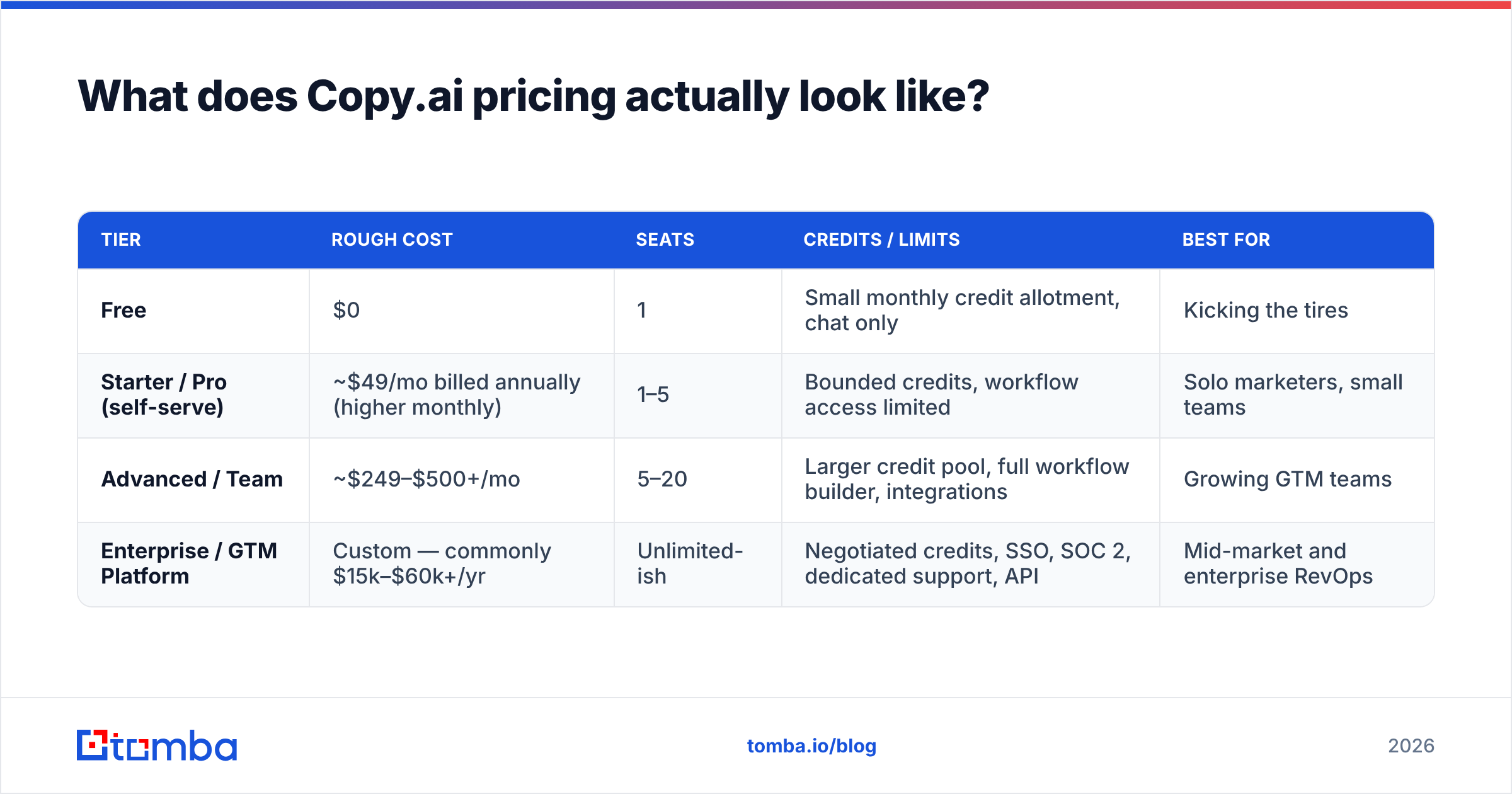
Copy.ai's public pricing has shifted repeatedly, and the vendor now routes most serious buyers to sales. Here is the honest shape of it, based on the published tiers and what buyers report on G2 and Capterra:
| Tier | Rough cost | Seats | Credits / limits | Best for |
|---|---|---|---|---|
| Free | $0 | 1 | Small monthly credit allotment, chat only | Kicking the tires |
| Starter / Pro (self-serve) | ~$49/mo billed annually (higher monthly) | 1–5 | Bounded credits, workflow access limited | Solo marketers, small teams |
| Advanced / Team | ~$249–$500+/mo | 5–20 | Larger credit pool, full workflow builder, integrations | Growing GTM teams |
| Enterprise / GTM Platform | Custom — commonly $15k–$60k+/yr | Unlimited-ish | Negotiated credits, SSO, SOC 2, dedicated support, API | Mid-market and enterprise RevOps |
Two structural things matter more than the sticker numbers:
- Annual lock-in is where the discount lives. The monthly price is deliberately unattractive. If you are not sure about 12 months of usage, you pay a premium for that flexibility.
- Credits are the meter, not seats. One research-heavy run over a 500-account list can eat a month of a lower-tier credit pool. Two teams on the same plan can pay very different real costs.
Always check the official Copy.ai pricing page before you buy — the tiers move.
How do credits actually get consumed?#
This is the part nobody explains until you have already paid, so let's be concrete. A credit is consumed roughly per AI step, per record.
- Simple chat prompt — cheapest. A handful of credits, negligible.
- Single-step workflow over one record — one AI call, small cost. Fine.
- Multi-step workflow (research → enrich → score → write) over one record — 4+ AI calls. Now multiply.
- The same workflow over 1,000 accounts — 4,000+ AI calls in one run. This is where mid-tier credit pools evaporate in days.
- Web-browsing or long-context steps — much pricier, because the model reads far more tokens.
- Retries and iteration during build — every failed workflow test burns real credits. Budget 20–30% overhead just for development.
The practical rule: estimate your monthly record volume, multiply by the number of AI steps in your workflow, add 30%, and ask sales what that costs. If they won't give you a number, that's your answer about pricing transparency.
What do Copy.ai reviews actually say?#
Aggregate review sentiment lands around 4.5/5 on the big directories, which is high — but the distribution matters more than the average. Read the substance rather than the star count and the same themes repeat.
What reviewers consistently praise:
- Workflow builder depth. Once configured, one Copy.ai run does what a team of SDRs would take a week to research by hand. This is the genuine product win.
- Brand voice / infobase. Feeding company docs, ICP definitions, and tone guides into a persistent knowledge base produces output that reads more on-brand than raw ChatGPT.
- Integration breadth. Native HubSpot and Salesforce connections mean output lands where reps already work, not in a doc nobody opens.
- Support responsiveness on paid tiers is repeatedly called out positively.
What reviewers consistently complain about:
- Credit anxiety. This is the number one recurring criticism. Users ration runs, avoid experiments, and get surprised by overage talks. A tool you are afraid to use is a tool you underuse.
- Learning curve on workflows. The builder is powerful and therefore not simple. Teams without a technical RevOps person often never get past templates.
- Output still needs editing. Nobody ships Copy.ai output raw. The claim is speed, not finality — reviewers who expected finality are the ones leaving 2-star reviews.
- Price-to-value at the low end. At $49/month for bounded chat plus light workflows, you compete against a $20 ChatGPT Plus seat. That comparison is brutal, and reviewers make it constantly.
- Pricing opacity at the top end. "Contact sales" for anything serious frustrates buyers who want to self-qualify.
The fair reading: Copy.ai is a good product priced for a buyer who has already decided that GTM orchestration is a line item. It is a bad product for someone comparison-shopping AI writers on price.
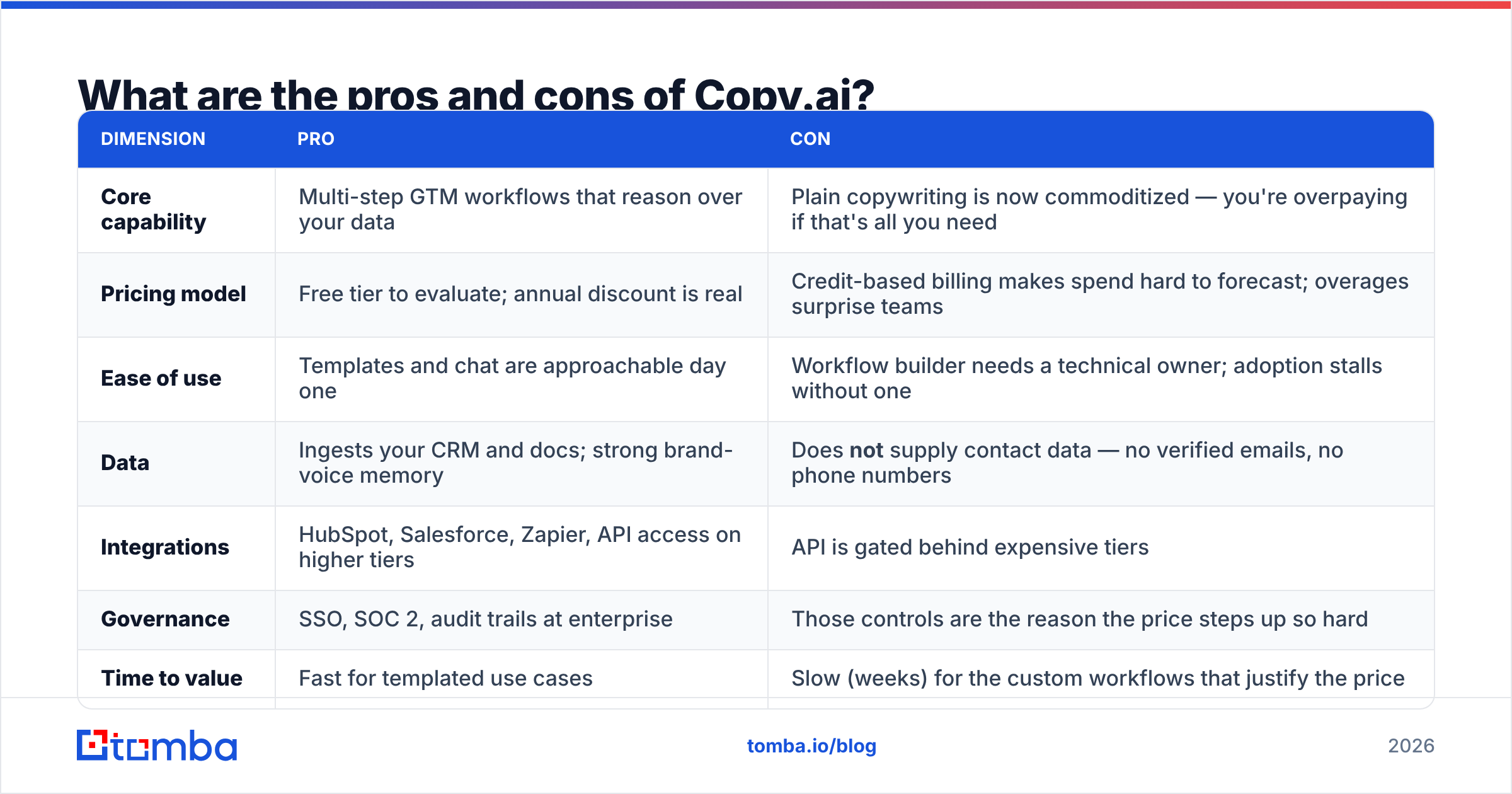
Copy.ai pricing, reviews, pros and cons in one table#
| Dimension | Pro | Con |
|---|---|---|
| Core capability | Multi-step GTM workflows that reason over your data | Plain copywriting is now commoditized — you're overpaying if that's all you need |
| Pricing model | Free tier to evaluate; annual discount is real | Credit-based billing makes spend hard to forecast; overages surprise teams |
| Ease of use | Templates and chat are approachable day one | Workflow builder needs a technical owner; adoption stalls without one |
| Data | Ingests your CRM and docs; strong brand-voice memory | Does not supply contact data — no verified emails, no phone numbers |
| Integrations | HubSpot, Salesforce, Zapier, API access on higher tiers | API is gated behind expensive tiers |
| Governance | SSO, SOC 2, audit trails at enterprise | Those controls are the reason the price steps up so hard |
| Time to value | Fast for templated use cases | Slow (weeks) for the custom workflows that justify the price |
The asymmetry worth internalizing: Copy.ai's ceiling is high and its floor is not competitive. If you'll invest a quarter into building real workflows, it pays. If you'll use it as a fancier autocomplete, you're setting money on fire.

Is Copy.ai worth it compared to the alternatives?#
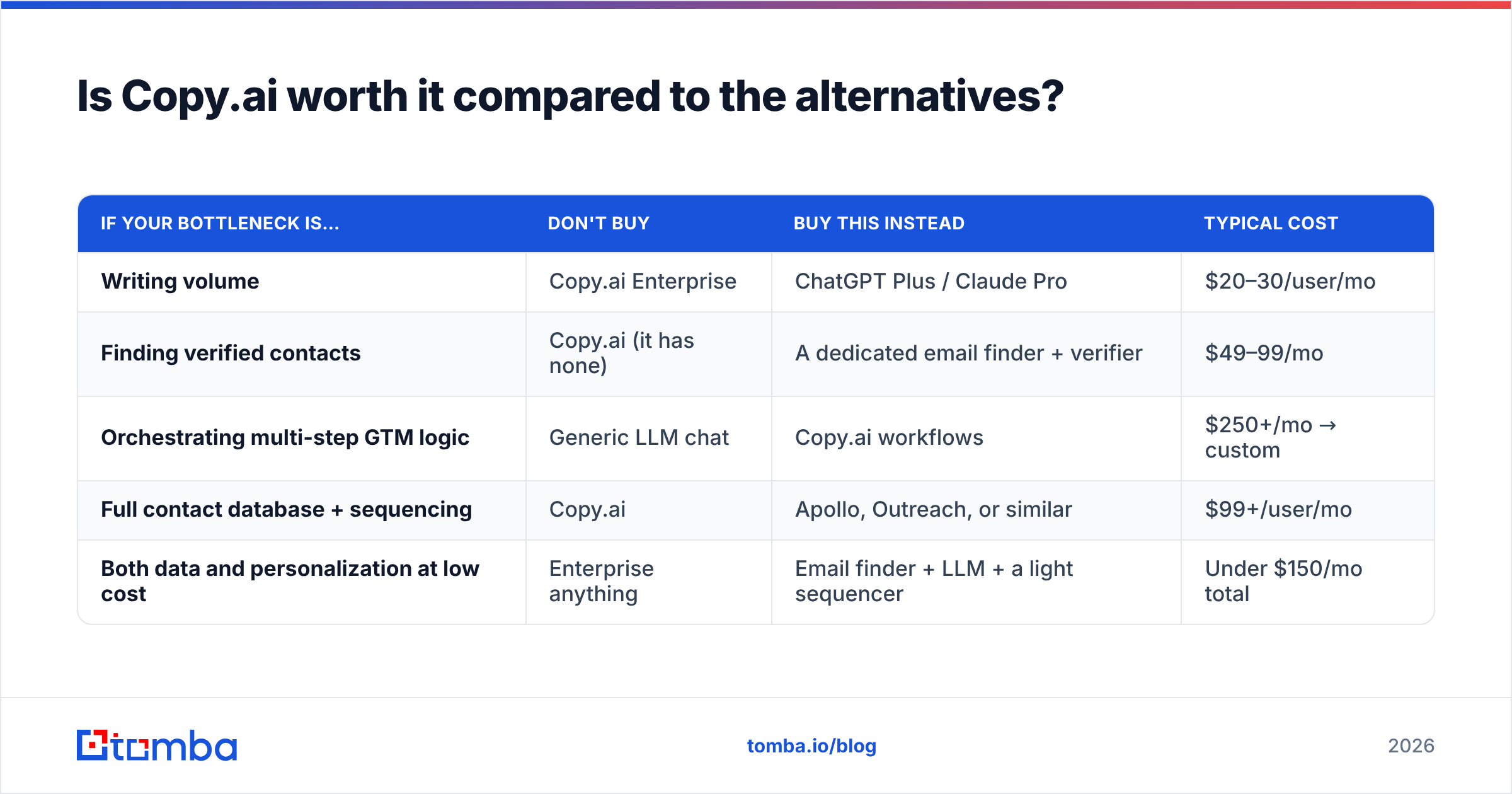
It depends on what your bottleneck really is. Most teams that shop for "an AI GTM tool" are misdiagnosing a data problem as a content problem.
| If your bottleneck is… | Don't buy | Buy this instead | Typical cost |
|---|---|---|---|
| Writing volume | Copy.ai Enterprise | ChatGPT Plus / Claude Pro | $20–30/user/mo |
| Finding verified contacts | Copy.ai (it has none) | A dedicated email finder + verifier | $49–99/mo |
| Orchestrating multi-step GTM logic | Generic LLM chat | Copy.ai workflows | $250+/mo → custom |
| Full contact database + sequencing | Copy.ai | Apollo, Outreach, or similar | $99+/user/mo |
| Both data and personalization at low cost | Enterprise anything | Email finder + LLM + a light sequencer | Under $150/mo total |
The last row is where most SMB and early mid-market teams land, and it's underrated. You need three things for personalized outbound: a correct email address, enough context to say something specific, and a way to send it. Copy.ai only addresses the middle one — expensively.
A stack that covers all three for less:
- Contact discovery: run domain search against target companies to pull the right roles, then push through an email verifier so bounces stay under 2% and your email deliverability holds. Tomba's pricing starts free (25 searches/month), with Starter at $49/mo, Growth at $99/mo, and Pro at $249/mo.
- Context: a $20 LLM seat, or the Tomba data enrichment endpoint for firmographics you can drop straight into a merge field.
- Sending: any sequencer with warmup and inbox rotation.
That's roughly $70–150/month all-in for a small team, against a Copy.ai platform contract. It also produces better results, because personalization built on verified, current contact data beats eloquent copy sent to a dead mailbox every time.
Where Copy.ai genuinely wins that stack: when you run the same complex reasoning chain across thousands of records every month, and a human doing it costs more than the credit bill. That threshold is real — it is just much higher than the marketing implies.
Worth noting alongside it: for teams whose need is purely a clean, ready-to-use B2B list rather than orchestration, providers like BookYourData sell verified contacts directly, which sidesteps the tooling question altogether. Different shape of solution, and for some buyers a simpler one.
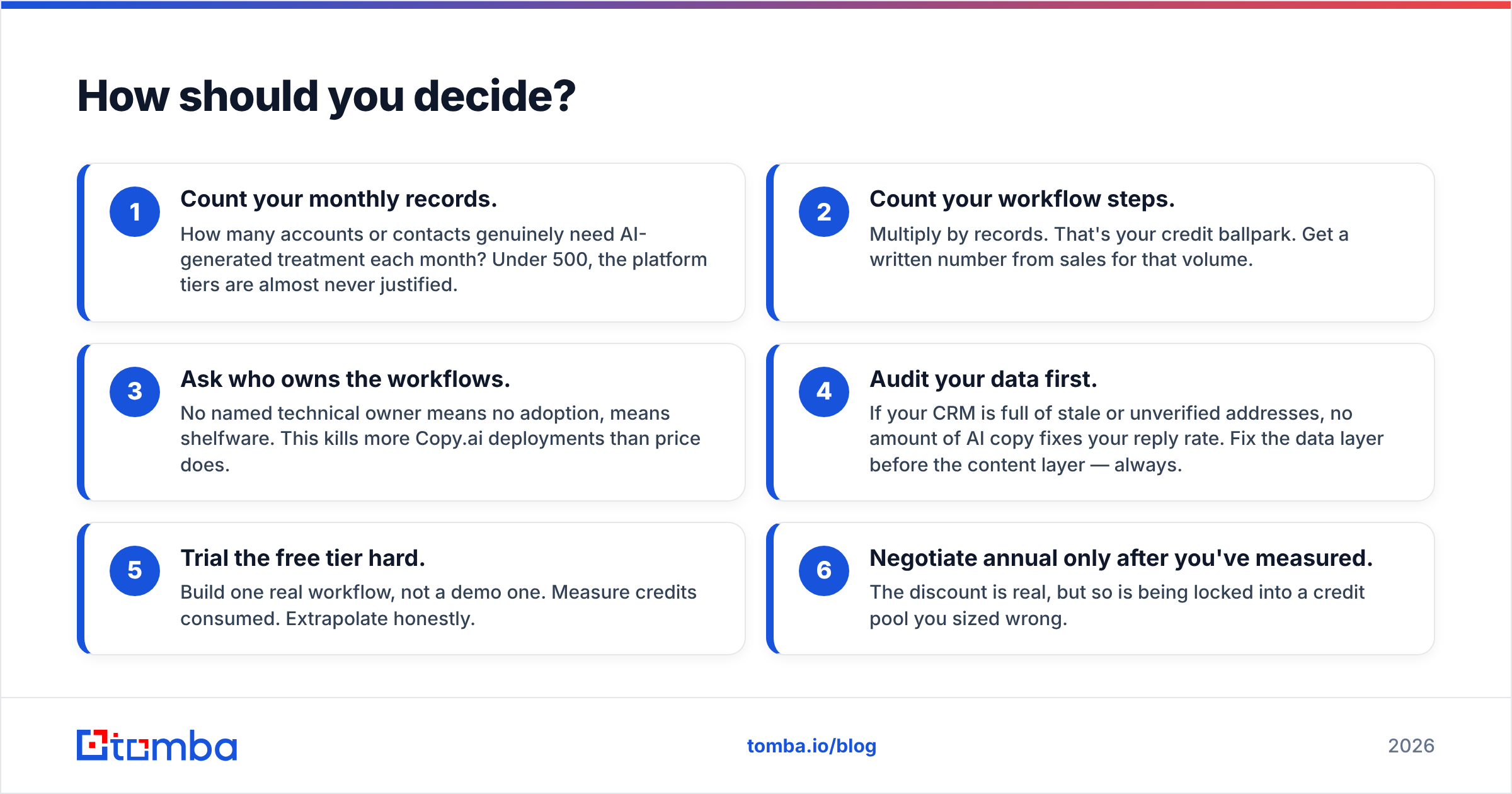
How should you decide?#
Run this decision sequence before you talk to a sales rep.
- Count your monthly records. How many accounts or contacts genuinely need AI-generated treatment each month? Under 500, the platform tiers are almost never justified.
- Count your workflow steps. Multiply by records. That's your credit ballpark. Get a written number from sales for that volume.
- Ask who owns the workflows. No named technical owner means no adoption, means shelfware. This kills more Copy.ai deployments than price does.
- Audit your data first. If your CRM is full of stale addresses, no amount of AI copy fixes your reply rate. Fix the data layer before the content layer.
- Trial the free tier hard. Build one real workflow, not a demo one. Measure credits consumed. Extrapolate honestly.
- Negotiate annual only after you've measured. The discount is real, but so is being locked into a credit pool you sized wrong.
If steps 1 and 2 produce big numbers and step 3 produces a name, Copy.ai is a reasonable buy. If step 4 reveals your list is the problem, buy data, not a platform. Most teams discover the latter.
For a broader look at how the AI GTM category is consolidating, HubSpot's research on AI in sales is a useful neutral reference point on where budget is actually moving.
The bottom line#
Copy.ai in 2026 is a legitimate GTM orchestration platform wearing the price tag of one. It is not overpriced for what it does — it is frequently mismatched to what buyers need. The credit model punishes experimentation, the low tiers lose on value against $20 LLM seats, and the high tiers demand a technical owner most teams have not hired. That is the honest summary of Copy.ai pricing, reviews, pros and cons.
Before you sign a platform contract, make sure the constraint you are solving is really content generation and not contact accuracy. Pull a sample list of 100 target accounts, find the decision-makers with the Tomba Email Finder, verify them, and send a plainly-written, well-targeted sequence. If reply rates jump, your problem was never the copy — and you just saved five figures a year. Start free with 25 searches a month, and scale only when the data proves you need to.
Related guides#
Ready to find emails that actually work?
Join 150,000+ professionals who stopped guessing and started sending. Free credits on signup — no credit card required.
Get the Tomba newsletter
Practical outbound tactics and product updates — once every two weeks.
About the author