Corefactors Alternatives: 9 Better CRM & Sales Tools for 2026
Corefactors bundles CRM, calling, and email into one RevOps suite — but the bundle is also its weakness. Here are 9 alternatives that beat it on data quality, deliverability, and price.
TL;DR — Which Corefactors alternative should you pick?#
- Corefactors is an all-in-one RevOps suite (CRM + cloud telephony + email + ticketing) aimed mostly at Indian SMBs. It's cheap and broad, but shallow in the places outbound teams feel pain: contact data, email deliverability, and enrichment.
- The single biggest gap is data. Corefactors gives you a place to store contacts; it does not reliably find them. Pair any CRM with a dedicated email finder and your pipeline math changes more than switching CRMs ever will.
- Best all-round CRM swap: HubSpot (free tier, huge ecosystem). Best cheap swap: Zoho CRM. Best for outbound-first teams: Apollo or Instantly + a real data layer.
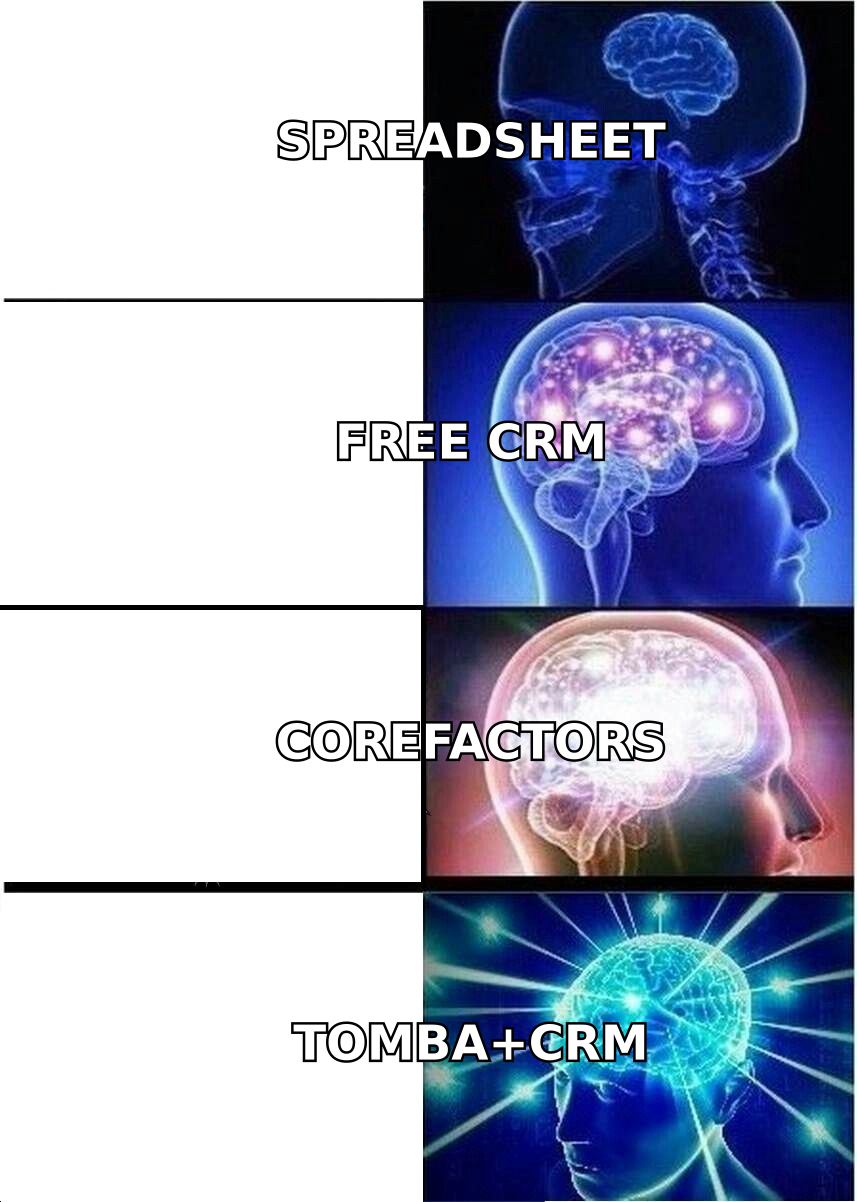
- Best data layer: Tomba — free tier at 25 searches/mo, Starter $49/mo, and an API that plugs into whichever CRM you land on.
- Don't rip and replace on price alone. Map your must-haves (telephony? ticketing? Indian phone compliance?) before you migrate. Some Corefactors users leave and come back.
What is Corefactors, and who actually uses it?#
Corefactors (corefactors.in) markets itself as an "AI-powered RevOps CRM." The pitch: instead of buying a CRM, a dialer, an email tool, and a helpdesk separately, you buy one suite with four modules — Sales Box, Marketing Box, Support Box, and Success Box — that share a single customer record.
That's a genuinely good idea for a certain company. If you're a 10–60 person SMB running inbound leads, doing a lot of phone follow-up, and paying support tickets out of the same team, having one timeline per contact is worth a lot. Corefactors' cloud telephony integration is its strongest single feature: click-to-call, call recording, IVR, and lead auto-assignment on inbound calls are baked in rather than bolted on. Pricing sits well below the Salesforce/HubSpot tier, which is why it wins deals in price-sensitive markets.
The complaints cluster in predictable places. The UI feels dated compared to modern CRMs. Integrations outside the suite are thin — you'll be living in Zapier. Reporting is functional but not analyst-grade. And the module that most outbound teams need — a way to actually source and verify the contacts going into the CRM — barely exists. Corefactors assumes you already have the leads.
That last point is why "Corefactors alternatives" is a search with two very different answers depending on what you're actually replacing.
Why do teams look for Corefactors alternatives?#
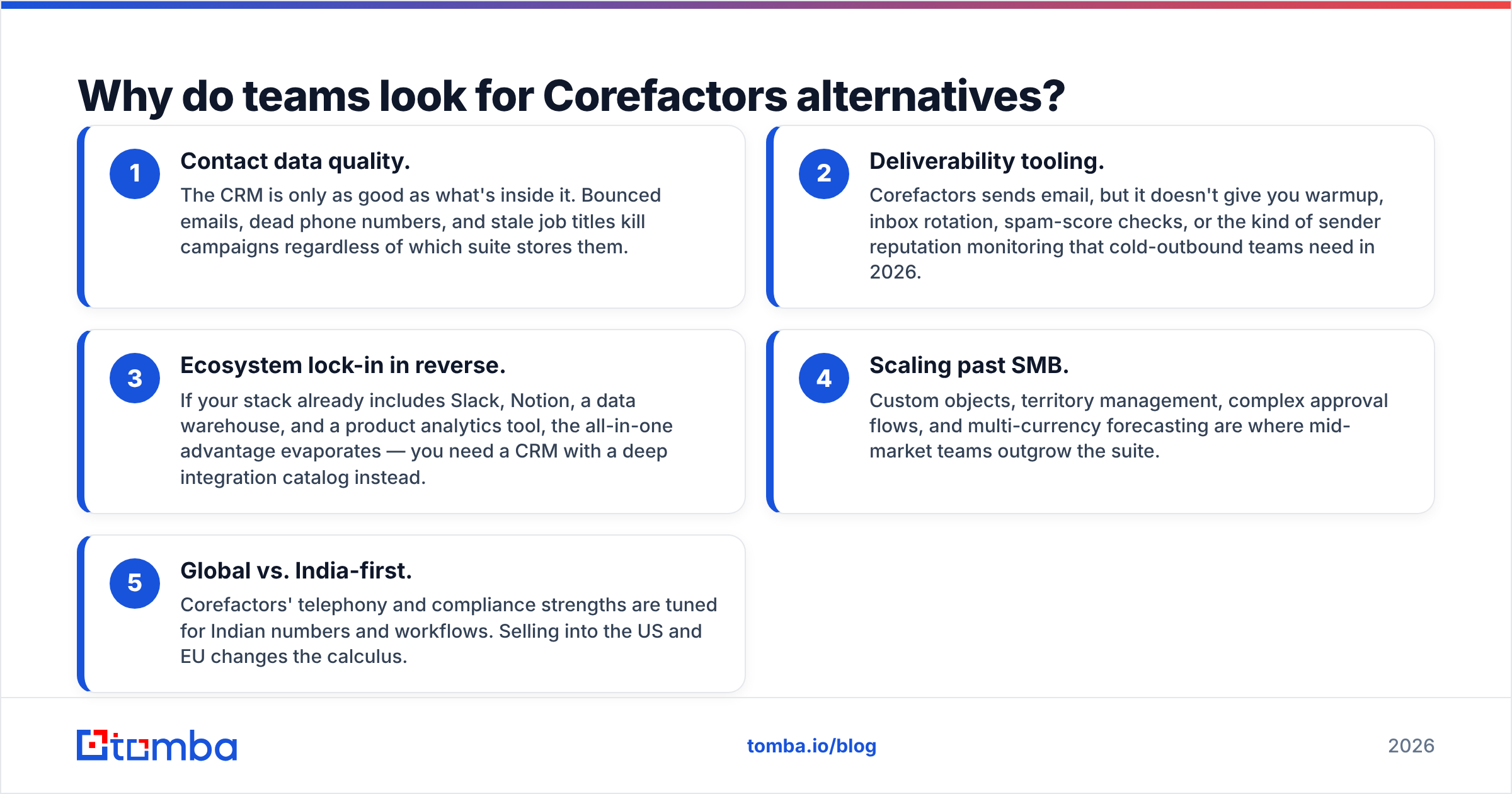
Five reasons come up repeatedly in G2 and Capterra reviews and in conversations with teams that have migrated:
- Contact data quality. The CRM is only as good as what's inside it. Bounced emails, dead phone numbers, and stale job titles kill campaigns regardless of which suite stores them.
- Deliverability tooling. Corefactors sends email, but it doesn't give you warmup, inbox rotation, spam-score checks, or the kind of sender reputation monitoring that cold-outbound teams need in 2026.
- Ecosystem lock-in in reverse. If your stack already includes Slack, Notion, a data warehouse, and a product analytics tool, the all-in-one advantage evaporates — you need a CRM with a deep integration catalog instead.
- Scaling past SMB. Custom objects, territory management, complex approval flows, and multi-currency forecasting are where mid-market teams outgrow the suite.
- Global vs. India-first. Corefactors' telephony and compliance strengths are tuned for Indian numbers and workflows. Selling into the US and EU changes the calculus.
Notice how many of those are data problems wearing a CRM costume. Before you spend three weeks migrating records, be honest about which category you're in.
What are the best Corefactors alternatives in 2026?#
Here's the field, grouped by what you're actually trying to fix.
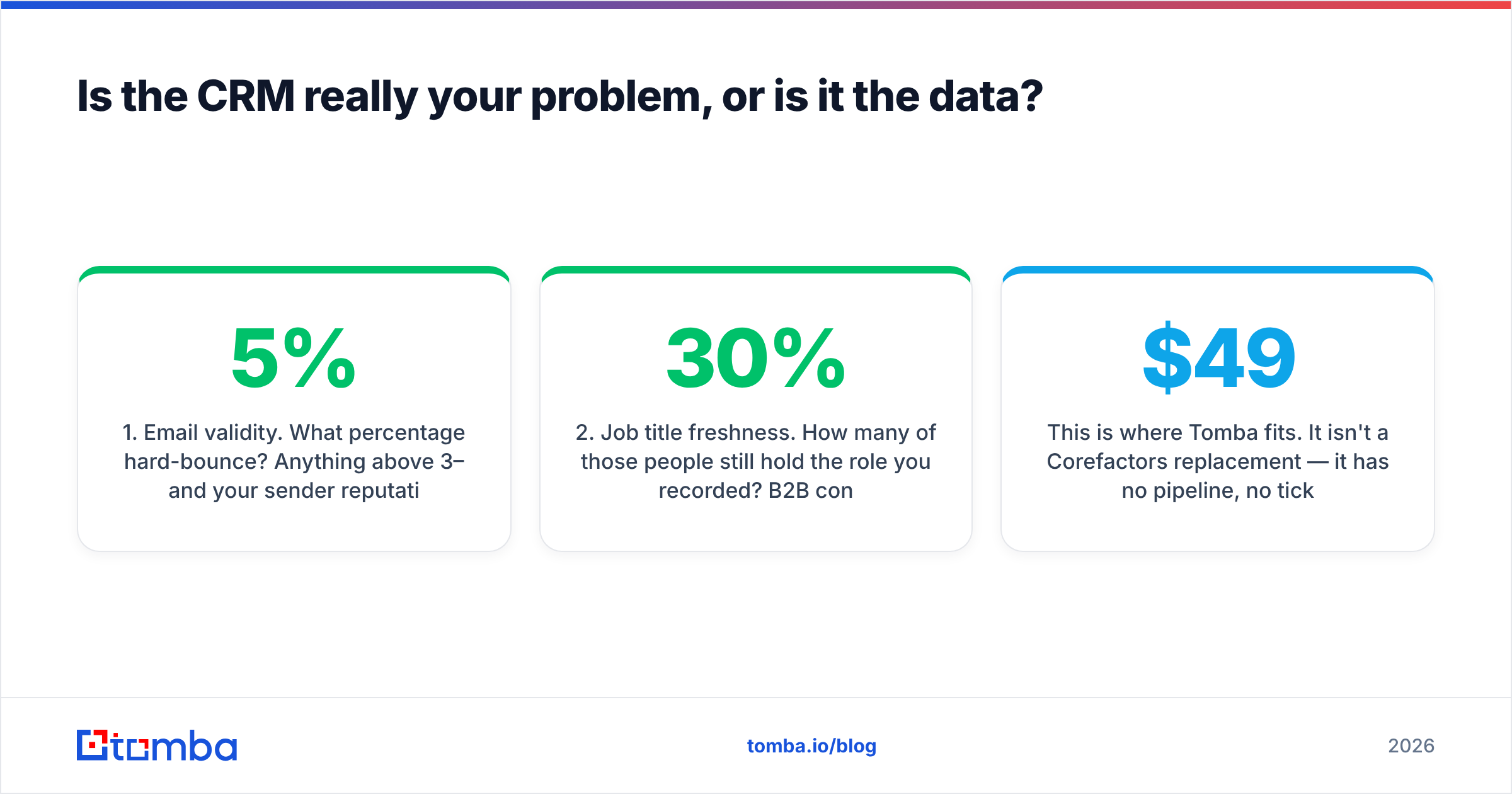
| Tool | Best for | Entry price | Built-in dialer | Contact data included | Migration effort |
|---|---|---|---|---|---|
| HubSpot CRM | All-round replacement, inbound-heavy teams | Free; Sales Hub from $20/seat/mo | Add-on | Limited (Breeze Intelligence) | Medium |
| Zoho CRM | Cheapest like-for-like suite swap | $14/seat/mo | Yes (Zoho Voice) | No | Low |
| Freshsales | India-based teams wanting a modern UI | Free; paid from $9/seat/mo | Yes (Freshcaller) | No | Low |
| Pipedrive | Simple pipeline-first sales teams | $14/seat/mo | Add-on | No | Low |
| Apollo.io | Outbound-first teams that want data + sequences | Free; paid from $49/seat/mo | Yes | Yes (large DB) | Medium |
| Salesforce Starter | Teams planning to scale past 100 seats | $25/seat/mo | Add-on | No | High |
| Instantly | Cold email at volume (not a CRM) | From $37/mo | No | Partial | Low |
| BookYourData | Pay-as-you-go verified B2B contact lists | Pay per contact | No | Yes (verified) | None (data only) |
| Tomba | The data layer under any CRM | Free (25/mo); Starter $49/mo | No | Yes (find + verify) | None (API/CSV) |
Two honest caveats on that table. First, "entry price" is list price for the smallest paid tier — real cost depends on seats and add-ons, and telephony minutes are almost always extra. Second, several of these aren't Corefactors substitutes at all; they're the missing half of what Corefactors doesn't do. Read on.
HubSpot — the safest full replacement#

If your reason for leaving is "the UI is dated and nothing integrates," HubSpot is the low-risk answer. The free CRM tier is genuinely usable for a small team, the integration marketplace is the largest in the category, and reporting is a clear step up. The catch is the pricing curve: HubSpot is cheap at the bottom and expensive fast once you add Marketing Hub, sequences, and higher contact tiers. Budget for that before you commit, and connect it to your data layer via the HubSpot integration.
Zoho CRM — the cheapest like-for-like swap#

Zoho is the closest philosophical match to Corefactors: a broad suite, aggressively priced, with its own telephony (Zoho Voice) and helpdesk (Zoho Desk). If you liked the shape of Corefactors but want a more mature product with a bigger install base, this is the move. Zoho's UI is not beautiful either, but it's deeper, and the ecosystem of Zoho-native apps means fewer Zapier hops.
Freshsales — modern UI, same region#
Freshworks is India-headquartered and its CRM is markedly more modern-feeling than Corefactors. Built-in phone (Freshcaller), AI lead scoring, and a free tier make it an easy trial. It's less of a "RevOps suite" and more of a sales CRM with support sold separately (Freshdesk), which some teams prefer.
Apollo.io — when the real problem is outbound#
If you're leaving Corefactors because you can't fill it with leads, Apollo is the tool people jump to: a large contact database, sequences, and a dialer in one product. It works. The trade-off is data quality variance — Apollo's database is broad but hit-and-miss on verification, and you'll still want a verifier in the loop. If you go this route and later find the credits math painful, there's a reasonable Apollo alternative path that keeps the data and drops the seat cost.
BookYourData — buy the list, skip the tooling#
Not every team wants another subscription. BookYourData sells verified B2B contacts on a pay-as-you-go basis with an accuracy guarantee, which is a clean fit if you need a targeted list for a specific campaign rather than an always-on data platform. It's a respected option in this space and pairs fine with any CRM on this list — you're buying data, not a workflow.
Is the CRM really your problem, or is it the data?#
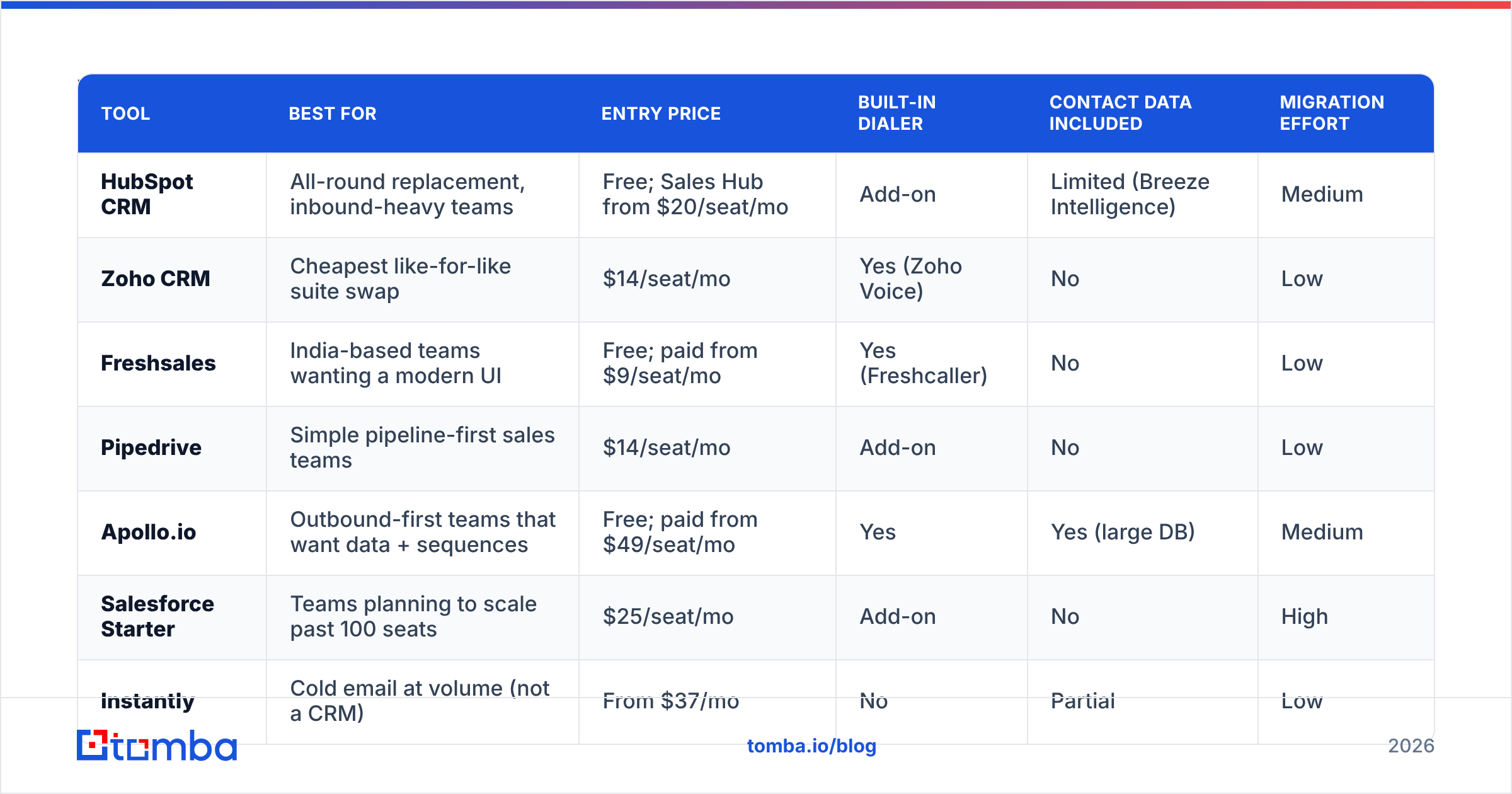
Run this test before you migrate anything. Pull 200 contacts out of Corefactors at random and check three things:
- Email validity. What percentage hard-bounce? Anything above 3–5% and your sender reputation is already being taxed.
- Job title freshness. How many of those people still hold the role you recorded? B2B contact data decays at roughly 25–30% per year, per most industry estimates.
- Coverage. For the accounts you care about, how many decision-makers do you actually have contacts for? Usually the answer is "one, and they're a manager."
If those numbers are bad — and for most teams that have been running a CRM for two-plus years, they are — then switching to HubSpot fixes your UI and your reporting and does absolutely nothing for your reply rate. You'd be redecorating a house with a cracked foundation.
The fix is a dedicated data layer that sits underneath whatever CRM you choose. That means:
- Find — resolve a name + company domain into a verified work email. A domain search returns every public email pattern on a company, which beats guessing formats by hand.
- Verify — SMTP-check before you send. An email verifier catches the dead addresses that would otherwise cost you deliverability.
- Enrich — fill in title, seniority, company size, and phone so your scoring and routing rules have something to work with. That's what data enrichment does on import and on an ongoing schedule.
This is where Tomba fits. It isn't a Corefactors replacement — it has no pipeline, no ticketing, no dialer. It's the thing that makes whichever CRM you pick actually worth logging into. Free tier gives you 25 searches a month to test the accuracy on your own accounts; Starter is $49/mo, Growth $99/mo, and Pro $249/mo when you're running real volume. Full Tomba pricing is public, and the credits don't expire mid-cycle in weird ways.

How do the alternatives compare on total cost?#
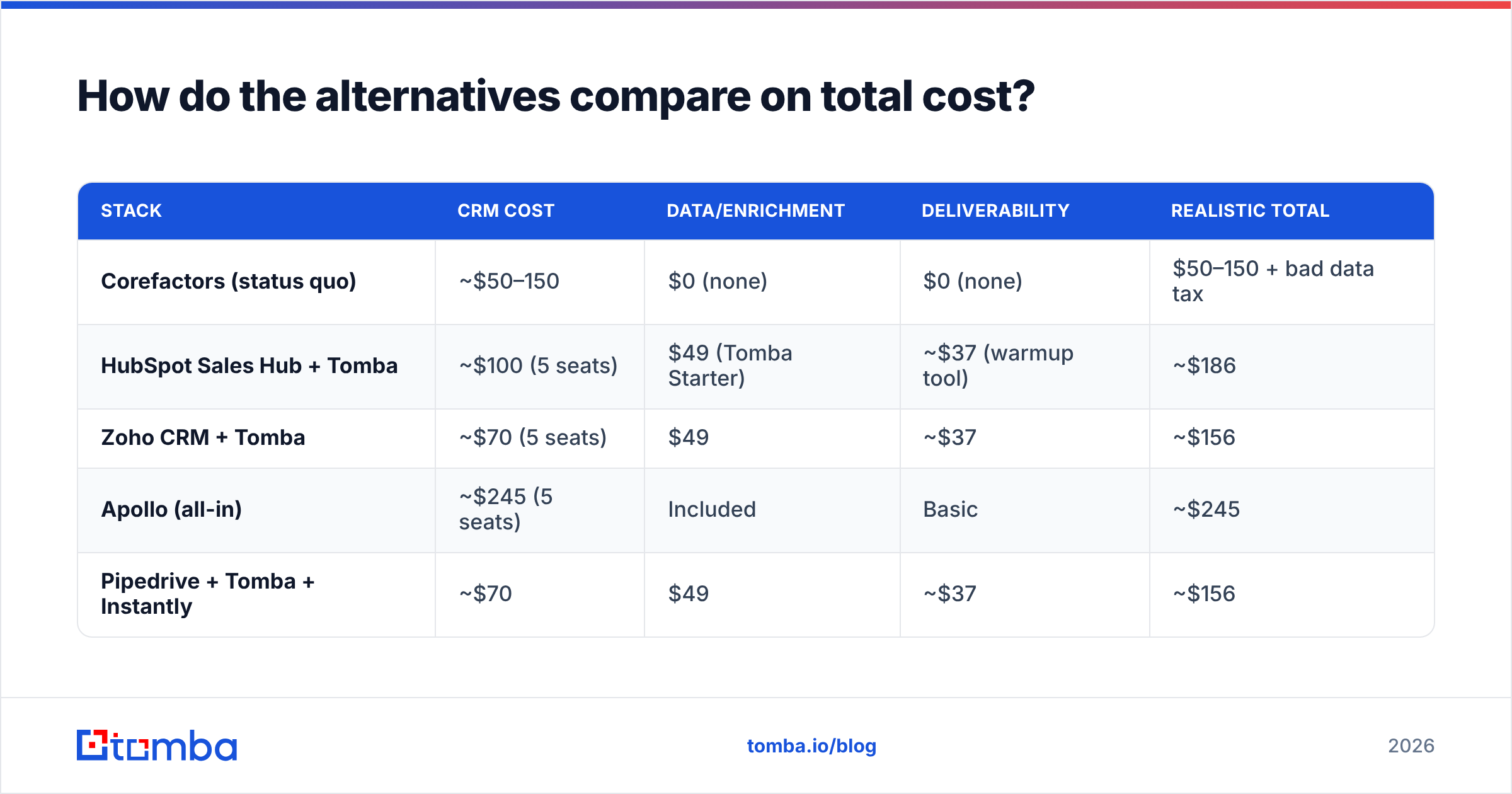
List prices lie. Here's a more honest model for a 5-person sales team doing real outbound, per month:
| Stack | CRM cost | Data/enrichment | Deliverability | Realistic total |
|---|---|---|---|---|
| Corefactors (status quo) | ~$50–150 | $0 (none) | $0 (none) | $50–150 + bad data tax |
| HubSpot Sales Hub + Tomba | ~$100 (5 seats) | $49 (Tomba Starter) | ~$37 (warmup tool) | ~$186 |
| Zoho CRM + Tomba | ~$70 (5 seats) | $49 | ~$37 | ~$156 |
| Apollo (all-in) | ~$245 (5 seats) | Included | Basic | ~$245 |
| Pipedrive + Tomba + Instantly | ~$70 | $49 | ~$37 | ~$156 |
The "bad data tax" line is the one nobody puts on a pricing page. A 12% bounce rate on a 3,000-contact campaign doesn't just waste 360 sends — it degrades domain reputation, which suppresses inbox placement on the 2,640 good ones. That's the compounding cost of skipping the data layer, and it's why the $49/mo line item is usually the highest-ROI row in this table.
What should you actually do next?#
Pick your lane and stop overthinking it:
- "Corefactors works, it's just ugly and I can't find leads." Keep it. Add a data layer. Spend $49/mo instead of three weeks of migration.
- "I need better integrations and reporting." Move to HubSpot. Start on the free tier, upgrade when you feel the ceiling.
- "I need the same suite but better and cheaper." Zoho CRM or Freshsales. Low migration risk, similar mental model.
- "My whole motion is outbound and the CRM is secondary." Apollo or a Pipedrive + Instantly + Tomba stack. Let the CRM be a database and put your money into data and deliverability.
- "I just need a clean list for one campaign." Buy it — BookYourData for pay-as-you-go, or run a bulk job through a bulk email finder if you already have company domains.
Whatever you choose, validate the contacts before the first send. Every CRM on this list will happily store a dead email forever and never tell you.
Read the reviews yourself before committing — G2's CRM category is the least-biased place to see how these tools rank on the criteria that matter to your segment, and it's worth 20 minutes.
Ready to fix the data under your CRM?#
The uncomfortable truth about most "Corefactors alternatives" searches is that the CRM was never the bottleneck. Your reps aren't losing deals because the pipeline view is ugly — they're losing them because half the contacts in it don't answer, don't exist, or moved companies eight months ago.
Start with the Tomba Email Finder. Run your worst-performing account list through it, verify the results, and compare the bounce rate to what you're getting now. The free tier covers 25 searches — enough to prove the point on your own data before you spend a dollar. If the numbers hold up, $49/mo Starter turns that into an always-on layer under whichever CRM you end up choosing, via CSV, the Chrome extension, Google Sheets, or the API.
Fix the foundation first. Then redecorate.
Related guides#
Ready to find emails that actually work?
Join 150,000+ professionals who stopped guessing and started sending. Free credits on signup — no credit card required.
Get the Tomba newsletter
Practical outbound tactics and product updates — once every two weeks.
About the author