Coresignal vs EasyLeadz: Which B2B Data Tool Wins in 2026?
Coresignal sells raw firmographic and employee datasets at scale. EasyLeadz sells direct mobile numbers, one contact at a time. Here is the honest head-to-head, plus where both leave gaps.
TL;DR#
- Coresignal is a data-as-a-service provider: bulk company, employee, and job-posting datasets delivered by API or flat file. It is built for engineers and data teams, not SDRs.
- EasyLeadz (and its Mr. E extension) is a contact-level tool focused on direct mobile numbers, especially strong in India and APAC, priced per credit.
- They barely compete. Choosing between them is really choosing between bulk enrichment infrastructure and per-prospect dialing data.
- Neither is a great email finder. Coresignal returns work emails only on some records; EasyLeadz leads with phone. If email is your primary channel, you need a dedicated finder and verifier layered on top.
- Budget reality: Coresignal starts in the thousands per year for meaningful data volume. EasyLeadz starts around $19–$59/mo on credit packs. Tomba sits between at $49/mo with a free tier.
What are Coresignal and EasyLeadz, actually?#
Start here, because the marketing pages blur the difference.
Coresignal is a web-data company. It crawls and structures public professional data — company profiles, employee records, job postings, funding events — and sells it as datasets. You either pull it through a REST API, query it in a search index, or take a bulk delivery (Parquet/JSON) into your own warehouse. The buyer is usually a data engineer at an ML/analytics team, a VC platform, an HR-tech product, or a large RevOps org building its own scoring model.
EasyLeadz is a prospecting tool. Its headline product, Mr. E, is a Chrome extension that sits on a LinkedIn profile and reveals a direct mobile number. It also has a company-search database and an API. The buyer is an SDR, a founder doing outbound, or a recruiter who wants to call rather than email. Its Indian and Southeast Asian phone coverage is genuinely good — better than most US-centric vendors.
So the question "Coresignal vs EasyLeadz" is a bit like asking whether a cement supplier is better than a power drill. Both are real products. They belong in different parts of the build.
How do Coresignal and EasyLeadz compare head-to-head?#
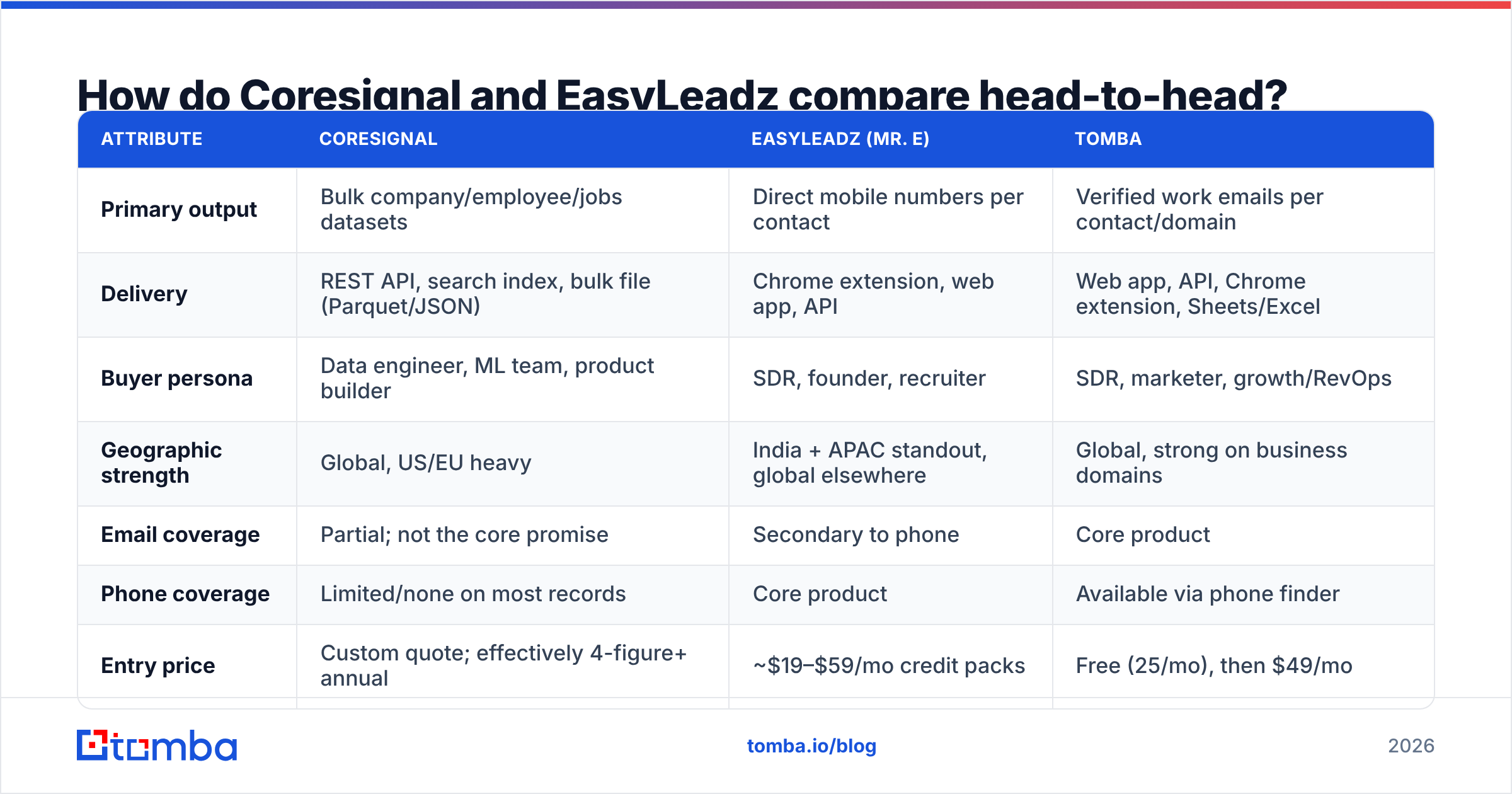
| Attribute | Coresignal | EasyLeadz (Mr. E) | Tomba |
|---|---|---|---|
| Primary output | Bulk company/employee/jobs datasets | Direct mobile numbers per contact | Verified work emails per contact/domain |
| Delivery | REST API, search index, bulk file (Parquet/JSON) | Chrome extension, web app, API | Web app, API, Chrome extension, Sheets/Excel |
| Buyer persona | Data engineer, ML team, product builder | SDR, founder, recruiter | SDR, marketer, growth/RevOps |
| Geographic strength | Global, US/EU heavy | India + APAC standout, global elsewhere | Global, strong on business domains |
| Email coverage | Partial; not the core promise | Secondary to phone | Core product |
| Phone coverage | Limited/none on most records | Core product | Available via phone finder |
| Entry price | Custom quote; effectively 4-figure+ annual | ~$19–$59/mo credit packs | Free (25/mo), then $49/mo |
| Free tier | Sample data on request | Limited free credits | Yes — 25 searches/mo |
| Best for | Building a data product or internal graph | Cold calling, especially India/APAC | Email-first outbound at team scale |
| Worst for | One-off SDR lookups | Warehouse-scale enrichment | Buying raw bulk datasets |
Read the "worst for" row twice. It is the whole article compressed.
Which one should you buy for your use case?#
Rather than declaring a winner, map the decision:
- You are building a product or model on top of company/people data. Coresignal. Nobody else in this pair delivers hundreds of millions of structured records you can own in your own warehouse. Check their official site for current dataset dimensions before you commit — schemas change.
- Your team dials before it emails, and your ICP is in India, SEA, or the Gulf. EasyLeadz. The mobile-number hit rate in those regions is the thing competitors quietly lose on. Verify with a trial on 50 real accounts from your own list, not their demo list.
- Email is your primary channel. Neither. You need a purpose-built email finder plus an email verifier so bounces stay under 2%. Layering a finder on top of a phone tool wastes credits on both sides.
- You need both email and phone, and you're under 20 seats. A finder-first platform with a phone finder attached is cheaper than stacking two point tools. Run the math per contact, not per month — that's where stacked credit packs get ugly.
- You need to enrich an existing CRM of 100k rows. Coresignal if you have engineering time; a bulk API with data enrichment if you don't. EasyLeadz will not scale here economically.
- You're a solo founder validating a niche. Start free. Burn zero dollars until your ICP is confirmed.
Is Coresignal worth the price for a normal sales team?#
Usually no — and that's not a criticism.
Coresignal prices like infrastructure. There is no meaningful self-serve tier where an SDR swipes a card and starts prospecting on Monday. You talk to sales, scope record volume, negotiate a data license, and then somebody has to actually ingest it. The value shows up when 500,000 records are worth more to you than 500 are, and when you own the pipeline that turns them into signal.
If your team is 6 AEs and 3 SDRs, that math almost never closes. You would be paying for a warehouse to store a shopping bag.
The honest counterpoint: teams that do build on Coresignal get something you cannot buy from a prospecting tool — a private data asset. Job-posting velocity, headcount deltas, and tech-stack shifts become intent signals you own rather than rent. That is a legitimate moat, and it is why data-first GTM orgs pay for it. Analyst coverage of the DaaS category on G2 reflects this split clearly: the reviews are from engineers, not reps.
Is EasyLeadz accurate enough to build outbound on?#
Directionally yes, with caveats you should hear before you buy.
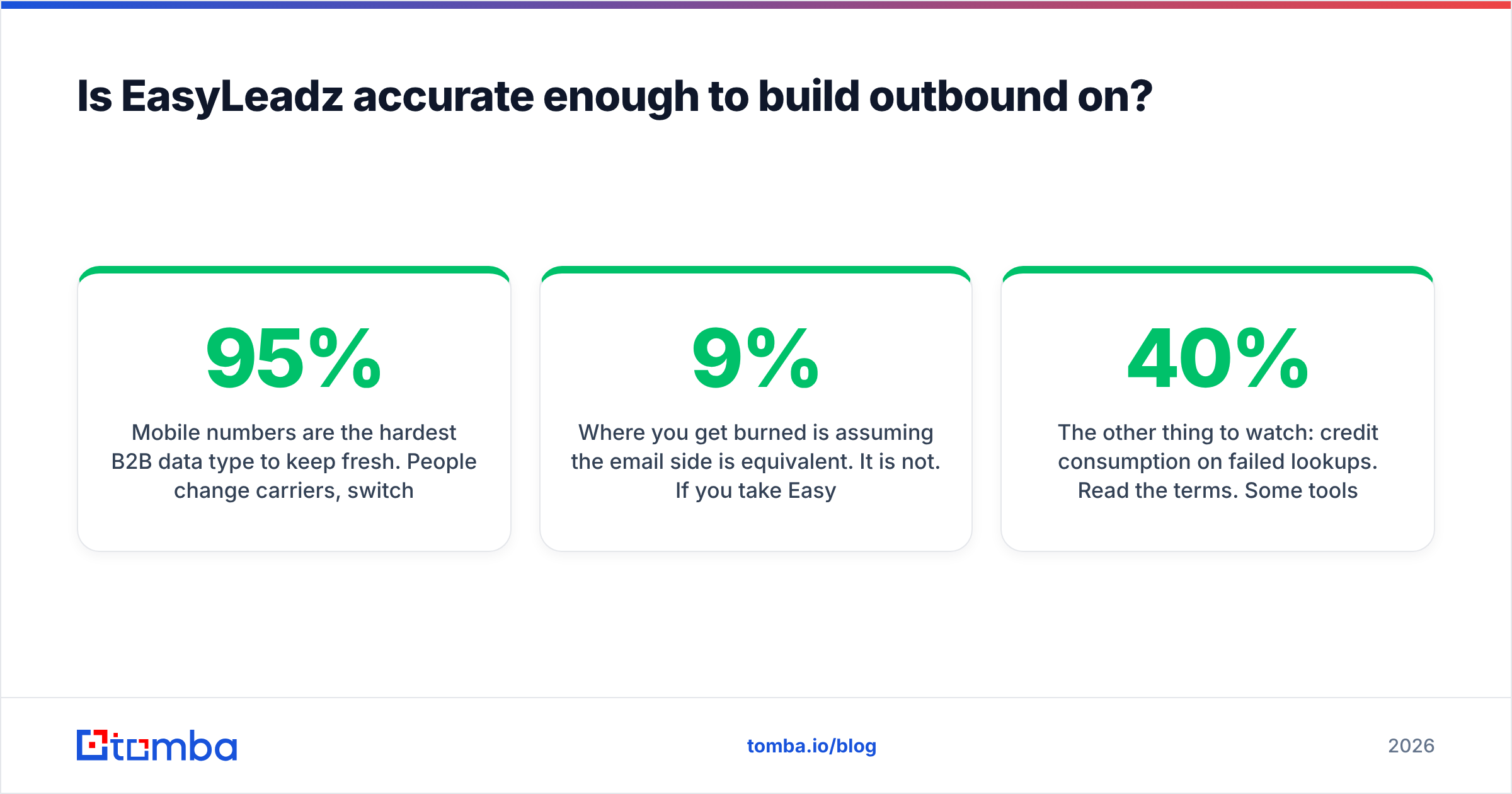
Mobile numbers are the hardest B2B data type to keep fresh. People change carriers, switch personal-to-work devices, and never update anything public. Any vendor claiming 95%+ mobile accuracy globally is selling you a story. EasyLeadz's real strength is that it does not pretend to be a global everything-machine — it is a phone tool with a regional edge, and it prices accordingly.
Where you get burned is assuming the email side is equivalent. It is not. If you take EasyLeadz-sourced emails straight into a cold sequence without independent verification, you will find out what a 9% bounce rate does to email deliverability. Run every list through a verifier regardless of source. That is not vendor-specific advice — it applies to Coresignal exports too, and to Tomba's own output.
The other thing to watch: credit consumption on failed lookups. Read the terms. Some tools in this category charge on attempt, not on hit, and a 40% hit rate on a hard ICP suddenly triples your effective cost per contact.
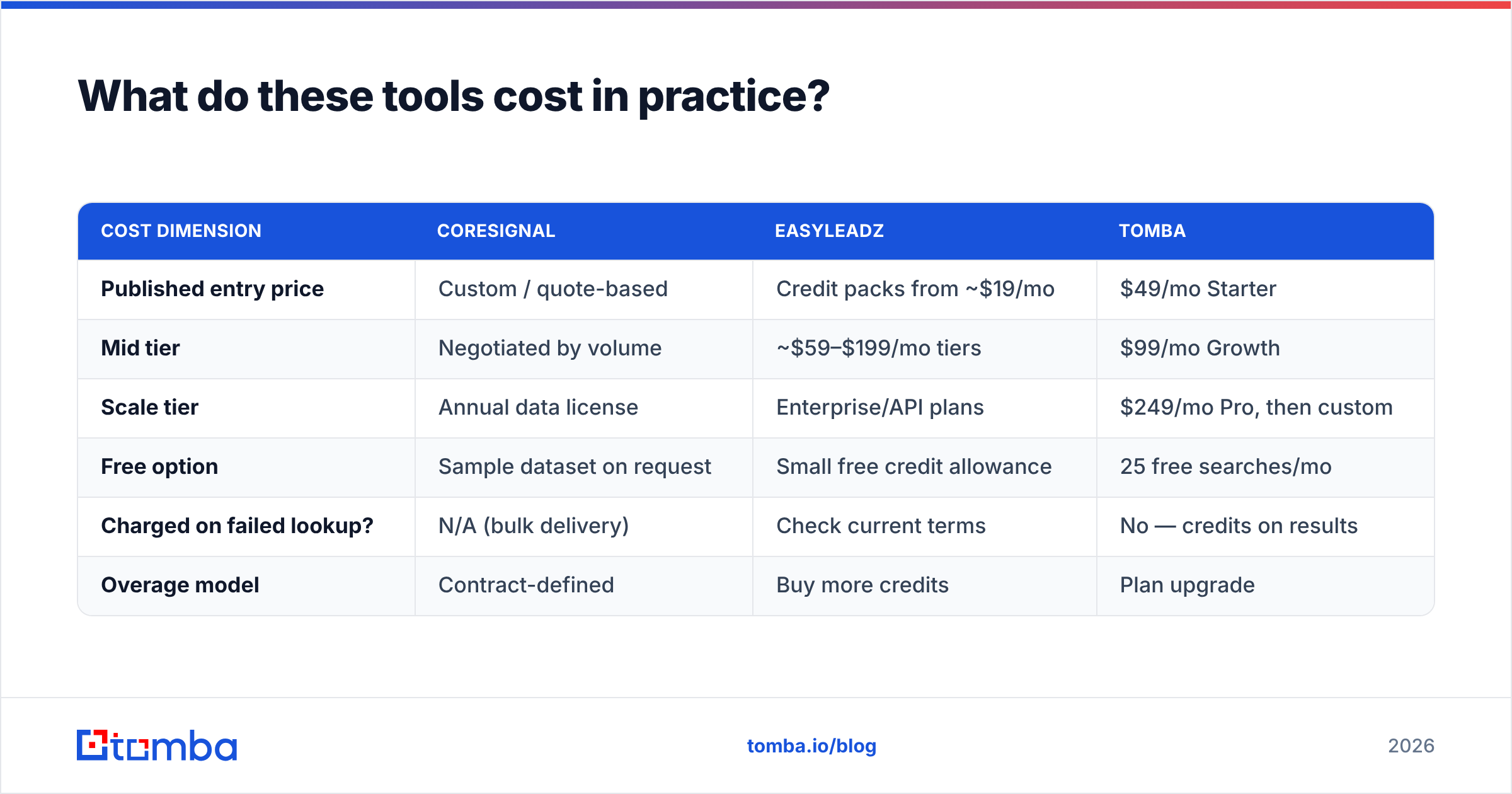
What do these tools cost in practice?#
| Cost dimension | Coresignal | EasyLeadz | Tomba |
|---|---|---|---|
| Published entry price | Custom / quote-based | Credit packs from ~$19/mo | $49/mo Starter |
| Mid tier | Negotiated by volume | ~$59–$199/mo tiers | $99/mo Growth |
| Scale tier | Annual data license | Enterprise/API plans | $249/mo Pro, then custom |
| Free option | Sample dataset on request | Small free credit allowance | 25 free searches/mo |
| Charged on failed lookup? | N/A (bulk delivery) | Check current terms | No — credits on results |
| Overage model | Contract-defined | Buy more credits | Plan upgrade |
Full Tomba pricing is public, which is worth noting only because quote-gated pricing is the single biggest hidden cost in this category. When a vendor won't publish, you are budgeting blind and your finance team will make you re-run the exercise in six months.
A practical costing rule: compute cost per usable contact, not cost per credit. Take the plan price, divide by credits, then divide again by your real hit rate and again by your verified-deliverable rate. A $0.02 credit with a 45% hit rate and an 85% deliverable rate is really costing you about $0.052 per usable contact. That number is comparable across vendors. Sticker price is not.
Where do both tools leave a gap?#
Three gaps show up repeatedly in real stacks.
- Verification. Neither product is a verification-first platform. Coresignal ships data as-is at crawl time; EasyLeadz optimizes for phone. Anything going into a sending tool needs an independent verification pass, including catch-all verification, which is where most "verified" lists quietly fail.
- Workflow surface. Coresignal expects you to build the UI. EasyLeadz gives you a great extension but a thinner bulk workflow. If your reps live in Sheets and your ops lives in HubSpot, you want native surfaces — a Google Sheets add-on, a HubSpot integration, a documented Tomba API — not a CSV round-trip. HubSpot's own data-quality documentation is blunt about what dirty imports do to a portal.
- Coverage honesty. Both are regionally uneven, as every provider is. The fix is not finding a mythical 100% vendor. It is running the same 100-row ICP sample through two or three tools and measuring hit rate and bounce rate yourself. Two hours of work, and it settles arguments that otherwise last a quarter.
Worth mentioning for completeness: if what you actually want is a prebuilt, filterable contact database rather than either an API firehose or a per-profile extension, that is a third category — vendors like BookYourData sell curated, pay-as-you-go B2B lists with guaranteed deliverability terms, which is a genuinely different and often cheaper path for teams that just want a clean list today. Don't force Coresignal or EasyLeadz into a job a list vendor does better.
How should you run the evaluation?#
Do this before you sign anything.
- Build a 100-account ICP sample from your own closed-won list — not a generic tech list.
- Run it through each vendor's trial. Record hit rate (contact returned) and coverage rate (the right contact returned).
- Verify every returned email independently. Bounce rate is the only score that matters downstream.
- Dial 20 numbers. Connect rate tells you more than any accuracy claim on a pricing page.
- Compute cost per usable contact using the formula above.
- Check the contract for data-license restrictions — some DaaS agreements limit resale, model training, or CRM sync in ways that will surprise your legal team.
Whoever wins on step 5 with acceptable numbers in steps 3 and 4 is your vendor. Not whoever has the better landing page.
The verdict#
Coresignal wins if you are building on data — a product, a model, an internal graph. It is infrastructure, priced like infrastructure, and it is good at that job.
EasyLeadz wins if you are dialing, and especially if your ICP concentrates in India and APAC where its mobile coverage genuinely outperforms the US-centric field. It is a respectable, focused tool that knows what it is.
Neither wins if your channel is email — which, for most B2B teams in 2026, it still is. That is a different tool class entirely, and forcing either of these into it is how you end up with a burned domain and a confused ops team.
If email-first outbound is the actual job, start with the Tomba Email Finder. Find emails by domain, name, or company; verify them before they touch a sequence; and pull the results straight into Sheets, HubSpot, or your own stack through the API. The free tier gives you 25 searches a month — enough to run the 100-row ICP test above alongside Coresignal and EasyLeadz and let the bounce rates decide instead of the marketing pages. Paid plans start at $49/mo when the test comes back the way we expect.
Related guides#
Ready to find emails that actually work?
Join 150,000+ professionals who stopped guessing and started sending. Free credits on signup — no credit card required.
Get the Tomba newsletter
Practical outbound tactics and product updates — once every two weeks.
About the author