Coresignal vs LeadIQ (2026): Which B2B Data Tool Wins?
Coresignal sells raw B2B datasets by the million; LeadIQ captures contacts one LinkedIn tab at a time. They barely compete — and picking the wrong one wastes a year of budget. Here's the honest breakdown.
TL;DR
- Coresignal is a data supplier, not a sales tool. It sells firmographic, employee, and jobs datasets by API or bulk delivery. You need engineers to use it. It does not hand a rep a verified email inside a LinkedIn tab.
- LeadIQ is a rep-facing prospecting tool. Chrome extension, one-click capture from LinkedIn Sales Navigator, CRM push, AI email drafting. Priced per seat.
- They only look like competitors on a G2 category page. If you're comparing them head-to-head, you probably have an unresolved question about who consumes the data — engineers or SDRs.
- Neither is the cheapest path to verified email addresses. If the actual job is "get correct emails for a list of people at a list of companies," a dedicated email finder does it for a fraction of either price.
- Rough call: Coresignal for data products and enrichment pipelines. LeadIQ for a seat-based SDR team living in Sales Navigator. Tomba if you want accurate contact data via API or UI without a data-engineering project or a per-seat tax.
What are Coresignal and LeadIQ, really?#
They sit in completely different layers of the stack, and that's the whole answer to most of this comparison.
Coresignal is a B2B data-as-a-service company. It scrapes and structures public web data — company profiles, employee records, job postings, funding, technographics — and sells access to those datasets through APIs, search endpoints, and bulk file delivery (Parquet, CSV, JSON, cloud buckets). Its customers are typically data teams building something: an ICP scoring model, a market intelligence product, a recruitment platform, a private-equity sourcing engine. Coresignal is upstream infrastructure. It does not care about your sequence.
LeadIQ is a sales prospecting platform. Its center of gravity is the browser extension: a rep opens a LinkedIn or Sales Navigator profile, clicks capture, and LeadIQ returns a work email and sometimes a mobile number, then pushes the contact into Salesforce, HubSpot, Outreach, or Salesloft with the right fields mapped. It also ships "Scribe," an AI writer that drafts personalized openers from the prospect's profile and recent activity. Its customers are SDRs and the managers who buy their tools.
So the honest framing of Coresignal vs LeadIQ is not "which is better." It's: are you building a data pipeline, or equipping humans?
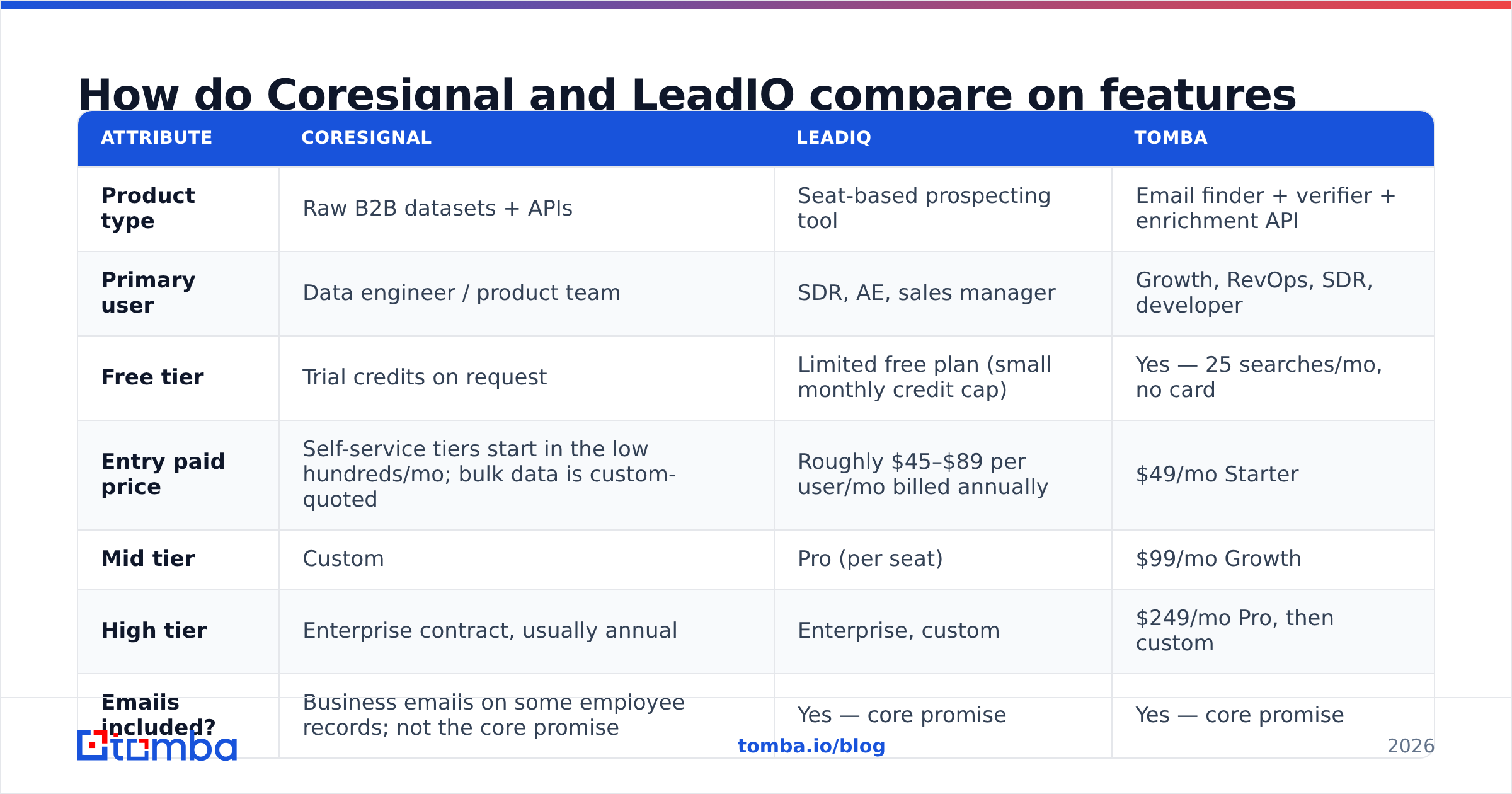
How do Coresignal and LeadIQ compare on features and price?#
Pricing on both sides moves, and both hide their real numbers behind sales calls at the top end. The table below reflects publicly listed structures at the time of writing — verify on the vendors' own pages before you sign anything.
| Attribute | Coresignal | LeadIQ | Tomba |
|---|---|---|---|
| Product type | Raw B2B datasets + APIs | Seat-based prospecting tool | Email finder + verifier + enrichment API |
| Primary user | Data engineer / product team | SDR, AE, sales manager | Growth, RevOps, SDR, developer |
| Free tier | Trial credits on request | Limited free plan (small monthly credit cap) | Yes — 25 searches/mo, no card |
| Entry paid price | Self-service tiers start in the low hundreds/mo; bulk data is custom-quoted | Roughly $45–$89 per user/mo billed annually | $49/mo Starter |
| Mid tier | Custom | Pro (per seat) | $99/mo Growth |
| High tier | Enterprise contract, usually annual | Enterprise, custom | $249/mo Pro, then custom |
| Emails included? | Business emails on some employee records; not the core promise | Yes — core promise | Yes — core promise |
| Email verification | Not a verification vendor | Basic validation | Dedicated verifier + catch-all handling |
| Bulk / CSV workflow | Native (that's the product) | Limited; capture-driven | Native bulk finder + verifier |
| Chrome extension | No | Yes — main interface | Yes |
| API-first? | Yes | API exists, secondary | Yes — full REST API, CLI, MCP |
| Contract | Often annual, minimums common | Annual for real seats | Monthly or annual, cancel anytime |
Read that table twice. The rows where Coresignal wins (bulk delivery, dataset breadth, historical records) are rows LeadIQ doesn't try to win. The rows where LeadIQ wins (extension, CRM push, per-prospect workflow) are rows Coresignal doesn't try to win.

Which one is more accurate for finding emails?#
This is where the comparison actually gets decided for most buyers, because most buyers are ultimately trying to reach a human.
Coresignal's email coverage is a byproduct. Employee records may include a business email, but the dataset is built around profile, role, tenure, and company signals. There is no SMTP verification layer, no catch-all handling, no bounce guarantee. If you pull a million employee records and blast the emails that came attached, you will damage your domain. Coresignal doesn't claim otherwise — it sells data, and treats deliverability as your problem.
LeadIQ's email coverage is the product, and it's decent for the population it's designed for: mid-market and enterprise contacts with a public LinkedIn presence in North America and Western Europe. Where reps report friction is coverage gaps outside that band, credit burn on captures that return nothing usable, and the per-seat model that punishes you for giving access to more people.
The uncomfortable third option: neither tool is optimized for the specific job of "resolve first name + last name + domain into a verified, deliverable inbox." That's a narrow, well-defined problem, and narrow tools beat broad ones at it. A dedicated email finder does pattern detection, source triangulation, and SMTP-level checks in one call, and a separate email verifier grades the result so you know what you're sending to before you send.
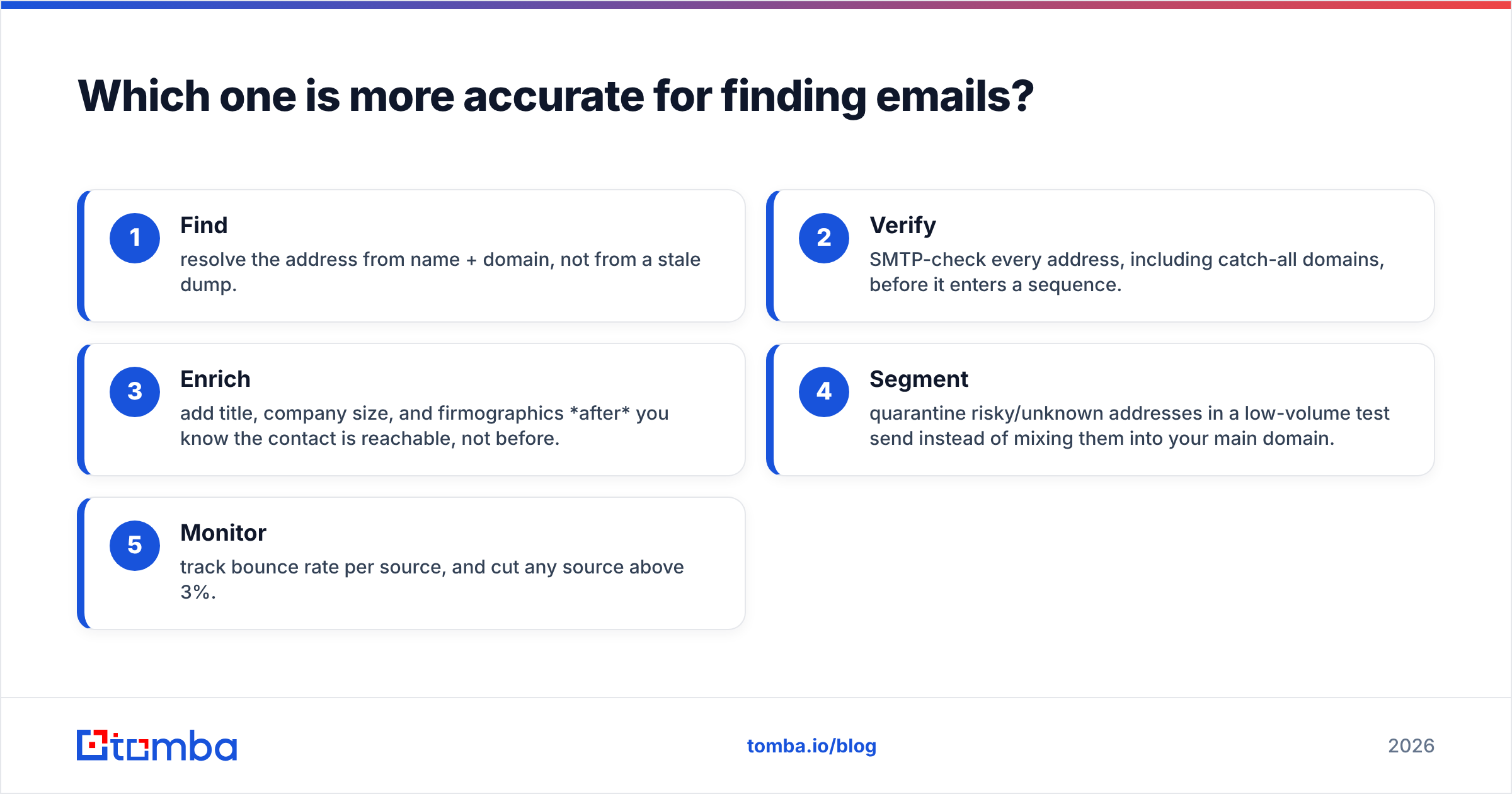
If your bounce rate is what keeps you up at night, do this in order:
- Find — resolve the address from name + domain, not from a stale dump.
- Verify — SMTP-check every address, including catch-all domains, before it enters a sequence.
- Enrich — add title, company size, and firmographics after you know the contact is reachable, not before.
- Segment — quarantine risky/unknown addresses in a low-volume test send instead of mixing them into your main domain.
- Monitor — track bounce rate per source, and cut any source above 3%.
Most teams do this in the wrong order: they buy a broad dataset first, discover 20% of it bounces, and then go shopping for a verifier. Reverse it and you save the domain and the money.
When should you choose Coresignal?#
Pick Coresignal when the data is going into a system, not into a rep's browser.
- You're building a product. Recruitment platforms, market intelligence dashboards, PE sourcing tools, ICP scoring models — Coresignal's breadth and historical depth are genuinely hard to replicate. You get millions of company and employee records with structured fields you can join against.
- You want to own the data. Bulk delivery to your own S3 bucket means no per-seat tax, no UI to fight, and no vendor sitting between your model and its inputs.
- You have engineers. This is not optional. Coresignal is a schema, a rate limit, and a delivery format. Nobody on your SDR team is going to "just use it."
- Your questions are aggregate. "Which companies grew headcount 30%+ in engineering last quarter?" is a Coresignal question. "What's Sarah's email?" is not.
The catch: cost and commitment scale fast. Self-service tiers exist, but the interesting volumes land in annual contracts with minimums. And you're still not done — raw records need cleaning, deduplication, and verification before they're safe to email.
When should you choose LeadIQ?#
Pick LeadIQ when you have a seated SDR team whose day happens inside Sales Navigator.
- Your reps live in LinkedIn. The capture-to-CRM flow removes real friction. Fewer tabs, fewer copy-paste errors, cleaner Salesforce hygiene.
- CRM cleanliness matters more than volume. LeadIQ's field mapping and duplicate detection are a real strength — captured contacts land in the right place with the right owner.
- You want AI drafting inside the same tool. Scribe is a reasonable first-draft generator. It won't replace a good writer, but it beats a blank compose window.
- You buy per seat and headcount is stable. The model only makes sense if every seat is actively prospecting.
The catch: cost per contact is high compared with an API-based finder, coverage outside core geos is inconsistent, and the value collapses if your workflow isn't LinkedIn-first. Teams working from conference lists, website visitors, or scraped domains get very little from the extension. If that's you, look at the LeadIQ alternative route before renewing.
Is there a third option that beats both?#
For the specific job most teams are actually trying to do — turn a list of companies and people into verified, deliverable contact data — yes, and it's cheaper than either.
The middle path is a contact-data platform that's API-first like Coresignal but rep-usable like LeadIQ:
- Domain search — give it a domain, get every discoverable email at that company with roles and confidence scores. This replaces the "buy an employee dataset and filter it" workflow for anything under enterprise scale.
- Email finder — name + domain in, verified address out, with a confidence score and the sources it triangulated from.
- Bulk processing — upload a CSV of thousands of rows and get finds + verifications back, no engineer required. This is the workflow that quietly makes Coresignal's bulk pipeline unnecessary for most sales orgs.
- Full API and CLI — the Tomba API gives your engineers the same primitives your reps use in the UI, so RevOps and product aren't buying two different vendors.
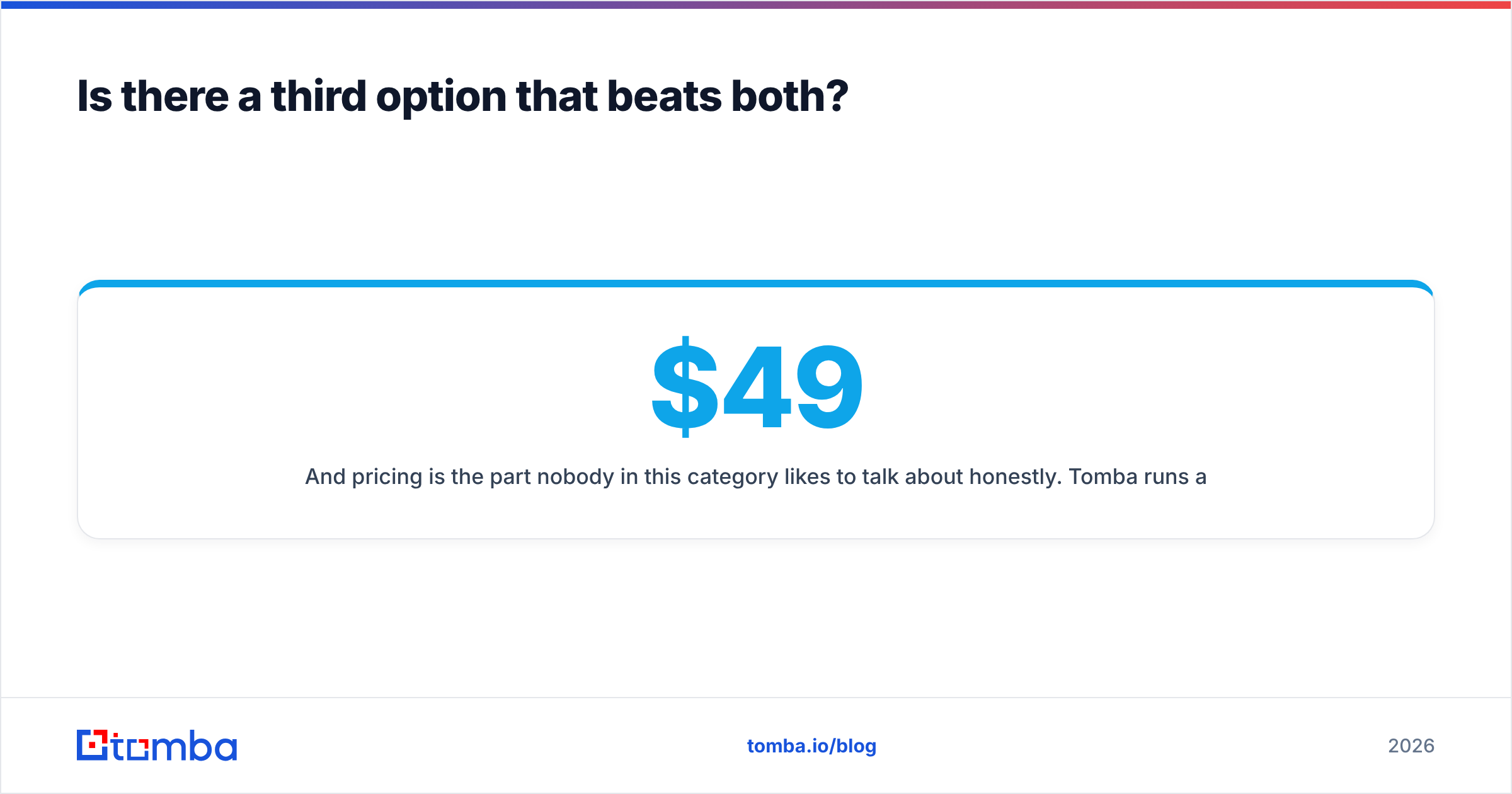
And pricing is the part nobody in this category likes to talk about honestly. Tomba runs a free tier at 25 searches/month, Starter at $49/mo, Growth at $99/mo, and Pro at $249/mo — flat, not per seat. Give the tool to your whole team without multiplying the invoice. Full Tomba pricing is public, which is more than can be said for most of this category.

What do real buyers complain about?#
Skip the marketing pages and read the review sites — G2 is the least-filtered source available. The recurring themes:
On Coresignal: the data is good, the onboarding is heavy. Buyers describe a gap between "we bought access" and "we produced value" measured in weeks of engineering. Schema questions, credit accounting, and delivery-format mismatches show up repeatedly. Nobody complains about breadth — they complain about the ramp.
On LeadIQ: capture is fast, credits vanish faster. The most common complaint is paying a credit for a contact that turns out to be wrong, outdated, or a bounce. The second is the per-seat model — teams that grow from 6 to 12 SDRs get a nasty renewal quote. The third is coverage: strong in US tech, thinner in EMEA mid-market and non-English markets.
On both: neither replaces a verification step. If you're running cold email in 2026, Gmail and Microsoft's bulk-sender rules mean a 5% bounce rate is not a "we'll fix it next quarter" problem — it's a deliverability cliff. Check your setup with an SPF checker and clean your list before every send, whatever your data source is.
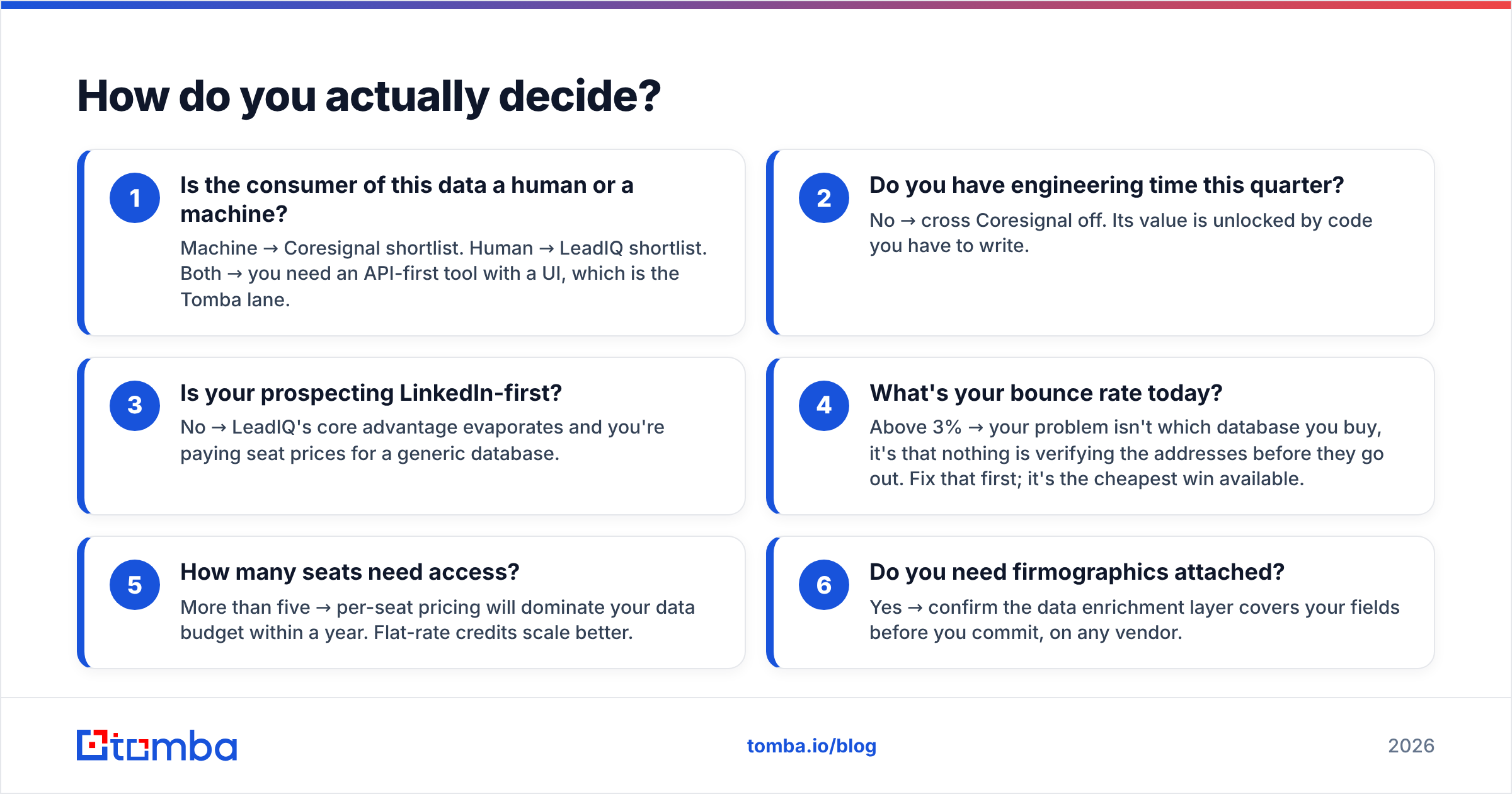
How do you actually decide?#
Run this decision tree honestly.
- Is the consumer of this data a human or a machine? Machine → Coresignal shortlist. Human → LeadIQ shortlist. Both → you need an API-first tool with a UI, which is the Tomba lane.
- Do you have engineering time this quarter? No → cross Coresignal off. Its value is unlocked by code you have to write.
- Is your prospecting LinkedIn-first? No → LeadIQ's core advantage evaporates and you're paying seat prices for a generic database.
- What's your bounce rate today? Above 3% → your problem isn't which database you buy, it's that nothing is verifying the addresses before they go out. Fix that first; it's the cheapest win available.
- How many seats need access? More than five → per-seat pricing will dominate your data budget within a year. Flat-rate credits scale better.
- Do you need firmographics attached? Yes → confirm the data enrichment layer covers your fields before you commit, on any vendor.
Most teams that arrive at "Coresignal vs LeadIQ" as a serious question are actually two teams sharing a budget line: a data team that wants raw records and a sales team that wants working emails. Buying one tool for both is how you end up with an unused API contract and a churned SDR team.
The verdict#
Coresignal wins if you're building. LeadIQ wins if you're staffing. Neither wins if what you actually need is verified email addresses at a sane cost per contact — and for a majority of B2B teams, that is the need, dressed up as a data strategy.
Before you sign an annual contract with either, run the same 200-lead list through all three and measure one number: the percentage of addresses that land in an inbox. Not coverage claims, not database size — deliverability on your real ICP. That test takes an afternoon and settles arguments no vendor demo can.
Start with the free tier of the Tomba Email Finder — 25 searches, no card, no sales call. Run your list, check the bounce rate, and let the numbers pick your vendor. If it holds up, Starter is $49/mo flat, and you can give it to the whole team without recalculating the invoice every time you hire.
Related guides#
Ready to find emails that actually work?
Join 150,000+ professionals who stopped guessing and started sending. Free credits on signup — no credit card required.
Get the Tomba newsletter
Practical outbound tactics and product updates — once every two weeks.
About the author