Coresignal vs Leadzen.ai (2026): Which B2B Data Tool Wins?
One sells raw datasets by the million. The other sells finished leads in a browser tab. Here is the honest breakdown of Coresignal vs Leadzen.ai — data depth, contact accuracy, pricing, and who each one actually fits.
Coresignal vs Leadzen.ai is a shortlist a lot of teams end up with. It is also the wrong fight. One vendor sells raw data by the million. The other sells finished leads in a browser tab. Here is the honest breakdown, and the pick for each kind of team.
TL;DR
- Coresignal is not a lead tool. It is a data vendor. It sells big, fresh datasets (company, employee, job posting) through an API and bulk files. You build the product. Coresignal supplies the raw material.
- Leadzen.ai is not a data warehouse. It is a lead app. Search a name, a company, or a LinkedIn profile. You get back a contact record you can call or email today.
- They fight for the same budget, not the same job. Compare them feature by feature and you will buy the wrong one.
- Neither one is built for email accuracy. Both hand you contact fields. Neither is a verifier. That gap is where a dedicated email verifier earns its keep.
- Fast rule for Coresignal vs Leadzen.ai: Got engineers and a data model? Look at Coresignal. Got SDRs and a quota? Look at Leadzen.ai — or at a purpose-built email finder that costs a fraction of either.
What are Coresignal and Leadzen.ai, actually?#
Start here. The label "B2B data" hides two very different businesses.
Coresignal is a public web data provider. Its product is scale. You get hundreds of millions of employee records, tens of millions of company records, and a huge job-posting archive. It ships through a REST API, a search API, or flat files dropped in your cloud bucket.
The typical buyer is a data engineer. They work at an HR-tech, investment, or sales-intelligence company. They are building something on the data: a talent graph, a hiring-signal model, an ICP scoring engine. History is the real edge here. You can watch headcount move over time, which is the whole point if you model growth signals.
Leadzen.ai is a prospecting app built around live search. Give it a person, a company, or a URL. It returns an enriched contact card: role, company, and often a business email and phone.
It also ships a browser extension for LinkedIn, bulk search, and a light campaign layer. The buyer is an SDR manager or a founder who sells. Pricing and support are India-first, and the price tag shows it.
So the honest framing of Coresignal vs Leadzen.ai is not "which tool has more records." It is "do you need a supply chain or a finished good?"
How do Coresignal vs Leadzen.ai compare head to head?#
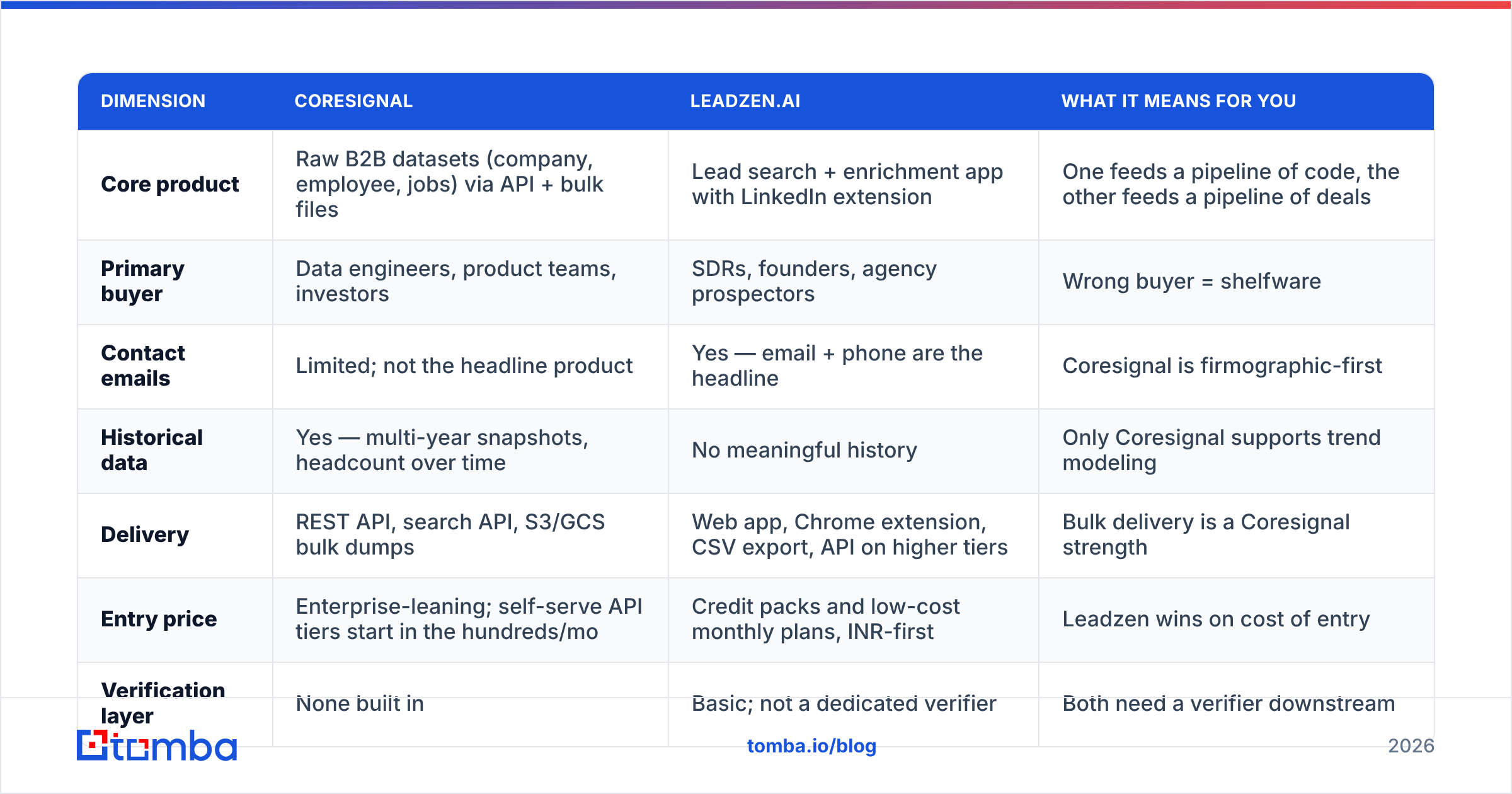
Here is the 2026 picture. Treat every price as a rough guide. Both vendors quote by volume, and both change their packaging. Check their pricing pages before you sign.
| Dimension | Coresignal | Leadzen.ai | What it means for you |
|---|---|---|---|
| Core product | Raw B2B datasets (company, employee, jobs) via API + bulk files | Lead search + enrichment app with LinkedIn extension | One feeds a pipeline of code, the other feeds a pipeline of deals |
| Primary buyer | Data engineers, product teams, investors | SDRs, founders, agency prospectors | Wrong buyer = shelfware |
| Contact emails | Limited; not the headline product | Yes — email + phone are the headline | Coresignal is firmographic-first |
| Historical data | Yes — multi-year snapshots, headcount over time | No meaningful history | Only Coresignal supports trend modeling |
| Delivery | REST API, search API, S3/GCS bulk dumps | Web app, Chrome extension, CSV export, API on higher tiers | Bulk delivery is a Coresignal strength |
| Entry price | Enterprise-leaning; self-serve API tiers start in the hundreds/mo | Credit packs and low-cost monthly plans, INR-first | Leadzen wins on cost of entry |
| Verification layer | None built in | Basic; not a dedicated verifier | Both need a verifier downstream |
| Time to first useful lead | Weeks (schema, ingest, dedupe) | Minutes | This is the real dividing line |
| Best for | Building a data product or ICP model | Filling a rep's call list this week | Different jobs, different tools |
The table makes the trap obvious. Buy Coresignal and expect a lead list, and you will pay an engineer to build one. Buy Leadzen.ai and expect a research-grade dataset, and the coverage and history will be too thin to model on. That is the whole Coresignal vs Leadzen.ai mistake in one line.
Is Coresignal worth it for a sales team?#
Usually no. That is not a knock on Coresignal.
Coresignal sits upstream on purpose. You buy a firehose of structured records. You own everything after that: schema design, dedupe, entity resolution, ICP filters, contact derivation, and the sending itself.
That is a real engineering project. Expect weeks of work before a single reply lands. If you have a data team and you are building a product, that work is the point. A recruiting platform, an investment screener, a scoring model — Coresignal's history-aware datasets are hard to copy.
Where it fails as a sales buy:
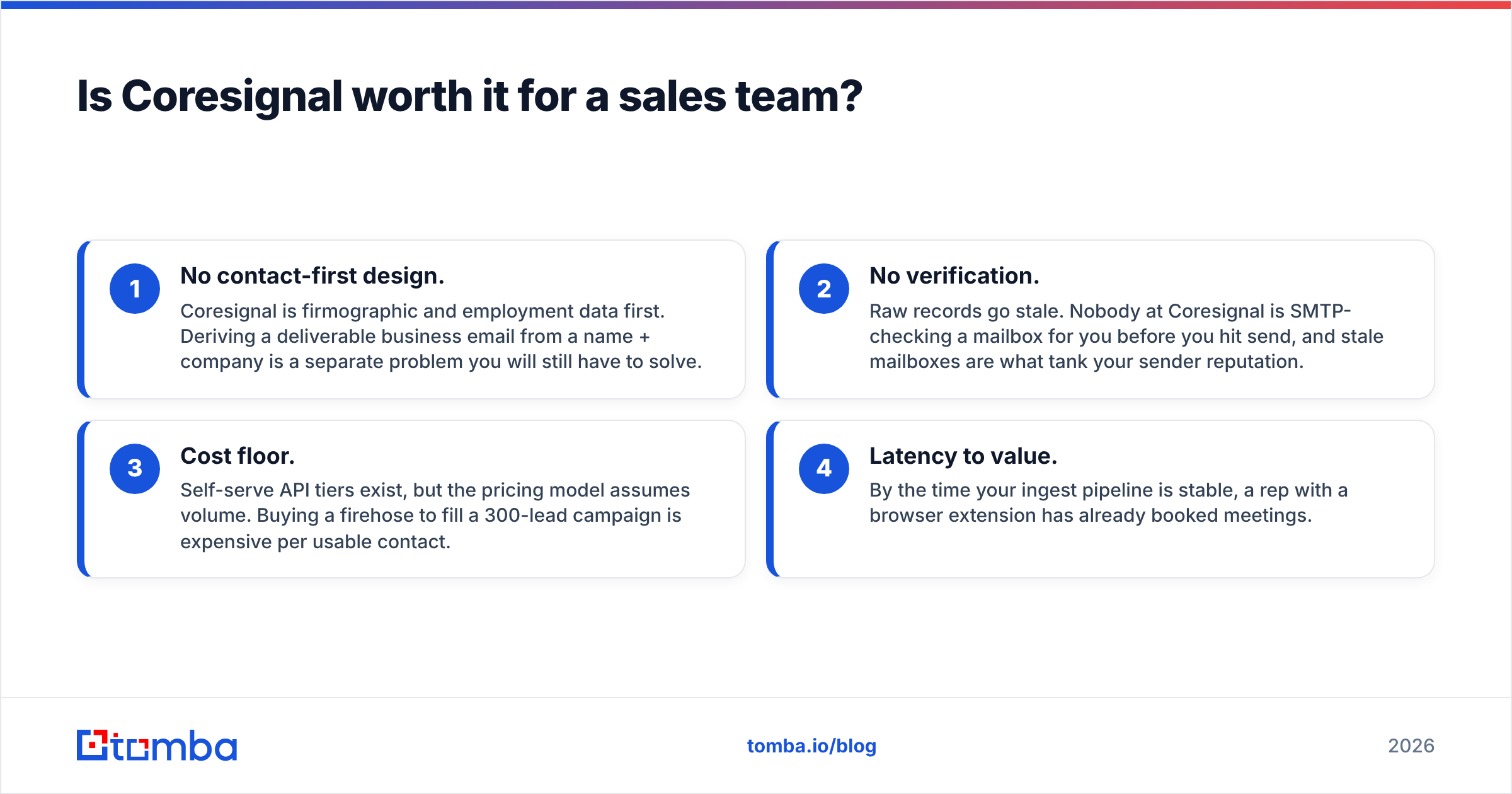
- No contact-first design. Coresignal leads with company and job data. Turning a name plus a company into a live email is a separate problem, and it is still yours to solve.
- No verification. Raw records go stale. Nobody at Coresignal checks the mailbox before you hit send. Dead mailboxes are what wreck your sender reputation.
- Cost floor. Self-serve API tiers exist. Still, the pricing assumes volume. Buying a firehose to fill a 300-lead campaign is pricey per usable contact.
- Slow to value. By the time your ingest pipeline is stable, a rep with a browser extension has already booked meetings.
Building an internal account-scoring layer? Coresignal is a serious candidate. Need 500 verified contacts by Friday? It is the wrong shape. That is the first half of the Coresignal vs Leadzen.ai answer.
Is Leadzen.ai good enough for serious outbound?#
For a small team on a tight budget, yes. Price in the caveats first.
Leadzen.ai is fast. Live search means you are not paging through a stale snapshot. You pull a record when you ask for it.
The Chrome extension drops into the LinkedIn flow most SDRs already run. Entry cost is low next to the US-priced incumbents. For founder-led sales and lean agencies, that mix is hard to beat.
The caveats:
- Coverage skews. Live search works best where the public footprint is rich. Coverage thins out on smaller EU and APAC companies. It also thins out on non-technical roles at mid-market firms. Run your own sample first.
- Deliverability is your problem. Getting an address back is not the same as that address taking mail. Catch-all domains look "valid" to naive checks, then bounce or blackhole. Put a real catch-all verifier in the loop.
- The campaign layer is thin. It works, but it is no sequencer. You will export to your own stack anyway.
- API depth. API access sits on higher tiers. The docs are lighter than a data team expects. If you automate, budget the integration time.
None of this makes it a bad tool. It makes it a prospecting tool. Judge it against other prospecting tools, not against a dataset vendor. That is the second half of Coresignal vs Leadzen.ai.
What does a realistic evaluation look like?#
Skip the feature grids on the vendor sites. Run this test on your ICP, not on a sample list a vendor hands you. It settles Coresignal vs Leadzen.ai faster than any spec sheet.
- Pull 100 accounts from your closed-won list. You know these companies exist. You know you can sell to them. If a tool misses here, it will miss in cold territory.
- Ask each tool for one role at each account. Use the exact title you sell to. Not "anyone at the company." Coverage looks great until you constrain it.
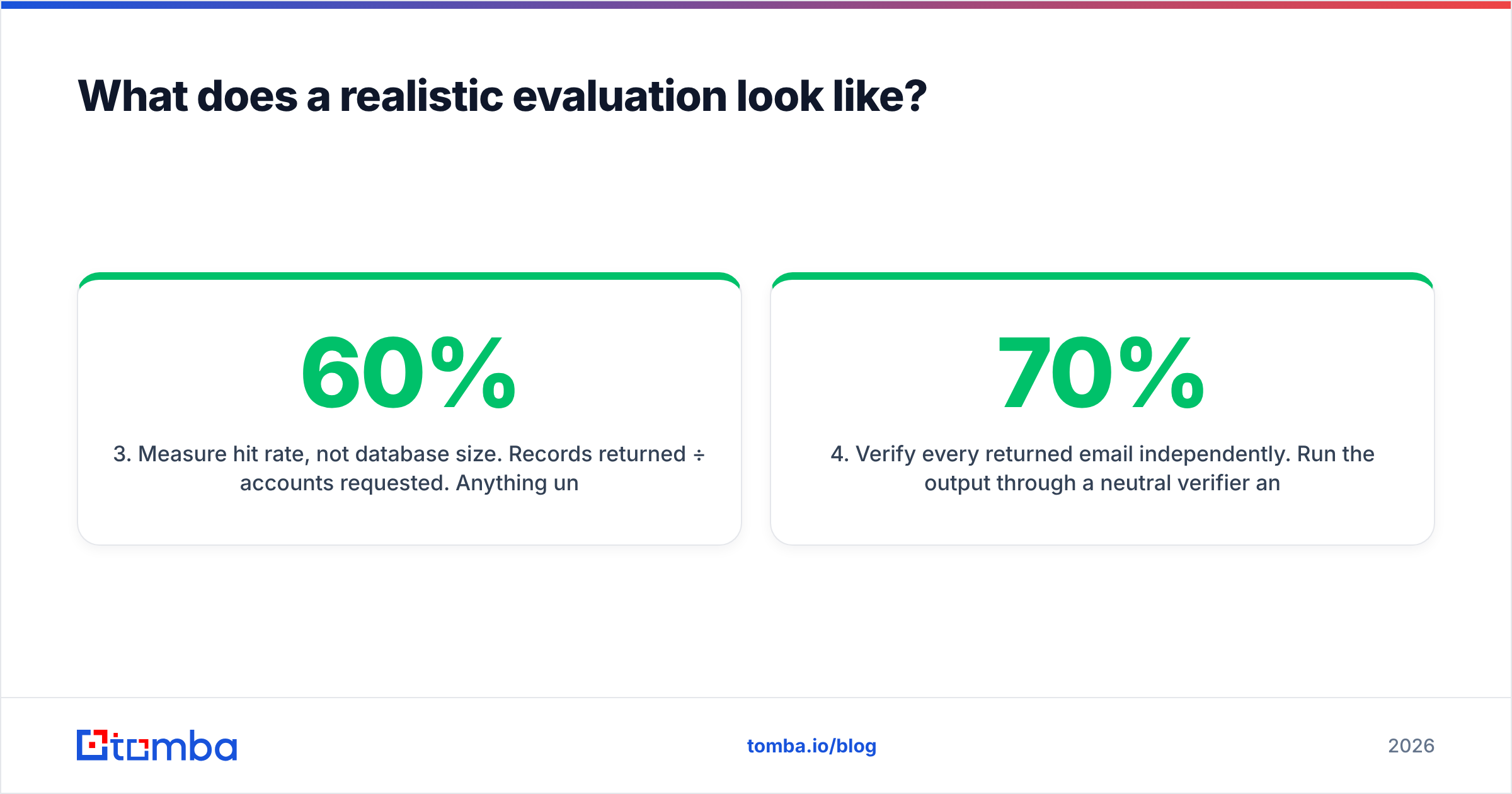
- Measure hit rate, not database size. Records returned ÷ accounts requested. Under 60% on your core ICP is a problem, whatever the homepage claims.
- Verify every email you get back. Run the output through a neutral verifier. Count the real bounces. A 70% hit rate with 95% deliverability beats a 90% hit rate with 70% deliverability. Every time.
- Price per usable contact. Divide monthly cost by verified-deliverable contacts. The number is usually 2–4× the sticker price. It is the only one that matters.
- Time the whole workflow. Count engineering hours for Coresignal. A cheap dataset that eats three engineer-weeks is not cheap.
Step 4 is where most evaluations fall apart. Vendors report "found" rates. Your inbox reports bounce rates. Only one of those decides whether your domain lands in the inbox next quarter. The mechanics are in this primer on email deliverability.

Coresignal vs Leadzen.ai vs a dedicated email finder#
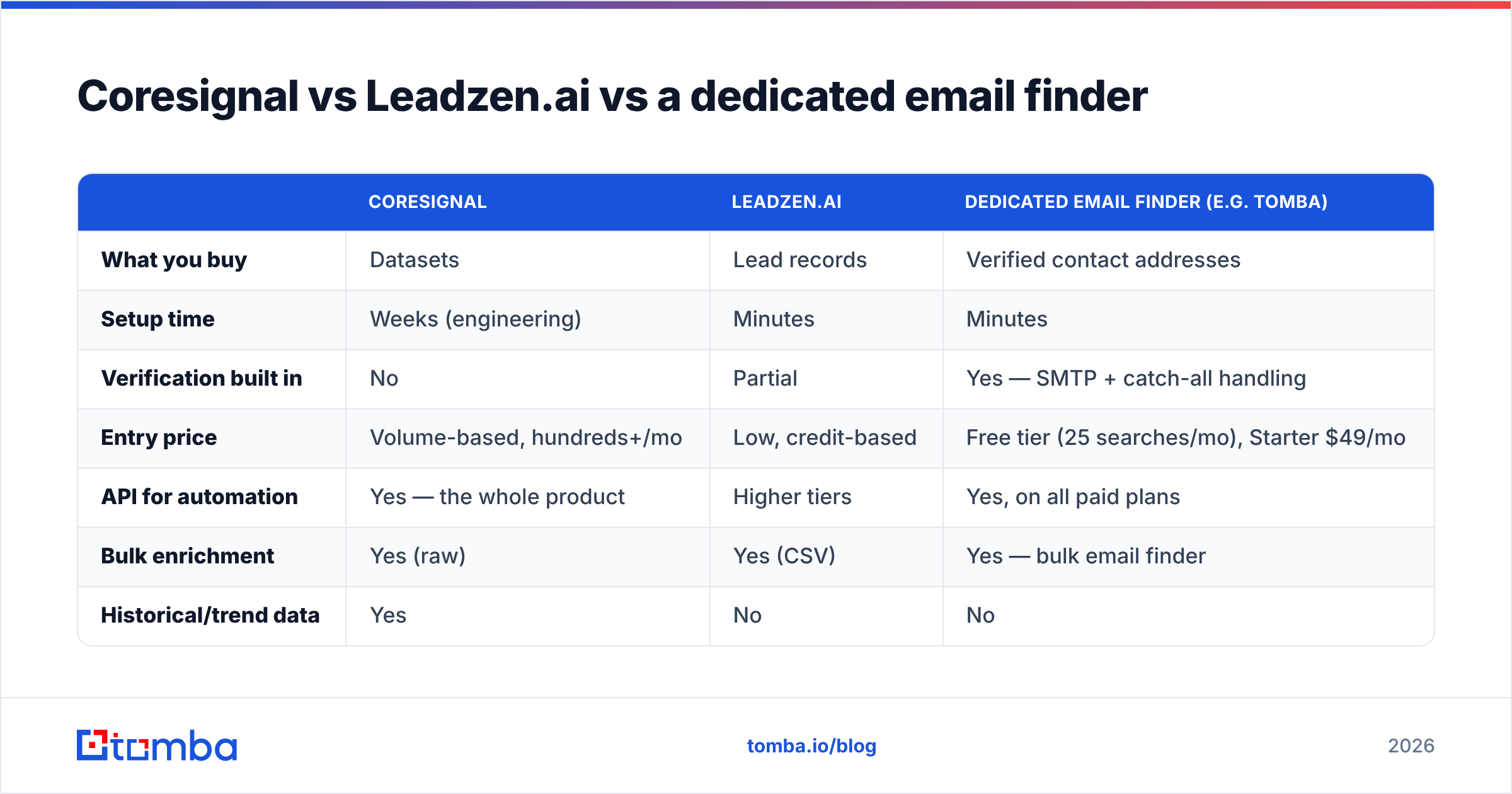
Here is the part both vendors would rather you skip. For a lot of teams, neither one is the right buy.
The real job is simple: get a verified, deliverable business email for a known person at a known company. That job has its own tool category.
| Coresignal | Leadzen.ai | Dedicated email finder (e.g. Tomba) | |
|---|---|---|---|
| What you buy | Datasets | Lead records | Verified contact addresses |
| Setup time | Weeks (engineering) | Minutes | Minutes |
| Verification built in | No | Partial | Yes — SMTP + catch-all handling |
| Entry price | Volume-based, hundreds+/mo | Low, credit-based | Free tier (25 searches/mo), Starter $49/mo |
| API for automation | Yes — the whole product | Higher tiers | Yes, on all paid plans |
| Bulk enrichment | Yes (raw) | Yes (CSV) | Yes — bulk email finder |
| Historical/trend data | Yes | No | No |
| Best fit | Data product teams | Lean SDR teams | Outbound teams who send email |
Most outbound teams win with a layered stack, not one vendor:
- Signal layer — where accounts come from. That could be Coresignal (if you model), a curated database, or intent tooling. BookYourData also fits here. It sells a pre-built, pay-as-you-go contact database rather than raw datasets. Fair buy if you would rather not build.
- Contact layer — turning an account and a person into a working address. This is where a purpose-built finder plus a domain search belongs.
- Hygiene layer — verification, catch-all handling, dedupe. Not optional. Every credit you spend here saves you three in reputation damage.
- Send layer — your sequencer or CRM.
Buy both tools and expect them to cover all four layers, and you end up with a $1,000/mo stack and a 6% reply rate.
Which one should you pick?#
Pick Coresignal if:
- You are building a product, a model, or an internal system on B2B data
- You need history: headcount trends, hiring speed, job-posting archives
- You have engineers and a data warehouse already
- Volume is big enough that per-record beats per-credit
Pick Leadzen.ai if:
- You need contacts in your reps' hands this week
- Budget is tight next to the US-priced incumbents
- Your team works LinkedIn-first and lives in a browser extension
- You accept that you will add a verification step later
Pick neither if:
- You already know who to reach. You just need an email that works.
- You send cold email at volume, and bounce rate is your real limit
- You want a free tier to test coverage before you spend
For user sentiment, read the review profiles on G2. Read the complaints, not the praise. Coresignal reviews mention integration lift. Leadzen reviews mention coverage swings. Both match what the products are.
What's the honest verdict on Coresignal vs Leadzen.ai?#
They are not really rivals. That is the single most useful thing to know before you buy.
Coresignal is infrastructure. It wins when the deliverable is a system. Its multi-year history is a moat most contact tools do not have.
Leadzen.ai is a workflow tool. It wins when the deliverable is a meeting this month. For a lean team, the entry price is hard to argue with.
Neither one is built for the dull middle step that decides everything: producing an email address a mail server will accept. Records go stale at roughly 2–3% a month as people change jobs. A "found" address that bounces costs you twice. You lose the credit, and you take a sender reputation hit that drags your next three campaigns into spam.
So test on your own ICP. Measure verified-deliverable contacts, not database size. Price the whole stack, not one line item. That process usually says the same thing. The dataset vendor is overkill. The app is under-verified. What you needed was a clean finder with a verifier attached.
Start with the layer that decides everything#
However you settle Coresignal vs Leadzen.ai, fix the contact layer first. Then decide whether you need a dataset on top of it.
Tomba Email Finder does one thing well. It turns a name and a domain into a verified, deliverable business email. SMTP checks and catch-all handling ship in the same call.
Start on the free tier (25 searches/mo). Run the 100-account test above against whatever you pay for now. If Tomba's verified hit rate on your real ICP wins, the $49/mo Starter plan pays for itself in the first campaign. See the full Tomba pricing breakdown, or wire it into your stack with the Tomba API.
Run the test. Let the bounce rate pick the winner.
Related guides#
Ready to find emails that actually work?
Join 150,000+ professionals who stopped guessing and started sending. Free credits on signup — no credit card required.
Get the Tomba newsletter
Practical outbound tactics and product updates — once every two weeks.
About the author