Coresignal vs SalesIntel (2026): Which B2B Data Wins?
Coresignal sells raw B2B data feeds to engineers. SalesIntel sells human-verified contacts to sales teams. They barely compete — and most buyers pick the wrong one. Here's how to tell which fits, and when neither does.
Coresignal vs SalesIntel is one of the most common B2B data match-ups. It is also one of the most misread. The two tools look alike on the homepage. They are not alike at all. Here is what each one sells, what it costs, and when a cheaper tool beats both.
TL;DR
- Coresignal is a data-as-a-service company. It sells firmographic, employee, and job-posting datasets through APIs and bulk files. There is no seat-based sales UI. It is built for engineers who want to build on top of raw records.
- SalesIntel is a sales-team platform. It sells human-verified contacts — emails plus direct dials — inside a searchable UI with CRM sync and intent data. It is built for SDRs and demand gen.
- They are rarely a true either/or. If you are weighing Coresignal vs SalesIntel head-to-head, one of the two is almost certainly wrong for your use case.
- Both ask for a big commitment: annual contracts, quote-based pricing, and minimums. Small teams and side projects are priced out.
- Do you just need "a verified work email for this person at this company"? A focused email finder does that job for far less. Tomba starts free and goes to $49/mo.
What are Coresignal and SalesIntel, really?#
Start here, before you compare Coresignal vs SalesIntel pricing sheets. These two firms sell different products to different buyers. They only look alike because both say "B2B data" on the homepage.
Coresignal (coresignal.com) is a raw-materials data provider. It gathers public web data — company profiles, employee profiles, job postings, funding, tech stacks. It cleans that data and hands it to you as an API response or a huge export file.
The buyer is usually a developer or a data engineer. They are building a recruiting product, an investment screener, a market dashboard, or an enrichment layer inside their own SaaS. Coresignal does not care what you do with the records. It cares about volume, freshness, and a stable schema.
SalesIntel (salesintel.io) is a go-to-market platform. Its edge is human verification. A research team re-checks contacts on a rolling cycle. The pitch is simple: a person has touched the phone number you are about to dial.
It sells direct dials, work emails, tech stack data, and intent signals (via a Bombora partnership). All of it sits in a UI your SDRs log into, with a Chrome extension and CRM push. The buyer is a VP of Sales or a demand gen lead.
So the honest framing for Coresignal vs SalesIntel is not "which is better." It is this: do you need a data pipeline or a prospecting tool? Everything else follows from that answer.
Coresignal vs SalesIntel: how do they compare head-to-head?#
Here is the practical side-by-side. Both vendors keep list pricing off the public site and quote per deal. So the pricing rows below reflect what buyers report on review sites, not a published rate card. Check with the vendor before you budget.
| Attribute | Coresignal | SalesIntel | Tomba |
|---|---|---|---|
| Primary product | Raw B2B datasets + API | Verified contact database + UI | Email finder + verifier |
| Built for | Data engineers, product teams | SDRs, demand gen, RevOps | Sales, marketing, developers |
| Contact emails | Yes, within employee data | Yes, core offering | Yes, core offering |
| Direct dials | Limited | Yes — key differentiator | Via phone finder |
| Human verification | No (automated pipeline) | Yes — research team | Automated SMTP + pattern validation |
| Intent data | No | Yes (Bombora) | No |
| Bulk export | Yes — very large volumes | Yes, credit-limited | Yes — bulk finder |
| Self-serve signup | Partial (API tiers) | No — demo required | Yes, instant |
| Free tier | Trial/sample data | No | 25 searches/mo |
| Entry price | Quote-based, four figures/mo typical | Quote-based, annual contract | $49/mo Starter |
| Contract | Annual commitment typical | Annual commitment typical | Monthly, cancel anytime |
| Geography strength | Global, strong EU + APAC | Strongest in North America | Global |
| API-first? | Yes — the whole product | API available, secondary | Yes — documented REST API |
The pattern in that table matters more than any single row. Coresignal wins on volume and schema control. SalesIntel wins on phone numbers and US verification. Neither wins on entry cost. Neither wins on speed to first result. And neither lets you try the thing before you talk to a rep.

Coresignal vs SalesIntel: how accurate is the data?#
Accuracy is where the marketing gets slippery. Be precise about what each vendor claims.
SalesIntel claims human verification. Researchers re-check contacts on a cycle, and the company markets a high accuracy figure for that verified pool.
Here is the nuance most buyers miss. The human-verified pool is a subset of the full database. The rest is machine-processed, like everyone else's. So when you pull a list of 5,000 contacts, ask two questions. What share of this list carries the human-verified stamp? And how recently? If a rep quotes a headline accuracy number, ask whether it covers the whole database or only the verified slice.
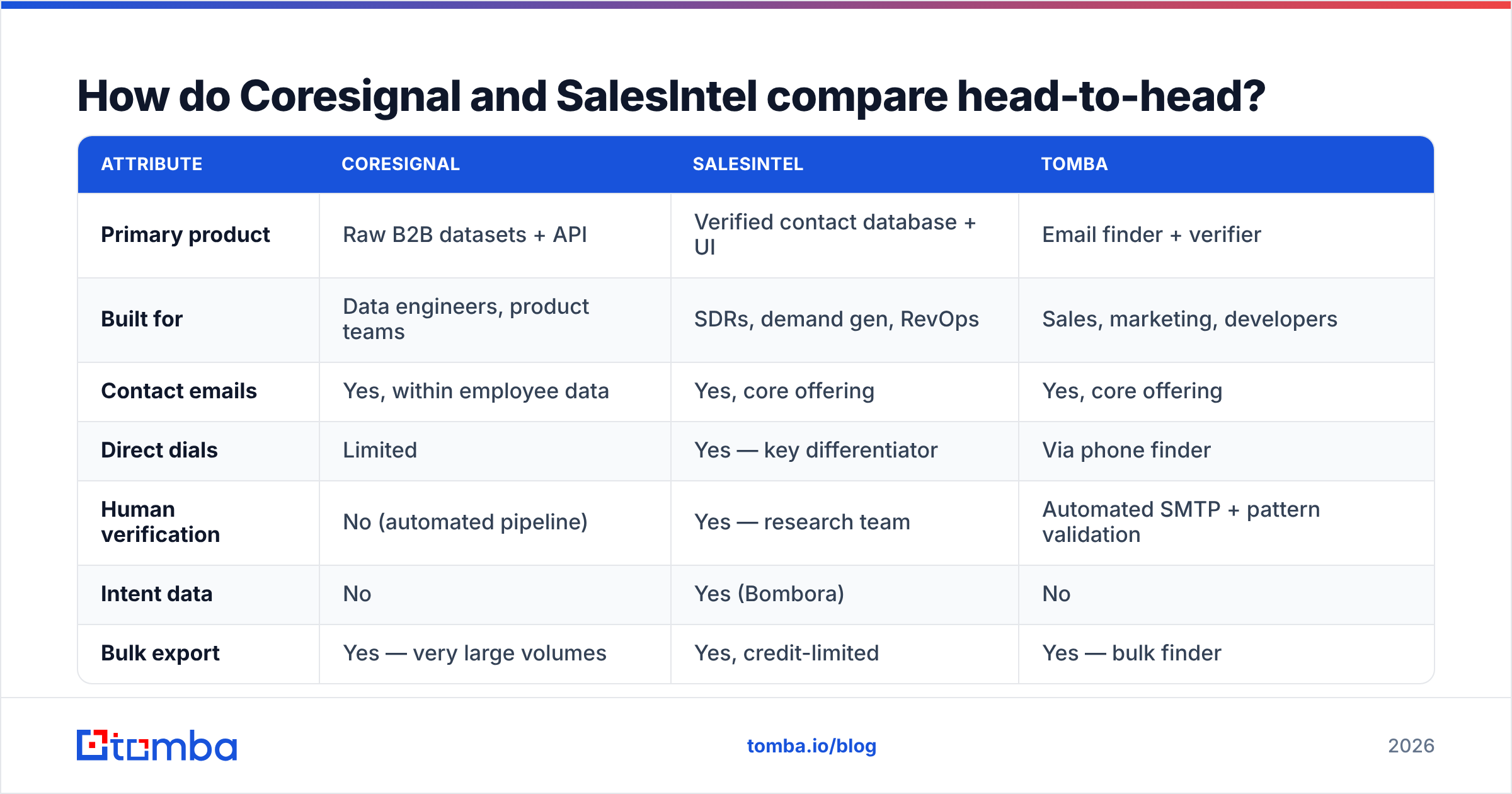
Coresignal claims freshness and scale. It publishes record counts in the hundreds of millions and a refresh cadence per dataset. The data comes from public web sources, not hand checks. So emails inside employee records lean on patterns and inference.
That is fine — good, even — if you are enriching a product and can live with some misses. It is not fine if you fire a cold sequence tomorrow morning. A 12% bounce rate will torch your sender reputation.
Both facts lead to the same rule: verify before you send, whatever your source. Contact data decays about 2-3% per month as people change jobs. A list that was 95% accurate in January is much worse by June. Run any purchased list through an email verifier before it touches your sequencer. That is basic hygiene, not a knock on either vendor.

User reviews on G2 tell the same story for both. Coverage gaps cluster around non-US SMBs. Accuracy gaps cluster around contacts that were correct at purchase and stale by the time they were used. No vendor escapes decay. Distrust the ones that pretend otherwise.
Coresignal vs SalesIntel: which one should you pick?#
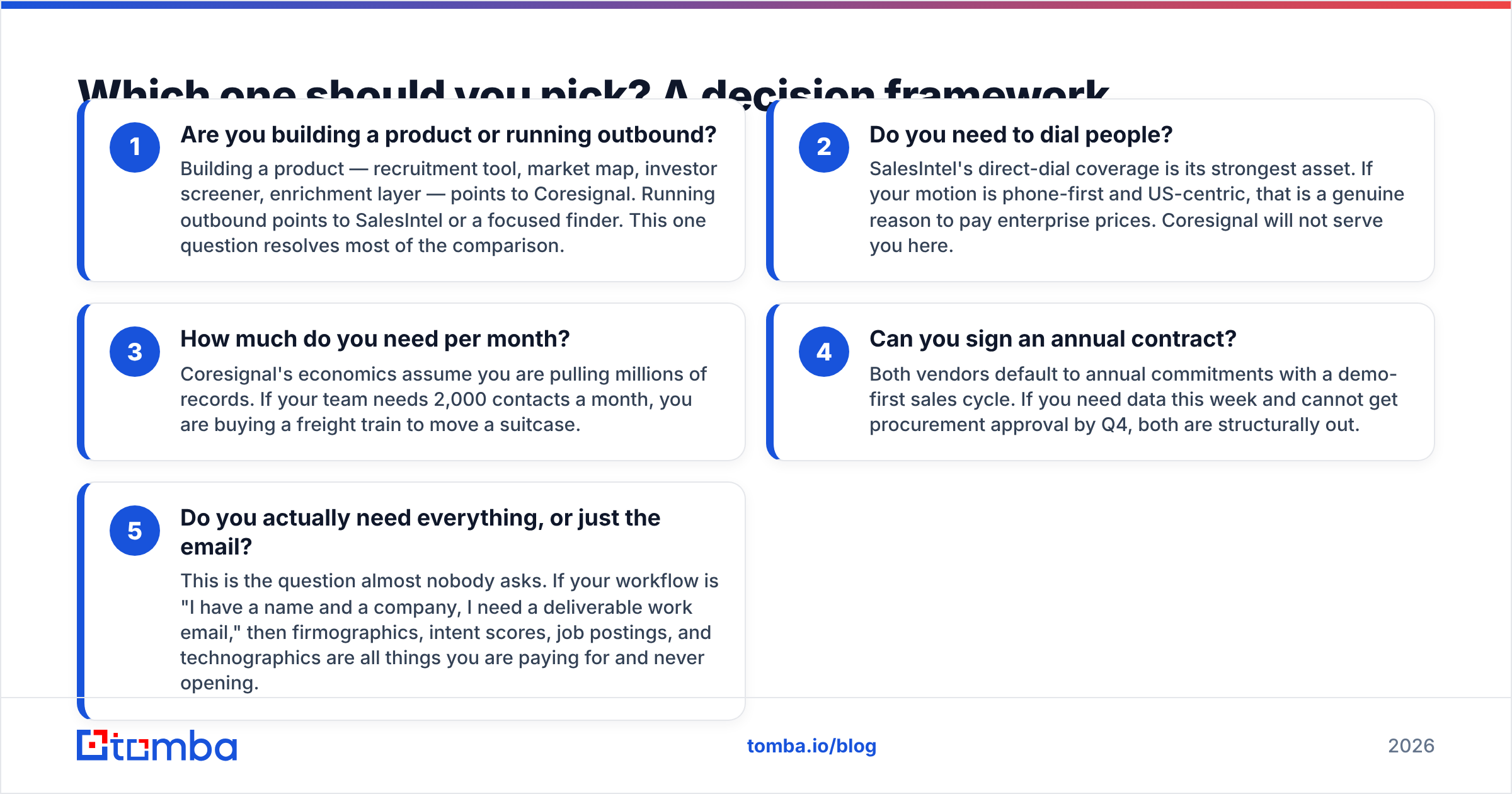
Skip the feature checklist. Answer these five questions in order. The choice makes itself.
- Are you building a product or running outbound? Building a product — a recruiting tool, a market map, an investor screener, an enrichment layer — points to Coresignal. Running outbound points to SalesIntel or a focused finder. This one question settles most of the debate.
- Do you need to dial people? Direct dials are SalesIntel's strongest asset. If your motion is phone-first and US-centric, that alone can justify enterprise prices. Coresignal will not help you here.
- How much data do you need each month? Coresignal's economics assume you pull millions of records. If your team needs 2,000 contacts a month, you are buying a freight train to move a suitcase.
- Can you sign an annual contract? Both vendors default to annual deals and a demo-first sales cycle. If you need data this week, both are structurally out.
- Do you need everything, or just the email? Almost nobody asks this. If your job is "I have a name and a company, I need a work email," then firmographics, intent scores, job postings, and tech stacks are things you pay for and never open.
What does each one actually cost?#
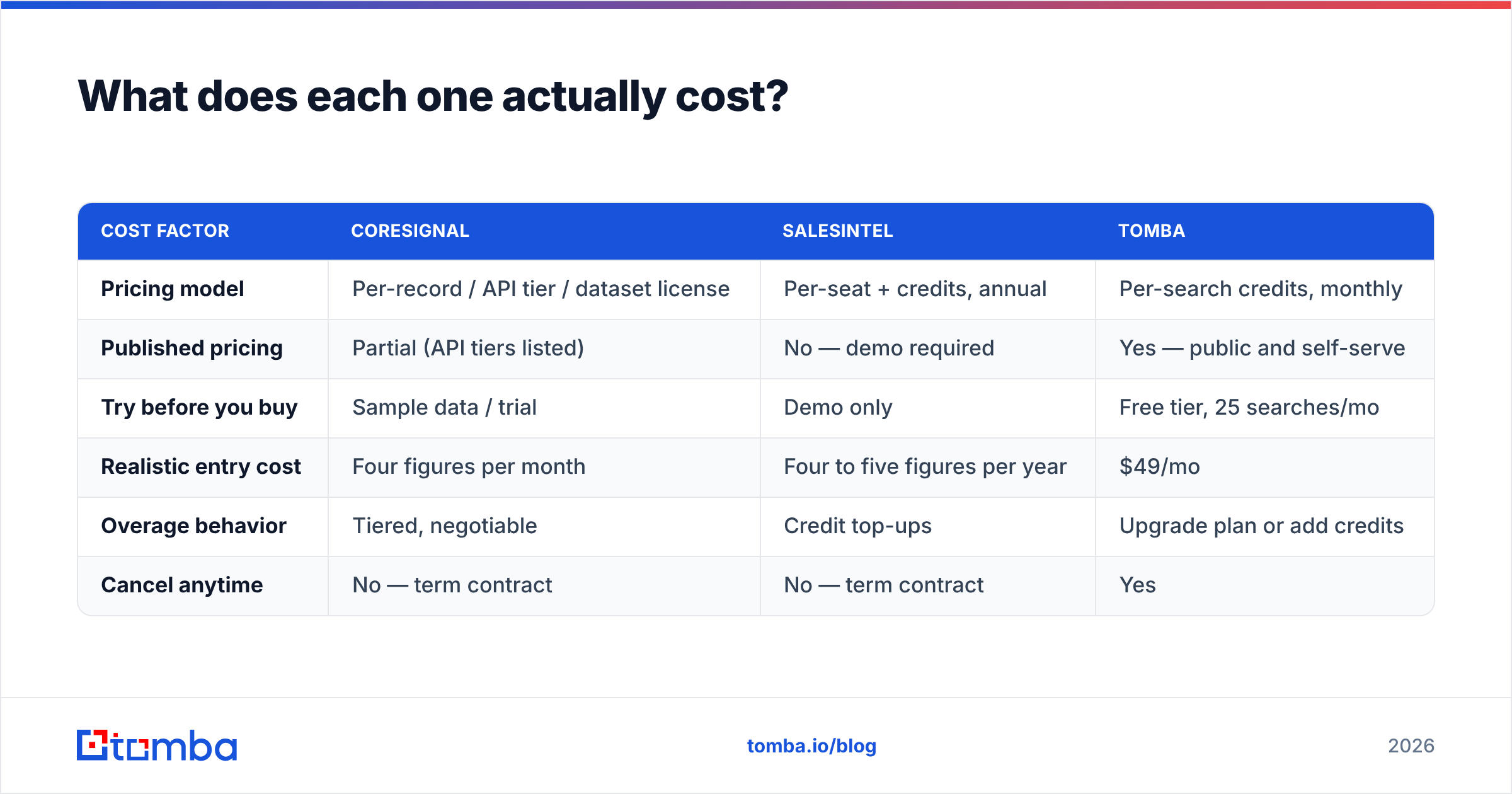
Coresignal vs SalesIntel pricing is quote-based on both sides. Neither publishes a simple rate card, which is itself a signal about who they sell to. Expect a discovery call, a demo, and a quote shaped by your volume and contract length.
| Cost factor | Coresignal | SalesIntel | Tomba |
|---|---|---|---|
| Pricing model | Per-record / API tier / dataset license | Per-seat + credits, annual | Per-search credits, monthly |
| Published pricing | Partial (API tiers listed) | No — demo required | Yes — public and self-serve |
| Try before you buy | Sample data / trial | Demo only | Free tier, 25 searches/mo |
| Realistic entry cost | Four figures per month | Four to five figures per year | $49/mo |
| Overage behavior | Tiered, negotiable | Credit top-ups | Upgrade plan or add credits |
| Cancel anytime | No — term contract | No — term contract | Yes |
For context, the Tomba pricing ladder runs Free (25 searches/mo), Starter at $49/mo, Growth at $99/mo, Pro at $249/mo, and custom Enterprise. That is not an apples-to-apples match with a dataset license. That is the point. If you just need verified work emails for people you already want to reach, the gap between $49/mo and a five-figure annual contract buys a lot of other things.

Is there a better option than either?#
For one very common use case: yes.
The Coresignal vs SalesIntel debate assumes you need a database — a big pool of records you search, filter, and export. But many B2B teams do not start from a database. They start from a list they already have. A conference sheet. A LinkedIn Sales Navigator search. An ICP list built by a researcher. A set of target accounts handed down by the CEO.
They already know who. They are missing how to reach them. That is a lookup problem, not a database problem, and it is solved differently:
- Domain-first. You know the company and need everyone in a role. Domain search returns the addresses on a company domain, plus the pattern it uses.
- Name-first. You know the person and the company. That is the core email finder workflow — first name, last name, domain, out comes a scored result.
- List-first. You have 3,000 rows in a CSV. Bulk email finder processes the file so you do not have to script it.
- Pipeline-first. You want this inside your own app. The Tomba API does it in a REST call, with the same endpoints behind the Sheets, Excel, and Chrome integrations.
None of that needs a licensed dataset or an annual commitment. It needs accurate resolution and honest confidence scores. That is a much narrower problem than modeling the whole B2B universe.
When is Coresignal genuinely the right call?#
Be fair to the tool. Coresignal is excellent at a job most people do not have:
- You are shipping a product whose core value is the data — a talent intelligence platform, a competitor tracker, a PE deal-sourcing engine.
- You need historical snapshots, not just current state. Think headcount trends or hiring velocity over time.
- You need coverage outside North America, especially EU and APAC company records.
- You have engineers who can ingest, normalize, and maintain a large schema. Schema stability matters more to you than any UI.
If three of those four are true, Coresignal belongs on your shortlist. SalesIntel is not even in the conversation.
When is SalesIntel genuinely the right call?#
Equally fairly:
- Your outbound motion is phone-heavy and North America-focused. A working direct dial is worth more to you than any other data point.
- You want intent signals on top of contact data, without wiring up a separate Bombora contract.
- You have SDRs who need a UI, not an API, and RevOps who need clean CRM sync.
- You have budget for an annual platform spend, and the volume to justify it.
Are you a five-person startup, still testing whether cold email works at all? Then SalesIntel is a good product bought at the wrong stage. That is the most common mistake in this category. It is not picking the "worse" tool. It is picking a heavyweight tool before you have proven the motion it is meant to scale.
How should you stack your data sources?#
Nobody serious uses one source. Coverage is patchy everywhere, so layer it:
- Define the ICP precisely before you buy anything. Vague ICPs are how you pay for 300 million records and use 4,000.
- Source the accounts from what you already have — CRM, Sales Navigator, site traffic, a conference list, an industry directory.
- Resolve the contacts with a dedicated finder. Enrich only what survives your filter. Data enrichment on a filtered list costs a fraction of enriching everything.
- Verify right before you send, not at purchase time. A two-month-old verification is a guess.
- Move to a heavyweight platform only when volume justifies it. If you burn through credits every month and the pipeline math works, then go take the demo — with real numbers in hand.
That order keeps you cheap while you learn. It also lets you buy the expensive thing at the moment it is worth the money. Reverse the order — buy the platform first and hope it creates the motion — and the contract sits unused by month seven.
Coresignal vs SalesIntel: the verdict#
For most buyers, Coresignal vs SalesIntel is a false comparison. Coresignal is infrastructure for teams building data products. SalesIntel is a sales platform for phone-first North American outbound teams with budget. If you clearly sit in one of those camps, you already know which one. The other tool should not be on your shortlist.
Do you sit in neither camp? You have target accounts, you need reachable contacts, and you want to start today without a procurement cycle. Then you are not shopping for a database. You are shopping for a lookup tool that is accurate, honest about its confidence, and priced like software.
Try the Tomba Email Finder free — 25 searches a month, no card, no demo call. Give it a name and a domain and see what comes back. Then run the results through the verifier before you send a single message. If you outgrow it, the API and bulk tools scale with you. The demo-and-contract vendors will still be there when your volume earns them.
Related guides#
Ready to find emails that actually work?
Join 150,000+ professionals who stopped guessing and started sending. Free credits on signup — no credit card required.
Get the Tomba newsletter
Practical outbound tactics and product updates — once every two weeks.
About the author