Coresignal vs SeamlessAI (2026): Which One Should You Buy?
Coresignal vs SeamlessAI is a comparison most buyers get wrong. Coresignal sells raw B2B data through an API. Seamless.AI sells seats in a prospecting app. Here is the honest breakdown, and the cheaper third option.
Coresignal vs SeamlessAI is a comparison most buyers get wrong. One sells raw data through an API. The other sells seats in a prospecting app. They solve different jobs. Here is the short version first, then the detail.
TL;DR
- Coresignal vs SeamlessAI is not a fair fight — they are not the same product. Coresignal is a raw B2B data provider (API + bulk datasets, built for engineers). Seamless.AI is a per-seat prospecting UI for reps.
- Buy Coresignal if you are building a product, a data warehouse, or a scoring model. It gives you company, employee, and job-posting records at scale.
- Buy Seamless.AI if your SDRs just need to click "find email" and push to the CRM. You will pay per seat, per year, and data quality will swing.
- Neither one publishes full pricing. Both send serious buyers to sales. Budget for that, and negotiate.
- If you only need verified work emails, a focused email finder with clear per-credit pricing costs less than either tool. Tomba starts at $49/mo and has a free tier.
What is Coresignal, actually?#
Coresignal is a B2B data-as-a-service company. It scrapes, parses, and cleans public web data: company profiles, employee profiles, job postings, tech stacks, and funding events. You can buy access three ways. There is a REST API. There are ready-made datasets (CSV, JSON, or Parquet dropped into your cloud bucket). And there is a search layer on top.
The buyer is almost never a sales rep. It is a data engineer, a founder building a market-intelligence product, or a RevOps team filling a warehouse. Coresignal's documentation and pricing page is written for people who know what a rate limit is.
Two things follow from that.
- You get depth, not convenience. Coresignal will hand you 100M+ employee records with job history and skills. It will not hand you a Chrome extension that drops a contact into your sequence.
- Email coverage is a side dish, not the main course. The core value is profile and company data. If you need verified work emails at a high hit rate, you will bolt on an email discovery and email verification layer.
What is Seamless.AI, actually?#
Seamless.AI is a sales prospecting platform. You search for people by title, industry, company size, and location. The tool returns emails and phone numbers. You push them to your CRM or export them. The pitch is "AI-powered real-time search": it checks contacts when you query, instead of serving stale rows from a static database.
The buyer is an SDR, an AE, or a sales leader buying seats for a team. There is a free tier with a few credits, a Chrome extension, and integrations with Salesforce, HubSpot, and Outreach.
Now the reality check from the G2 reviews. Users praise the speed and the volume. They also complain about two things. Data accuracy swings hard by segment. And the contract stings: annual terms, per-seat pricing that is never listed, and credits that reset in ways buyers did not expect. Both halves are true at the same time.

Coresignal vs SeamlessAI: how do they compare head-to-head?#
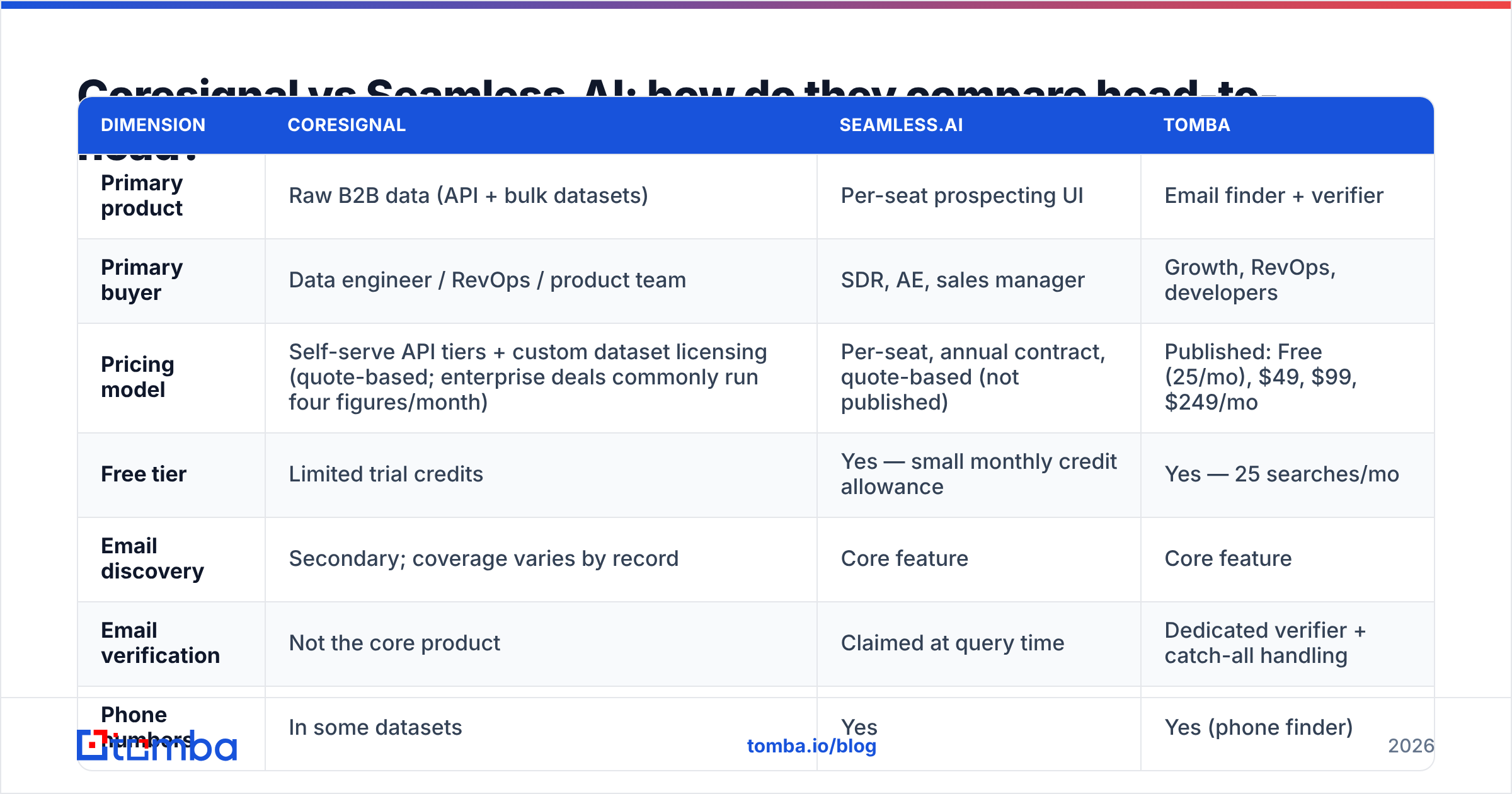
Here is the honest side-by-side. Where pricing is not public, I say so instead of inventing a number.
| Dimension | Coresignal | Seamless.AI | Tomba |
|---|---|---|---|
| Primary product | Raw B2B data (API + bulk datasets) | Per-seat prospecting UI | Email finder + verifier |
| Primary buyer | Data engineer / RevOps / product team | SDR, AE, sales manager | Growth, RevOps, developers |
| Pricing model | Self-serve API tiers + custom dataset licensing (quote-based; enterprise deals commonly run four figures/month) | Per-seat, annual contract, quote-based (not published) | Published: Free (25/mo), $49, $99, $249/mo |
| Free tier | Limited trial credits | Yes — small monthly credit allowance | Yes — 25 searches/mo |
| Email discovery | Secondary; coverage varies by record | Core feature | Core feature |
| Email verification | Not the core product | Claimed at query time | Dedicated verifier + catch-all handling |
| Phone numbers | In some datasets | Yes | Yes (phone finder) |
| Bulk export | Full datasets, warehouse delivery | Export capped by credits/plan | Bulk CSV upload + export |
| API access | Yes — the whole point | Available, but not the focus | Yes, on all paid plans |
| Best at | Volume, breadth, historical/job data | Speed for a rep in a browser | Deliverable emails at a known cost |
| Weakest at | Anything rep-facing | Predictable cost, data consistency | Not a full firmographic warehouse |

The table makes the real choice obvious: these two tools answer different questions. Coresignal answers "what does the market look like?" Seamless.AI answers "who do I email in the next ten minutes?" One of those is your actual job. Work out which one before you sit through two demos.
Which one has better data accuracy?#
Most comparison posts get lazy here. So let's be precise about what "accuracy" means. It splits into three metrics, and vendors like to blur them together.
- Coverage (hit rate) — of 1,000 target contacts, how many does the tool return anything for? High coverage is easy to fake. Guess a pattern for everyone and you hit 100%.
- Validity (bounce rate) — of the emails returned, how many actually accept mail? This is the number that decides whether your domain survives the quarter.
- Freshness — how recently was the record confirmed? A 2023 email at a company with 30% annual churn is a coin flip.
Coresignal is strongest on coverage and freshness of profile data. Think job changes, headcount moves, and new postings. That is what its crawlers are built for. It is weakest on email validity, because delivering verified inboxes was never the deal it made with you.
Seamless.AI flips that. It returns an email for nearly every search. That looks great in a demo and worse in your bounce log. The "real-time verification" claim is doing a lot of work. User reports and review threads describe bounce rates that swing by segment: decent on large US tech firms, rough on SMB, non-US, and non-technical roles.

The practical takeaway holds for either vendor: never send to an unverified list. Whatever tool finds the address, run it through a dedicated verifier first. Handle catch-all domains on purpose before anything enters a sequence. A catch-all domain accepts every address at the SMTP layer. So "valid" from a naive checker means nothing, and that is the gap a catch-all verifier closes.

What does each one actually cost in 2026?#
Neither company publishes a full price list. That alone tells you something.
Coresignal sells self-serve API tiers plus custom dataset licensing. The self-serve entry point is cheap enough to test. But the deals that make Coresignal worth it — bulk employee and company datasets, refreshed on a schedule — are quoted. Real volume lands in the four-figures-per-month range and up. If you are a two-person outbound team, this is not your line item.
Seamless.AI publishes a free tier and then routes you to sales. Pricing is per seat, per year. Buyers report real pressure to commit annually. Credits are the second variable. What you are negotiating is credits × seats. And the renewal quote is rarely the signup quote.
Tomba publishes everything: Free (25 searches/mo), Starter $49/mo, Growth $99/mo, Pro $249/mo, Enterprise custom. You can read the whole Tomba pricing page in thirty seconds. No calendar invite needed.
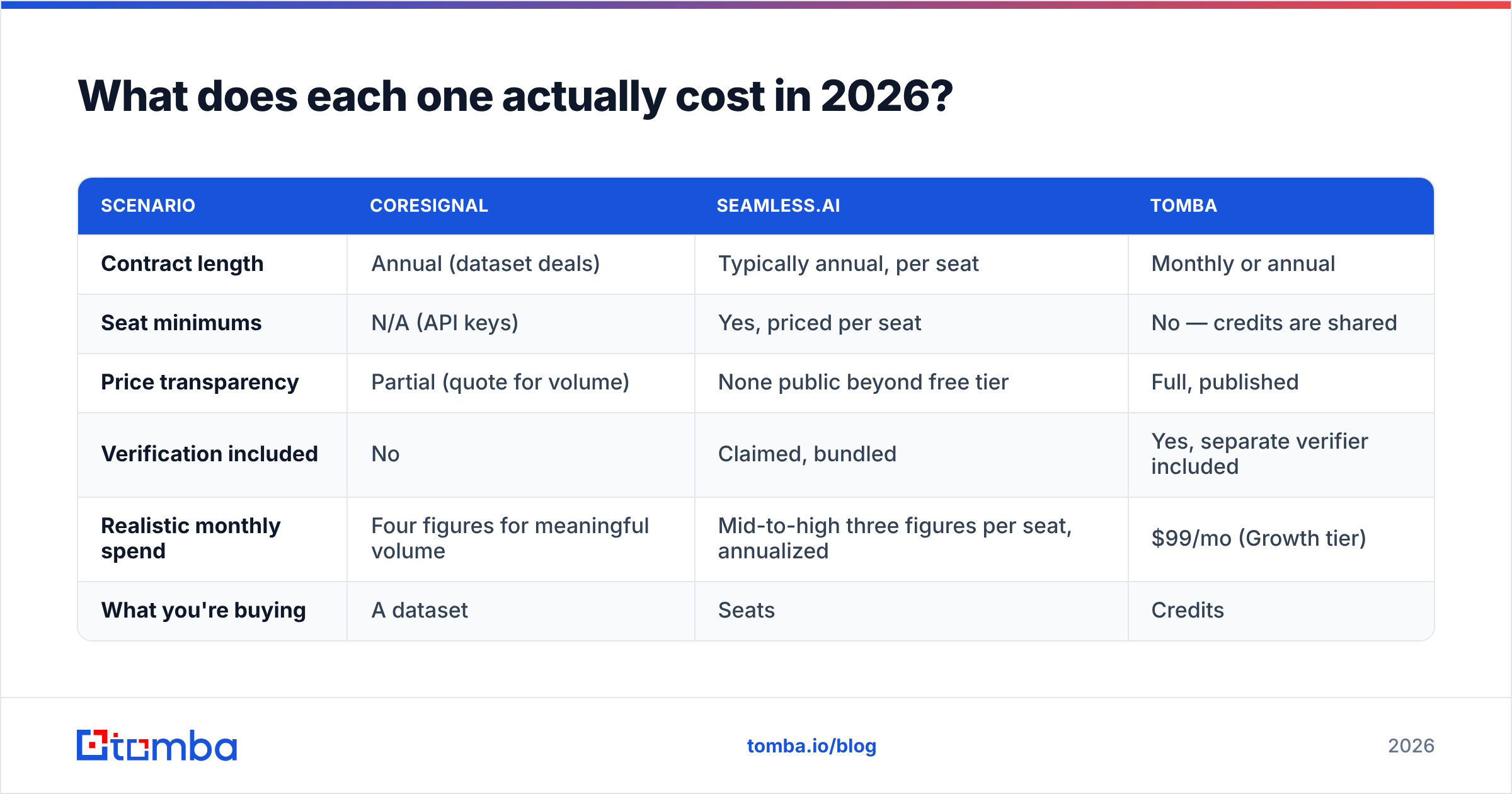
Here is a rough cost shape for a five-person outbound team that needs about 5,000 verified emails a month.
| Scenario | Coresignal | Seamless.AI | Tomba |
|---|---|---|---|
| Contract length | Annual (dataset deals) | Typically annual, per seat | Monthly or annual |
| Seat minimums | N/A (API keys) | Yes, priced per seat | No — credits are shared |
| Price transparency | Partial (quote for volume) | None public beyond free tier | Full, published |
| Verification included | No | Claimed, bundled | Yes, separate verifier included |
| Realistic monthly spend | Four figures for meaningful volume | Mid-to-high three figures per seat, annualized | $99/mo (Growth tier) |
| What you're buying | A dataset | Seats | Credits |
Ask yourself what you are really buying. If the answer is credits — not a dataset, not seats — then both tools in this comparison are overpriced for you.
When should you choose Coresignal?#
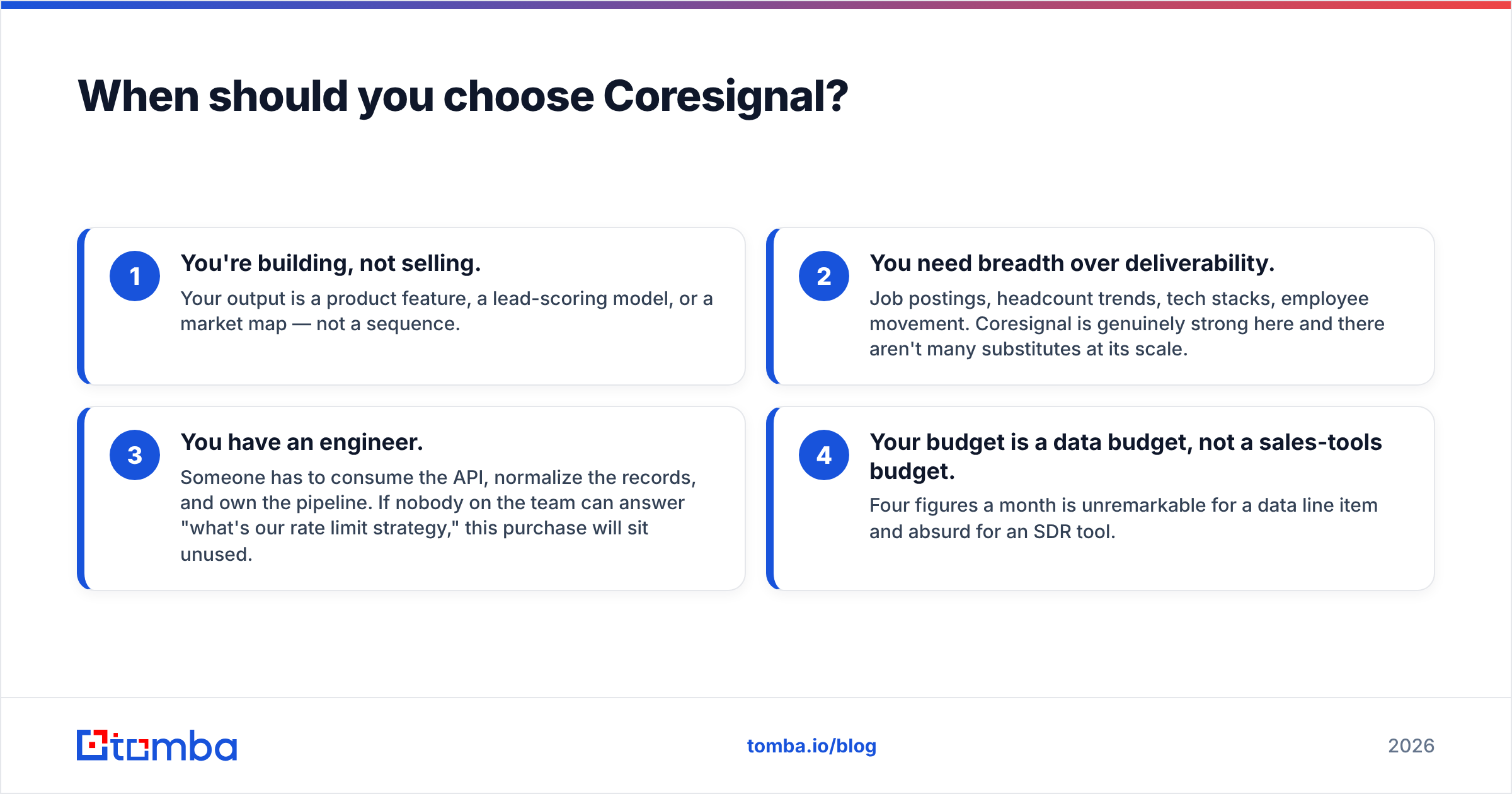
Pick Coresignal when at least two of these are true.
- You're building, not selling. Your output is a product feature, a lead-scoring model, or a market map. It is not a sequence.
- You need breadth more than deliverability. Job postings, headcount trends, tech stacks, employee moves. Coresignal is genuinely strong here, and few rivals match its scale.
- You have an engineer. Someone must consume the API, clean the records, and own the pipeline. If nobody can answer "what is our rate limit strategy," this purchase will sit unused.
- Your budget is a data budget, not a sales-tools budget. Four figures a month is normal for data. It is absurd for an SDR tool.
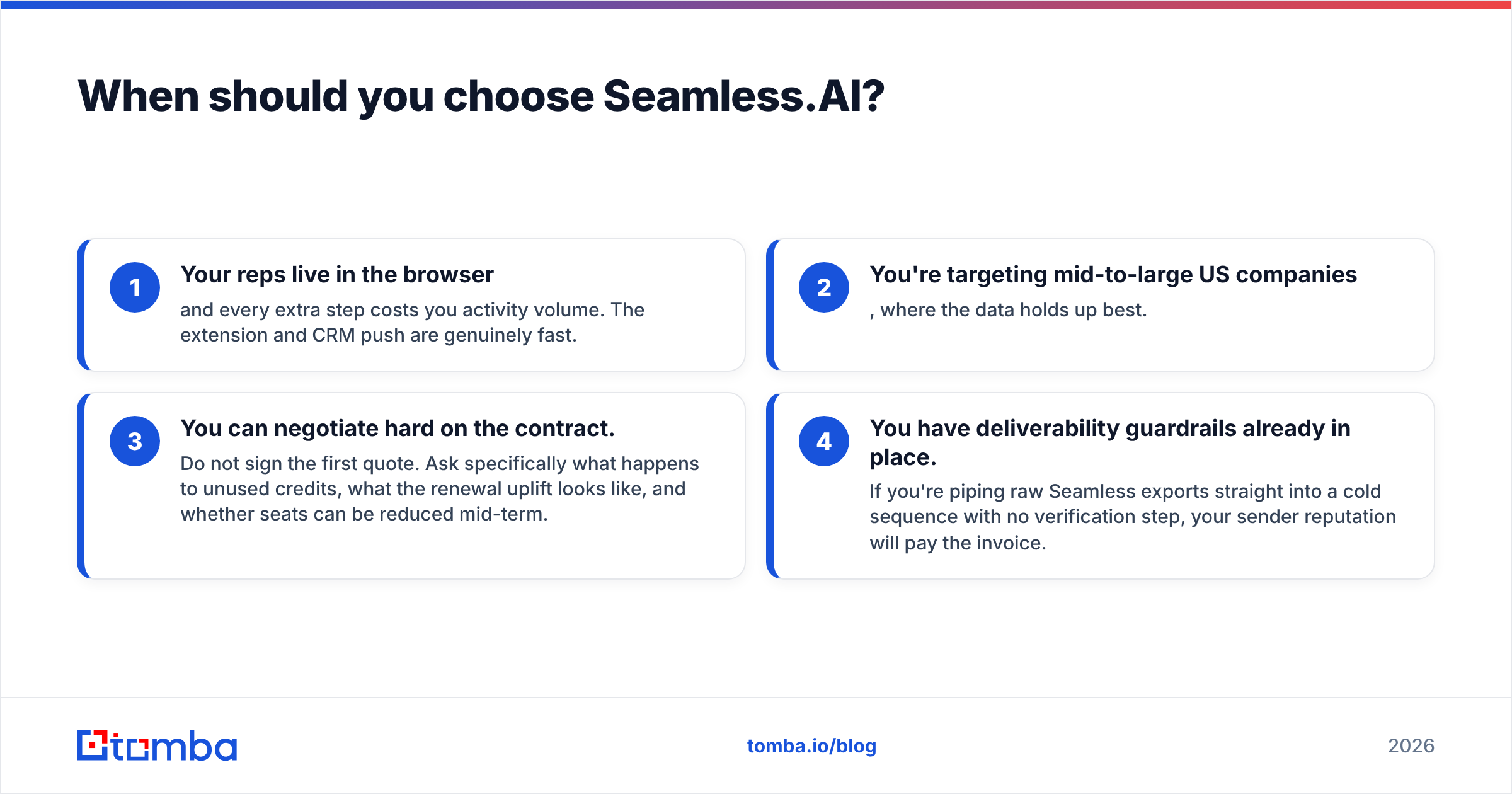
When should you choose Seamless.AI?#
Pick Seamless.AI when these fit.
- Your reps live in the browser. Every extra step costs you activity. The extension and the CRM push are genuinely fast.
- You target mid-to-large US companies. That is where the data holds up best.
- You can negotiate hard. Do not sign the first quote. Ask what happens to unused credits. Ask about the renewal uplift. Ask whether you can drop seats mid-term.
- You already have deliverability guardrails. Pipe raw Seamless exports straight into a cold sequence with no verification step, and your sender reputation pays the invoice.
If you have already ruled Seamless out, the honest alternatives are covered in our Seamless.AI alternative breakdown. That includes per-credit options that skip the seat math entirely.
Is there a third option most teams should consider first?#
Yes, and it is the boring one: buy the narrow tool that fixes the real bottleneck.
Most teams comparing Coresignal vs SeamlessAI are not really choosing between a data warehouse and a prospecting UI. They are choosing between two ways to solve one problem: I have a list of people and companies, and I need working email addresses for them.
That is an email finder problem. It does not need a four-figure data contract. It does not need annual per-seat commitments. It needs:
- A finder with a real hit rate — pattern inference plus source checks, not guessing.
- A verifier that handles catch-alls honestly instead of marking them "valid."
- An API and a bulk mode, so the same engine works from a spreadsheet, a CRM, or a script. Tomba exposes all of it through the Tomba API, CSV bulk upload, and a Sheets add-on.
- Enrichment when you need it — job title, company, LinkedIn — without buying a whole dataset licence. That is what data enrichment is for.
- Published pricing, so finance stops asking you what this costs.
HubSpot's writeup on choosing sales tools makes the same point in different words. The tool that wins is the one your team actually opens on a Tuesday. It is not the one with the longest feature matrix.
The verdict#
Coresignal wins if you are a data or product team. You need raw B2B records at scale, and you have an engineer to consume them. It is a legitimate, well-built data business. It is just not a sales tool.
Seamless.AI wins if you need rep-facing speed today, target large US accounts, and can negotiate a contract you will not resent in month seven.
Neither wins if your real need is "verified work emails, priced per credit, no contract." That is a narrower job. Paying warehouse or per-seat prices for it is the most common budget leak in outbound.
So start with the bottleneck, not the vendor.
Want to test the third option before you sign anything? Run 25 free searches through the Tomba Email Finder. Find emails by name and domain, check them against catch-all logic, and export to CSV or your CRM. No seat minimums. No annual lock-in. Every tier's price is published. If the hit rate holds on your own list, you just saved yourself two demos and a contract negotiation.
Related guides#
Ready to find emails that actually work?
Join 150,000+ professionals who stopped guessing and started sending. Free credits on signup — no credit card required.
Get the Tomba newsletter
Practical outbound tactics and product updates — once every two weeks.
About the author