Coresignal vs Smarte (2026): Which B2B Data Tool Wins?
Coresignal sells raw B2B datasets at scale. Smarte sells ready-to-dial contacts. They are not the same product — and picking the wrong one costs you a quarter. Here is the honest breakdown.
TL;DR
- Coresignal and Smarte are not competitors in the way the search results imply. Coresignal is a bulk B2B data provider (company, employee, and job-posting datasets delivered via API or datafeed). Smarte is a go-to-market contact platform that hands reps verified emails and mobile numbers inside a UI.
- Pick Coresignal if you are building a product, a lead-scoring model, or an internal data warehouse and you want millions of records you can join, filter, and re-model yourself.
- Pick Smarte if you have SDRs who need to prospect today, want a Chrome extension and CRM push, and do not want to hire a data engineer.
- Both are enterprise-shaped buys. Expect annual contracts, sales calls, and minimums. Neither is a swipe-your-card-and-go tool.
- If all you actually need is "give me this person's verified work email," neither is the cheapest path — a dedicated email finder starting at $49/mo does that job without the platform tax.
What are Coresignal and Smarte, actually?#
Start here, because most "X vs Y" pages treat these two as interchangeable and they are not.
Coresignal is a data-as-a-service company. Its product is data itself: company records, employee/professional profiles, job postings, and firmographic attributes, refreshed on a schedule and delivered as an API response, a flat datafeed dropped into cloud storage, or a full historical dataset. The buyer is usually a data team, a founder building a data product, an investor doing signal work, or a RevOps group feeding a warehouse. Coresignal does not care whether you ever send an email.
Smarte (often written SMARTe) is a sales-intelligence platform. Its product is a workflow: search for accounts and personas, get emails and mobile numbers, push them to your CRM or sequencer, and let the rep start working. It leans hard on mobile-number coverage and on privacy compliance for outbound in regulated regions. The buyer is a sales leader, not a data engineer.
So the honest framing of Coresignal vs Smarte is not "which is more accurate." It is "do you want raw material or a finished workflow?" Those are different budgets, different teams, and different failure modes.
How do Coresignal and Smarte compare head-to-head?#
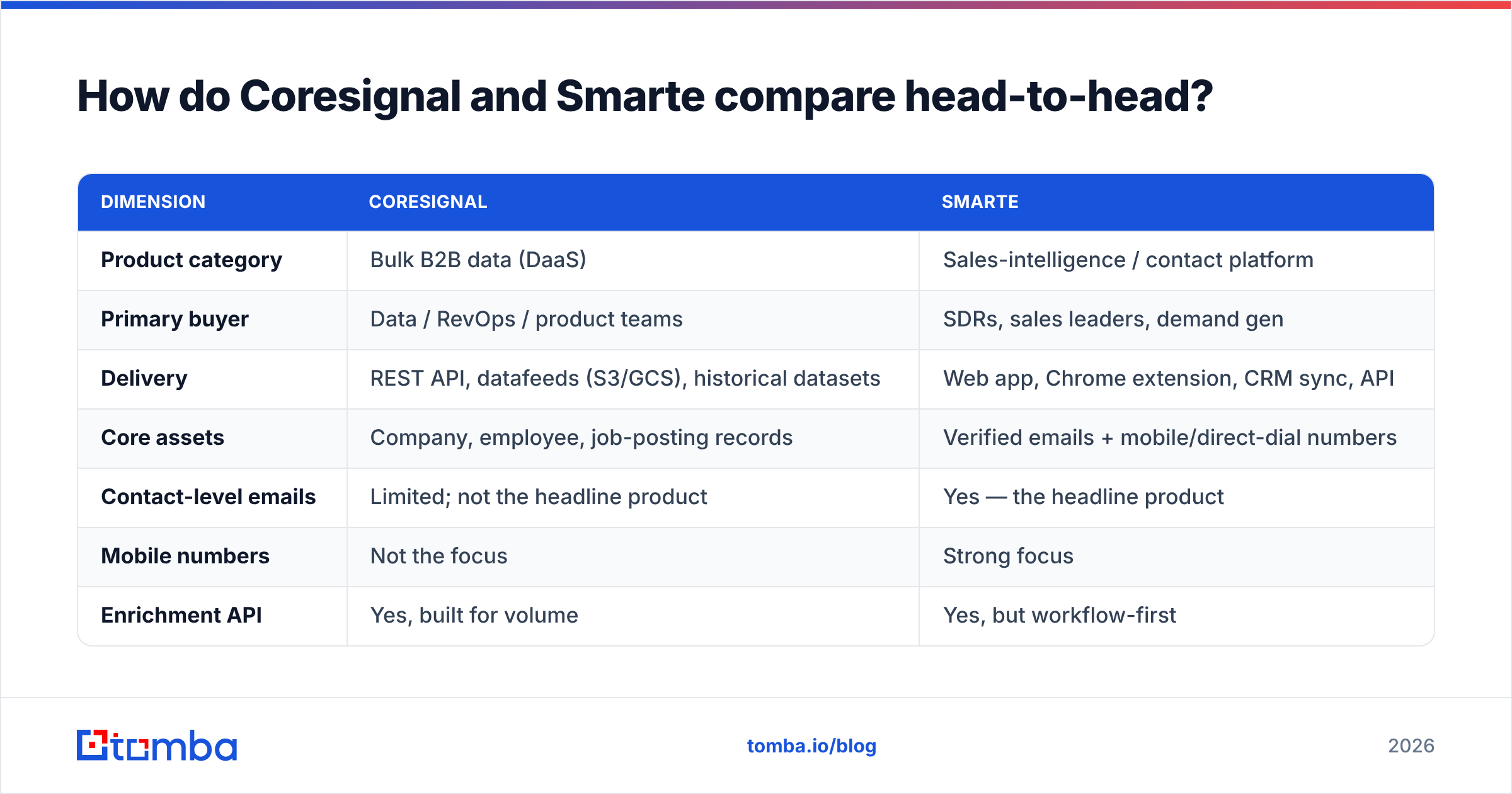
Here is the comparison that matters. Pricing figures move — treat these as directional and confirm on each vendor's current pricing page before you sign anything.
| Dimension | Coresignal | Smarte |
|---|---|---|
| Product category | Bulk B2B data (DaaS) | Sales-intelligence / contact platform |
| Primary buyer | Data / RevOps / product teams | SDRs, sales leaders, demand gen |
| Delivery | REST API, datafeeds (S3/GCS), historical datasets | Web app, Chrome extension, CRM sync, API |
| Core assets | Company, employee, job-posting records | Verified emails + mobile/direct-dial numbers |
| Contact-level emails | Limited; not the headline product | Yes — the headline product |
| Mobile numbers | Not the focus | Strong focus |
| Enrichment API | Yes, built for volume | Yes, but workflow-first |
| Free tier | No true free plan; trial/sample data on request | Limited free credits historically offered |
| Entry pricing | Self-serve credit tiers, then custom quotes; scales into four figures/mo | Quote-based; per-seat and credit bundles |
| Contract shape | Often annual, volume-committed | Often annual, seat-committed |
| Best at | Scale, joinability, historical depth | Speed to first sequence, rep adoption |
| Worst at | Zero-to-one for a rep with no data stack | Feeding a warehouse with millions of rows |
The pattern is consistent: Coresignal is optimized for volume and modelling, Smarte for immediacy and adoption. If you try to force either one across the line, you overpay.

Which one has better data accuracy?#
This is where buyers get burned, because "accuracy" means two different things to these two vendors.
For Coresignal, accuracy is freshness and completeness at the record level. Did the company record update when the headcount changed? Is the job posting still live? Did the employee's title change three weeks ago and did the dataset catch it? Their public positioning centers on refresh cadence and record counts in the hundreds of millions. If you are training a model or scoring accounts, that is the accuracy that matters — a stale headcount ruins your ICP scoring, and a missing email does not.
For Smarte, accuracy is deliverability and connect rate. Does the email bounce? Does the mobile number ring the actual human? Their marketing leans on verified contacts and on mobile-number coverage precisely because that is the number a sales leader gets fired over.

Two things to hold onto:
- Neither vendor's marketing number is your number. Coverage rates are computed on the vendor's test list, not your ICP. A tool that claims 95% coverage on US SaaS mid-market may return 40% on German manufacturing SMBs.
- Run your own bake-off before you commit. Take 200 real accounts from your pipeline — not a clean sample — and ask both vendors to enrich them. Measure hit rate, bounce rate on a seed send, and how many records you'd have thrown out anyway. Then divide the contract price by the number of usable records. That number, not the sticker price, is your real CPL.
If you want a third data point in that bake-off, run the same list through a standalone email verifier so you are grading each vendor's emails against an independent check rather than against their own claim.
What do Coresignal and Smarte actually cost?#
Both vendors run a quote-driven motion at the top, and this is the single biggest practical difference from a self-serve tool.
Coresignal publishes self-serve credit tiers for its API but the real economics show up at volume: datafeeds and full dataset access land in the four-figures-per-month range and up, usually on an annual commitment. You are buying rows. If you need 5 million company records refreshed monthly, that is the correct shape of the deal. If you need 500 emails a month, you are paying for a warehouse to store a shoebox.
Smarte sells seats plus credits. That means your cost scales with headcount, not with data volume. Add three SDRs and your bill moves, even if the team's total credit consumption stayed flat. For a team of 10 reps, that is fine. For a solo founder or a two-person growth team, the seat math is punishing.
The shared surprise for both: there is no meaningful free tier to de-risk the buy. You go from a demo to a contract, and you find out how the data performs on your ICP after money changed hands.

The pricing shapes, side by side#
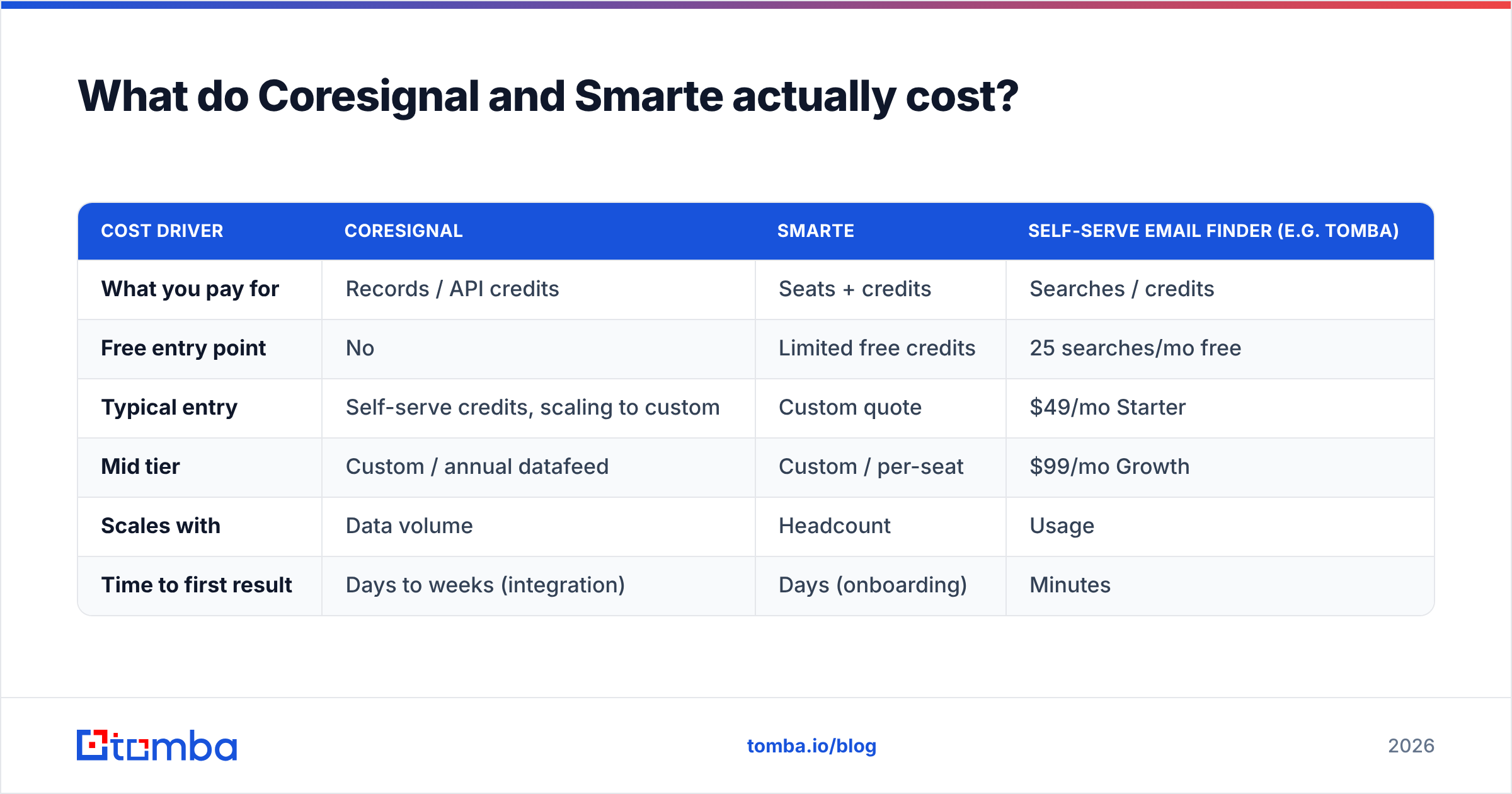
| Cost driver | Coresignal | Smarte | Self-serve email finder (e.g. Tomba) |
|---|---|---|---|
| What you pay for | Records / API credits | Seats + credits | Searches / credits |
| Free entry point | No | Limited free credits | 25 searches/mo free |
| Typical entry | Self-serve credits, scaling to custom | Custom quote | $49/mo Starter |
| Mid tier | Custom / annual datafeed | Custom / per-seat | $99/mo Growth |
| Scales with | Data volume | Headcount | Usage |
| Time to first result | Days to weeks (integration) | Days (onboarding) | Minutes |
That last column is not a sales pitch, it is a category note: single-purpose tools are cheap because they do one thing. See Tomba pricing if you want the exact tiers.
Is Coresignal better than Smarte for outbound prospecting?#
For pure outbound prospecting, Smarte is the better fit — and it is not close.
Reps do not want a dataset. They want to open a LinkedIn profile, click an extension, get a verified email and a mobile number, and push it into a sequence. Smarte is built around that loop: browser extension, CRM and sequencer integrations, persona and account filters, and a data set biased toward reachable humans rather than complete company graphs.
Coresignal can absolutely support outbound, but only after somebody builds the layer that turns rows into a prospecting workflow. That layer is real engineering: normalization, dedupe, matching profiles to your CRM accounts, deciding which record wins when two disagree, and then hosting all of it somewhere reps can use. Companies do this — and they are right to, at scale, because owning the pipeline is cheaper per record than renting seats forever. But the first 90 days produce zero meetings.
A simple test: if your team cannot name who owns the ETL job, you are not ready to buy raw data.
Is Smarte better than Coresignal for building a data product?#
No. If you are building a product, an ICP model, a market map, or an investment signal, Coresignal is the correct shape of vendor and Smarte is the wrong one.
Platform tools like Smarte are deliberately rate-limited and workflow-bound. You are licensed to prospect, not to warehouse. Pulling millions of records through a seat-based UI is both a terms-of-service problem and an engineering nightmare. Coresignal, by contrast, sells you the firehose on purpose: bulk delivery, historical snapshots, and schema stability so your joins do not break every quarter.
Four questions that settle it in one meeting:
- Who consumes the data — a human or a query? Human means platform. Query means DaaS.
- Do you need history? Point-in-time snapshots (headcount 18 months ago, job postings last quarter) only come from a data provider.
- Is coverage or reachability the binding constraint? Coverage → Coresignal. Reachability → Smarte.
- Can you tolerate a 6–10 week integration? If not, do not buy raw data.
What are the alternatives to Coresignal and Smarte?#
Most teams evaluating Coresignal vs Smarte discover mid-evaluation that they were solving a narrower problem than either vendor is priced for. The honest alternatives:
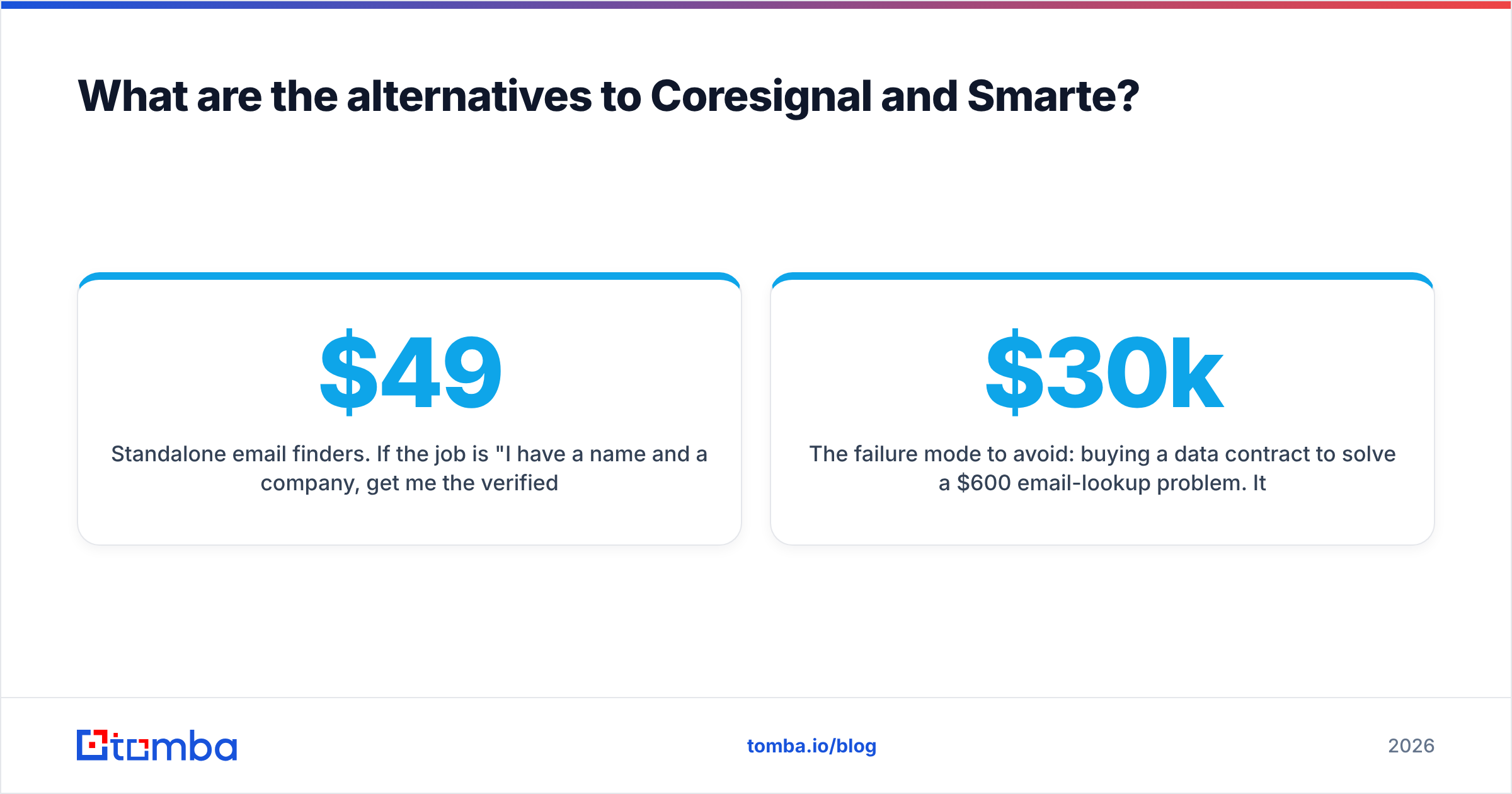
- Standalone email finders. If the job is "I have a name and a company, get me the verified work email," a dedicated finder does that at a fraction of the cost, with an email finder API you can call from your own stack. Tomba's Free tier gives 25 searches/mo, Starter is $49/mo, Growth $99/mo, Pro $249/mo — no seat tax, no annual commit. Add a domain search when you want every reachable contact at a target account instead of one at a time.
- BookYourData. A solid pay-as-you-go option when you want to buy a verified list outright rather than rent a platform, with an accuracy guarantee and no seat minimums. Worth a look if your buying motion is "one campaign, one list, no contract."
- Apollo / ZoomInfo-class platforms. Broader all-in-one suites: data plus sequencing plus dialer. More features, more sprawl, and you will pay for modules you never open. Compare on G2 where the review volume is high enough to be useful.
- Build on enrichment APIs. If you already have a warehouse, a lean data enrichment API on top of your existing account list often beats a full dataset license — you enrich what you actually work, not what you might someday work.
The failure mode to avoid: buying a $30k/yr data contract to solve a $600/yr email-lookup problem. It happens constantly, because "data platform" demos are impressive and the actual job — turning a name and a domain into a deliverable address — is unglamorous.
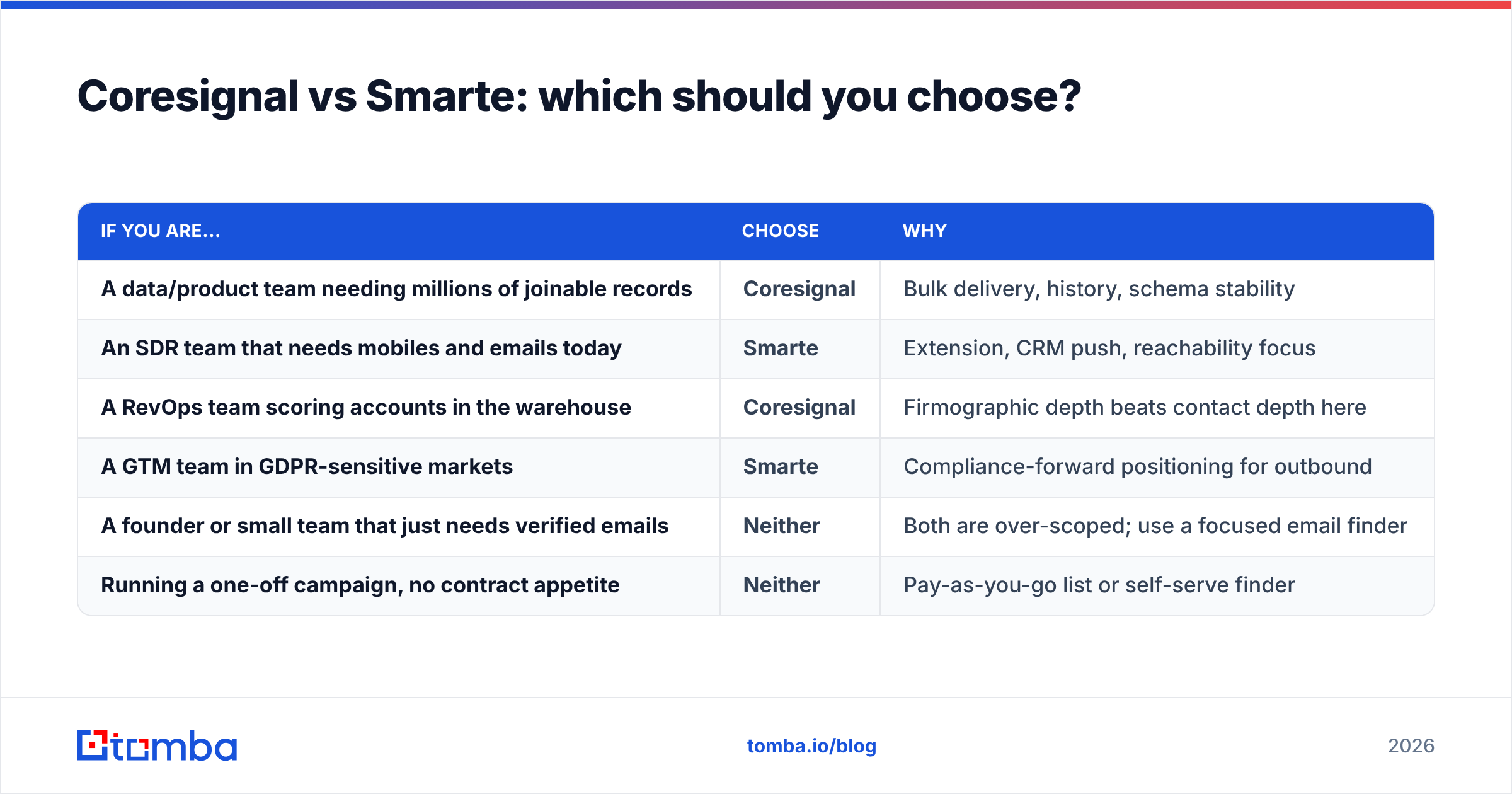
Coresignal vs Smarte: which should you choose?#
Here is the decision, compressed.
| If you are... | Choose | Why |
|---|---|---|
| A data/product team needing millions of joinable records | Coresignal | Bulk delivery, history, schema stability |
| An SDR team that needs mobiles and emails today | Smarte | Extension, CRM push, reachability focus |
| A RevOps team scoring accounts in the warehouse | Coresignal | Firmographic depth beats contact depth here |
| A GTM team in GDPR-sensitive markets | Smarte | Compliance-forward positioning for outbound |
| A founder or small team that just needs verified emails | Neither | Both are over-scoped; use a focused email finder |
| Running a one-off campaign, no contract appetite | Neither | Pay-as-you-go list or self-serve finder |
Two rules to leave with:
Rule one: never buy on record counts. Every vendor's headline number is a superset of a superset. What matters is coverage on your ICP, and only your own bake-off measures that.
Rule two: match contract shape to team shape. Seat-based pricing punishes growing teams. Volume-based pricing punishes small ones. Usage-based pricing punishes nobody, which is why it is the right default until you know your real consumption.
Start with the narrow tool, expand only when it breaks#
If your honest answer to "what do I need?" is verified work emails, at a predictable cost, without a sales call, start there and skip the platform evaluation entirely.
Tomba Email Finder does exactly that job: find professional email addresses by domain, name, or company, verify them before you send, and call it from the API, a spreadsheet, or the browser extension. Free tier is 25 searches/mo — enough to run the bake-off described above against your real account list before you sign anything with anyone. If it turns out you genuinely need 5 million rows in a warehouse, you will know within a month, and Coresignal will still be there. Most teams find they never get that far.
Related guides#
Ready to find emails that actually work?
Join 150,000+ professionals who stopped guessing and started sending. Free credits on signup — no credit card required.
Get the Tomba newsletter
Practical outbound tactics and product updates — once every two weeks.
About the author