CounterPath Bria Alternatives: 7 Softphones Compared for 2026
Bria is a solid SIP softphone, but it stops at the dial tone. Here are seven CounterPath Bria alternatives compared on price, SIP flexibility, CRM depth, and what they actually do for outbound sales teams.
TL;DR
- Bria is a softphone, not a sales platform. CounterPath (now part of Alianza) built Bria to register against any SIP provider and make calls. It does that well. It does not score leads, log calls to your CRM automatically, or dial 40 prospects in a row for you.
- Most teams leaving Bria want one of two things: either a cheaper/free SIP client (MicroSIP, Linphone, Zoiper) or a full cloud phone system with dialer + CRM sync (Aircall, JustCall, Dialpad, RingCentral).
- Bria's real cost is licensing math. Roughly $3–$5 per user/month sounds cheap until you add the SIP trunk, the PBX, and the admin time. A bundled cloud provider often lands within a few dollars of the same number.
- The softphone is the last 10% of a call. The other 90% is whether the number is real and whether the person picks up. Bad data kills more dials than any dialer feature.
- Best-fit picks: MicroSIP (free, Windows, power users), Zoiper (cross-platform BYOC), 3CX (self-hosted PBX + client), Aircall/JustCall (sales teams on HubSpot or Salesforce), Dialpad (AI coaching), RingCentral (enterprise UC).
What is CounterPath Bria and who actually uses it?#
Bria is a SIP softphone. You bring your own SIP account — from a PBX, a carrier, a trunk provider — and Bria turns your laptop or phone into the handset. CounterPath, the Vancouver company that built it, was acquired by Alianza in 2021, and the product now lives under that umbrella as Bria Solo, Bria Teams, and Bria Enterprise.
That "bring your own SIP" design is exactly why people like it and exactly why people leave it.
You like it when you already own the telephony layer. If you run Asterisk, FreeSWITCH, FreePBX, 3CX, or you've bought trunks from Twilio or Telnyx, Bria is a clean, well-behaved client that registers, holds a stable connection, does HD codecs, handles transfers, and doesn't fight you. Support for it in the SIP world is broad — most provisioning guides you'll find from a VoIP carrier include a "how to configure Bria" section.
You leave it when telephony is not your job. If you're a five-person SDR team, "configure the SIP account, then the STUN server, then the codec priority" is not a workflow. It's a Tuesday you'll never get back. And once you add up what Bria Teams costs plus the trunk plus whoever maintains the PBX, the bundled cloud dialers start looking like a bargain rather than a splurge.
So the honest framing: Bria is not bad. Bria is narrow. The right alternative depends entirely on which side of the "do I want to own my SIP stack?" line you're standing on.
Why do teams look for CounterPath Bria alternatives?#
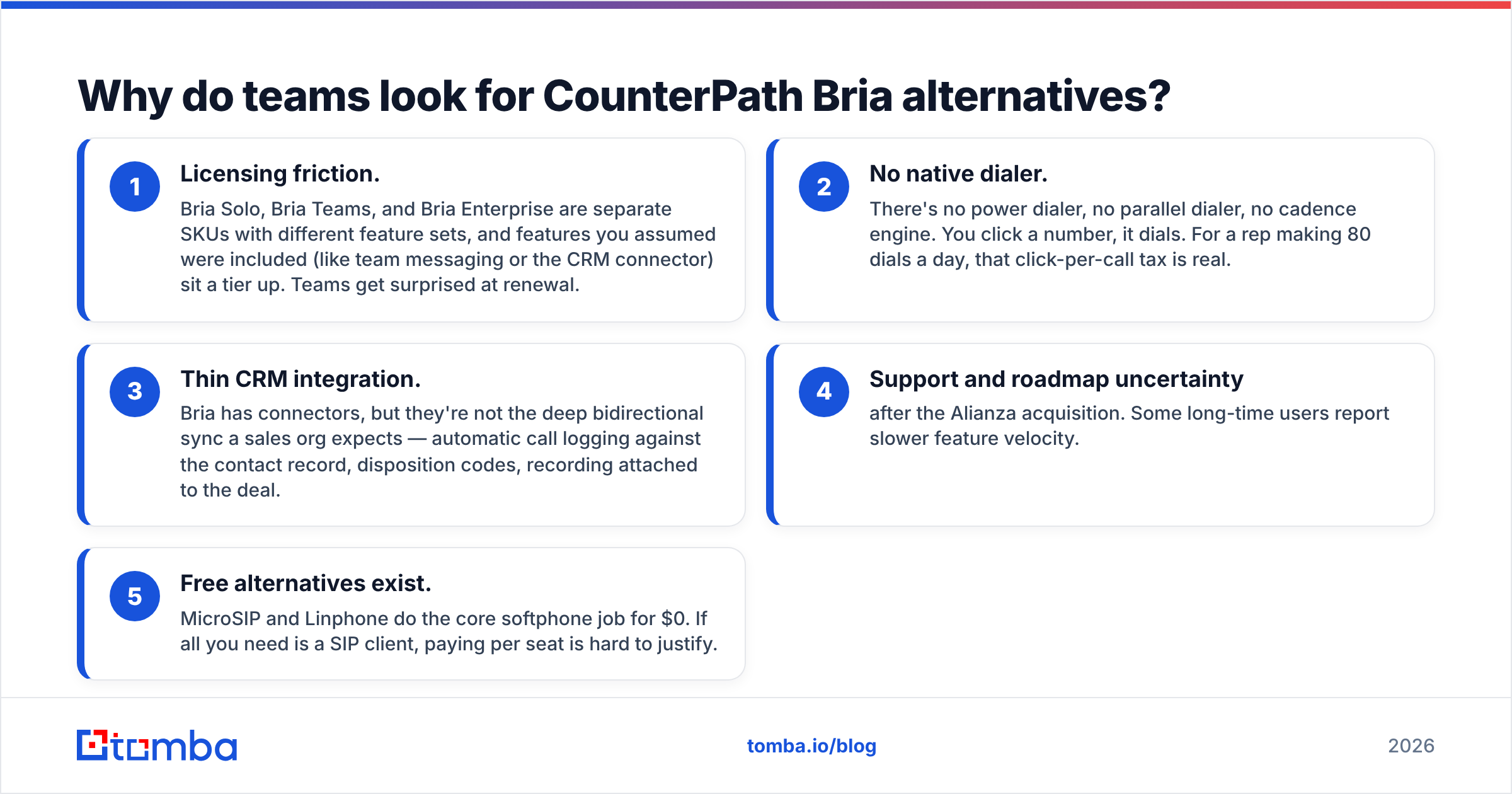
Five reasons keep coming up in G2 reviews and VoIP forums.
- Licensing friction. Bria Solo, Bria Teams, and Bria Enterprise are separate SKUs with different feature sets, and features you assumed were included (like team messaging or the CRM connector) sit a tier up. Teams get surprised at renewal.
- No native dialer. There's no power dialer, no parallel dialer, no cadence engine. You click a number, it dials. For a rep making 80 dials a day, that click-per-call tax is real.
- Thin CRM integration. Bria has connectors, but they're not the deep bidirectional sync a sales org expects — automatic call logging against the contact record, disposition codes, recording attached to the deal.
- Support and roadmap uncertainty after the Alianza acquisition. Some long-time users report slower feature velocity.
- Free alternatives exist. MicroSIP and Linphone do the core softphone job for $0. If all you need is a SIP client, paying per seat is hard to justify.
None of these mean Bria is broken. They mean Bria is a component, and a lot of buyers wanted a system.
How do the top CounterPath Bria alternatives compare?#
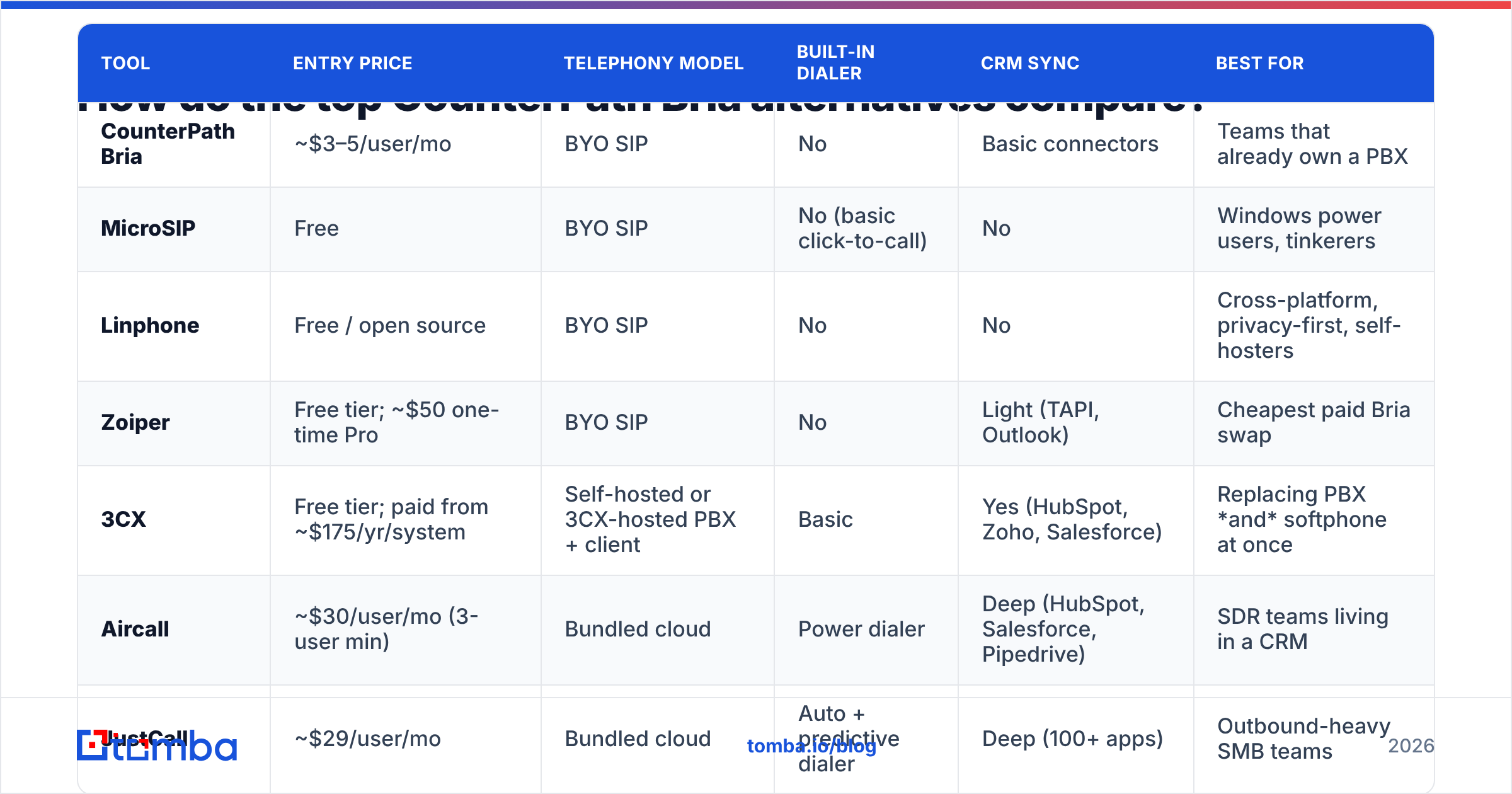
Pricing below is list pricing at the time of writing and moves often — treat it as a shape, not a quote. "BYO SIP" means you supply the trunk; "Bundled" means calling minutes and numbers come with the plan.
| Tool | Entry price | Telephony model | Built-in dialer | CRM sync | Best for |
|---|---|---|---|---|---|
| CounterPath Bria | ~$3–5/user/mo | BYO SIP | No | Basic connectors | Teams that already own a PBX |
| MicroSIP | Free | BYO SIP | No (basic click-to-call) | No | Windows power users, tinkerers |
| Linphone | Free / open source | BYO SIP | No | No | Cross-platform, privacy-first, self-hosters |
| Zoiper | Free tier; ~$50 one-time Pro | BYO SIP | No | Light (TAPI, Outlook) | Cheapest paid Bria swap |
| 3CX | Free tier; paid from ~$175/yr/system | Self-hosted or 3CX-hosted PBX + client | Basic | Yes (HubSpot, Zoho, Salesforce) | Replacing PBX and softphone at once |
| Aircall | ~$30/user/mo (3-user min) | Bundled cloud | Power dialer | Deep (HubSpot, Salesforce, Pipedrive) | SDR teams living in a CRM |
| JustCall | ~$29/user/mo | Bundled cloud | Auto + predictive dialer | Deep (100+ apps) | Outbound-heavy SMB teams |
| Dialpad | ~$15–27/user/mo | Bundled cloud | Power dialer (higher tiers) | Yes | AI transcription + live coaching |
| RingCentral | ~$20–30/user/mo | Bundled cloud | Via RingCX / add-ons | Yes | Enterprise UC, compliance, global DIDs |
Read that table as three clusters:
- Free SIP clients (MicroSIP, Linphone, Zoiper) — you're replacing Bria one-for-one and pocketing the license fee.
- PBX + client bundles (3CX) — you're replacing Bria and the thing behind it.
- Cloud sales phone systems (Aircall, JustCall, Dialpad, RingCentral) — you're admitting you never wanted a softphone, you wanted a calling workflow.
Which free Bria alternatives are actually good?#
MicroSIP is the answer most VoIP admins give first, and they're right. It's a tiny Windows SIP client — a few megabytes — that does registration, multiple accounts, call recording, DTMF, transfers, and a click-to-call protocol handler. It's ugly. It's also rock solid and completely free. If your rep is on Windows and your trunk is already provisioned, MicroSIP replaces Bria in about ten minutes with zero functional loss for basic calling.
Linphone is the cross-platform, open-source pick. Desktop (Windows/macOS/Linux), iOS, Android, plus a well-documented SDK if you want to embed calling in your own product. End-to-end encryption via ZRTP is a genuine differentiator if you're in a regulated vertical. The UI is more modern than MicroSIP's; the codec handling is slightly less forgiving on flaky networks.
Zoiper sits between free and paid. The free tier handles SIP calling with a codec limit; Zoiper Pro is a modest one-time purchase (not a subscription) that unlocks G.729, video, and click-to-dial integrations. For a team that specifically resents Bria's recurring per-seat charge, Zoiper's one-time license is the cleanest philosophical swap.
The honest caveat on all three: you get a dial pad, not a sales process. No cadences, no call dispositions, no automatic logging, no analytics beyond a call history list. If that's what you were paying Bria for, these are lateral moves — cheaper, but lateral.
Is a cloud phone system better than a softphone for sales teams?#
For outbound sales, usually yes — and it's not close.
Here's the split. A softphone optimizes the call. A cloud phone system optimizes the hour. An SDR's hour contains maybe 25 minutes of talk time and 35 minutes of overhead: finding the number, pasting it, waiting for ring-out, logging the outcome, writing the follow-up email, updating the CRM. Bria addresses none of that overhead. Aircall, JustCall, and Dialpad exist specifically to eat it.
Concretely, what you gain:
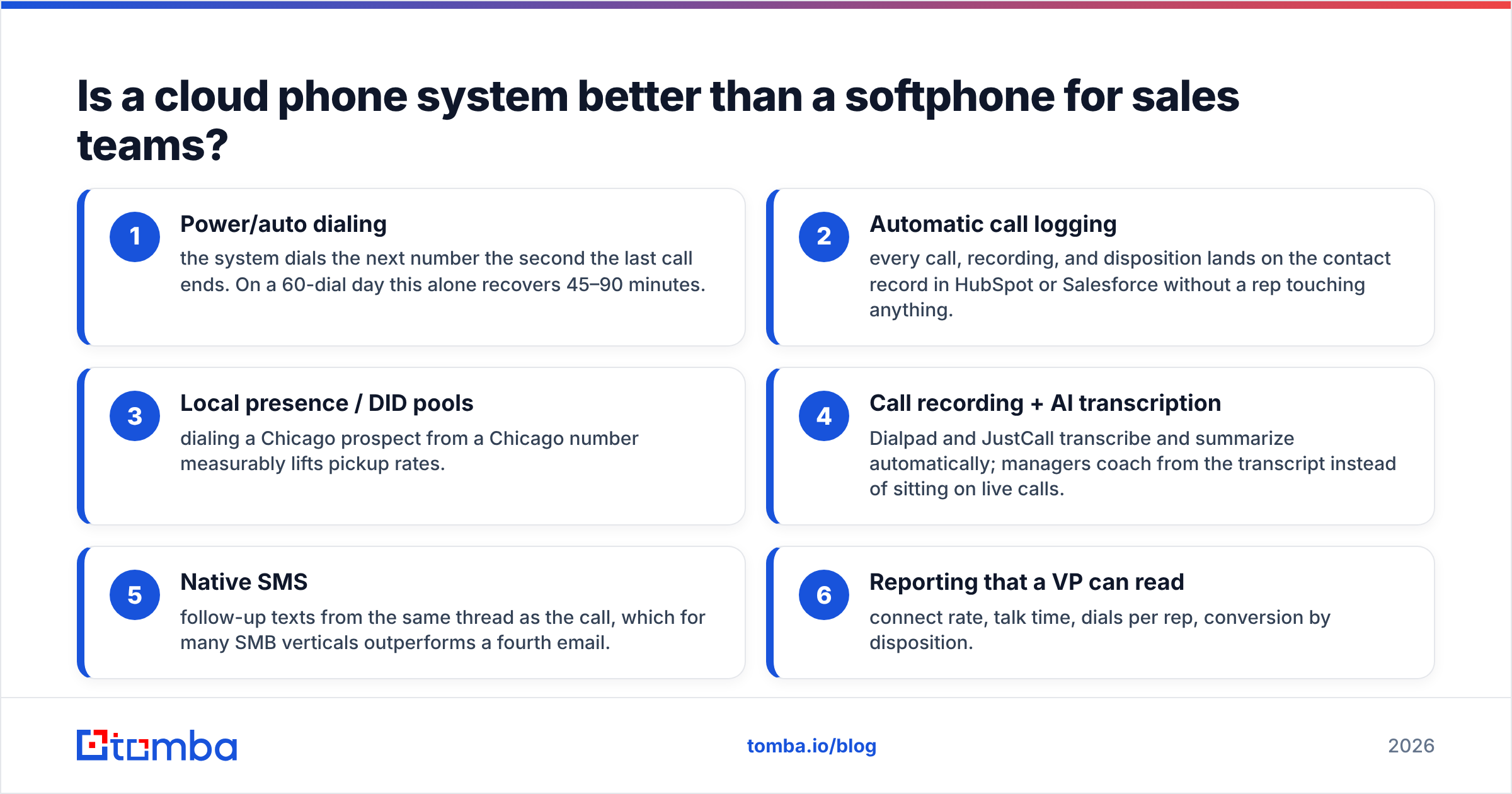
- Power/auto dialing — the system dials the next number the second the last call ends. On a 60-dial day this alone recovers 45–90 minutes.
- Automatic call logging — every call, recording, and disposition lands on the contact record in HubSpot or Salesforce without a rep touching anything.
- Local presence / DID pools — dialing a Chicago prospect from a Chicago number measurably lifts pickup rates.
- Call recording + AI transcription — Dialpad and JustCall transcribe and summarize automatically; managers coach from the transcript instead of sitting on live calls.
- Native SMS — follow-up texts from the same thread as the call, which for many SMB verticals outperforms a fourth email.
- Reporting that a VP can read — connect rate, talk time, dials per rep, conversion by disposition.
What you give up: control and, sometimes, cost. You're now on their trunks at their rates, and international calling can get expensive. If you already negotiated a great wholesale rate on a SIP trunk, moving to a bundled provider can raise your per-minute cost even as it raises rep productivity. Run that math with real numbers before you switch — it usually still favors the cloud system, but not always.
For a deeper look at how the dial fits into the broader motion, our breakdown of cold calling and phone sales benchmarks is a useful sanity check on what "good" looks like before you blame the tool.
What about 3CX — replacing the PBX, not just the phone?#
3CX deserves its own paragraph because it's the only option here that solves the layer underneath Bria.
If you're running Bria against an aging on-prem PBX, the softphone isn't your problem — the PBX is. 3CX gives you a modern PBX you can self-host (on-prem, or on your own AWS/Azure/GCP instance) plus native web/desktop/mobile clients that make Bria redundant. You keep BYO-SIP flexibility, keep control of your data, get a decent free tier for small deployments, and pick up call queues, IVR, live chat, and WhatsApp routing along the way. CRM connectors for HubSpot, Zoho, Salesforce, and Pipedrive ship in the box.
The trade: you are now a PBX administrator. Someone owns updates, certificates, firewall rules, and codec troubleshooting. That's a real job. If nobody on your team wants it, skip 3CX and go bundled.
Why does your data matter more than your dialer?#
Here's the part most "best softphone" listicles skip, and it's the part that actually moves your connect rate.
You can migrate from Bria to the best power dialer on earth and still have a terrible day, because the dialer is only as good as the numbers you feed it. Industry churn on B2B contact records runs roughly 25–30% per year — people change jobs, companies get acquired, direct lines get reassigned. A list you bought eighteen months ago is, statistically, a coin flip. Dialing it faster just means reaching disconnected numbers faster.
So before you comparison-shop softphones, audit the input:
- Are the numbers direct dials or switchboards? A switchboard number in a power dialer is a gatekeeper machine that will happily eat your whole afternoon.
- Are they validated? A quick pass through a phone validator catches disconnected and invalid lines before your dialer ever touches them.
- Do you have a fallback channel? Most B2B prospects will not pick up a first call. If you don't also have a verified email on the record, that dial is a dead end rather than the first touch in a sequence.
- Is the record enriched? Title, company size, and tech stack decide what you say when they pick up. A dialer can't fix a call with no reason for existing.
This is where a lot of teams get the sequencing backwards. They spend three weeks evaluating softphones and zero days on list hygiene. Run a phone finder and data enrichment pass over your target accounts first, and the dialer question gets a lot less dramatic — because at that point almost any of the options in the table above will work.
It's also worth noting that a phone-only motion is fragile by design. The teams with the best connect rates run calls and email in parallel: the email warms the name, the call converts it. That means every record needs a verified address alongside the direct dial, which is a data problem long before it's a telephony problem.
Which Bria alternative should you pick?#
Match the tool to the constraint, not to the review score.
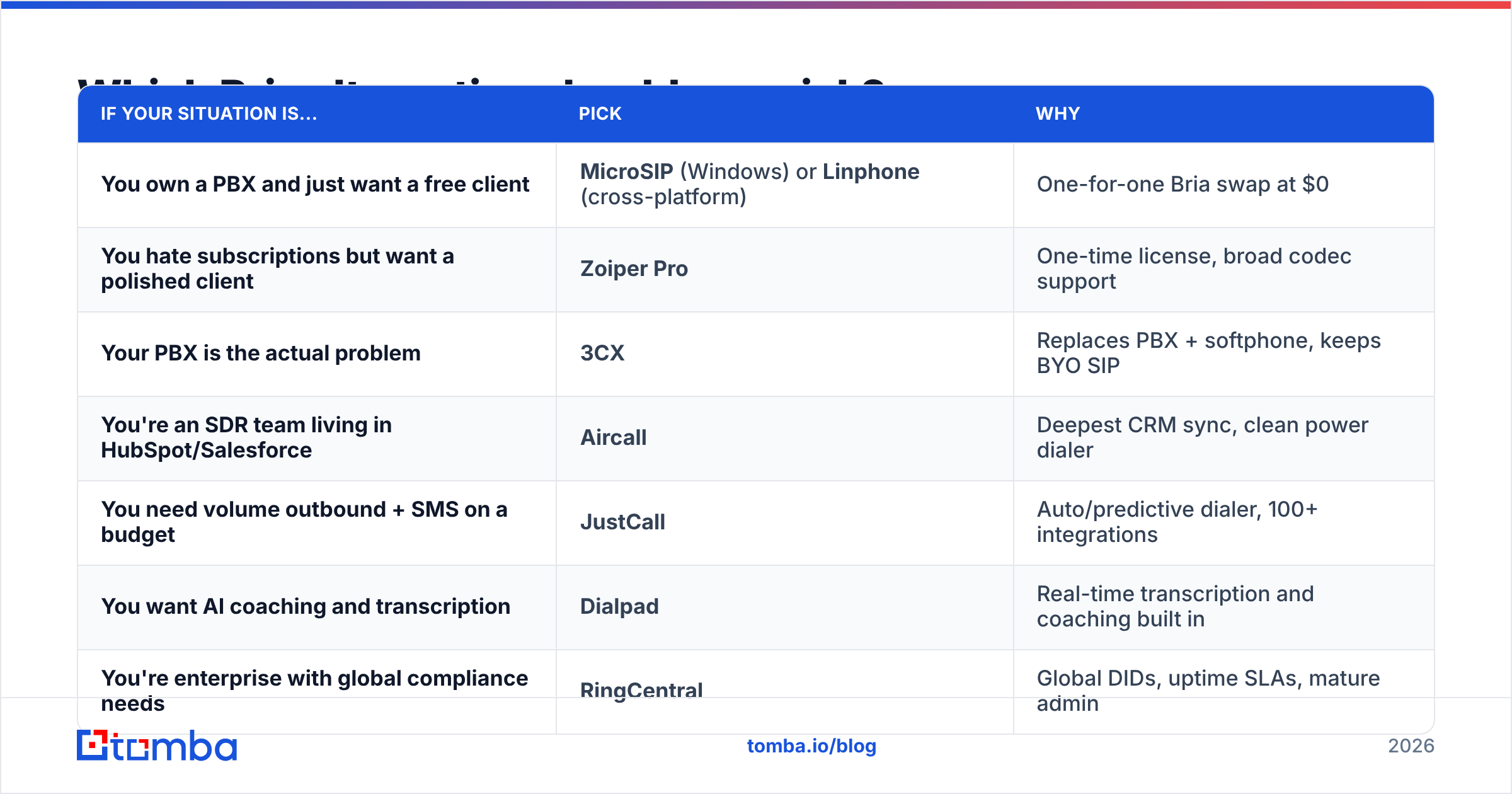
| If your situation is... | Pick | Why |
|---|---|---|
| You own a PBX and just want a free client | MicroSIP (Windows) or Linphone (cross-platform) | One-for-one Bria swap at $0 |
| You hate subscriptions but want a polished client | Zoiper Pro | One-time license, broad codec support |
| Your PBX is the actual problem | 3CX | Replaces PBX + softphone, keeps BYO SIP |
| You're an SDR team living in HubSpot/Salesforce | Aircall | Deepest CRM sync, clean power dialer |
| You need volume outbound + SMS on a budget | JustCall | Auto/predictive dialer, 100+ integrations |
| You want AI coaching and transcription | Dialpad | Real-time transcription and coaching built in |
| You're enterprise with global compliance needs | RingCentral | Global DIDs, uptime SLAs, mature admin |
And if you're still on the fence: stay on Bria if it works and you own your SIP stack. Switching costs are real, and "the softphone is fine" is a perfectly good reason to spend your evaluation energy somewhere with more upside — like the quality of the list you're dialing.
Frequently asked questions#
Is CounterPath Bria discontinued? No. Bria continues under Alianza after the 2021 acquisition. Some users report a slower roadmap, but the product ships and is supported.
Can I use Bria with any SIP provider? Generally yes — that's its core strength. Any standards-compliant SIP trunk or PBX will register. This is also what makes it easy to replace with another BYO-SIP client.
What's the cheapest Bria alternative? MicroSIP and Linphone are free. Zoiper's free tier works with basic codecs; the Pro license is a one-time purchase.
Do cloud dialers replace a softphone entirely? Yes. Aircall, JustCall, Dialpad, and RingCentral all ship their own desktop and mobile clients, so the softphone disappears into the platform. You lose BYO-SIP flexibility in exchange.
Does a better dialer improve connect rates? Marginally. Local presence and higher dial volume help, but the biggest lever by far is whether the number is a valid direct dial for a person who still works there. Data quality beats dialer features every time. See how Tomba sources and verifies its data if you want to dig into that side.
Fix the list before you fix the phone#
Whichever softphone you land on, the call only happens if the contact data is right. Tomba's Email Finder pairs verified work emails with the direct dials your dialer needs, so every record in your sequence has two ways in instead of one dead phone number. Start free with 25 searches a month, or check Tomba pricing — Starter is $49/mo — and stop blaming the dial pad for a data problem.
Sources: CounterPath / Alianza, 3CX, G2 softphone category
Related guides#
Ready to find emails that actually work?
Join 150,000+ professionals who stopped guessing and started sending. Free credits on signup — no credit card required.
Get the Tomba newsletter
Practical outbound tactics and product updates — once every two weeks.
About the author