CPQ Meaning Explained: Configure, Price, Quote in 2026
CPQ stands for Configure, Price, Quote — but the acronym hides what actually matters: who needs it, what it costs, and why most CPQ rollouts stall on bad data rather than bad software.
TL;DR
- CPQ means Configure, Price, Quote — software that turns a chosen product configuration into a legally-priced, approved, sendable quote without a human rebuilding a spreadsheet every time.
- It exists because quoting is where deals quietly leak: wrong SKUs, wrong discounts, wrong terms, and a 3-day wait for a sales engineer to sanity-check a PDF.
- CPQ pays off when your product has variants, tiers, bundles, or approval rules. If you sell one plan at one price, you do not need CPQ — you need a payment link.
- Typical results teams report: quote turnaround dropping from days to minutes, and discount leakage shrinking because the rules live in software, not in a rep's head.
- The biggest CPQ failure mode is not the tool. It's dirty upstream data — wrong contacts, dead emails, duplicate accounts — so the quote lands in nobody's inbox.
What does CPQ actually mean?#
CPQ stands for Configure, Price, Quote. It's a category of sales software that sits between your CRM and your billing system and answers one question: given what this customer wants, what exactly do we sell them, at what price, on what terms — and can we send that document today?
Think of it like the difference between a diner and a build-your-own-burrito counter. A diner has a fixed menu; the price is printed. A burrito counter has ingredients, combinations, upcharges, and rules ("no, you can't have three proteins at the taco price"). CPQ is the point-of-sale system for the burrito counter — it enforces which combinations are legal and what each one costs, so the person at the register isn't doing mental math and guessing.
Technically: CPQ is a rules engine plus a document generator, wired to your product catalog, price book, discount policy, and approval hierarchy. Salesforce popularized the term with its CPQ product line, and it's now a distinct software category on review sites like G2, with dozens of vendors ranging from CRM-native modules to standalone quoting platforms.
What do the three letters actually do?#
Each letter is a distinct job, and most teams are only bad at one or two of them:
- Configure — Assemble a valid product/service combination. This is where compatibility rules live: "Enterprise SSO requires the Enterprise plan," "this hardware SKU needs a mounting kit," "you can't buy the add-on without the base seat." Without CPQ, this knowledge sits in a solutions engineer's head, which is why they get pinged 40 times a week.
- Price — Apply the correct price to that configuration. Volume tiers, multi-year discounts, regional price books, currency, ramp deals, usage overages, partner margins. This is the letter that quietly protects your gross margin.
- Quote — Produce the artifact. A branded, versioned, expiring document with the right legal terms, routed through the right approvals, delivered to the right person, and ideally e-signable in the same flow.
A fourth, unwritten letter is approve — the workflow that stops a rep from unilaterally handing out 45% off. Most CPQ tools bake approval routing directly into the pricing step.
Why do companies buy CPQ software?#
Because quoting is a bottleneck disguised as an administrative task. Three symptoms show up before anyone Googles "cpq meaning":
- Quote latency. A rep says "I'll get that over to you by end of week." In a competitive deal, end of week is a loss. The lag is almost never the customer's fault — it's internal review queues.
- Discount leakage. Nobody tracks the cumulative cost of "just this once" concessions until someone runs the report and finds the average realized price is 18% below list.
- Quote errors. A wrong SKU on a signed order is not a typo; it's a revenue recognition problem, a fulfillment problem, and a trust problem, all in one PDF.
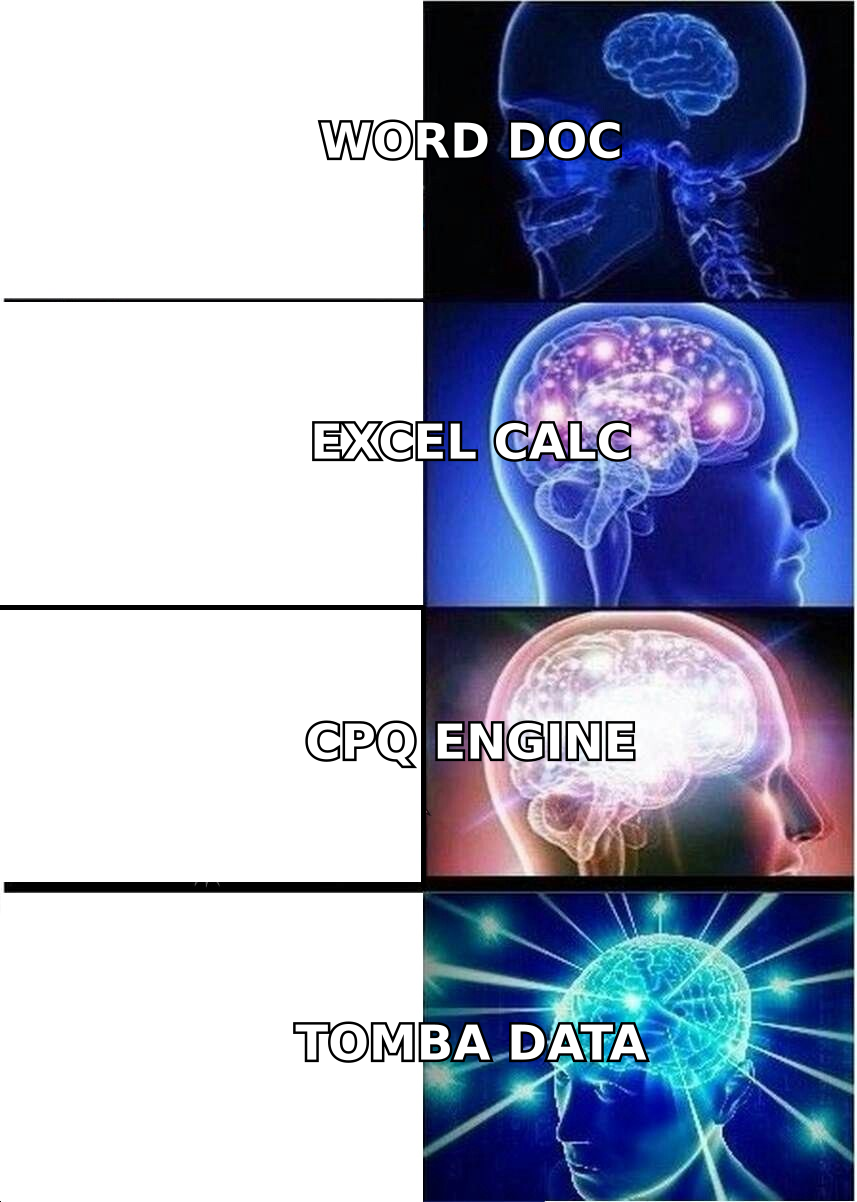
CPQ replaces tribal knowledge with enforced rules. That's the entire value proposition. Everything else — the templates, the e-signature integration, the analytics — is packaging.
Is CPQ different from a CRM or a spreadsheet?#
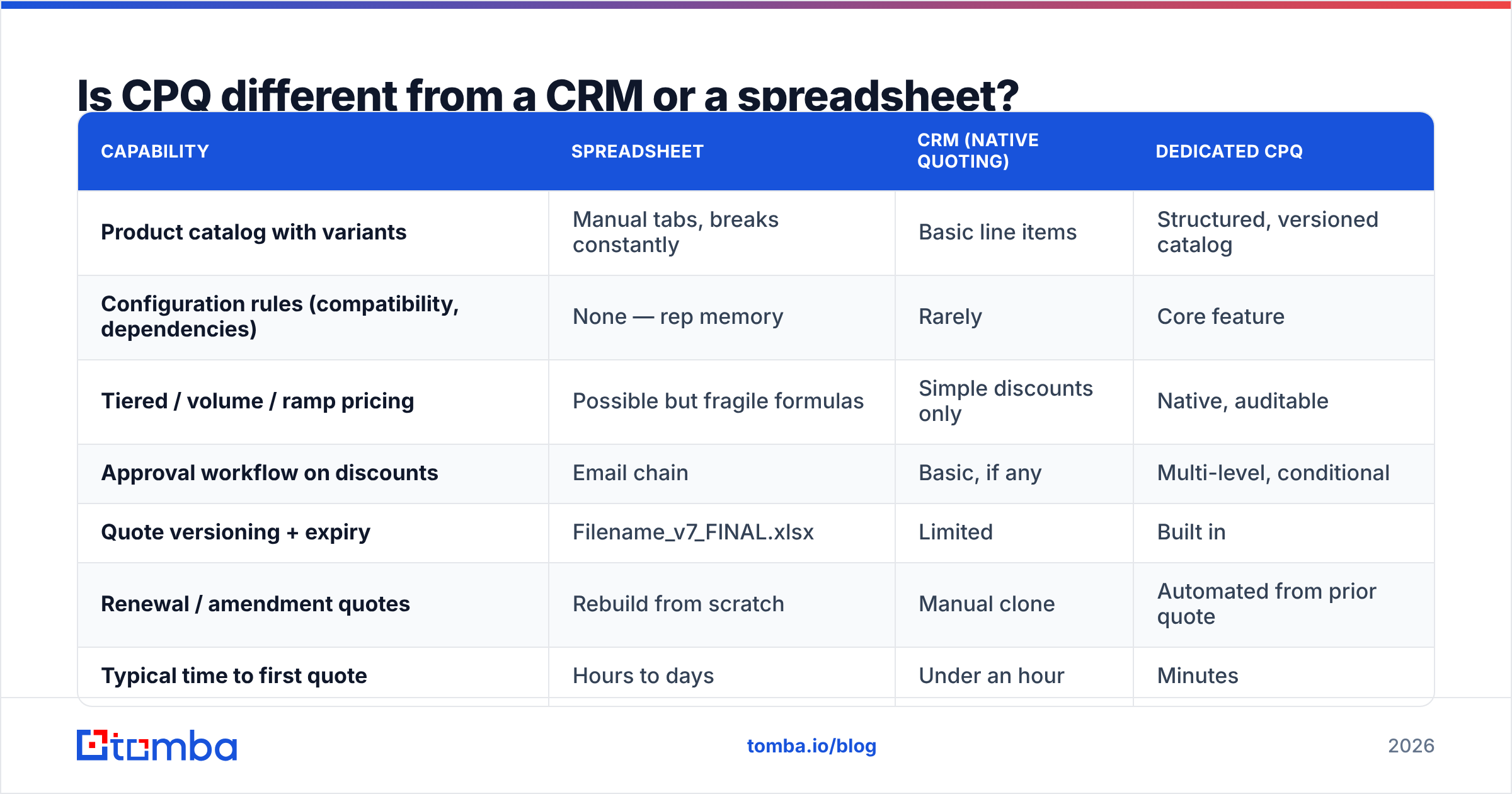
Yes, and conflating them is the most common mistake in this space. Your CRM records that a deal exists. A spreadsheet calculates a number. CPQ enforces that the number is allowed.
| Capability | Spreadsheet | CRM (native quoting) | Dedicated CPQ |
|---|---|---|---|
| Product catalog with variants | Manual tabs, breaks constantly | Basic line items | Structured, versioned catalog |
| Configuration rules (compatibility, dependencies) | None — rep memory | Rarely | Core feature |
| Tiered / volume / ramp pricing | Possible but fragile formulas | Simple discounts only | Native, auditable |
| Approval workflow on discounts | Email chain | Basic, if any | Multi-level, conditional |
| Quote versioning + expiry | Filename_v7_FINAL.xlsx | Limited | Built in |
| Renewal / amendment quotes | Rebuild from scratch | Manual clone | Automated from prior quote |
| Typical time to first quote | Hours to days | Under an hour | Minutes |
| Realistic cost | $0 + hidden error cost | Bundled with CRM seat | Per-user add-on, often the priciest seat in the stack |
The honest read: a growing number of CRMs now ship "good enough" quoting. HubSpot includes quote objects in its Sales Hub tiers, and Salesforce has folded CPQ into its broader Revenue Cloud. If your pricing is a three-tier SaaS plan with a seat count, that native quoting will hold for a long time. CPQ becomes necessary when the configuration logic outgrows a dropdown.
What does the CPQ landscape look like in 2026?#
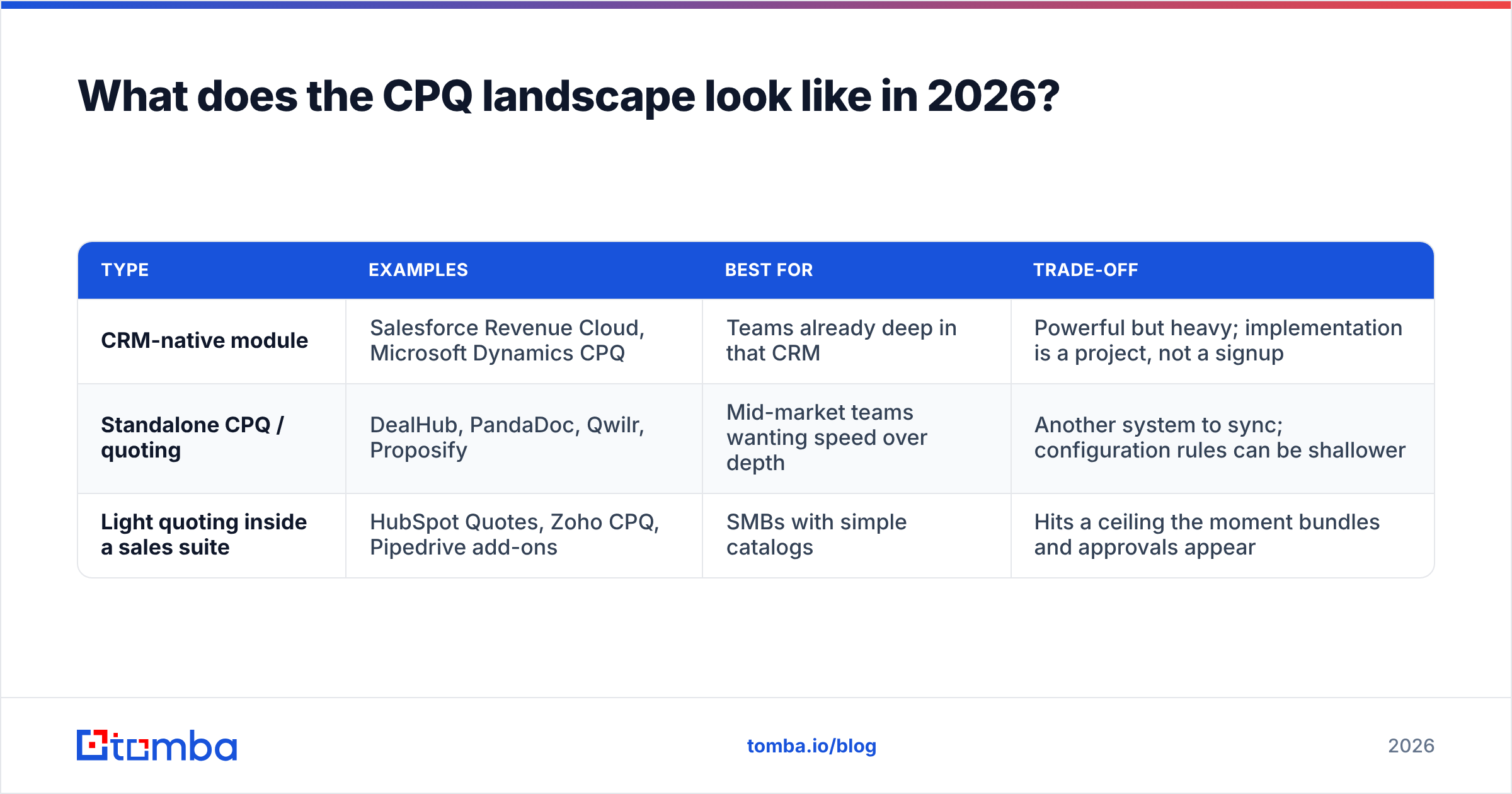
The market splits into three shapes. Vendors change packaging often, so treat entry points as directional and verify on the vendor's own pricing page before you budget.
| Type | Examples | Best for | Trade-off |
|---|---|---|---|
| CRM-native module | Salesforce Revenue Cloud, Microsoft Dynamics CPQ | Teams already deep in that CRM | Powerful but heavy; implementation is a project, not a signup |
| Standalone CPQ / quoting | DealHub, PandaDoc, Qwilr, Proposify | Mid-market teams wanting speed over depth | Another system to sync; configuration rules can be shallower |
| Light quoting inside a sales suite | HubSpot Quotes, Zoho CPQ, Pipedrive add-ons | SMBs with simple catalogs | Hits a ceiling the moment bundles and approvals appear |
Two practical filters when shortlisting:
- Rules depth vs. rollout speed. These trade off directly. Enterprise-grade CPQ can model a manufacturing bill of materials; it will also take a quarter and a consultant. Lightweight quoting tools ship in a week and cap out fast.
- Does it read from, and write back to, your CRM cleanly? A CPQ that becomes a second source of truth for accounts and contacts is a data problem you have created on purpose.
Do you actually need CPQ?#
Be honest with this checklist. If you tick three or more, CPQ is probably worth the line item:
- Your catalog has dependencies. Product A requires B; C is incompatible with D.
- Reps ask for pricing help. If a solutions engineer or a manager is in the loop on most quotes, that's a rules engine waiting to be written down.
- Discounts need approval. And that approval currently happens over Slack.
- You sell multi-year, ramped, or usage-based deals. Formula complexity grows superlinearly here.
- Renewals and amendments are frequent. Rebuilding a renewal quote by hand is the single most wasteful hour in B2B sales.
- Quote-to-sign takes more than 48 hours and you can trace the delay internally.
If you tick zero or one, do not buy CPQ. Buy time back somewhere else — cleaner data, better sales automation, a shorter proposal template. CPQ bought too early is a tax on a process that isn't complex enough to need it.
What does a CPQ implementation actually involve?#
Here's the part vendors skip in the demo. Roughly in order:
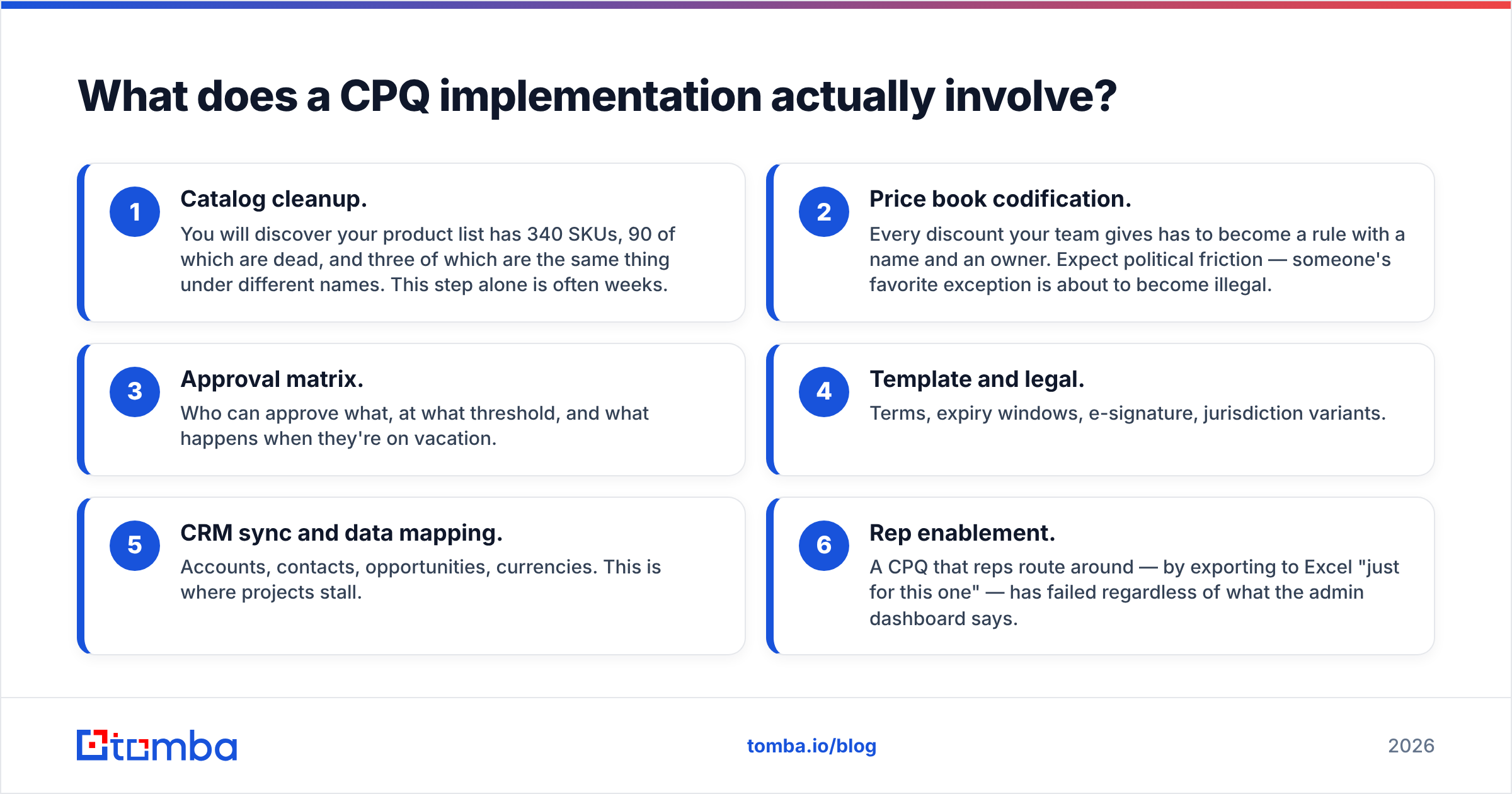
- Catalog cleanup. You will discover your product list has 340 SKUs, 90 of which are dead, and three of which are the same thing under different names. This step alone is often weeks.
- Price book codification. Every discount your team gives has to become a rule with a name and an owner. Expect political friction — someone's favorite exception is about to become illegal.
- Approval matrix. Who can approve what, at what threshold, and what happens when they're on vacation.
- Template and legal. Terms, expiry windows, e-signature, jurisdiction variants.
- CRM sync and data mapping. Accounts, contacts, opportunities, currencies. This is where projects stall.
- Rep enablement. A CPQ that reps route around — by exporting to Excel "just for this one" — has failed regardless of what the admin dashboard says.
Gartner's research on sales technology consistently makes the same point across categories: adoption, not capability, decides whether the tool returns anything. You can browse their IT glossary for the formal definitions, but the field lesson is simpler — the rules have to be easier to follow than to bypass.
Where do most CPQ rollouts actually break?#
On data, not on configuration logic.
A quote engine is a beautiful machine that produces a document. That document then has to reach a human being who can sign it. And that's where the stack quietly fails: the contact record is 14 months old, the champion changed jobs, the email bounces, and the perfectly-configured quote sits in a dead inbox while the deal ages out of the pipeline.
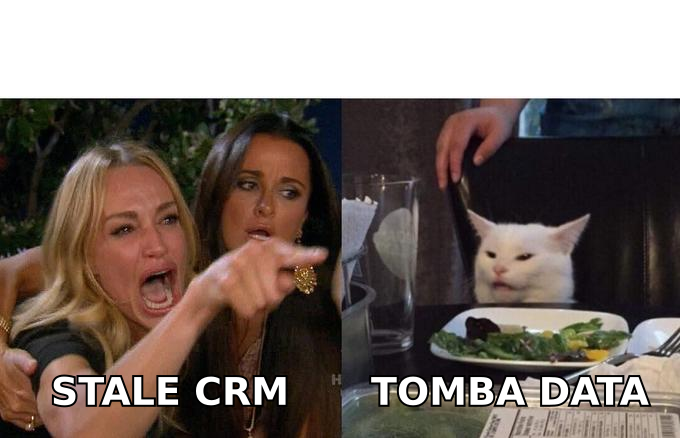
This is the unglamorous truth about the whole quote-to-cash chain: precision downstream is worthless if the inputs upstream are wrong. Three checks that cost far less than a CPQ license:
- Verify the recipient before you send. A bounced quote is indistinguishable from a lost deal in your reporting. Running decision-maker addresses through an email verifier before the quote goes out is a five-second step that protects a five-figure document.
- Enrich the account record. Headcount, tech stack, and role data determine which price tier and which bundle you should even be configuring. Stale firmographics mean you quote the wrong package. Data enrichment keeps the configuration honest.
- Find the actual signer, not just the contact you have. The person who requested the quote frequently isn't the person who signs it. Pulling the right procurement or finance contact — by name, by role, by domain — is often the difference between a quote that closes and a quote that gets "circulated internally" into oblivion.
None of this is CPQ's job. That's exactly the point: CPQ is a downstream tool, and it inherits whatever quality your RevOps data has. Teams that fix the data first get compounding returns from CPQ. Teams that don't just automate the delivery of quotes to the wrong people, faster.
What are the most common CPQ mistakes?#
- Buying for a complexity you don't have. Enterprise CPQ on a three-tier SaaS catalog is a Ferrari in a parking garage.
- Encoding exceptions as rules. If every rule has three carve-outs, you haven't standardized pricing — you've documented chaos in a more expensive format.
- Skipping the approval design. An approval chain with no SLA becomes the new bottleneck, and reps will route around it.
- Treating CPQ as a source of truth for contacts. It isn't. Your CRM is, and your CRM is only as good as the contact data feeding it.
- Measuring the wrong thing. "Quotes generated" is a vanity metric. Measure quote-to-close rate, average realized discount, and time from configuration to signature.
How should you actually sequence this?#
If you're starting from spreadsheets, the pragmatic order is:
- Clean and verify your contact and account data. Cheapest step, biggest immediate lift, and it makes every downstream tool measurably better.
- Standardize your price book on paper — before any software. If you can't write the rules in a doc, you can't configure them in a tool.
- Use your CRM's native quoting until it visibly breaks. Let the pain define the requirements instead of a vendor deck.
- Then buy CPQ, scoped to the rules you actually wrote down in step 2.
Most teams do this backwards, buy the platform first, and spend the implementation quarter discovering their pricing policy was never a policy.
Start upstream: get the quote to a real person#
CPQ makes your quote correct. It cannot make your quote arrive. Before you spend a quarter and a consulting budget on configuring pricing rules, make sure the contact on the other end of that document is real, current, and the person who can actually sign.
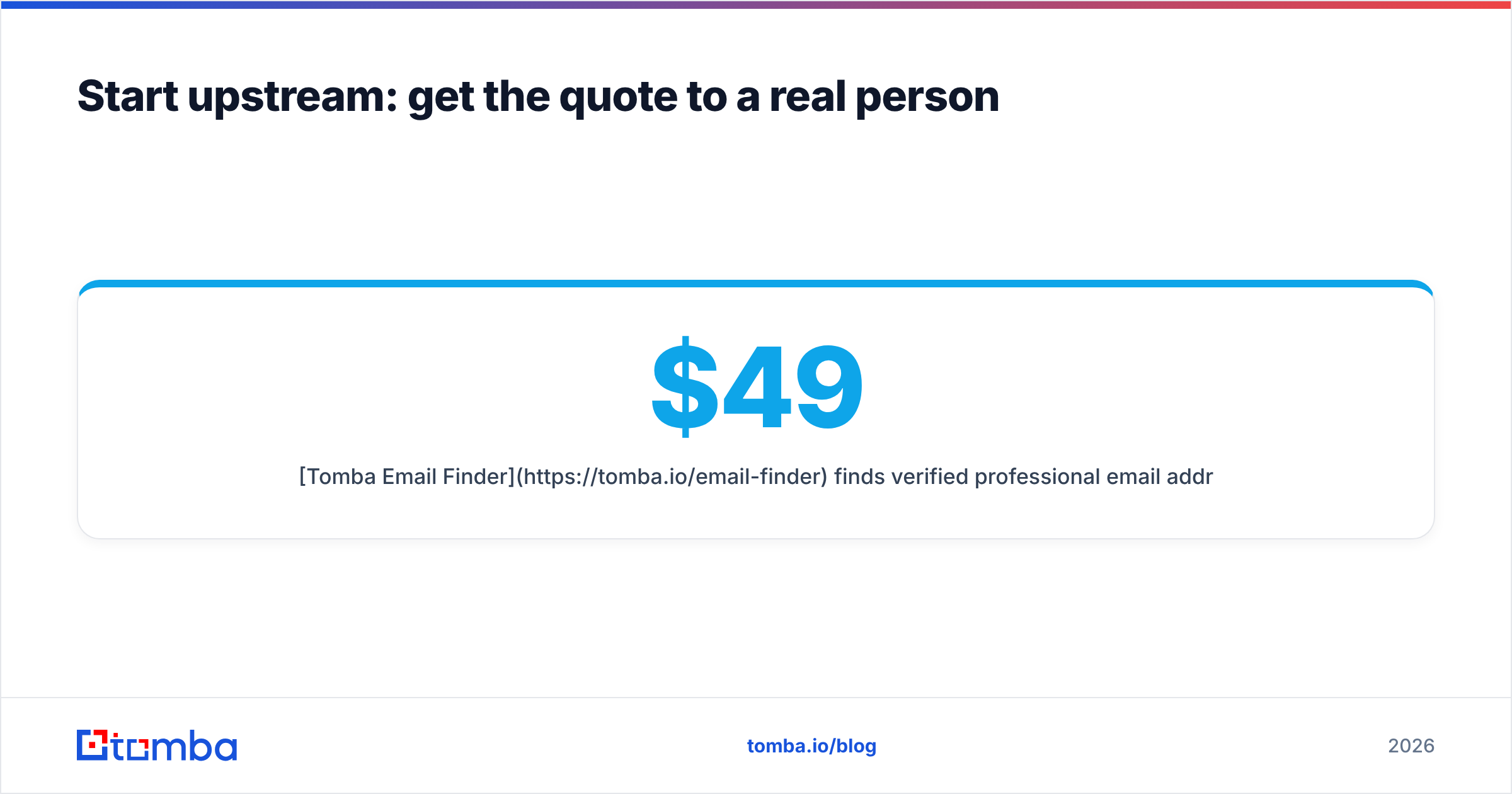
Tomba Email Finder finds verified professional email addresses by name, company, or domain — so the quote your CPQ engine builds lands in a live inbox instead of a bounce log. Start free with 25 searches a month; paid plans begin at $49/mo (Starter), $99/mo (Growth), and $249/mo (Pro). Full Tomba pricing is public, no demo call required.
Fix the inputs first. The quote engine will do the rest.
Related guides#
Ready to find emails that actually work?
Join 150,000+ professionals who stopped guessing and started sending. Free credits on signup — no credit card required.
Get the Tomba newsletter
Practical outbound tactics and product updates — once every two weeks.
About the author