7 Best Crawlbase Alternatives in 2026: Tested and Ranked
Crawlbase is a solid crawling API, but it is not the right fit for every job. Here are seven alternatives compared on pricing, success rates, JS rendering, and how fast you can go from signup to usable data.
TL;DR
- Crawlbase (formerly ProxyCrawl) is a competent crawling API with a generous free trial, but teams outgrow it when they need enterprise-grade proxy pools, managed extraction, or LLM-ready output.
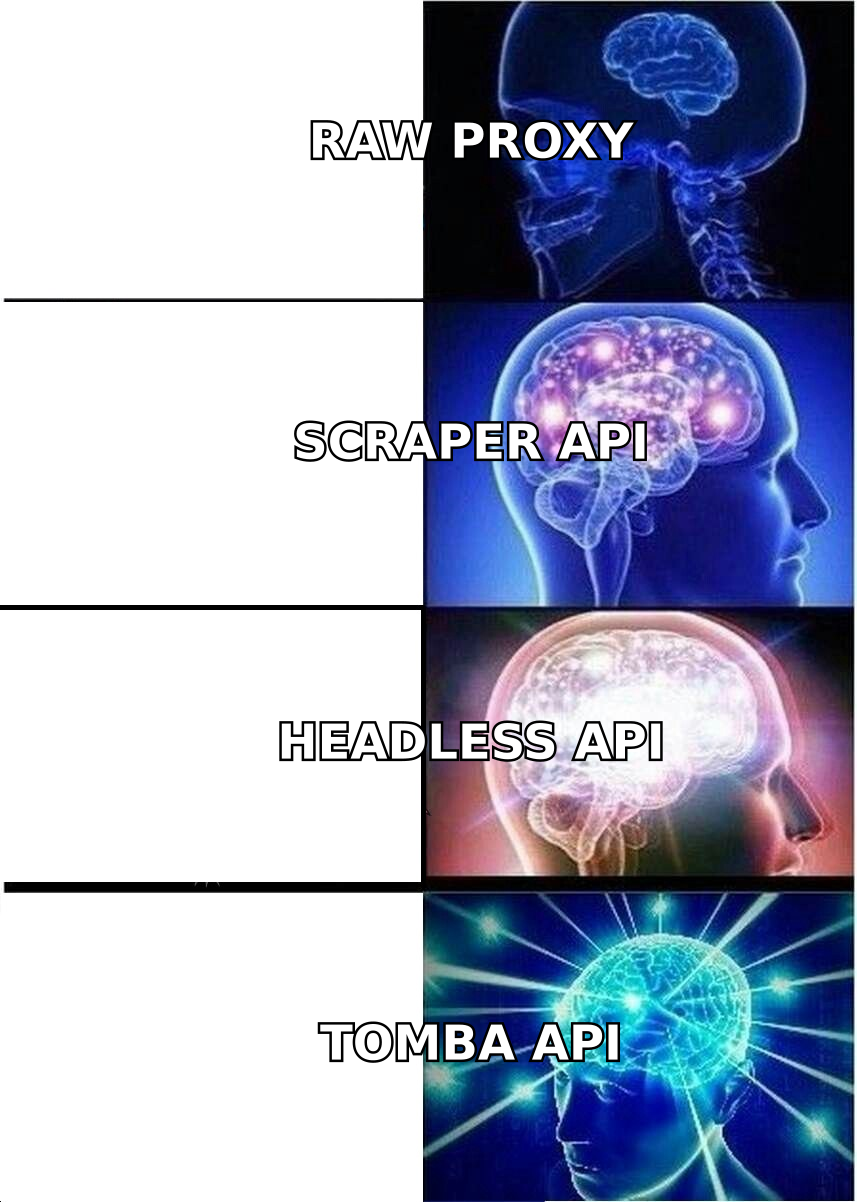
- The best Crawlbase alternative depends on what you are actually buying: raw proxies (Bright Data, Oxylabs), a scraping API (ScraperAPI, ScrapingBee, Zyte), a full crawl platform (Apify, Firecrawl), or finished data (Tomba, BookYourData).
- If you are scraping the web only to end up with B2B contact records, an API that returns verified emails directly is faster and cheaper than maintaining scrapers.
- Budget reality: proxy-based tools price by bandwidth, scraping APIs price by request credit, and data platforms price by record. Comparing "per month" numbers without normalising units will mislead you.
- Skip the rebuild: Tomba's email finder API returns verified contacts by domain with no proxy rotation, no headless browser, and no CAPTCHA budget.
What is Crawlbase and what does it actually do?#
Crawlbase is a web scraping infrastructure company — it rebranded from ProxyCrawl in 2022 and now sells four things under one roof: a Crawling API that fetches a page through rotating proxies and returns HTML, a Smart Proxy endpoint for teams that want to keep their own scraper stack, an asynchronous Crawler for large jobs with webhook callbacks, and cloud Storage for the resulting pages. There is also a Leads API for company contact data.
The pitch is straightforward. You send a URL, Crawlbase handles the proxy rotation, the browser rendering, and the retry logic, and you get the page back. Pricing starts in the low-double-digit range per month, with a free trial of roughly 1,000 requests to test the pipeline before you commit. You can confirm current tiers on crawlbase.com.
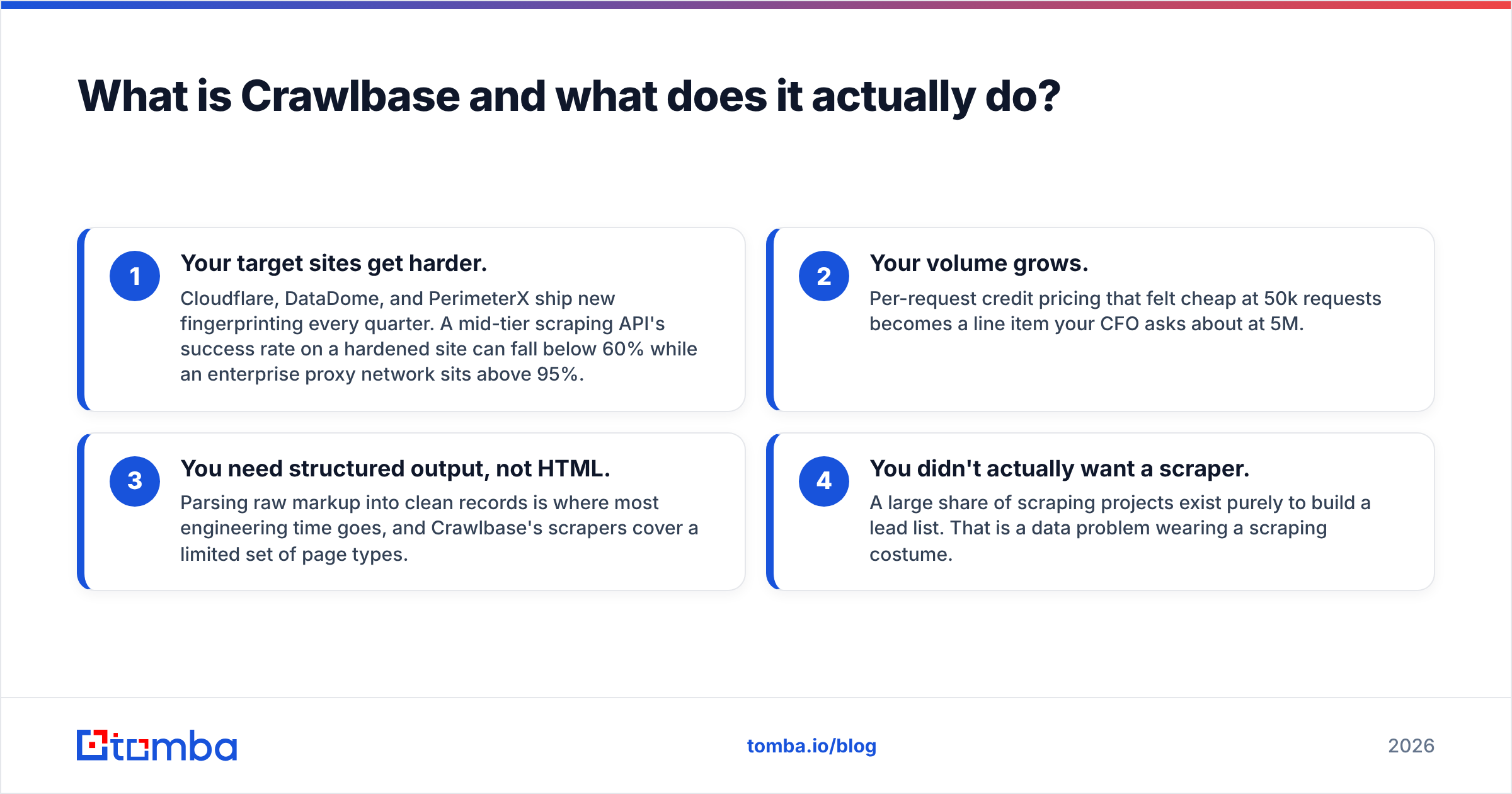
That model works well until one of four things happens:
- Your target sites get harder. Cloudflare, DataDome, and PerimeterX ship new fingerprinting every quarter. A mid-tier scraping API's success rate on a hardened site can fall below 60% while an enterprise proxy network sits above 95%.
- Your volume grows. Per-request credit pricing that felt cheap at 50k requests becomes a line item your CFO asks about at 5M.
- You need structured output, not HTML. Parsing raw markup into clean records is where most engineering time goes, and Crawlbase's scrapers cover a limited set of page types.
- You didn't actually want a scraper. A large share of scraping projects exist purely to build a lead list. That is a data problem wearing a scraping costume.
Why do teams look for Crawlbase alternatives?#
The complaints cluster into a few honest buckets. Reviews on G2 and vendor comparison threads surface the same themes repeatedly:
- Success rate variance by target. Crawlbase performs well on ecommerce and general sites, less consistently on aggressively protected SaaS dashboards and social platforms.
- Thin managed extraction. You get HTML. Turning HTML into clean rows is on you unless a prebuilt scraper exists for your target.
- Support depth at low tiers. Fine for solo builders. Enterprise buyers expect an SLA and a named contact.
- Credit maths. JavaScript rendering typically costs more credits than a plain fetch, which makes budgeting for a mixed target list annoying.
- Overkill for contact data. If the end product is
firstname.lastname@company.com, scraping is the most expensive possible route.
None of these make Crawlbase a bad product. They make it a specific product. The question is whether it is your product.
What are the best Crawlbase alternatives in 2026?#
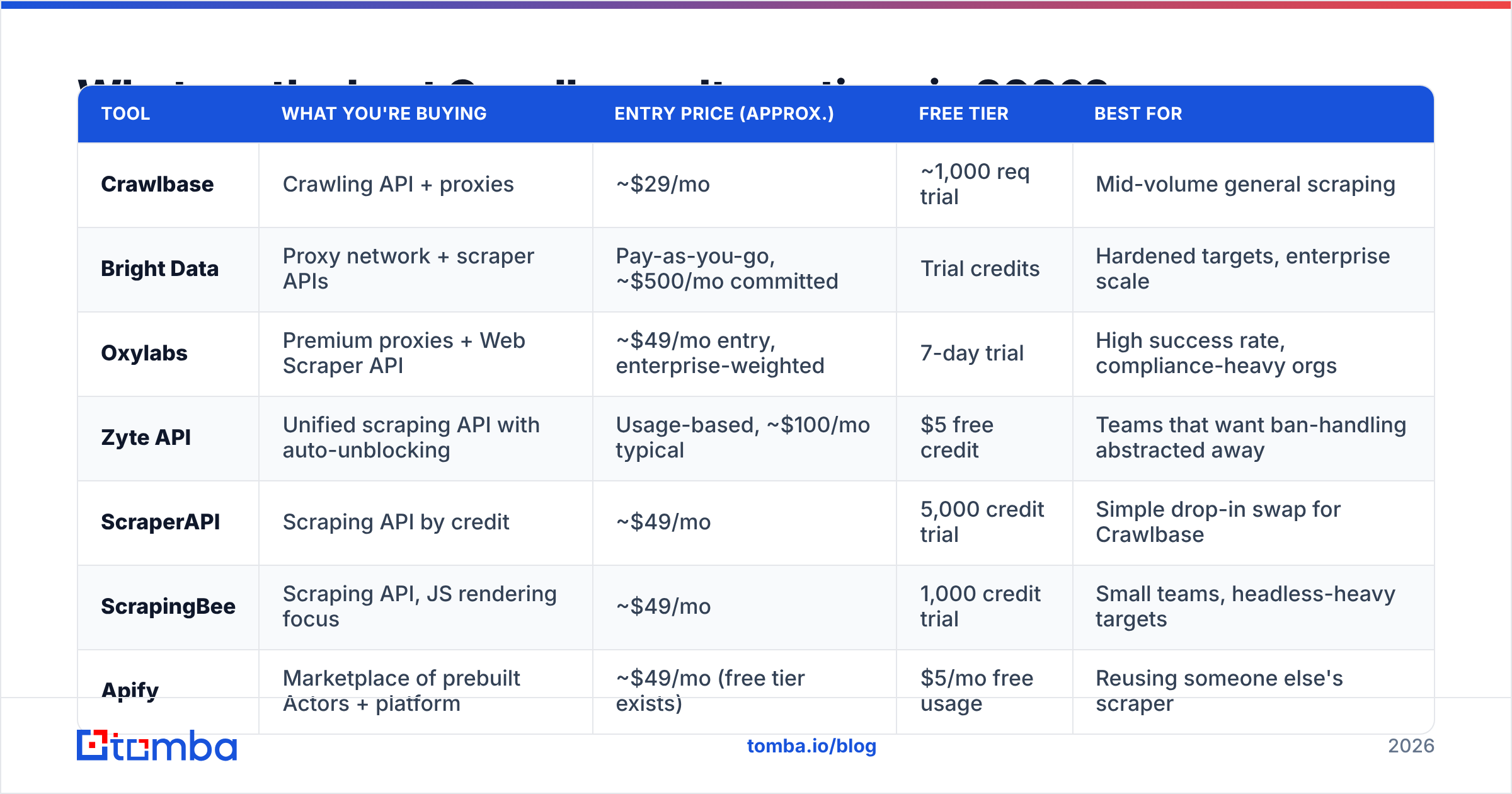
Here is the honest field. Prices are indicative entry points — every vendor changes tiers, so verify before you buy.
| Tool | What you're buying | Entry price (approx.) | Free tier | Best for |
|---|---|---|---|---|
| Crawlbase | Crawling API + proxies | ~$29/mo | ~1,000 req trial | Mid-volume general scraping |
| Bright Data | Proxy network + scraper APIs | Pay-as-you-go, ~$500/mo committed | Trial credits | Hardened targets, enterprise scale |
| Oxylabs | Premium proxies + Web Scraper API | ~$49/mo entry, enterprise-weighted | 7-day trial | High success rate, compliance-heavy orgs |
| Zyte API | Unified scraping API with auto-unblocking | Usage-based, ~$100/mo typical | $5 free credit | Teams that want ban-handling abstracted away |
| ScraperAPI | Scraping API by credit | ~$49/mo | 5,000 credit trial | Simple drop-in swap for Crawlbase |
| ScrapingBee | Scraping API, JS rendering focus | ~$49/mo | 1,000 credit trial | Small teams, headless-heavy targets |
| Apify | Marketplace of prebuilt Actors + platform | ~$49/mo (free tier exists) | $5/mo free usage | Reusing someone else's scraper |
| Firecrawl | Crawl-to-markdown for LLM pipelines | ~$16/mo | 500 credits | RAG and AI ingestion |
| Tomba | Verified B2B contact data (API) | Free tier; $49/mo Starter | 25 searches/mo | Skipping the scraper entirely for lead data |
| BookYourData | Prebuilt B2B contact lists | Pay-per-record | Sample list | Buying a list outright, no engineering |
1. Bright Data — when the target fights back#
The largest proxy network in the category, and the default answer when a site is genuinely hostile. Residential, mobile, ISP, and datacenter pools, plus a Web Unlocker and prebuilt scraper APIs sitting on top. See brightdata.com for the current product split.
Pick it if: your success rate on a key target is unacceptable and you have the budget to fix it. Skip it if: you are scraping ten thousand simple pages a month. You will pay enterprise complexity tax for nothing.
2. Oxylabs — the compliance-friendly enterprise option#
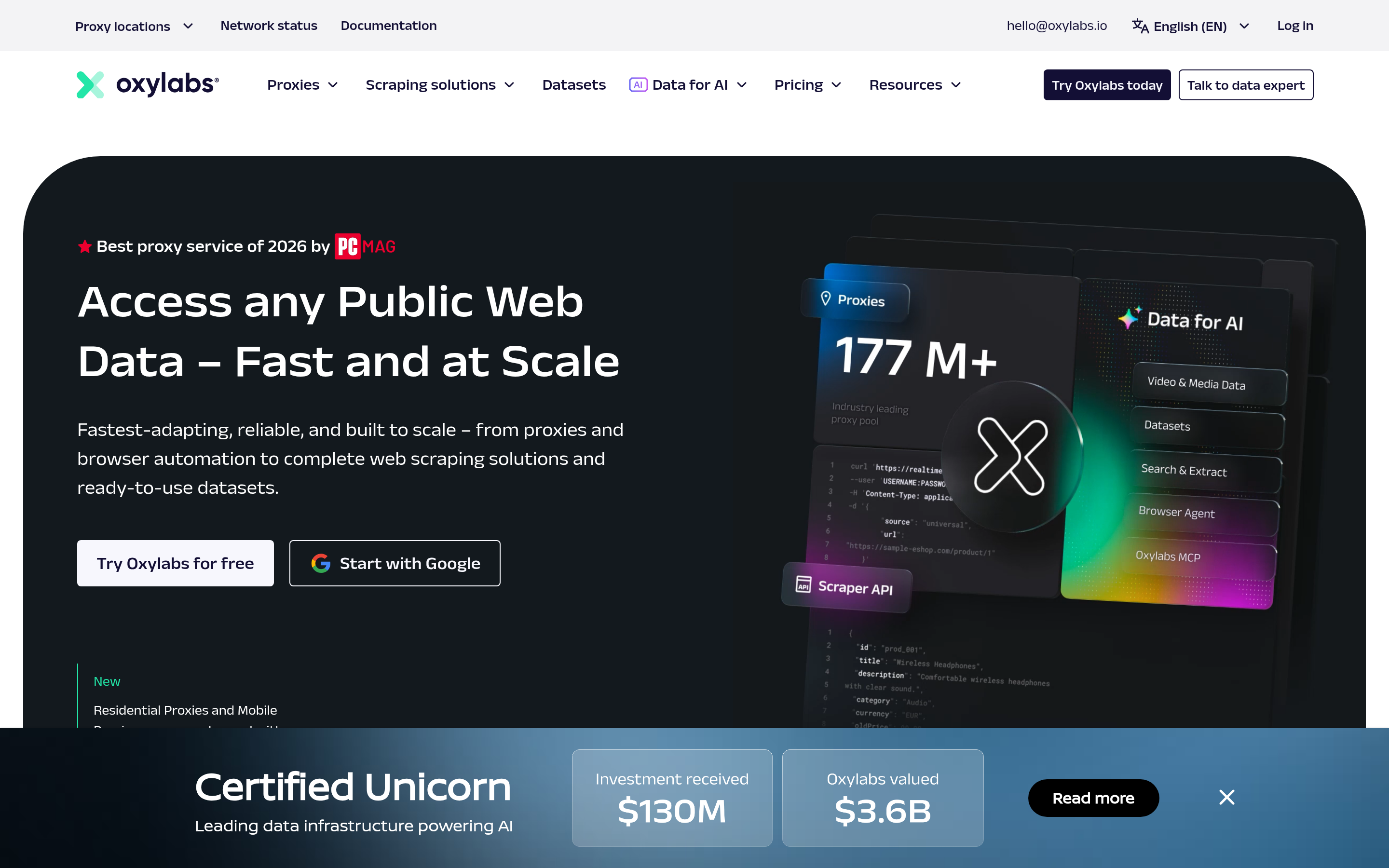
Similar shape to Bright Data: premium proxy pools plus a managed Web Scraper API. Oxylabs leans harder on compliance posture and enterprise support, which matters if your legal team reviews vendors. Entry pricing is approachable; real usage skews enterprise.
Pick it if: you need documented compliance and a named account team. Skip it if: you are a two-person startup optimising for cost per request.
3. Zyte API — auto-unblocking, one endpoint#
Zyte (the Scrapy maintainers) collapsed their product line into a single API that decides for itself whether a request needs a browser, a residential IP, or a plain fetch. That is the core value: you stop tuning ban-handling and let the API pick the cheapest path that works.
Pick it if: your engineers are tired of tuning retry logic. Skip it if: you want deterministic, predictable per-request costs.
4. ScraperAPI — the closest like-for-like swap#
If Crawlbase mostly works for you and you just want better pricing or a different support experience, ScraperAPI is the smallest migration. Same mental model: one endpoint, credits per request, extra credits for JS rendering, geotargeting flags.
Pick it if: you want a lateral move with minimal code changes. Skip it if: you need managed extraction into structured records.
5. ScrapingBee — clean DX for small teams#
ScrapingBee's advantage is developer experience: excellent docs, straightforward headless browser control, screenshot support, and an AI-assisted extraction feature that turns a prompt into selectors. Volume ceilings are lower than the enterprise players.
Pick it if: you are a small team scraping JS-heavy pages and value clarity over raw scale.
6. Apify — don't write the scraper at all#
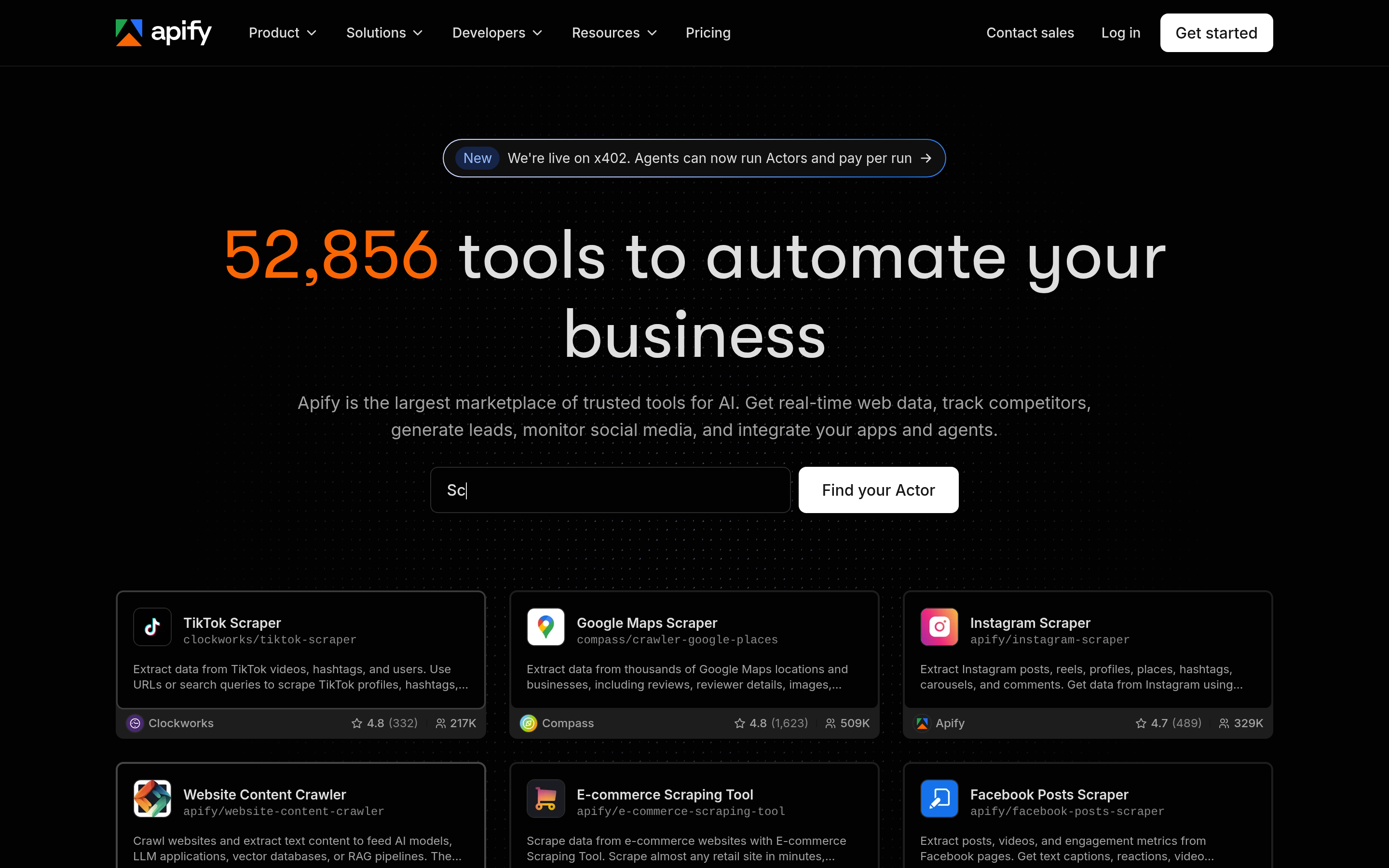
Apify is a platform, not just an API. Thousands of prebuilt "Actors" scrape specific targets — LinkedIn profiles, Google Maps, Amazon listings, Instagram — and you rent them by compute unit. If someone has already solved your target, you are done in an afternoon.
Pick it if: a public Actor already covers your target. Skip it if: your target is bespoke — you will be writing the Actor yourself, on their pricing model.
7. Firecrawl — for AI ingestion, not lead lists#
Firecrawl exists because the LLM era changed what "scraped output" means. It crawls a site and returns clean markdown, ready to embed into a vector store. It is not trying to be a proxy network.
Pick it if: you are building RAG and want documentation-quality text. Skip it if: you need CAPTCHA-solving on adversarial targets.
8. Tomba — when the scraper was never the point#
Here is the uncomfortable question worth asking before you renew any scraping contract: what are you actually going to do with the HTML?
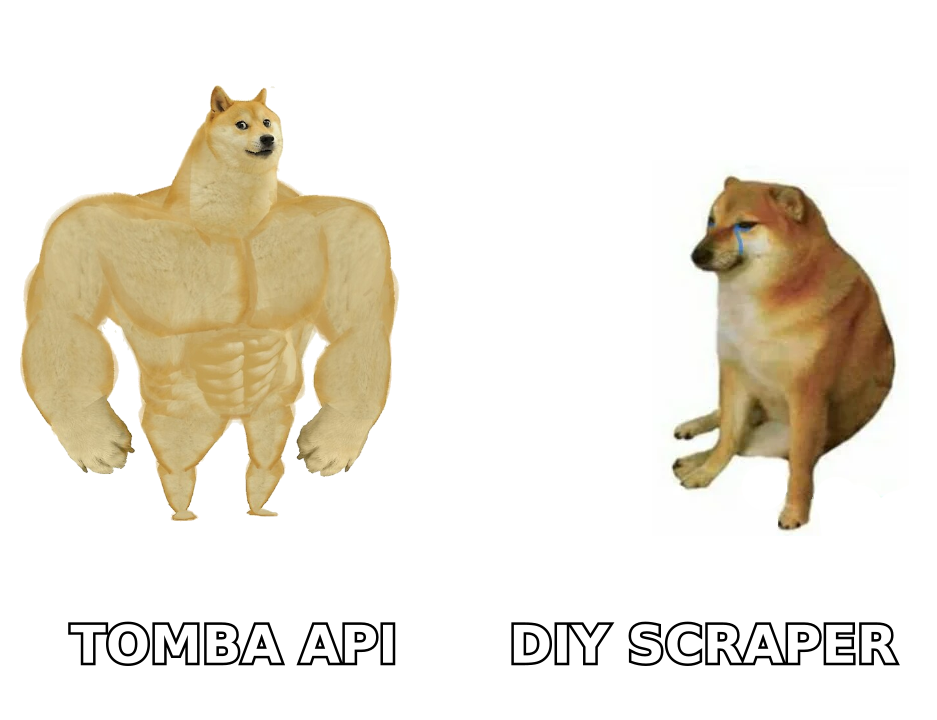
If the honest answer is "extract company employees and their email addresses so sales can reach out," then you are paying for a scraping stack, a proxy budget, a parsing layer, an email-verification step, and the engineer who maintains all four — in order to reproduce something an email finder API returns in one call.
Tomba takes a domain, a name, or a company and returns verified professional email addresses, with sources and a confidence score. Domain search returns every discoverable contact at a company; bulk email finder runs it across thousands of accounts; data enrichment fills in the rest of the record. No proxies. No CAPTCHA budget. No selector maintenance the week a target site ships a redesign.
Pick it if: the deliverable is contactable B2B leads. Skip it if: you need product prices, SERP results, reviews, or any non-contact data — that is genuinely a scraping job, and one of the tools above is the right buy.
How do you choose between a scraping API and a data API?#
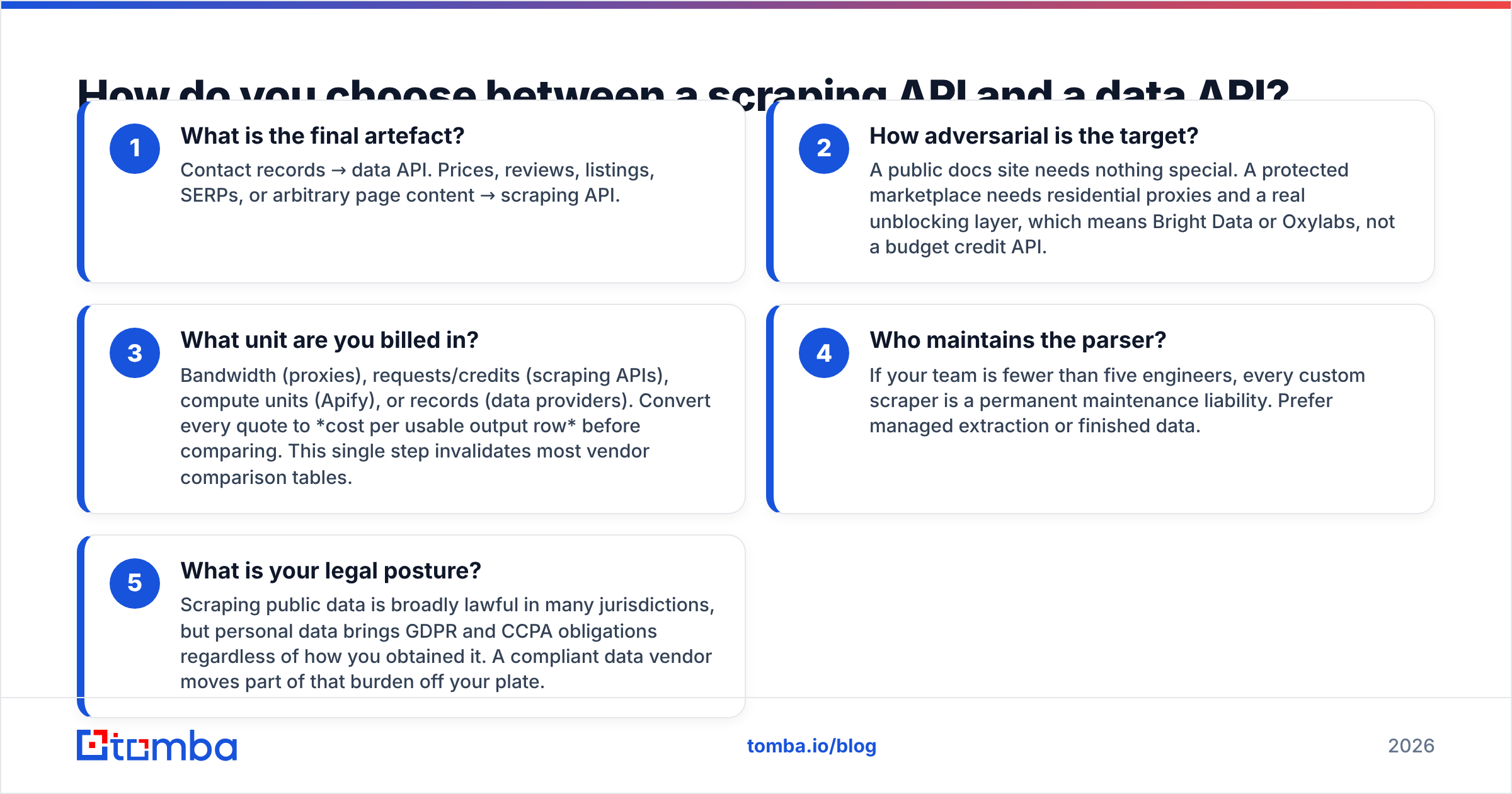
Run your project through these five questions. They resolve most of the decision in about ten minutes.
- What is the final artefact? Contact records → data API. Prices, reviews, listings, SERPs, or arbitrary page content → scraping API.
- How adversarial is the target? A public docs site needs nothing special. A protected marketplace needs residential proxies and a real unblocking layer, which means Bright Data or Oxylabs, not a budget credit API.
- What unit are you billed in? Bandwidth (proxies), requests/credits (scraping APIs), compute units (Apify), or records (data providers). Convert every quote to cost per usable output row before comparing. This single step invalidates most vendor comparison tables.
- Who maintains the parser? If your team is fewer than five engineers, every custom scraper is a permanent maintenance liability. Prefer managed extraction or finished data.
- What is your legal posture? Scraping public data is broadly lawful in many jurisdictions, but personal data brings GDPR and CCPA obligations regardless of how you obtained it. A compliant data vendor moves part of that burden off your plate.
What does each option really cost per usable row?#
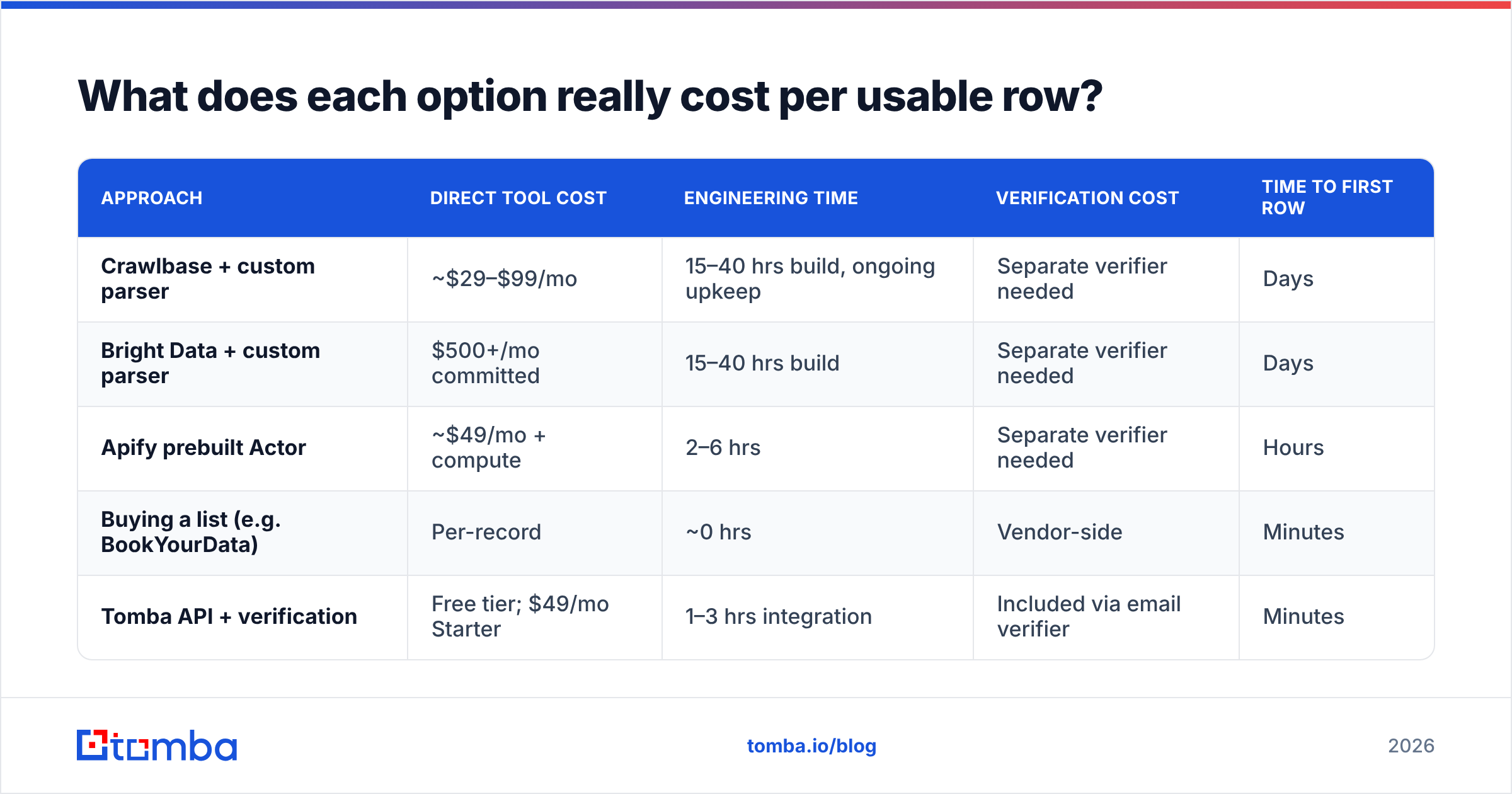
The headline monthly price is close to meaningless. Here is a more useful frame — a hypothetical job of building a 10,000-contact prospect list from company websites.
| Approach | Direct tool cost | Engineering time | Verification cost | Time to first row |
|---|---|---|---|---|
| Crawlbase + custom parser | ~$29–$99/mo | 15–40 hrs build, ongoing upkeep | Separate verifier needed | Days |
| Bright Data + custom parser | $500+/mo committed | 15–40 hrs build | Separate verifier needed | Days |
| Apify prebuilt Actor | ~$49/mo + compute | 2–6 hrs | Separate verifier needed | Hours |
| Buying a list (e.g. BookYourData) | Per-record | ~0 hrs | Vendor-side | Minutes |
| Tomba API + verification | Free tier; $49/mo Starter | 1–3 hrs integration | Included via email verifier | Minutes |
The row that surprises people is engineering time. A scraping API at $29/mo that costs a developer twenty hours to wire up and four hours a month to keep alive is not a $29/mo tool. At any realistic loaded engineering rate, it is the most expensive line in the table.
Is Crawlbase still worth it in 2026?#
Yes — for the job it is built for. Crawlbase remains a sensible mid-market crawling API: cheaper than the enterprise proxy giants, more managed than running your own Scrapy cluster with rented IPs, with a free trial large enough to prove out a pipeline before you spend anything.
Where it loses is at the two extremes. At the hard end, hardened anti-bot targets favour Bright Data or Oxylabs. At the easy end, if your only goal is B2B contacts, any general-purpose scraper is a detour — you are building infrastructure to solve a problem that is already solved as a product.
The honest summary: Crawlbase is a good scraper and a poor lead-gen strategy. Which of those you needed was decided before you ever compared vendors.
What should you do next?#
Audit the last three scraping projects your team shipped. For each, write down the output schema. If more than one of them ends in a column called email, you have been paying a scraping tax on a data problem.
Start with the free tier of Tomba's Email Finder — 25 searches a month, no card — and run it against ten target domains you have already scraped. Compare the contacts you get in ninety seconds against the ones your pipeline produced in a week. If Tomba wins, the Starter plan at $49/mo replaces a scraper, a proxy bill, and a verification step for less than most teams spend on proxies alone. And when a project genuinely does need general-purpose crawling, keep Crawlbase or one of the alternatives above for that — the right tool for each job beats one tool forced onto both.
Related guides#
// get started
Find, verify and enrich your first contacts today
Start on the free plan with 25 searches a month, then scale when your team is ready.
Free plan · No credit card required · GDPR & CCPA
Get the Tomba newsletter
Product and data updates
// about the author