Crawlnow Pricing Reviews Pros and Cons: The 2026 Breakdown
Crawlnow promises faster crawling and indexing without the SEO busywork. Here is what the plans actually cost, where the tool earns its keep, and the three cases where a cheaper stack beats it outright.
Crawlnow pricing reviews pros and cons, all in one place: what each tier costs, what users report, and when a cheaper stack wins. Short answer — buy it if you publish at volume. Skip it if your growth comes from outbound.
TL;DR
- Crawlnow does one job well. It gets your URLs discovered, crawled, and indexed faster than an organic crawl cycle would. It is a crawl-and-index layer, not an all-in-one SEO suite.
- Pricing is credit-based. You pay by URLs submitted or pages crawled per month. There is a free tier for testing, and paid tiers scale by volume. Check the live pricing page before you budget — this category re-prices often.
- The sticker price is rarely the real cost. Overage credits, per-domain limits, and the fact that no vendor can promise indexing are what bite.
And the reviews say
- Reviews skew positive on speed and setup time. They skew negative on "guaranteed indexing" claims and on support at the entry tier.
- If your goal is pipeline rather than page indexing, a crawl tool is the wrong line item. Pair a lean crawl budget with a contact data layer like the Tomba Email Finder and spend the difference on outreach.
What is Crawlnow, exactly?#
Crawlnow is a crawl-and-index acceleration tool. You point it at a domain or a list of URLs, it pings search engines through the available submission channels (IndexNow, sitemap pings, API-based submission where supported), monitors whether those URLs get picked up, and reports back on crawl and index status over time.
Think of it like a courier for your sitemap. Search engines will eventually find your new pages on their own, the same way mail eventually reaches you. Crawlnow is the courier that walks the envelope to the door and tells you when it was opened. It does not decide whether the recipient likes what is inside — that is still your content's job.
That distinction matters because it explains both the pros and the cons that follow. Crawlnow can reliably compress discovery time. It cannot force indexing, and no vendor can. Google's own Search Central documentation is blunt about this: submission is a request, not a command.
How does Crawlnow pricing actually work?#
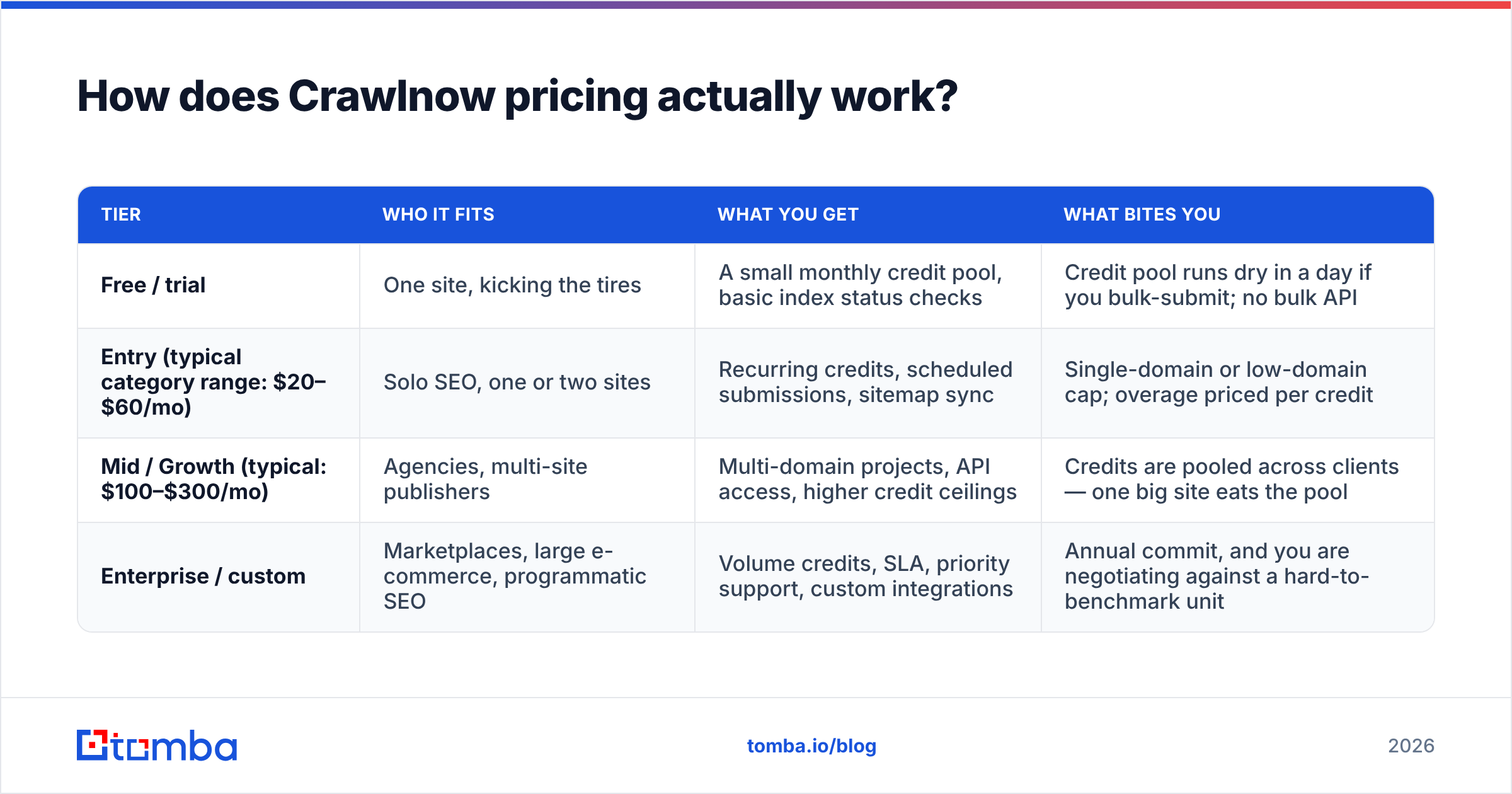
Crawlnow prices on volume, not seats. The unit is a URL submission or crawl credit, refreshed monthly, with limits on how many domains or projects you can attach to a plan.
Here is the shape of the plan ladder. Exact dollar figures move — verify them on the vendor's page before you sign anything — but the structure below is what you are buying:
| Tier | Who it fits | What you get | What bites you |
|---|---|---|---|
| Free / trial | One site, kicking the tires | A small monthly credit pool, basic index status checks | Credit pool runs dry in a day if you bulk-submit; no bulk API |
| Entry (typical category range: $20–$60/mo) | Solo SEO, one or two sites | Recurring credits, scheduled submissions, sitemap sync | Single-domain or low-domain cap; overage priced per credit |
| Mid / Growth (typical: $100–$300/mo) | Agencies, multi-site publishers | Multi-domain projects, API access, higher credit ceilings | Credits are pooled across clients — one big site eats the pool |
| Enterprise / custom | Marketplaces, large e-commerce, programmatic SEO | Volume credits, SLA, priority support, custom integrations | Annual commit, and you are negotiating against a hard-to-benchmark unit |
Two rules of thumb before you pick a tier:
- Estimate credits from page velocity, not page count. If you publish 40 URLs a month, you do not need a 100,000-credit plan. If you run programmatic SEO and ship 10,000 URLs a week, the entry tier is theatre.
- Model the overage, not the base. Every credit-based tool in this category makes its margin on the month you go over. Ask what a credit costs outside the bundle.

What do Crawlnow reviews actually say?#
Most Crawlnow pricing reviews pros and cons write-ups lean on a thin sample. Review volume is still low next to legacy SEO tools. So treat scores on G2 and Capterra as directional, not definitive. Read across user reports and the same themes recur:
What users praise
- Setup is genuinely fast. Connect a domain, sync the sitemap, done. Most reviewers report being live in under 20 minutes, which is not something you can say about a full technical-SEO platform.
- Discovery time drops measurably. Users publishing new URLs report faster first-crawl on engines that honour push-based submission. This is the core promise and it mostly lands.
- The dashboard answers the one question you have. "Did this URL get crawled, and did it get indexed?" — surfaced clearly, without you living inside Search Console.
What users complain about
- "Indexing guaranteed" framing. The loudest negative reviews across this whole tool category come from people who expected indexation and got crawling. Crawling is a request; indexation is a quality judgment. If a page is thin, no submission tool saves it.
- Credit burn is surprising. Re-submitting a URL after an update consumes credits again. Bulk operations drain a month's pool quickly.
- Support at the entry tier. Slower response times below the Growth plan is a recurring gripe, which is typical for volume-priced SaaS.
The honest read: reviewers who bought Crawlnow as a discovery accelerator are happy. Reviewers who bought it as an SEO strategy are not.
What are the real pros and cons of Crawlnow?#
Pros
- Single-purpose clarity. It does crawl submission and index monitoring. It is not trying to be a rank tracker, a backlink tool, and a CRM at once — and it prices accordingly.
- Low time-to-value. Sitemap in, status out. No onboarding call required.
- API access on paid tiers. If you run programmatic SEO or a headless CMS, submission can be a build-step, not a chore someone forgets.
- Multi-domain support for agencies. One dashboard across client sites is a real workflow win.
Cons
- It cannot guarantee indexation — and any marketing that implies otherwise should lower your trust, not raise it.
- Credit accounting is opaque until you're inside. Resubmissions, retries, and failed fetches may all draw down the pool.
- Overlap with free tooling. IndexNow is an open protocol. Search Console lets you submit sitemaps and inspect URLs at zero cost. You are paying for automation, monitoring, and scale — decide whether that is worth the line item.
- It solves a top-of-funnel traffic problem, not a pipeline problem. Faster indexing does nothing if the pages that get indexed do not convert, and nothing at all if your growth model is outbound rather than inbound.
Is Crawlnow worth it compared with the alternatives?#
Most Crawlnow pricing reviews pros and cons comparisons stop at rival crawl tools. That is too narrow. The right comparison set is everything else you could buy with the same budget to reach the same outcome — more qualified traffic, more conversations, more pipeline.
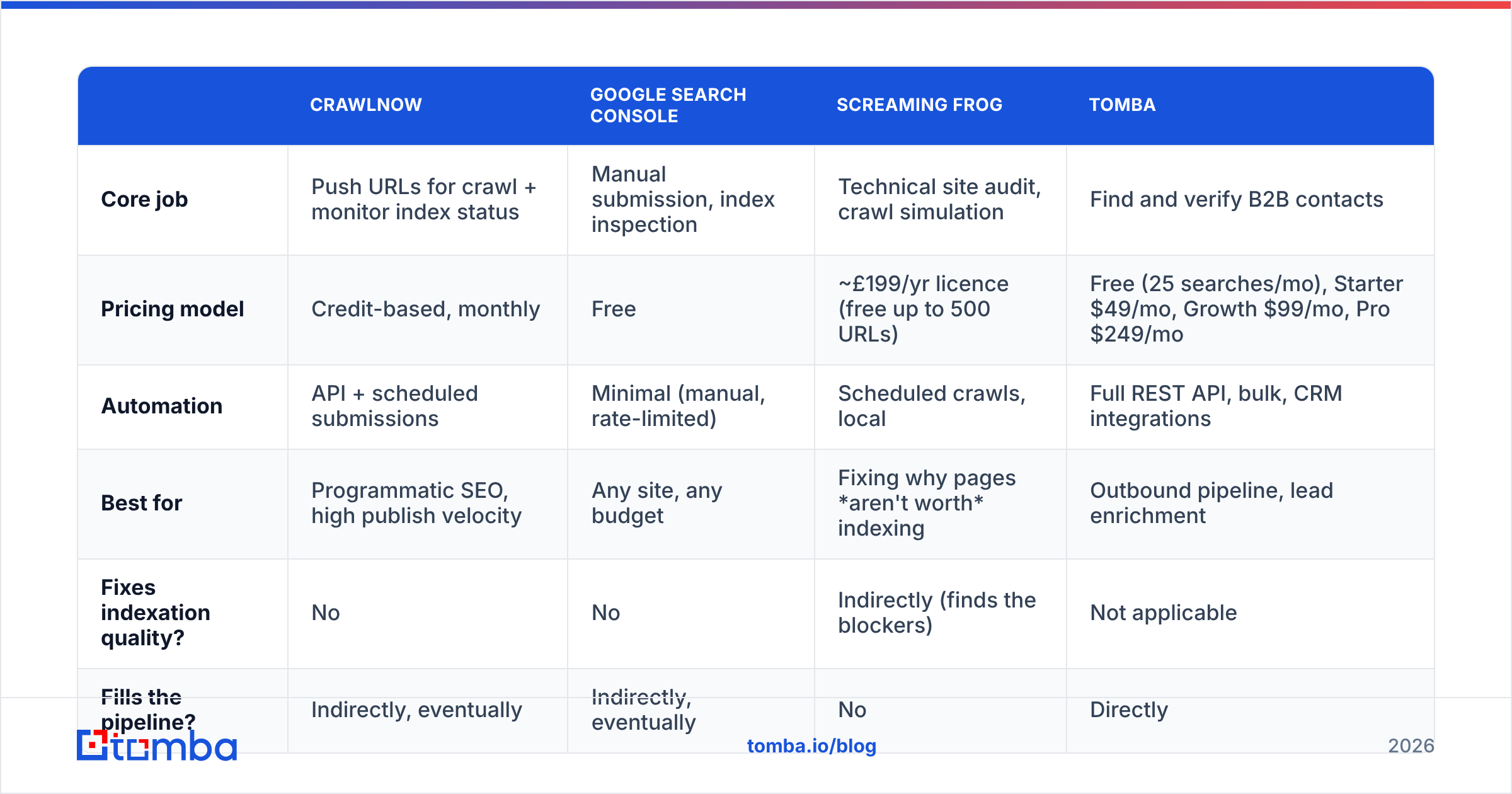
| Crawlnow | Google Search Console | Screaming Frog | Tomba | |
|---|---|---|---|---|
| Core job | Push URLs for crawl + monitor index status | Manual submission, index inspection | Technical site audit, crawl simulation | Find and verify B2B contacts |
| Pricing model | Credit-based, monthly | Free | ~£199/yr licence (free up to 500 URLs) | Free (25 searches/mo), Starter $49/mo, Growth $99/mo, Pro $249/mo |
| Automation | API + scheduled submissions | Minimal (manual, rate-limited) | Scheduled crawls, local | Full REST API, bulk, CRM integrations |
| Best for | Programmatic SEO, high publish velocity | Any site, any budget | Fixing why pages aren't worth indexing | Outbound pipeline, lead enrichment |
| Fixes indexation quality? | No | No | Indirectly (finds the blockers) | Not applicable |
| Fills the pipeline? | Indirectly, eventually | Indirectly, eventually | No | Directly |
Read that table honestly and a decision tree falls out:
- You ship fewer than ~50 URLs a month? Search Console plus a clean sitemap is enough. Skip the subscription.
- Pages get crawled but not indexed? Your problem is content quality or duplication. Screaming Frog or a technical audit will find it. Crawlnow will not.
- You ship hundreds or thousands of URLs and discovery lag is measurably costing revenue? This is the case where Crawlnow's entry or Growth tier pays for itself. Buy it, cap the credits, and monitor overage.
- Your revenue comes from outbound, not organic? Every dollar in crawl tooling is a dollar not spent on contact data and sequences. That is the trade nobody puts on the pricing page.
What does Crawlnow cost you beyond the subscription?#
Four hidden costs to underwrite before you commit:
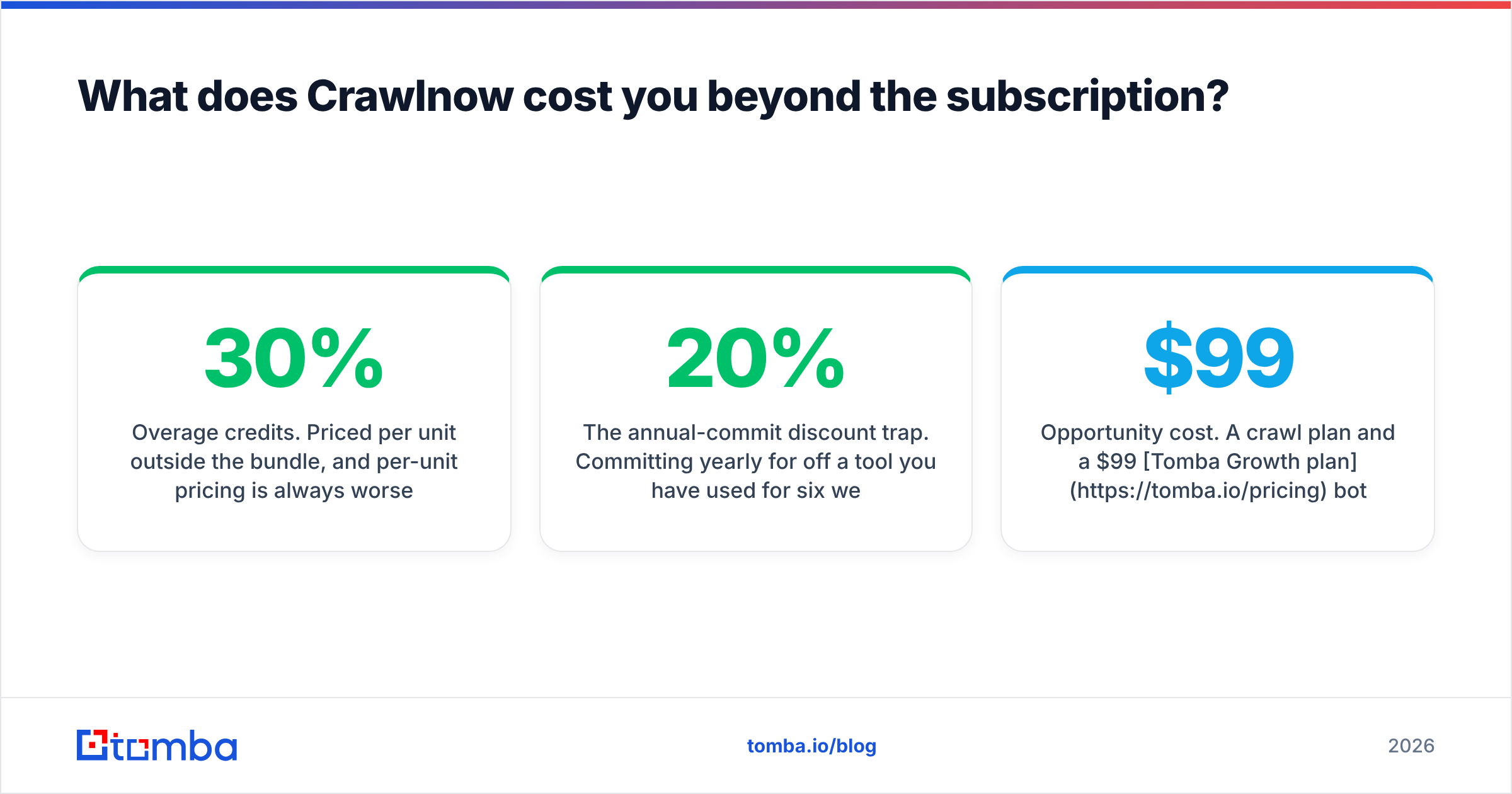
- Overage credits. Priced per unit outside the bundle, and per-unit pricing is always worse than bundled. Model a 30% overshoot month and see what it does to the bill.
- Resubmission churn. Update a page, spend a credit. Sites with frequent content refreshes burn far more than their raw URL count implies.
- The annual-commit discount trap. Committing yearly for 20% off a tool you have used for six weeks is how SaaS budgets rot. Run monthly until you have two clean months of data.
- Opportunity cost. A $99/mo crawl plan and a $99/mo Tomba Growth plan both cost $99. Only one of them puts a named, verified decision-maker in your outbox this afternoon.
When should you skip Crawlnow entirely?#
Skip it if any of these are true:
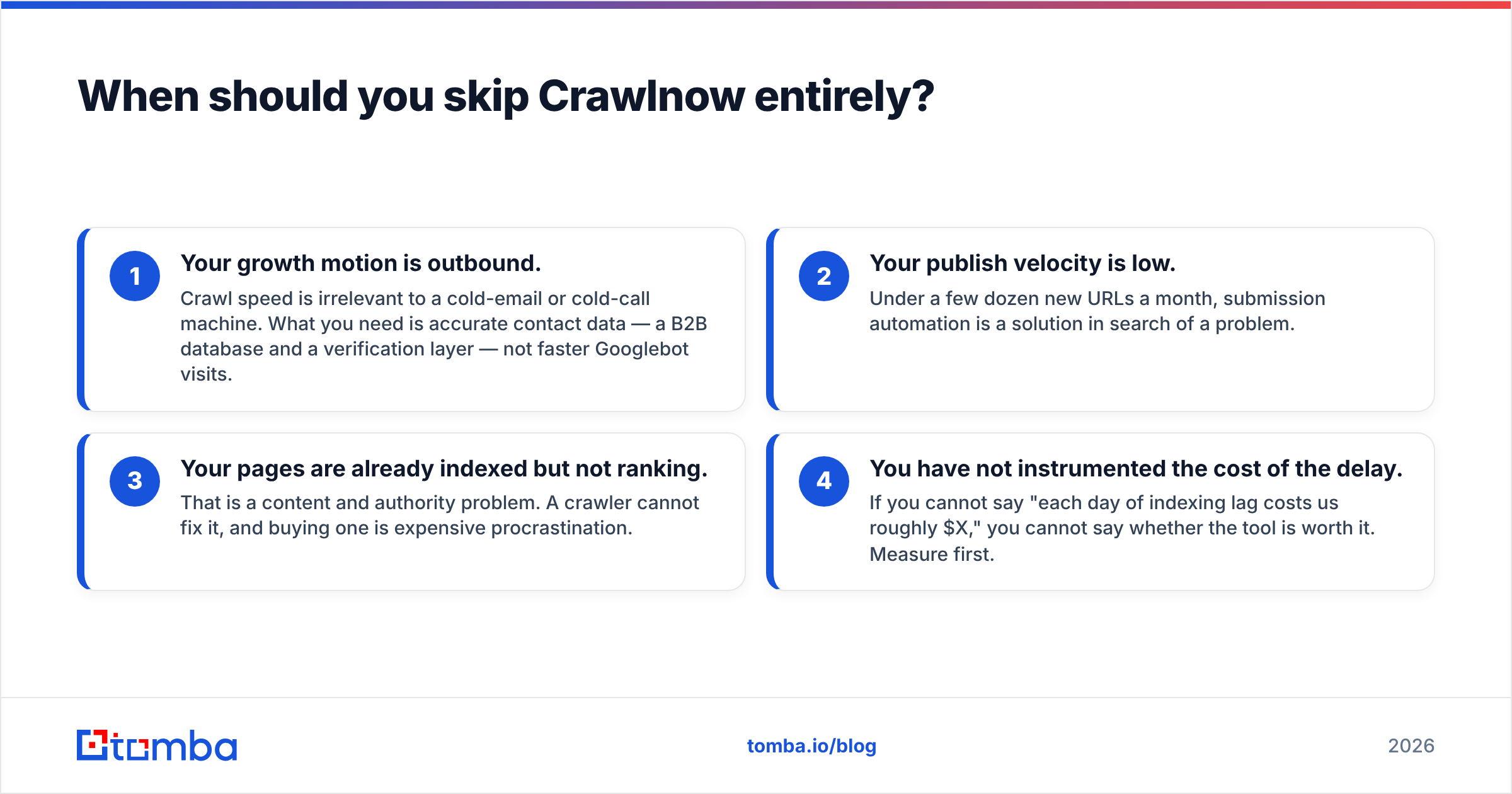
- Your growth motion is outbound. Crawl speed is irrelevant to a cold-email or cold-call machine. What you need is accurate contact data — a B2B database and a verification layer — not faster Googlebot visits.
- Your publish velocity is low. Under a few dozen new URLs a month, submission automation is a solution in search of a problem.
- Your pages are already indexed but not ranking. That is a content and authority problem. A crawler cannot fix it, and buying one is expensive procrastination.
- You have not instrumented the cost of the delay. If you cannot say "each day of indexing lag costs us roughly $X," you cannot say whether the tool is worth it. Measure first.
How do you build a stack where crawl speed actually pays off?#
Crawl tooling only earns its keep as one layer in a system where the other layers are already working. A sane 2026 stack looks like this:
- Technical hygiene first. Clean sitemap, no orphan pages, sane internal linking, no duplicate canonical chaos. Free to fix, and it removes most of the reasons pages fail to index.
- Push-based submission second. This is where Crawlnow or the raw IndexNow protocol slots in. Automate it inside your deploy pipeline so nobody has to remember it.
- Contact data third. Organic traffic is anonymous by default. Turning it into revenue means identifying who is on the other side — through website visitor reveal, lead capture, or straightforward outbound to the same ICP you are writing for.
- Verification always. Whether the address came from a form fill or a prospecting list, run it through an email verifier before it touches a sending domain. Bounce rates kill sender reputation faster than any crawl delay kills traffic.
The pattern that separates teams who win from teams who buy tools: they treat indexing as a plumbing problem with a fixed, capped budget, and they put the marginal dollar into pipeline.
Crawlnow pricing reviews pros and cons: the final verdict#
Here is where the Crawlnow pricing reviews pros and cons debate lands in 2026.
Buy it if you publish at volume, you have measured a real discovery lag, and you want that automated inside your build pipeline. At the entry-to-Growth range it is a defensible line item. Reviewers who use it that way are happy.
Don't buy it if you hope it will make mediocre pages rank, if your publish velocity is modest, or if your revenue comes from outbound. In those cases you are paying a subscription to solve a problem you do not have.
And be sceptical of any indexing tool — Crawlnow included — that markets a guarantee. Discovery can be accelerated. Indexation is earned.
If pipeline is the goal, start where the pipeline starts. Crawling gets your pages found; it does not get your emails answered. Tomba's Email Finder turns a company domain and a name into a verified, deliverable work address in seconds — with a free tier at 25 searches a month, Starter at $49/mo, and Growth at $99/mo when you are ready to scale. Point it at the accounts you actually want, verify before you send, and let the crawler worry about Googlebot.
Related guides#
Ready to find emails that actually work?
Join 150,000+ professionals who stopped guessing and started sending. Free credits on signup — no credit card required.
Get the Tomba newsletter
Practical outbound tactics and product updates — once every two weeks.
About the author