Crayon Alternatives: 9 Competitive Intel Tools for 2026
Crayon is a strong competitive intelligence platform with a quote-only price tag. Here are nine Crayon alternatives — from enterprise battlecard suites to $20/mo page monitors — scored on price, data depth, and who actually uses the output.
TL;DR
- Crayon is a legitimate competitive intelligence (CI) platform — automated competitor tracking, battlecards, and win/loss reporting. Its main friction points are quote-only pricing (buyers commonly report five figures a year), a heavy setup lift, and the fact that most of the intel never reaches a rep mid-deal.
- The best Crayon alternative depends on what you actually need: battlecard enablement (Klue, Kompyte), market/news intelligence (Contify, AlphaSense), digital market share (Similarweb), or cheap change monitoring (Visualping, Competitors App).
- If you're paying enterprise CI money mostly to watch competitor pricing pages change, a $20/mo monitor plus a shared Slack channel gets you 80% of the value.
- Competitive intel is only worth what you do with it. The missing layer for most teams isn't more dashboards — it's contact data to reach the accounts your competitor is losing. That's where a tool like Tomba fits alongside, not instead of, a CI platform.
- Realistic budget bands: $0–$50/mo (monitoring), $200–$1,000/mo (mid-market CI), $15k+/yr (enterprise CI suites).
What is Crayon and what does it actually do?#
Crayon is a competitive intelligence platform. It crawls your competitors' public surface — websites, pricing pages, review sites, job postings, ad libraries, social posts, news mentions — and turns the stream of changes into a feed. Analysts curate that feed into battlecards: one-page objection-handling docs that live inside Salesforce, HubSpot, Slack, or a Chrome extension so a rep can pull them up mid-call.
It also does win/loss analysis, competitive newsletters, and adoption reporting so the CI team can prove reps are actually opening the cards.
That's the honest picture: Crayon is not a scraper toy. It's a CI program in software form, and it's usually bought by a dedicated product marketing manager (PMM) or a competitive intelligence lead at a company with 100+ reps.
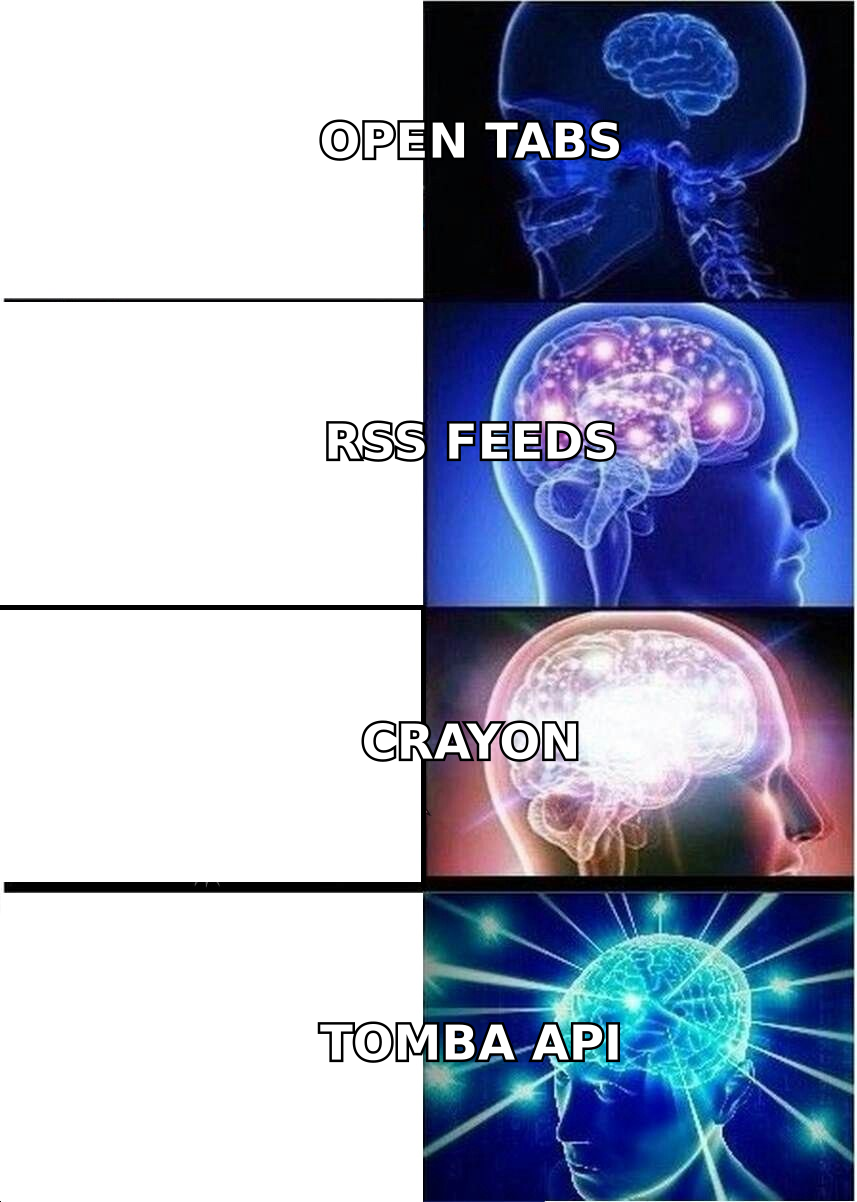
Which is also the core reason people search for Crayon alternatives. If you don't have a full-time PMM to curate the feed, you're buying an expensive firehose.
Why do teams look for Crayon alternatives?#
Four reasons come up over and over in G2 reviews and buyer conversations:
- Quote-only pricing. Crayon doesn't publish a price. Buyers commonly report annual contracts in the mid-five figures, with the exact number depending on competitor count, seats, and modules. There's no self-serve tier to test with, and no public number to benchmark against.
- Noise-to-signal ratio. Automated capture means hundreds of "changes" a week — a footer tweak, a reworded H1, a new headshot. Someone has to triage. Without that someone, the feed rots.
- Adoption cliff. Battlecards only pay off if reps open them during live deals. If your team is 12 AEs who already know the two competitors cold, the platform is solving a problem you don't have.
- Overlap with tools you already own. Job-posting signals, tech-stack detection, and ad monitoring exist in cheaper single-purpose tools. If you only need one of those, you're paying for a suite.
Which Crayon alternatives are worth evaluating in 2026?#
Here's the shortlist, grouped by what job you're hiring the tool to do.
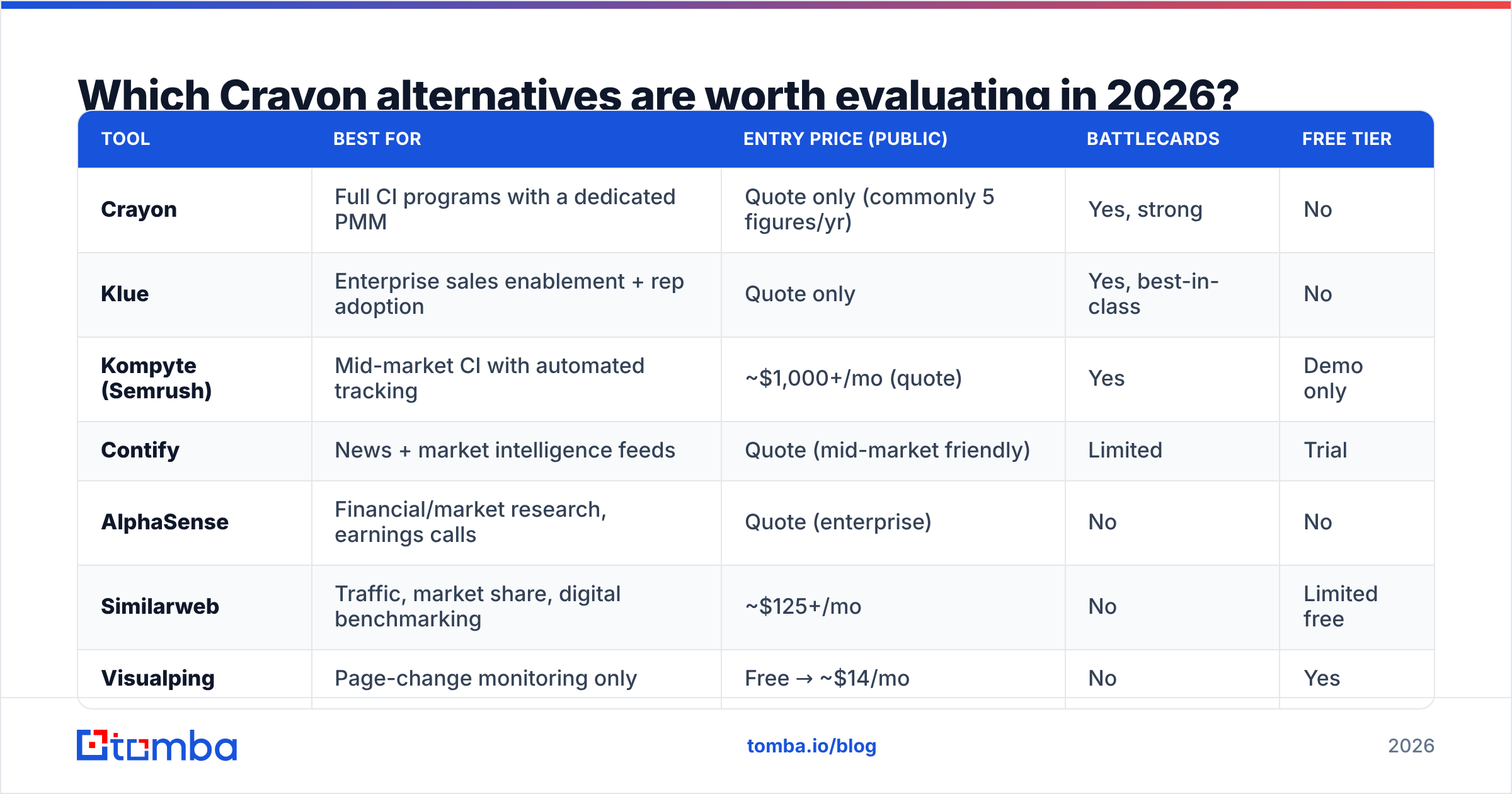
| Tool | Best for | Entry price (public) | Battlecards | Free tier |
|---|---|---|---|---|
| Crayon | Full CI programs with a dedicated PMM | Quote only (commonly 5 figures/yr) | Yes, strong | No |
| Klue | Enterprise sales enablement + rep adoption | Quote only | Yes, best-in-class | No |
| Kompyte (Semrush) | Mid-market CI with automated tracking | ~$1,000+/mo (quote) | Yes | Demo only |
| Contify | News + market intelligence feeds | Quote (mid-market friendly) | Limited | Trial |
| AlphaSense | Financial/market research, earnings calls | Quote (enterprise) | No | No |
| Similarweb | Traffic, market share, digital benchmarking | ~$125+/mo | No | Limited free |
| Visualping | Page-change monitoring only | Free → ~$14/mo | No | Yes |
| Competitors App | Budget all-in-one competitor monitoring | ~$19/mo | No | Trial |
| Tomba | Turning competitive signal into contacts | Free (25/mo), $49/mo Starter | No (not a CI tool) | Yes |
Prices are the publicly listed or commonly reported figures at time of writing. Anything marked "quote" means the vendor requires a sales conversation — treat any number you hear from a peer as directional, not a rate card.
Is Klue a better Crayon alternative?#
Klue is Crayon's closest competitor and the answer is: it depends on who consumes the output.
Klue leans harder into sales enablement. Its battlecard UX inside CRM and Slack is generally considered the strongest in the category, and its "compete" reporting is built to show which cards influenced which closed-won deals. If your CI problem is "we have intel, reps ignore it," Klue is the sharper instrument.
Crayon leans harder into capture breadth and analyst workflow. If your problem is "we don't know what our 14 competitors are doing," Crayon's feed and curation tooling is excellent.
Both are quote-only and both land in the same budget bracket. Switching from Crayon to Klue to save money is not a real strategy — switching to fix adoption might be.
When to pick Klue:
- You have 50+ reps and measurable competitive loss rate
- A PMM owns the program and will curate weekly
- You need win/loss tied to CRM opportunity data
When to stay on Crayon:
- You track many competitors across many surfaces
- Your CI team values raw capture over polished cards
- You're mid-contract and adoption is already healthy
What if you need CI without an enterprise contract?#
This is where most searchers actually land. Three tiers of "good enough":
- Kompyte (now part of Semrush) — The most credible mid-market swap. Automated competitor tracking, auto-generated battlecards, Slack/CRM delivery. Priced below the enterprise suites but still a real contract, not a credit card signup. Best fit: 20–100 rep companies with a marketer who owns compete part-time.
- Contify — Strong on news and market intelligence rather than product-change tracking. If your competitive risk lives in funding rounds, partnerships, exec hires, and regulatory moves — not pricing-page edits — Contify is the better shape. It's also the friendlier option for consulting, financial services, and manufacturing, where "competitor" means a market, not a SaaS pricing page.
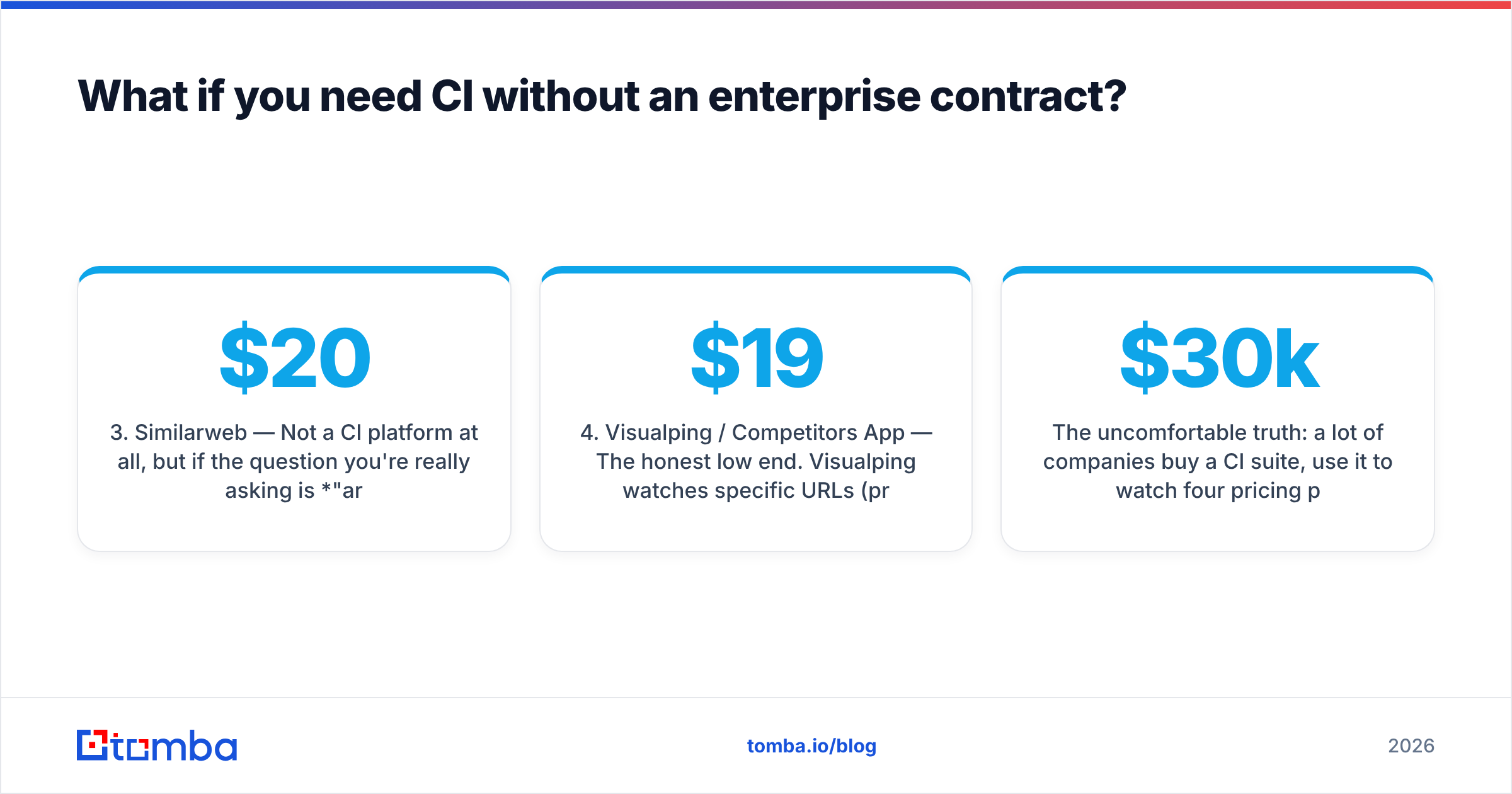
- Similarweb — Not a CI platform at all, but if the question you're really asking is "are we gaining or losing share?", Similarweb answers it with traffic, keyword, and channel-mix data you can benchmark quarterly. Many teams pair Similarweb with a $20 change monitor and skip the CI suite entirely.
- Visualping / Competitors App — The honest low end. Visualping watches specific URLs (pricing, features, careers) and pings you when pixels change. Competitors App bundles website, email, ad, and social monitoring for around $19–$99/mo. Neither builds battlecards. Both cover the single use case that drives most CI purchases in the first place.
- BuiltWith / Wappalyzer — Tech-stack intelligence. Useful when your competitive story is "they're still on legacy X" or when you want to build a target list of accounts running a competitor's tag.
The uncomfortable truth: a lot of companies buy a $30k CI suite, use it to watch four pricing pages, and email a monthly PDF nobody reads. If that describes you, a $14/mo monitor and a disciplined Slack channel will outperform the suite — because the intel will actually be short enough to read.

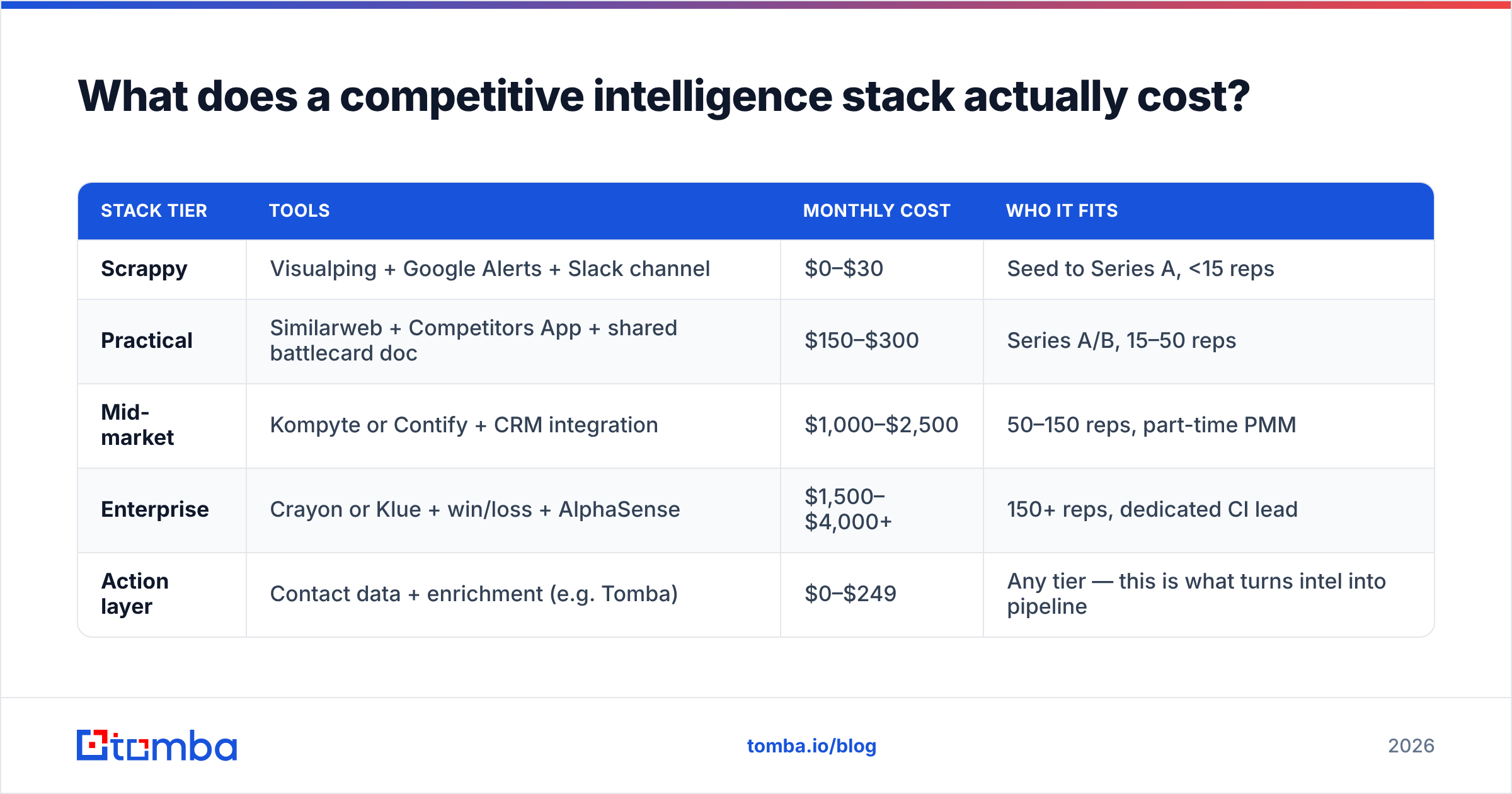
What does a competitive intelligence stack actually cost?#
| Stack tier | Tools | Monthly cost | Who it fits |
|---|---|---|---|
| Scrappy | Visualping + Google Alerts + Slack channel | $0–$30 | Seed to Series A, <15 reps |
| Practical | Similarweb + Competitors App + shared battlecard doc | $150–$300 | Series A/B, 15–50 reps |
| Mid-market | Kompyte or Contify + CRM integration | $1,000–$2,500 | 50–150 reps, part-time PMM |
| Enterprise | Crayon or Klue + win/loss + AlphaSense | $1,500–$4,000+ | 150+ reps, dedicated CI lead |
| Action layer | Contact data + enrichment (e.g. Tomba) | $0–$249 | Any tier — this is what turns intel into pipeline |
Note the last row. It's the one most CI evaluations skip.
What's the piece every CI tool leaves out?#
Contacts. Every competitive intelligence platform tells you what changed. None of them tell you who to email about it.
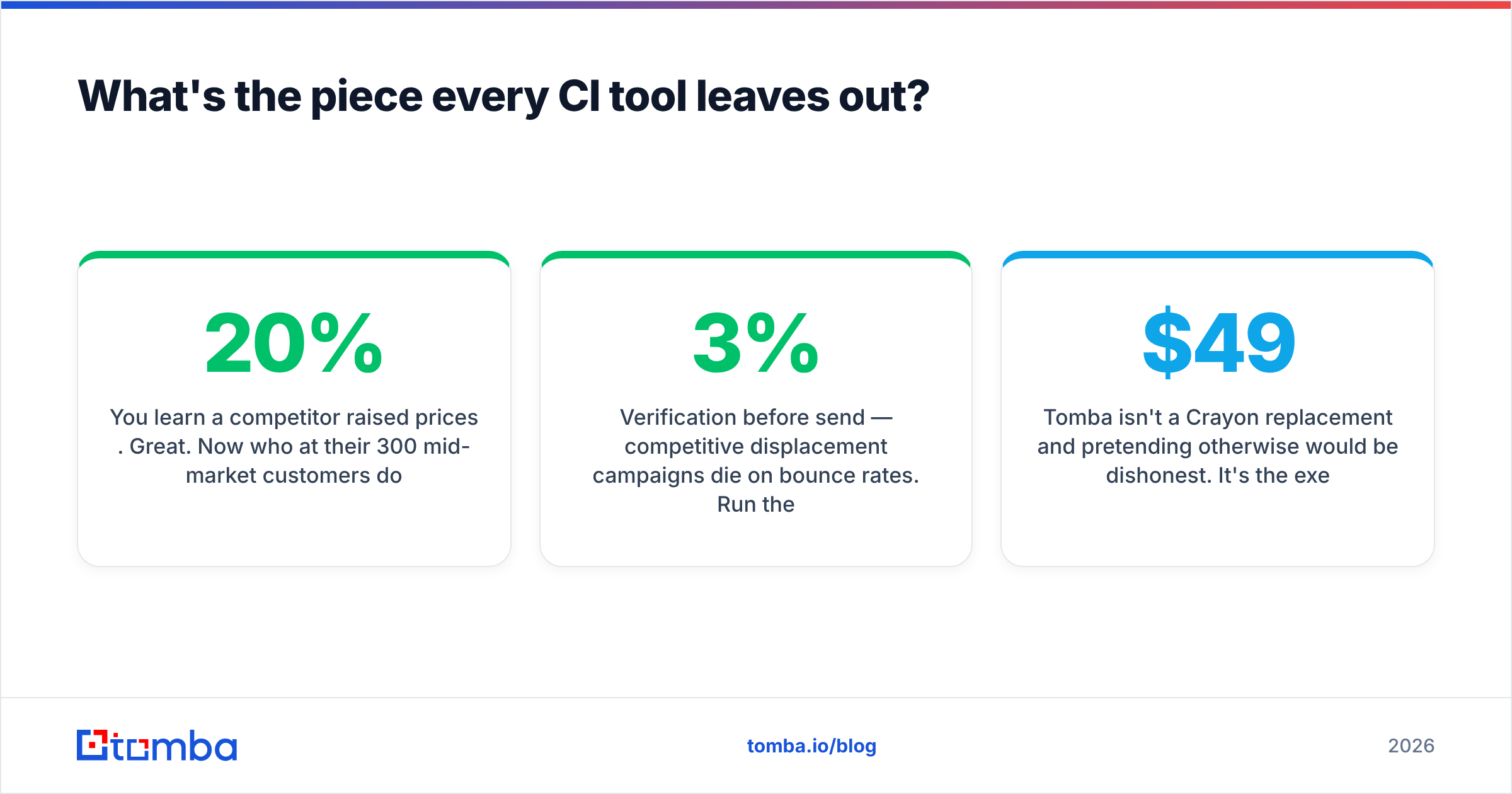
You learn a competitor raised prices 20%. Great. Now who at their 300 mid-market customers do you actually reach? You learn they killed a product line. Who owned that product internally, and who are the champions now shopping? You learn a competitor's key AE just left. Which accounts are suddenly unowned?
CI produces a signal. Pipeline requires a person with an inbox. The gap between those two things is where most compete programs die — the PMM ships a beautiful teardown, the reps nod, and nothing gets sent.
That's the layer to budget for, and it's cheap relative to the suite:
- Domain search — pull every discoverable email at a target company, with role and department, so you can build a "displacement list" the day a competitor stumbles.
- Data enrichment — take a flat list of company names from your CI feed (new logos your competitor announced, accounts on their case-study page) and turn it into contactable rows with titles and verified emails.
- Website visitor reveal — identify the companies already comparison-shopping you against a competitor before they ever fill out a form. That's first-party competitive intel your CI platform can't see.
- Verification before send — competitive displacement campaigns die on bounce rates. Run the list through an email verifier first; a 3%+ bounce rate on a cold domain will cost you more than the intel was worth.
Tomba isn't a Crayon replacement and pretending otherwise would be dishonest. It's the execution layer that sits downstream of whichever CI tool you pick. Tomba pricing runs Free (25 searches/mo), Starter at $49/mo, Growth at $99/mo, and Pro at $249/mo — which is roughly a rounding error against an enterprise CI contract, and it's the part that produces revenue you can point at.
How should you actually choose?#
Run this in order. It takes an afternoon.
- Name the decision the intel changes. "We want to know what competitors are doing" is not a decision. "We want to cut our loss rate to Competitor X from 34% to 25%" is. If you can't name the decision, don't buy a platform yet.
- Count your real competitors. Under five? A monitor plus a doc is enough. Over ten across multiple segments? You need a suite.
- Identify the curator. If no named human owns triage for at least four hours a week, an enterprise CI tool will fail on adoption regardless of vendor. Buy the cheap tier instead.
- Check where the output lands. If reps live in Slack, buy the tool with the best Slack card. If they live in Salesforce, buy the tool with the best CRM embed. This single question eliminates half the shortlist.
- Budget the action layer. Reserve 5–10% of the CI budget for contact data and verification. Intel with no route to a human is a newsletter.
- Negotiate the quote. Both Crayon and Klue discount meaningfully on multi-year and at end-of-quarter. The first number is not the number.
Frequently asked questions#
Is there a free Crayon alternative? Not a full one. Visualping has a free tier for a handful of URLs, Similarweb has a limited free view, and Google Alerts costs nothing. Stitched together they replicate the monitoring layer — not battlecards, not win/loss.
Is Crayon worth the money? For a company with a dedicated CI lead, a double-digit competitive loss rate, and 100+ reps, yes — a two-point loss-rate improvement typically pays for it several times over. For a 20-person startup with two competitors, no.
What's the difference between Crayon and Klue? Crayon is stronger on breadth of automated capture and analyst workflow. Klue is stronger on rep-facing battlecards and adoption reporting. Both are quote-only, both are enterprise-priced.
Can I just use AI to scrape competitor sites? You can, and plenty of teams now run a scheduled agent against competitor pricing pages. It works for monitoring. It does not give you win/loss data, CRM-embedded cards, or the curation discipline that makes a compete program stick.
The move#
Pick your CI platform on the decision it changes and the human who will curate it — not on feature-list length. Crayon and Klue are the right answer for real CI programs. Kompyte and Contify are the right answer for mid-market. Visualping and Similarweb are the right answer for everyone else, and they're a tenth of the price.
Then close the loop. The moment your feed tells you a competitor raised prices, sunset a product, or lost an exec, you need names and inboxes at their accounts within hours — not a battlecard next quarter. Start with the Tomba Email Finder: free for your first 25 searches, $49/mo when you're ready to run displacement campaigns at volume, and it plugs into whichever CI tool you land on. Intel is the input. Pipeline is the point.
Related guides#
Ready to find emails that actually work?
Join 150,000+ professionals who stopped guessing and started sending. Free credits on signup — no credit card required.
Get the Tomba newsletter
Practical outbound tactics and product updates — once every two weeks.
About the author