Crayon vs Klue (2026): Which Competitive Intel Tool Wins?
Crayon and Klue both promise to win you more competitive deals. They get there very differently. Here is an honest breakdown of pricing, alerts, battlecards, and which one your team should actually buy in 2026.
TL;DR — Crayon vs Klue in 30 seconds#
- Crayon is the capture-everything engine. It monitors a huge volume of competitor web, pricing, review, and social signals, and it's the stronger pick if your problem is "we don't know what our competitors are doing."
- Klue is the enablement engine. It's built around getting curated intel into a rep's hands at the moment of the deal, and it's the stronger pick if your problem is "we have the intel, but nobody uses it."
- Neither publishes list pricing. Expect roughly $20k–$40k+/year for a real deployment of either, with Klue often quoted higher at enterprise scale.
- The deciding factor is almost never the feature grid. It's whether you have a person who owns competitive intel. No owner = both tools become expensive RSS feeds.
- Competitive intel only pays off if it lands on the right accounts and the right people — which is a data problem, not a monitoring problem.
What problem do Crayon and Klue actually solve?#
Competitive intelligence (CI) platforms exist because your competitors change their pricing page on a Tuesday and nobody on your revenue team finds out for six weeks. By then you've lost three deals to a discount you didn't know existed.
Both Crayon and Klue automate the same core loop:
- Collect — crawl competitor websites, pricing pages, job boards, review sites, ad libraries, news, and social.
- Curate — a human (usually a product marketer) decides what actually matters.
- Distribute — push the curated intel into battlecards, Slack, Teams, Salesforce, or HubSpot where reps live.
- Measure — tie competitive deals to win rates so you can prove CI moved the number.
The tools diverge on which of those four steps they were architected around. Crayon was built collection-first. Klue was built distribution-first. Everything else — pricing, onboarding effort, who ends up loving it — flows from that one difference.

How do Crayon and Klue compare head to head?#
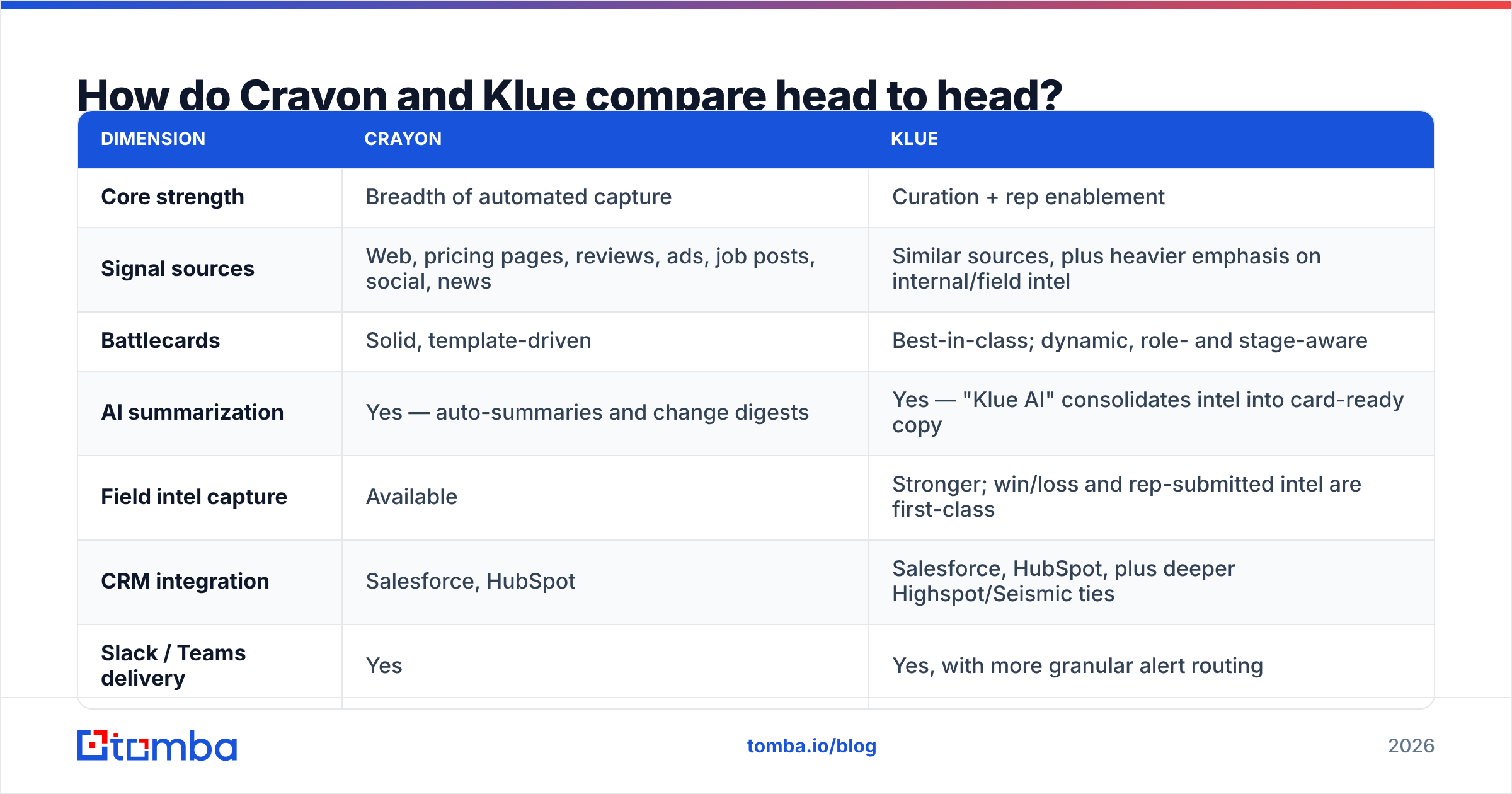
| Dimension | Crayon | Klue |
|---|---|---|
| Core strength | Breadth of automated capture | Curation + rep enablement |
| Signal sources | Web, pricing pages, reviews, ads, job posts, social, news | Similar sources, plus heavier emphasis on internal/field intel |
| Battlecards | Solid, template-driven | Best-in-class; dynamic, role- and stage-aware |
| AI summarization | Yes — auto-summaries and change digests | Yes — "Klue AI" consolidates intel into card-ready copy |
| Field intel capture | Available | Stronger; win/loss and rep-submitted intel are first-class |
| CRM integration | Salesforce, HubSpot | Salesforce, HubSpot, plus deeper Highspot/Seismic ties |
| Slack / Teams delivery | Yes | Yes, with more granular alert routing |
| Typical buyer | Product marketing at mid-market | Product marketing + enablement at enterprise |
| Pricing | Custom quote; commonly ~$20k–$30k/yr entry | Custom quote; commonly higher at enterprise tiers |
| Free trial | Demo-gated | Demo-gated |
| Time to first value | Faster — data starts flowing quickly | Slower — value depends on curation being staffed |
Read that table again and notice what's missing: there is no row where one tool has a capability the other completely lacks. This is a mature category. Both vendors have shipped every table-stakes feature. What you're actually buying is a philosophy about who does the work.
Is Crayon better than Klue for monitoring?#
Yes — if raw monitoring is the job to be done.
Crayon's pitch has always been volume. It tracks a very wide surface area per competitor and flags changes automatically, which means you find out that a rival quietly added a "Free" tier or removed a logo from their customer wall without anyone manually checking. For a lean team with no dedicated CI headcount, that automation is the difference between having a competitive program and having a Confluence page that was last edited in 2024.
Where Crayon gets criticized in G2 reviews is signal-to-noise. When a tool captures everything, someone has to decide what matters. If you don't have that someone, Crayon's inbox becomes another notification stream your team learns to ignore.
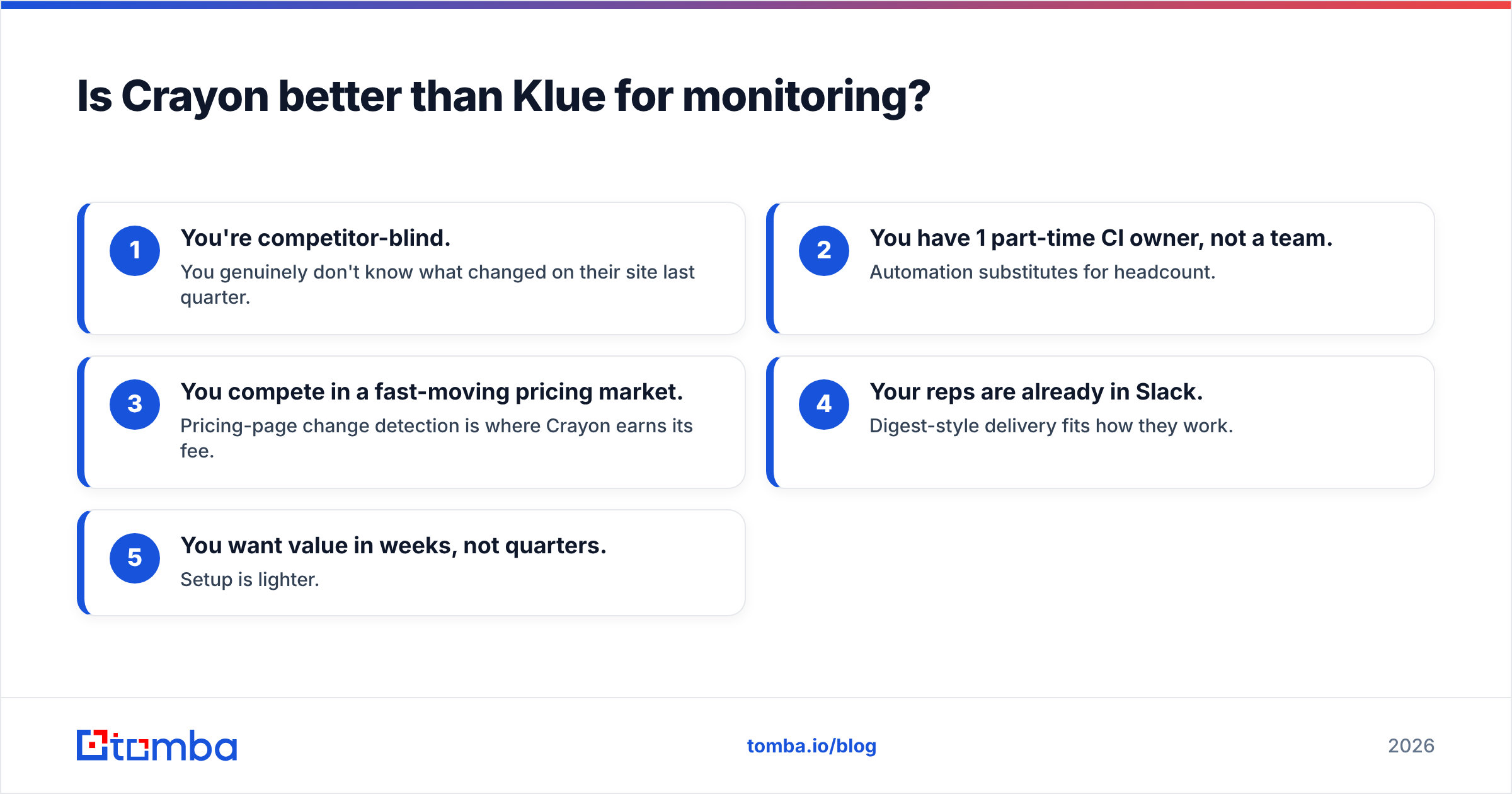
Choose Crayon when:
- You're competitor-blind. You genuinely don't know what changed on their site last quarter.
- You have 1 part-time CI owner, not a team. Automation substitutes for headcount.
- You compete in a fast-moving pricing market. Pricing-page change detection is where Crayon earns its fee.
- Your reps are already in Slack. Digest-style delivery fits how they work.
- You want value in weeks, not quarters. Setup is lighter.
Is Klue better than Crayon for sales enablement?#
Also yes — for a different job.
Klue's core insight is that intel nobody reads is worth zero. Its battlecards are the strongest in the category: they adapt by deal stage, by competitor, by persona, and they surface inside the CRM record rather than in a separate portal a rep has to remember exists. Klue also treats field intel — the "I just lost a deal to Competitor X and here's what they said" note from an AE — as a primary input, not an afterthought. That closes the loop between what the market says and what your battlecards claim.
The cost of that design is that Klue expects a human to curate. It rewards teams that have a product marketer whose job title actually includes competitive intelligence. Drop Klue into an org with no owner and you'll pay enterprise money for a very pretty empty card deck.
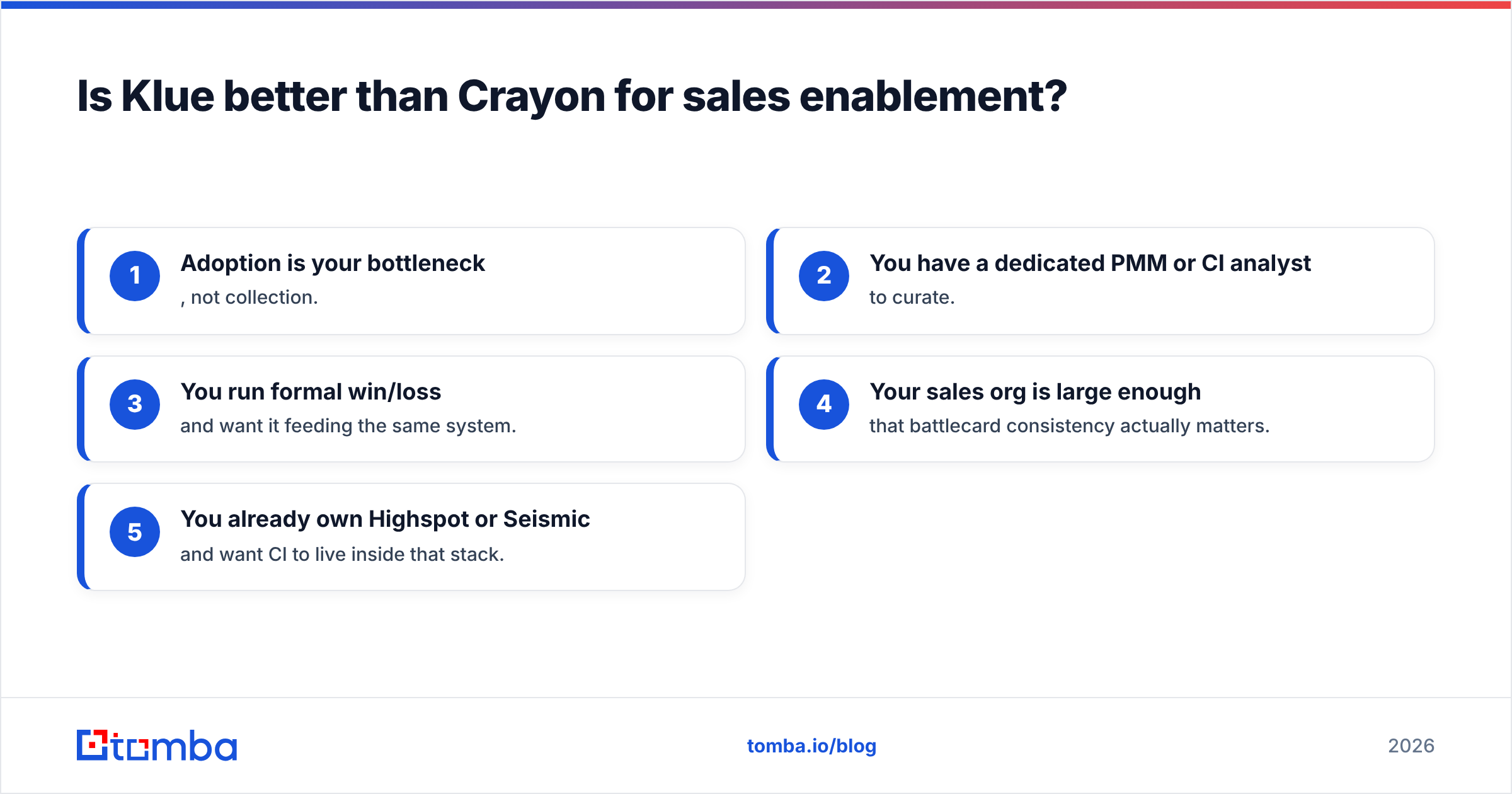
Choose Klue when:
- Adoption is your bottleneck, not collection.
- You have a dedicated PMM or CI analyst to curate.
- You run formal win/loss and want it feeding the same system.
- Your sales org is large enough that battlecard consistency actually matters.
- You already own Highspot or Seismic and want CI to live inside that stack.
What do Crayon and Klue actually cost in 2026?#
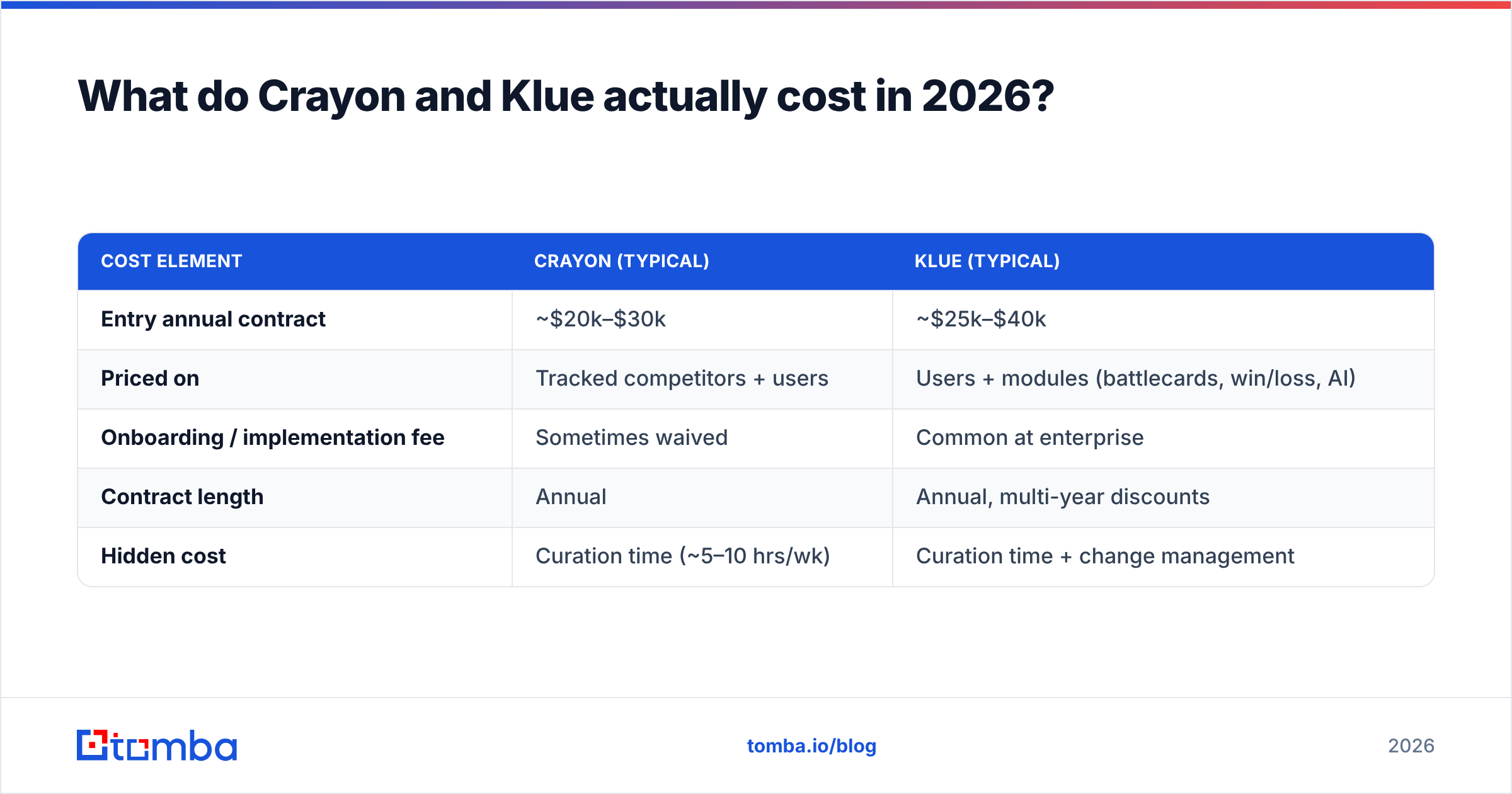
Neither publishes pricing, which is the single most common complaint about this category. Both route you through a demo, then quote based on seats, competitor count, and how many sources you want tracked.
From publicly reported ranges and buyer discussions, here's the honest shape of it:
| Cost element | Crayon (typical) | Klue (typical) |
|---|---|---|
| Entry annual contract | ~$20k–$30k | ~$25k–$40k |
| Priced on | Tracked competitors + users | Users + modules (battlecards, win/loss, AI) |
| Onboarding / implementation fee | Sometimes waived | Common at enterprise |
| Contract length | Annual | Annual, multi-year discounts |
| Hidden cost | Curation time (~5–10 hrs/wk) | Curation time + change management |
That last row is the one buyers underprice. The tool is not the expensive part — the human is. Budget for a person who spends at least half a day a week grooming intel, or don't buy either tool. Both vendors will tell you this privately; neither leads with it on the pricing page, because there is no pricing page.

Which one wins for a mid-market GTM team?#
Crayon, in most cases. Here's the reasoning, not just the verdict.
Mid-market teams (roughly 50–500 employees, 10–60 reps) almost never have a full-time competitive intelligence owner. They have a product marketer who also does launches, also does website copy, also does the analyst relations deck. For that person, automation beats curation tooling, because curation tooling assumes time they don't have. Crayon's automatic capture gives them a defensible program with a few hours a week.
Klue wins at enterprise, where a CI function actually exists, where 200+ reps need consistent messaging, and where the cost of one rep freelancing an answer about a competitor is a lost seven-figure deal.
And there's a third answer nobody sells you: neither, yet. If you don't have a repeatable outbound motion, a competitive intelligence platform is a solution to a problem you haven't earned. Fix pipeline first. A $30k CI contract on top of 40 leads a month is a rounding error against the cost of not having enough at-bats.
What do these tools not do?#
This is the part vendor comparison posts skip.
Crayon and Klue tell you what your competitor is doing and how to respond when you're already in a deal against them. They do not tell you who to contact or how to reach them. Competitive intel is an in-deal weapon; it is not a top-of-funnel engine.
That gap shows up in three concrete places:
- Competitor-customer targeting. You learn a rival raised prices 18%. Great — now you need contacts at the companies using them. CI platforms won't give you verified emails for those buyers.
- Displacement campaigns. A competitor announces they're sunsetting a product. That's a 60-day window. You need a clean, verified contact list today, not next quarter.
- Signal-to-send latency. The value of a competitive signal decays fast. If it takes you three weeks to build the list, the signal is dead.
This is where a B2B database and an email finder sit next to your CI stack rather than compete with it. You use Crayon or Klue to find the why, and a contact-data layer to find the who. Teams that pair the two see competitive intel convert into meetings; teams that buy CI alone see it convert into slide decks.
How do you build the full competitive stack?#
A workable 2026 stack looks like this:
- Monitoring layer — Crayon or Klue, per the logic above. This is your radar.
- Enablement layer — battlecards delivered in-CRM. Klue natively; Crayon plus Highspot/Seismic if you already own one.
- Targeting layer — a contact database with real coverage of the accounts your CI flags. Use domain search to pull the decision-makers at a competitor's customer list, then run them through an email verifier before anything goes out.
- Deliverability layer — displacement campaigns are cold email by another name. Bounce rates above 3% will torch your sender reputation faster than any competitor can.
- Measurement layer — competitive win rate, tracked in the CRM. If you can't tie CI to win rate, you can't renew the contract.
Most teams buy layer 1, skip layer 3, and then wonder why their competitive program produced insight but no revenue. The insight was never the constraint.
Crayon vs Klue: the final call#
| If your situation is… | Buy |
|---|---|
| No CI owner, need automation to substitute for headcount | Crayon |
| Dedicated PMM/CI analyst, adoption is the problem | Klue |
| 200+ reps, message consistency is a board-level risk | Klue |
| Fast-moving pricing war, need change alerts today | Crayon |
| Already on Highspot/Seismic, want CI embedded | Klue |
| Under $5M ARR, no repeatable outbound motion | Neither — fix pipeline first |
Both are good products. The failure mode is identical for both: buying the platform without funding the human who feeds it. Decide who owns competitive intel before you take the demo, and the Crayon vs Klue question mostly answers itself.
Turn competitive signals into actual pipeline#
Competitive intelligence is only worth what you do with it. When Crayon or Klue flags that a rival just raised prices, sunset a product, or lost a marquee customer, you have a short window to reach the people affected — and that requires verified contact data, not another dashboard.
Tomba's Email Finder turns a company name or domain into verified, deliverable contacts for the buyers you actually need to reach, with a free tier of 25 searches per month and paid plans starting at $49/mo. See full Tomba pricing, or wire it straight into your CRM so every competitive signal your CI tool surfaces lands as a real, sendable list instead of a slide.
Related guides#
Ready to find emails that actually work?
Join 150,000+ professionals who stopped guessing and started sending. Free credits on signup — no credit card required.
Get the Tomba newsletter
Practical outbound tactics and product updates — once every two weeks.
About the author