Creative Email Subject Lines: 60+ Examples That Get Opens
Creative doesn't mean clever. It means specific enough to earn a click. Here are 60+ creative email subject lines, the psychology behind why they work, and the formats that quietly kill your open rate.
TL;DR#
- Creative does not mean clever. The highest-performing creative email subject lines are specific, low-friction, and written like a human typed them in a hurry — not like a copywriter workshopped them for an hour.
- Six formats do most of the work: the specific observation, the curiosity gap with a payload, the pattern interrupt, the number-led line, the question that only they can answer, and the plain-boring line that feels internal.
- Length matters less than the first 3 words. Mobile clients truncate around 35-40 characters, so front-load the differentiator.
- A creative subject line cannot rescue a bad list. If 18% of your addresses bounce, your sender reputation eats the creativity before the recipient ever sees it. Verify first, write second.
- Test one variable at a time. Subject line A/B tests with two changed elements teach you nothing.
What Makes an Email Subject Line "Creative" in 2026?#
Creative subject lines earn attention without spending trust. That's the whole job.
The failure mode most teams fall into is confusing "creative" with "clever." Clever is a pun. Clever is "Lettuce turnip the beet 🥬". Clever gets a smile from your team in the Slack review channel and a delete from the VP of Engineering you're trying to reach. It signals marketing email, and marketing email is the category your brain filters before your eyes finish the sentence.
Creative, in the sense that actually moves numbers, means one of three things:
- You noticed something specific. "Your careers page lists 4 AE roles" is creative because nobody else sent it.
- You framed a known thing in an unexpected way. "The 11-minute problem in your onboarding flow" reframes a generic pain point as a measurable object.
- You broke the visual pattern of the inbox. Lowercase, short, no punctuation, in a sea of Title Case Marketing Headlines.
None of those require a pun. All of them require you to know something about the recipient — which means creativity in cold email is downstream of data quality, not copywriting talent.
Wait — that's the honest version of most subject-line advice. You write the pun, you send 2,000 of them, and the reply rate comes back at 0.4%. The line wasn't the problem. The line was the only thing you controlled, so it got the blame.
Which Subject Line Formats Actually Get Opened?#
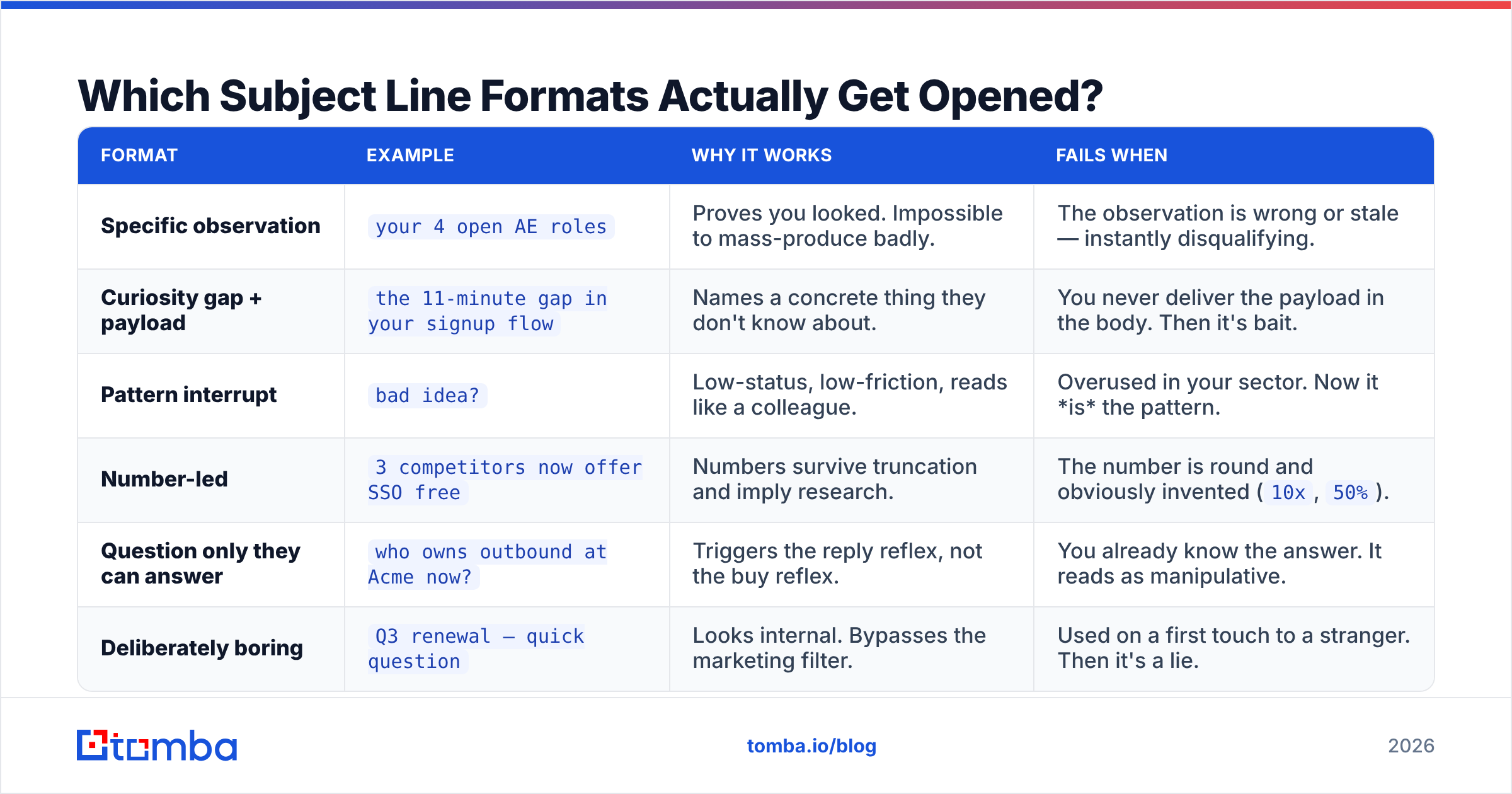
Here are the six formats worth building a library around, with the mechanism each one uses.
| Format | Example | Why it works | Fails when |
|---|---|---|---|
| Specific observation | your 4 open AE roles |
Proves you looked. Impossible to mass-produce badly. | The observation is wrong or stale — instantly disqualifying. |
| Curiosity gap + payload | the 11-minute gap in your signup flow |
Names a concrete thing they don't know about. | You never deliver the payload in the body. Then it's bait. |
| Pattern interrupt | bad idea? |
Low-status, low-friction, reads like a colleague. | Overused in your sector. Now it is the pattern. |
| Number-led | 3 competitors now offer SSO free |
Numbers survive truncation and imply research. | The number is round and obviously invented (10x, 50%). |
| Question only they can answer | who owns outbound at Acme now? |
Triggers the reply reflex, not the buy reflex. | You already know the answer. It reads as manipulative. |
| Deliberately boring | Q3 renewal — quick question |
Looks internal. Bypasses the marketing filter. | Used on a first touch to a stranger. Then it's a lie. |
The pattern across all six: the subject line makes a promise the body can keep in one sentence. That's the test. If you can't pay it off immediately, the open you won becomes a delete you earned.
60+ creative subject lines, sorted by use case#
Cold outbound (first touch)
your careers page → a questionnoticed the Stripe → Chargebee move4 AEs, no enrichment tool?bad timing?quick one on [Company]'s pricing pagere: your talk at SaaStrthe thing your competitors just shippedworth 9 minutes?you're hiring 3 SDRs — here's the mathnot a pitch (a graph)
Follow-up / bump
bumping this upclosing the loopshould I stop?one more anglewrong person?last one from medid this get buried?2-line version
Newsletter / nurture
the metric nobody on your team trackswe were wrong about cold callingwhat 4,000 sends taught us about Tuesdaysunsubscribe if this is boringthe ugliest email that ever workedno news this week (on purpose)
Re-engagement
should I delete your account?it's been 94 daysbreaking up (unless…)your data is getting stale
Event / webinar
20 seats, 4 leftyou missed it — here's the 6-minute versionthe slide everyone screenshotted
Product / lifecycle
you're using 12% of what you pay forthis feature was built because you complainedwe killed the thing you hated
Use these as scaffolding, not scripts. A subject line copied verbatim from a blog post is, by definition, the opposite of creative — three thousand other people read the same post.
Are Curiosity-Gap Subject Lines Worth the Risk?#
Yes, but only when you can close the gap in the first line of the body.
The curiosity gap works because an unresolved question is cognitively uncomfortable. the 11-minute gap in your signup flow creates an itch. The problem is that the itch is a loan against your credibility, and the interest rate is brutal. If the recipient opens and the body says "Hi {{FirstName}}, I'd love to hop on a call to discuss how we help companies like yours…", you have converted an open into a permanent block.
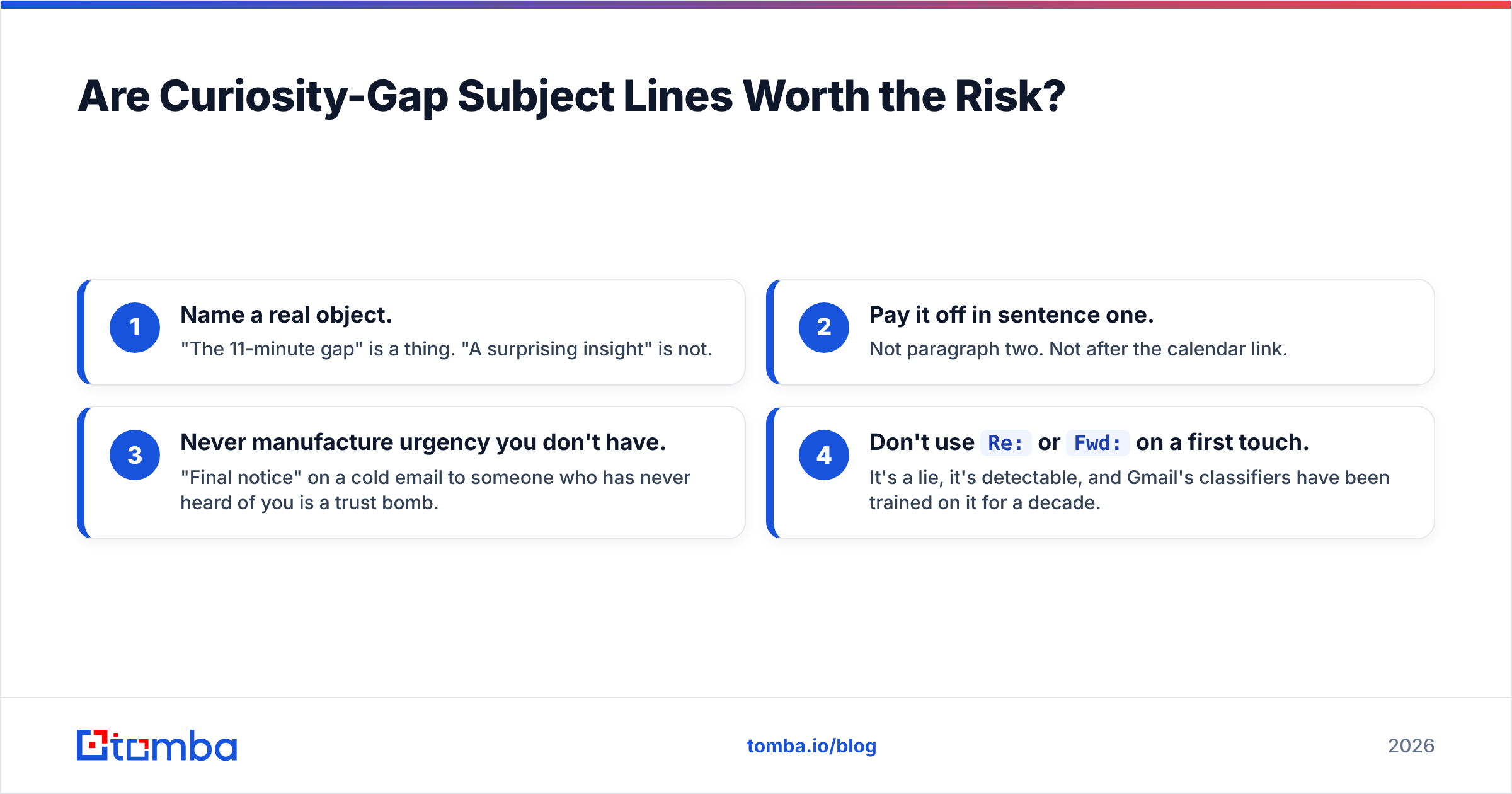
Rules for using curiosity without becoming clickbait:
- Name a real object. "The 11-minute gap" is a thing. "A surprising insight" is not.
- Pay it off in sentence one. Not paragraph two. Not after the calendar link.
- Never manufacture urgency you don't have. "Final notice" on a cold email to someone who has never heard of you is a trust bomb.
- Don't use
Re:orFwd:on a first touch. It's a lie, it's detectable, and Gmail's classifiers have been trained on it for a decade.
Point 4 is worth dwelling on. Fake-thread subject lines still circulate in outbound playbooks because they did work — in 2018. The deceptive-header patterns that made them work are now among the strongest negative signals in spam filtering, and they violate the letter of the CAN-SPAM Act, which explicitly prohibits misleading subject lines. Creativity that costs you your domain is not creativity.
How Long Should a Creative Subject Line Be?#
Short — but the real constraint is the first three words, not the character count.
Mobile mail clients truncate somewhere between 33 and 43 characters depending on device and orientation. Desktop clients show more, but the preview pane fights the preheader for space. What survives universally is the opening fragment.
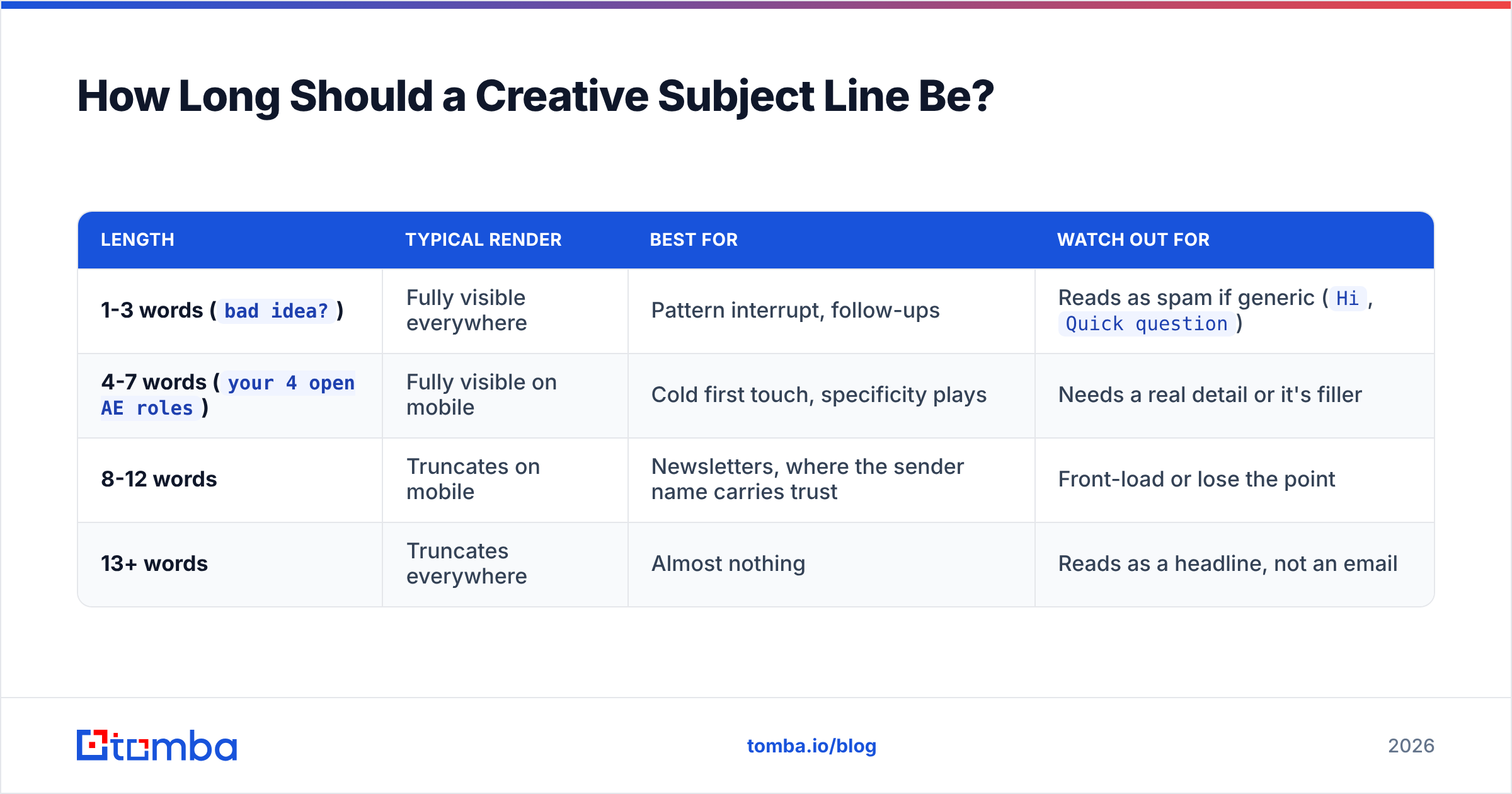
| Length | Typical render | Best for | Watch out for |
|---|---|---|---|
1-3 words (bad idea?) |
Fully visible everywhere | Pattern interrupt, follow-ups | Reads as spam if generic (Hi, Quick question) |
4-7 words (your 4 open AE roles) |
Fully visible on mobile | Cold first touch, specificity plays | Needs a real detail or it's filler |
| 8-12 words | Truncates on mobile | Newsletters, where the sender name carries trust | Front-load or lose the point |
| 13+ words | Truncates everywhere | Almost nothing | Reads as a headline, not an email |
A practical rule: write the line, then delete the first two words. "I noticed your careers page lists 4 AE roles" becomes "your careers page lists 4 AE roles" becomes "your 4 open AE roles." Each cut removes you from the sentence and puts the recipient in it.
Run candidates through a subject line tester before you commit a sequence to them, and if you're stuck at a blank page, a subject line generator is a faster way to produce twenty mediocre options you can then cut to two good ones.
Does the Subject Line Even Matter If Your List Is Bad?#
No. And this is the part most subject-line articles skip because it's not fun to write about.
Open rate is a product of three multiplied factors, in this order:
- Delivery — did the message reach the inbox at all?
- Sender — do they recognize or trust the from-name?
- Subject — did the line earn the click?
If factor one is 0.6 because your bounce rate torched your sender reputation, a subject line improvement from 38% to 45% moves your actual open rate by four points, not seven. And bounce rate is the fastest way to poison factor one: mailbox providers read hard bounces as a signal that you're sending to a purchased or scraped list, and they downgrade you accordingly. Google's own bulk sender guidelines put spam-rate and authentication requirements ahead of anything you write.
The sequence that works:
- Build the list from verified sources. Use a domain search to pull the real contacts at a target company rather than guessing at
firstname@. - Verify before send. An email verifier pass costs pennies and removes the addresses that would have bounced.
- Then get creative. Now the line you wrote actually lands in front of a human.
Teams reverse this order constantly. They spend three days workshopping subject lines and thirty seconds assembling the list. The list is the leverage.
How Do You Personalize Without Sounding Like a Merge Tag?#
Personalization fails when it's visible as personalization. {{FirstName}}, quick question about {{Company}} is not personal — it's a template with the seams showing, and recipients pattern-match it in under a second.
Real personalization in a subject line uses a fact that could only have come from looking:
| Weak (merge-tag personalization) | Strong (research personalization) |
|---|---|
John, a quick question |
the 4 SDR roles on your careers page |
Ideas for Acme Corp |
Acme's new Snowflake stack |
Helping Acme grow revenue |
your Q3 pricing change |
{{Company}} + {{OurCompany}}? |
saw the Series B — congrats, and a question |
Hi from [Rep] at [Vendor] |
re: your comment on the Gartner post |
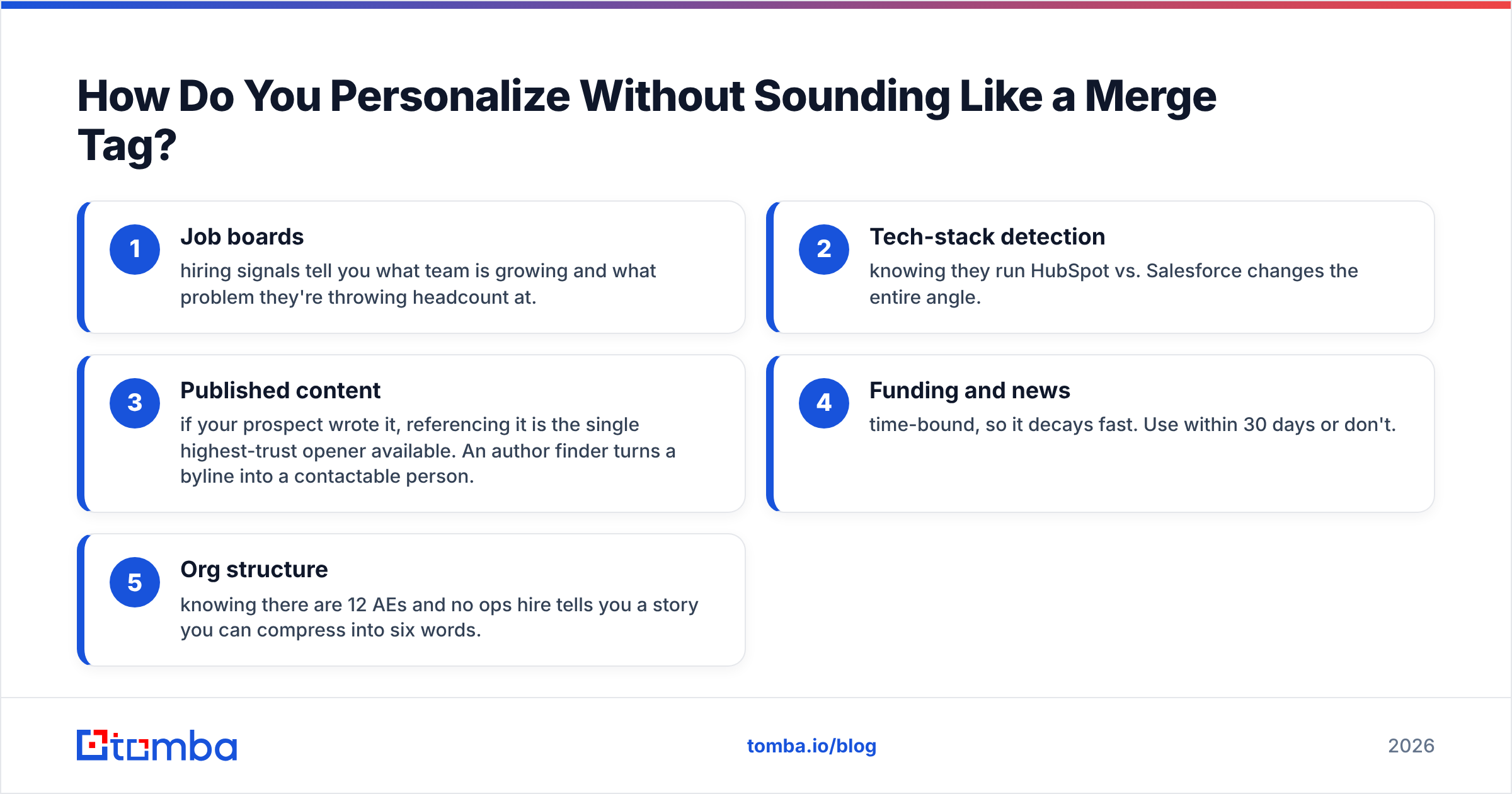
The right column requires data the left column doesn't: job postings, tech stack, funding events, published content, org structure. That's why data enrichment sits underneath good creative work — the enrichment layer is what supplies the specific nouns that make a subject line unrepeatable.
Where do these facts come from in practice?
- Job boards — hiring signals tell you what team is growing and what problem they're throwing headcount at.
- Tech-stack detection — knowing they run HubSpot vs. Salesforce changes the entire angle.
- Published content — if your prospect wrote it, referencing it is the single highest-trust opener available. An author finder turns a byline into a contactable person.
- Funding and news — time-bound, so it decays fast. Use within 30 days or don't.
- Org structure — knowing there are 12 AEs and no ops hire tells you a story you can compress into six words.
For the mechanics of testing which of these angles wins, HubSpot's research on subject lines is a reasonable baseline, and vendor-neutral review sites like G2 are useful for seeing which tools teams actually keep after the trial.
What Should You A/B Test — and What Should You Ignore?#
Test one variable. Everything else is noise dressed as data.
Worth testing:
- Format against format. Question vs. statement. Number-led vs. observation-led.
- Specificity level. Company-level detail vs. person-level detail.
- Casing. Lowercase vs. sentence case — this is a genuine pattern-interrupt lever and it's free.
- Length bucket. 3 words vs. 7 words, not 3 words vs. 4 words.
Not worth testing (at typical B2B volumes):
- Emoji vs. no emoji. In B2B outbound, the answer is no emoji. You don't need 4,000 sends to confirm it.
- Single word swaps.
quickvs.fastwill never reach significance on a 500-contact list. - Punctuation. Unless you're using exclamation marks, in which case stop.
Sample size is the constraint nobody respects. To detect a 3-point difference in open rate with any confidence, you need thousands of sends per variant. Most B2B teams are testing on 200 contacts and drawing conclusions from a difference that is entirely within the margin of error. If your list is small, test formats — big, structural differences — not word choices.
And keep a record. A shared doc of every subject line you've sent, its open rate, and its segment is worth more than any swipe file you'll find online, because it's calibrated to your audience and your sender reputation. Pair it with cold email templates for the body so you're not rebuilding the whole message each time.
What Kills a Creative Subject Line Before It's Read?#
Four things, in descending order of damage:
- Bounces. Invalid addresses tank your email deliverability and everything downstream. Keep hard bounces under 2%.
- Spam-trigger phrasing. "Free," "guarantee," "act now," and ALL-CAPS anything still carry weight in classifiers. Run a draft through a spam checker if you're unsure.
- Broken authentication. No SPF, DKIM, or DMARC means your creative line never gets rendered. Check your SPF record before you blame the copy.
- Volume without warmup. A brand-new domain sending 500/day is a reputation problem, not a copy problem.
Notice that three of the four have nothing to do with writing. The subject line is the last 5% of the work and the first thing everyone optimizes.
Where Should You Start?#
Start with the list, then the format library, then the test.
Concretely, for the next campaign:
- Pull contacts at your 100 target accounts with verified emails — not guessed patterns.
- Enrich each with one specific fact: a hire, a stack change, a published post.
- Write three subject-line formats — one observation, one question, one pattern interrupt — using that fact.
- Send in two waves, one week apart, so bounce data from wave one informs wave two.
- Log everything.
The creative part is step 3. It's the shortest step, and it only pays off because steps 1 and 2 gave it something true to say.
Get the data your subject lines need. The most creative line in the world dies against a bounced address. Tomba's Email Finder pulls verified professional emails by name, domain, or company, so the specific, unrepeatable detail you built your subject line around actually reaches the person it's about. Free tier gives you 25 searches a month to test the workflow; paid plans start at $49/mo. See Tomba pricing for the full breakdown, and check where Tomba gets data if you want to know what's under the hood before you commit.
Related guides#
Ready to find emails that actually work?
Join 150,000+ professionals who stopped guessing and started sending. Free credits on signup — no credit card required.
Get the Tomba newsletter
Practical outbound tactics and product updates — once every two weeks.
About the author