Creative Email Subject Lines for Sales: 60 That Get Opens
Clever isn't the same as creative. Here are 60 sales subject lines that earn opens in 2026, the formulas behind them, and the testing method that keeps your domain safe.
TL;DR
- Creative does not mean clever. The subject lines that win in 2026 are specific, short (3-7 words), and make a promise the email body actually keeps.
- Seven formulas cover almost every high-performing sales subject line: the Observation, the Number, the Question, the Referral, the Contrarian, the Micro-Ask, and the Pattern Break.
- Curiosity-gap lines get opens but tank reply rates when the body disappoints. Track replies, not opens.
- Open-rate data is unreliable now that Apple Mail Privacy Protection inflates it. Use reply rate and meeting rate as your real scoreboard.
- The best subject line in the world still fails if the address bounces. Clean the list first, get creative second.
What actually makes a sales subject line "creative"?#
Creative means unexpected but relevant. That's it.
A subject line is creative when the prospect reads it and thinks "how does this person know that about us?" — not "what is this person on about?" The difference is whether the surprise points at something true about their business, or just at your thesaurus.
Compare these two:
- ❌ "Unlocking synergies for exponential pipeline velocity"
- ✅ "Your careers page says 6 AEs. Your CRM says?"
Both are unusual. Only one earns a click, because only one contains a fact the prospect recognizes as their own. Creativity in cold email is research wearing a costume. When your subject line references something specific — a hiring pattern, a pricing page change, a competitor they just lost to — the "creative" part takes care of itself.
The reason this matters is mechanical. Inbox scanning happens in roughly one second. Your prospect reads a sender name and about 35 characters of subject text on mobile. In that second they're answering one question: does this concern me? Cleverness answers "is this person entertaining?" — the wrong question, and the reason so many witty lines get archived unopened.
Why do most sales subject lines fail?#
They fail for four reasons, in descending order of frequency.
- They're about you, not them. "Introducing our AI-powered platform" is a headline for your press release, not their inbox. Roughly nine out of ten cold subject lines in my swipe file lead with the sender's product, company, or role.
- They're indistinguishable from the other 40 in the queue. "Quick question", "Following up", "Touching base", "Checking in" — these are now pattern-matched to sales by every buyer with a pulse. They're not bad because they're boring; they're bad because they're signals.
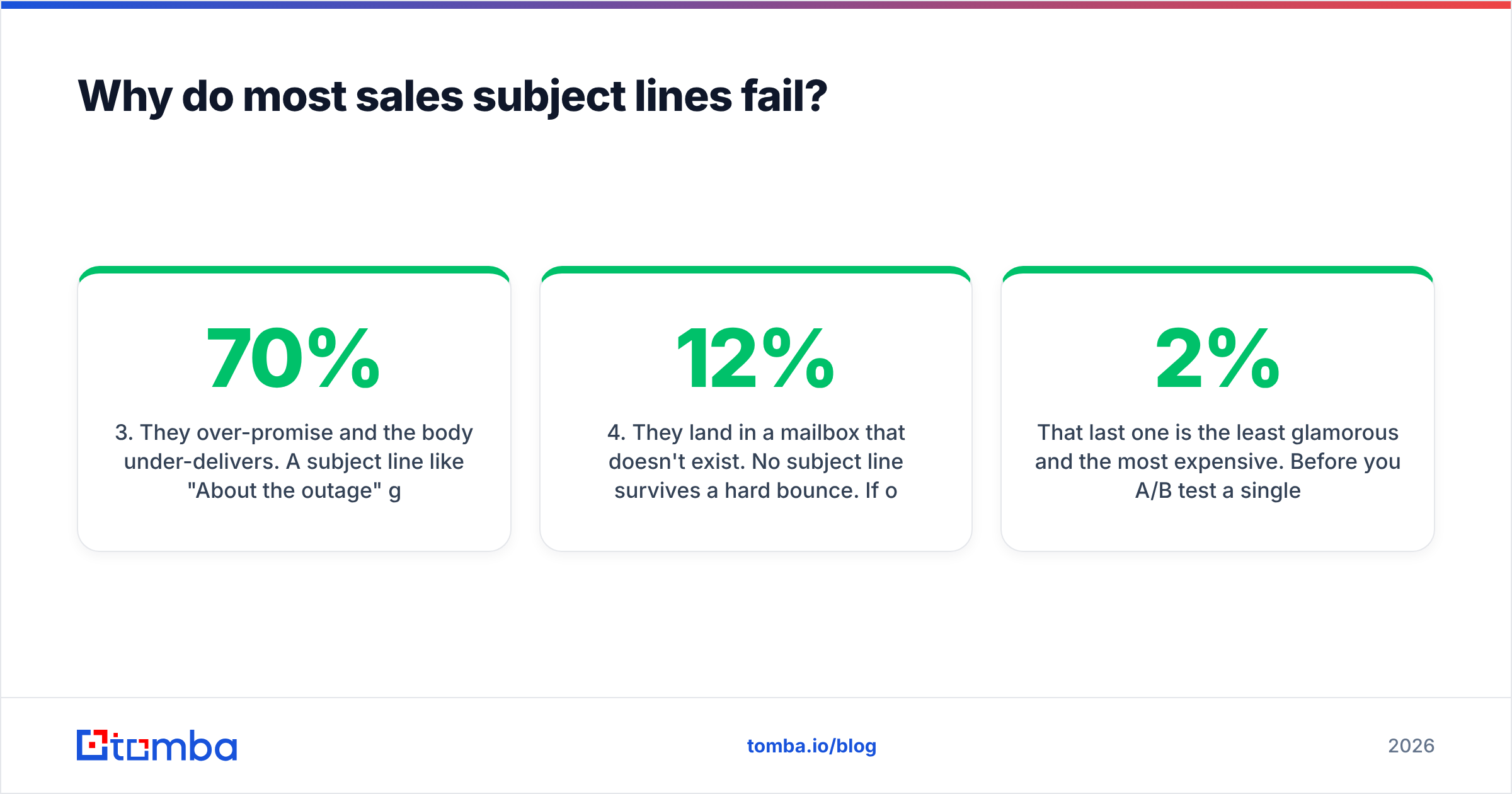
- They over-promise and the body under-delivers. A subject line like "About the outage" gets a 70% open rate and a 0% reply rate, plus a spam complaint. Bait costs more than it earns.
- They land in a mailbox that doesn't exist. No subject line survives a hard bounce. If 12% of your list is dead, your creative work is being graded on a curve you set yourself.
That last one is the least glamorous and the most expensive. Before you A/B test a single word, run the list through an email verifier and get bounce rate under 2%. Mailbox providers weight bounce rate heavily in reputation scoring, and a poisoned sender reputation means even your best line never reaches the inbox to be judged.
What are the 7 creative subject line formulas that still work?#
These are the underlying structures. Everything else is a variation.
- The Observation — Reference something they did, changed, or published. "Saw the new pricing page", "Your Series B + 9 open SDR roles". Highest reply rate of any formula, because it proves the email is not a blast.
- The Number — Lead with a specific figure tied to their world. "3 broken links on /demo", "$40k in dead pipeline?". Numbers survive the one-second scan because the eye stops on digits.
- The Question — Ask something they can answer in one word, not a rhetorical trap. "Still handling enrichment manually?" works. "Want more revenue?" does not.
- The Referral — Name a mutual connection, customer, or competitor. "{{MutualContact}} said to reach out", "What {{Competitor}} does differently". Borrowed trust is the strongest opener in B2B, but only when it's true.
- The Contrarian — Say the thing they don't expect a vendor to say. "Don't buy an email tool yet", "Your outbound isn't the problem". Works because it breaks the vendor script.
- The Micro-Ask — Make the subject line the entire ask. "Wrong person?", "11 minutes Thursday?". Low friction, low creativity ceiling, high floor.
- The Pattern Break — Deliberately unpolished, lowercase, or fragmentary. "quick thought on your onboarding", "re: your Q3 hiring". Use "re:" only when there genuinely was a prior thread — faking a reply chain is a fast route to a spam complaint and, in the US, a shaky position under the CAN-SPAM Act, which prohibits deceptive headers.
Mix formulas across a sequence rather than repeating one. If email 1 is an Observation, make email 3 a Contrarian and email 5 a Micro-Ask. Same prospect, three different reasons to look.
Which subject line style fits each stage of the sequence?#
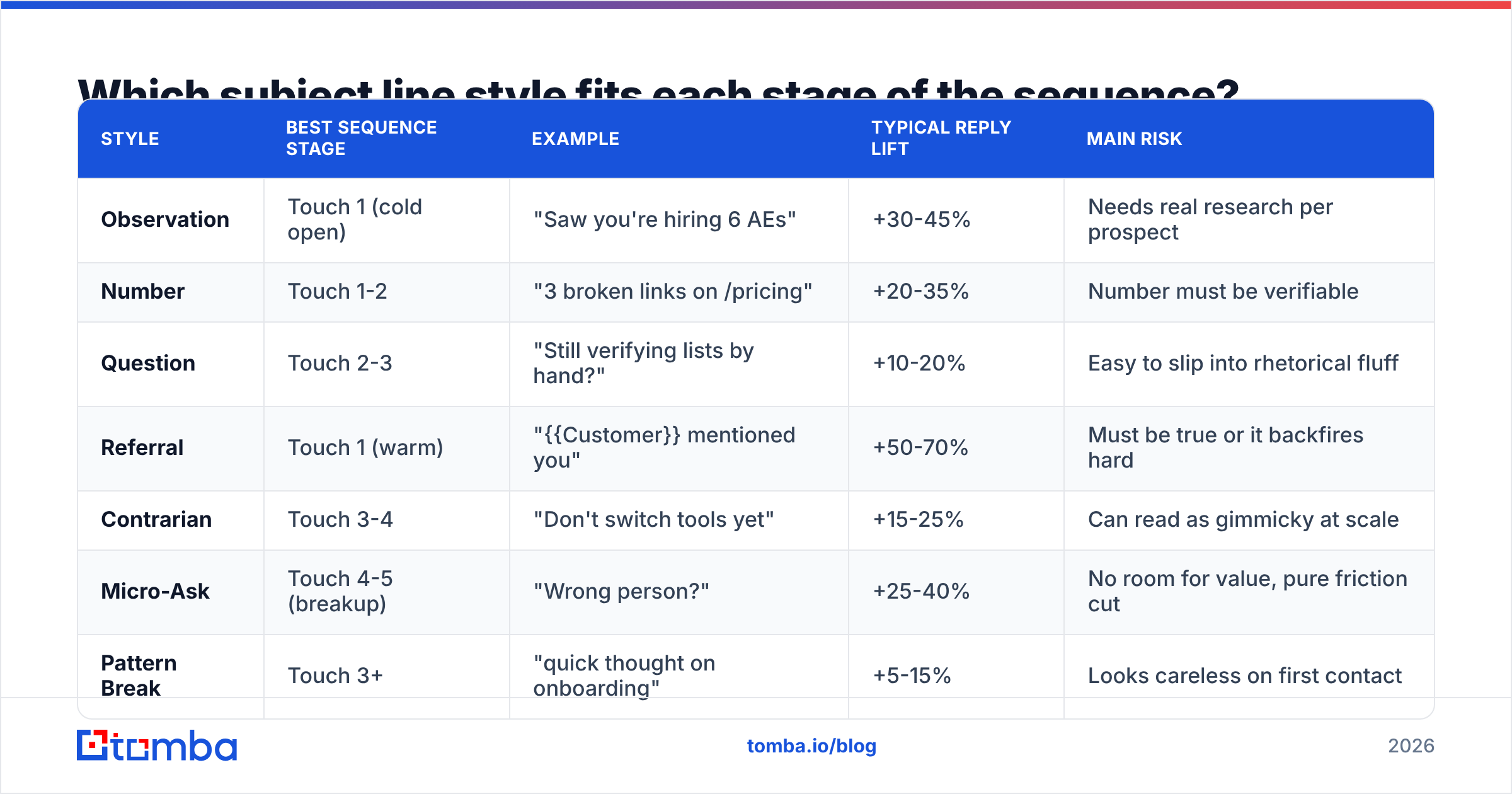
Not every formula belongs everywhere. A Pattern Break on a first touch to a CFO reads as sloppy; the same line on touch four reads as human. Here's how the styles map:
| Style | Best sequence stage | Example | Typical reply lift | Main risk |
|---|---|---|---|---|
| Observation | Touch 1 (cold open) | "Saw you're hiring 6 AEs" | +30-45% | Needs real research per prospect |
| Number | Touch 1-2 | "3 broken links on /pricing" | +20-35% | Number must be verifiable |
| Question | Touch 2-3 | "Still verifying lists by hand?" | +10-20% | Easy to slip into rhetorical fluff |
| Referral | Touch 1 (warm) | "{{Customer}} mentioned you" | +50-70% | Must be true or it backfires hard |
| Contrarian | Touch 3-4 | "Don't switch tools yet" | +15-25% | Can read as gimmicky at scale |
| Micro-Ask | Touch 4-5 (breakup) | "Wrong person?" | +25-40% | No room for value, pure friction cut |
| Pattern Break | Touch 3+ | "quick thought on onboarding" | +5-15% | Looks careless on first contact |
Read the "reply lift" numbers as directional, not gospel — they're the ranges I see across mid-market B2B sequences, and your ICP will shift them. The structural point holds regardless: front-load research-heavy formulas, back-load friction-cutting ones.
What are 60 creative email subject lines for sales?#
Grouped by scenario. Swap the merge tags for real data — a merge tag that fires blank is worse than no personalization at all.
Cold open (research-led)
- Saw the {{Company}} hiring spree
- Your careers page says 6 AEs
- {{Company}} + {{Competitor}}: noticed something
- Question about your /pricing page
- 3 broken links on {{Company}}.com
- Your Series B and your SDR count
- Noticed you moved off {{Tool}}
- {{FirstName}}, quick note on your demo flow
- Read your post on outbound math
- Your G2 reviews mention one thing twice
Numbers and specificity
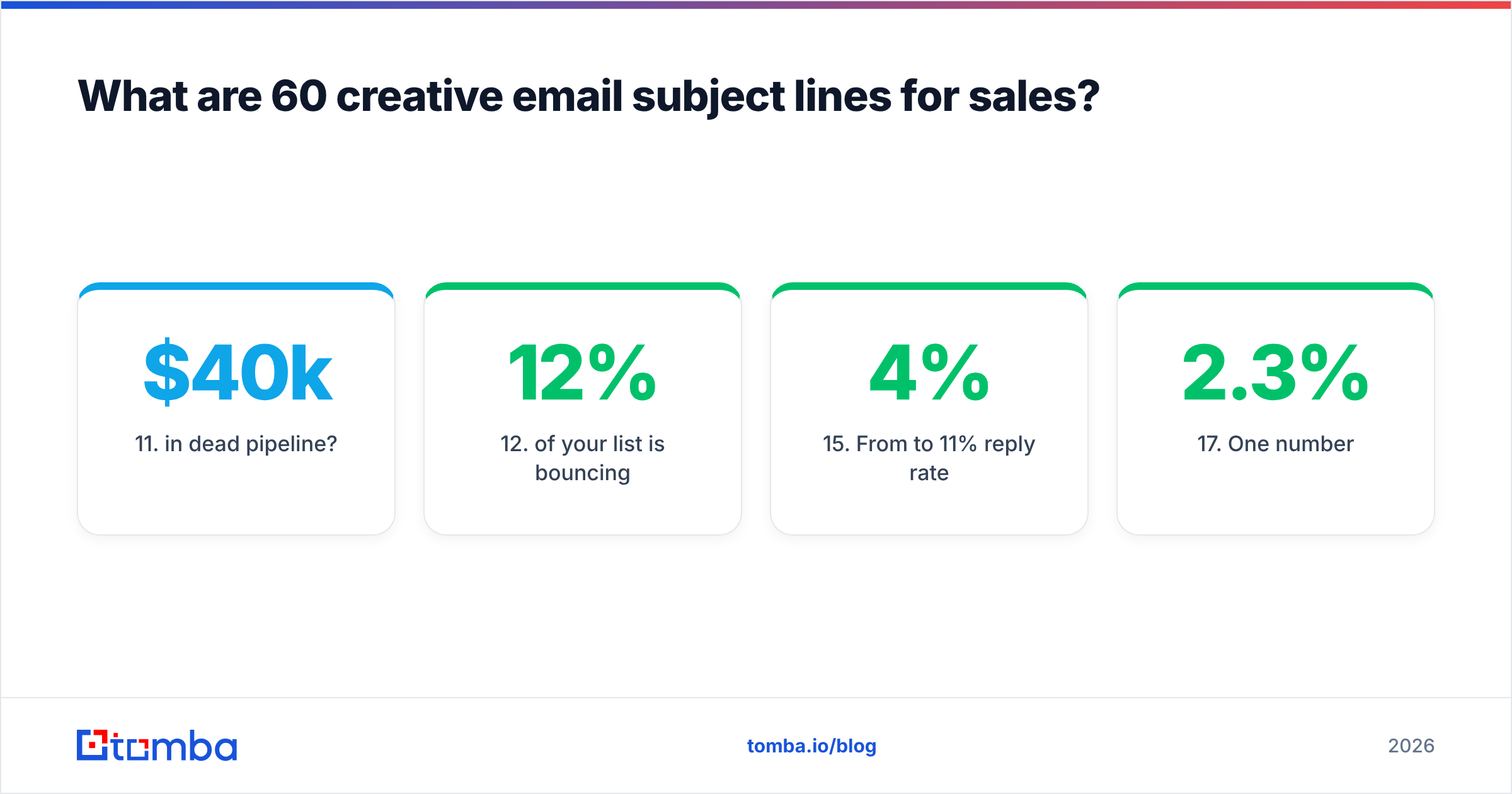
- $40k in dead pipeline?
- 12% of your list is bouncing
- 11 minutes on Thursday
- 2 changes, 1 quarter
- From 4% to 11% reply rate
- 87 leads you already paid for
- One number: 2.3%
- 6 hours a week, back
- Your CAC vs the median
- 40 emails, 0 replies — why
Questions that get answered
- Still verifying lists by hand?
- Who owns outbound at {{Company}}?
- Worth a look, or bad timing?
- Is {{Tool}} still working for you?
- Am I reading your funnel wrong?
- Wrong person for this?
- Open to a contrarian take?
- Does {{Company}} still do outbound?
- What's blocking Q3 pipeline?
- Is bounce rate on your radar?
Referral and social proof
- {{MutualContact}} said to reach out
- {{Customer}} sent me your way
- What {{Competitor}} does differently
- Your peers at {{Company}} switched
- Borrowing 60 seconds from {{MutualContact}}
- Three {{Industry}} teams, one fix
- {{Customer}} cut bounces to 1.1%
- Saw you both at {{Event}}
- {{MutualContact}}'s exact words
- The tool {{Customer}} won't shut up about
Contrarian and pattern breaks
- Don't buy an email tool yet
- Your outbound isn't the problem
- This is a sales email
- Ignore this if Q3 is locked
- Bad time? Say bad time
- I was wrong about {{Topic}}
- Skip the demo
- Most of this market is overpriced
- You probably don't need us
- Honest pitch, 40 seconds
Follow-up and breakup
- Closing the loop on {{Topic}}
- Last one from me
- Should I stop emailing?
- Bumping this once, then done
- Still worth 11 minutes?
- Moving you to the no pile?
- One more angle, then silence
- Did this get buried?
- Reviving this if timing changed
- Permission to close your file
Two rules when you use these. First, the body has to honor the promise — if the subject says "3 broken links," list all three in the first line. Second, run every candidate through a subject line tester before it goes into a sequence, so you catch spam-trigger words, length problems, and mobile truncation before your prospects do.
Do length and personalization actually change results?#
Length: yes, but not the way most people think.
Subject lines between 3 and 7 words tend to outperform longer ones, mostly because of mobile truncation. iPhone Mail shows roughly 35-40 characters in portrait; Gmail's app shows a bit more. Anything past that is invisible on the device where more than half your prospects triage email. If your line needs 12 words to make sense, it's not a subject line — it's your first sentence.
Personalization: yes, when it's information, not decoration. Inserting {{FirstName}} is decoration. Every vendor does it, and buyers have learned to ignore it. Inserting a fact — their tech stack, their hiring, their funding, a specific page on their site — is information, and information is what earns the click. HubSpot's sales team has published the same conclusion repeatedly: specificity beats familiarity.
There's a hard ceiling on this. You cannot personalize what you don't know, and you can't know it at scale without data. That's why the highest-performing subject lines are usually downstream of enrichment, not copywriting. If you know a prospect's role, their company's headcount trend, and their stack, the Observation formula writes itself. If all you have is an email address, you're stuck writing "Quick question." Feeding your sequences with proper contact enrichment is upstream of every creative decision you'll make.
One more caveat on measurement: open rate is now a compromised metric. Apple's Mail Privacy Protection pre-fetches tracking pixels, which means a meaningful share of your "opens" never happened. If you optimize for opens, you'll optimize toward bait. Optimize for replies, and, ideally, for meetings booked.
How do you test creative subject lines without burning your domain?#
Test in small, disciplined batches. The method:
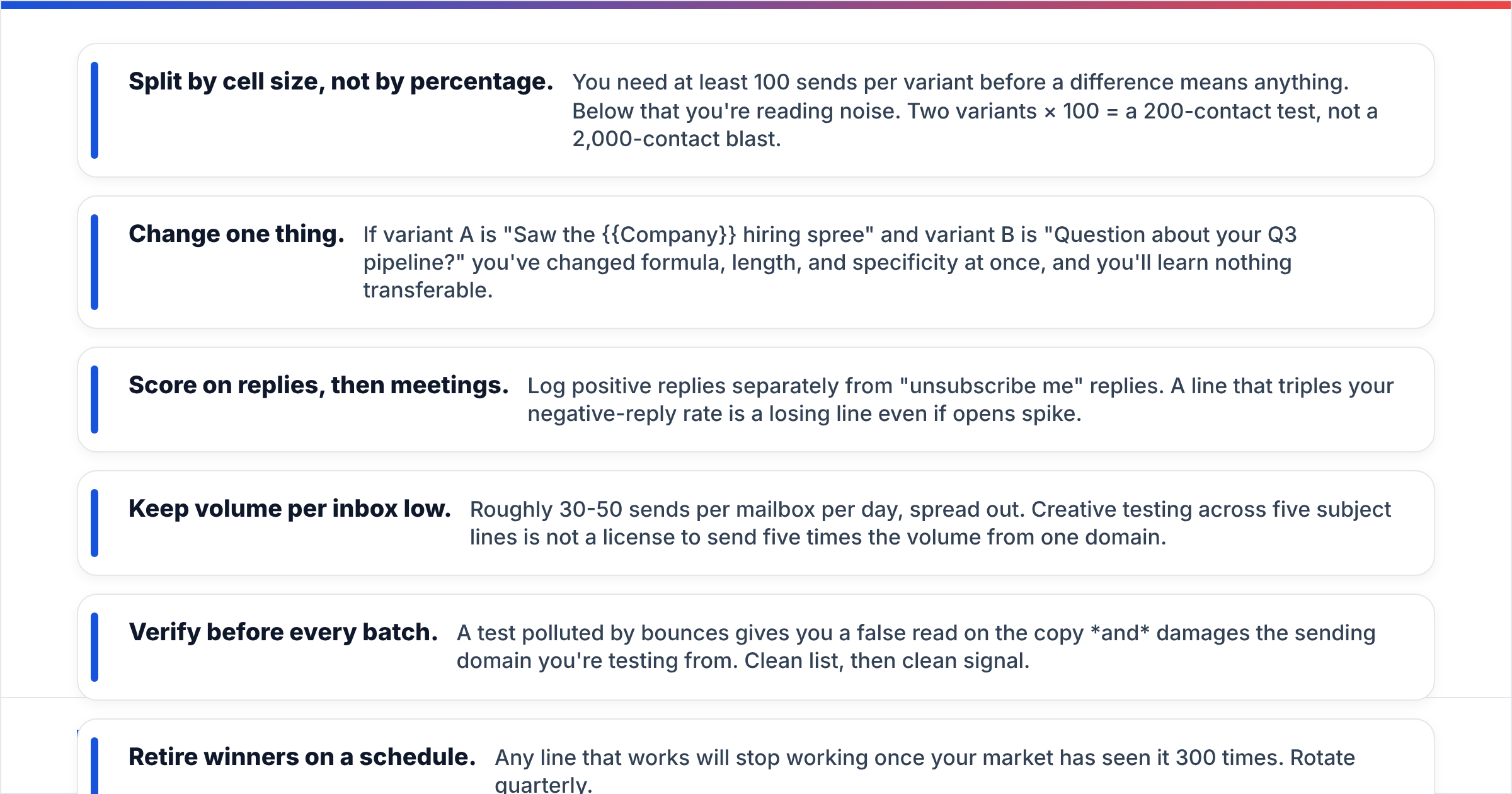
- Split by cell size, not by percentage. You need at least 100 sends per variant before a difference means anything. Below that you're reading noise. Two variants × 100 = a 200-contact test, not a 2,000-contact blast.
- Change one thing. If variant A is "Saw the {{Company}} hiring spree" and variant B is "Question about your Q3 pipeline?" you've changed formula, length, and specificity at once, and you'll learn nothing transferable.
- Score on replies, then meetings. Log positive replies separately from "unsubscribe me" replies. A line that triples your negative-reply rate is a losing line even if opens spike.
- Keep volume per inbox low. Roughly 30-50 sends per mailbox per day, spread out. Creative testing across five subject lines is not a license to send five times the volume from one domain.
- Verify before every batch. A test polluted by bounces gives you a false read on the copy and damages the sending domain you're testing from. Clean list, then clean signal.
- Retire winners on a schedule. Any line that works will stop working once your market has seen it 300 times. Rotate quarterly.
If you're comparing tooling for this — sequencers, enrichment providers, verification vendors — G2's category pages are a reasonable place to see how the players stack up on real reviews rather than vendor claims. Just remember that the tool decides your deliverability floor, not your creative ceiling.
What mistakes kill an otherwise good subject line?#
- ALL CAPS or excessive punctuation. "URGENT!!!" is a spam filter magnet and a credibility sink.
- Fake reply threads. "RE:" on a first touch is deceptive header practice. It works once and costs you the relationship.
- Emojis in B2B cold email. Rare exceptions exist. Assume you're not one of them.
- Broken merge tags. "Hi {{FirstName}}," in the wild is the fastest way to prove your email is a blast. Guard every tag with a fallback, and verify your data fields are populated before send.
- Vague urgency. "Time-sensitive" without a reason is a bluff, and buyers call it instantly.
- Subject and body mismatch. The single biggest destroyer of reply rate. Whatever the subject promised, deliver it in sentence one.
Where should you start?#
Pick three formulas, write five lines each, and test them against 100 verified contacts per variant. That's a week of work and it will teach you more about your market than any swipe file — including this one.
But get the order right. Creative subject lines are the last 10% of an outbound system, not the first. Before you write a single line, you need contacts who actually exist, at companies that actually match your ICP, with data rich enough to make the Observation formula possible. That's what the Tomba Email Finder is built for: find verified professional email addresses by domain, name, or company, with the enrichment context that makes personalization real instead of decorative. The free tier gives you 25 searches a month to test the workflow, and paid plans start at $49/mo on Starter — check Tomba pricing for the full breakdown. Clean the data, then get creative. In that order.
Related guides#
Ready to find emails that actually work?
Join 150,000+ professionals who stopped guessing and started sending. Free credits on signup — no credit card required.
Get the Tomba newsletter
Practical outbound tactics and product updates — once every two weeks.
About the author