Creative Ways to Ask for Referrals: 12 Plays That Work
"Do you know anyone else who'd benefit?" is where referrals go to die. Here are 12 creative ways to ask for referrals — with the timing, scripts, and follow-through that turn a name into a booked meeting.
TL;DR
- The default ask — "do you know anyone else who'd benefit?" — fails because it makes the customer do your prospecting for you. Specificity is the whole game.
- The best referral moments are behavioral, not calendar-based: right after a win, a renewal, a support save, or an unprompted compliment.
- Creative asks work by lowering cognitive load: name the person, write the intro, or ask for a category instead of a contact.
- A referral name is not a lead. You still need a verified email, a reason to reach out, and a message that references the referrer by name within the first line.
- Track referrals like pipeline, not like goodwill. Attribution is what gets the program funded next quarter.
Why do most referral asks fail?#
Because they outsource the hard part.
When you ask "do you know anyone who might need this?", you are handing your customer a blank search field and asking them to run a mental query across their entire professional network, filter it against a value proposition they only half-remember, and then volunteer to spend social capital on your behalf. That is genuinely hard work. So they do what any busy person does with hard work that has no deadline: they say "let me think about it," and then they never think about it.
The second reason is timing. Most reps ask at the moment that's convenient for the rep — end of quarter, during a QBR, when the pipeline looks thin — rather than the moment the customer feels the most goodwill. Those two moments almost never overlap.
The third reason is that the ask has no shape. There's no format, no next step, no draft. Even a customer who genuinely wants to help you can't act on "keep me in mind."
Referral-sourced deals consistently close faster and at higher rates than cold outbound, which is exactly why word-of-mouth has survived every shift in the sales stack. The channel isn't broken. The ask is.
What makes a referral ask creative instead of annoying?#
"Creative" here doesn't mean gimmicky. It means you've engineered the ask so the customer's effort drops close to zero while the specificity of the outcome goes way up.
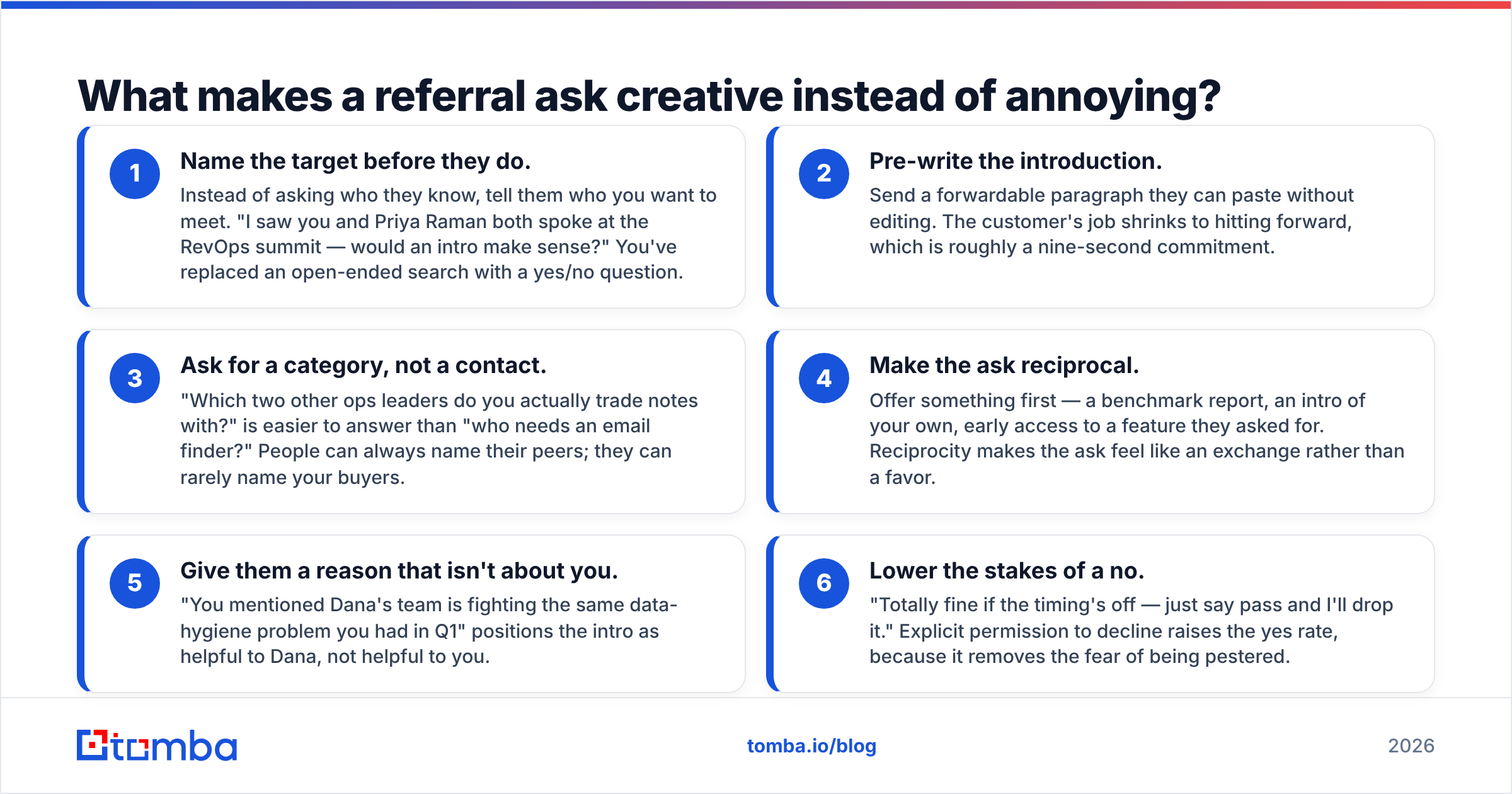
Four levers do most of the work:
- Name the target before they do. Instead of asking who they know, tell them who you want to meet. "I saw you and Priya Raman both spoke at the RevOps summit — would an intro make sense?" You've replaced an open-ended search with a yes/no question.
- Pre-write the introduction. Send a forwardable paragraph they can paste without editing. The customer's job shrinks to hitting forward, which is roughly a nine-second commitment.
- Ask for a category, not a contact. "Which two other ops leaders do you actually trade notes with?" is easier to answer than "who needs an email finder?" People can always name their peers; they can rarely name your buyers.
- Make the ask reciprocal. Offer something first — a benchmark report, an intro of your own, early access to a feature they asked for. Reciprocity makes the ask feel like an exchange rather than a favor.
- Give them a reason that isn't about you. "You mentioned Dana's team is fighting the same data-hygiene problem you had in Q1" positions the intro as helpful to Dana, not helpful to you.
- Lower the stakes of a no. "Totally fine if the timing's off — just say pass and I'll drop it." Explicit permission to decline raises the yes rate, because it removes the fear of being pestered.
Every play below is some combination of those six levers.
When is the right moment to ask for a referral?#
Stop scheduling referral asks and start triggering them. The signal you want is demonstrated satisfaction, and it shows up in specific, loggable events:
- The value moment. The customer hits the outcome you sold them — first campaign shipped, first hire made, first month of clean data. Ask within 48 hours, while the result is still emotional.
- The unprompted compliment. Someone replies "this is great" or leaves a review on G2. That person has already put your praise in writing; asking them to repeat it to one peer is a small step, not a leap.
- The support save. Counterintuitively, a customer whose problem you fixed fast is often more loyal than one who never had a problem. Service recovery creates a debt they want to settle.
- The renewal or expansion. They just re-signed with their own money. That's the strongest possible statement of belief.
- The offboarding of a champion. Your champion is leaving for a new company. This is the single most underused referral moment in B2B — they're about to need a stack at their new job, and they know who else is hiring.
The anti-pattern: asking during onboarding, before value has landed. It reads as transactional, and it burns the moment you'll want in ninety days.
What are the 12 creative ways to ask for referrals?#
Here they are, grouped by how much effort they demand from you and from the customer.
Low-lift asks (send today)
- The pre-written forward. Draft the entire intro email — subject line, two-sentence context, your ask — and send it to the customer with one line: "If this is easy, forward it. If not, ignore it." Nothing is faster to say yes to.
- The named ask. Do the research yourself. Find two or three people in their orbit — same conference speaker list, same alumni network, same Slack community — and ask about them by name. Yes/no beats open-ended every time.
- The "who do you trade notes with?" question. Ask which peers they actually swap advice with. You're not asking for a lead, you're asking about their professional life. The names come out anyway.
- The review-to-referral bridge. When someone leaves a public review, reply with: "This made my week. Is there one person you'd want to hear it from directly?" You're converting public praise into private introduction.
Medium-lift asks (build into your cadence)
- The results-recap ask. Send a one-page recap of what the customer achieved — numbers, timeline, what changed. Close with: "If this recap would be useful to anyone on your side or in your network, I'll tailor it for them." You're offering a document, not asking for a favor.
- The advisory invitation. Invite your best customers to a small roundtable or advisory group and ask each to bring one peer. The referral is now an invitation to something exclusive, which is much easier to extend than a sales intro.
- The champion-tracking play. Monitor when champions change jobs. Reach out with congratulations first, a referral ask second — and ask both about their new company and about who replaced them at the old one. One departure can produce two opportunities.
- The co-created content ask. Interview the customer for a case study, a podcast, or a blog quote. Everyone they'd want to see it is, functionally, a referral list. Ask who they'd like you to send the finished piece to.
High-lift asks (reserve for your top accounts)
- The reverse intro. Introduce them to someone valuable first — a hire, a partner, a peer in their industry. Do it with no strings. Ask three weeks later. The reciprocity is real and it is remembered.
- The referral sprint. Run a two-week window where you ask ten happy accounts at once, with a shared deadline and a small incentive tied to a charity of the customer's choice. The deadline creates urgency that a standing program never does.
- The peer-group audit. Offer a free benchmark: "Send me three companies you consider peers and I'll show you how their public data compares to yours." You get a target list and they get something genuinely useful.
- The exit-interview ask. Even churned customers refer, if you leave well. Ask, honestly, what didn't work — and then ask who might be a better fit for what you actually do. Reps almost never do this, which is exactly why it works.
Which referral ask should you use?#
There's no single best play — there's the play that matches the relationship depth and the moment. Use this to pick.
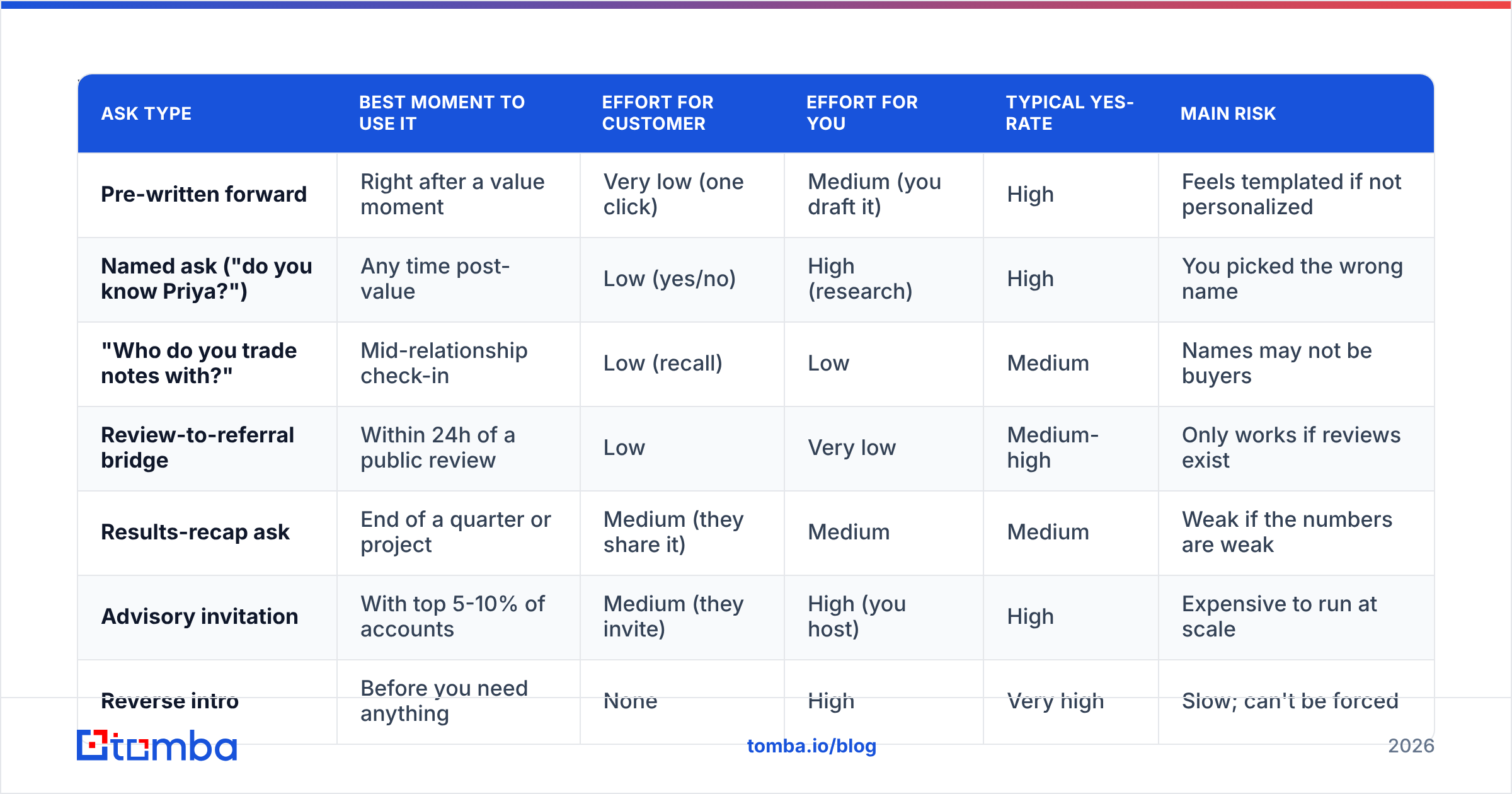
| Ask type | Best moment to use it | Effort for customer | Effort for you | Typical yes-rate | Main risk |
|---|---|---|---|---|---|
| Pre-written forward | Right after a value moment | Very low (one click) | Medium (you draft it) | High | Feels templated if not personalized |
| Named ask ("do you know Priya?") | Any time post-value | Low (yes/no) | High (research) | High | You picked the wrong name |
| "Who do you trade notes with?" | Mid-relationship check-in | Low (recall) | Low | Medium | Names may not be buyers |
| Review-to-referral bridge | Within 24h of a public review | Low | Very low | Medium-high | Only works if reviews exist |
| Results-recap ask | End of a quarter or project | Medium (they share it) | Medium | Medium | Weak if the numbers are weak |
| Advisory invitation | With top 5-10% of accounts | Medium (they invite) | High (you host) | High | Expensive to run at scale |
| Reverse intro | Before you need anything | None | High | Very high | Slow; can't be forced |
| Exit-interview ask | At churn | Low | Low | Low-medium | Can feel tone-deaf if handled badly |
The pattern is simple: the asks with the highest yes-rates are the ones where you did the work in advance. Effort transfers. Either you spend it, or your customer does — and if your customer spends it, they usually don't.
How do you turn a referral name into a booked meeting?#
This is where most referral programs quietly leak. The customer says "you should talk to Dana at Northwind," and then... nothing. No email. No context. The name sits in a Slack DM until it goes cold.
Build a repeatable handoff:
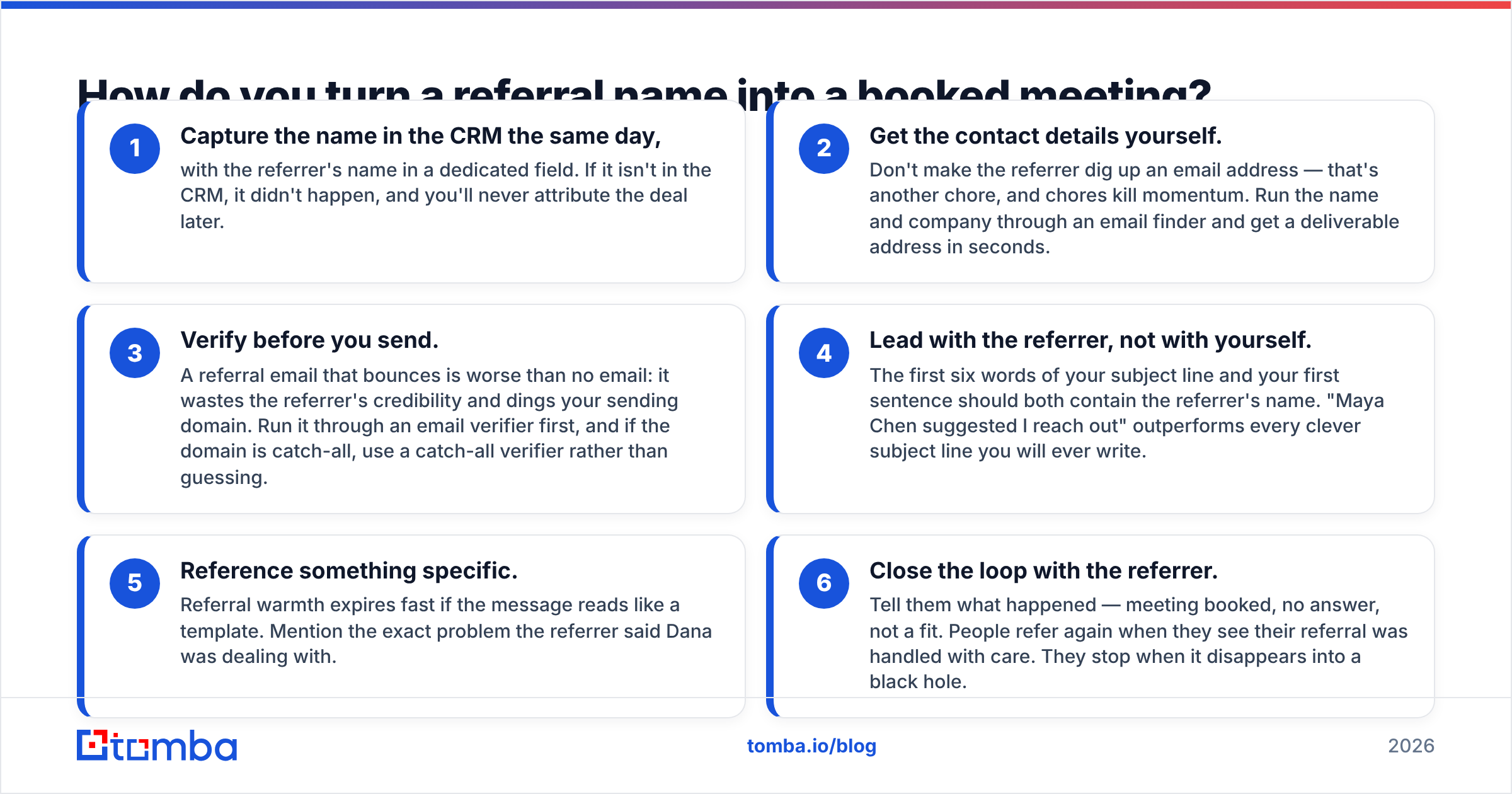
- Capture the name in the CRM the same day, with the referrer's name in a dedicated field. If it isn't in the CRM, it didn't happen, and you'll never attribute the deal later.
- Get the contact details yourself. Don't make the referrer dig up an email address — that's another chore, and chores kill momentum. Run the name and company through an email finder and get a deliverable address in seconds.
- Verify before you send. A referral email that bounces is worse than no email: it wastes the referrer's credibility and dings your sending domain. Run it through an email verifier first, and if the domain is catch-all, use a catch-all verifier rather than guessing.
- Lead with the referrer, not with yourself. The first six words of your subject line and your first sentence should both contain the referrer's name. "Maya Chen suggested I reach out" outperforms every clever subject line you will ever write.
- Reference something specific. Referral warmth expires fast if the message reads like a template. Mention the exact problem the referrer said Dana was dealing with.
- Close the loop with the referrer. Tell them what happened — meeting booked, no answer, not a fit. People refer again when they see their referral was handled with care. They stop when it disappears into a black hole.
If you're processing more than a handful at a time — after a referral sprint, or a conference where a champion introduced you to a table of peers — a bulk email finder turns a list of names into verified, sendable contacts in one pass instead of forty tabs.
How do you track referrals without building a formal program?#
You don't need software with a name and a logo. You need three fields and a habit.
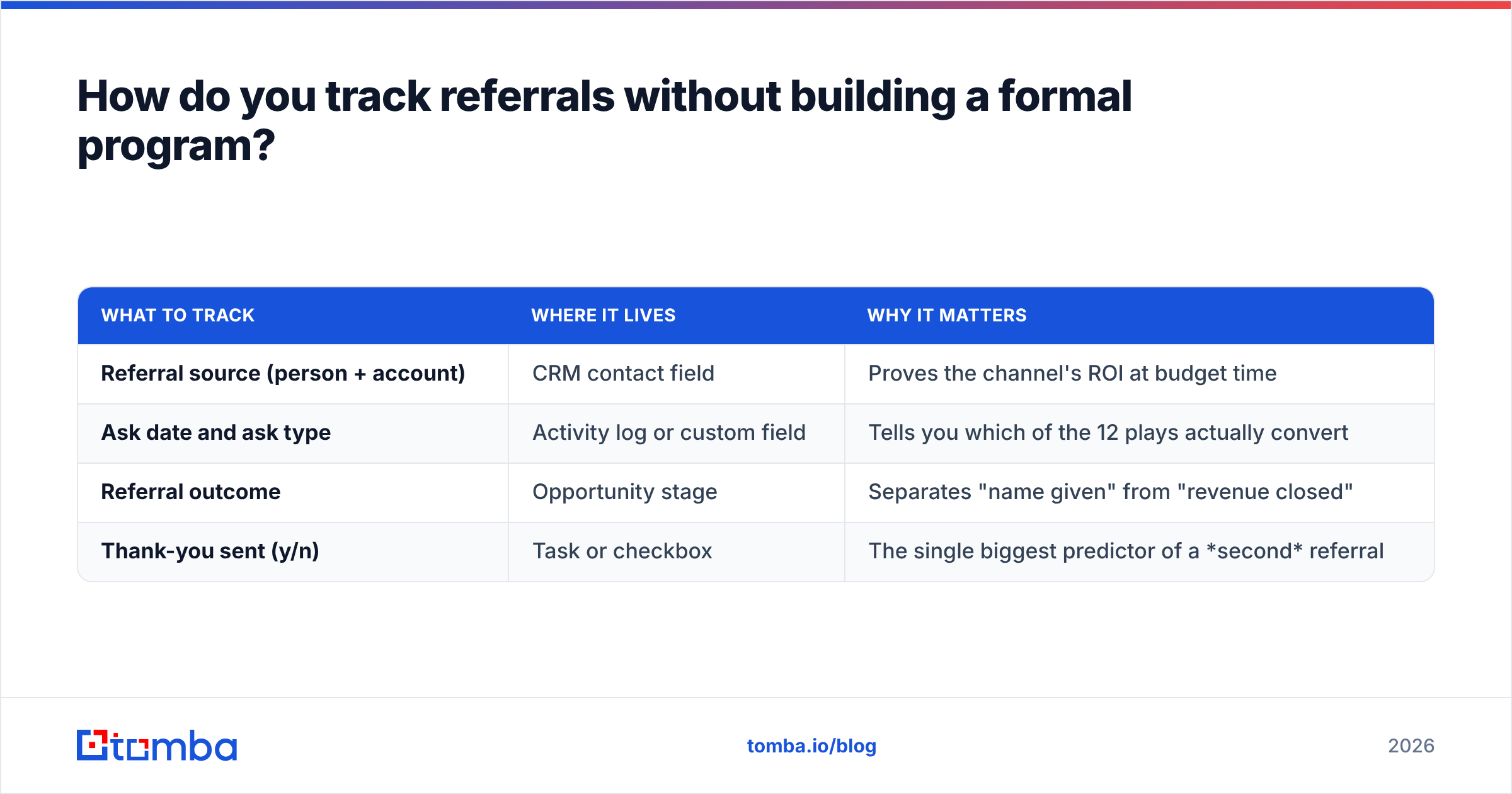
| What to track | Where it lives | Why it matters |
|---|---|---|
| Referral source (person + account) | CRM contact field | Proves the channel's ROI at budget time |
| Ask date and ask type | Activity log or custom field | Tells you which of the 12 plays actually convert |
| Referral outcome | Opportunity stage | Separates "name given" from "revenue closed" |
| Thank-you sent (y/n) | Task or checkbox | The single biggest predictor of a second referral |
Once you have a quarter of that data, you can compute a referral win rate and compare it against your cold outbound baseline. In most B2B teams the gap is embarrassing enough that referrals get resourced properly the moment someone finally measures them. Vendor research from HubSpot and Salesforce has been pointing at the same conclusion for years — the constraint is almost never demand for referrals, it's discipline in asking for them.
On rewards: cash incentives can work in transactional B2B, but in enterprise they often backfire, because they turn a trusted recommendation into a paid endorsement and your referrer knows it. Safer alternatives that still feel generous:
- A donation to a charity the referrer picks
- Early or free access to a feature they've asked for
- A genuine reciprocal introduction
- Public credit — a quote, a co-authored post, a speaking slot
What should you never do when asking for referrals?#
- Don't ask before value has landed. An ask at week two of onboarding tells the customer you care about your pipeline more than their outcome.
- Don't ask everyone the same way. A blast email asking your entire customer base for referrals converts near zero and mildly annoys the people you most need.
- Don't use the referrer's name without permission. "Maya suggested I reach out" when Maya did no such thing is a fireable move and it will get back to her.
- Don't ask twice in a row without giving something. Two asks with nothing in between converts a relationship into a transaction.
- Don't let the name rot. If you're not going to contact the referral within 72 hours, don't ask for it yet.
- Don't skip verification. Referral intros are your highest-trust emails. Bouncing one is the fastest way to make a champion regret helping you.
Where should you start this week?#
Pick five accounts that hit a value moment in the last 30 days. For each, do the research yourself — find two named people in their orbit — and send the named ask with a pre-written forward attached. That's it. Five asks, two hours of prep, and you'll learn more about which plays work in your market than any framework can tell you.
Then handle the follow-through properly. Look up each referred contact, confirm the address is real, and send an email that opens with the referrer's name. Tomba's Email Finder turns a name and a company domain into a verified professional email in seconds, so a warm referral never dies waiting on a contact detail — and the free tier (25 searches a month) is enough to run your first referral sprint before you commit to anything. If it works, Tomba pricing starts at $49/mo for the Starter plan, which covers most single-rep referral motions comfortably.
Referrals are the highest-converting channel most teams have, and the only one they consistently forget to ask for. Fix the ask, fix the follow-through, and the pipeline takes care of itself.
Related guides#
Ready to find emails that actually work?
Join 150,000+ professionals who stopped guessing and started sending. Free credits on signup — no credit card required.
Get the Tomba newsletter
Practical outbound tactics and product updates — once every two weeks.
About the author