Cresta Pricing Reviews Pros and Cons: An Honest 2026 Look
Cresta hides its price behind a sales call. Here is what contact-center teams actually pay in 2026, what reviewers praise, where it falls short, and when a cheaper stack beats it.
This guide breaks down Cresta pricing reviews pros and cons in plain terms. You will see what teams actually pay, what buyers praise, where the product falls short, and when a cheaper stack wins.
TL;DR
- Cresta publishes no list price. Every deal is a custom quote. Buyers consistently report per-seat annual contracts in the roughly $100–$200/agent/month range, plus a platform fee and an implementation phase.
- Reviewers on G2 and Gartner Peer Insights rate the real-time agent assist and coaching highly. The most common complaints: setup time, tuning effort, and the price relative to smaller point tools.
- Cresta is built for high-volume contact centers (usually 100+ agents). Below that headcount, the math rarely works.
- The strongest pros are live prompting during calls and auto-generated QA scoring. The strongest cons are opaque pricing, dependence on a vendor-side data science team, and long time-to-value.
- If your problem is "our reps talk to the wrong people," Cresta doesn't solve it. That's a data and prospecting problem, not a conversation-intelligence one.
What is Cresta and who is it actually built for?#
Cresta is an AI platform for contact centers. It listens to live calls and chats and prompts agents in real time with suggested responses and next steps. It also auto-scores every conversation for QA. Those results roll up into coaching and analytics dashboards for supervisors. The pitch is simple: take the behavior of your top 10% of agents, encode it, and push it to everyone else while they're still on the call — not in a coaching session three weeks later.
It sits in the category people variously call conversation intelligence, agent assist, or real-time guidance. Competitors include Gong (heavily sales-side), Observe.AI, Balto, Level AI, and the native offerings bundled into NICE and Genesys.
One thing matters before you look at any price. Cresta is an enterprise contact-center product, not an SMB sales tool. Its models train on your conversation data, so the platform gets much better with volume. A 25-person sales team doesn't generate enough transcripts to feed it well, and the pricing structure reflects that. Cresta's own product site leans hard on customer-care, sales, and retention use cases at scale — think telco, insurance, financial services, and large BPOs.

How much does Cresta pricing actually cost in 2026?#
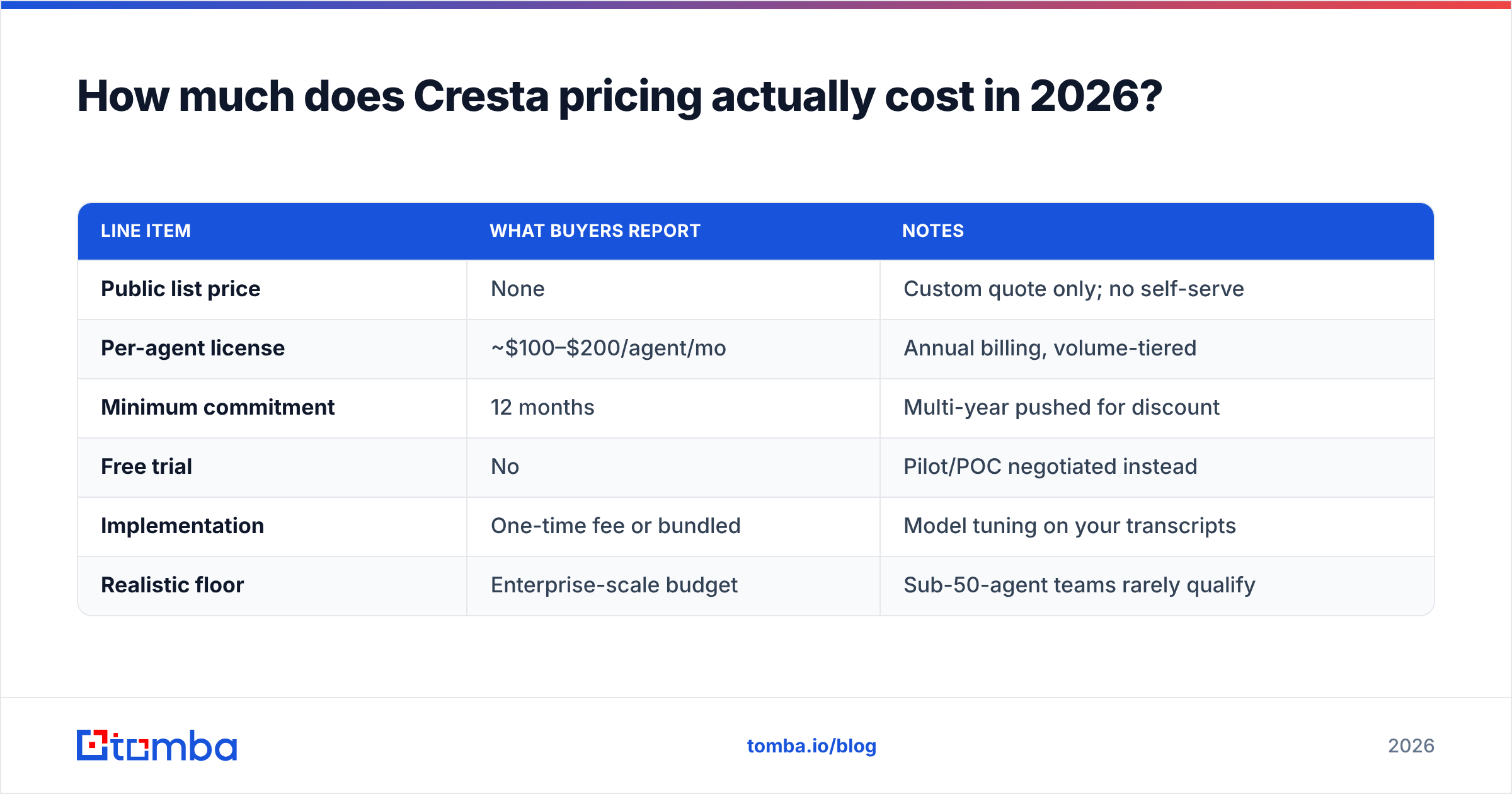
Cresta does not publish a pricing page. There is no free tier, no self-serve signup, and no public per-seat rate. Every engagement runs through a sales conversation, a discovery call, and a scoping exercise. That's normal for the category — Gong and Observe.AI do the same — but it makes budgeting hard.
Based on buyer reports across review platforms and procurement discussions, here is what the shape of a Cresta contract typically looks like:
- Per-agent, per-month licensing. The most commonly cited range is $100–$200 per agent per month, billed annually. Where you land depends on seat count, which modules you take (agent assist vs. QA vs. analytics), and how hard you negotiate.
- Annual commitment, not monthly. Expect a 12-month floor and pressure toward multi-year terms in exchange for discount.
- Implementation and onboarding fees. Model tuning on your data is not free. Some buyers report a one-time services charge. Others say it's folded into year-one pricing as a concession.
- Module-based expansion. Cresta Agent Assist, Cresta Director (supervisor/coaching), and conversation analytics are sold as components. The quote you get for one is not the quote you'll get for three.
- Volume-tiered discounting. The effective per-seat price drops sharply above a few hundred agents. That is exactly why the product is unfriendly to small teams.
Treat those numbers as directional, not gospel. The only real price is the one in your quote. But if a vendor's floor is a five- or six-figure annual commitment and your entire sales tooling budget is $30k, you've learned something useful in ninety seconds.
| Line item | What buyers report | Notes |
|---|---|---|
| Public list price | None | Custom quote only; no self-serve |
| Per-agent license | ~$100–$200/agent/mo | Annual billing, volume-tiered |
| Minimum commitment | 12 months | Multi-year pushed for discount |
| Free trial | No | Pilot/POC negotiated instead |
| Implementation | One-time fee or bundled | Model tuning on your transcripts |
| Realistic floor | Enterprise-scale budget | Sub-50-agent teams rarely qualify |
What do Cresta reviews actually say?#
Cresta reviews skew positive. The praise and the criticism both follow a clear pattern.
What reviewers like. The real-time assist is the headline, and it earns the headline. Agents say the in-call prompting genuinely changes behavior. It surfaces the right objection handling, the right compliance disclosure, and the right upsell moment while the conversation is still live. Supervisors like that QA coverage jumps from a 2% sample to 100% of conversations scored automatically. That kills a whole category of manual busywork. Several reviewers also call out Cresta's customer success team as unusually hands-on.
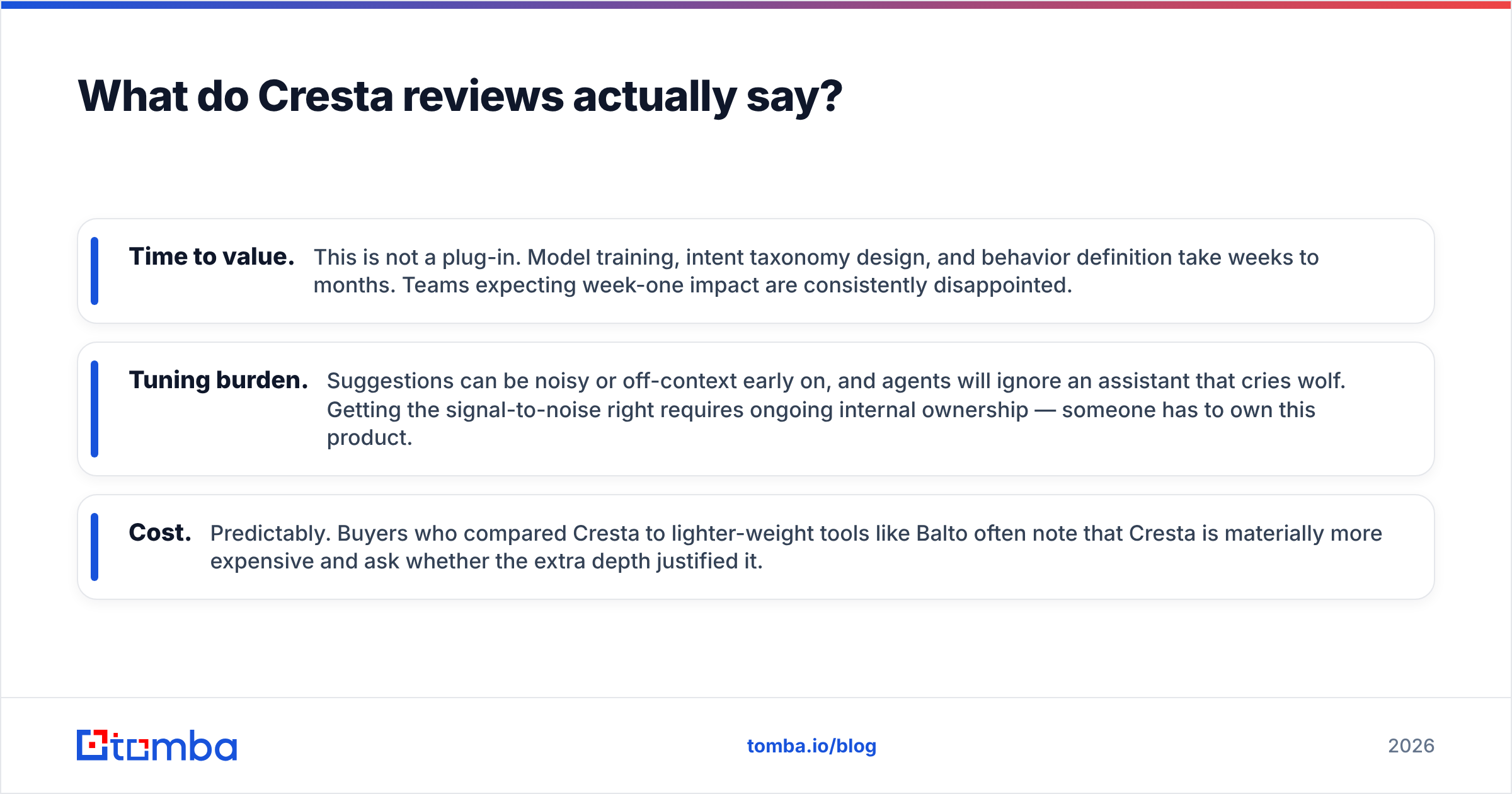
What reviewers criticize. Three themes recur across G2 and Gartner Peer Insights:
- Time to value. This is not a plug-in. Model training, intent taxonomy design, and behavior definition take weeks to months. Teams expecting week-one impact are consistently disappointed.
- Tuning burden. Suggestions can be noisy or off-context early on, and agents will ignore an assistant that cries wolf. Getting the signal-to-noise right takes ongoing internal ownership. Someone has to own this product.
- Cost. Predictably. Buyers who compared Cresta to lighter tools like Balto often note that Cresta costs much more, and they ask whether the extra depth justified it.
The honest read: satisfaction tracks almost perfectly with two things — an internal owner, and enough call volume. Nobody who bought it "to see what AI can do" is happy.
What are the pros of Cresta?#
- Real-time guidance that lands during the call. Post-call coaching tells a rep what they did wrong. Cresta tells them what to do next, now. That difference is the entire product thesis, and it's a real one.
- 100% QA coverage instead of sampled QA. Auto-scoring every conversation removes the sampling bias that makes traditional QA nearly useless for coaching.
- Models trained on your data, not generic scripts. The suggestions reflect what actually works in your funnel. That's why the platform improves with volume.
- Supervisor tooling that's more than a dashboard. Cresta Director shows which behaviors correlate with outcomes. Coaching gets a target instead of a vibe.
- Serious enterprise posture. Security review, compliance, and integration with the major CCaaS platforms are handled at a level SMB tools don't attempt.
What are the cons of Cresta?#
- Opaque pricing. You cannot compare Cresta to alternatives without entering a sales cycle. That's a cost — in time, and in negotiating position.
- No free tier, no trial. A paid or scoped pilot is the entry point.
- Long ramp. Budget months, not days. If your leadership expects a quarterly ROI story, set that expectation carefully.
- You need volume. The model is only as good as the conversation corpus it learns from. Thin data, thin results.
- Agent resistance is real. Reps often experience real-time monitoring as surveillance. Rollout is a change-management project, not a software install.
- It optimizes conversations you're already having. It does nothing about whether those conversations are with the right people. Most buyers miss that point.
How does Cresta compare to Gong, Observe.AI, and Balto?#
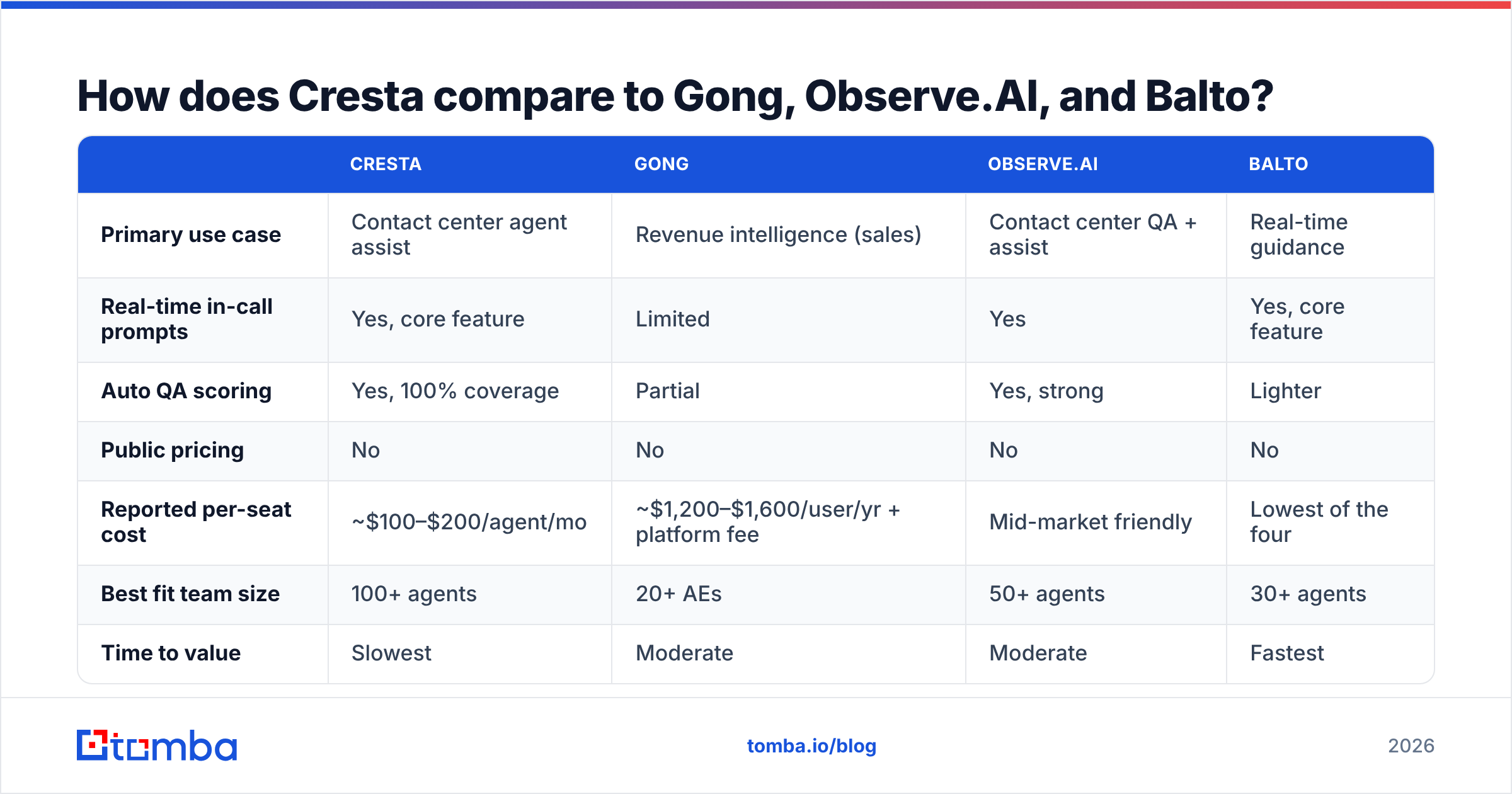
The category splinters along one axis: real-time vs. post-call. A second axis is sales vs. support. Here's where the main options land.
| Cresta | Gong | Observe.AI | Balto | |
|---|---|---|---|---|
| Primary use case | Contact center agent assist | Revenue intelligence (sales) | Contact center QA + assist | Real-time guidance |
| Real-time in-call prompts | Yes, core feature | Limited | Yes | Yes, core feature |
| Auto QA scoring | Yes, 100% coverage | Partial | Yes, strong | Lighter |
| Public pricing | No | No | No | No |
| Reported per-seat cost | ~$100–$200/agent/mo | ~$1,200–$1,600/user/yr + platform fee | Mid-market friendly | Lowest of the four |
| Best fit team size | 100+ agents | 20+ AEs | 50+ agents | 30+ agents |
| Time to value | Slowest | Moderate | Moderate | Fastest |
| Setup complexity | High | Moderate | Moderate | Low |
Read that table with one filter: what problem are you actually solving? If you're a sales org trying to understand deal risk and rep performance from recorded calls, Gong is the more natural shape. If you're a support/care center trying to lift CSAT and cut handle time across hundreds of agents, look at Cresta or Observe.AI. If you want 80% of the real-time value at 40% of the price and can live with less depth, Balto is the pragmatic pick.
Is Cresta worth it for your team?#
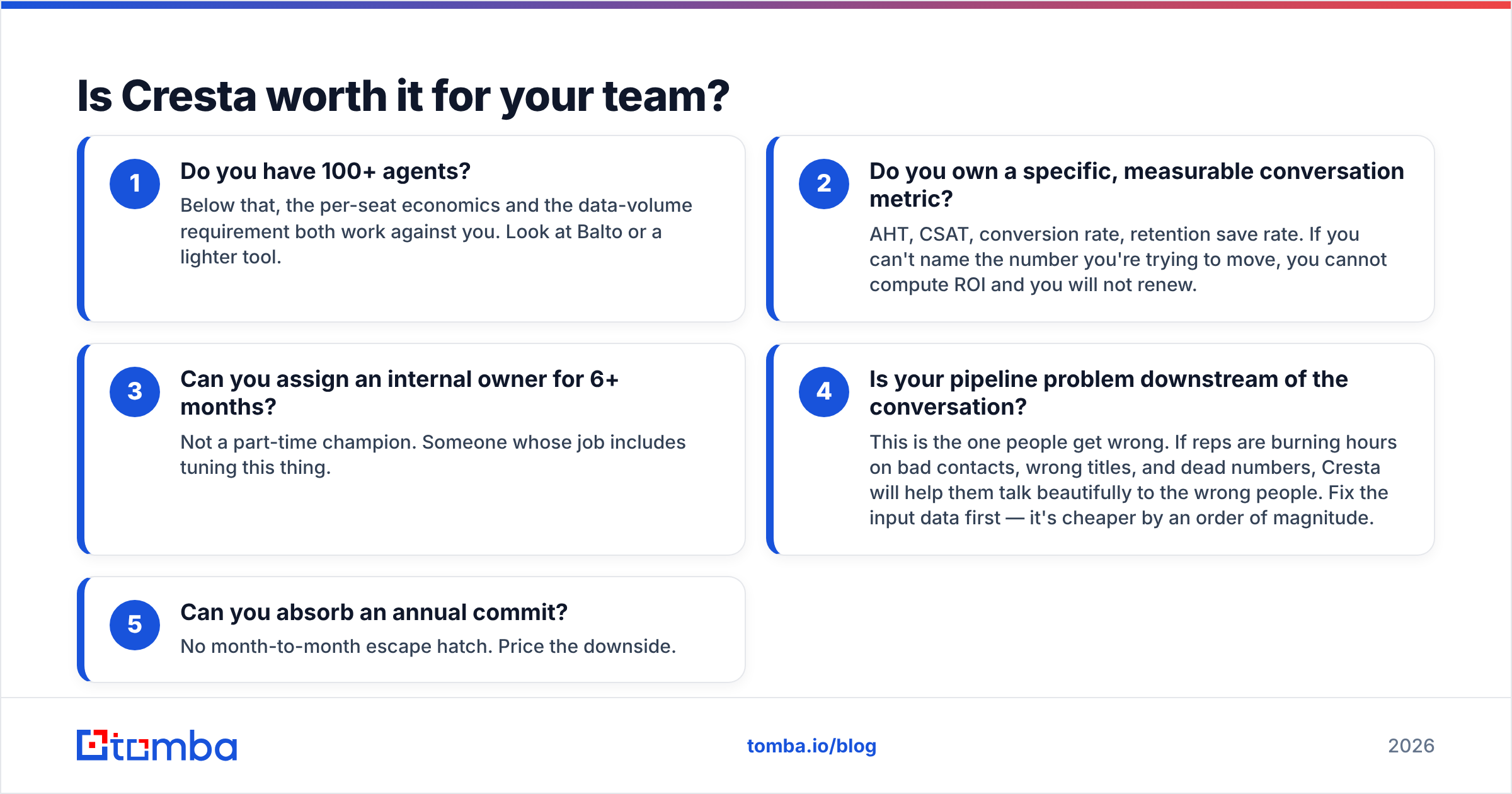
Run this checklist honestly before you take the call.
- Do you have 100+ agents? Below that, the per-seat economics and the data-volume requirement both work against you. Look at Balto or a lighter tool.
- Do you own a specific, measurable conversation metric? AHT, CSAT, conversion rate, retention save rate. If you can't name the number you're trying to move, you cannot compute ROI and you will not renew.
- Can you assign an internal owner for 6+ months? Not a part-time champion. Someone whose job includes tuning this thing.
- Is your pipeline problem downstream of the conversation? This is the one people get wrong. If reps burn hours on bad contacts, wrong titles, and dead numbers, Cresta will help them talk beautifully to the wrong people. Fix the input data first. It's cheaper by an order of magnitude.
- Can you absorb an annual commit? There is no month-to-month escape hatch. Price the downside.
If you answered yes to all five, Cresta is a legitimate contender, and the reviews suggest you'll get real value. If you flinched on two or more, you're shopping in the wrong category.
What should you fix before buying conversation AI?#
Here's the uncomfortable order of operations most GTM teams get backwards.
Conversation intelligence multiplies whatever already flows through your funnel. If the top of that funnel is full of stale contacts, catch-all domains, and job titles from three roles ago, an AI assistant just makes bad conversations more polished. It does not make them more valuable. Teams that get outsized returns from tools like Cresta almost always fixed their data layer first: verified contacts, accurate direct dials, enriched firmographics, and clean CRM records.
That's a much cheaper problem to solve. You can fix it this week rather than next quarter. A clean email finder plus real email verification removes the bounce-and-guess tax entirely. Add data enrichment on top, and reps open every conversation knowing who they're talking to. On Tomba pricing, that whole layer starts at $49/mo on Starter — roughly the cost of half a single Cresta seat.
Sequence matters. Data first, conversation AI second. Do it the other way, and your six-figure contract ends in a "we didn't see the ROI" post-mortem.
Cresta pricing reviews pros and cons: the bottom line#
Cresta is a strong product with a narrow, well-defined buyer. That buyer is a large contact center with high call volume, a measurable conversation metric, and the internal muscle to own a months-long rollout. For that team, the real-time assist and full-coverage QA are genuinely differentiated, and the reviews back it up.
For everyone else, the honest verdict on Cresta pricing reviews pros and cons is simple. The price is high, the pricing is opaque, and the ramp is long. Lighter tools get you most of the way there. And for many teams, the real bottleneck isn't call quality at all. It's who's on the other end of the call.
Before you spend six figures teaching reps how to talk, make sure they're talking to real, reachable, correctly-targeted people. Start with the Tomba Email Finder. Find verified professional emails by name, domain, or company, then plug them straight into your CRM or sequencer. Whatever conversation AI you buy later will finally have something worth working with. The free tier gives you 25 searches a month to test the difference for yourself.
Related guides#
Ready to find emails that actually work?
Join 150,000+ professionals who stopped guessing and started sending. Free credits on signup — no credit card required.
Get the Tomba newsletter
Practical outbound tactics and product updates — once every two weeks.
About the author