CRM Deal Stages Explained: Build a Pipeline That Closes
CRM deal stages are the backbone of a predictable pipeline. Here's how to define them, avoid the classic mistakes, and keep every stage clean with real buyer signals.
Most pipelines don't fail because reps stop working. They fail because the stages inside the CRM lie about where deals really are. A deal marked "Negotiation" that hasn't had a reply in three weeks isn't in negotiation — it's dead and nobody moved it. Get your crm deal stages right and forecasting, coaching, and revenue planning all get easier at once.
TL;DR#
- CRM deal stages are the named steps a deal passes through from first touch to closed. Each stage should represent a buyer action, not a seller feeling.
- A tight pipeline uses 5 to 7 stages with clear exit criteria — more than that and reps guess; fewer and you can't forecast.
- Every stage needs an objective entry/exit rule ("demo completed and next step booked"), not a vibe.
- Bad data poisons stages faster than bad process. Clean contact data feeds accurate stage movement — start with a reliable email finder and verified records.
- Review stage conversion rates monthly. If 60% of deals die in one stage, that stage is where your process is broken.
What are CRM deal stages?#
Think of deal stages like the boarding process at an airport. Check-in, security, gate, boarding, wheels-up — each step has a gate you literally cannot skip, and airport staff know exactly how many passengers sit at each point. Your CRM should work the same way: at any moment you should know how many deals are "at security" versus "at the gate," and roughly how long each leg takes.
Technically, a deal stage is a status field on an opportunity record that tracks progression through your sales cycle. In tools like HubSpot and Salesforce, the deal stage drives forecast categories, probability weighting, and automation triggers. When a rep drags a deal from one column to the next, they're not just tidying a board — they're changing the number your VP of Sales reports to the board.
The mistake most teams make is defining stages around what the seller is doing ("Sent proposal") instead of what the buyer has done ("Proposal reviewed, pricing questions raised"). Seller-centric stages inflate late-stage pipeline because a rep can send a proposal into the void and call it progress.
Why do deal stages matter so much for forecasting?#
Because your forecast is only as honest as your stage definitions. If "Qualified" means five different things to five reps, your weighted pipeline is fiction.
Well-defined stages give you three things:
- Predictable conversion math — you learn that 30% of "Discovery" deals reach "Proposal," so you know how much top-of-funnel you need to hit quota.
- Faster coaching — a manager can spot that a rep's deals stall at "Evaluation" and intervene before the quarter ends.
- Clean automation — reaching a stage can trigger a task, an email sequence, or a handoff without a human remembering to do it.
The revenue operations function lives or dies on this. RevOps can't build reliable models on top of stages that reps interpret differently, so standardizing exit criteria is usually step one of any pipeline cleanup.
What are the standard CRM deal stages?#
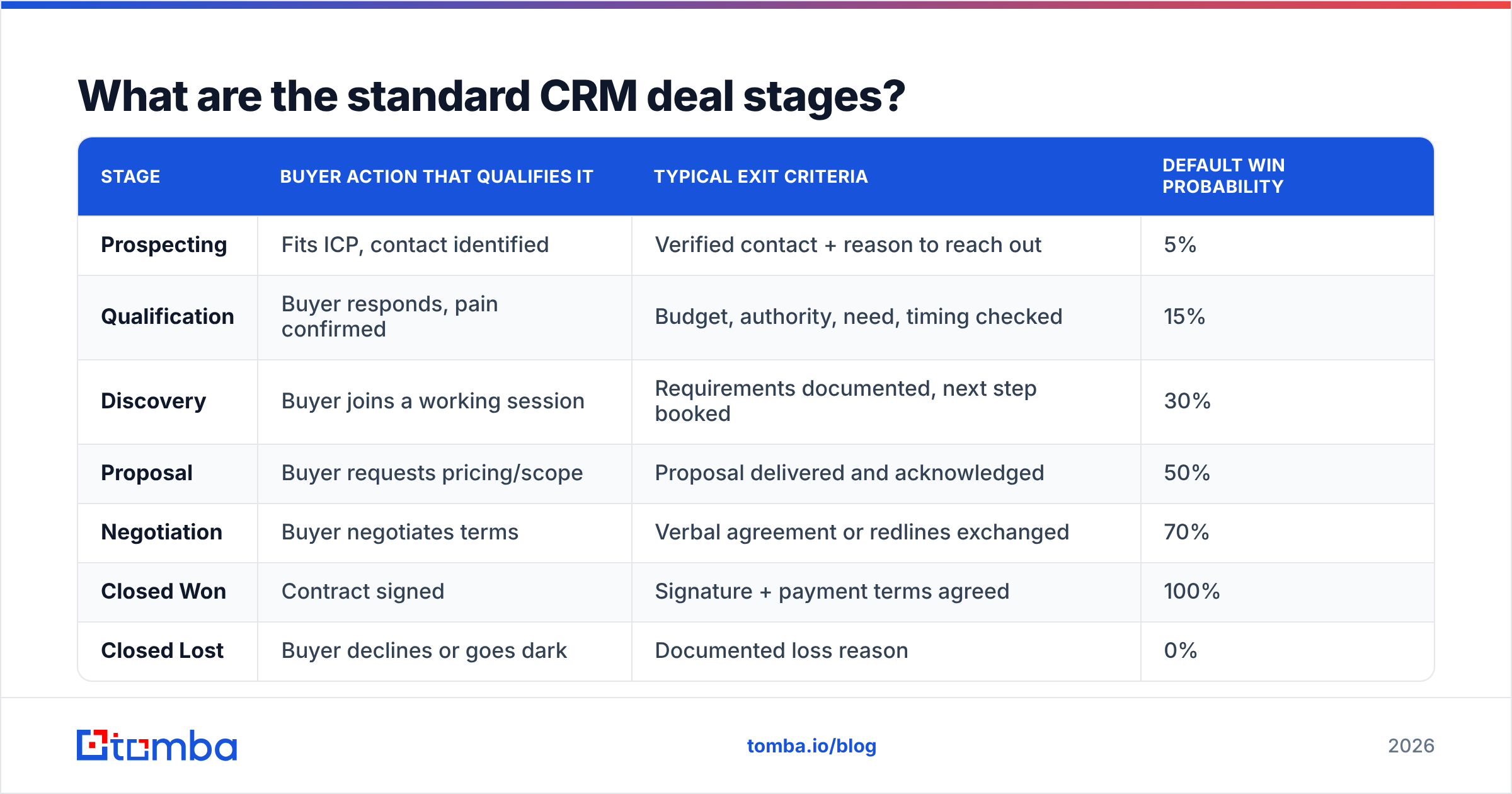
Most B2B teams converge on a similar backbone, then adapt the labels. Here's a common 7-stage model and what each stage actually means.
| Stage | Buyer action that qualifies it | Typical exit criteria | Default win probability |
|---|---|---|---|
| Prospecting | Fits ICP, contact identified | Verified contact + reason to reach out | 5% |
| Qualification | Buyer responds, pain confirmed | Budget, authority, need, timing checked | 15% |
| Discovery | Buyer joins a working session | Requirements documented, next step booked | 30% |
| Proposal | Buyer requests pricing/scope | Proposal delivered and acknowledged | 50% |
| Negotiation | Buyer negotiates terms | Verbal agreement or redlines exchanged | 70% |
| Closed Won | Contract signed | Signature + payment terms agreed | 100% |
| Closed Lost | Buyer declines or goes dark | Documented loss reason | 0% |
You don't need all seven. A high-velocity, low-ACV team might collapse Proposal and Negotiation into one. An enterprise team might split Discovery into "Technical Eval" and "Business Case." The rule is simple: every stage must map to something the buyer did that you can verify.
How many deal stages should you have?#
Five to seven for most B2B teams. Here's the trade-off.
- Too few stages (3-4): You lose forecasting resolution. A deal jumps from "Qualified" straight to "Closing" with no visibility into the messy middle where most deals actually die.
- Too many stages (9+): Reps stop updating them accurately because the distinctions get fuzzy. Is this "Solution Design" or "Technical Validation"? When reps can't tell, they guess, and your data rots.
A quick gut check: if two reps can't independently place the same deal in the same stage using only your written criteria, you have too many stages or vague definitions. Fix the criteria before adding more columns.
What makes a good deal stage definition?#
Objective, binary entry and exit criteria. A stage should answer "yes or no — is this deal here?" without debate.
Compare these two definitions of a "Discovery" stage:
- Weak: "We're learning about the customer's needs." (Every active deal feels like this.)
- Strong: "A discovery call has happened, requirements are documented in the deal notes, and a next meeting is on the calendar." (Either it's true or it isn't.)
Good exit criteria share three traits:
- Buyer-verified — the buyer took an observable action.
- Time-bound where possible — "no reply in 14 days" auto-flags a stage for review.
- Documented in the record — the proof lives in the CRM, not the rep's head.
How do you keep deal stages clean?#
Clean stages come from clean inputs and enforced discipline. Three habits do most of the work.
1. Feed the pipeline verified data. A deal that enters "Prospecting" with a guessed email address is already contaminated — bounces waste rep time and skew your conversion rates. Verify contacts before they enter the pipeline using an email verifier, and enrich accounts so reps aren't qualifying on incomplete records. If you're building lists at scale, a bulk email finder keeps top-of-funnel accurate without manual lookups.
2. Enforce exit criteria with automation. Don't rely on reps to remember rules. Require a "next step date" field before a deal can advance, and auto-flag any deal with no activity in X days. Both HubSpot and Salesforce support required fields and rotting-deal alerts.
3. Run a weekly pipeline hygiene review. Ten minutes per rep: any deal past its expected close date, any stage with no recent activity, any deal in "Negotiation" that a manager doesn't recognize. Deals that can't survive the question "what's the next committed buyer action?" get moved back or marked lost.
What are the most common deal-stage mistakes?#
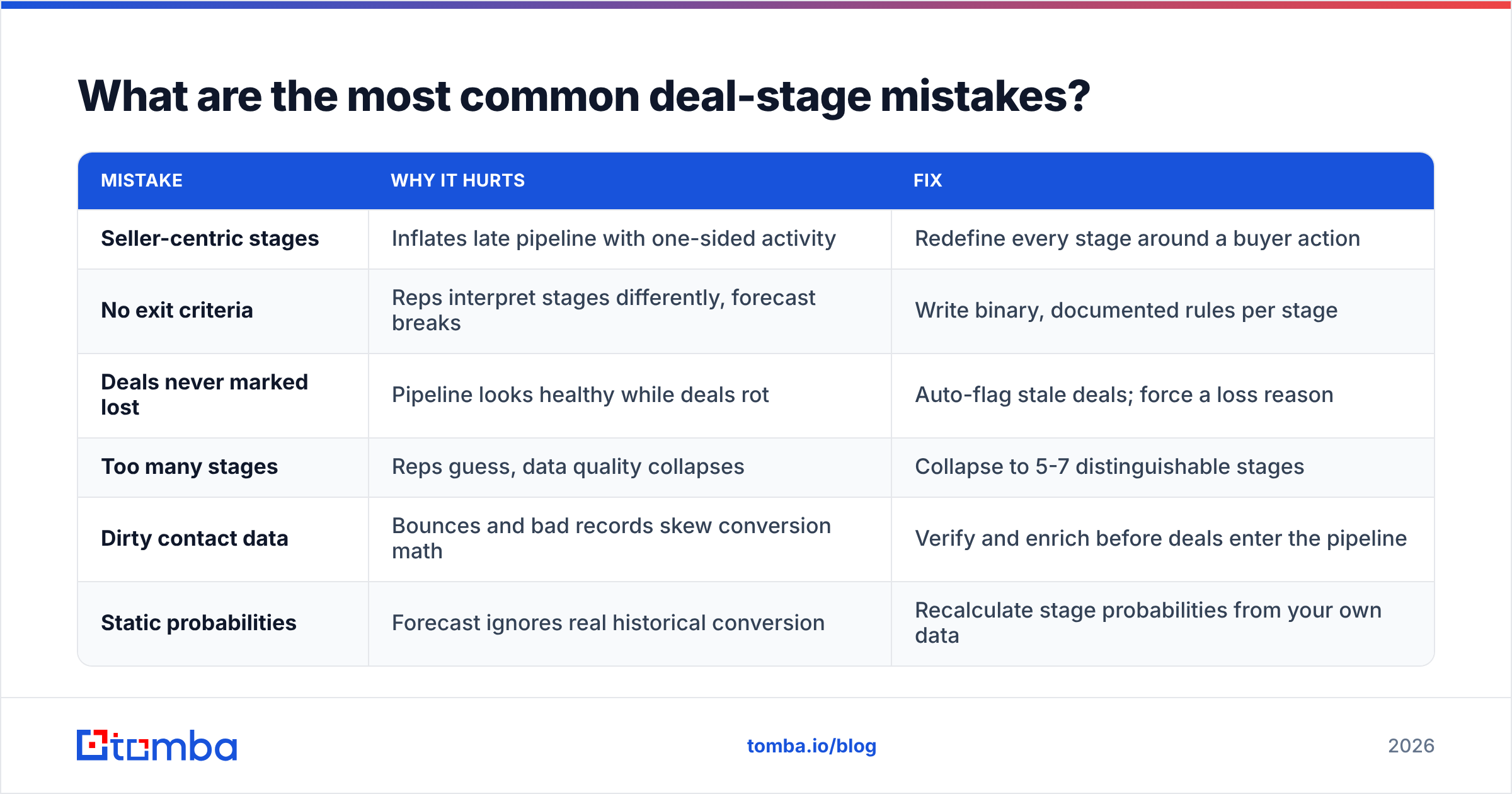
| Mistake | Why it hurts | Fix |
|---|---|---|
| Seller-centric stages | Inflates late pipeline with one-sided activity | Redefine every stage around a buyer action |
| No exit criteria | Reps interpret stages differently, forecast breaks | Write binary, documented rules per stage |
| Deals never marked lost | Pipeline looks healthy while deals rot | Auto-flag stale deals; force a loss reason |
| Too many stages | Reps guess, data quality collapses | Collapse to 5-7 distinguishable stages |
| Dirty contact data | Bounces and bad records skew conversion math | Verify and enrich before deals enter the pipeline |
| Static probabilities | Forecast ignores real historical conversion | Recalculate stage probabilities from your own data |
The last row matters more than teams realize. Those default win-probabilities in the table above are starting points — your actual "Proposal" stage might convert at 38%, not 50%. Once you have 6-12 months of history, replace the defaults with your measured conversion rates. That single change usually tightens forecast accuracy more than any new tool.
How do deal stages connect to your sales process?#
Stages are the CRM shadow of your real sales process — they only work if the underlying sales process is real. If your team improvises every deal, no amount of stage engineering saves you, because there's nothing consistent to model.
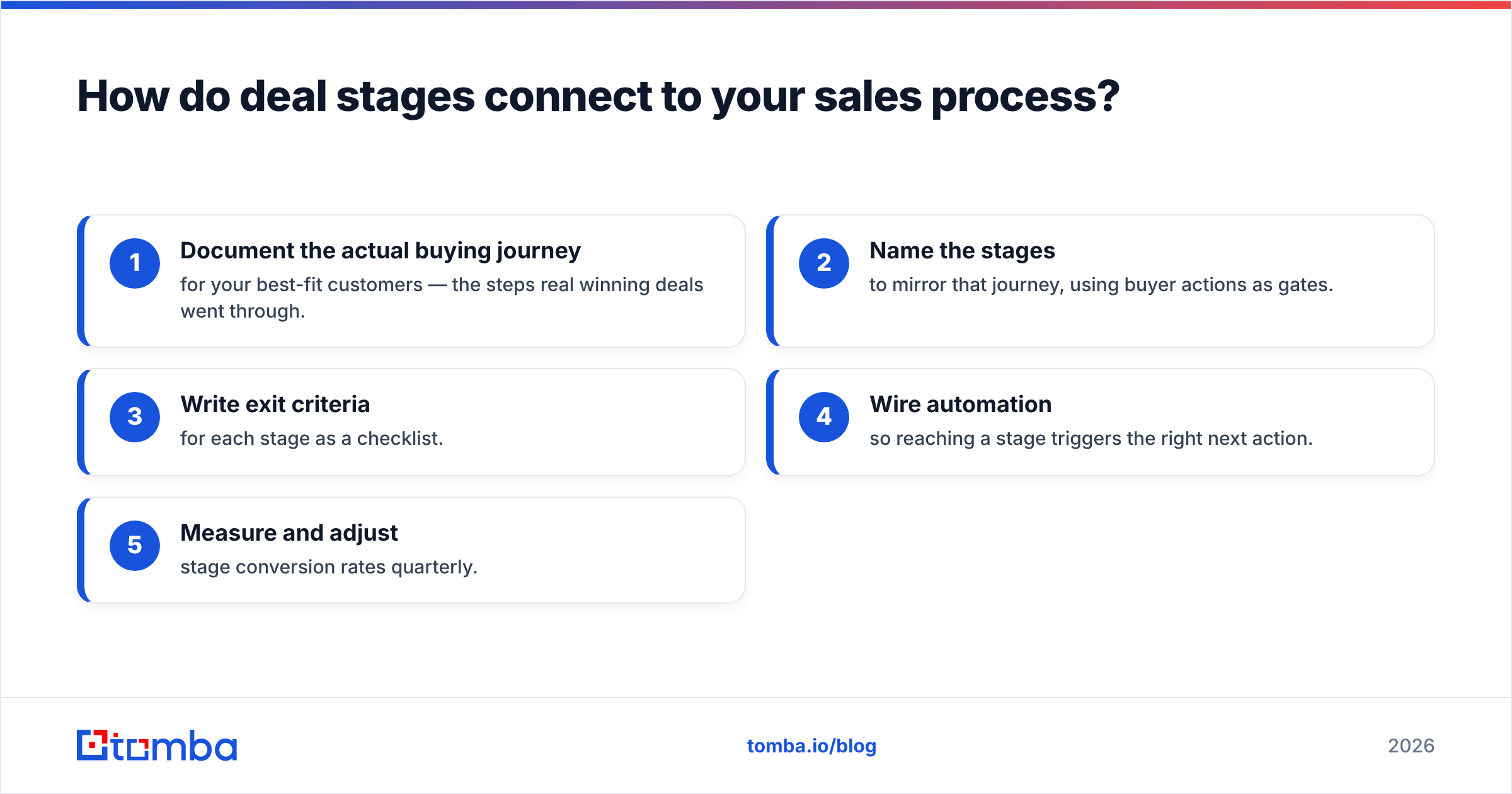
Map it in this order:
- Document the actual buying journey for your best-fit customers — the steps real winning deals went through.
- Name the stages to mirror that journey, using buyer actions as gates.
- Write exit criteria for each stage as a checklist.
- Wire automation so reaching a stage triggers the right next action.
- Measure and adjust stage conversion rates quarterly.
This is also where data tooling earns its keep. Prospecting stages fed by a domain search that surfaces the right contacts at a target account move faster and convert better than stages fed by scraped, unverified lists. The cleaner the entry, the more honest every downstream stage becomes.
Deal stages vs. lead stages: what's the difference?#
They're easy to confuse but they track different objects. Lead stages describe a person's readiness (new, working, MQL, SQL). Deal stages describe an opportunity's progression toward a signed contract. A single lead can generate one deal, and a single deal can involve several leads (the champion, the economic buyer, the technical evaluator).
Keep them separate in your CRM. Blending them creates the classic mess where a "lead" and a "deal" for the same account show contradictory statuses, and your forecast double-counts revenue that only exists once.
Putting it together#
The teams with the most accurate forecasts aren't the ones with the fanciest CRM — they're the ones whose stages describe reality. Five to seven stages, each defined by a buyer action, each with binary exit criteria, all fed by verified data and reviewed weekly. That's the entire formula. Everything else is decoration.
If your pipeline feels bloated or your forecast keeps missing, start by auditing one thing: pick ten open deals and ask whether each one truly meets the written criteria for its current stage. The gaps you find are your roadmap.
Start with clean data feeding every stage#
Great deal stages collapse the moment garbage contacts enter your pipeline. Before you obsess over stage names and probabilities, make sure the records driving them are real. The Tomba Email Finder helps you find and verify professional email addresses by name, domain, or company — so deals enter "Prospecting" with contacts that actually respond, not bounces that quietly wreck your conversion math. Pair it with verification and enrichment, and every stage downstream tells the truth. Check the Tomba pricing plans — the free tier gives you 25 searches a month to test it against your own pipeline before you commit.
Related guides#
Ready to find emails that actually work?
Join 150,000+ professionals who stopped guessing and started sending. Free credits on signup — no credit card required.
Get the Tomba newsletter
Practical outbound tactics and product updates — once every two weeks.
About the author