CRM Forecasting in 2026: Methods, Tools, and Real Accuracy
CRM forecasting turns pipeline data into revenue you can bank on — if the data is clean. Here are the methods, tools, and accuracy traps that actually matter in 2026.
Every sales leader has stood in a QBR and defended a number they only half-believed. CRM forecasting is the discipline of replacing that half-belief with something you can actually put in the board deck — a revenue prediction built from the deals, stages, and history sitting in your CRM instead of a rep's optimism.
The problem is that most CRM forecasts are wrong, and predictably so. Not because the math is hard, but because the inputs are dirty and the method is mismatched to the business. This guide breaks down how CRM forecasting really works in 2026, which methods fit which teams, how the major tools compare, and the unglamorous data work that separates a 90%-accurate forecast from a coin flip.
TL;DR#
- CRM forecasting predicts future revenue by analyzing the deals, stages, close dates, and history already stored in your CRM — it is only as good as the data feeding it.
- There are five core methods (stage-based, historical, pipeline, opportunity, and AI/predictive); most teams should blend two rather than pick one.
- Forecast accuracy under 75% almost always traces to data hygiene — stale contacts, missing decision-makers, and rep-inflated close dates — not to the forecasting model.
- Native CRM forecasting (HubSpot, Salesforce) is fine to start; dedicated tools like Clari or Gong add call-signal intelligence but cost 5-10x more.
- Clean, enriched contact and account data is the cheapest accuracy upgrade available — fix the inputs before you buy a fancier model.
What is CRM forecasting?#
CRM forecasting is the process of using data inside your customer relationship management system to project how much revenue your team will close over a defined period — a month, a quarter, a fiscal year.
Think of it like weather forecasting. A meteorologist does not guess; they take current conditions (pressure, humidity, wind) and run them through models trained on decades of history. CRM forecasting does the same with sales conditions: open deal value, stage, age, win rates, and seasonality. The forecast is the prediction; the CRM is the atmosphere you are reading.
Technically, a CRM forecast aggregates every open opportunity, weights each one by its probability of closing, factors in the expected close date, and rolls those weighted values into a single expected number (plus, ideally, a range). The CRM is the system of record that makes this possible at scale — without it you are forecasting in spreadsheets, which is where accuracy goes to die.
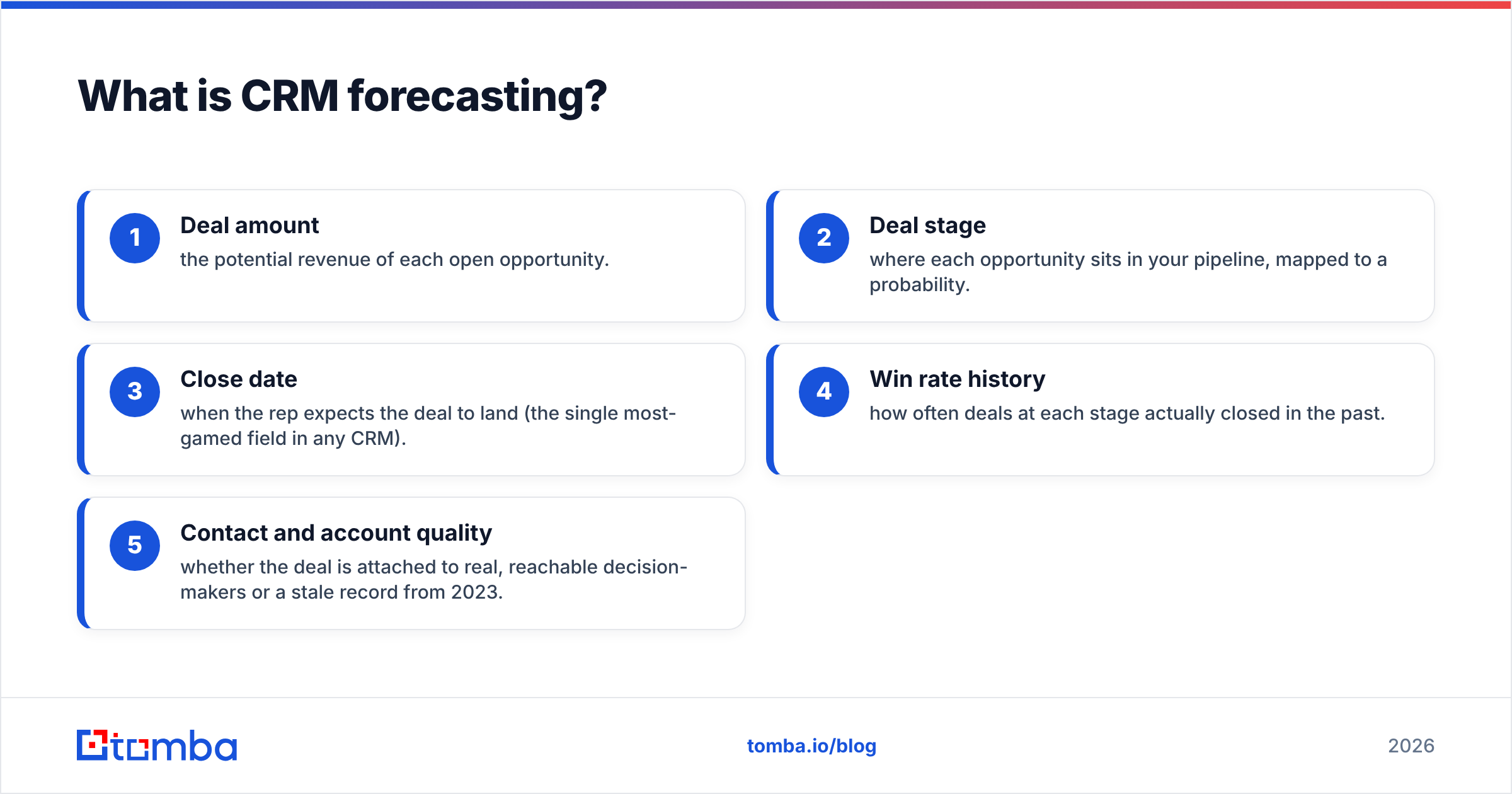
The core inputs a forecast depends on:
- Deal amount — the potential revenue of each open opportunity.
- Deal stage — where each opportunity sits in your pipeline, mapped to a probability.
- Close date — when the rep expects the deal to land (the single most-gamed field in any CRM).
- Win rate history — how often deals at each stage actually closed in the past.
- Contact and account quality — whether the deal is attached to real, reachable decision-makers or a stale record from 2023.
That last input is the one teams ignore, and it quietly poisons everything downstream.
What are the main CRM forecasting methods?#
There is no single "right" method — there are five, and the best teams blend them. Here is how each works and who it fits.
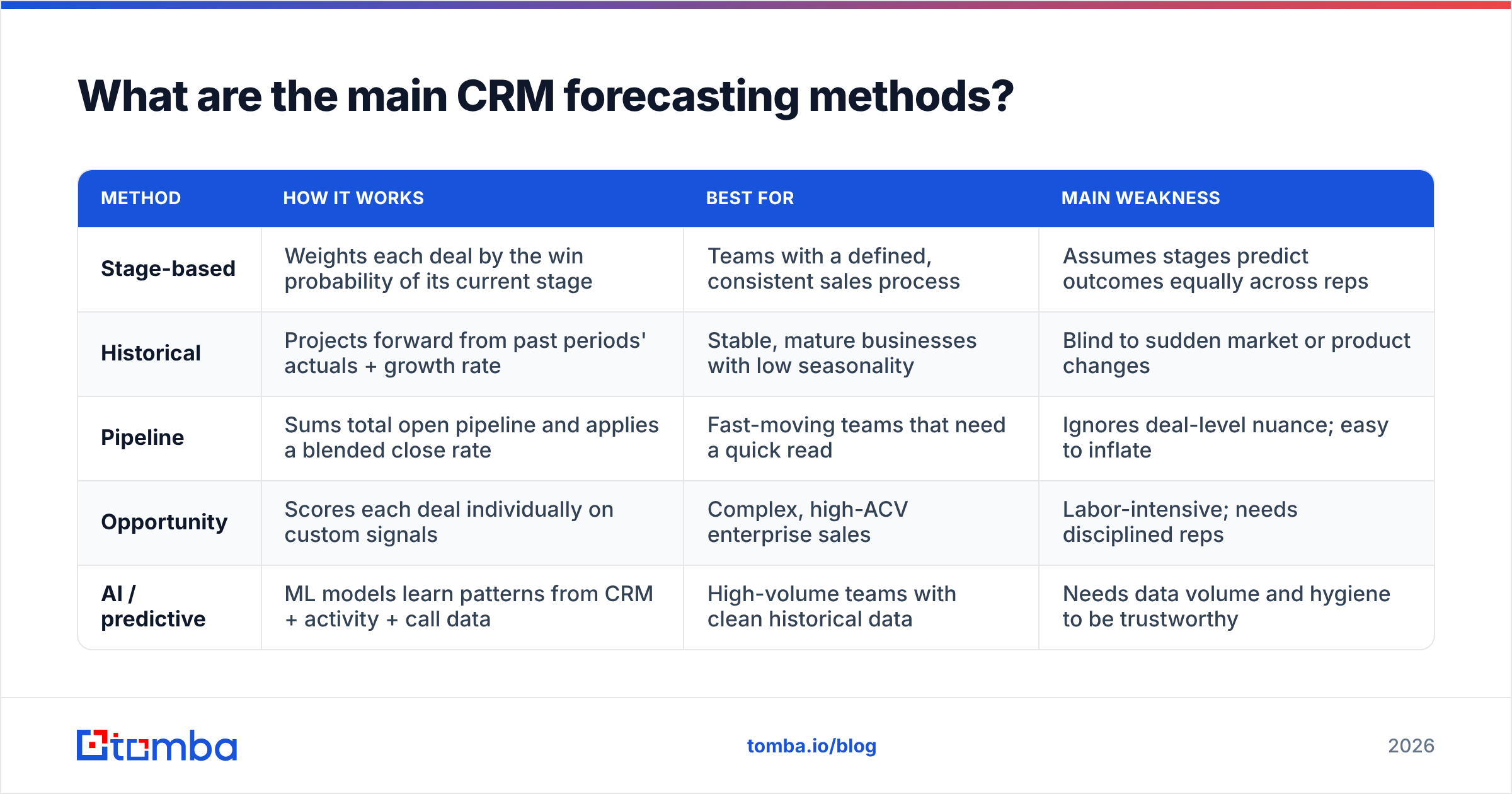
| Method | How it works | Best for | Main weakness |
|---|---|---|---|
| Stage-based | Weights each deal by the win probability of its current stage | Teams with a defined, consistent sales process | Assumes stages predict outcomes equally across reps |
| Historical | Projects forward from past periods' actuals + growth rate | Stable, mature businesses with low seasonality | Blind to sudden market or product changes |
| Pipeline | Sums total open pipeline and applies a blended close rate | Fast-moving teams that need a quick read | Ignores deal-level nuance; easy to inflate |
| Opportunity | Scores each deal individually on custom signals | Complex, high-ACV enterprise sales | Labor-intensive; needs disciplined reps |
| AI / predictive | ML models learn patterns from CRM + activity + call data | High-volume teams with clean historical data | Needs data volume and hygiene to be trustworthy |
Stage-based forecasting is the default in most CRMs. Assign each stage a probability (Discovery 20%, Proposal 60%, Negotiation 80%), multiply by deal value, and sum. Simple and transparent, but it treats every Proposal-stage deal as equally likely to close, which is rarely true.
Historical forecasting ignores current pipeline and instead says "we closed $2M last Q3, we're growing 15%, so expect ~$2.3M." Reliable for mature businesses, useless during rapid change.
Pipeline forecasting is the fast-and-loose version: total open pipeline times an average conversion rate. Good for a gut check, dangerous as a commit number because a few bloated deals distort it.
Opportunity forecasting scores each deal on its own merits — champion engaged, budget confirmed, competitor removed. It is the most accurate for enterprise deals and the most demanding of rep discipline.
AI/predictive forecasting is where 2026 is heading. Models trained on your closed-won and closed-lost history, plus email and call activity, surface risk signals a human would miss. But — and this matters — AI forecasting amplifies whatever data you feed it. Garbage in, confident garbage out.
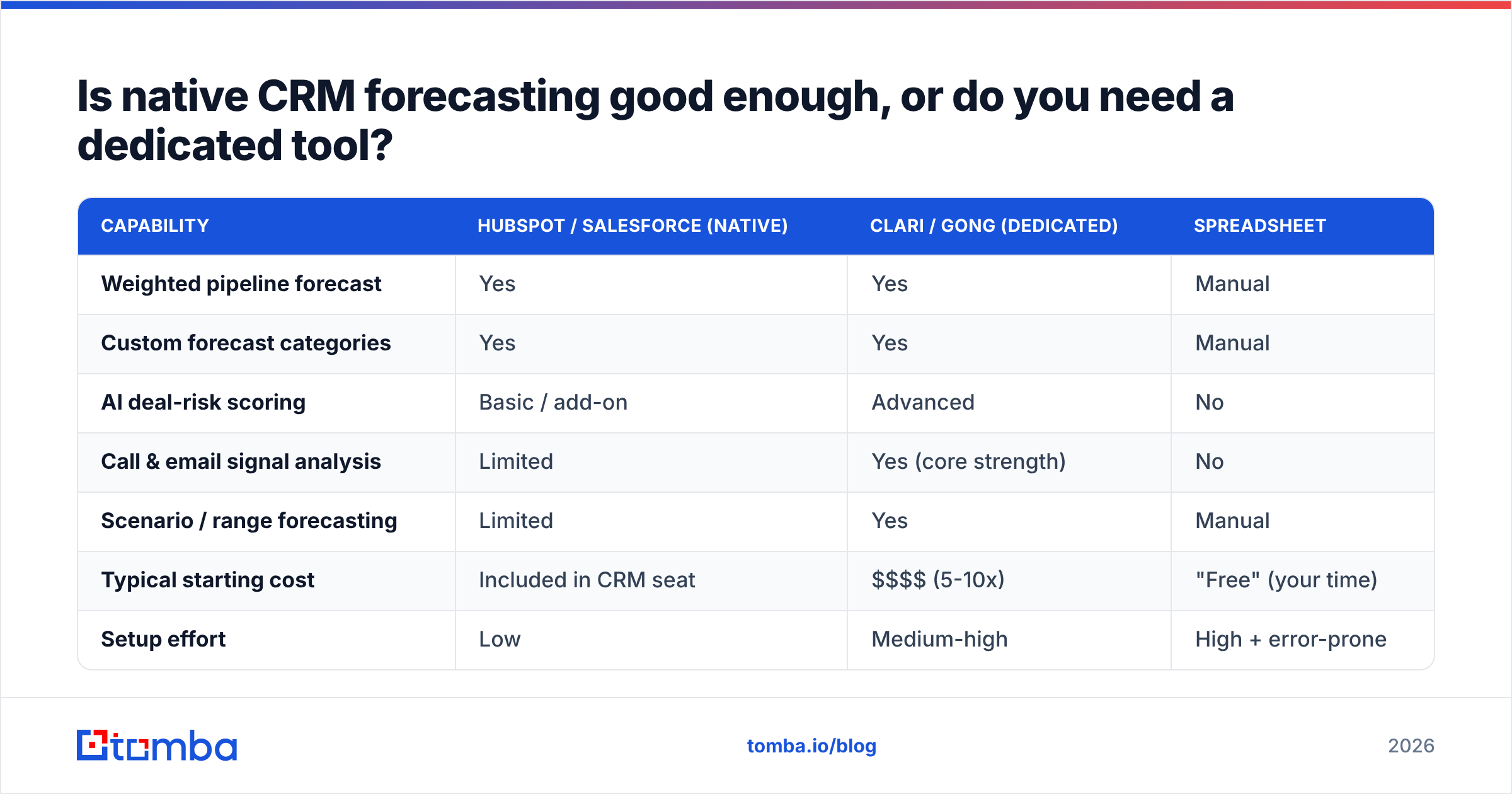
Is native CRM forecasting good enough, or do you need a dedicated tool?#
For most teams under $10M ARR, native CRM forecasting is good enough — the money is better spent on data quality than on a forecasting layer. Above that, dedicated revenue-intelligence tools start earning their price.
Here is how the tiers compare:
| Capability | HubSpot / Salesforce (native) | Clari / Gong (dedicated) | Spreadsheet |
|---|---|---|---|
| Weighted pipeline forecast | Yes | Yes | Manual |
| Custom forecast categories | Yes | Yes | Manual |
| AI deal-risk scoring | Basic / add-on | Advanced | No |
| Call & email signal analysis | Limited | Yes (core strength) | No |
| Scenario / range forecasting | Limited | Yes | Manual |
| Typical starting cost | Included in CRM seat | $$$$ (5-10x) | "Free" (your time) |
| Setup effort | Low | Medium-high | High + error-prone |
Salesforce and HubSpot both ship capable native forecasting: forecast categories, weighted pipelines, and increasingly, AI predictions. Dedicated tools like Clari and Gong layer conversation intelligence on top — they listen to calls and read emails to flag deals that look healthy in the CRM but are quietly dying. That signal is genuinely valuable for large, complex deals. It is overkill for a five-rep team closing SMB business in 30 days.
The honest rule: do not buy a $50k/year forecasting tool to fix a data problem a $99/month enrichment fix would solve. Which brings us to the part everyone skips.
Why is your CRM forecast wrong? (It's the data.)#
Nine times out of ten, an inaccurate CRM forecast is a data problem wearing a math costume. The model is fine. The inputs are rotten.
Here are the usual culprits:
- Stale contacts. The champion you're forecasting to left the company four months ago. Your deal is attached to a ghost. Studies of B2B databases consistently show contact data decaying at roughly 22-30% per year — a third of your CRM is wrong within twelve months if left untouched.
- Missing decision-makers. The opportunity has one contact: a mid-level manager who can't sign. No economic buyer means no real forecast, only hope.
- Duplicate and merged records. The same account appears three times, so your pipeline total is inflated by deals that are actually one deal.
- Sandbagged or inflated close dates. Reps push close dates to protect quota timing or pull them in to look busy. Either way, your period cutoff is fiction.
- Empty firmographic fields. Company size, industry, and revenue are blank, so you can't segment the forecast or apply the right win rates.
Fixing this isn't glamorous, but it's the highest-ROI work in forecasting. Start by keeping contact records current and complete. When a deal's primary contact goes stale, you need a fast way to find the right person's email again — an email finder that resolves a name and company into a verified address closes that gap in seconds instead of derailing the deal. For accounts missing decision-makers entirely, a domain search surfaces the full roster of reachable contacts at the company so your opportunity isn't riding on a single fragile relationship.
And before any of that data enters a forecast, it should be validated. Running your list through an email verifier strips out the bounced, invalid, and role-based addresses that make a pipeline look bigger than it is. A forecast built on verified, enriched records is not automatically accurate — but a forecast built on unverified records is automatically suspect.
How do you improve CRM forecast accuracy?#
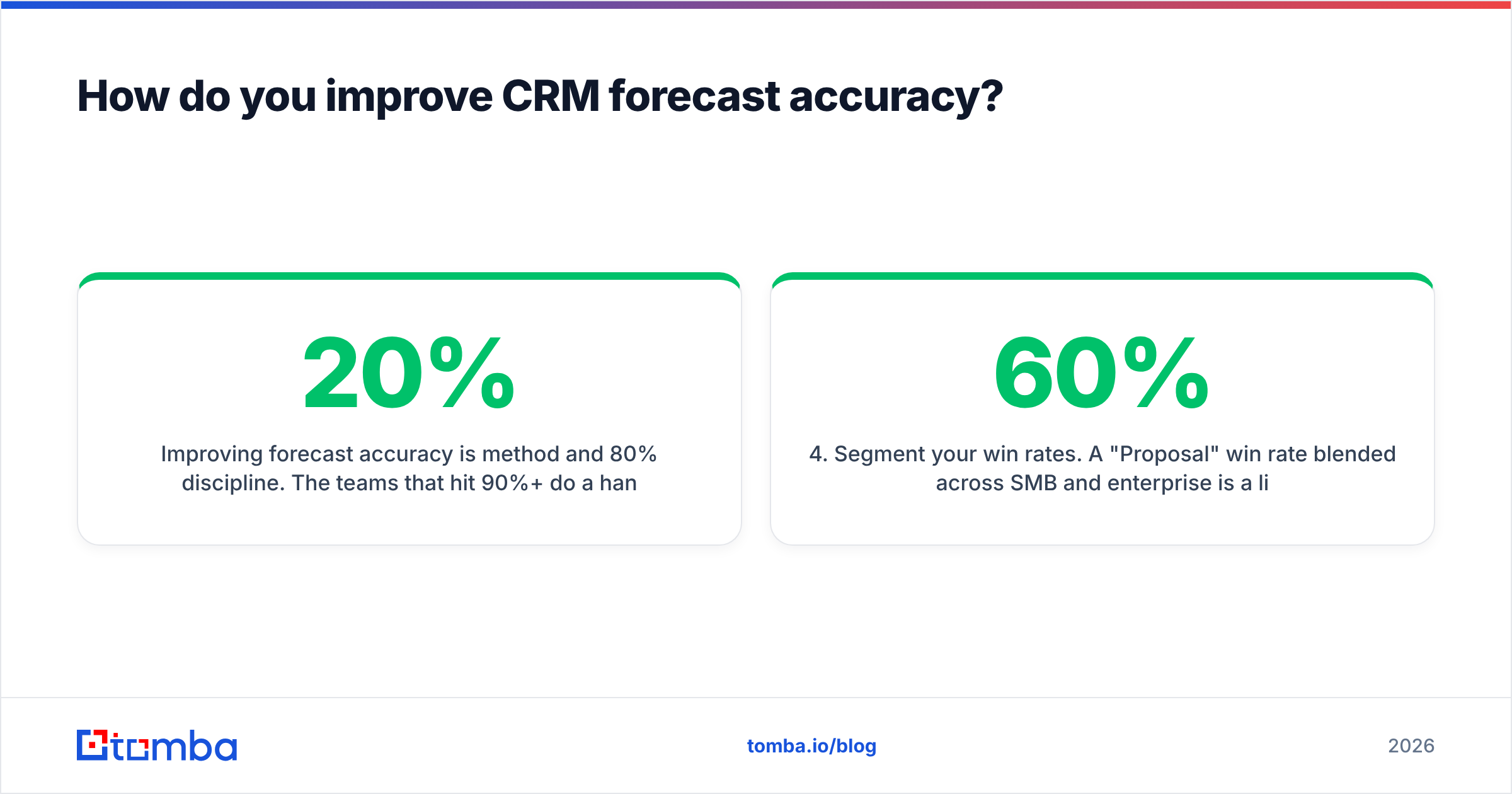
Improving forecast accuracy is 20% method and 80% discipline. The teams that hit 90%+ do a handful of unglamorous things relentlessly.
- Define exit criteria for every stage. A deal doesn't advance to "Proposal" because a rep feels good — it advances when a specific, checkable condition is met (proposal sent, pricing agreed). This is what makes stage-based probabilities meaningful.
- Enrich and verify contact data on a schedule. Don't wait for a deal to stall. Run standing data enrichment against your open pipeline monthly so every forecasted deal has current, complete contacts and firmographics.
- Track forecast vs. actual every period. Accuracy is a measurable number. Log what you predicted and what closed, then compute the variance. You can't improve what you don't score.
- Segment your win rates. A 60% "Proposal" win rate blended across SMB and enterprise is a lie to both. Calculate stage probabilities per segment.
- Kill the deals that should be dead. Reps hoard zombie deals to keep pipeline coverage looking healthy. A no-decision after 90 days of silence is a loss — mark it, and your forecast tightens instantly.
- Separate the commit from the best case. Report a range (commit / most-likely / best-case), not a single number. Ranges are honest and they train the org to think in probabilities.
Do these six things and your accuracy climbs before you ever change forecasting software. For deeper reading on the operational side of this, Gartner and Forrester both publish annual revenue-operations research worth tracking — see Gartner's sales research hub for current benchmarks on forecast accuracy across B2B segments.
What's the difference between forecast categories and deal stages?#
Deal stages describe where a deal is; forecast categories describe how confident you are it will close this period. Conflating them is one of the most common CRM forecasting mistakes.
A deal in the "Negotiation" stage might sit in the "Best Case" forecast category if the close date is uncertain, or "Commit" if paper is out for signature. Stages track process; categories track probability-of-close-in-period. Mature forecasting uses both axes at once:
- Pipeline — early, unqualified, not counted in the number.
- Best Case — could close if things break right.
- Commit — the rep is putting their name on it this period.
- Closed — done, won or lost.
Rolling up only "Commit" plus a discounted "Best Case" gives you a defensible number that survives a board meeting.
Which CRM forecasting method should you actually use?#
Match the method to your motion, and blend two for safety:
- SMB / high-velocity, short cycles: Pipeline + historical. You have volume and repeatability, so averages hold.
- Mid-market / defined process: Stage-based + forecast categories. Discipline plus confidence weighting.
- Enterprise / complex, high-ACV: Opportunity-level + AI signals. Every deal is a snowflake and worth scoring individually.
- Any team with 2+ years of clean history: Layer AI/predictive on top of whatever manual method you run — let the model catch what humans miss.
The one universal: none of these methods outrun bad data. The most sophisticated predictive model in the world, fed a CRM that's 30% stale, will confidently forecast a number built on people who no longer work there.
The bottom line#
CRM forecasting is not primarily a math problem or a software problem — it's a data-discipline problem. Pick a method that matches your sales motion, blend it with forecast categories for confidence, track your accuracy every period, and above all, keep the contacts and accounts feeding the forecast clean, complete, and verified.
That last step is the cheapest and most overlooked lever you have. Before you evaluate a five-figure revenue-intelligence platform, make sure the records inside your CRM are real. Use Tomba's Email Finder to keep decision-maker contacts current across your open pipeline, verify them so bounced addresses stop inflating your numbers, and enrich accounts that are missing the firmographics your segmentation depends on. A forecast is only ever as trustworthy as the data underneath it — start there, and the number you defend in the next QBR will finally be one you believe. Check Tomba pricing to see which plan fits the size of your pipeline; the free tier is enough to clean up your highest-value deals this week.
Related guides#
// get started
Find, verify and enrich your first contacts today
Start on the free plan with 25 searches a month, then scale when your team is ready.
Free plan · No credit card required · GDPR & CCPA
Get the Tomba newsletter
Product and data updates
// about the author