Best Free CRM Software in 2026: An Honest Buyer's Guide
A free CRM can run your whole pipeline — or quietly cap you at the worst possible moment. Here's how the top free CRM plans really compare in 2026, including the limits vendors bury in the fine print.
Free CRM software has gotten good enough that most small sales teams never need to pay for a while. But "free" hides a wide range of realities — from a genuinely usable pipeline tool to a stripped demo built to frustrate you into a $50-per-seat upgrade by month two.
This guide cuts through it. You'll see what the leading free CRM plans actually include in 2026, where the ceilings sit, and how to tell whether a free tier is a smart starting point or a trap.
TL;DR#
- The best free CRM in 2026 for most small teams is HubSpot — unlimited users and generous limits, with the trade-off that advanced automation lives behind paid tiers.
- Zoho CRM and Freshsales are strong free alternatives when you want more customization or a lighter interface without HubSpot's upsell pressure.
- "Free forever" almost always means "free until you need X" — the real cost is contact caps, automation limits, and per-seat pricing on the very next tier.
- A free CRM is only as good as the data inside it. Clean, verified contacts matter more than the logo on the software.
- Pair any free CRM with a dedicated prospecting stack — most free plans don't find or verify emails, so you'll bolt on tools like Tomba Email Finder anyway.
What is a free CRM, and what does "free" really mean?#
A free CRM is a customer relationship management tool with a no-cost plan that lets you store contacts, track deals, and log activity without a subscription. Think of it like a gym with a free membership tier: you get the treadmills and the locker room, but the classes, the sauna, and the personal trainer cost extra — and the free plan is designed so you eventually want those extras.
The word "free" splits into three very different models:
- Free forever, capped. A permanent plan limited by contacts, records, or features (HubSpot, Zoho, Freshsales). Genuinely usable long-term for small teams.
- Free trial. Full features for 14–30 days, then you pay. Not a free CRM — it's a paid CRM with a sample.
- Open-source / self-hosted. Free software you run yourself (SuiteCRM, EspoCRM). Zero license cost, real infrastructure and maintenance cost.
Most people searching for a free CRM want the first model. The rest of this guide focuses there, and flags where a "free" label is doing marketing work it hasn't earned.
Which free CRM is best in 2026?#
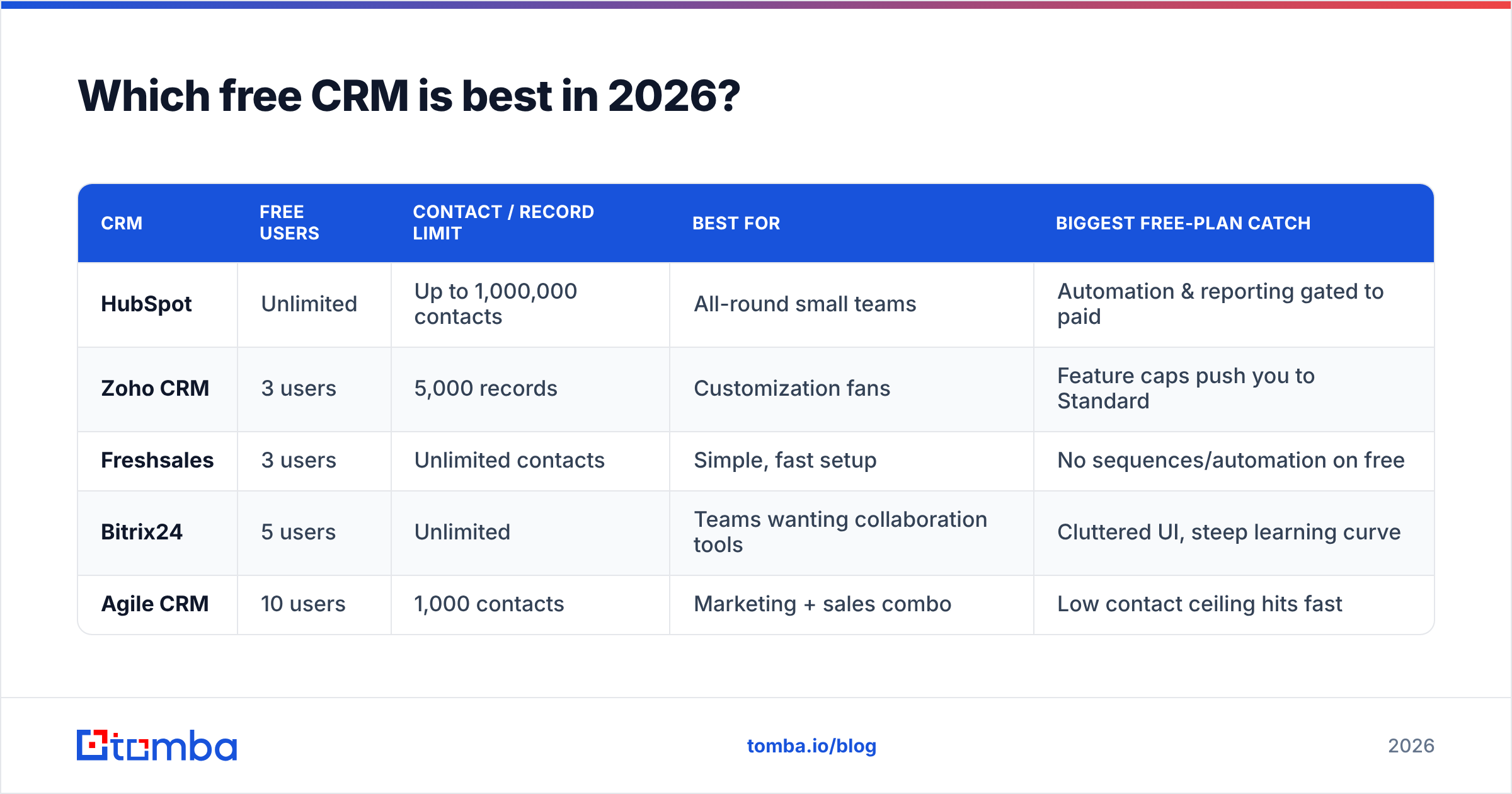
Here's the honest comparison. These are the free tiers as they stand in 2026 — always confirm on the vendor's pricing page, since limits shift quarterly.
| CRM | Free users | Contact / record limit | Best for | Biggest free-plan catch |
|---|---|---|---|---|
| HubSpot | Unlimited | Up to 1,000,000 contacts | All-round small teams | Automation & reporting gated to paid |
| Zoho CRM | 3 users | 5,000 records | Customization fans | Feature caps push you to Standard |
| Freshsales | 3 users | Unlimited contacts | Simple, fast setup | No sequences/automation on free |
| Bitrix24 | 5 users | Unlimited | Teams wanting collaboration tools | Cluttered UI, steep learning curve |
| Agile CRM | 10 users | 1,000 contacts | Marketing + sales combo | Low contact ceiling hits fast |
Read the table by your real constraint, not the headline number. If you have five reps, Zoho's 3-user cap disqualifies its free plan immediately — the "5,000 records" figure is irrelevant. If you have 50,000 contacts, Agile's 1,000-contact ceiling makes it a non-starter regardless of the 10 free seats.
The pattern: every free CRM is generous on one axis and stingy on another, and the stingy axis is chosen to match what growing teams need most.
How to choose a free CRM in 6 steps#
- Count your seats first. User caps kill more free plans than contact caps do. Unlimited users (HubSpot, and paid Pipedrive) is worth more than a high record limit for most teams.
- Estimate your 12-month contact volume. Import your existing lists and add your monthly prospecting rate. If you'll cross the cap within a year, the free tier is a short bridge, not a home.
- Check what triggers the upsell. Read the first paid tier. That's the feature the vendor bet you'll need — usually automation, sequences, or reporting.
- Test the import/export. A CRM you can't cleanly export from is a hostage situation. Verify CSV export exists on the free plan before you commit data.
- Map your integrations. Confirm the free tier connects to your email, calendar, and data tools. Some vendors gate integrations behind paid plans.
- Pressure-test the data model. Custom fields, deal stages, and pipelines you can't rename or reorder on free will frustrate you within a week.
Do those six and you'll avoid the most common mistake: picking a free CRM by brand recognition, then migrating off it three months later.
Is a free CRM good enough for a real sales team?#
Yes — for a while, and for a specific shape of team. A free CRM is genuinely good enough when you have fewer than five reps, under a few thousand active contacts, and a sales motion that's more relationship-driven than automation-driven. Solo founders, early startups, agencies, and local service businesses run entire books of business on free tiers without issue.
Where free plans break down:
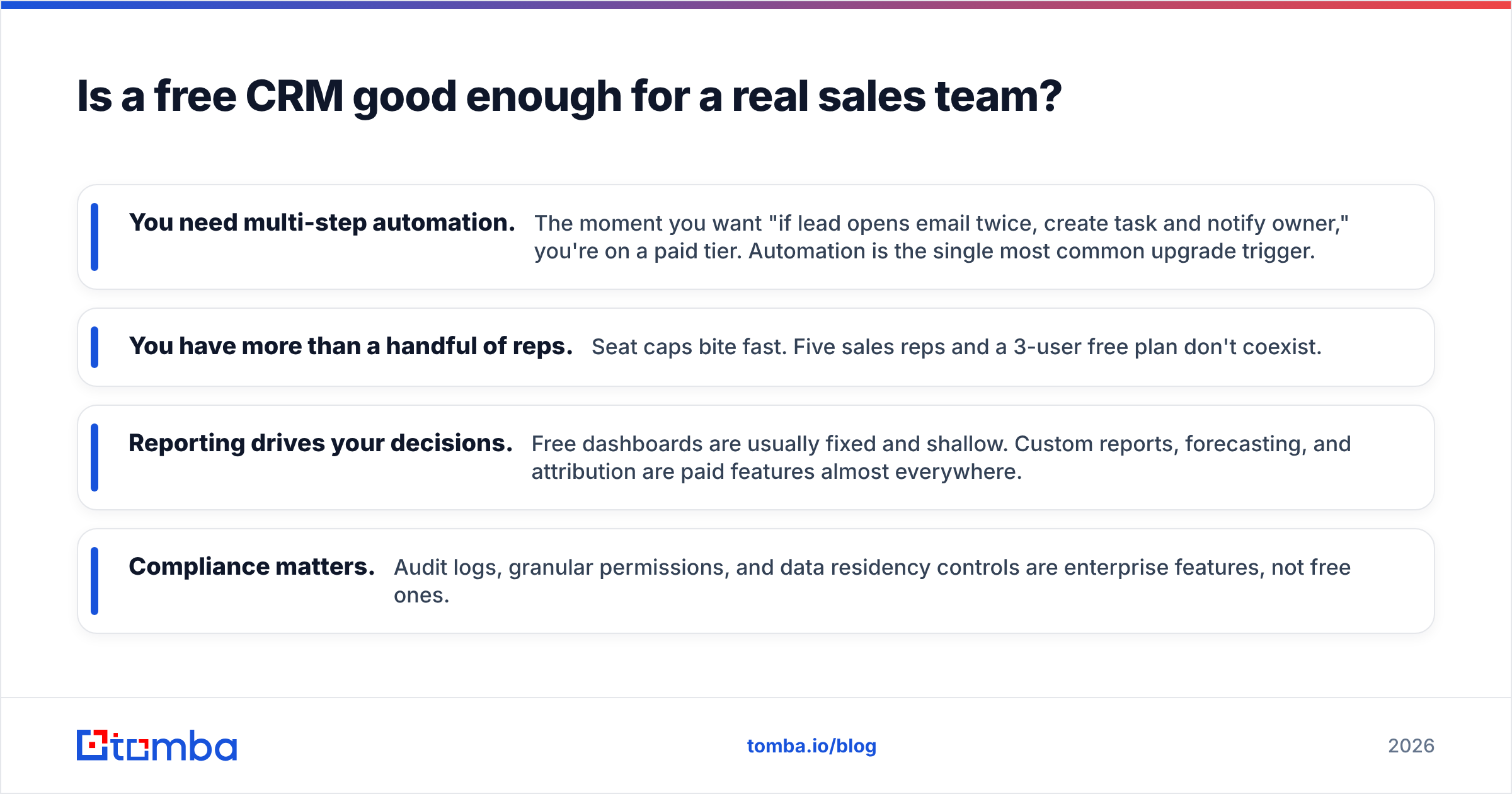
- You need multi-step automation. The moment you want "if lead opens email twice, create task and notify owner," you're on a paid tier. Automation is the single most common upgrade trigger.
- You have more than a handful of reps. Seat caps bite fast. Five sales reps and a 3-user free plan don't coexist.
- Reporting drives your decisions. Free dashboards are usually fixed and shallow. Custom reports, forecasting, and attribution are paid features almost everywhere.
- Compliance matters. Audit logs, granular permissions, and data residency controls are enterprise features, not free ones.
The uncomfortable truth is that free CRMs are excellent at storing relationships and mediocre at building them. They assume the contacts are already in your list. Getting the right contacts in there — with correct, deliverable emails and phone numbers — is a separate job the CRM doesn't do.
What does a free CRM not include (that you'll still need)?#
This is where most "free CRM" guides go quiet. A CRM organizes contacts; it rarely sources them. Your free plan will not, in almost every case:
- Find email addresses for prospects who aren't already in your database.
- Verify that emails are deliverable before you send, which protects your sender reputation.
- Enrich thin records with job titles, company data, or phone numbers.
- Detect and merge duplicates at scale on the free tier.
So the real 2026 stack for a lean team is a free CRM as the system of record, plus a focused prospecting layer that feeds it clean data. That's the honest architecture — one tool to store relationships, another to build the list.
That's the gap Tomba fills. Instead of manually guessing email formats or buying stale lists, you use an email finder to source verified contacts, run them through an email verifier to strip bounces, and push the survivors into your free CRM. You can even enrich leads with firmographic data before they hit a rep's queue.
Free CRM vs. paid CRM vs. CRM + prospecting stack#
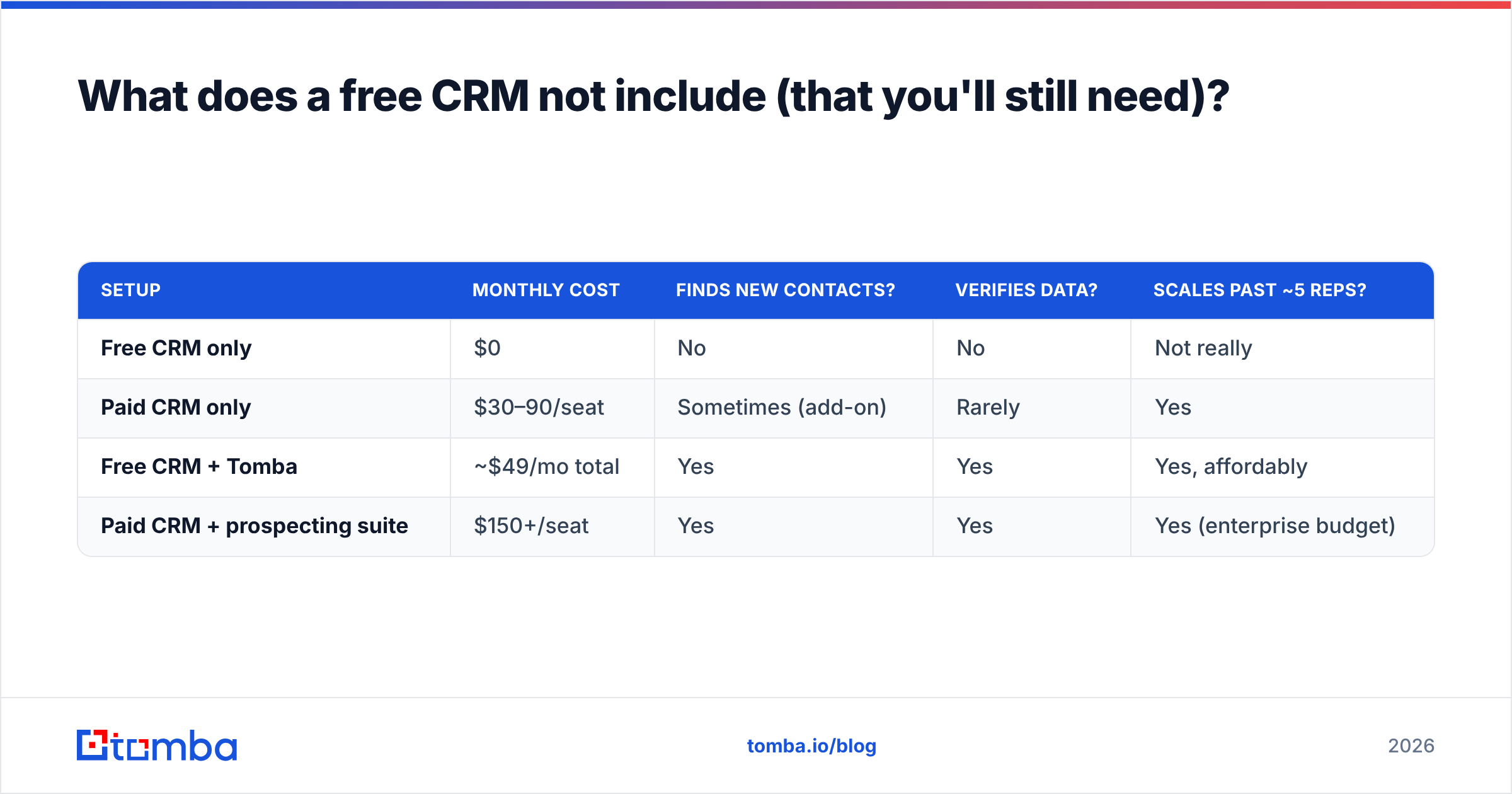
| Setup | Monthly cost | Finds new contacts? | Verifies data? | Scales past ~5 reps? |
|---|---|---|---|---|
| Free CRM only | $0 | No | No | Not really |
| Paid CRM only | $30–90/seat | Sometimes (add-on) | Rarely | Yes |
| Free CRM + Tomba | ~$49/mo total | Yes | Yes | Yes, affordably |
| Paid CRM + prospecting suite | $150+/seat | Yes | Yes | Yes (enterprise budget) |
The third row is the sweet spot for most bootstrapped and SMB teams: keep the CRM cost at zero, spend a modest amount on the data engine that actually drives pipeline. Tomba pricing starts with a free tier of 25 searches per month, then Starter at $49/mo — so you can validate the workflow before spending anything.
How much does a "free" CRM actually cost over a year?#
Model it honestly and the free CRM is rarely free by month 12. Run this quick calculation before you commit:
- Seats over the cap. If you'll hire past the free user limit, price the first paid tier × months × seats.
- The automation upgrade. Most teams cross into needing sequences or workflows within one to two quarters. That's the tier you'll actually pay for.
- Data hygiene. Bounced sends, wasted rep hours chasing bad numbers, and deals lost to unreachable contacts are real costs that free CRMs don't prevent.
- Migration risk. If you outgrow the free plan and its export is weak, you pay in switching friction.
A free CRM keeps your software line at zero, but total cost of ownership includes the pipeline you don't build because the tool can't source or clean data. A team that spends $0 on CRM and $49 on a data engine will usually out-produce a team that spends $90/seat on CRM and $0 on data quality. The bottleneck is almost never where the CRM stores the contact — it's whether the contact is real and reachable.
What should you look for beyond the free label?#
Use these criteria to separate a strategic free CRM from a bait tier:
- Clean export on the free plan. Non-negotiable. If you can't leave with your data, don't move in.
- A sane upgrade path. The jump from free to the first paid tier should be a step, not a cliff. Compare that first paid price across vendors — it's the number you'll likely pay.
- Native integrations on free. Confirm email, calendar, and your data tools connect without a paid plan. Check the vendor's marketplace, not just their homepage claims.
- Real user reviews. Read recent G2 and Capterra reviews filtered to the free plan specifically — paid-tier praise tells you nothing about the free experience.
- Transparent limits. Vendors who publish exact caps (HubSpot, Zoho) respect you more than those who say "generous limits" and make you find out.
For deeper vendor documentation, HubSpot's own free CRM page and Salesforce's Starter comparison are worth reading directly — just read them as sales material, because they are.
The bottom line#
A free CRM in 2026 is a legitimately good starting point — HubSpot for range, Zoho for customization, Freshsales for simplicity — as long as you go in knowing exactly which limit will eventually push you to pay. Choose by your real constraint (seats, contacts, or automation), verify you can export, and treat "free forever" as "free until we need the thing we're building toward."
But remember what the CRM doesn't do: it doesn't find your next 500 prospects, and it doesn't guarantee the emails already in it will deliver. That's the layer that actually moves revenue.
Start free on both ends: spin up a free CRM for your pipeline, then use the Tomba Email Finder to source and verify the contacts that fill it. Find real, deliverable email addresses by name, company, or domain, push them straight into your CRM, and let your free plan do what it's genuinely great at — organizing relationships that are worth having. Try Tomba's free tier at tomba.io/email-finder and give your free CRM something worth storing.
Related guides#
Ready to find emails that actually work?
Join 150,000+ professionals who stopped guessing and started sending. Free credits on signup — no credit card required.
Get the Tomba newsletter
Practical outbound tactics and product updates — once every two weeks.
About the author