CRM Sales Process Steps: The 7-Stage Framework for 2026
A stage-by-stage breakdown of the CRM sales process steps that move deals from first touch to closed-won — with the tools, exit criteria, and metrics that make each stage repeatable in 2026.
Your CRM is only as good as the process you pour into it. A pipeline with named stages but no exit criteria is just a colorful to-do list — deals drift, forecasts lie, and reps freelance their own steps. This guide breaks down the CRM sales process steps that actually move revenue, what has to be true to advance each deal, and how to instrument every stage so your forecast stops being fiction.
TL;DR#
- A CRM sales process is a fixed sequence of stages — each with an entry trigger, an exit criterion, and an owner — that every deal passes through the same way.
- Seven stages cover most B2B motions: lead generation, qualification, discovery, proposal, negotiation, closing, and onboarding/handoff.
- Exit criteria beat gut feel. A deal advances only when a concrete, observable event happens — not when a rep "feels good" about it.
- Clean contact data is the fuel. Bad emails and missing phone numbers stall stage one before the process even starts; tools like the Tomba Email Finder keep the top of the pipe full.
- Instrument each stage with a conversion rate and an average time-in-stage, then attack the worst offender first.
What is a CRM sales process?#
A CRM sales process is the documented, repeatable path a deal travels from first contact to closed revenue, mirrored as stages inside your CRM. Think of it like an assembly line: raw material (a lead) enters one end, moves through fixed stations (stages), and exits as a finished product (a customer). Every station has a job, a hand-off, and a quality check.
The difference between a pipeline and a process is discipline. A pipeline is where deals sit. A process defines how they move — the entry trigger that puts a deal into a stage, the work done there, and the exit criterion that lets it advance. Without those rules, two reps looking at the same deal will disagree on whether it's in "Discovery" or "Proposal," and your forecast inherits that noise.
Well-run teams treat the CRM as the single source of truth. If it isn't in the CRM, it didn't happen. That principle is what makes the steps below measurable instead of aspirational.
What are the 7 CRM sales process steps?#
Here is the core sequence. Most B2B motions map cleanly onto these seven stages; adjust the names to your team's language, but keep the exit criteria strict.
- Lead generation — Fill the top of the funnel with contacts who match your ICP. Trigger: a new contact enters the CRM. Exit: the lead has a verified email/phone and passes a basic fit check.
- Qualification — Confirm budget, authority, need, and timing before you spend rep hours. Exit: the lead becomes a marketing qualified lead or SQL with fit + intent confirmed.
- Discovery — Diagnose the prospect's problem in their words. Exit: you've documented a quantified pain and the decision process.
- Proposal — Present a scoped solution and pricing. Exit: the prospect has received a written proposal tied to their stated pain.
- Negotiation — Resolve objections, terms, and procurement. Exit: verbal or written agreement on scope and price.
- Closing — Get the signature and payment. Exit: contract signed, deal marked closed-won.
- Onboarding & handoff — Transfer to customer success cleanly so the account doesn't churn in month two. Exit: kickoff complete, success owner assigned.
Each stage below gets its own breakdown: the goal, the exit criterion, and the tooling that removes friction.
How do you set up each stage?#
Stage 1 — Lead generation#
The goal is volume with fit. Garbage leads inflate your pipeline and crater your conversion rates downstream. Pull contacts from inbound forms, LinkedIn, events, and targeted sales prospecting — then enrich and verify before they ever touch a rep.
The single most common failure here is dead contact data. If half your new leads have bouncing emails, stage one leaks before qualification starts. Run new contacts through an email verifier and fill gaps with a bulk email finder so reps work real people, not typos.
Exit criterion: contact has a verified email or phone number and matches at least the firmographic floor of your ICP.
Stage 2 — Qualification#
Not every lead deserves a rep's calendar. Qualification is a filter, and a good one saves your most expensive resource: selling time. Use a framework — BANT, MEDDIC, or a lightweight fit + intent score — and record the answers as CRM fields, not free-text notes.
Exit criterion: budget range, decision-maker identified, a real need, and a timeframe are all captured. Missing any one? The deal stays here or gets nurtured, not advanced.
Stage 3 — Discovery#
Discovery is where you earn the right to sell. The objective is a diagnosis: what breaks in the prospect's world, how much it costs them, and who else votes on the fix. Talk less, ask more, and write down the pain in the customer's own numbers.
Exit criterion: a documented, quantified pain ("we lose ~$40k/quarter to churn") and a mapped buying committee.
Stage 4 — Proposal#
Now you present a scoped solution mapped directly to the pain from discovery. A proposal that recites features instead of outcomes is a proposal that gets "let me think about it." Tie every line to something the prospect told you.
Exit criterion: written proposal delivered, referencing the specific pain and stakeholders identified earlier.
Stage 5 — Negotiation#
Objections aren't rejection — they're the buyer telling you what stands between them and yes. Handle price, terms, security review, and procurement here. Keep momentum by giving concessions only in exchange for something (a signature date, a bigger scope, a case-study commitment).
Exit criterion: agreement in principle on scope and price, with only paperwork remaining.
Stage 6 — Closing#
Closing is administrative when the earlier stages were done right. Send the contract, chase the signature, confirm payment terms. If closing routinely stalls, the leak is almost always upstream in discovery or qualification — not here.
Exit criterion: signed contract, deal marked closed-won, revenue booked.
Stage 7 — Onboarding & handoff#
The sale isn't finished at signature; it's finished when the customer gets value. A sloppy handoff from sales to customer success is a top cause of early churn. Transfer the full context — pain, promises made, stakeholders — so the customer never has to repeat themselves.
Exit criterion: kickoff scheduled, success owner assigned, expectations from the deal documented.
What tools support each CRM sales process step?#
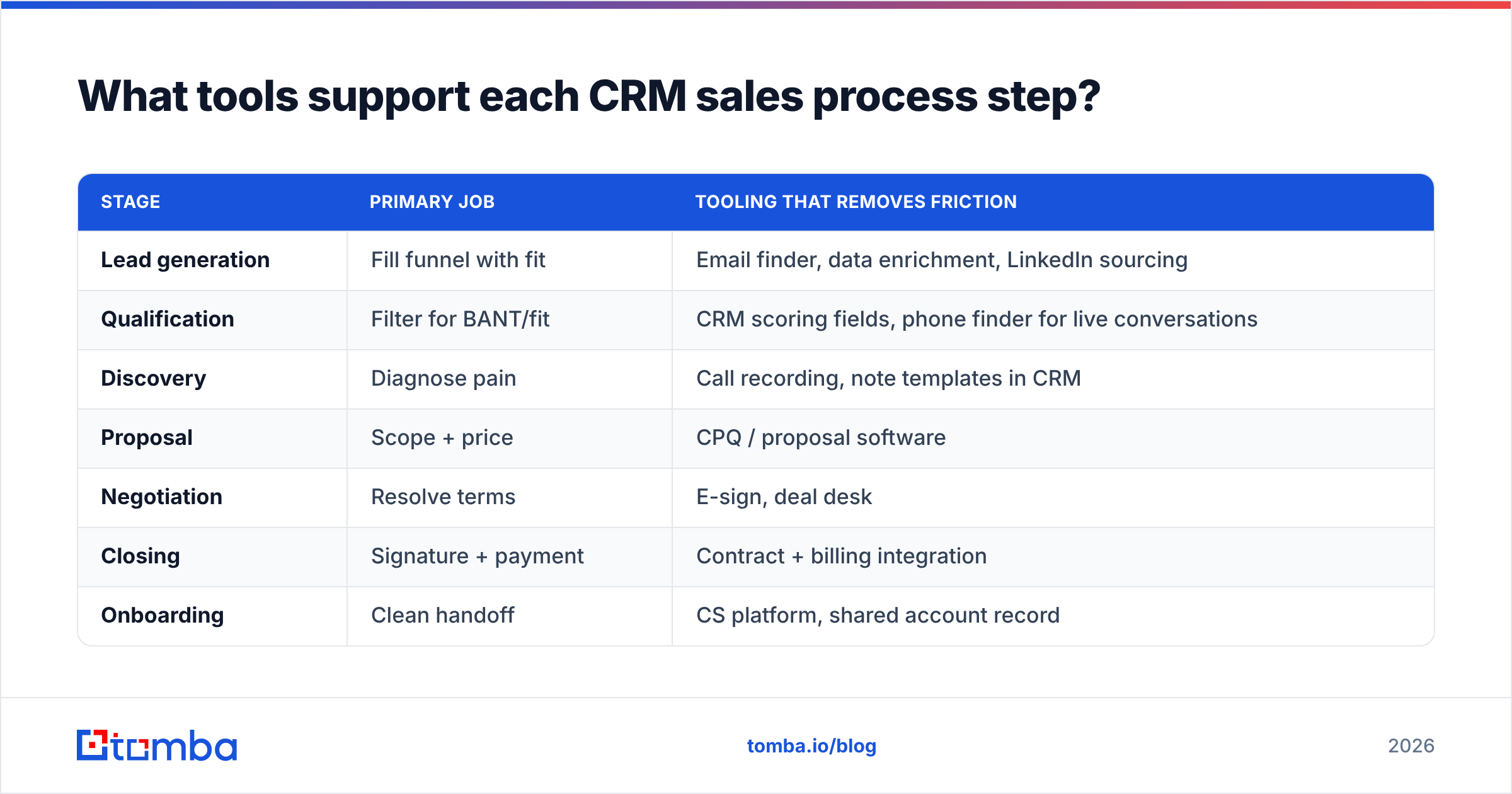
You don't need forty tools. You need the CRM as the spine and a few sharp instruments feeding it clean data. Here's how the stages map to tooling.
| Stage | Primary job | Tooling that removes friction |
|---|---|---|
| Lead generation | Fill funnel with fit | Email finder, data enrichment, LinkedIn sourcing |
| Qualification | Filter for BANT/fit | CRM scoring fields, phone finder for live conversations |
| Discovery | Diagnose pain | Call recording, note templates in CRM |
| Proposal | Scope + price | CPQ / proposal software |
| Negotiation | Resolve terms | E-sign, deal desk |
| Closing | Signature + payment | Contract + billing integration |
| Onboarding | Clean handoff | CS platform, shared account record |
Notice the pattern: the earlier the stage, the more it depends on data quality. A polished proposal template can't save a pipeline built on unverified contacts. That's why teams anchor stages one and two with an email finder and verification before investing rep time downstream.
How do you measure and improve the process?#
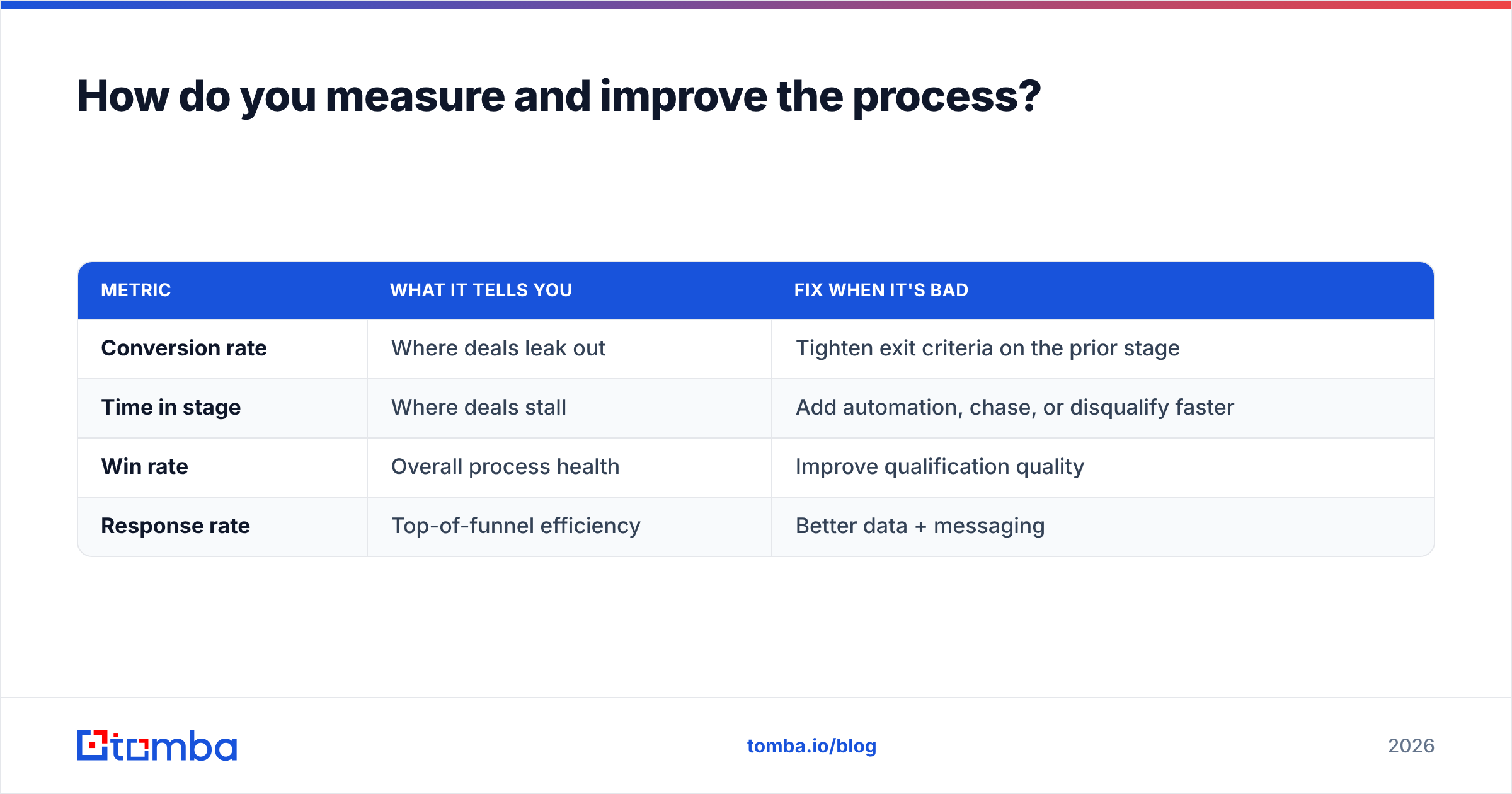
Two metrics per stage tell you almost everything: stage-to-stage conversion rate and average time in stage. Together they expose where deals die and where they rot.
| Metric | What it tells you | Fix when it's bad |
|---|---|---|
| Conversion rate | Where deals leak out | Tighten exit criteria on the prior stage |
| Time in stage | Where deals stall | Add automation, chase, or disqualify faster |
| Win rate | Overall process health | Improve qualification quality |
| Response rate | Top-of-funnel efficiency | Better data + messaging |
Start with your worst conversion step, not your favorite one. If 60% of deals die between discovery and proposal, no amount of closing training helps — the diagnosis is broken. Improving the biggest leak by ten points beats micro-optimizing three healthy stages.
A quick self-audit:
- Does every stage have a written exit criterion? If not, reps are guessing.
- Can you name your worst-converting stage from memory? If not, you aren't measuring.
- Is the CRM the source of truth, or do deals live in reps' heads and Slack DMs?
- Does clean data enter at stage one, or do you clean it up at proposal time (too late)?
For a deeper look at how upstream data quality drives downstream response rate, the connection is direct: verified contacts get delivered, delivered emails get replies, and replies feed qualification.
What are the most common CRM sales process mistakes?#
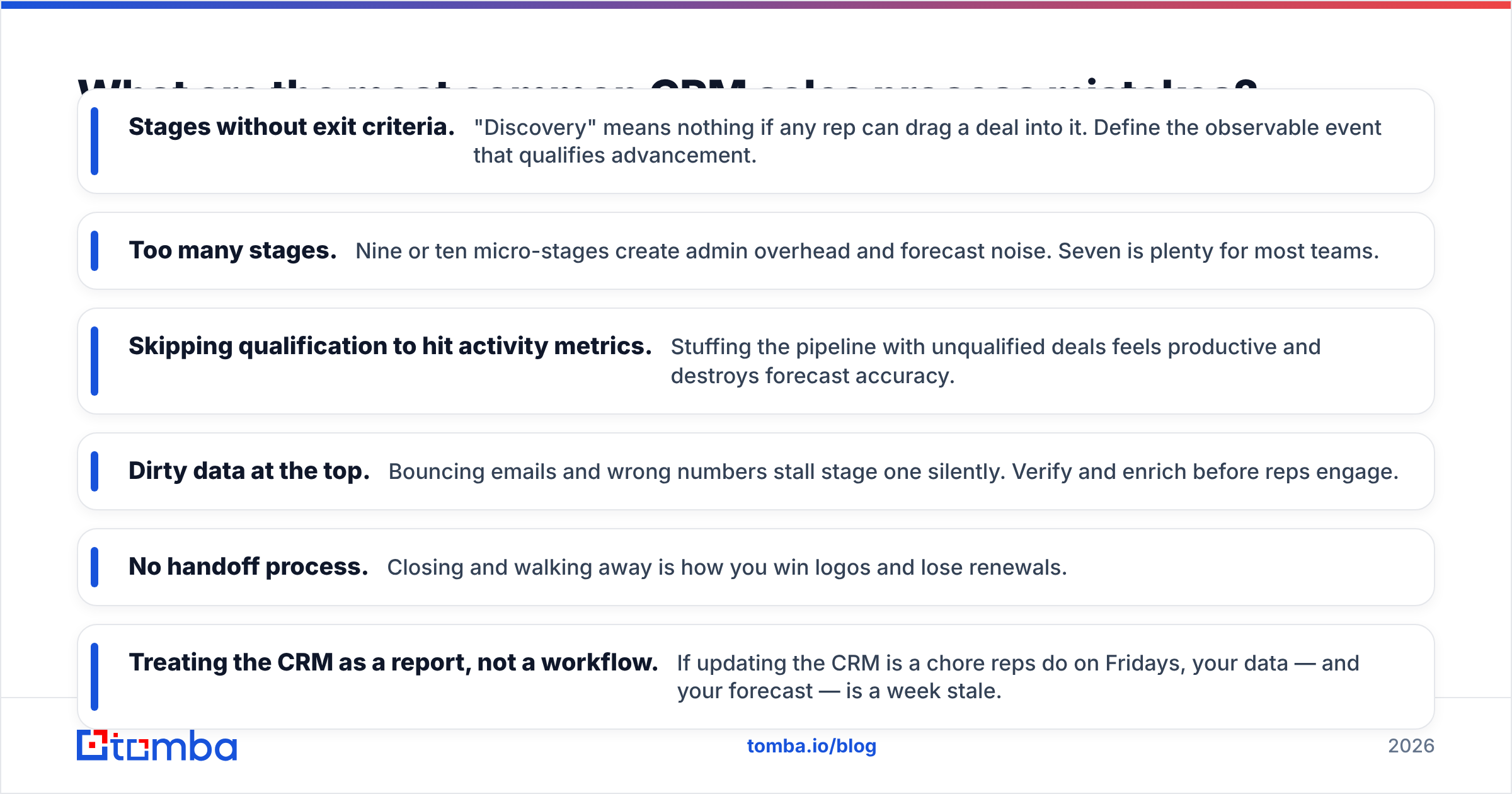
- Stages without exit criteria. "Discovery" means nothing if any rep can drag a deal into it. Define the observable event that qualifies advancement.
- Too many stages. Nine or ten micro-stages create admin overhead and forecast noise. Seven is plenty for most teams.
- Skipping qualification to hit activity metrics. Stuffing the pipeline with unqualified deals feels productive and destroys forecast accuracy.
- Dirty data at the top. Bouncing emails and wrong numbers stall stage one silently. Verify and enrich before reps engage.
- No handoff process. Closing and walking away is how you win logos and lose renewals.
- Treating the CRM as a report, not a workflow. If updating the CRM is a chore reps do on Fridays, your data — and your forecast — is a week stale.
The through-line: process discipline compounds. Each strict exit criterion makes the next stage's data cleaner, which makes the forecast truer, which makes coaching sharper.
How does data quality change the whole process?#
Everything downstream inherits the quality of stage one. Feed the pipeline verified, enriched contacts and every later stage runs on trustworthy inputs. Feed it guesses, and reps waste discovery calls on people who never had budget or authority.
According to industry research from firms like Gartner and validated by G2 review data on sales tooling, data decay is relentless — B2B contact data degrades roughly 2–3% per month as people change jobs. A process that doesn't re-verify is quietly rotting. That's the case for building verification into stage one and re-enrichment into your renewal motion, using a B2B database and enrichment layer that stays current.
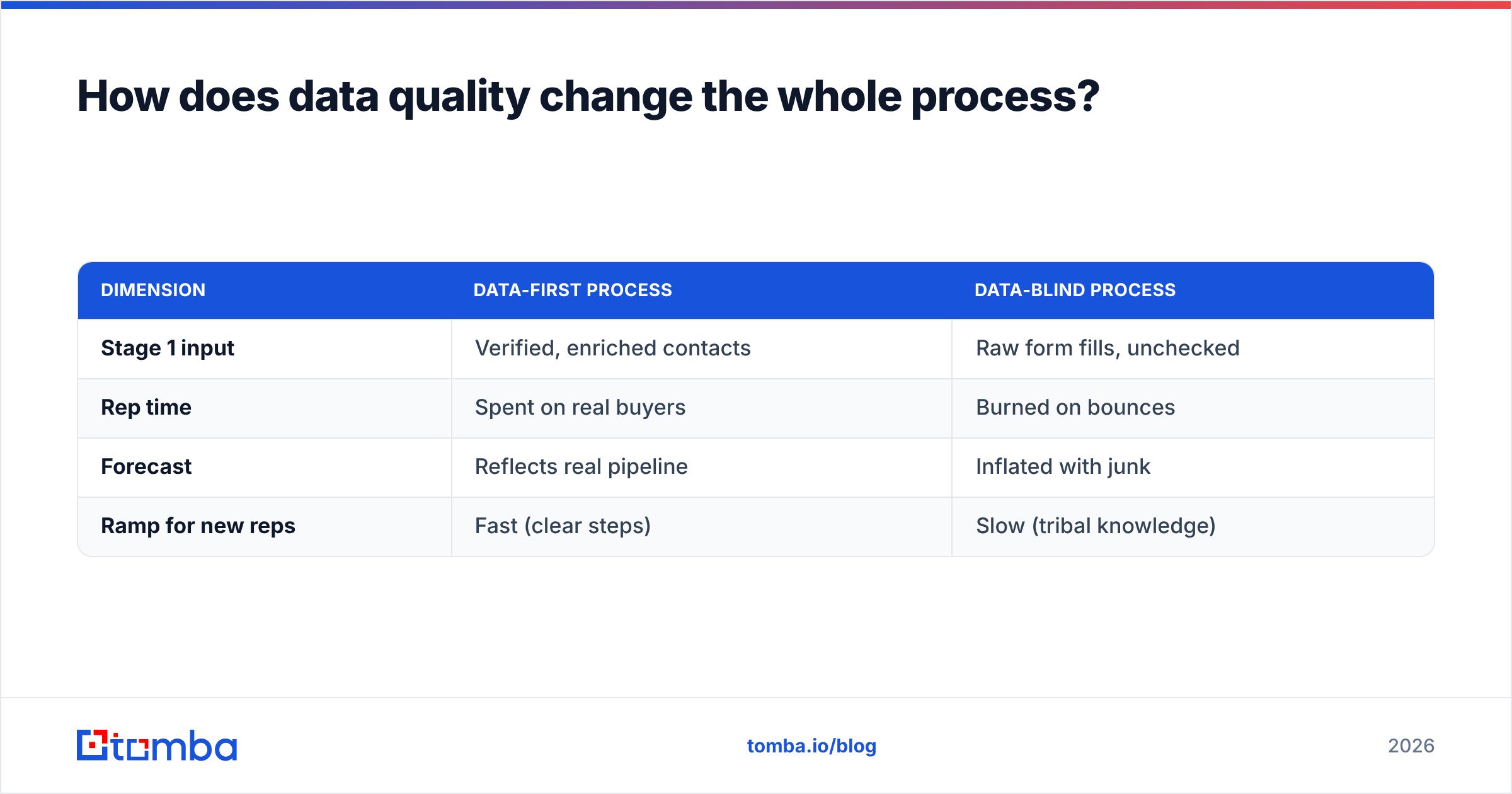
Compare a data-first process against a data-blind one:
| Dimension | Data-first process | Data-blind process |
|---|---|---|
| Stage 1 input | Verified, enriched contacts | Raw form fills, unchecked |
| Rep time | Spent on real buyers | Burned on bounces |
| Forecast | Reflects real pipeline | Inflated with junk |
| Ramp for new reps | Fast (clear steps) | Slow (tribal knowledge) |
Frequently asked questions#
How many stages should a CRM sales process have? Five to seven for most B2B teams. Fewer than five and stages blur together; more than seven and you're creating admin overhead that reps route around. The right number is the smallest set where each stage has a distinct exit criterion.
What's the difference between a sales pipeline and a sales process? The pipeline is the container — where deals sit by stage. The process is the set of rules for how deals move between stages. You can have a pipeline without a process (deals drift), but not a real process without a pipeline to run it on.
Where do most deals get stuck? Usually between discovery and proposal, because qualification was too loose. If you can't clearly articulate the prospect's quantified pain, you shouldn't be sending a proposal — you should be back in discovery.
Do I need separate tools for each stage? No. Anchor everything on your CRM, then add sharp instruments where friction is highest — data tools at the top of the funnel, e-sign at the bottom. Resist the forty-tool sprawl.
Put clean data at the front of your process#
The best process in the world stalls if stage one runs on bad contacts. Before you refine exit criteria or add automation, fix the fuel: make sure every lead entering your CRM has a verified, deliverable email and, where you sell by phone, a real number.
The Tomba Email Finder fills the top of your pipeline with accurate professional emails by name, company, or domain — and pairs with verification so reps spend their time on buyers, not bounces. Start on the free tier (25 searches/month), then scale with a plan that fits your volume as your process matures. See Tomba pricing to match a tier to your pipeline. Get the data right at step one, and every stage after it gets easier.
Related guides#
Ready to find emails that actually work?
Join 150,000+ professionals who stopped guessing and started sending. Free credits on signup — no credit card required.
Get the Tomba newsletter
Practical outbound tactics and product updates — once every two weeks.
About the author