CRMOne Alternatives in 2026: 7 Better CRM & Data Tools
CRMOne bundles CRM, marketing, and support into one suite — but it isn't your only option. Here are seven CRMOne alternatives worth testing in 2026, with real pricing, honest trade-offs, and the data tools that feed them.
CRMOne markets itself as an all-in-one CRM: pipelines, marketing automation, help desk, and reporting under a single login. That bundle is attractive when you want one bill and one vendor. It also means you inherit whatever CRMOne decides to build next — and you're stuck with its data quality, its enrichment, and its pricing curve as you scale.
If you're pricing out CRMOne alternatives in 2026, the real question isn't "which suite has the most features." It's "which stack actually fills my pipeline with contacts I can reach." This guide breaks down seven options across three buckets — full CRM suites, focused sales-data tools, and the enrichment layer that makes any CRM useful — so you can build the stack that fits how your team actually sells.
TL;DR — The Short Version#
- CRMOne is fine as a starter suite, but its contact data and enrichment are its weakest link — most teams outgrow that part first.
- Best all-in-one swap: HubSpot if you want polish and integrations; a lighter CRM if you want speed and price.
- Best focused data layer: pair any CRM with a dedicated email finder and verifier so your records stay reachable, not just organized.
- Cheapest honest entry point: Tomba's free tier gives you 25 searches/month, then $49/mo Starter — no seat minimums.
- Don't rip-and-replace blindly. Score each tool on data accuracy, integrations, and total cost per seat before you migrate.
What Is CRMOne, and Why Look for Alternatives?#
CRMOne is a bundled CRM platform aimed at small and mid-market teams that want sales, marketing, and support in one place. The pitch is consolidation: fewer tools, one contract, a unified contact timeline.
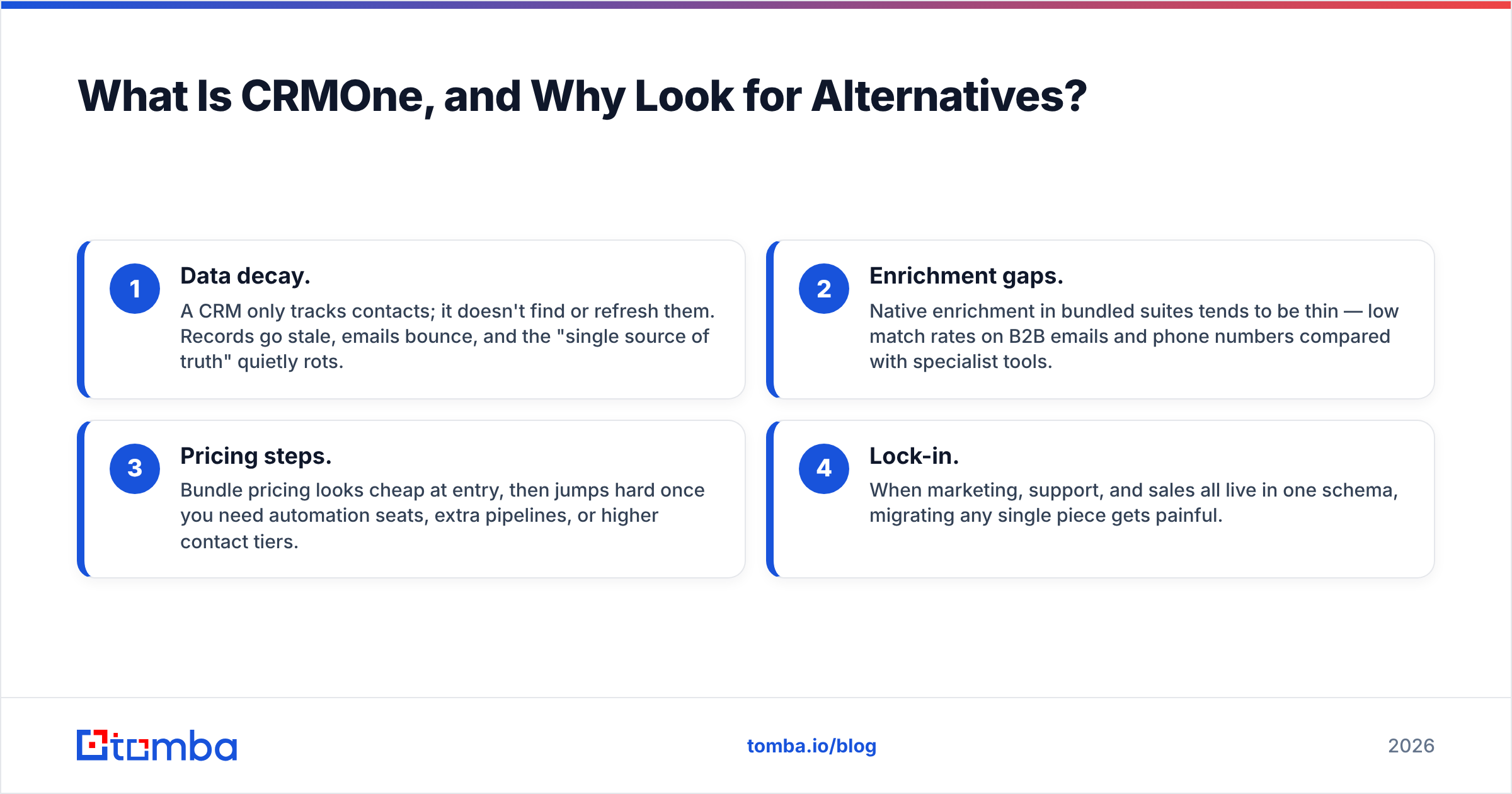
The trade-off is the trade-off of every all-in-one — you optimize for convenience, not for best-in-class in any single category. Teams typically start shopping for CRMOne alternatives for a few concrete reasons:
- Data decay. A CRM only tracks contacts; it doesn't find or refresh them. Records go stale, emails bounce, and the "single source of truth" quietly rots.
- Enrichment gaps. Native enrichment in bundled suites tends to be thin — low match rates on B2B emails and phone numbers compared with specialist tools.
- Pricing steps. Bundle pricing looks cheap at entry, then jumps hard once you need automation seats, extra pipelines, or higher contact tiers.
- Lock-in. When marketing, support, and sales all live in one schema, migrating any single piece gets painful.
None of these make CRMOne a bad product. They just mean the "one tool to rule them all" model isn't automatically the right call for your team.
How Should You Compare CRMOne Alternatives?#
Score every option on the same five axes instead of feature-count vanity metrics:
- Data accuracy — What percentage of emails and phone numbers are correct and deliverable? This is the number that decides whether your outreach lands.
- Coverage — Does the tool find contacts in your target geographies and company sizes?
- Integrations — Does it push cleanly into the CRM, sequencer, and spreadsheet you already use?
- Total cost per seat — Not the sticker price. The real monthly cost once you add the seats and credits you'll actually consume.
- Time-to-value — How fast can one rep go from signup to a verified contact in their pipeline?
A CRM that organizes bad data is just a tidy graveyard. That's why the strongest 2026 stacks separate the system of record (your CRM) from the system of discovery (a dedicated email finder and enrichment layer).
What Are the Best CRMOne Alternatives in 2026?#
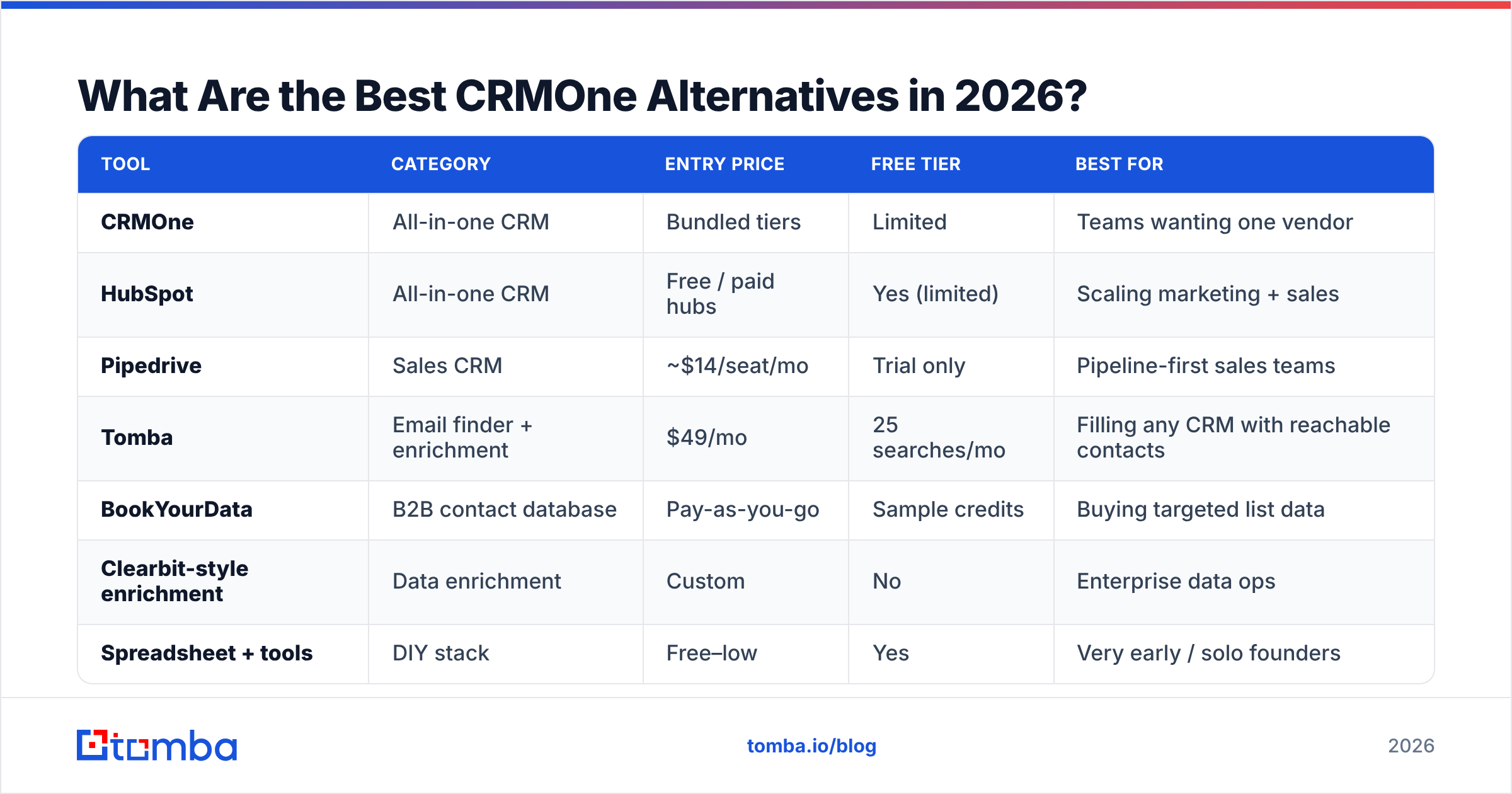
Here's the head-to-head. Prices are entry/published tiers as of mid-2026 — always confirm on the vendor's own page before you buy.
| Tool | Category | Entry price | Free tier | Best for |
|---|---|---|---|---|
| CRMOne | All-in-one CRM | Bundled tiers | Limited | Teams wanting one vendor |
| HubSpot | All-in-one CRM | Free / paid hubs | Yes (limited) | Scaling marketing + sales |
| Pipedrive | Sales CRM | ~$14/seat/mo | Trial only | Pipeline-first sales teams |
| Tomba | Email finder + enrichment | $49/mo | 25 searches/mo | Filling any CRM with reachable contacts |
| BookYourData | B2B contact database | Pay-as-you-go | Sample credits | Buying targeted list data |
| Clearbit-style enrichment | Data enrichment | Custom | No | Enterprise data ops |
| Spreadsheet + tools | DIY stack | Free–low | Yes | Very early / solo founders |
1. HubSpot — The Polished All-in-One#
If you want CRMOne's "everything in one place" model but with a deeper ecosystem, HubSpot is the obvious upgrade. Its free CRM tier is genuinely usable, the marketplace of integrations is enormous, and the reporting is best-in-class for mid-market.
The catch is cost. HubSpot's paid hubs escalate fast once you need automation, and contact-tier pricing can surprise you. Read reviews on G2 before committing to a Professional-tier annual contract.
Best for: teams that will invest in marketing automation and want one platform to grow into.
2. Pipedrive — The Pipeline-First CRM#
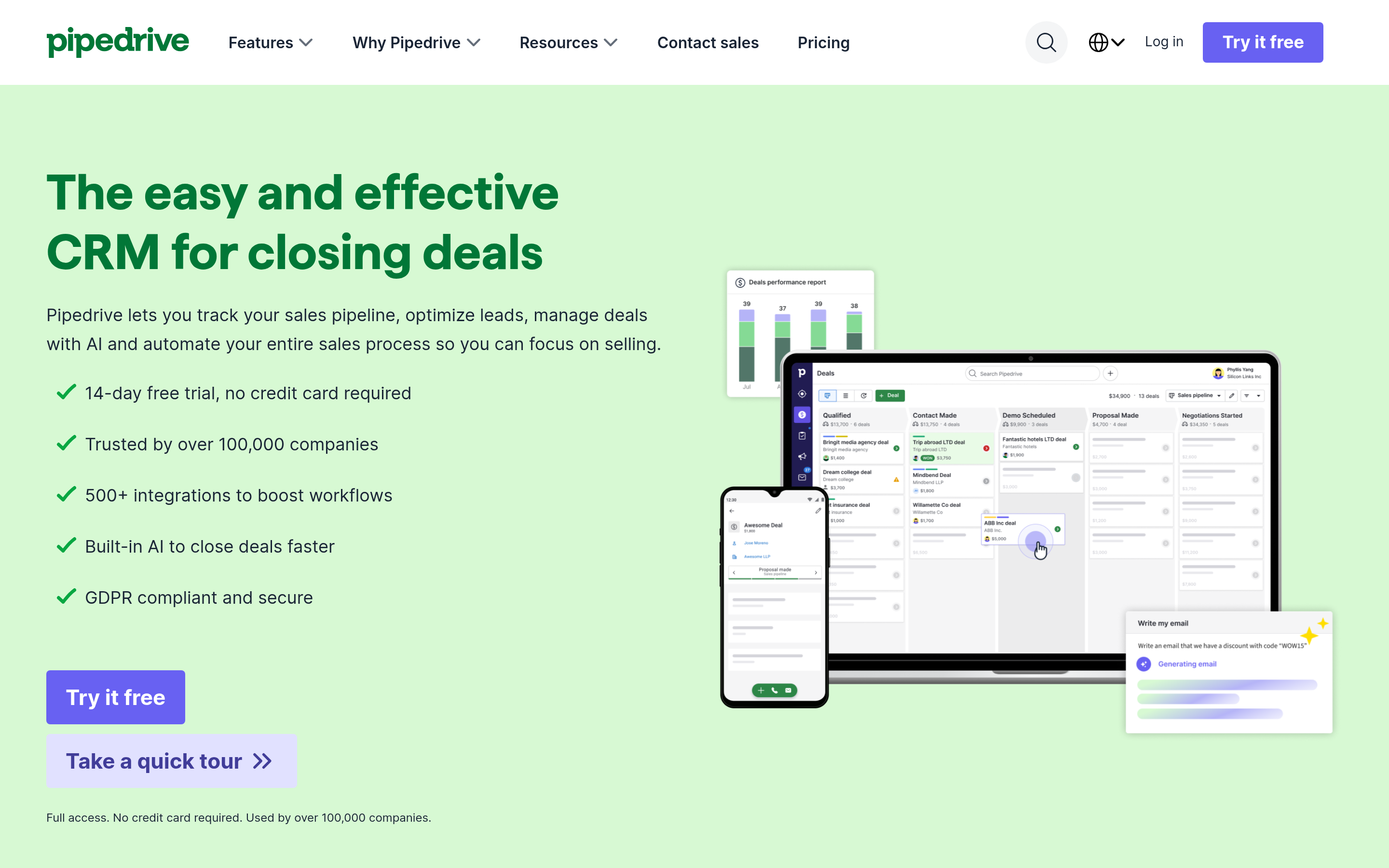
Where CRMOne spreads across sales, marketing, and support, Pipedrive stays ruthlessly focused on the sales pipeline. It's fast, visual, cheap per seat, and reps actually enjoy using it. If your pain is "our CRM is bloated and nobody updates it," a focused sales CRM often fixes adoption overnight.
You give up native marketing and help-desk features — but you can bolt those on via integrations if you ever need them.
Best for: sales-led teams that value speed and adoption over an all-in-one bundle.
3. Tomba — The Data Layer Every CRM Needs#
Here's the piece bundled suites underserve: finding and verifying the contacts in the first place. Tomba's email finder locates professional email addresses by name, domain, or company, then runs them through verification so your CRM fills with reachable people, not guesses.
This isn't a CRM replacement — it's the discovery engine you point at your CRM. Use domain search to map every contact at a target account, enrich existing records with Tomba's data enrichment, and push clean records straight into HubSpot, Pipedrive, or CRMOne itself via the Tomba API.
Pricing is transparent: a free tier with 25 searches/month, then Starter at $49/mo, Growth at $99/mo, and Pro at $249/mo — no per-seat minimums forcing you to buy for a whole team on day one.
Best for: any team whose real problem is empty or stale pipelines, not a missing CRM.

4. BookYourData — Targeted List Data On Demand#
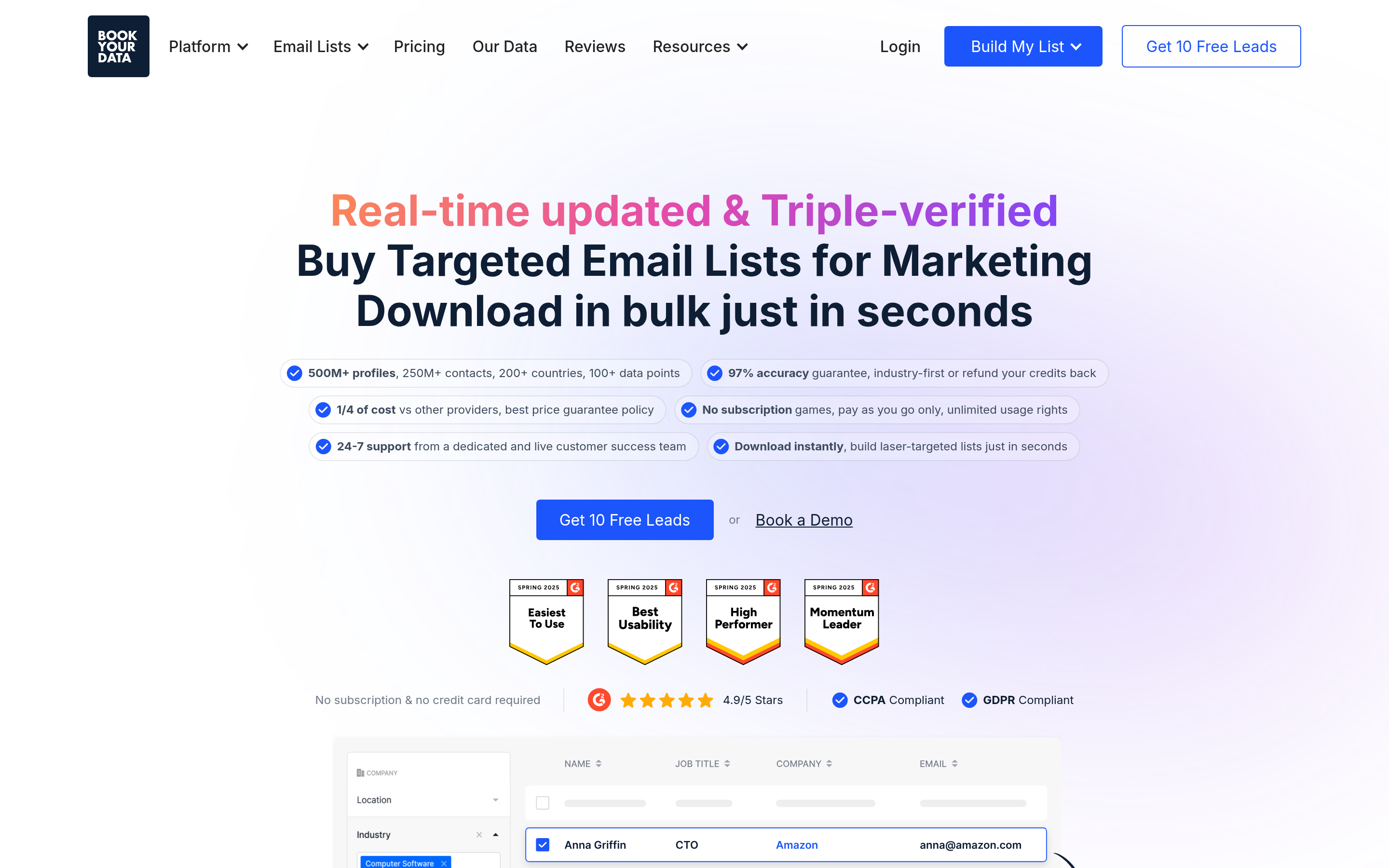
When you need net-new accounts rather than tools, BookYourData offers a strong pay-as-you-go B2B contact database with granular targeting by industry, title, and geography. It's a respected option for teams that prefer buying verified list data outright over building lists search by search.
BookYourData and a finder like Tomba solve adjacent problems — one sells you a curated list, the other lets you find and verify contacts on demand for accounts you've already identified. Many teams run both: buy for volume, find-and-verify for precision.
Best for: teams that want to purchase targeted, ready-to-load B2B lists.
5. Enterprise Enrichment (Clearbit-Style)#
Large data-ops teams sometimes replace a bundled CRM's weak enrichment with a dedicated enterprise enrichment platform. These offer deep firmographic and technographic data and real-time API enrichment — at custom, usually steep, pricing.
If that's your bracket but the price stings, note that Tomba positions itself as a leaner Clearbit alternative with transparent tiers rather than "contact sales" quotes.
Best for: enterprises with dedicated RevOps and a real data budget.
6. Focused Sales CRMs (The Long Tail)#
Beyond Pipedrive, there's a long list of lightweight, sales-focused CRMs — Close, Copper, Folk, and others — each optimized for a niche (inbox-native, agency, founder-led). If CRMOne feels heavy, one of these plus a data layer often beats a bigger suite on both cost and adoption.
Best for: teams with a specific workflow a general suite handles clumsily.
7. The DIY Stack (Spreadsheet + Tools)#
For solo founders and very early teams, a spreadsheet plus a few focused tools genuinely competes with a paid suite. Use Google Sheets as your record, a Sheets email finder add-on to populate contacts, and free tools to keep the list clean. It won't scale forever — but it's free, and it forces you to learn what you actually need before you buy.
Best for: pre-revenue teams testing motion before committing budget.
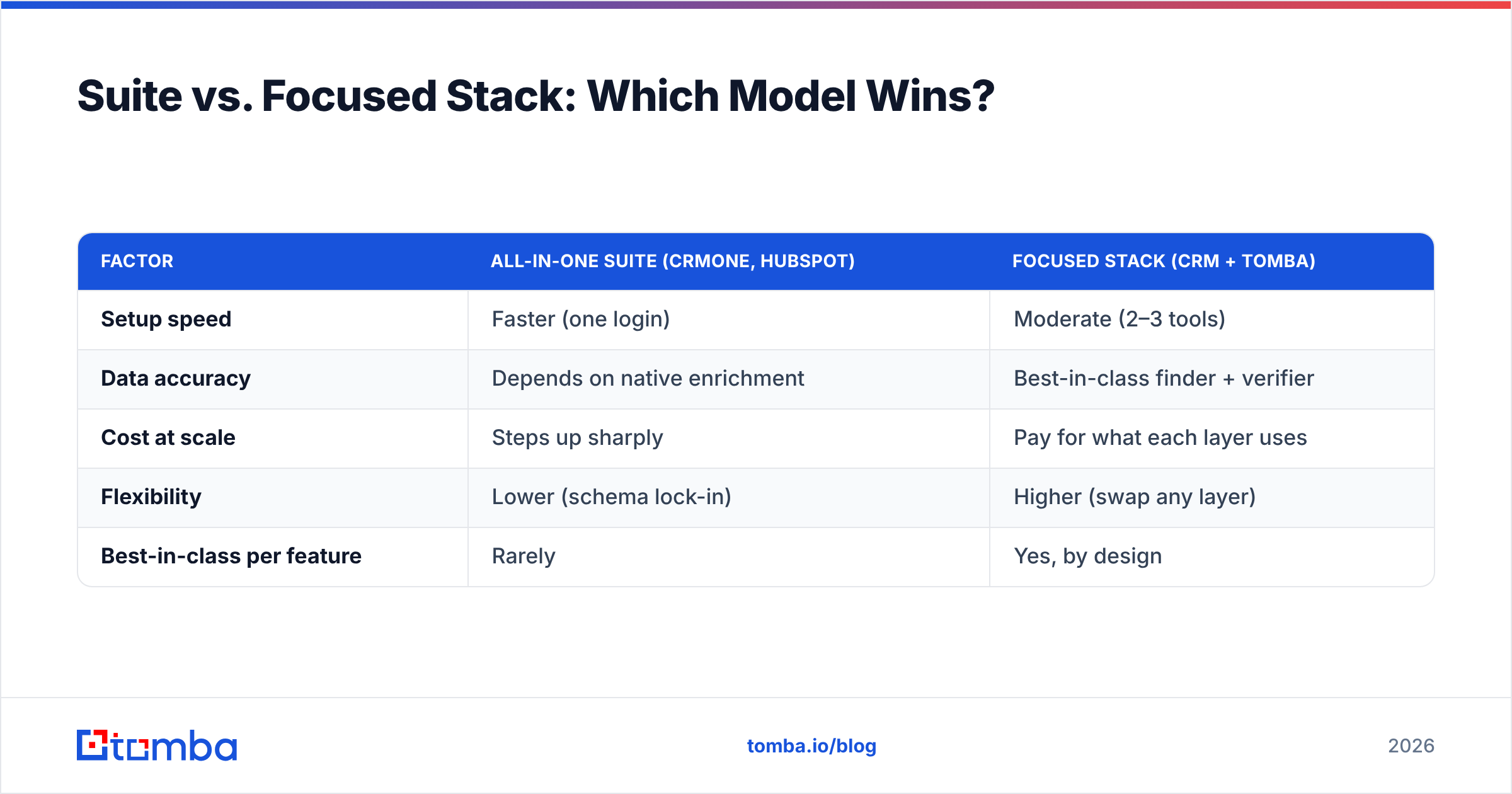
Suite vs. Focused Stack: Which Model Wins?#
There's no universal answer — but there is a clear decision rule.
| Factor | All-in-one suite (CRMOne, HubSpot) | Focused stack (CRM + Tomba) |
|---|---|---|
| Setup speed | Faster (one login) | Moderate (2–3 tools) |
| Data accuracy | Depends on native enrichment | Best-in-class finder + verifier |
| Cost at scale | Steps up sharply | Pay for what each layer uses |
| Flexibility | Lower (schema lock-in) | Higher (swap any layer) |
| Best-in-class per feature | Rarely | Yes, by design |
Choose a suite if your top priority is one vendor, one bill, and fast internal rollout, and your contact volume is modest.
Choose a focused stack if outreach performance is a revenue lever — because the tool that finds and verifies contacts matters more to your number than the tool that stores them. In practice, most growing teams end up with a lean CRM plus a dedicated data layer, precisely because that combination beats a bundle on the metric that pays: reachable contacts per dollar.
How Do You Migrate Without Breaking Your Pipeline?#
Switching off CRMOne doesn't have to be a fire drill. Run it in four steps:
- Export and audit. Pull your full CRMOne contact export and check what percentage of emails still verify. This tells you how much of your "data" is actually usable — and it's usually less than you think.
- Re-verify before you import. Run the export through an email verifier so you migrate clean records, not bounces. Migrating dirty data just moves the problem.
- Map your fields. Match CRMOne's schema to the new CRM's before importing. Decide upfront which custom fields survive.
- Wire the data layer. Connect your finder and enrichment via API or a native integration so new records arrive verified from day one.
Do this and you migrate a clean pipeline — not a rehousing of the same stale contacts.
The Bottom Line#
CRMOne's all-in-one model is convenient, but convenience isn't the metric that fills your pipeline. The best CRMOne alternatives in 2026 come down to a choice: another suite if you value one vendor, or a focused CRM paired with a real data layer if you value reachable contacts and flexible cost.
Whichever CRM you land on, its value is capped by the quality of the contacts inside it. That's the layer to get right first.
Ready to stop organizing stale contacts and start filling your CRM with reachable ones? Start free with the Tomba Email Finder — find professional email addresses by name, domain, or company, verify them on the spot, and push clean records into whatever CRM you choose. Twenty-five searches a month cost nothing, and the $49/mo Starter plan carries most small teams with no seat minimums. Fix the data layer, and every CRM decision after it gets easier.
Related guides#
Ready to find emails that actually work?
Join 150,000+ professionals who stopped guessing and started sending. Free credits on signup — no credit card required.
Get the Tomba newsletter
Practical outbound tactics and product updates — once every two weeks.
About the author