Cross Selling vs Up Selling: Key Differences and When to Use Each
Cross-selling adds complementary products; up-selling trades up to a better one. Learn the real difference, when each works, and how to build both into your pipeline without annoying buyers.
Cross selling vs up selling: the two get lumped together in every sales deck. But they solve different problems, and they fail in different ways. Confuse them and you either bolt on products nobody wants, or push a bigger package to someone who was never going to buy. Get them right and you grow revenue from customers you already have. That is the cheapest revenue there is.
TL;DR#
- Cross-selling sells a complementary product ("customers who bought X also need Y"). Up-selling sells a better or bigger version of what the buyer already chose.
- Up-selling usually moves the bigger number per deal. Cross-selling usually wins on frequency and stickiness.
- Both depend on timing and relevance. Pitched to the wrong account at the wrong moment, they read as greedy and cost you trust.
- The engine behind both is data: knowing who the account is, what they already own, and who the right contact is. Clean contact data — the kind Tomba Email Finder surfaces — is what makes the offer land on the right desk.
- Use the decision framework and comparison table below to pick the right play per segment instead of guessing.
What is the difference between cross-selling and up-selling?#
Here is the one-line version: up-selling trades up, cross-selling adds on.
Think of ordering a coffee. When the barista asks if you want a large instead of a medium, that is an up-sell — same product, higher tier. When they ask if you want a pastry with it, that is a cross-sell — a different product that pairs well. Same interaction, two distinct motions.
In B2B the mechanics are the same, just with bigger numbers. A company on your mid-tier CRM plan gets nudged to the enterprise tier with SSO and advanced reporting — up-sell. That same company gets offered your analytics add-on or a dedicated onboarding package — cross-sell. One deepens the commitment to the core product. The other widens the footprint across your catalog.
The reason the distinction matters: they carry different risk. An up-sell asks the buyer to spend more on a decision they have already made. So the objection is usually value ("is the bigger version worth it?"). A cross-sell asks them to make a new decision. So the objection is usually need ("do I even want this?"). You handle those two objections with completely different plays.

Cross selling vs up selling: a side-by-side comparison#
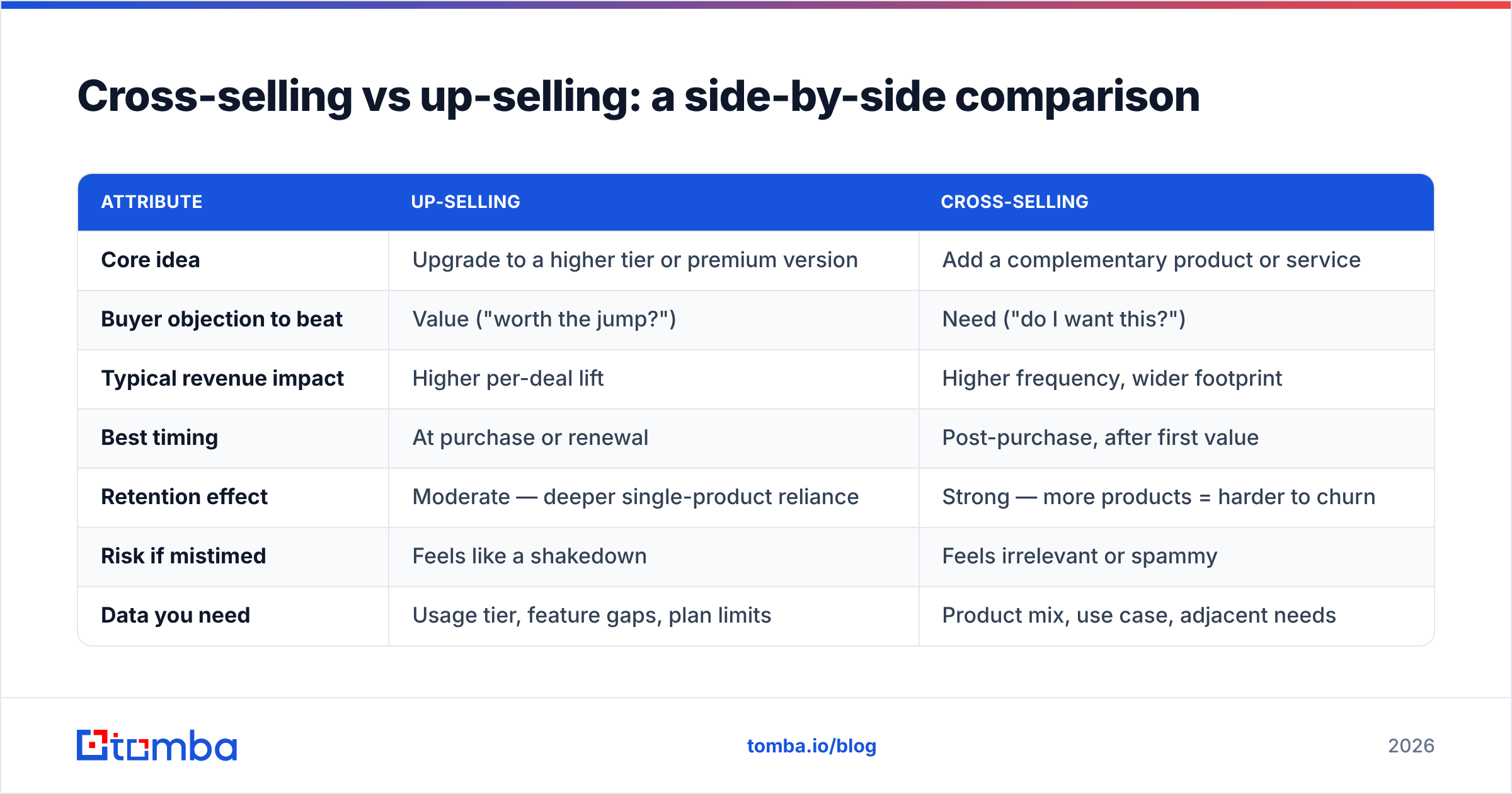
| Attribute | Up-Selling | Cross-Selling |
|---|---|---|
| Core idea | Upgrade to a higher tier or premium version | Add a complementary product or service |
| Buyer objection to beat | Value ("worth the jump?") | Need ("do I want this?") |
| Typical revenue impact | Higher per-deal lift | Higher frequency, wider footprint |
| Best timing | At purchase or renewal | Post-purchase, after first value |
| Retention effect | Moderate — deeper single-product reliance | Strong — more products = harder to churn |
| Risk if mistimed | Feels like a shakedown | Feels irrelevant or spammy |
| Data you need | Usage tier, feature gaps, plan limits | Product mix, use case, adjacent needs |
Neither column is "the winner." The right answer is almost always both, sequenced correctly — and the sequencing depends on where the customer sits in their lifecycle.
When should you use up-selling?#
Reach for an up-sell when the buyer has already accepted the core value and is now hitting the limits of their current tier. The signal is friction. They hit a usage cap, they ask for a feature that lives one plan up, or their team outgrew the seat count.
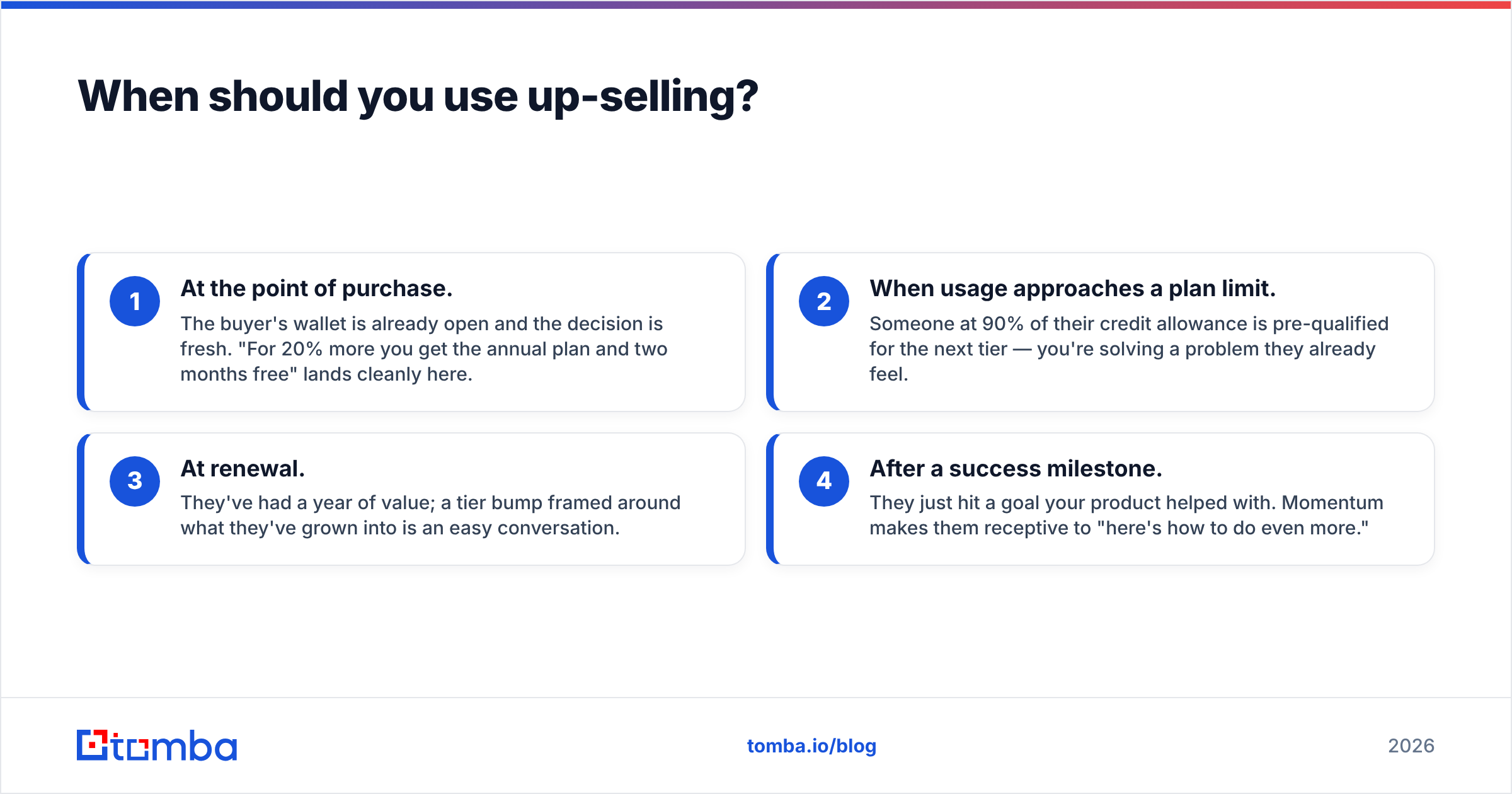
The four moments where up-selling converts best:
- At the point of purchase. The buyer's wallet is already open and the decision is fresh. "For 20% more you get the annual plan and two months free" lands cleanly here.
- When usage approaches a plan limit. Someone at 90% of their credit allowance is pre-qualified for the next tier. You are solving a problem they already feel.
- At renewal. They have had a year of value. A tier bump framed around what they have grown into is an easy conversation.
- After a success milestone. They just hit a goal your product helped with. Momentum makes them open to "here is how to do even more."
The failure mode is up-selling someone who has not reached value yet. Push the enterprise tier at a customer still fumbling through onboarding and you confirm their worst fear — that you care about the invoice, not the outcome. Anchor every up-sell to a limit they have actually hit or a goal they have actually stated.
When should you use cross-selling?#
Cross-selling works after the customer has felt the core product pay off. The logic is simple. Trust earned on product A is the currency that buys attention for product B. Pitch the add-on too early and you are asking for a second yes before you have fully delivered on the first.
The strongest cross-sell triggers are behavioral. A customer using your email verifier heavily is an obvious candidate for a bulk email finder — the adjacency is baked into their workflow. A sales team that lives in your contact database probably needs data enrichment to keep those records fresh. The best cross-sell does not feel like a new pitch. It feels like the logical next tool for a job they are already doing.
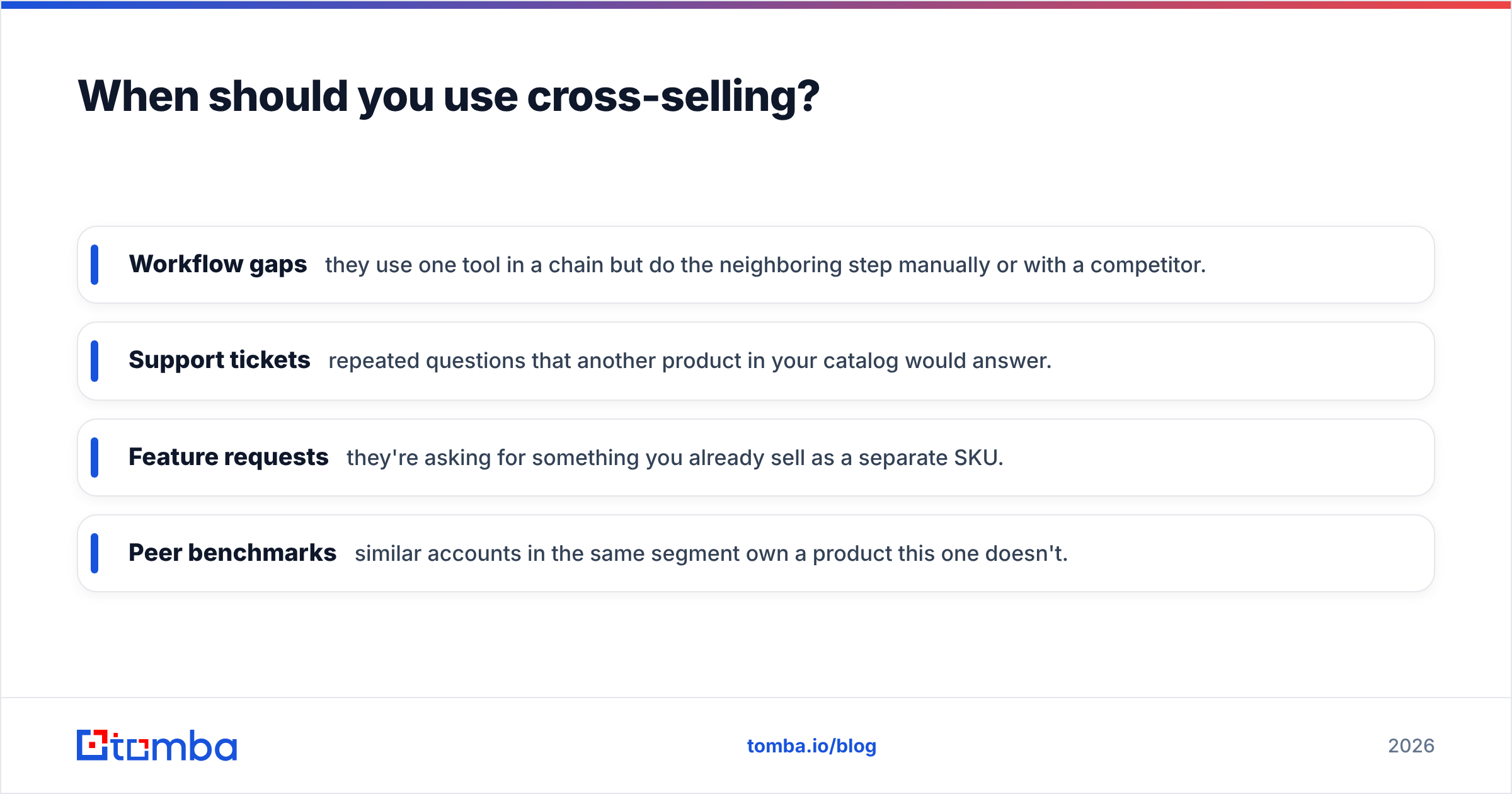
A quick way to spot cross-sell openings across your base:
- Workflow gaps — they use one tool in a chain but do the neighboring step manually or with a competitor.
- Support tickets — repeated questions that another product in your catalog would answer.
- Feature requests — they are asking for something you already sell as a separate SKU.
- Peer benchmarks — similar accounts in the same segment own a product this one does not.
Map those signals to specific SKUs and you turn cross-selling from a guessing game into a targeted play.

Which one grows revenue faster?#
Short answer: up-selling usually moves revenue faster per deal, cross-selling compounds harder over time.
Up-selling has less friction because you are not introducing a new product. You are expanding a decision already made. That is why SaaS companies lean on tier upgrades and seat expansion as their main net-revenue-retention lever. It is the fastest path to a bigger contract without a fresh sales cycle. Research from firms like Gartner and Forrester consistently shows expansion revenue from existing customers carries a far lower acquisition cost than net-new logos.
Cross-selling plays a longer game. Each new product a customer adopts raises switching costs. A company using three of your tools is much harder to dislodge than one using a single product. So while any single cross-sell may be smaller, the cumulative effect on retention and lifetime value tends to outrun a one-time tier bump. The classic finding, echoed across HubSpot's own sales content, is that multi-product customers churn less and refer more.
The practical takeaway: if you need revenue this quarter, prioritize up-sells to accounts sitting at plan limits. If you are building durable net revenue retention, invest in a cross-sell motion that widens footprint over the customer's life.
How do you build both into your sales pipeline?#
Expansion does not happen by accident. It happens when your pipeline has explicit stages and signals for it. Treat cross-sell and up-sell as their own motions inside your sales process and pipeline, not as afterthoughts a rep remembers on a good day.
A workable framework:
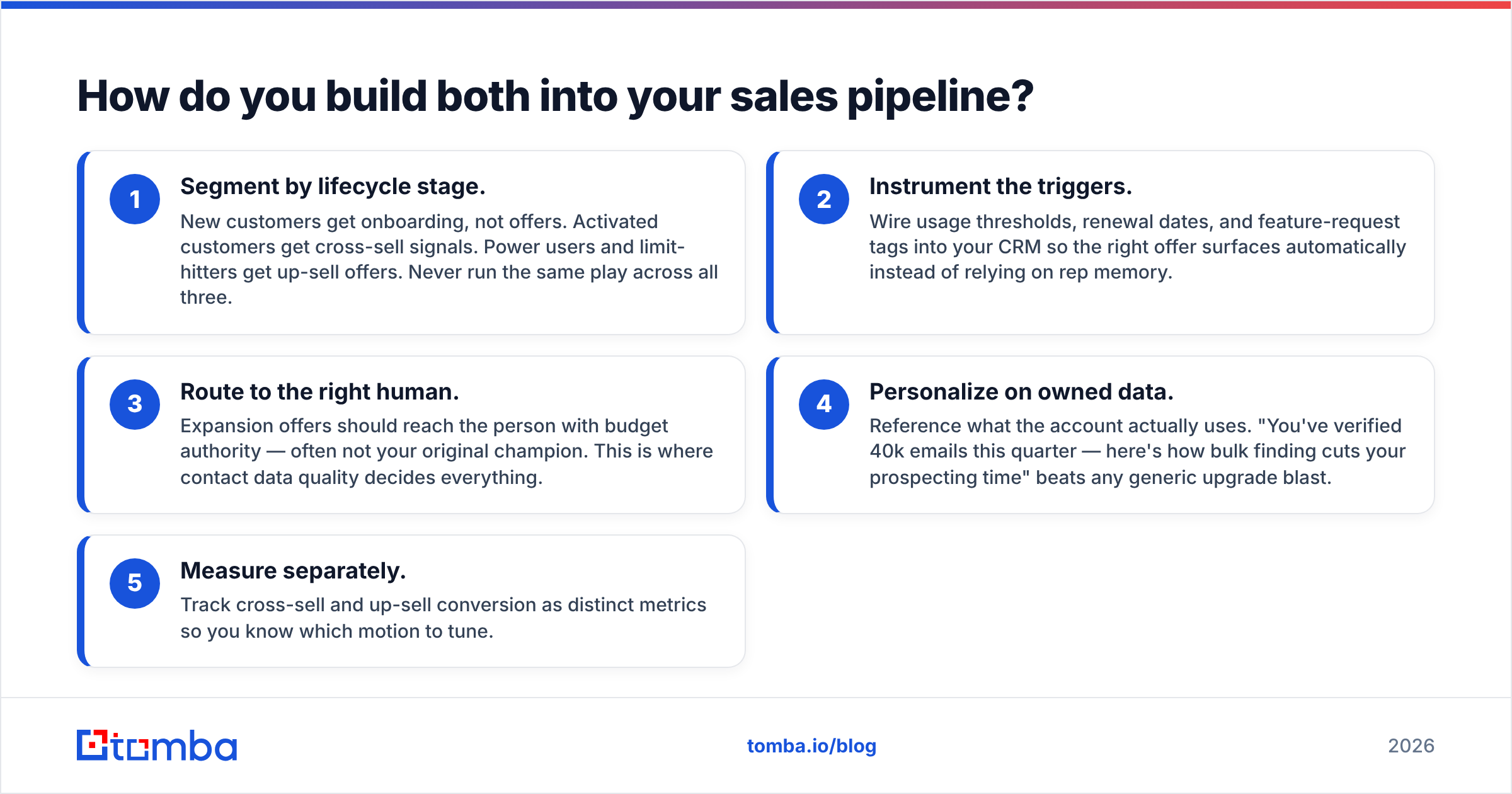
- Segment by lifecycle stage. New customers get onboarding, not offers. Activated customers get cross-sell signals. Power users and limit-hitters get up-sell offers. Never run the same play across all three.
- Instrument the triggers. Wire usage thresholds, renewal dates, and feature-request tags into your CRM so the right offer surfaces automatically instead of relying on rep memory.
- Route to the right human. Expansion offers should reach the person with budget authority — often not your original champion. This is where contact data quality decides everything.
- Personalize on owned data. Reference what the account actually uses. "You have verified 40k emails this quarter — here is how bulk finding cuts your prospecting time" beats any generic upgrade blast.
- Measure separately. Track cross-sell and up-sell conversion as distinct metrics so you know which motion to tune.
Step three is where most expansion programs quietly leak. You identify a perfect up-sell account, then send the offer to a contact who left the company, or to a generic info@ inbox nobody reads. The play was right. The address was wrong.
Where does data quality fit in?#
Both motions live or die on knowing who to reach and what they already have. An expansion offer sent to a stale contact is worse than no offer. It signals your data is old, which undermines the whole pitch.
That is the unglamorous foundation under every cross-sell and up-sell: verified, current contact information tied to the right decision-maker. When a champion moves roles, you need to find the new owner of the account. When you expand into a second department, you need the buyer in that org, not your existing sponsor. Tools like Tomba's domain search map the real contacts inside an account, and an email verifier keeps your outreach from bouncing into spam folders and dragging down sender reputation.
You can also enrich existing CRM records so your expansion triggers fire on accurate firmographics — company size, role, seniority — rather than whatever a rep typed in eighteen months ago. Garbage in, mistimed offer out. The vendors worth comparing here range from full platforms to focused finders. Independent review sites like G2 are a reasonable neutral starting point if you are evaluating options beyond your current stack.
What are the most common mistakes?#
Three failure patterns show up again and again:
- Leading with the bigger number. Opening a relationship by pushing the top tier before the buyer has felt any value. The offer is not wrong. The timing is. Deliver value first, expand second.
- Cross-selling by catalog, not by need. Blasting every add-on to every customer because "it is in the deck." Relevance is the entire game. An irrelevant cross-sell trains customers to ignore you.
- Ignoring the data layer. Running perfect expansion plays on stale contacts and outdated account records. The strategy can be flawless and still fail if it reaches the wrong inbox.
Avoid those and you are ahead of most teams, who treat expansion as a quarterly scramble rather than an instrumented, data-backed motion.
The bottom line#
The cross selling vs up selling choice comes down to this: up-selling trades the buyer up to a better version, and cross-selling adds a complementary one. Up-selling tends to move revenue faster per deal. Cross-selling compounds retention over time. Mature revenue teams run both, sequenced to the customer's lifecycle rather than the rep's mood. The differentiator is not which tactic you pick. It is whether your offer reaches the right decision-maker at the right moment with data you can trust.
That last part is where most expansion programs stumble, and it is the cheapest to fix. Start with clean, verified contact data so every cross-sell and up-sell lands where it should. Tomba Email Finder helps you find and verify the exact decision-makers inside your existing accounts — free for your first 25 searches a month, then $49/mo on the Starter plan. Check the full Tomba pricing and build your expansion motion on data that actually reaches people.
Related guides#
Ready to find emails that actually work?
Join 150,000+ professionals who stopped guessing and started sending. Free credits on signup — no credit card required.
Get the Tomba newsletter
Practical outbound tactics and product updates — once every two weeks.
About the author