Crunchbase vs Kipplo (2026): Which B2B Data Tool Wins?
Crunchbase and Kipplo both promise cleaner B2B data, but they solve different problems. Here's an honest 2026 breakdown of coverage, pricing, accuracy, and which one belongs in your prospecting stack.
Picking a B2B data platform usually comes down to one question: do you need to understand a market, or do you need to reach the people in it? Crunchbase and Kipplo sit on opposite ends of that line, and choosing the wrong one wastes budget on data you'll never action.
This is a neutral, hands-on comparison. No vendor spin — just where each tool is strong, where each falls short, and how to plug the gaps so your outbound actually lands.
TL;DR: Crunchbase vs Kipplo at a glance#
- Crunchbase is a company-intelligence database. It's best for market research, funding signals, and account discovery — not for pulling verified contact emails at scale.
- Kipplo positions itself as a leaner, prospecting-focused data tool aimed at getting reps to contactable leads faster and cheaper.
- Neither is a full outbound engine. Both give you accounts and some contact data, but neither replaces a dedicated email finder and verification layer.
- Pricing philosophy differs: Crunchbase sells structured subscription tiers; Kipplo leans toward lighter, prospecting-oriented plans.
- Best combo: use one for account discovery, then run contacts through a dedicated email verifier before you send a single message.
What is Crunchbase and who is it for?#
Crunchbase started as a database of startups, funding rounds, and investors, and it's grown into a broad company-intelligence platform. If you've ever researched who funded a company, when they raised, or which executives sit on the board, you've probably touched Crunchbase data.
Its core strength is signal. Funding events, acquisitions, leadership changes, and headcount growth are the kind of triggers that tell a sales or investment team "reach out now." Crunchbase Pro adds saved searches, alerts, and CRM-style list building on top of that dataset.
Where it gets weaker is the last mile. Crunchbase will happily tell you a company just raised a Series B and who the VP of Sales is. It's far less reliable at handing you that VP's verified, deliverable email address. That's not the product's job — but it's often the job you actually need done.
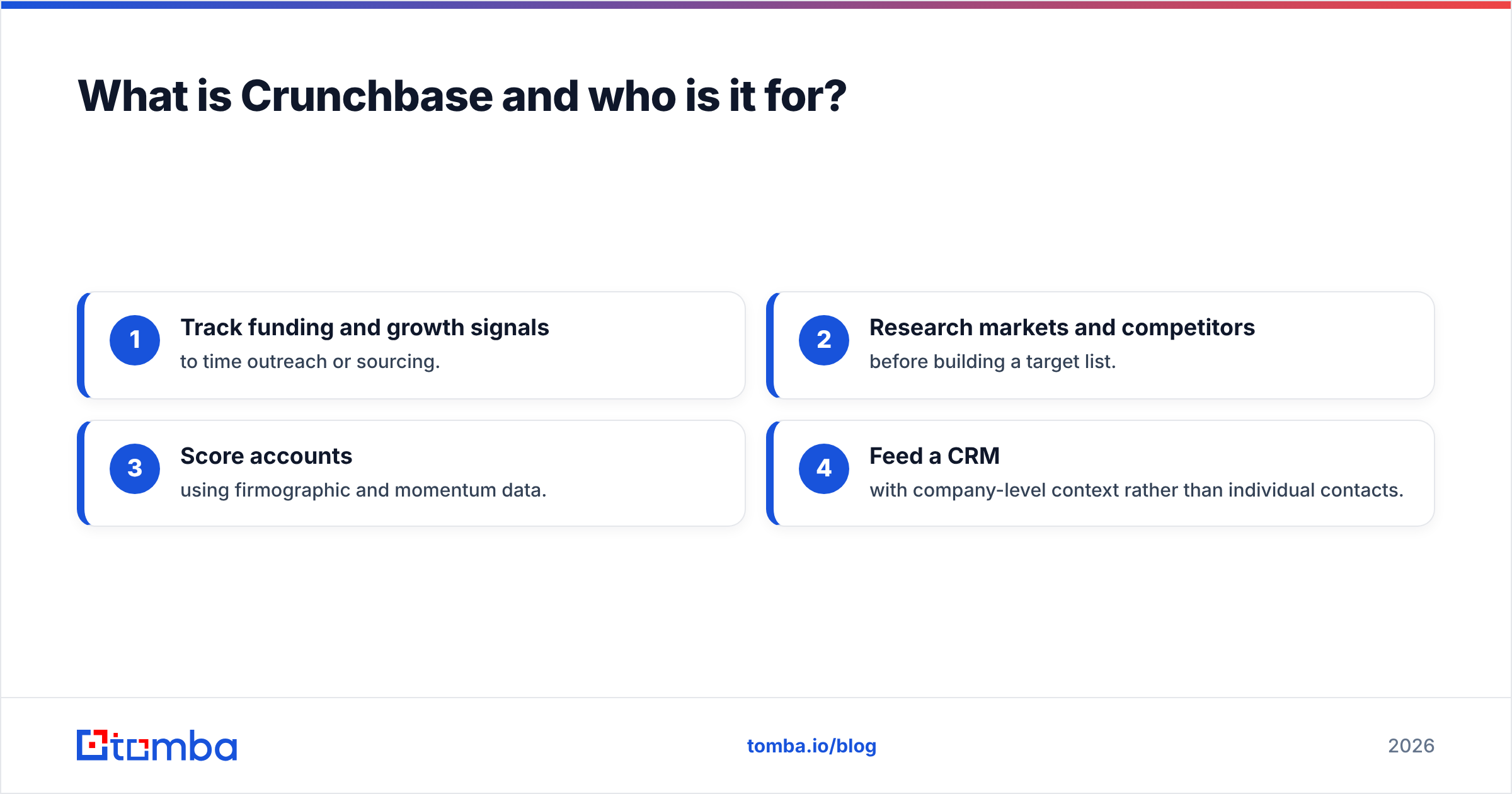
Crunchbase fits best when you:
- Track funding and growth signals to time outreach or sourcing.
- Research markets and competitors before building a target list.
- Score accounts using firmographic and momentum data.
- Feed a CRM with company-level context rather than individual contacts.

What is Kipplo and how is it different?#
Kipplo is the newer, prospecting-first option in this matchup. Where Crunchbase optimizes for depth of company intelligence, Kipplo optimizes for speed to a usable lead list — the workflow a rep runs when they need contacts to email this week, not a market map.
That framing matters. A tool built for prospecting tends to prioritize contact coverage, list exports, and simple filtering over the rich funding-history graph that makes Crunchbase valuable to analysts and investors. For a founder or SDR who just wants "give me 200 marketing directors at mid-market SaaS companies," that trade-off can be the right one.
The honest caveat: prospecting-focused databases live and die on data freshness and accuracy. Contact records decay fast — people change jobs, companies rebrand, catch-all domains hide bad addresses. Any tool in this lane, Kipplo included, should be judged on how current its records are and how transparent it is about sourcing. Always test a sample against your own known-good contacts before committing to a plan.
Check either vendor's current profiles on a review site like G2 before you buy — self-reported coverage numbers and real user reports often tell different stories.
Crunchbase vs Kipplo: the core comparison#
Here's the head-to-head on the attributes that actually change your workflow. Pricing shifts often, so treat the figures as directional and confirm on each vendor's site before purchase.
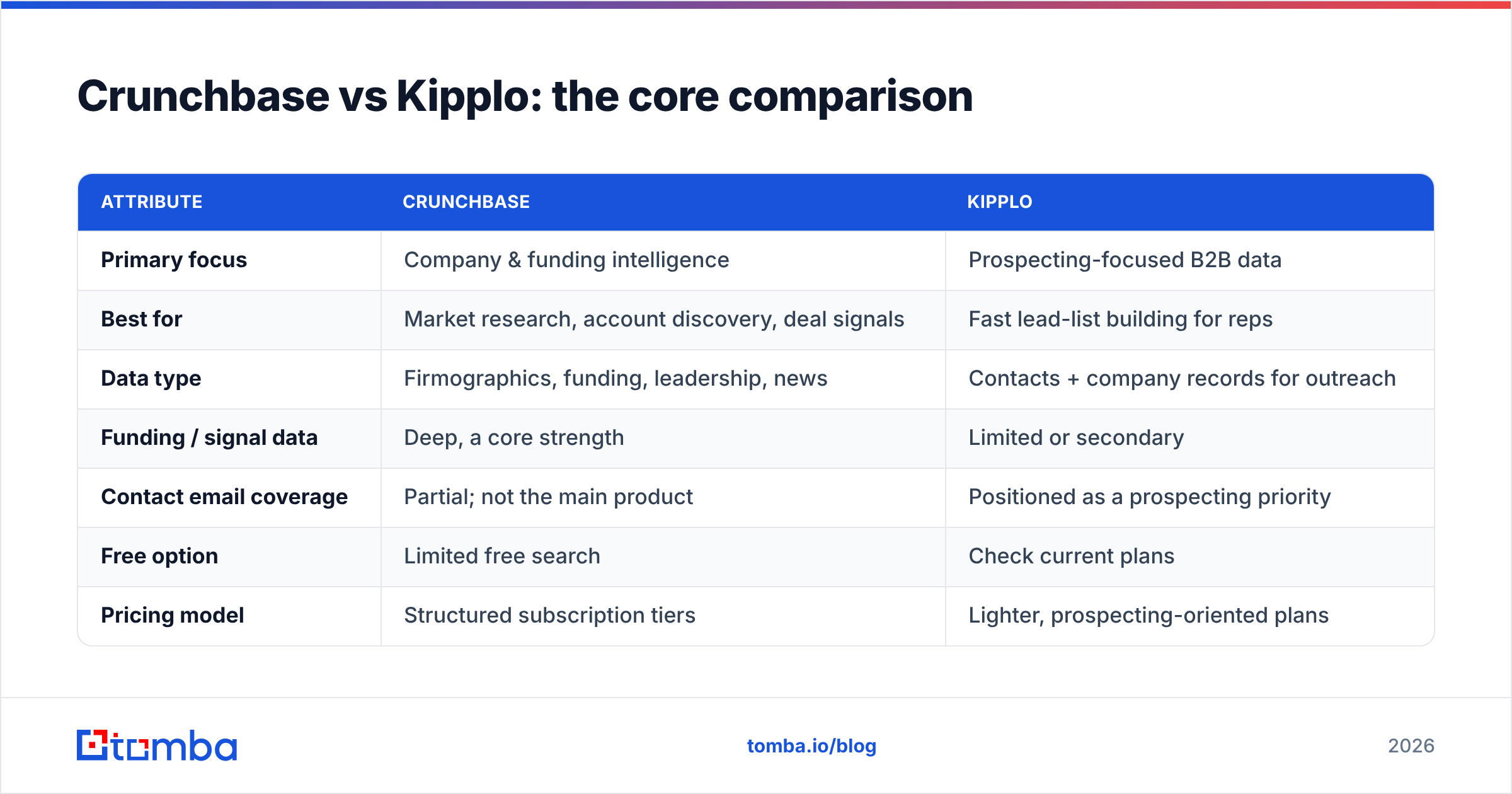
| Attribute | Crunchbase | Kipplo |
|---|---|---|
| Primary focus | Company & funding intelligence | Prospecting-focused B2B data |
| Best for | Market research, account discovery, deal signals | Fast lead-list building for reps |
| Data type | Firmographics, funding, leadership, news | Contacts + company records for outreach |
| Funding / signal data | Deep, a core strength | Limited or secondary |
| Contact email coverage | Partial; not the main product | Positioned as a prospecting priority |
| Free option | Limited free search | Check current plans |
| Pricing model | Structured subscription tiers | Lighter, prospecting-oriented plans |
| Built-in email verification | No dedicated verifier | Verify before sending regardless |
The pattern is clear: Crunchbase wins on intelligence, Kipplo aims to win on contactable volume. Neither ships a rigorous verification layer, which is exactly where deliverability problems start.
Which one has better data accuracy?#
Accuracy depends on what you're measuring. For company-level facts — funding rounds, acquisitions, leadership names — Crunchbase is generally the stronger, better-sourced dataset because that's its origin and its moat.
For contact-level accuracy — is this email real, is this person still in this role — the answer is: don't trust either at face value. This isn't a knock on one vendor. It's how the entire B2B data market works. Contact data decays at roughly 2-3% per month, which means a list that was 95% accurate at export can drop below 80% within a quarter.
That's why the verification step is non-negotiable. Before you load any exported list into a sequencer, run it through a real email verification pass to catch invalid, risky, and catch-all addresses. Skipping this is the single fastest way to torch your sender reputation.

How do pricing and value compare?#
Crunchbase uses a tiered subscription model — a free search layer, then paid plans (Starter and Pro) that unlock saved searches, alerts, exports, and higher usage limits. It's predictable and easy to budget, but you're paying for the whole intelligence platform even if you only want contacts.
Kipplo leans toward a lighter, prospecting-oriented structure designed to get individual reps or small teams into usable lead lists without an enterprise commitment. For a bootstrapped team, that lower entry point is genuinely appealing.
But "cheaper per plan" isn't the same as "cheaper per usable lead." Here's the calculation that actually matters:
- Raw contacts exported — the headline number.
- Deliverable rate after verification — usually the real cost driver.
- Signal quality — are you reaching the right accounts at the right time?
- Tooling gaps — what you'll spend on the finder and verifier neither tool fully provides.
A plan that looks cheap but returns 30% bad emails is more expensive than a pricier source with clean data, once you factor in wasted sends and reputation damage. For context on how a purpose-built contact tool prices this, compare against transparent Tomba pricing.
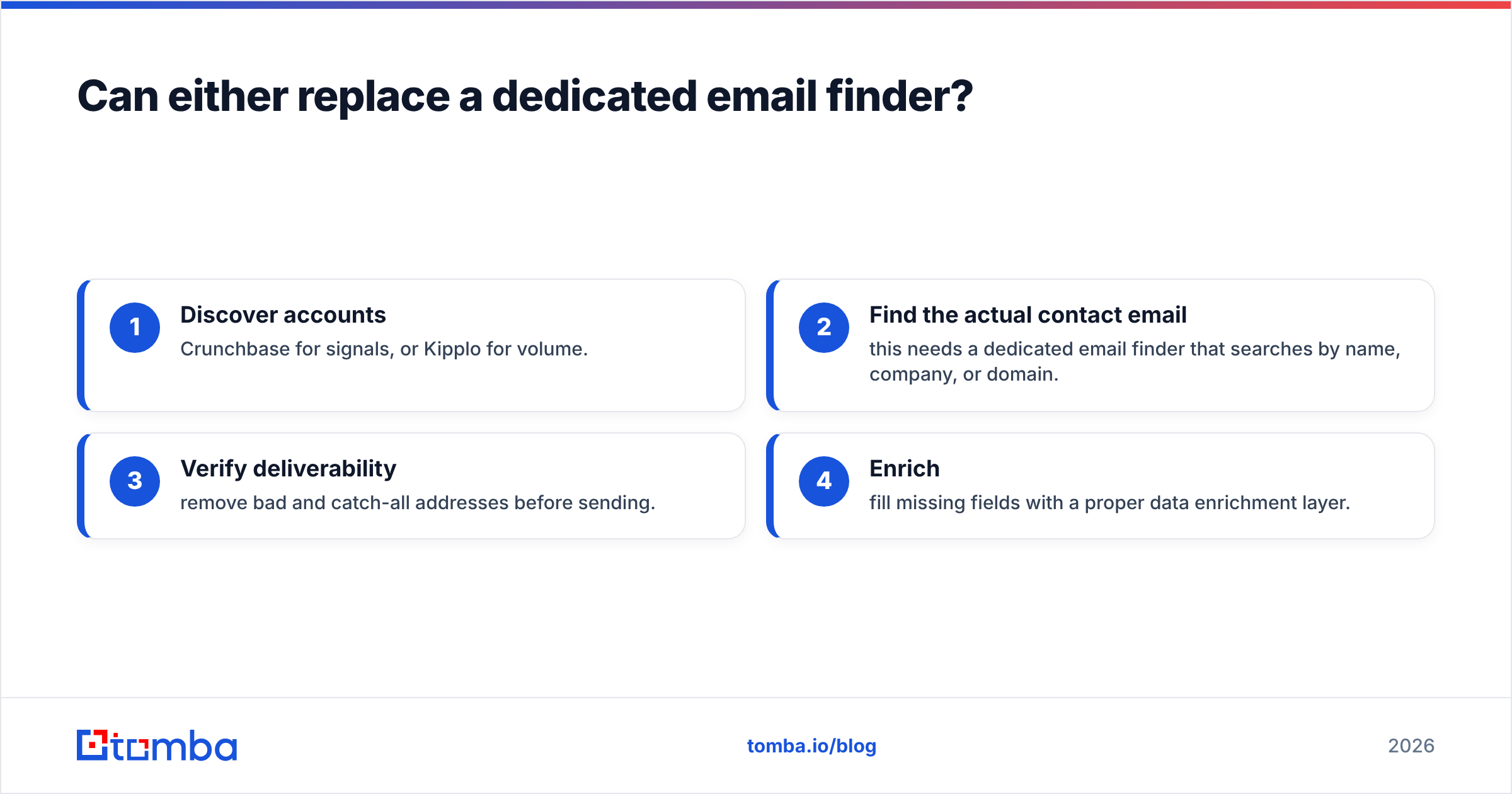
Can either replace a dedicated email finder?#
No — and this is the most important takeaway. Both Crunchbase and Kipplo are discovery tools. They help you decide who to contact. Neither is engineered to reliably produce a verified, deliverable email for every contact you export.
That leaves a gap in every real outbound workflow:
- Discover accounts — Crunchbase for signals, or Kipplo for volume.
- Find the actual contact email — this needs a dedicated email finder that searches by name, company, or domain.
- Verify deliverability — remove bad and catch-all addresses before sending.
- Enrich — fill missing fields with a proper data enrichment layer.
Tools like Tomba are built specifically for steps 2-4. You can point a domain search at a company Crunchbase surfaced and pull the verified email patterns for the roles you care about — closing the loop that neither Crunchbase nor Kipplo fully covers on its own.
Crunchbase vs Kipplo: pros and cons#
Crunchbase pros
- Deep, well-sourced funding and company intelligence.
- Strong signal data for timing outreach.
- Reliable for market research and account scoring.
Crunchbase cons
- Contact emails aren't the core product.
- You pay for the full platform even if you only need lists.
- No dedicated verification layer.
Kipplo pros
- Prospecting-first workflow built for speed.
- Lighter entry point for small teams and solo reps.
- Contact coverage is a stated priority.
Kipplo cons
- Less funding/signal depth than Crunchbase.
- Contact freshness must be tested, not assumed.
- Still needs an external verification step.
Which should you choose in 2026?#
Match the tool to the job:
- Choose Crunchbase if your team runs on market intelligence — sourcing investments, timing outreach to funding events, or building account plans around firmographic momentum.
- Choose Kipplo if you're a lean team that mainly needs contactable lists fast and wants a lower-commitment starting point than a full intelligence suite.
- Choose neither as your whole stack. Whichever you pick for discovery, pair it with a real finder-and-verifier so the leads you export actually reach a human inbox.
The teams that win at outbound in 2026 aren't the ones with the biggest database. They're the ones with the cleanest one — accounts chosen with good signal, contacts confirmed deliverable before the first send.
The bottom line#
Crunchbase and Kipplo aren't really competitors so much as tools for two different stages. Crunchbase tells you which markets and accounts deserve attention. Kipplo tries to get a rep to a lead list faster and cheaper. Both leave the same gap: turning a name and a company into a verified email you can actually send to.
That's where Tomba fits. Use Crunchbase or Kipplo to decide who, then run those accounts through the Tomba Email Finder to get verified, deliverable emails by name, company, or domain — and skip the bounce-and-blacklist spiral that kills cold campaigns. Start free with 25 searches a month, and only pay once you've seen the data quality for yourself.
Related guides#
Ready to find emails that actually work?
Join 150,000+ professionals who stopped guessing and started sending. Free credits on signup — no credit card required.
Get the Tomba newsletter
Practical outbound tactics and product updates — once every two weeks.
About the author