Crunchbase vs SalesIntel (2026): Which B2B Data Tool Wins?
Crunchbase tracks companies and funding; SalesIntel sells human-verified contacts. Here's an honest, side-by-side breakdown of which one fits your GTM stack in 2026 — and where both leave gaps.
Crunchbase and SalesIntel get lumped together as "B2B data tools," but they solve different halves of the same problem. One tells you which companies are worth chasing. The other tells you which humans to email. Pick the wrong one for your workflow and you either drown in firmographics with no contacts, or pay enterprise prices for data your reps could source cheaper.
This is a straight comparison — no vendor spin. Here's how Crunchbase and SalesIntel actually differ, what each costs, and where you'll still need a dedicated finder to close the loop.
TL;DR#
- Crunchbase is a company-intelligence and funding database. It's world-class for market research, investor tracking, and account discovery — but weak on direct-dial phones and individual verified emails.
- SalesIntel is a contact-data platform built around human-verified emails and mobile numbers, with technographic and intent layers on top. Stronger for handing reps ready-to-dial lists.
- Pricing: Crunchbase Pro starts around $99/mo per seat; SalesIntel is quote-only and lands in enterprise territory (often $10k+/yr).
- Neither is a precision email finder. Both carry stale contacts at scale, and SalesIntel gates fresh "on-demand" research behind credits.
- Best combo: use Crunchbase for account selection, then a dedicated tool like the Tomba Email Finder to pull and verify the exact addresses you need — at a fraction of a full SalesIntel seat.
What is Crunchbase?#
Crunchbase started life as a public directory of startups, funding rounds, and investors, and it's still the reference point for company-level intelligence. If you want to know who raised a Series B last quarter, which firms are hiring aggressively, or how a target's headcount has trended, Crunchbase is where analysts and founders look first.
Its strengths are breadth and freshness on the firmographic side:
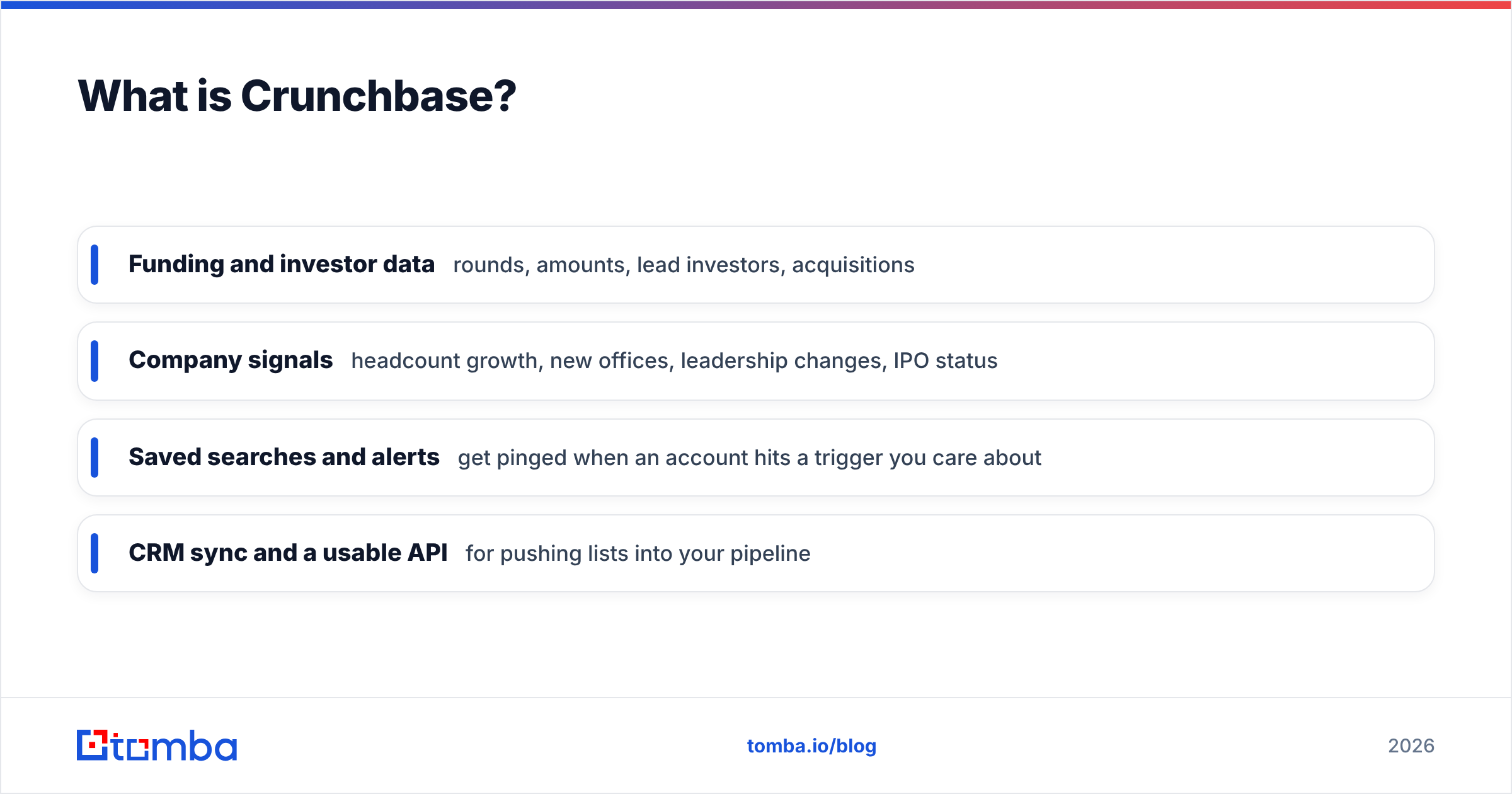
- Funding and investor data — rounds, amounts, lead investors, acquisitions
- Company signals — headcount growth, new offices, leadership changes, IPO status
- Saved searches and alerts — get pinged when an account hits a trigger you care about
- CRM sync and a usable API for pushing lists into your pipeline
Where Crunchbase gets thin is the last mile: the actual person and their working email or mobile. You'll often get a company and a title, but not a verified inbox you can drop into a sequence. That's by design — Crunchbase is a market map, not a rep's dialer. For the vendor's own view, see crunchbase.com.

What is SalesIntel?#
SalesIntel positions itself as the "human-verified" contact database. Its pitch is that a research team re-verifies contacts on a rolling cycle, so the emails and direct-dial mobile numbers you export are less likely to bounce than the machine-scraped alternatives.
Core of the platform:
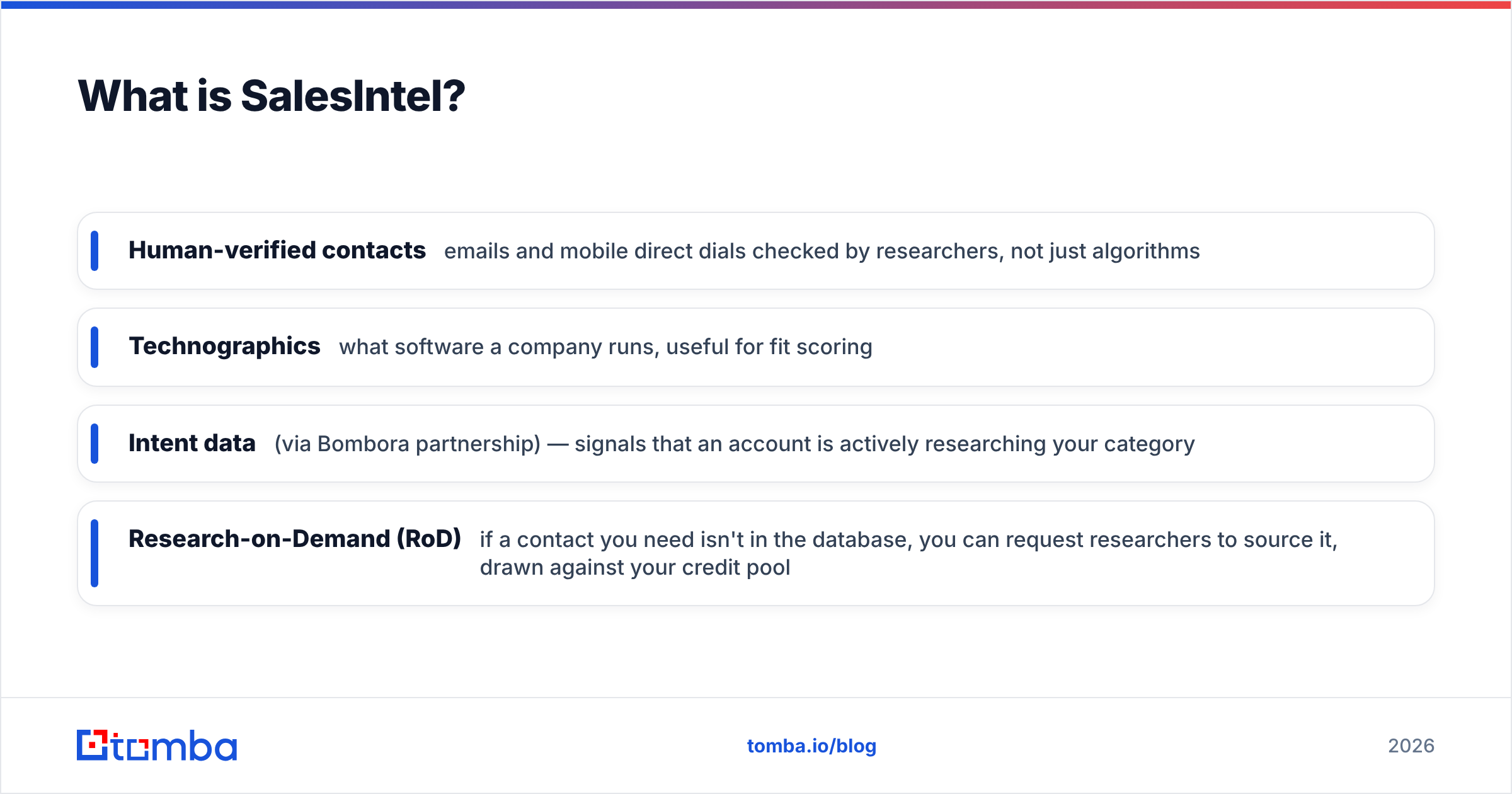
- Human-verified contacts — emails and mobile direct dials checked by researchers, not just algorithms
- Technographics — what software a company runs, useful for fit scoring
- Intent data (via Bombora partnership) — signals that an account is actively researching your category
- Research-on-Demand (RoD) — if a contact you need isn't in the database, you can request researchers to source it, drawn against your credit pool
That RoD model is the real differentiator. Instead of promising 100% coverage, SalesIntel promises it will go find the missing record — but that fulfillment takes time and consumes credits, which matters when you're scaling outbound. Check current positioning at salesintel.io and peer reviews on G2.
Crunchbase vs SalesIntel: how do they compare?#
Here's the honest side-by-side. Read it by job to be done, not by feature count — a longer feature list doesn't help if it's the wrong half of your funnel.
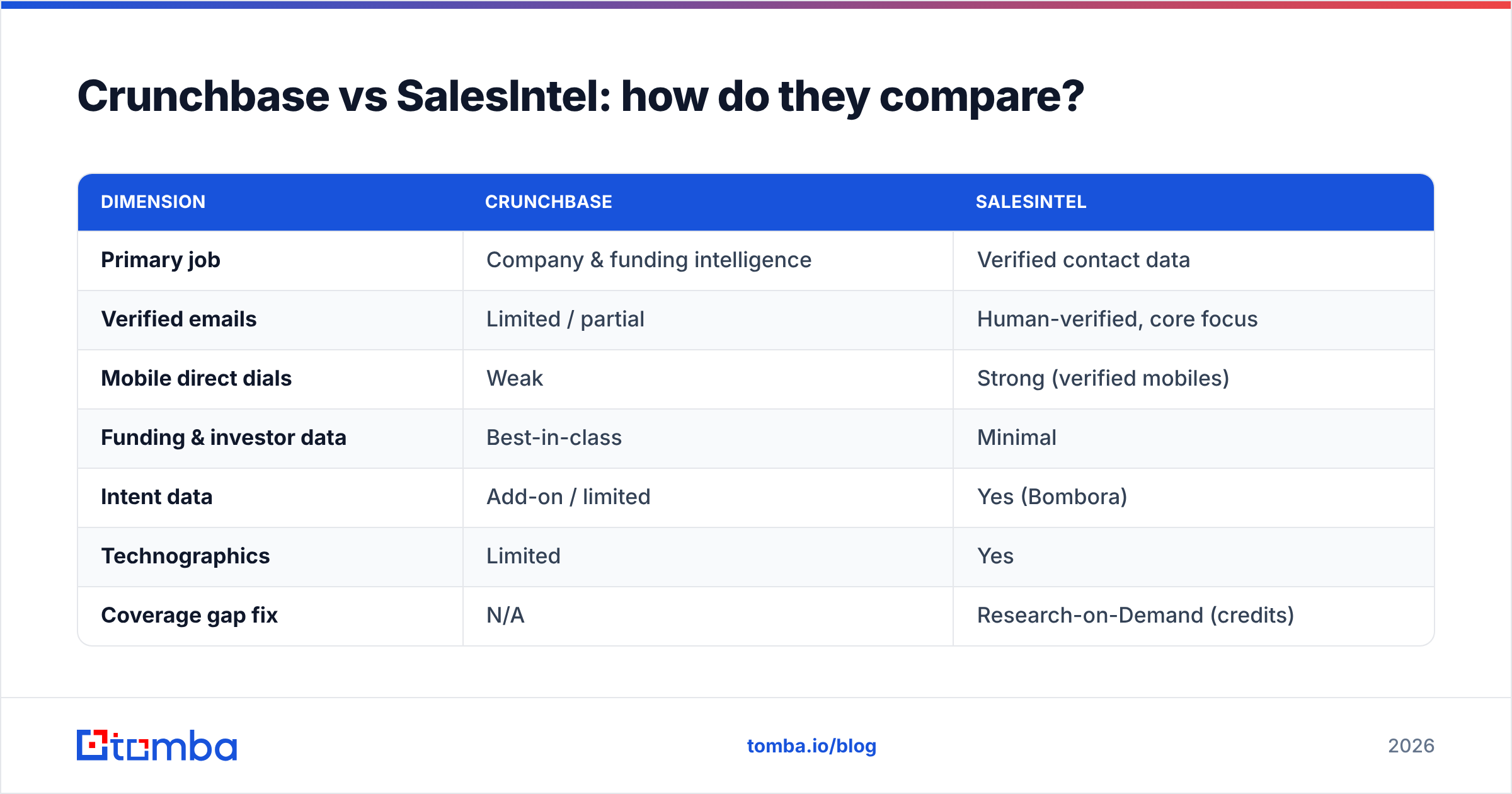
| Dimension | Crunchbase | SalesIntel |
|---|---|---|
| Primary job | Company & funding intelligence | Verified contact data |
| Verified emails | Limited / partial | Human-verified, core focus |
| Mobile direct dials | Weak | Strong (verified mobiles) |
| Funding & investor data | Best-in-class | Minimal |
| Intent data | Add-on / limited | Yes (Bombora) |
| Technographics | Limited | Yes |
| Coverage gap fix | N/A | Research-on-Demand (credits) |
| Starting price | ~$99/mo per seat | Custom quote (enterprise) |
| Free tier | Basic free profiles | No |
| Best for | Founders, investors, market research, account discovery | SDR/AE teams needing dial-ready lists |
The pattern is clear: Crunchbase wins the "which accounts" question, SalesIntel wins the "which people" question. They overlap less than their marketing suggests. A market-research analyst and an SDR would rarely fight over which one to buy — they'd want different tools.
Is SalesIntel better than Crunchbase?#
Not universally — it depends entirely on your motion.
Choose Crunchbase if your team spends its time on account selection: TAM sizing, tracking funding events, prioritizing which logos to pursue this quarter. It's also the friendlier pick for founders and VCs who care about the company graph more than individual contacts. You get a real free tier and transparent per-seat pricing.
Choose SalesIntel if you run a high-volume outbound team that lives and dies by connect rates. Verified mobile numbers are genuinely hard to source at quality, and SalesIntel's human verification plus RoD is a legitimate answer to that. The tradeoff is cost and procurement friction — you're signing an annual enterprise contract, not swiping a card.
The uncomfortable middle: most teams need both jobs done but can't justify two enterprise contracts. That's where a lighter, usage-priced finder earns its place — you use Crunchbase (or its free tier) to build the account list, then pull verified contacts on demand instead of renting a giant static database you'll never fully use.
How accurate is the data, really?#
Both vendors advertise high accuracy, and both are partly right — for the records they've recently touched. The problem with any large static B2B database is decay. B2B contact data goes stale at roughly 22–30% per year as people change jobs, companies rename, and domains migrate. A "verified" record from eight months ago is not a verified record today.
SalesIntel's human verification narrows this gap versus pure scraping, but it can't beat physics: they re-verify on a cycle, so between cycles you're still exposed to churn. Crunchbase, meanwhile, is fresher on company facts (funding, headcount) than on contact facts, because that's what its data operation is optimized for.
The practical takeaway: whatever list you export, verify at the moment of send, not at the moment of purchase. A quick pass through an email verifier before a campaign catches the records that decayed since the database last looked. This single habit does more for deliverability than choosing between two vendors on their headline accuracy claims.
What do Crunchbase and SalesIntel both miss?#
Three gaps show up regardless of which one you pick:
- Precision, on-demand lookups. Both are built to hand you lists. When a rep just needs one exec's email for a warm intro today, spinning up a database query — or waiting on RoD — is overkill.
- Usage-based pricing. Crunchbase is per-seat; SalesIntel is annual enterprise. Neither scales down gracefully for a small team or a one-off campaign.
- Fresh verification at export. Neither guarantees the specific record you pull is live right now, which is the only moment that matters.
This is the seam a focused finder fills. Instead of renting the whole haystack, you point a tool at a domain or a name and get the verified needle — checked live. Tomba's domain search returns every discoverable address at a company with confidence scores, and its data enrichment fills the contact layer Crunchbase leaves blank — without a five-figure contract. For teams that want the underlying records at scale, the B2B database covers the same job SalesIntel charges enterprise rates for, on transparent usage pricing.
What does each one cost in 2026?#
Pricing is where the two diverge hardest — and where the "combo" approach gets attractive.
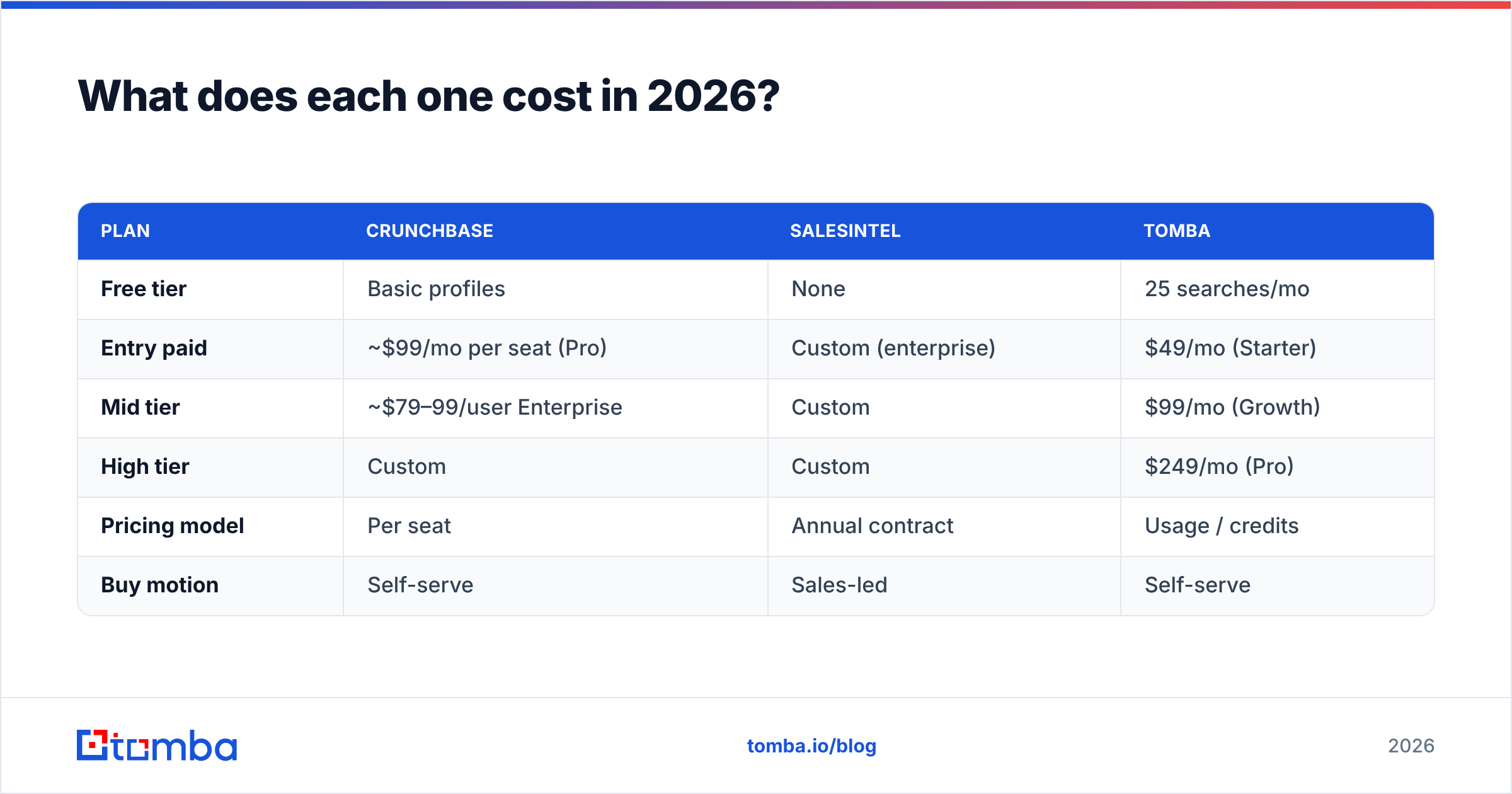
| Plan | Crunchbase | SalesIntel | Tomba |
|---|---|---|---|
| Free tier | Basic profiles | None | 25 searches/mo |
| Entry paid | ~$99/mo per seat (Pro) | Custom (enterprise) | $49/mo (Starter) |
| Mid tier | ~$79–99/user Enterprise | Custom | $99/mo (Growth) |
| High tier | Custom | Custom | $249/mo (Pro) |
| Pricing model | Per seat | Annual contract | Usage / credits |
| Buy motion | Self-serve | Sales-led | Self-serve |
Crunchbase is priced for individuals and small teams who want company intelligence; SalesIntel is priced for funded sales orgs. Tomba slots underneath both as the pay-for-what-you-find layer — full Tomba pricing is public, starting free and moving to $49/mo, so you're not committing budget before you've tested accuracy on your own accounts.
Which setup should you actually run?#
For most GTM teams in 2026, the winning stack isn't "Crunchbase or SalesIntel" — it's:
- Account layer: Crunchbase (even the free tier) to find and prioritize target companies by funding, growth, and trigger events.
- Contact layer: a usage-priced finder/verifier to pull and validate the exact people you'll actually contact, at the moment you contact them.
- Enterprise contact layer (optional): SalesIntel only if verified mobile direct-dials at volume are core to your motion and the budget clears procurement.
That keeps your spend proportional to output. You pay Crunchbase for market maps, you pay per verified contact instead of per giant static seat, and you only escalate to a full enterprise contract when the phone-dial use case truly demands it.
Frequently asked questions#
Is Crunchbase a good email finder? Not really. Crunchbase is excellent for company and funding intelligence but only partially exposes individual verified emails. For reliable, deliverable addresses, pair it with a dedicated email finder.
Does SalesIntel guarantee 100% accurate data? No database can. SalesIntel's human verification and Research-on-Demand reduce bounce risk versus pure scraping, but contact data still decays between verification cycles. Always re-verify before you send.
Is SalesIntel worth the enterprise price? If verified mobile direct-dials at volume are central to your outbound, it can be. If you mainly need emails and occasional contacts, a usage-priced tool delivers the same job without an annual contract.
Can I use Crunchbase and Tomba together? Yes — that's the recommended combo. Use Crunchbase to pick accounts, then use Tomba to find and verify the specific contacts at those accounts on demand.
The bottom line#
Crunchbase and SalesIntel aren't really rivals — they're two halves of a pipeline. Crunchbase answers which companies, SalesIntel answers which verified humans, and both leave you exposed on fresh, precise, pay-as-you-go lookups.
If you want the contact layer without the enterprise contract, start with the Tomba Email Finder. Find any professional email by name, company, or domain, verify it live before you send, and only pay for what you actually pull — so you can keep Crunchbase for the market map and skip the five-figure line item entirely.
Related guides#
Ready to find emails that actually work?
Join 150,000+ professionals who stopped guessing and started sending. Free credits on signup — no credit card required.
Get the Tomba newsletter
Practical outbound tactics and product updates — once every two weeks.
About the author