Crustdata Pricing Reviews Pros and Cons (2026 Guide)
A neutral breakdown of Crustdata pricing, real user reviews, and the honest pros and cons — plus where it fits, where it falls short, and a cheaper pick for pure email data.
Crustdata sells real-time B2B data through an API. You get company firmographics, headcount trends, people profiles, and enrichment. It's built for engineering and data teams that want fresh signals in their own product or GTM stack. But the pricing is quote-driven, the learning curve is real, and it's overkill if all you need is verified contact data. This is the neutral guide to Crustdata pricing reviews pros and cons. You'll see what it actually costs, what reviewers say, and where it fits.
Crustdata Pricing Reviews Pros and Cons: TL;DR#
- Crustdata is an API-first B2B data platform, not a point-and-click prospecting tool — you write code to get value out of it.
- Pricing is custom/quote-based. There's no public $/month tier; expect annual contracts scaled to API call volume and data types.
- Strengths: real-time company signals, headcount and growth trends, developer-friendly endpoints, and enrichment at scale.
- Weaknesses: opaque pricing, a steeper technical bar, and contact-data coverage that trails specialist email tools.
- If you mainly need verified emails and phone numbers, a focused tool like Tomba is far cheaper and faster to deploy.
What is Crustdata and who is it for?#
Crustdata is a data-as-an-API company. Instead of a dashboard where a sales rep clicks "find contacts," it exposes endpoints your engineers call to pull company data (funding, headcount, tech stack, growth signals) and people data (roles, profiles, enrichment). Think of it less like a prospecting app and more like a data supplier that plugs directly into whatever you're building.
That framing matters because it decides whether Crustdata is right for you. If you're a founder or RevOps lead building an internal scoring model, a lead-routing system, or a product feature that needs live company intelligence, Crustdata's API model is a genuine fit. If you're a two-person sales team that just wants a list of verified emails to start cold outreach, you'll be paying for engineering complexity you don't need.
The typical Crustdata buyer is technical: a data engineer, a growth engineer, or a product team that treats data as an input to code, not a CSV to download. That's the lens to hold through the rest of this review.

How much does Crustdata pricing cost in 2026?#
The honest answer: Crustdata does not publish flat monthly prices. Pricing is custom and quote-based. It's negotiated around your API call volume, the data types you need, and your contract length. That's normal for API data vendors (Clearbit, People Data Labs, and ZoomInfo all do the same), but it means you can't self-serve your way to a number.
Here's what shapes the quote, based on how data APIs in this category typically price:
- API call volume — the biggest lever. More monthly requests, higher tier.
- Data types — company firmographics are cheaper than enriched people data plus real-time signals.
- Freshness and history — live signals and historical trend data cost more than static snapshots.
- Contract length — annual commitments unlock better per-record rates than month-to-month.
- Support and SLAs — dedicated support, uptime guarantees, and onboarding add to enterprise quotes.
- Seats vs. usage — some line items are per-seat; the API core is usage-metered.
Because the number is negotiated, two companies buying "the same" Crustdata can pay very different amounts. Budget for an annual conversation, not a credit-card checkout. Want a published number to compare against? It helps to look at a vendor with transparent pricing details side by side.
Crustdata vs. a transparent-pricing alternative#
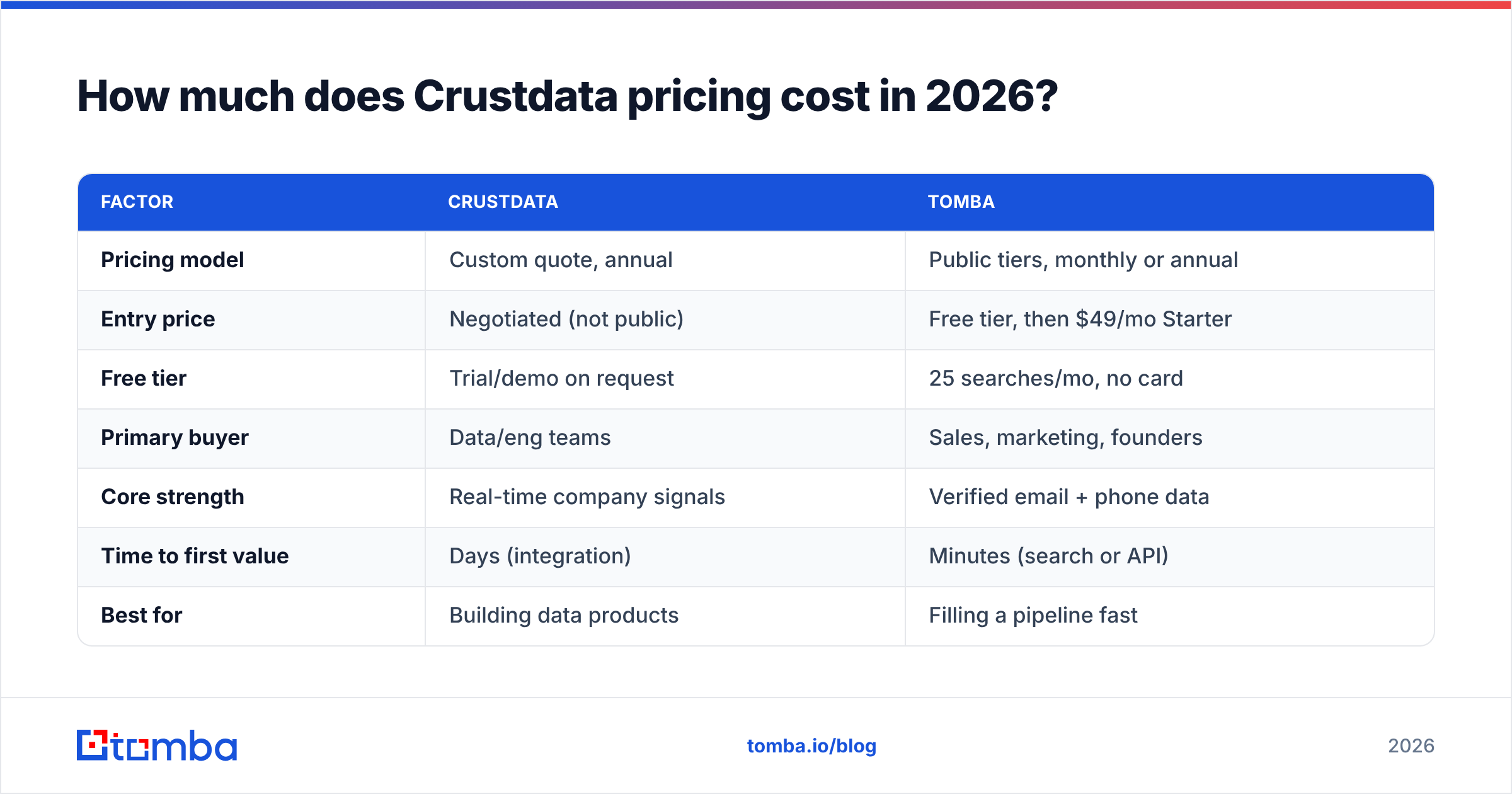
| Factor | Crustdata | Tomba |
|---|---|---|
| Pricing model | Custom quote, annual | Public tiers, monthly or annual |
| Entry price | Negotiated (not public) | Free tier, then $49/mo Starter |
| Free tier | Trial/demo on request | 25 searches/mo, no card |
| Primary buyer | Data/eng teams | Sales, marketing, founders |
| Core strength | Real-time company signals | Verified email + phone data |
| Time to first value | Days (integration) | Minutes (search or API) |
| Best for | Building data products | Filling a pipeline fast |
The table isn't "one wins" — it's about fit. Crustdata is priced and built for teams standing up a data pipeline. Tomba is priced and built for teams that need contacts today.
What do Crustdata reviews say?#
Public review volume for Crustdata is thinner than for legacy giants, so weigh individual reviews carefully. Across G2 and developer communities, a consistent picture emerges.
What reviewers praise:
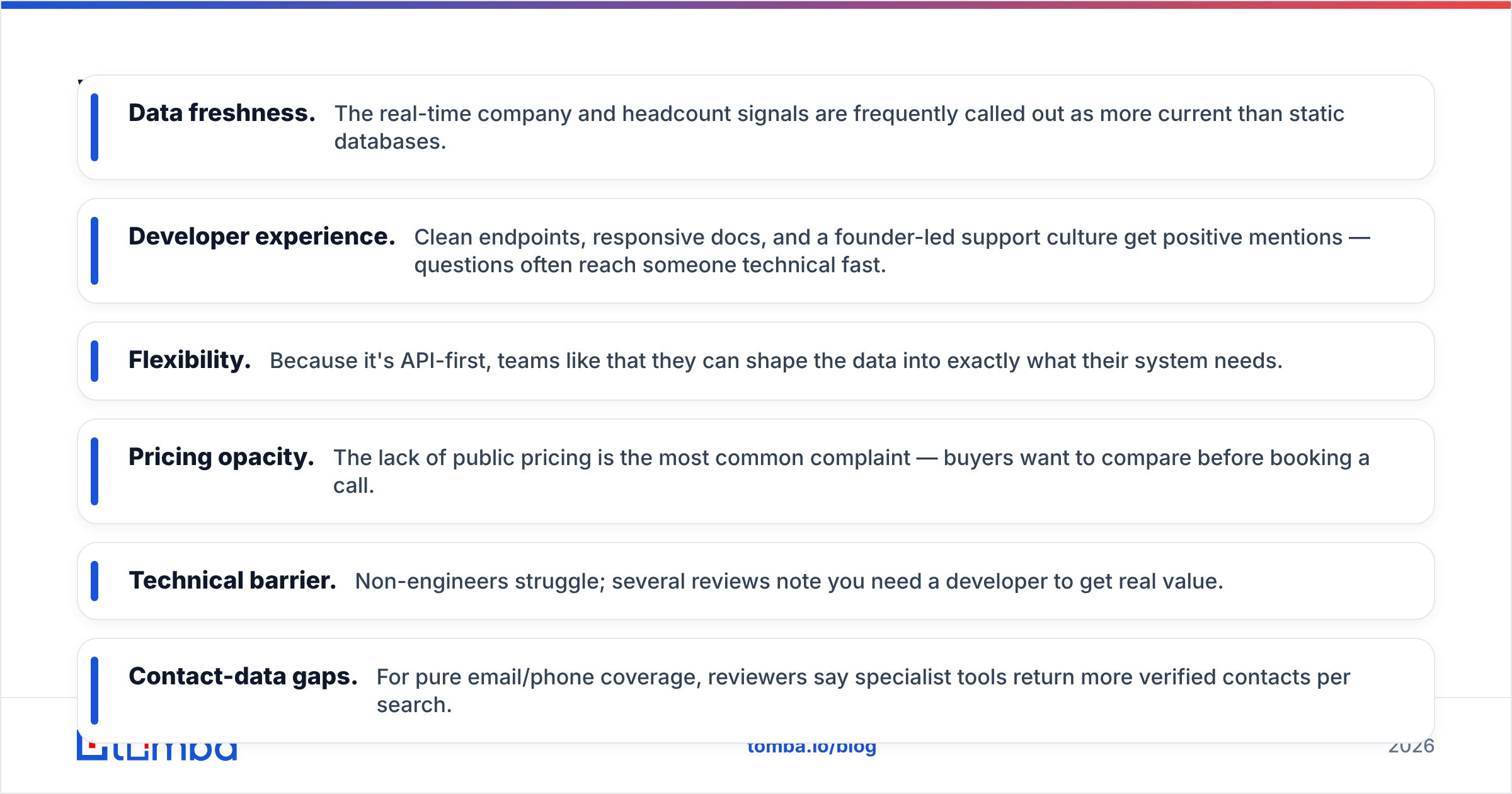
- Data freshness. The real-time company and headcount signals are frequently called out as more current than static databases.
- Developer experience. Clean endpoints, responsive docs, and a founder-led support culture get positive mentions — questions often reach someone technical fast.
- Flexibility. Because it's API-first, teams like that they can shape the data into exactly what their system needs.
What reviewers criticize:
- Pricing opacity. The lack of public pricing is the most common complaint — buyers want to compare before booking a call.
- Technical barrier. Non-engineers struggle; several reviews note you need a developer to get real value.
- Contact-data gaps. For pure email/phone coverage, reviewers say specialist tools return more verified contacts per search.
Treat the score with nuance. A niche, technical product tends to attract either enthusiastic power users or frustrated wrong-fit buyers, and that polarizes ratings. Read reviews for fit signals, not just stars.
What are the pros and cons of Crustdata?#
Here's the balanced verdict, stripped of marketing on either side.
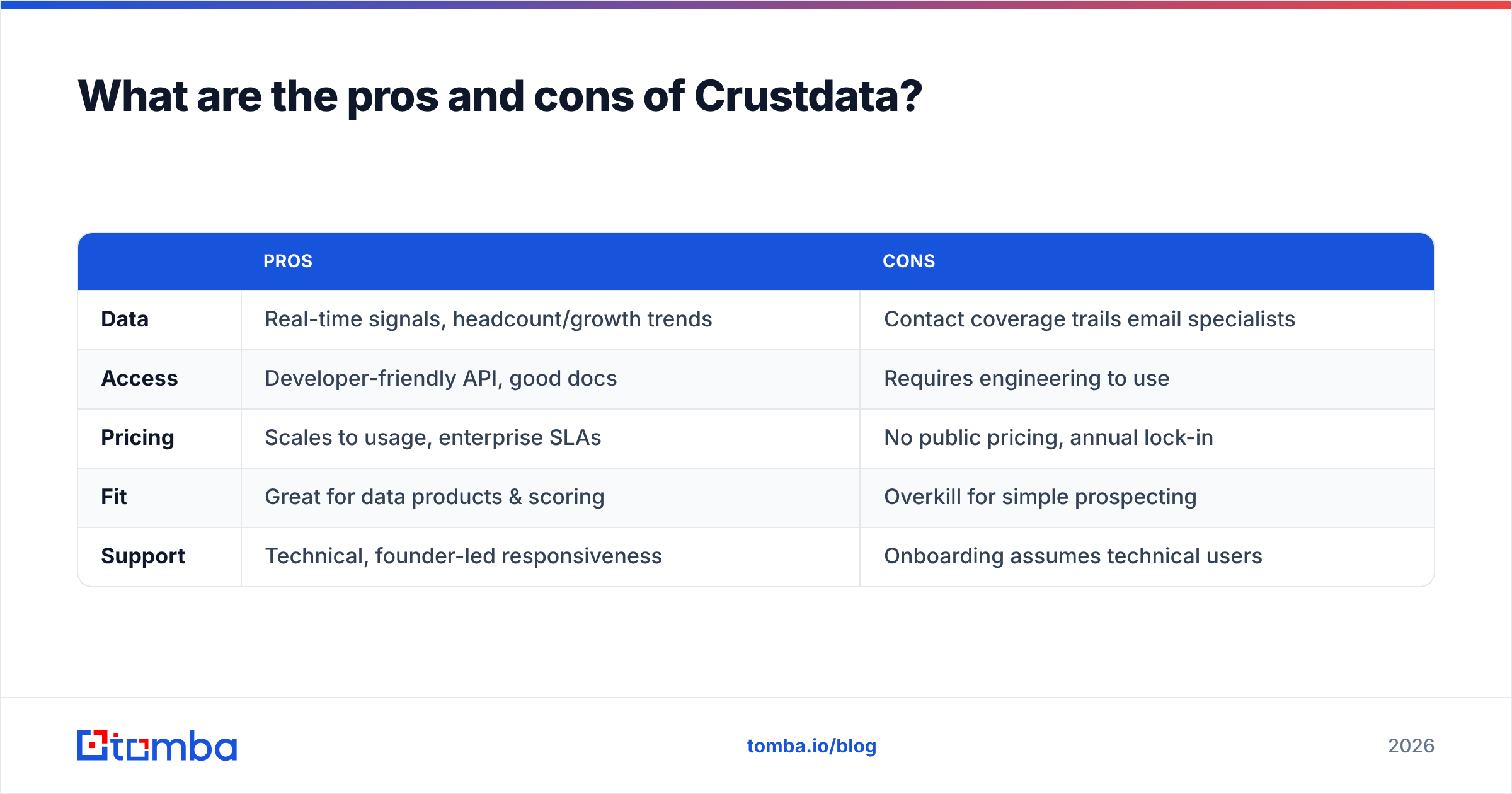
| Pros | Cons | |
|---|---|---|
| Data | Real-time signals, headcount/growth trends | Contact coverage trails email specialists |
| Access | Developer-friendly API, good docs | Requires engineering to use |
| Pricing | Scales to usage, enterprise SLAs | No public pricing, annual lock-in |
| Fit | Great for data products & scoring | Overkill for simple prospecting |
| Support | Technical, founder-led responsiveness | Onboarding assumes technical users |
The pros, in plain terms: if you're building something that needs live company intelligence — a lead-scoring engine, a market-map product, an enrichment layer — Crustdata gives you fresh, flexible, well-documented data you can bend to your schema. That's a real advantage over a static list you re-buy every quarter.
The cons, in plain terms: you pay in two currencies — dollars and engineering hours. The quote-based pricing makes budgeting harder. And if your actual need is "verified emails for outreach," you're buying a data platform to solve a contact-lookup problem.
Is Crustdata worth it, or should you use an alternative?#
It's worth it if you're technical and building on top of data. It's the wrong tool if you just need contacts. That single distinction resolves most of the "is Crustdata worth it" debate.
Choose Crustdata when:
- You have engineering resources to integrate and maintain an API.
- You need real-time company signals — funding, headcount changes, growth — not just static records.
- Data is an input to a system you're building, not a list a rep downloads.
- You can commit to an annual contract and negotiate the quote.
Look elsewhere when:
- Your main job is finding and verifying email addresses and phone numbers for outbound.
- You want transparent, predictable pricing you can start on today.
- Your team is sales/marketing-led, not engineering-led.
- You need value in minutes, not after a build sprint.
For that second column, a focused contact-data tool is the better economic and practical choice. You get an email finder, an email verifier, domain search, and a phone finder — plus a documented email finder API when you do want to automate — without an annual negotiation to get started.
A quick fit test#
Ask three questions:
- Who touches the data first — a developer or a rep? Developer leans Crustdata; rep leans a contact tool.
- Do you need live signals or verified contacts? Signals lean Crustdata; contacts lean a specialist.
- Can you commit annually and negotiate? Yes leans Crustdata; "I want to try it this week" leans transparent pricing.
If you answered "rep / contacts / try it now" to two or more, you're not really a Crustdata buyer. You're a contact-data buyer, and you'll spend less and ship faster with a tool built for that.
How does Crustdata compare to other B2B data tools?#
Crustdata sits in a crowded category, and the right comparison depends on what you're replacing.
- vs. ZoomInfo / Apollo: Those are broad GTM platforms with dashboards, sequences, and huge contact databases. Crustdata is narrower and more technical — better raw signal data, worse out-of-box usability. If you want an all-in-one app, Apollo-class tools fit; if you want an API, Crustdata does.
- vs. Clearbit / People Data Labs: This is Crustdata's true peer group — enrichment and firmographics via API. The decision comes down to data freshness, specific field coverage, and the quote you're offered. Benchmark on your accounts.
- vs. specialist contact tools: For email and phone specifically, dedicated finders and verifiers usually win on cost-per-verified-contact and speed to value. This is where a tool with public Tomba plans and a free tier removes the guesswork.
The mistake buyers make is comparing on brand instead of job. Crustdata is excellent at its job — real-time company data for builders. It's just not the same job as "get me 5,000 verified emails this week."
What should you check before you sign a Crustdata contract?#
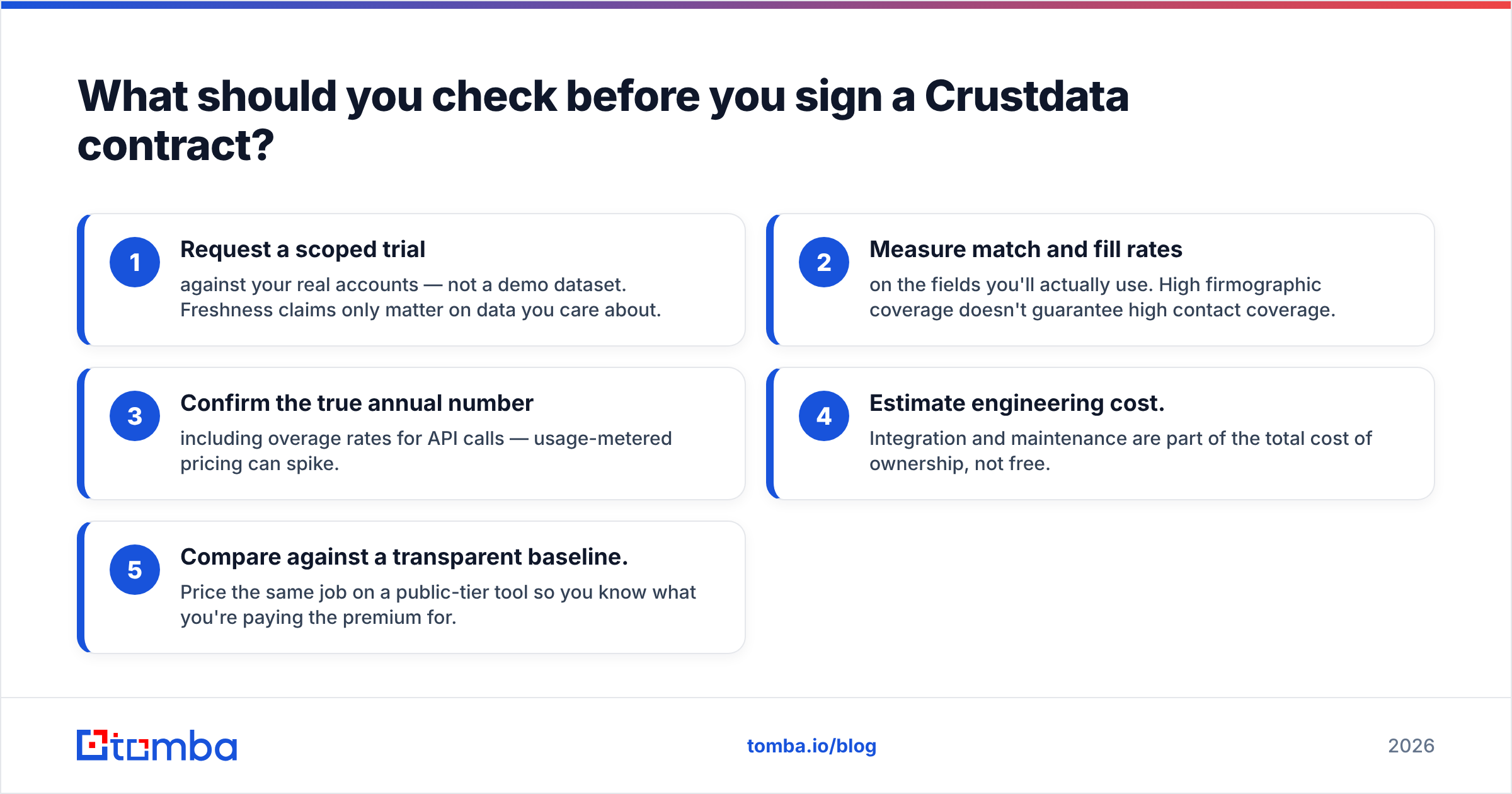
Because pricing is negotiated and value is technical, do this before committing:
- Request a scoped trial against your real accounts — not a demo dataset. Freshness claims only matter on data you care about.
- Measure match and fill rates on the fields you'll actually use. High firmographic coverage doesn't guarantee high contact coverage.
- Confirm the true annual number including overage rates for API calls — usage-metered pricing can spike.
- Estimate engineering cost. Integration and maintenance are part of the total cost of ownership, not free.
- Compare against a transparent baseline. Price the same job on a public-tier tool so you know what you're paying the premium for.
If steps 4 and 5 make you hesitate, that hesitation is the signal. Plenty of teams discover their actual need was contact data all along.
The bottom line#
That's the honest take on Crustdata pricing reviews pros and cons. Crustdata is a strong, developer-first B2B data API with genuinely fresh company signals, and it's priced and built for teams that will write code against it. The pros (real-time data, flexibility, good docs) are real, and so are the cons (opaque pricing, technical barrier, thinner contact coverage). It's worth it for the right buyer and a poor fit for everyone else.
If your real job is filling a pipeline with verified contacts rather than building a data product, skip the annual negotiation. Start with the Tomba Email Finder — find professional email addresses by domain, name, or company, verify them, and export in minutes. There's a free tier with 25 searches a month and no card required, transparent plans from $49/mo when you scale, and a full API when you're ready to automate. You'll know within an afternoon whether it does the job — no quote call required.
Related guides#
Ready to find emails that actually work?
Join 150,000+ professionals who stopped guessing and started sending. Free credits on signup — no credit card required.
Get the Tomba newsletter
Practical outbound tactics and product updates — once every two weeks.
About the author