Crustdata vs Leadzenai (2026): Which B2B Data Tool Wins?
Crustdata is a developer-first data API; Leadzen.ai is a lead-intelligence UI. We compare accuracy, pricing, coverage, and fit so you can pick the right B2B data engine for 2026.
The Crustdata vs Leadzenai choice comes down to one question. Do you want a raw data API your engineers wire into your product? Or a point-and-click lead platform your sales reps open every morning? Both tools solve overlapping problems. But they work from opposite ends of the stack. Pick the wrong one and you can waste a quarter of onboarding time.
This breakdown compares both on accuracy, coverage, pricing, and fit. Then it shows where a focused email layer like Tomba fills the gaps neither tool fully closes.
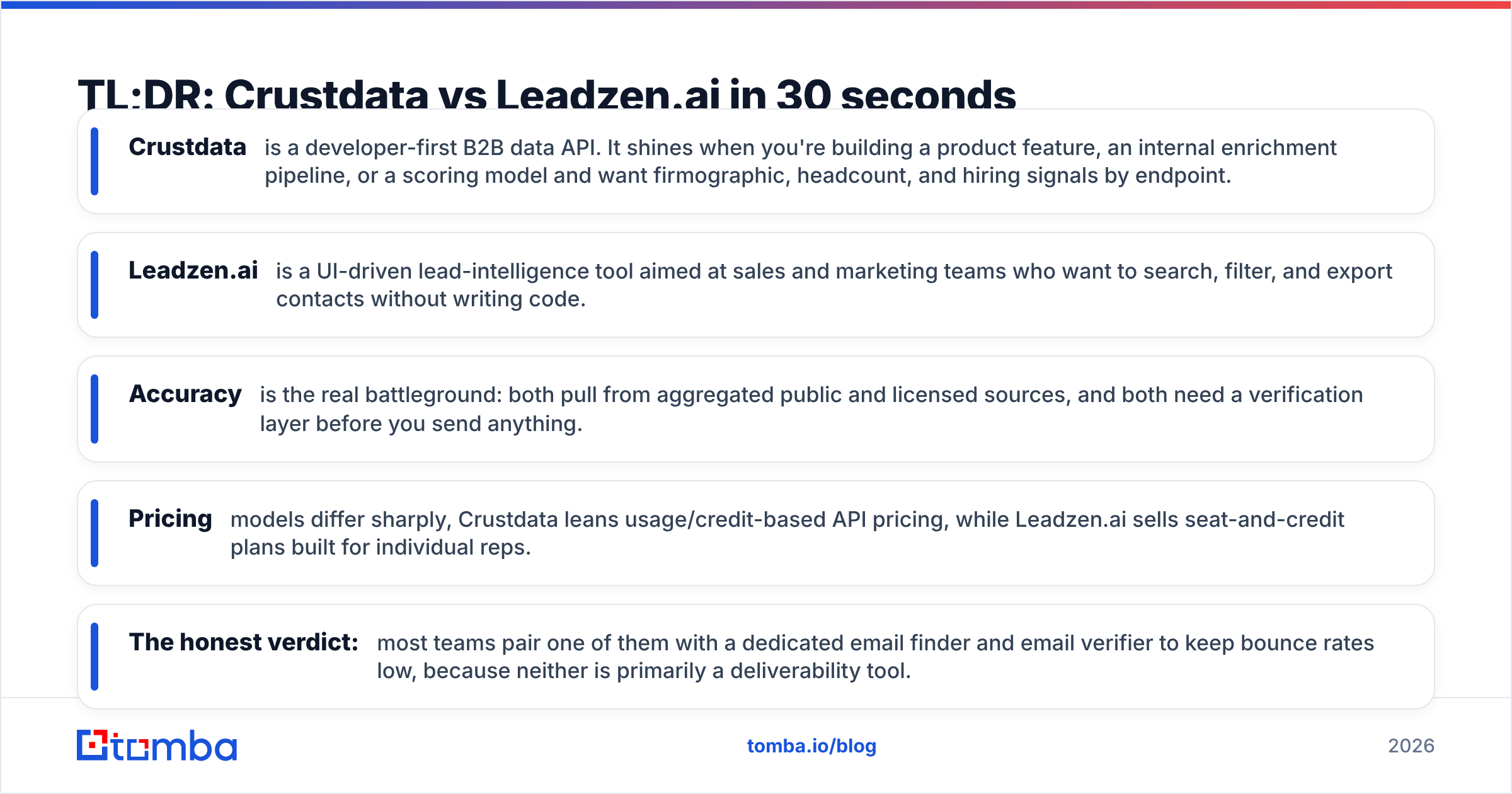
TL;DR: Crustdata vs Leadzen.ai in 30 seconds#
- Crustdata is a developer-first B2B data API. It shines when you build a product feature, an enrichment pipeline, or a scoring model. You get firmographic, headcount, and hiring signals by endpoint.
- Leadzen.ai is a UI-driven lead-intelligence tool. It suits sales and marketing teams who want to search, filter, and export contacts without code.
- Accuracy is the real battleground. Both pull from public and licensed sources. And both need a verification layer before you send anything.
- Pricing models differ sharply. Crustdata leans on usage-based API credits. Leadzen.ai sells seat-and-credit plans for individual reps.
- The honest verdict: most teams pair one of them with a dedicated email finder and email verifier. This keeps bounce rates low. Neither tool is primarily a deliverability tool.

What is Crustdata?#
Crustdata is a B2B data provider. It ships data as an API rather than a dashboard. Think of it like a wholesale supplier versus a retail store. You don't browse the shelves. You place structured orders and get structured data back. Their endpoints cover firmographics, headcount trends, job postings, technographics, and person-level enrichment. That makes it popular with founders building GTM tools, RevOps teams enriching their CRM, and data teams training lead-scoring models.
The strength is freshness and signal depth. Crustdata markets time-series data. So you can track when a company's engineering team grows 30% in a quarter. You can also see when it starts hiring for a role that signals buying intent. Explore their live docs on the official Crustdata site.
The trade-off is that Crustdata assumes an engineering resource. If nobody on your team writes code, you'll be staring at JSON with no place to click. It's an ingredient, not a meal.
What is Leadzen.ai?#
Leadzen.ai is a lead-intelligence and prospecting platform built for people, not pipelines. It offers a search interface and filters for industry, geography, designation, and company size. It also adds browser-style lookups and export to CSV or CRM. The target user is a sales rep, recruiter, or small-business owner who wants a list of contacts today.
Where Crustdata is an API, Leadzen.ai is a workspace. You log in, run a search, and pull contacts. No development sprint required. It leans into the Indian and broader APAC market with strong local coverage. It also carries global records. Review its feature set on the official Leadzen.ai site. You can cross-check user sentiment on G2.
The trade-off is the mirror image of Crustdata. You get less programmatic control and less time-series depth. And the workflow lives inside their UI, not inside your product.

Crustdata vs Leadzenai: The Head-to-Head Comparison#
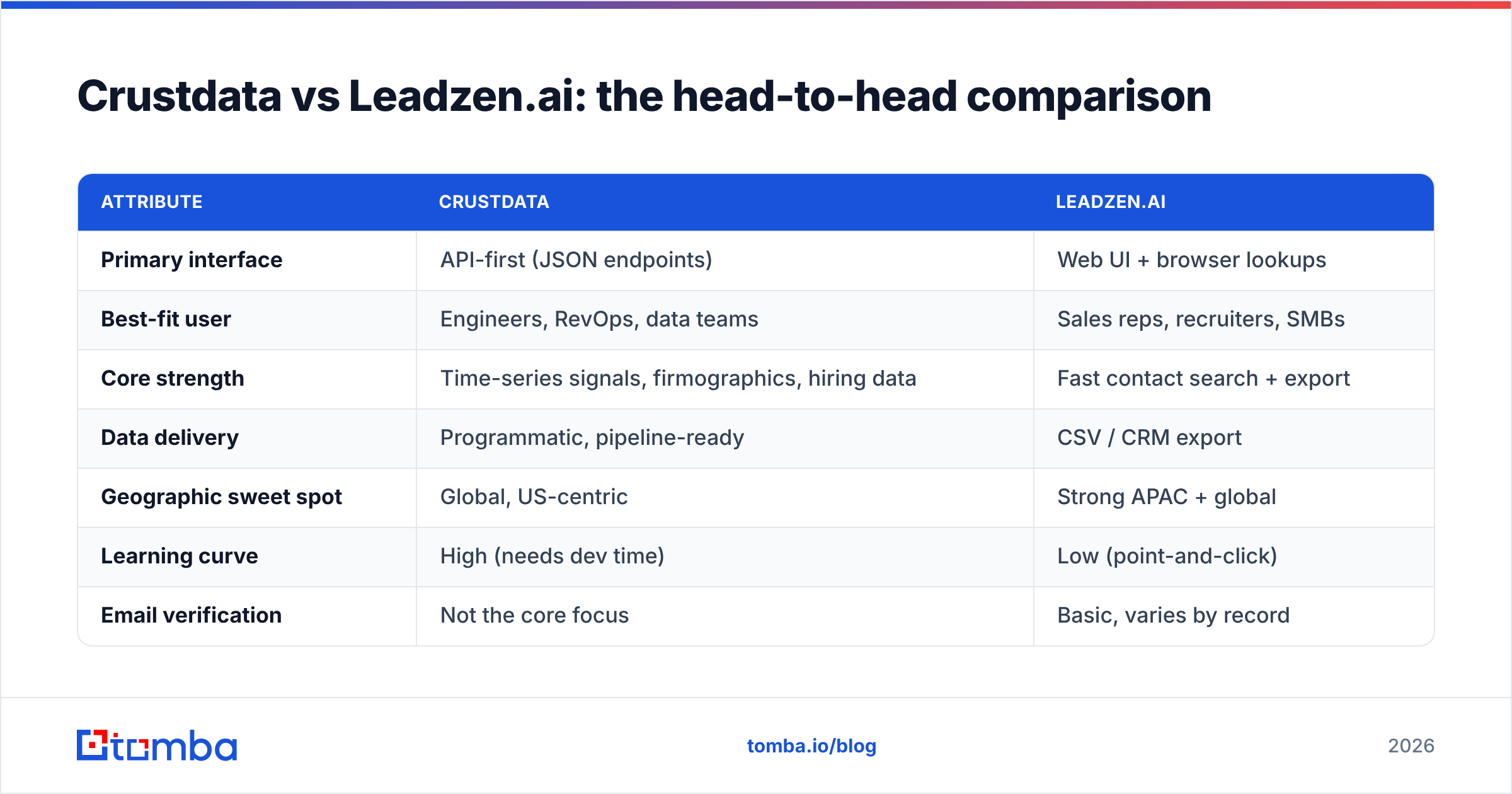
This Crustdata vs Leadzenai comparison shows how the two stack up across the attributes that change your buying decision.
| Attribute | Crustdata | Leadzen.ai |
|---|---|---|
| Primary interface | API-first (JSON endpoints) | Web UI + browser lookups |
| Best-fit user | Engineers, RevOps, data teams | Sales reps, recruiters, SMBs |
| Core strength | Time-series signals, firmographics, hiring data | Fast contact search + export |
| Data delivery | Programmatic, pipeline-ready | CSV / CRM export |
| Geographic sweet spot | Global, US-centric | Strong APAC + global |
| Learning curve | High (needs dev time) | Low (point-and-click) |
| Email verification | Not the core focus | Basic, varies by record |
| Pricing model | Usage/credit API tiers | Seat + credit plans |
The pattern is clear. Crustdata is infrastructure, and Leadzen.ai is a tool. Neither is "better" in a vacuum. They are built for different buyers. A 200-person data team will hate being boxed into a UI. A solo founder doing outbound will hate maintaining an API integration.
Is Crustdata or Leadzen.ai more accurate?#
Accuracy is where marketing claims and reality diverge. Treat every "95% accurate" badge with skepticism. Test each tool on your own list. Both platforms aggregate from public web data, licensed datasets, and community records. So both carry the same core risk: staleness. People change jobs every few years. And any provider is only as fresh as its last crawl.
Use this three-part framework to judge accuracy for your use case:
- Coverage — Does the tool actually have records for your target segment? Crustdata skews toward US and global tech companies. Leadzen.ai has denser APAC coverage. A tool with 99% accuracy on records it lacks is useless to you.
- Match rate — Of the contacts you look up, how many return a usable result? This is where UI tools and APIs often diverge from their headline numbers.
- Deliverability — Of the emails returned, how many actually land? This is the number that costs you money. A high bounce rate damages your sender reputation. It also hurts every future send.
The uncomfortable truth is simple. No data provider guarantees deliverability. Inbox placement depends on your domain, your warmup, and real-time mailbox status. That's why serious teams run every address through independent verification first. It doesn't matter which vendor sourced it.
How do pricing models compare?#
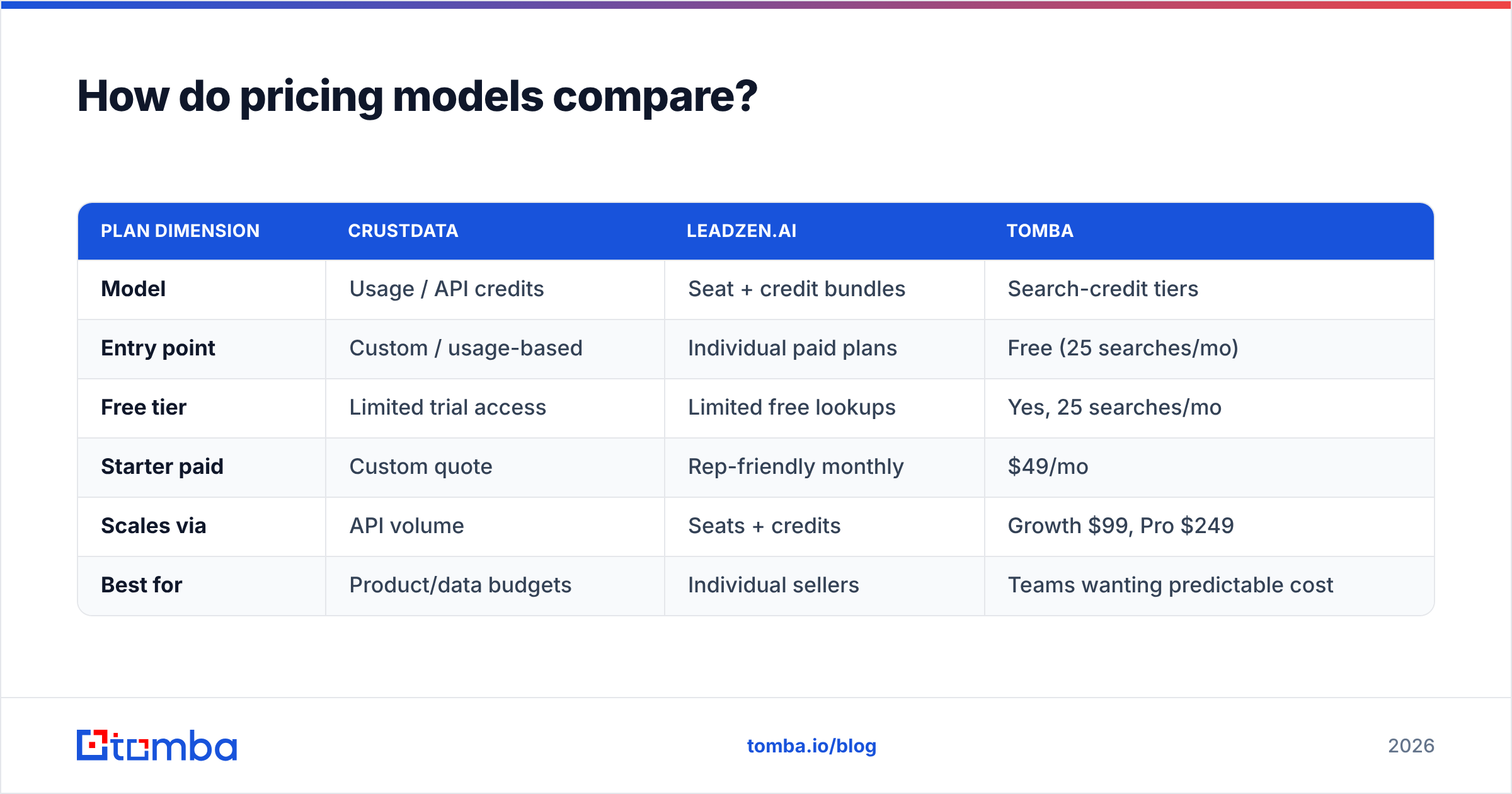
The pricing philosophies are almost as different as the products. This is a directional comparison. Always confirm current numbers on each vendor's pricing page. B2B data pricing changes often and is frequently custom-quoted.
| Plan dimension | Crustdata | Leadzen.ai | Tomba |
|---|---|---|---|
| Model | Usage / API credits | Seat + credit bundles | Search-credit tiers |
| Entry point | Custom / usage-based | Individual paid plans | Free (25 searches/mo) |
| Free tier | Limited trial access | Limited free lookups | Yes, 25 searches/mo |
| Starter paid | Custom quote | Rep-friendly monthly | $49/mo |
| Scales via | API volume | Seats + credits | Growth $99, Pro $249 |
| Best for | Product/data budgets | Individual sellers | Teams wanting predictable cost |
Crustdata's usage-based model rewards teams that can forecast API volume. But it can surprise you with overages if a job runs hot. Leadzen.ai's seat-and-credit approach is predictable for a small team. It gets expensive as you add reps. Want transparent, published tiers you can budget against? Compare them with Tomba pricing. It starts free and moves to a $49/mo Starter without a sales call.
Where does Tomba fit in this comparison?#
Tomba isn't trying to be a full firmographic API like Crustdata. It's not an all-in-one prospecting UI like Leadzen.ai either. It's the layer that makes whatever data you source actually usable for outreach. Think of the difference between having a phone number and having a phone that rings the right person.
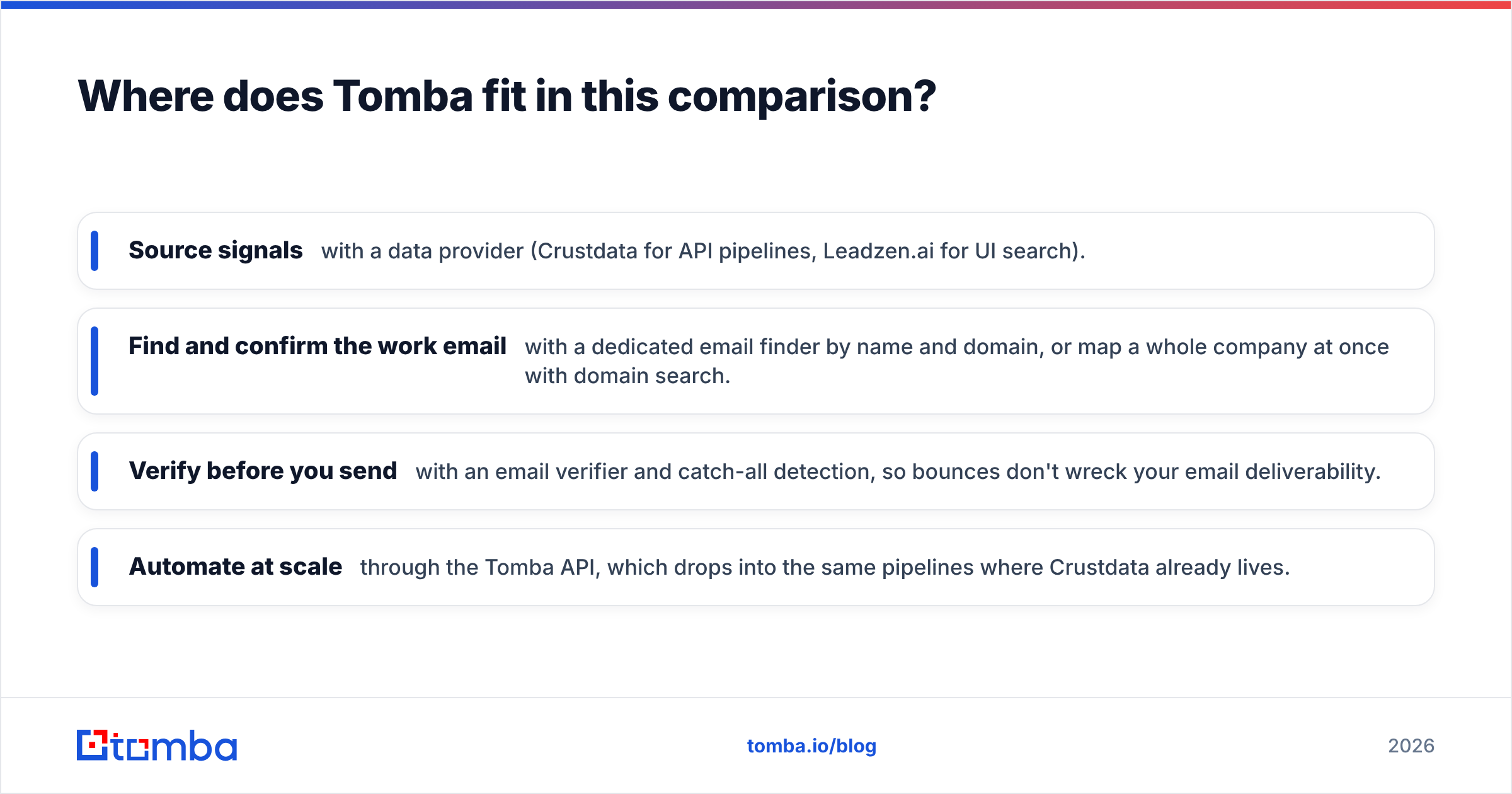
Here's the practical stack most disciplined teams run in 2026:
- Source signals with a data provider (Crustdata for API pipelines, Leadzen.ai for UI search).
- Find and confirm the work email with a dedicated email finder by name and domain, or map a whole company at once with domain search.
- Verify before you send with an email verifier and catch-all detection, so bounces don't wreck your email deliverability.
- Automate at scale through the Tomba API, which drops into the same pipelines where Crustdata already lives.
This is where Tomba's focus is an advantage, not a limitation. Email finding and verification is its core job, not a side feature. So the verification step catches stale records that slip through any aggregated dataset. You can also enrich the contacts you keep with data enrichment. It fills in titles, companies, and social profiles.
Which tool should you choose?#
Match the tool to how your team actually works, not to which one has the longest feature list.
- Choose Crustdata if you have engineering resources and want firmographic, hiring, and time-series signals delivered programmatically into a product or scoring model. It's infrastructure for teams that build.
- Choose Leadzen.ai if your reps need a fast, code-free way to search and export contacts. This fits APAC-heavy targets, and teams that value a workspace over an API.
- Choose Tomba if your bottleneck is finding and verifying accurate emails at a predictable price. You also get a Free tier and a clean API to start today.
For most outbound and RevOps teams, it isn't strictly either/or. You pick a signal source (Crustdata or Leadzen.ai). Then you pair it with a verification-first email layer. That way your sourced list doesn't bounce on the first send.
Frequently asked questions#
Is Crustdata better than Leadzen.ai? Not universally. Crustdata is better for developer-led, API-driven use cases with deep firmographic and hiring signals. Leadzen.ai is better for non-technical reps who need to search and export contacts quickly. The right answer depends on whether your buyer is an engineer or a seller.
Do Crustdata or Leadzen.ai guarantee email deliverability? No data provider can truly guarantee inbox placement. Deliverability depends on your domain reputation, warmup, and the recipient's live mailbox status. Always run sourced emails through an independent email verification step before sending.
Can I use Tomba alongside Crustdata or Leadzen.ai? Yes, and that's the common pattern. Use them to source companies and signals, then use Tomba to find, verify, and enrich the actual contact emails through the API or the app.
Which has a free option to test first? Leadzen.ai offers limited free lookups, and Crustdata offers trial access. Tomba includes a permanent Free tier with 25 searches per month. You can benchmark accuracy on your own list before paying.
The bottom line#
Crustdata and Leadzen.ai are strong tools for opposite buyers. One is a data API for builders. The other is a prospecting UI for sellers. But both leave the same gap: turning raw records into verified, deliverable contacts that won't torch your sender reputation.
That's exactly what Tomba is built for. Start free with the Tomba Email Finder. Find professional emails by name, company, or domain. Verify them before you send. Then plug the whole thing into the pipeline you already run. It's the fastest way to make your chosen data source actually convert.
Related guides#
Ready to find emails that actually work?
Join 150,000+ professionals who stopped guessing and started sending. Free credits on signup — no credit card required.
Get the Tomba newsletter
Practical outbound tactics and product updates — once every two weeks.
About the author