Csvgo vs FindThatLead (2026): Which Email Finder Wins?
Csvgo and FindThatLead both promise fast B2B email lists, but they win on different things. Here's an honest breakdown of accuracy, pricing, and data quality — plus a cheaper pick worth testing first.
Choosing between Csvgo and FindThatLead usually comes down to one question: do you want a bulk list-building workflow, or a prospecting-plus-outreach suite? Both find B2B emails. They just wrap the same core job — turning a name or a domain into a valid, deliverable address — in very different packaging.
This is a neutral, hands-on comparison. No spin, no "both are great, pick what feels right" cop-out. You'll get a straight read on accuracy, pricing, data freshness, and the workflows each tool is actually built for, so you can commit budget without regret.
TL;DR: Csvgo vs FindThatLead in 30 seconds#
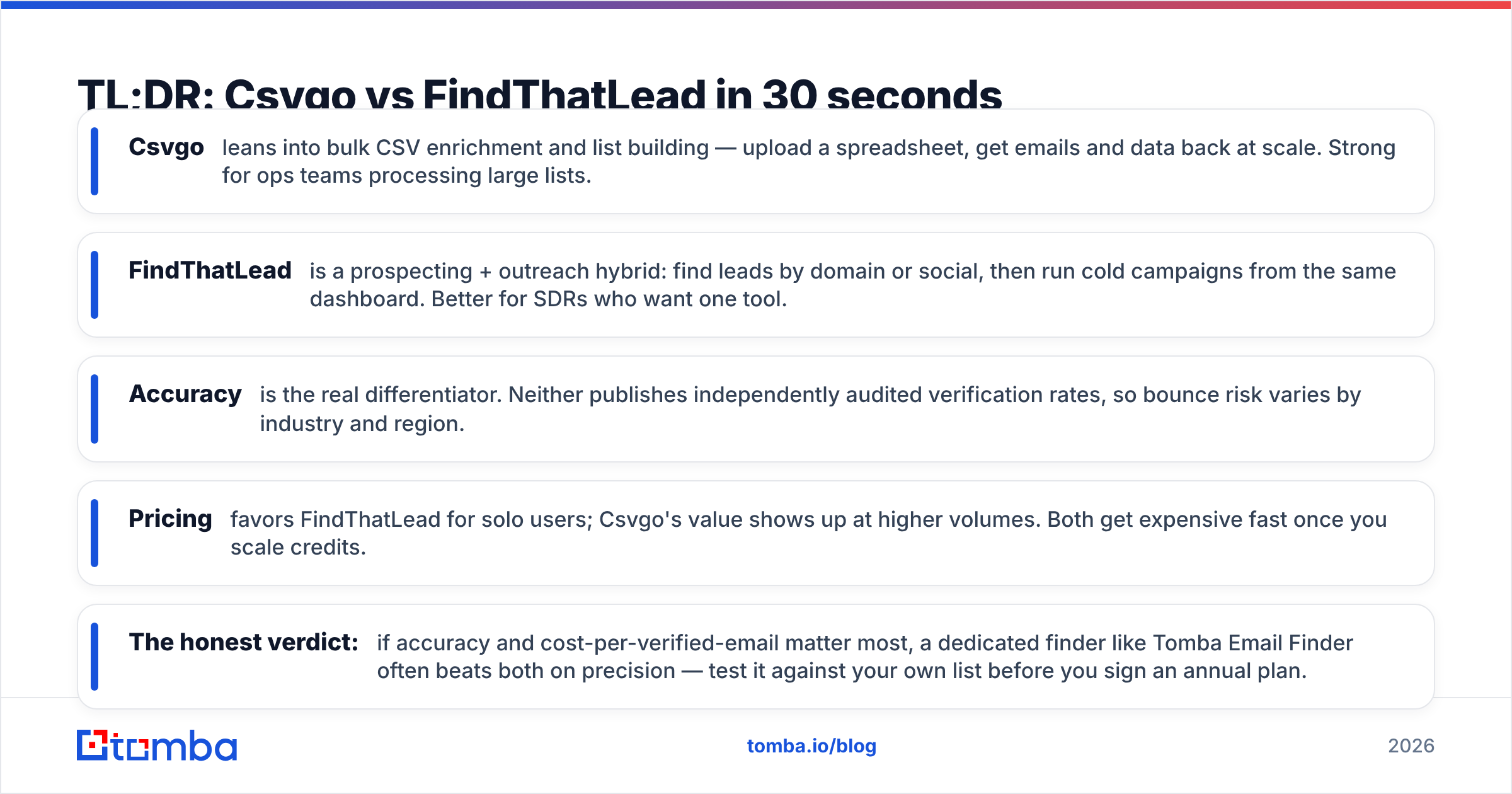
- Csvgo leans into bulk CSV enrichment and list building — upload a spreadsheet, get emails and data back at scale. Strong for ops teams processing large lists.
- FindThatLead is a prospecting + outreach hybrid: find leads by domain or social, then run cold campaigns from the same dashboard. Better for SDRs who want one tool.
- Accuracy is the real differentiator. Neither publishes independently audited verification rates, so bounce risk varies by industry and region.
- Pricing favors FindThatLead for solo users; Csvgo's value shows up at higher volumes. Both get expensive fast once you scale credits.
- The honest verdict: if accuracy and cost-per-verified-email matter most, a dedicated finder like Tomba Email Finder often beats both on precision — test it against your own list before you sign an annual plan.
What do Csvgo and FindThatLead actually do?#
Both tools solve the same fundamental problem — contact discovery — but they draw the line at different points in the funnel.
Csvgo is built around the spreadsheet. You bring a list of companies, domains, or partial contacts, and it enriches each row with email addresses and firmographic data. Think of it like a car wash for messy CSVs: dirty data goes in one end, cleaner, appended data comes out the other. That makes it a natural fit for RevOps and data teams who already live in exports and imports.
FindThatLead is closer to a full prospecting station. It finds emails by domain, by name, or from LinkedIn-style social profiles, then bolts on a "Scrab.in" prospecting layer and a cold-email sender. The pitch is convenience — discover a lead and email them without leaving the app. That end-to-end scope appeals to smaller sales teams who don't want to stitch three subscriptions together.
The trade-off is predictable. A suite that does discovery and sending rarely matches the raw find-rate of a tool that does one thing. And a bulk enrichment engine optimized for throughput doesn't always verify each address as aggressively as a dedicated email verifier would.

How do Csvgo and FindThatLead compare on features and pricing?#
Here's the side-by-side. Prices move, so treat these as directional and confirm on each vendor's live pricing page before you buy.
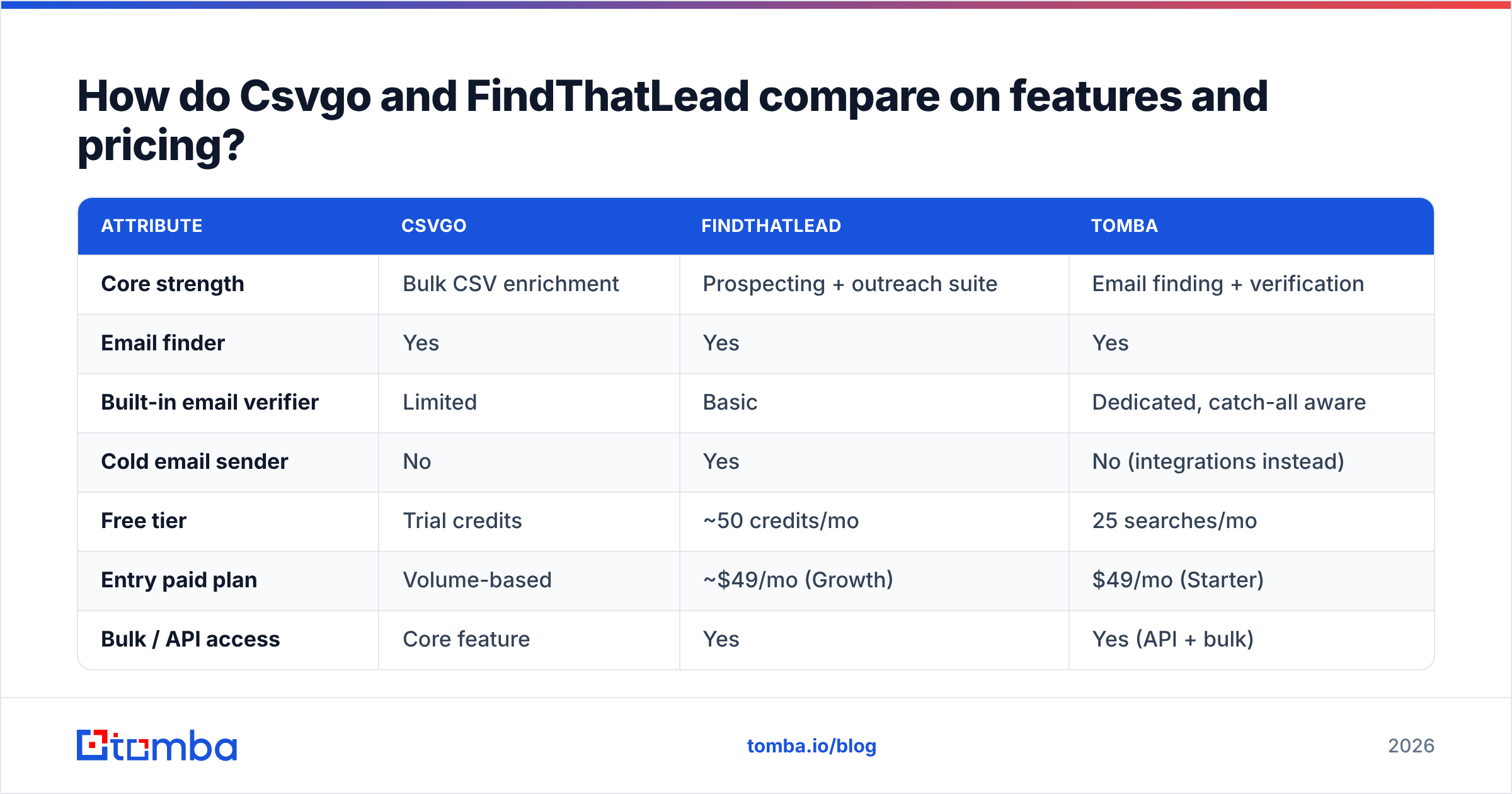
| Attribute | Csvgo | FindThatLead | Tomba |
|---|---|---|---|
| Core strength | Bulk CSV enrichment | Prospecting + outreach suite | Email finding + verification |
| Email finder | Yes | Yes | Yes |
| Built-in email verifier | Limited | Basic | Dedicated, catch-all aware |
| Cold email sender | No | Yes | No (integrations instead) |
| Free tier | Trial credits | ~50 credits/mo | 25 searches/mo |
| Entry paid plan | Volume-based | ~$49/mo (Growth) | $49/mo (Starter) |
| Bulk / API access | Core feature | Yes | Yes (API + bulk) |
| Best for | Data / RevOps teams | Solo SDRs & small teams | Accuracy-focused prospecting |
A few things stand out. FindThatLead's bundled sender is genuinely useful if you're a one-person outbound motion and want fewer logins. But bundling outreach into the same tool means your deliverability is tied to their sending infrastructure — and if you're serious about inbox placement, you'll likely want dedicated warmup and sender reputation controls anyway.
Csvgo's volume pricing is efficient when you're enriching thousands of rows, but the cost-per-credit story only makes sense above a certain scale. For occasional list cleanups, you may pay for capacity you never touch.
Which is more accurate: Csvgo or FindThatLead?#
Accuracy is where "it depends" earns its keep — and where you should demand evidence, not marketing claims.
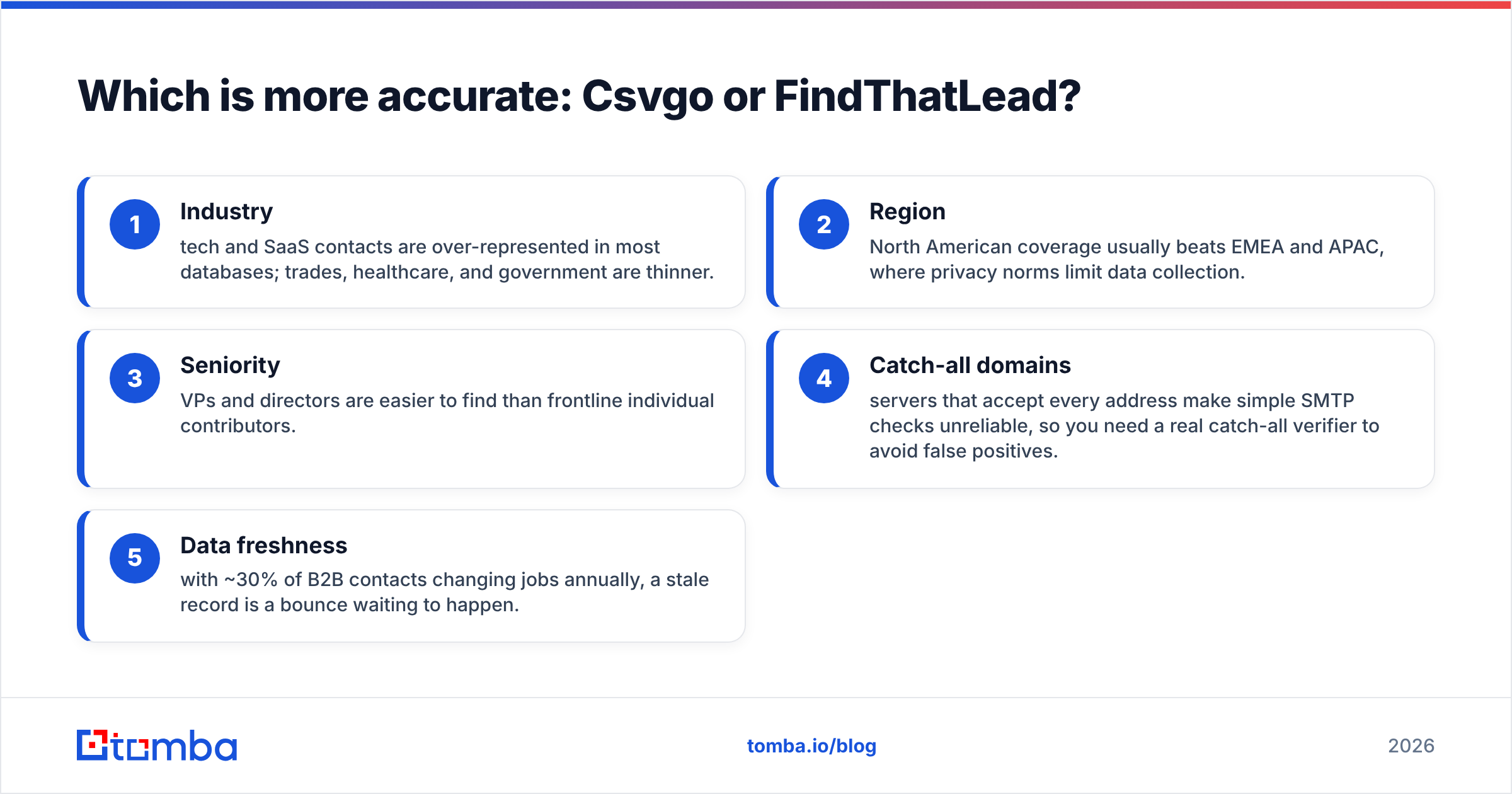
Neither Csvgo nor FindThatLead publishes a continuously audited, third-party verification rate. Self-reported accuracy numbers from any vendor are best treated as a ceiling under ideal conditions, not what you'll see on your niche list of manufacturing CFOs in the DACH region. Real-world find-rate and bounce-rate swing hard based on:
- Industry — tech and SaaS contacts are over-represented in most databases; trades, healthcare, and government are thinner.
- Region — North American coverage usually beats EMEA and APAC, where privacy norms limit data collection.
- Seniority — VPs and directors are easier to find than frontline individual contributors.
- Catch-all domains — servers that accept every address make simple SMTP checks unreliable, so you need a real catch-all verifier to avoid false positives.
- Data freshness — with ~30% of B2B contacts changing jobs annually, a stale record is a bounce waiting to happen.
The most reliable comparison is the one you run yourself: take 200 known-good contacts, run them through each tool, and measure both find-rate and verified deliverability. Two tools can claim the same headline accuracy while one quietly leans on riskier catch-all guesses.

This is also why a dedicated finder-plus-verifier stack tends to win on cost-per-usable-email. A cheap credit that returns an unverifiable address isn't cheap — it's a future bounce that dings your domain reputation and your email deliverability.
When should you choose Csvgo?#
Pick Csvgo when your workflow is fundamentally spreadsheet-shaped.
- You regularly enrich large lists — thousands of rows at a time — rather than researching one prospect at a time.
- Your team lives in CSV exports from a CRM or event platform and needs to append emails and firmographics in bulk.
- You care more about throughput and data appending than about running outreach from the same tool.
- You have the volume to make credit-based pricing efficient.
Csvgo is the better mental fit for a RevOps or data operations role where the deliverable is a clean, enriched file handed to the sales team — not a sent campaign. If that's you, its focus is a feature, not a limitation.
When should you choose FindThatLead?#
Pick FindThatLead when you want the fewest possible tools in your stack.
- You're a solo founder or small team running outbound without a dedicated ops person.
- You value discovering a lead and emailing them in one dashboard over best-in-class accuracy on either step.
- You do a lot of domain-based and social prospecting and want a lightweight "find leads by company" flow.
- Your volumes are modest enough that the bundled sender covers your sending needs.
The convenience is real. Just go in clear-eyed that an all-in-one suite trades peak performance in each category for the comfort of a single login and invoice. If your outbound scales, you'll probably outgrow the bundled sender before you outgrow the finder.
Is there a better alternative to both?#
For teams whose top priority is accuracy and cost-per-verified-email, a specialist tool is worth a serious look before you default to either suite.
Tomba focuses narrowly on the thing both Csvgo and FindThatLead do as one feature among many: finding and verifying professional email addresses. That specialization shows up in a few concrete places.
- Verification is native, not bolted on. Every found address can run through a real-time email verification step, including catch-all handling, so you're measuring deliverable emails — not raw guesses.
- Transparent, flat pricing. A free tier with 25 searches, then Starter at $49/mo, Growth at $99/mo, and Pro at $249/mo — no volume-tier guessing games.
- Bulk and API when you need scale. The same accuracy is available through bulk processing and a developer-friendly email finder API, so it fits both spreadsheet and pipeline workflows.
- It plays nice with your stack. Instead of locking you into one sender, Tomba connects to your CRM and outreach tools via native integrations, so you keep control of deliverability.

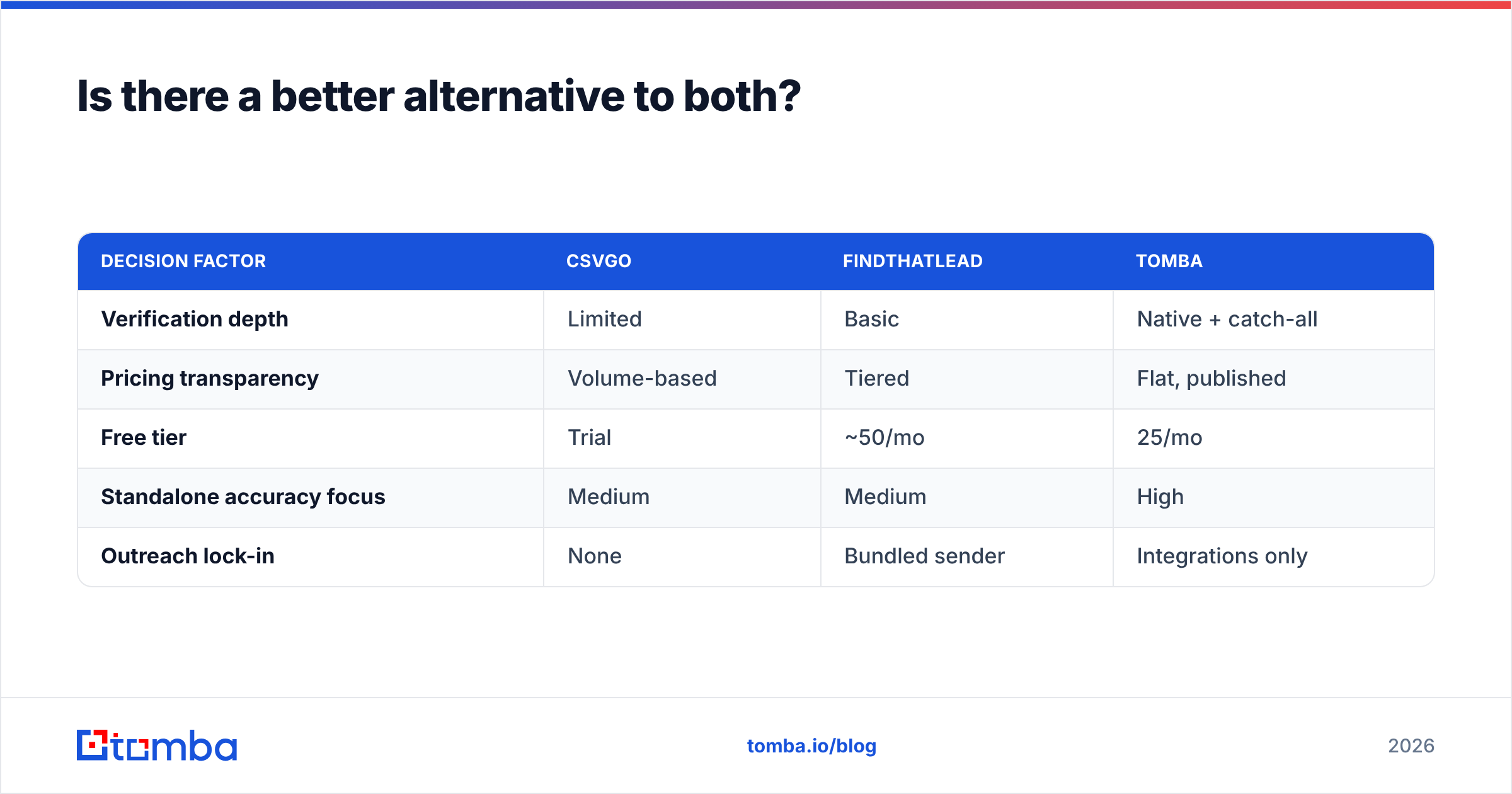
Here's how the three stack up on the dimensions that actually move your bounce rate and your budget.
| Decision factor | Csvgo | FindThatLead | Tomba |
|---|---|---|---|
| Verification depth | Limited | Basic | Native + catch-all |
| Pricing transparency | Volume-based | Tiered | Flat, published |
| Free tier | Trial | ~50/mo | 25/mo |
| Standalone accuracy focus | Medium | Medium | High |
| Outreach lock-in | None | Bundled sender | Integrations only |
None of this makes Csvgo or FindThatLead a bad choice — they're solid tools that win for the specific buyers described above. It just means "email finder" is not one product category. Match the tool to the job, and verify accuracy on your own data before you commit.
How to actually decide (a 3-step test)#
Don't buy on a features grid alone. Run a controlled bake-off:
- Build a truth set. Collect 100–200 contacts you already have verified, correct emails for. Spread them across the industries and regions you actually sell into.
- Run all three on their free or trial tiers. Measure two numbers per tool: find-rate (did it return an address?) and accuracy (did the address match your known-good one, and did it pass verification?).
- Compute cost-per-verified-email, not cost-per-credit. Divide the plan price by the count of addresses that were both found and verified. That number, on your data, is the only comparison that matters.
Most buyers who run this test are surprised — the cheapest headline price rarely produces the cheapest usable contact once bounces are stripped out. You can sanity-check reputations on independent review sites like G2 and Capterra, and read FindThatLead's own docs to confirm current limits, but let your own bake-off cast the deciding vote.
The bottom line#
Csvgo wins for bulk, spreadsheet-first enrichment at volume. FindThatLead wins for solo SDRs who want discovery and sending under one roof. Both are legitimate picks for those exact buyers.
But if your success metric is deliverable emails — the ones that land, get replies, and don't torch your domain reputation — accuracy and native verification should outrank bundled convenience. That's the case for testing a dedicated finder alongside them.
Start free and run the 200-contact bake-off yourself: find email addresses with Tomba Email Finder, verify them in the same workflow, and compare cost-per-verified-email against Csvgo and FindThatLead on your own list. Twenty-five free searches is enough to prove the difference before you spend a dollar.
Related guides#
Ready to find emails that actually work?
Join 150,000+ professionals who stopped guessing and started sending. Free credits on signup — no credit card required.
Get the Tomba newsletter
Practical outbound tactics and product updates — once every two weeks.
About the author