CSVGo vs ReachStream (2026): Which B2B Data Tool Wins?
CSVGo and ReachStream both promise fresh B2B contact data at low prices, but they win at very different things. Here is an honest, side-by-side breakdown to help you pick the right one.
Choosing between two B2B contact-data vendors usually comes down to one uncomfortable question: which list is less wrong? CSVGo and ReachStream both sell affordable access to millions of business contacts, and both claim high accuracy. But they solve the problem in different ways, and paying for the wrong model can quietly wreck your deliverability and your quota.
This is a neutral, side-by-side look at CSVGo vs ReachStream in 2026: what each one is, how their data and pricing differ, where each wins, and when a real-time finder like Tomba is the smarter buy.
TL;DR: CSVGo vs ReachStream in one screen#
- CSVGo is a bulk-export, credit-light platform built for cheap, high-volume list building. Best when you need thousands of rows fast and will verify them yourself.
- ReachStream is a subscription B2B database with a cleaner UI, segmentation filters, and included contact enrichment. Best for teams that want a self-serve database instead of raw CSV dumps.
- Accuracy is the real differentiator. Static databases decay 2 to 3% per month, so both lists go stale between refreshes. Neither verifies at the moment you send.
- Pricing favors CSVGo on raw cost-per-record; ReachStream feels more polished but locks value behind annual tiers.
- If bounce rate is your KPI, pair either tool with real-time verification, or skip the static list entirely and use an on-demand email finder that validates before you export.
What are CSVGo and ReachStream?#
CSVGo positions itself as a low-cost B2B data marketplace. You filter by industry, title, geography, or company size, then export the matching contacts as a CSV. The pitch is volume and price: get a lot of rows for very little money, and do your own cleanup downstream. That model appeals to agencies and high-volume outbound teams who treat data as a raw commodity.
ReachStream is closer to a traditional contact-database SaaS. You log into a dashboard, build a segment with filters, preview counts, and pull contacts with firmographic and (sometimes) technographic detail attached. It leans on the "unified profile" idea: one record with email, phone, company, and role, refreshed on the vendor's schedule. You can read real user impressions on G2 and Capterra before committing, which is worth doing for any data vendor.
The core distinction: CSVGo optimizes for cheap bulk export, ReachStream optimizes for a searchable, enriched database experience. Both are static — they sell you a snapshot of data that was verified at some point in the past, not at the moment you hit send.
How do CSVGo and ReachStream compare on features and pricing?#
Here is the side-by-side. Treat exact prices as directional — data vendors change tiers often and gate the best rates behind sales calls and annual commitments.
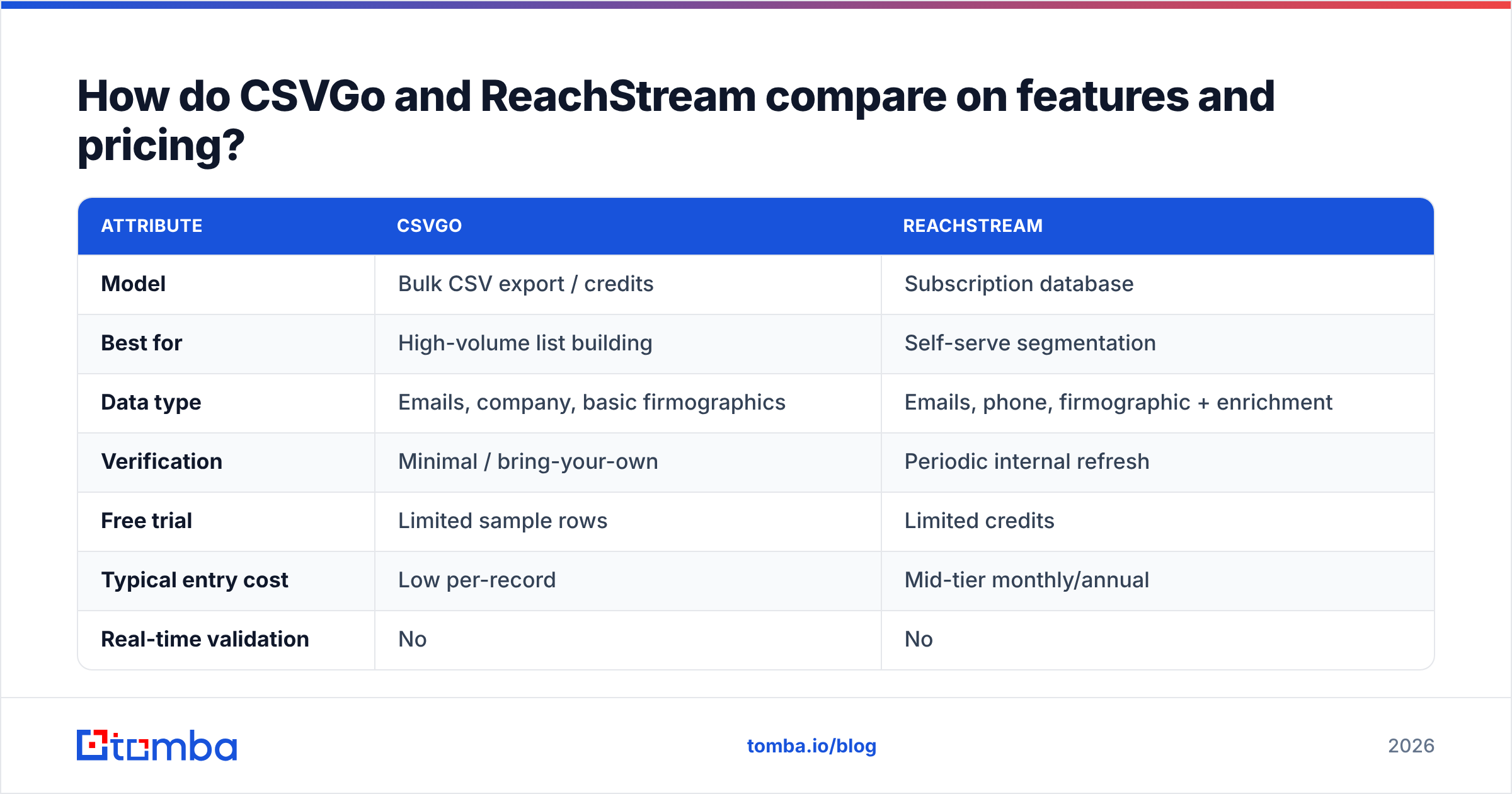
| Attribute | CSVGo | ReachStream |
|---|---|---|
| Model | Bulk CSV export / credits | Subscription database |
| Best for | High-volume list building | Self-serve segmentation |
| Data type | Emails, company, basic firmographics | Emails, phone, firmographic + enrichment |
| Verification | Minimal / bring-your-own | Periodic internal refresh |
| Free trial | Limited sample rows | Limited credits |
| Typical entry cost | Low per-record | Mid-tier monthly/annual |
| Real-time validation | No | No |
| API access | Limited | Available on higher tiers |
Two things stand out. First, neither platform validates an address at export time — both hand you data that was correct on some earlier date. Second, the "cheaper" option is not automatically cheaper once you factor in wasted sends. A $0.02 record that bounces costs you far more than two cents in domain reputation.

Which has better data accuracy?#
Accuracy is where this comparison actually gets decided, and it is where both tools share the same structural weakness.
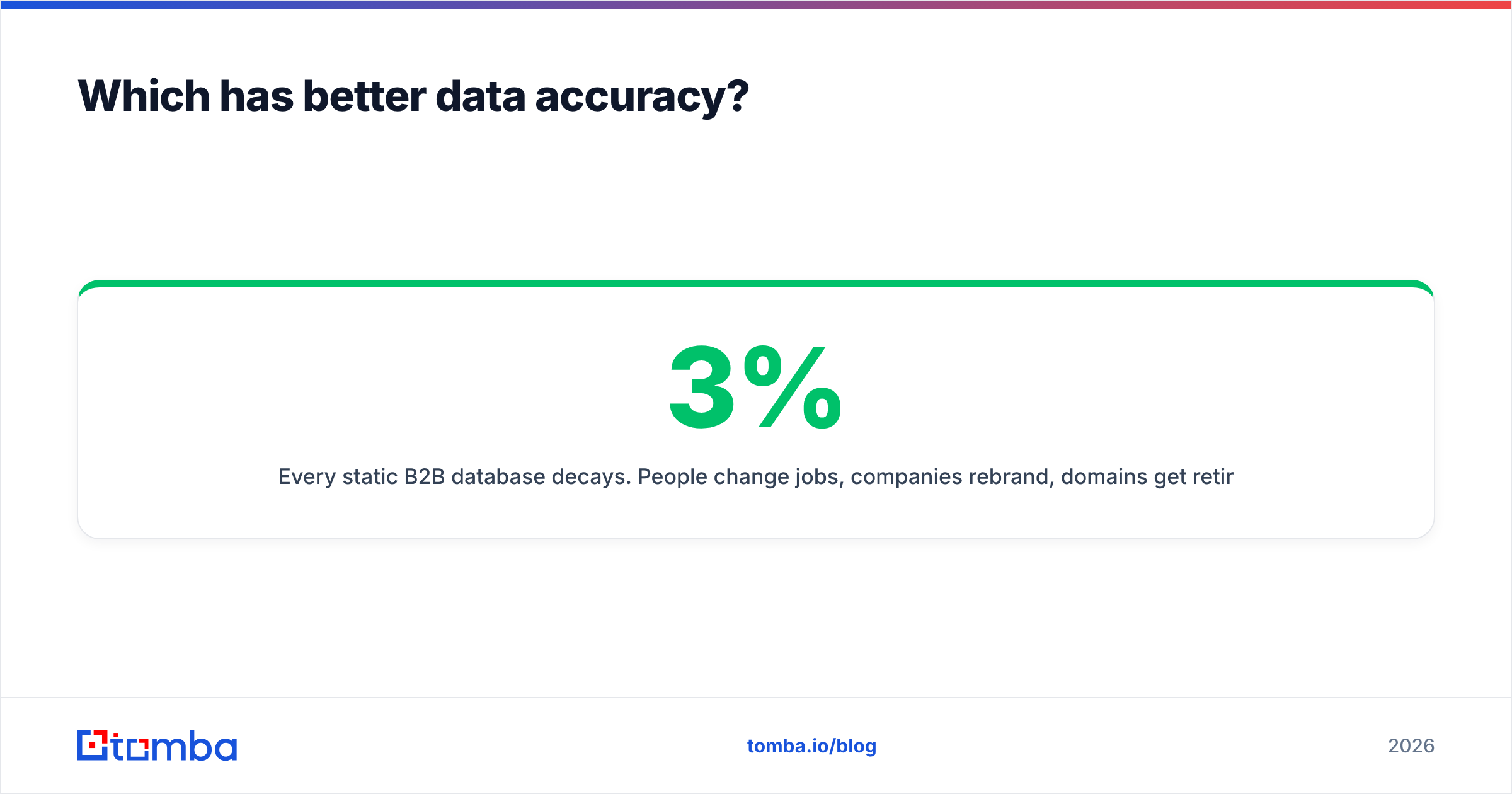
Every static B2B database decays. People change jobs, companies rebrand, domains get retired, and inboxes get deactivated. Industry estimates put B2B contact-data decay at roughly 2 to 3% per month — meaning a list that was 95% accurate at export can drift below 80% within six months. CSVGo and ReachStream both refresh on their own cadence, so the freshness you get depends entirely on when a given record was last touched, not when you download it.
The practical differences:
- CSVGo leans on breadth and low cost. You get a lot of rows, but the burden of cleaning them is yours. Expect to run every export through an email verifier before sending.
- ReachStream invests more in a maintained profile and periodic re-verification, so its lists often feel cleaner out of the box. But "periodically refreshed" is not "verified right now."
- Catch-all domains trip up both. Neither reliably tells you whether a catch-all address will actually accept mail, which is exactly where a dedicated catch-all verifier earns its keep.
- Phone and enrichment fields decay even faster than email in some segments, so treat any bundled phone number as a lead, not a fact.
The honest verdict on accuracy: ReachStream usually ships a tidier list, CSVGo usually ships a cheaper one, and both still need a verification layer before they touch your sending domain.
What about deliverability and verification?#
Deliverability is the silent tax on cheap data. Mailbox providers judge your domain by how often you hit dead addresses, spam traps, and complaints. Send to a stale list and you don't just lose those contacts — you lower inbox placement for the good addresses too. If you want the mechanics, the email deliverability fundamentals are worth a read.
Here is how to de-risk either tool before you scale sends:
- Verify at send-time, not export-time. Re-check the address the day you email it, not the day the vendor built the record.
- Segment out catch-alls and role accounts.
info@,sales@, and unknown catch-all domains inflate your risk profile. - Warm up gradually. A fresh domain blasting a 10,000-row static export is a bounce disaster waiting to happen.
- Watch your bounce rate like a hawk. Above 2 to 3% and providers start throttling you.
- Enrich, then re-verify. If you append data with a tool like contact enrichment, validate the new fields too.
The takeaway: whether you buy CSVGo or ReachStream, the deliverability outcome is mostly determined by your verification discipline, not the vendor's marketing accuracy number.
Which is better for which use case?#
Match the tool to the job instead of chasing a single "winner."
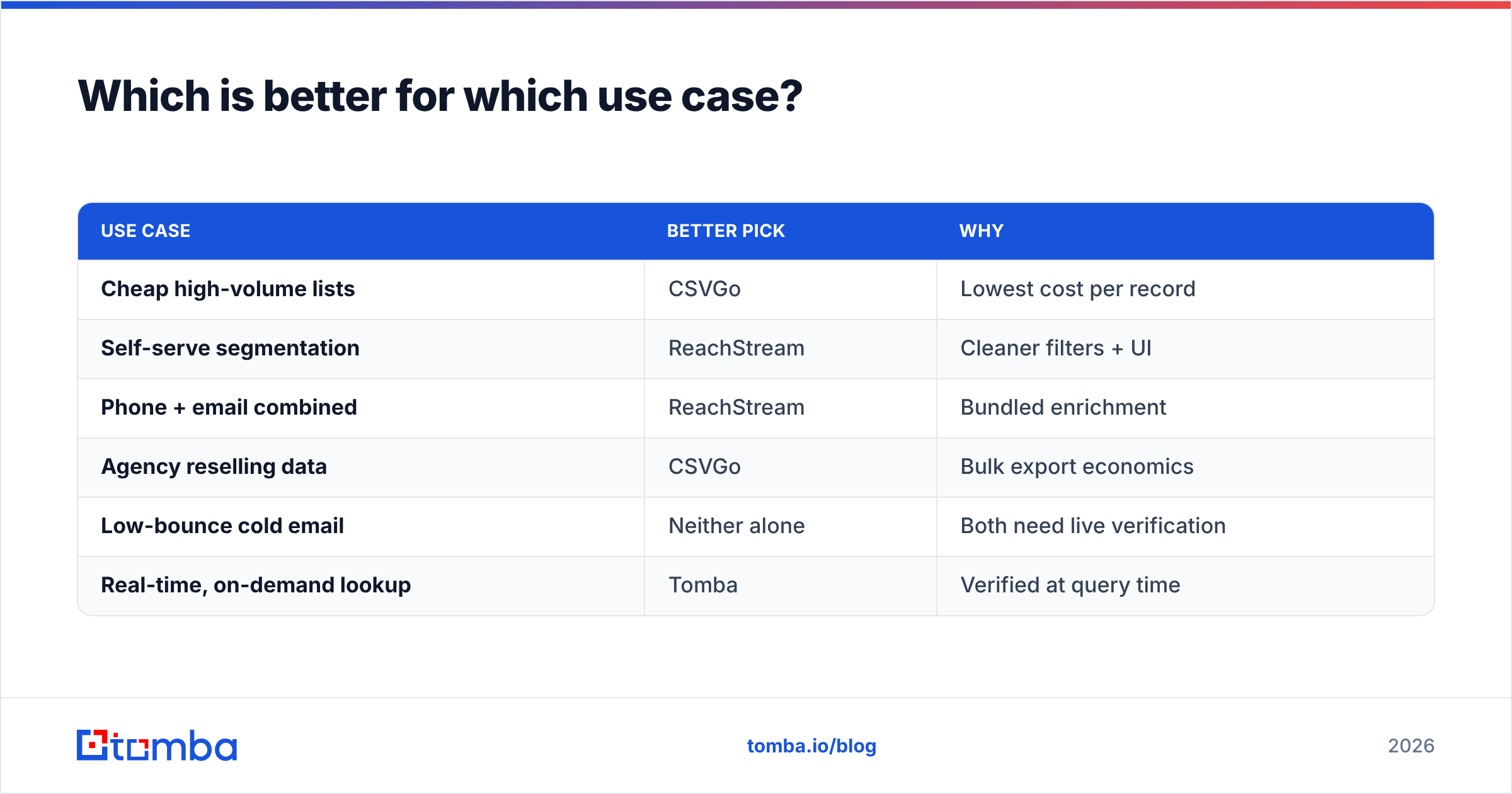
| Use case | Better pick | Why |
|---|---|---|
| Cheap high-volume lists | CSVGo | Lowest cost per record |
| Self-serve segmentation | ReachStream | Cleaner filters + UI |
| Phone + email combined | ReachStream | Bundled enrichment |
| Agency reselling data | CSVGo | Bulk export economics |
| Low-bounce cold email | Neither alone | Both need live verification |
| Real-time, on-demand lookup | Tomba | Verified at query time |
If your workflow is "download 5,000 rows, run my own scrubbing, load into a sequencer," CSVGo's economics are hard to beat. If your workflow is "log in, build a segment, hand it to an SDR," ReachStream's experience is smoother. But if your KPI is reply rate on a clean domain, the static-list model itself is the bottleneck.
Is there a better alternative to static B2B databases?#
Yes — for many teams, the better move is to stop buying snapshots and start querying live. That is the gap Tomba fills.
Instead of downloading a pre-built list that started decaying the moment it was created, Tomba's email finder resolves a professional address from a name and domain (or a full company via domain search) and verifies it against the mail server at query time. You get the address and its deliverability status in the same call, which is exactly the verification layer CSVGo and ReachStream leave to you.
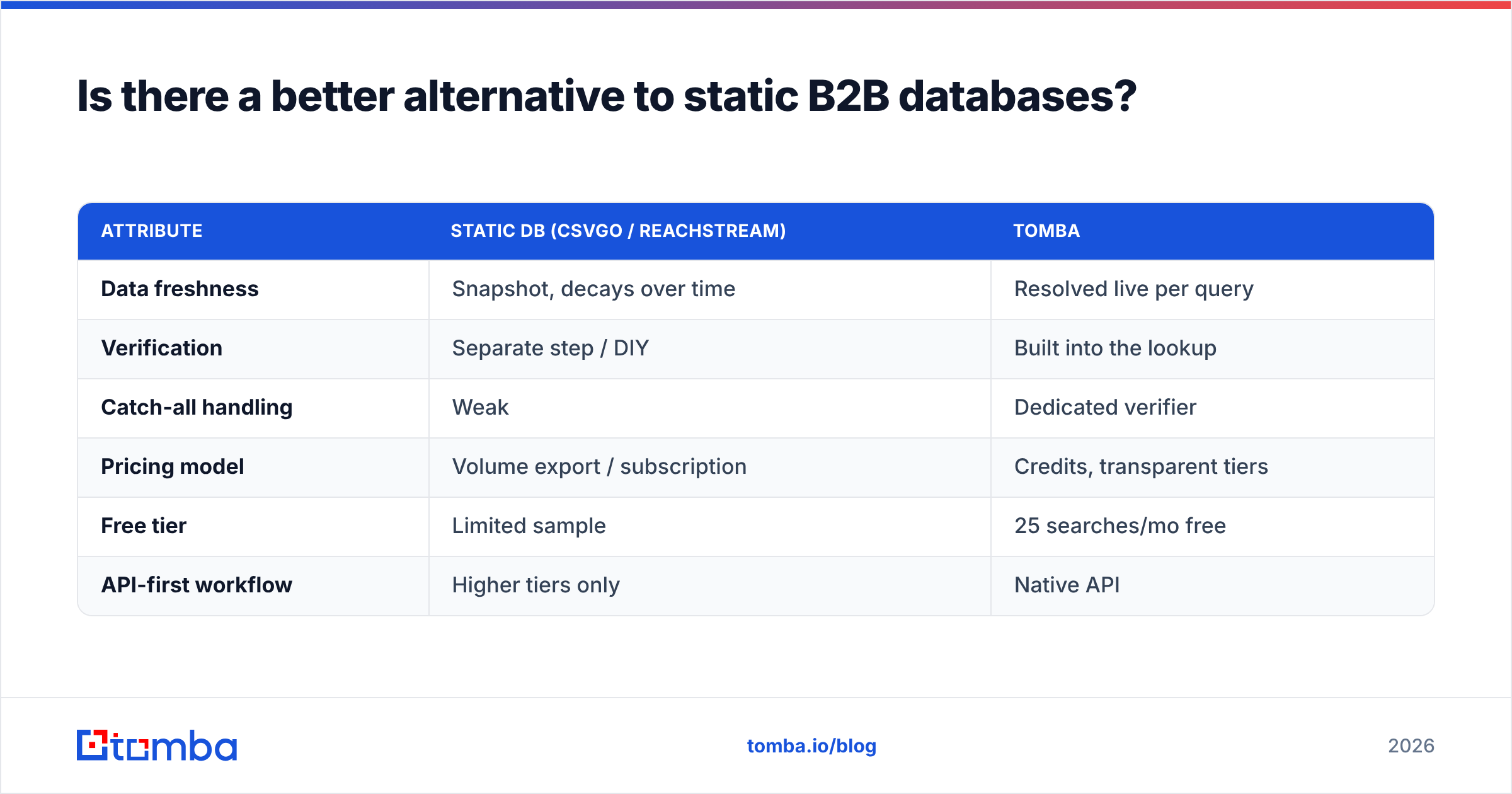
How Tomba compares in principle to the static model:
| Attribute | Static DB (CSVGo / ReachStream) | Tomba |
|---|---|---|
| Data freshness | Snapshot, decays over time | Resolved live per query |
| Verification | Separate step / DIY | Built into the lookup |
| Catch-all handling | Weak | Dedicated verifier |
| Pricing model | Volume export / subscription | Credits, transparent tiers |
| Free tier | Limited sample | 25 searches/mo free |
| API-first workflow | Higher tiers only | Native API |
Tomba's pricing starts free (25 searches per month), then Starter at $49/mo, Growth at $99/mo, and Pro at $249/mo, with an Enterprise tier for high volume. The point is not that Tomba is always cheaper per raw record — a bulk marketplace like CSVGo can win on sticker price. The point is cost per usable, deliverable contact, where verified-at-query-time data usually comes out ahead once you price in bounces and burned domain reputation.
To be fair to the static model: if you genuinely need a large, browsable database to slice by firmographics and you have a solid verification pipeline of your own, a subscription tool like ReachStream still has a legitimate place. Different jobs, different tools.
CSVGo vs ReachStream: the verdict#
- Pick CSVGo if price-per-record is your top constraint, you buy in volume, and you already run your own verification and scrubbing.
- Pick ReachStream if you want a polished, self-serve database with segmentation and bundled enrichment, and you are comfortable on a subscription tier.
- Pick a real-time finder if your success metric is low bounce rate and high reply rate — because no static export, however cheap or polished, is verified at the moment you send.
Both CSVGo and ReachStream are reasonable tools for what they are. The mistake is expecting a static snapshot to behave like live, verified data. It won't, and your bounce rate will tell you so.
Ready to stop buying stale lists?#
If deliverability is what actually keeps you up at night, skip the guesswork of decaying exports. Try the Tomba Email Finder — find professional emails by name, company, or domain, verified at query time, with 25 free searches a month to test it against your own targets. Run a batch of your hardest-to-reach prospects through it, compare the bounce rate to your last static list, and let the numbers decide.
FAQ#
Is CSVGo or ReachStream more accurate? ReachStream generally ships a cleaner list thanks to its maintained profiles and periodic refresh, while CSVGo trades polish for a lower price. Both are static, so both decay between refreshes and both benefit from live verification before you send.
Which is cheaper, CSVGo or ReachStream? CSVGo usually wins on raw cost per record because of its bulk-export model. ReachStream costs more but includes a segmentation UI and enrichment. Factor in wasted sends before deciding which is truly cheaper.
Do I still need an email verifier with these tools? Yes. Neither validates addresses at export time, so run every list through an email verifier and re-check right before you send to protect your sender reputation.
What is the best alternative to CSVGo and ReachStream? For low-bounce cold outreach, a real-time tool like Tomba resolves and verifies addresses on demand instead of selling a decaying snapshot, which many teams find lowers cost per deliverable contact.
Related guides#
Ready to find emails that actually work?
Join 150,000+ professionals who stopped guessing and started sending. Free credits on signup — no credit card required.
Get the Tomba newsletter
Practical outbound tactics and product updates — once every two weeks.
About the author