CSVGO vs Seamlessai: Which B2B Data Tool Wins in 2026?
CSVGO sells bulk lead CSVs; Seamless.AI streams real-time contacts. We compare accuracy, pricing, export limits, and workflow fit—plus a cheaper, verify-first pick for 2026.
Choosing between CSVGO vs Seamlessai comes down to one question: do you want a pile of leads dumped into a spreadsheet, or a live database you query one contact at a time? Both promise B2B contact data. They deliver it in almost opposite ways. The right answer depends on how your team actually prospects.
This is a neutral breakdown. We'll show where each tool wins and where each one quietly costs you. We'll also explain why a verify-first email finder often beats both on the metric that matters most: how many of your emails actually land.
TL;DR: CSVGO vs Seamlessai at a glance#
- CSVGO is a bulk list marketplace. You filter, buy, and download large CSV exports of B2B leads with pay-as-you-go credits. It's fast for volume but weaker on freshness.
- Seamless.AI is a real-time search engine plus Chrome extension. You look up contacts live, one company or person at a time, on a seat-and-credit plan.
- Accuracy is the deciding factor. Bulk lists decay fast. Real-time lookups are fresher, but they burn credits and can miss direct emails.
- Pricing clarity differs sharply. CSVGO shows credit costs upfront. Seamless.AI is quote-based and hard to pin down.
- The pragmatic pick for most cold-email teams is a verify-first finder like Tomba. It starts at a public $49/mo, and you find and validate before you ever hit send.
What is CSVGO?#
CSVGO is a B2B lead-list provider. You define an audience by industry, job title, company size, and geography. It then returns a downloadable CSV of matching contacts. Each row has names, emails, company data, and sometimes phone numbers. You pay per record or per credit pack, so the model rewards buying in bulk.
Think of it like a wholesale warehouse. You walk in with a shopping list, grab a pallet of leads, and walk out. That works when you need 5,000 contacts for a campaign tomorrow. But warehouse stock ages. Job titles change, people leave, and domains get retired. A CSV frozen at purchase time can't tell you which rows went stale last week.
For teams that live in spreadsheets and CRMs, that flat-file simplicity is a feature. For teams that care about email deliverability, the catch is clear: there's no verification at send time.
What is Seamless.AI?#
Seamless.AI is a real-time sales intelligence platform. Instead of handing you a static file, it searches the web live to build contact records on demand. You use its web app and a Chrome extension that overlays LinkedIn and company sites. You burn credits as you reveal emails and phone numbers.
The pitch is freshness. Because lookups happen in the moment, the data should be more current than a pre-built list. In practice, a real-time scrape is only as good as its sources. Reviewers on G2 call Seamless.AI strong on volume and coverage. But they find it inconsistent on direct-dial numbers and personal emails. Credits also run out fast during heavy prospecting, which pushes teams toward larger seats.

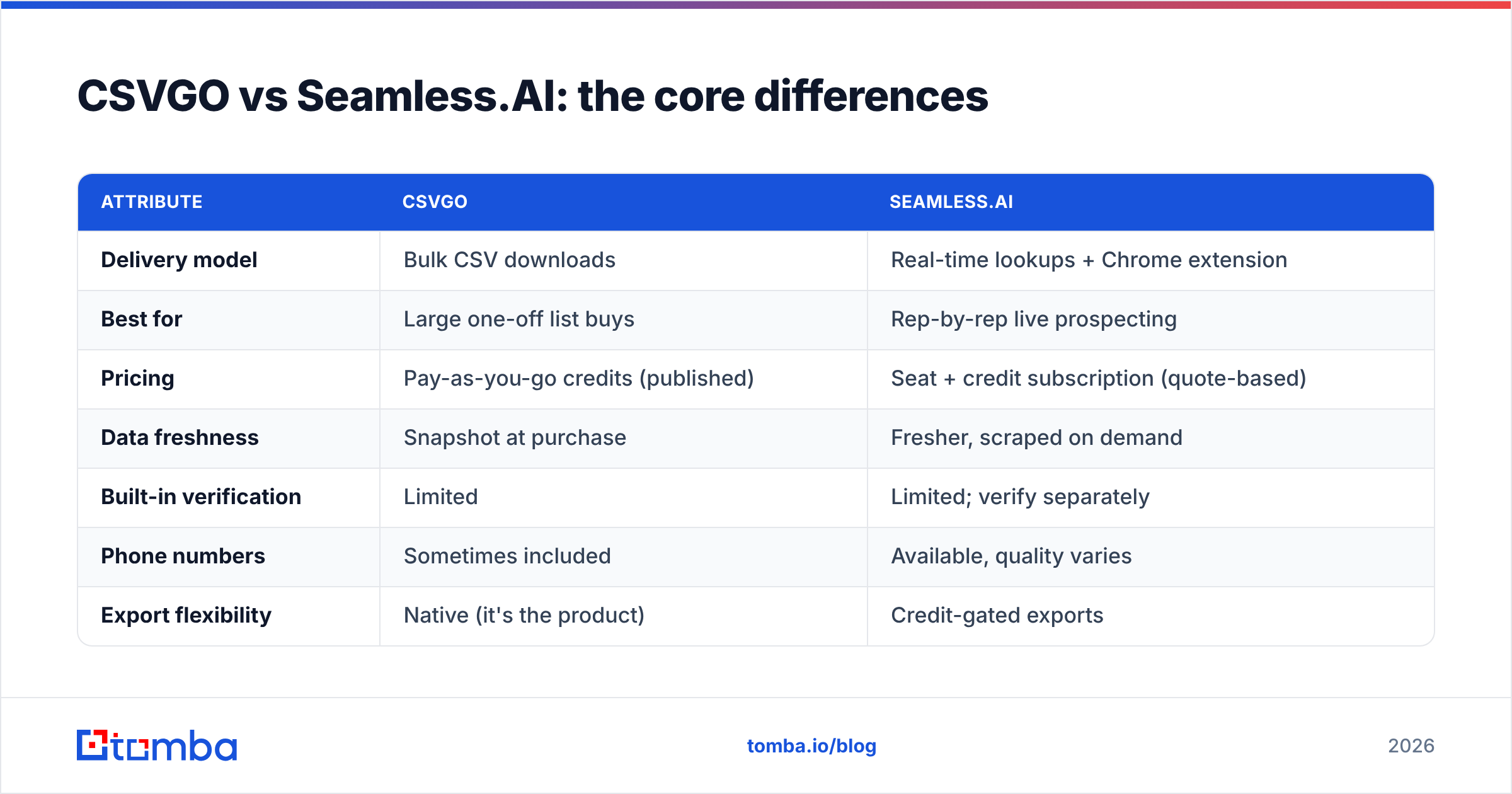
CSVGO vs Seamlessai: the core differences#
The two tools sit at opposite ends of the data spectrum. One is built for batch volume. The other is built for on-demand precision. Here's how that plays out across the traits that change your results.
| Attribute | CSVGO | Seamless.AI |
|---|---|---|
| Delivery model | Bulk CSV downloads | Real-time lookups + Chrome extension |
| Best for | Large one-off list buys | Rep-by-rep live prospecting |
| Pricing | Pay-as-you-go credits (published) | Seat + credit subscription (quote-based) |
| Data freshness | Snapshot at purchase | Fresher, scraped on demand |
| Built-in verification | Limited | Limited; verify separately |
| Phone numbers | Sometimes included | Available, quality varies |
| Export flexibility | Native (it's the product) | Credit-gated exports |
| Learning curve | Minimal (download + import) | Moderate (extension + workflow) |
Notice the pattern. Neither tool leads with accuracy at the moment of send. CSVGO gives you volume that decays. Seamless.AI gives you freshness that costs credits and still needs a check before you trust it in a cold sequence. That gap is exactly where a dedicated finder-plus-email verifier earns its place.
Is CSVGO or Seamless.AI more accurate?#
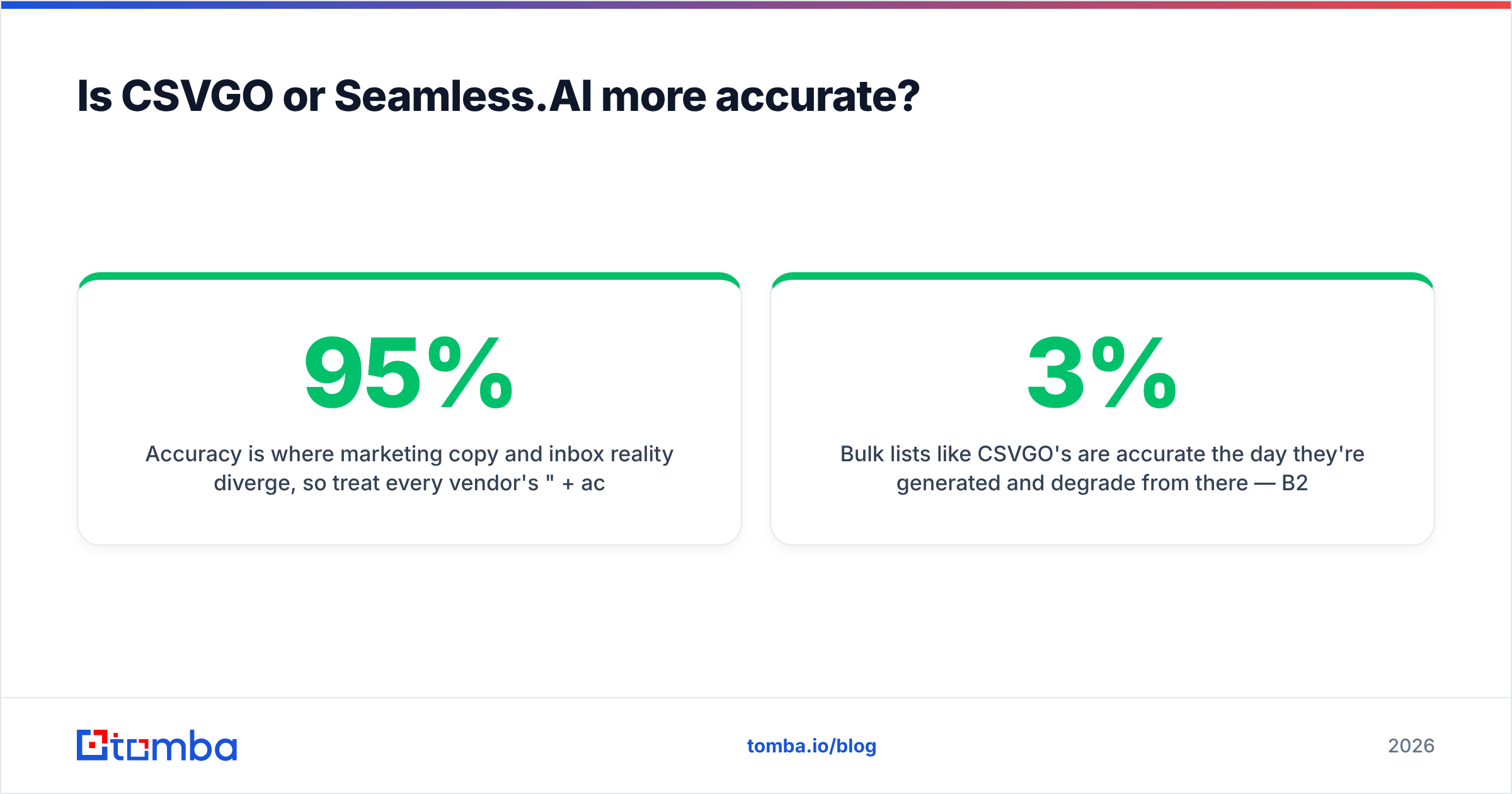
Accuracy is where marketing copy and inbox reality split. So treat every vendor's "95%+ accurate" claim as a guess, not a fact. The honest answer depends on recency and verification, not on which brand you pick.

Bulk lists like CSVGO's are accurate the day they're built. After that, they decay. B2B data goes bad by roughly 2–3% per month as people switch jobs. So a quarter-old file can be 8–10% dead before you send a single email. Real-time tools like Seamless.AI slow that decay by looking data up fresh. But a "fresh scrape" is not the same as a "verified deliverable." A newly found address that fails an SMTP check still bounces. It still hurts your sender reputation.
The only reliable path to accuracy is a two-step habit:
- Find the address. Either tool can do this.
- Verify it right before it enters a sequence. That means an SMTP check, catch-all detection, and syntax and MX validation.
Tools that fold verification into the find step close the window where data goes stale. That's the structural edge of a verify-first finder over both a list marketplace and a real-time lookup engine.
How do CSVGO and Seamless.AI pricing compare?#
Pricing philosophy is the clearest difference between them.
CSVGO publishes credit-based, pay-as-you-go rates. You can estimate cost per lead before you commit. That's handy for one-off campaigns and finance approvals. The risk is buying volume you never work through, or paying again to refresh a list that aged out.
Seamless.AI uses a seat-plus-credit plan and does not publish clear pricing. Plans are quote-based through sales. Reviewers on Capterra often flag credit limits, renewal terms, and upsell pressure. The real cost per verified contact can climb fast once credits run dry mid-month.
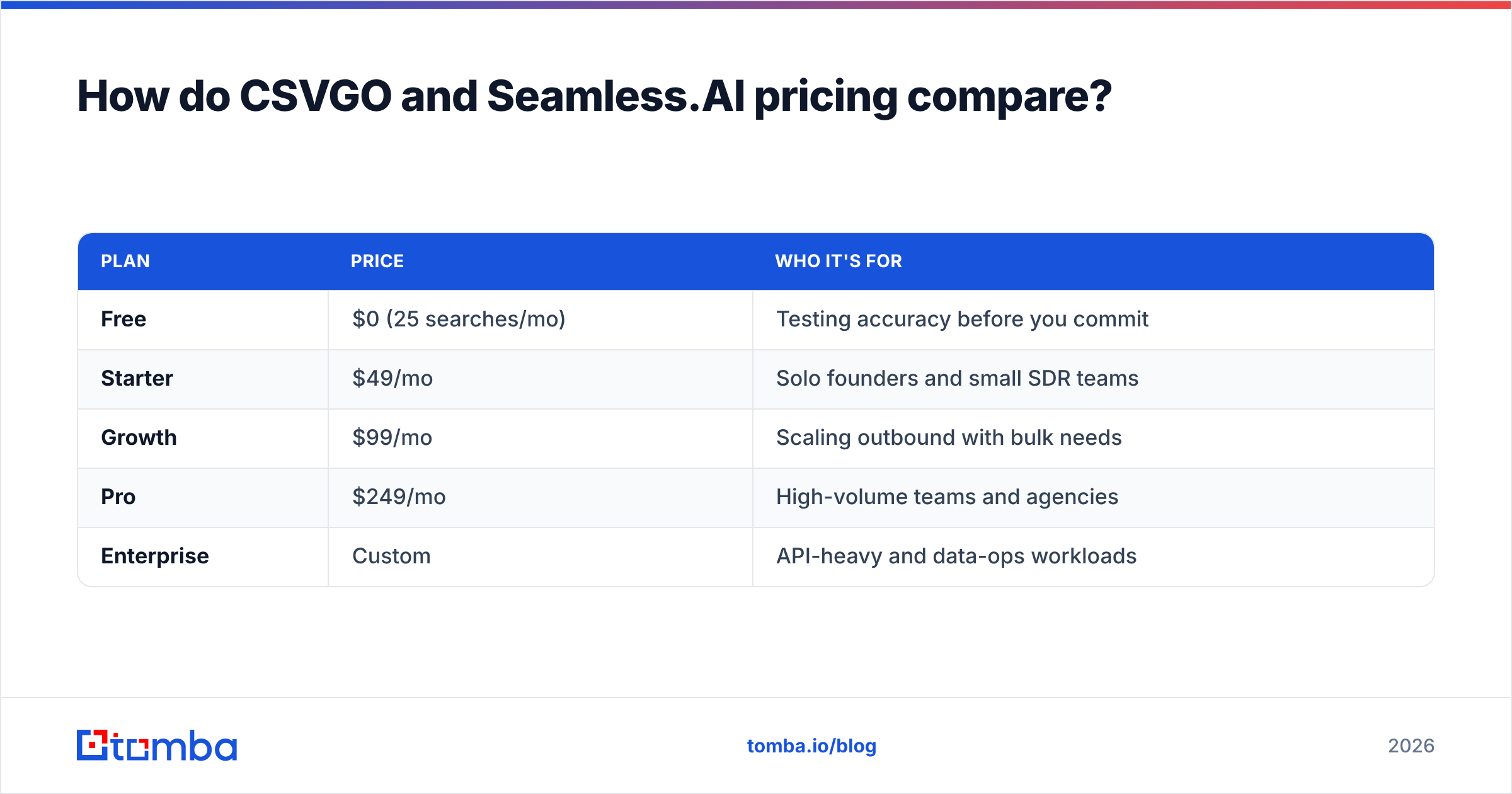
For comparison, a verify-first tool keeps pricing public and flat. Tomba pricing runs:
| Plan | Price | Who it's for |
|---|---|---|
| Free | $0 (25 searches/mo) | Testing accuracy before you commit |
| Starter | $49/mo | Solo founders and small SDR teams |
| Growth | $99/mo | Scaling outbound with bulk needs |
| Pro | $249/mo | High-volume teams and agencies |
| Enterprise | Custom | API-heavy and data-ops workloads |
The point isn't that cheaper always wins. It's that public, per-plan pricing lets you model cost per verified contact honestly. Neither an ad-hoc list buy nor a quote-gated plan makes that easy.
Which tool fits your workflow?#
Match the tool to how your team actually runs, not to the flashiest feature list.
- You need volume, fast, once. CSVGO's bulk export fills a spreadsheet quickly for one big push. Just verify the file before sending.
- Your reps prospect live inside LinkedIn. Seamless.AI's extension fits a rep-by-rep motion. Each SDR pulls contacts in the flow of research.
- You send cold email and watch your bounce rate. You want find and verify in one place, plus a bulk email finder and API access so the check isn't a separate, forgotten step.
- You run RevOps or enrichment at scale. You need clean data enrichment and programmatic access, not manual CSV juggling.
Most teams find their real bottleneck isn't finding contacts. Both categories do that well enough. The hard part is trusting the address enough to send without hurting deliverability. That reframes the whole comparison.
Where does a verify-first finder fit in?#
Between "a bulk list that decays" and "a real-time lookup you still have to check" sits a third model. You find the email and verify it in one motion, with clear pricing and a public accuracy benchmark.

That's the lane Tomba occupies. You can search by name, company, or domain with the email finder. You can run any result through the verifier. You can use domain search to pull every reachable address at a target company. All of this happens before a single email leaves your outbox. If you're weighing a switch, the Seamless.AI alternative breakdown maps the feature overlap directly.
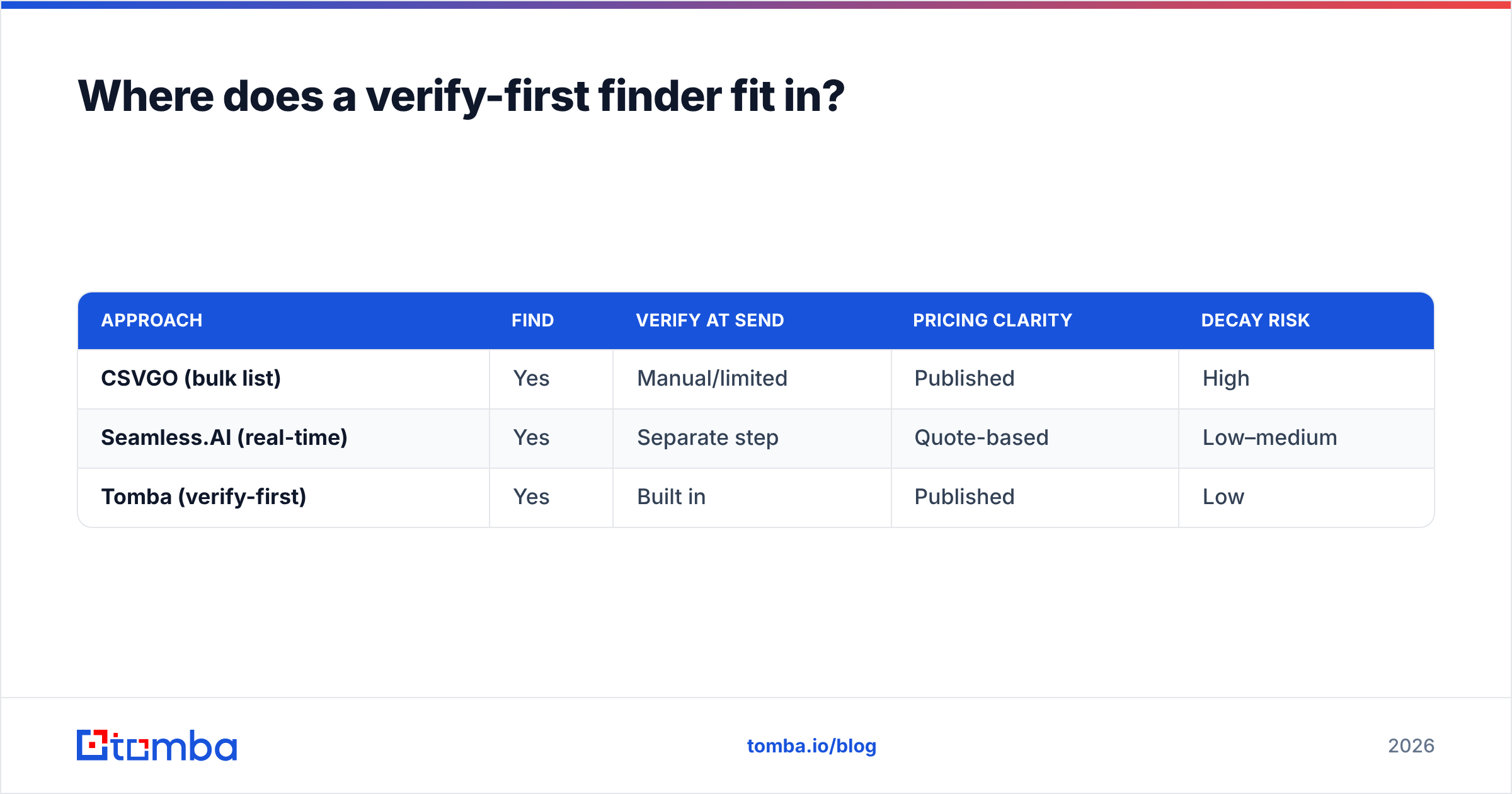
Here's how the three approaches compare on the thing that decides campaign ROI:
| Approach | Find | Verify at send | Pricing clarity | Decay risk |
|---|---|---|---|---|
| CSVGO (bulk list) | Yes | Manual/limited | Published | High |
| Seamless.AI (real-time) | Yes | Separate step | Quote-based | Low–medium |
| Tomba (verify-first) | Yes | Built in | Published | Low |
None of these tools is "bad." CSVGO is a fair way to buy volume. Seamless.AI is a capable real-time engine that many SDR teams like. The difference is where verification lives in your process: bolted on afterward, or baked in.
Frequently asked questions#
Is CSVGO better than Seamless.AI for cold email? For pure list volume, CSVGO is faster and cheaper per record. But cold email lives or dies on bounce rate. So whichever tool you choose, verify every address before sending. Neither makes verification automatic.
Does Seamless.AI include email verification? Seamless.AI focuses on finding contacts in real time. Strong at-send verification is best left to a dedicated verifier. Treat every scraped address as unverified until it passes an SMTP and catch-all check.
What's the cheapest reliable alternative to both? A verify-first finder with public pricing. Tomba starts free at 25 searches a month and moves to $49/mo. It lets you model cost per verified contact instead of guessing at quote-based credits.
Can I export leads to my CRM from all three? CSVGO exports natively as CSV. Seamless.AI exports are credit-gated. Tomba offers CSV plus HubSpot, Salesforce, and API-based integrations.
The verdict#
CSVGO wins on fast, clear bulk volume. Seamless.AI wins on real-time freshness inside a rep's live workflow. Both leave the same gap. You still have to verify the data yourself before it's safe to send. And one of them won't even tell you the price without a sales call.
If your priority is protecting deliverability while keeping costs predictable, skip the "list vs lookup" debate. Go find-and-verify in one place. Start with the free tier of the Tomba Email Finder. You get 25 searches a month, no card. Find your next 25 prospects, verify them on the spot, and compare the bounce rate against your current list. That one test tells you more than any vendor chart.
Related guides#
Ready to find emails that actually work?
Join 150,000+ professionals who stopped guessing and started sending. Free credits on signup — no credit card required.
Get the Tomba newsletter
Practical outbound tactics and product updates — once every two weeks.
About the author