CSVGo vs SMARTe: B2B Data Enrichment Compared for 2026
CSVGo and SMARTe both promise clean B2B contact data, but they solve different problems. Here's an honest, side-by-side breakdown of accuracy, pricing, and fit so you pick the right one.
Choosing between CSVGo and SMARTe usually comes down to one question: do you need a fast way to enrich lists you already have, or a full sales-intelligence database to build lists from scratch? They overlap enough to look interchangeable on a landing page, but they behave very differently once real data hits your CRM.
This guide breaks down both tools on accuracy, coverage, pricing model, and workflow fit — with no marketing gloss. By the end you'll know which one matches how your team actually prospects, and where a leaner, pay-for-what-you-use option fits in.
TL;DR: CSVGo vs SMARTe at a glance#
- CSVGo is built around CSV enrichment and bulk list cleanup — you bring the file, it fills in the gaps. Great for ops teams that live in spreadsheets.
- SMARTe is a sales-intelligence platform with a searchable database, strong on international phone and mobile coverage, especially outside North America.
- Accuracy on both is "good until the data ages" — neither replaces real-time email verification before you send.
- Pricing for both leans quote-based and seat-driven, which gets expensive as you scale seats or credits.
- If you want per-lookup control and pay-as-you-go pricing, a focused tool like Tomba's email finder covers the core email + enrichment job for less overhead.
What is CSVGo and who is it for?#
CSVGo positions itself as a data-enrichment engine for the file you already have. You upload a CSV of names, companies, or partial records, map the columns, and it appends missing fields — work emails, job titles, company size, LinkedIn URLs, and firmographics. The mental model is simple: it's a car wash for dirty lists. You drive in with a messy export from a webinar or a trade show, and drive out with something your SDRs can actually use.
That makes CSVGo a natural fit for revenue operations and marketing ops teams who inherit lists from events, form fills, and legacy databases. The strength is batch throughput — running thousands of rows through one enrichment pass without babysitting each lookup. The trade-off is that CSVGo is only as good as the input you give it. If your source file is thin (just a first name and a company), match rates drop, and you inherit whatever staleness lives in the underlying data.
Where CSVGo gets weaker is discovery. It's not designed to answer "give me every VP of Marketing at 500-person SaaS companies in Germany." For that you need a searchable database, which is exactly SMARTe's lane.

What is SMARTe and who is it for?#
SMARTe is a sales-intelligence platform: a searchable contact and company database with an emphasis on global coverage and mobile phone numbers. Reps use it to build target lists by filtering on title, industry, geography, headcount, and technographics, then push contacts into a CRM or sequencer. Its reputation is strongest in EMEA and APAC coverage, where many US-centric databases thin out.
If CSVGo is a car wash, SMARTe is closer to a parts warehouse — you go in knowing the specs of what you need and pull matching records off the shelf. That's powerful for outbound teams and account-based programs that start from an ideal customer profile rather than an existing list. It also layers in enrichment and a browser extension, so it competes with CSVGo on the "fill in my list" job while going further on the "find me new accounts" job.
The catch is the platform tax. A searchable database with international coverage is priced like enterprise software — seats, credit tiers, and annual commitments. Smaller teams often pay for breadth they never use. And like every static database, SMARTe's records decay: people change jobs, companies rebrand, and email formats shift. Coverage is a snapshot, not a live feed, which is why verification at send time still matters. You can read more on why decay hurts deliverability in Tomba's guide to email deliverability.
CSVGo vs SMARTe: the core comparison#
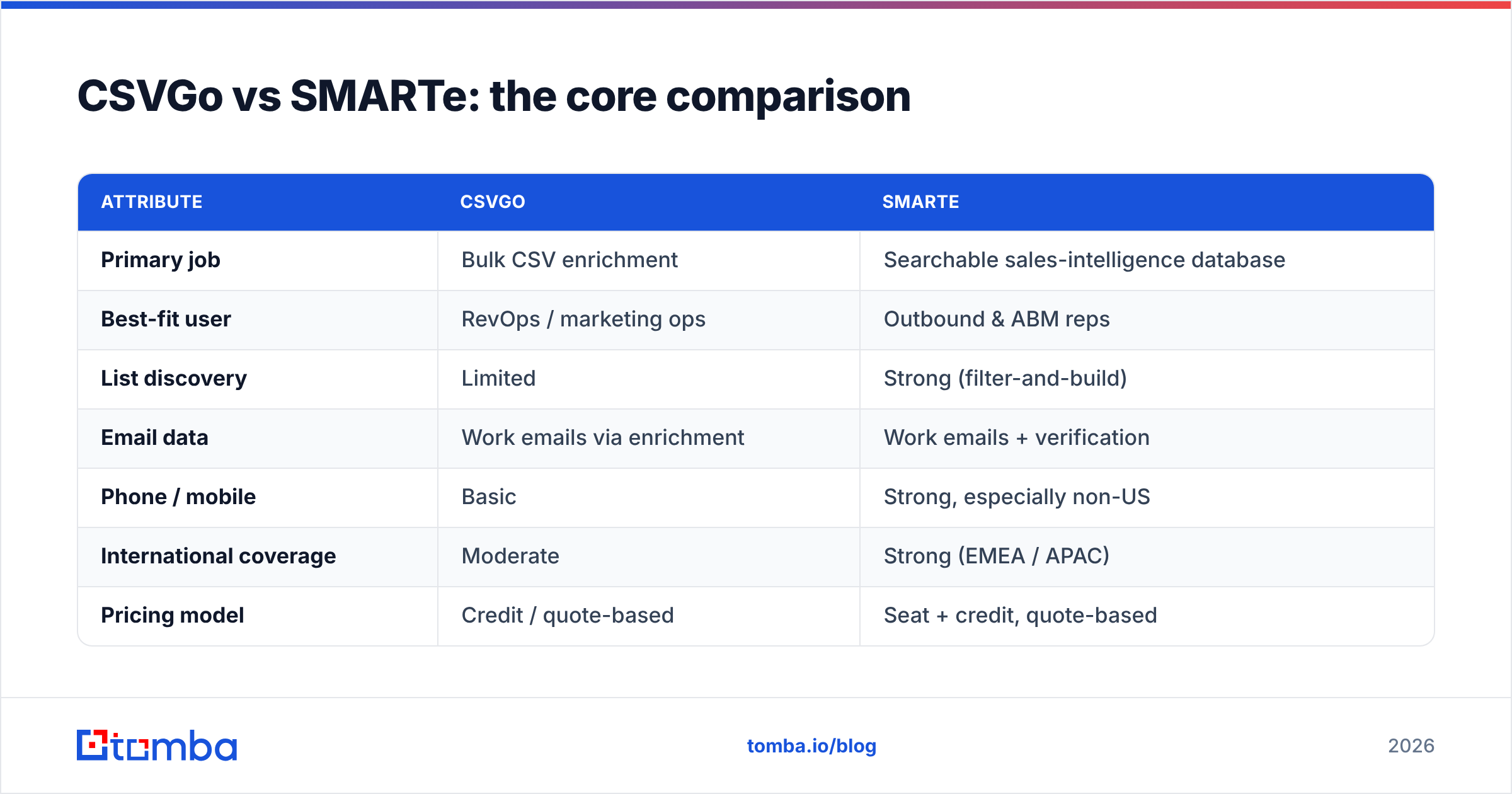
Here's how the two stack up on the attributes that actually change your results. Pricing is directional — both vendors lean toward custom quotes, so confirm current numbers directly before committing.
| Attribute | CSVGo | SMARTe |
|---|---|---|
| Primary job | Bulk CSV enrichment | Searchable sales-intelligence database |
| Best-fit user | RevOps / marketing ops | Outbound & ABM reps |
| List discovery | Limited | Strong (filter-and-build) |
| Email data | Work emails via enrichment | Work emails + verification |
| Phone / mobile | Basic | Strong, especially non-US |
| International coverage | Moderate | Strong (EMEA / APAC) |
| Pricing model | Credit / quote-based | Seat + credit, quote-based |
| Pay-as-you-go | Limited | Rare |
| Free tier | Trial-style | Demo / limited trial |
| API access | Yes | Yes |
The pattern is clear: CSVGo wins on spreadsheet-native batch cleanup, SMARTe wins on global discovery and phone data. Neither is "better" in a vacuum — they're optimized for different steps in the funnel.
Is CSVGo or SMARTe more accurate?#
Neither tool should be trusted blind, and that's not a knock — it's true of every database-driven provider. Accuracy claims like "95% deliverable" describe the moment the record was collected, not the moment you hit send. B2B data decays at roughly 2–3% per month as people switch roles, which means a list enriched in January is measurably worse by April.
SMARTe tends to edge out on phone accuracy internationally, which is its investment area. CSVGo tends to do well on firmographic fields (company size, industry, revenue bands) because those change less often than personal contact details. But for the field that makes or breaks a cold-email campaign — a live, deliverable work email — both benefit enormously from a verification pass right before you load the sequence.
That's the workflow gap worth closing. Run any enriched list through a dedicated email verifier so you catch role accounts, dead mailboxes, and catch-all domains before they tank your sender reputation. A clean 700-contact list beats a "3,000-contact" list where a third bounces. Independent reviews on G2 and Capterra are a useful sanity check on either vendor's current accuracy claims, since user-reported match rates drift over time.

How do CSVGo and SMARTe price their plans?#
This is where a lot of teams get surprised. Both tools lean toward quote-based, commitment-heavy pricing rather than transparent self-serve tiers.
- CSVGo typically prices around enrichment volume — credits or rows processed. That's fair for predictable batch work, but costs spike when you re-enrich the same lists frequently to fight decay.
- SMARTe layers seat licenses on top of credit consumption. For a five-rep team wanting full database access, the annual number climbs fast, and unused seats are dead money.
The hidden cost in both models is the same: you pay for a platform, not for outcomes. If your actual need is "find and verify 2,000 work emails this month," a platform subscription is a heavy way to buy it.
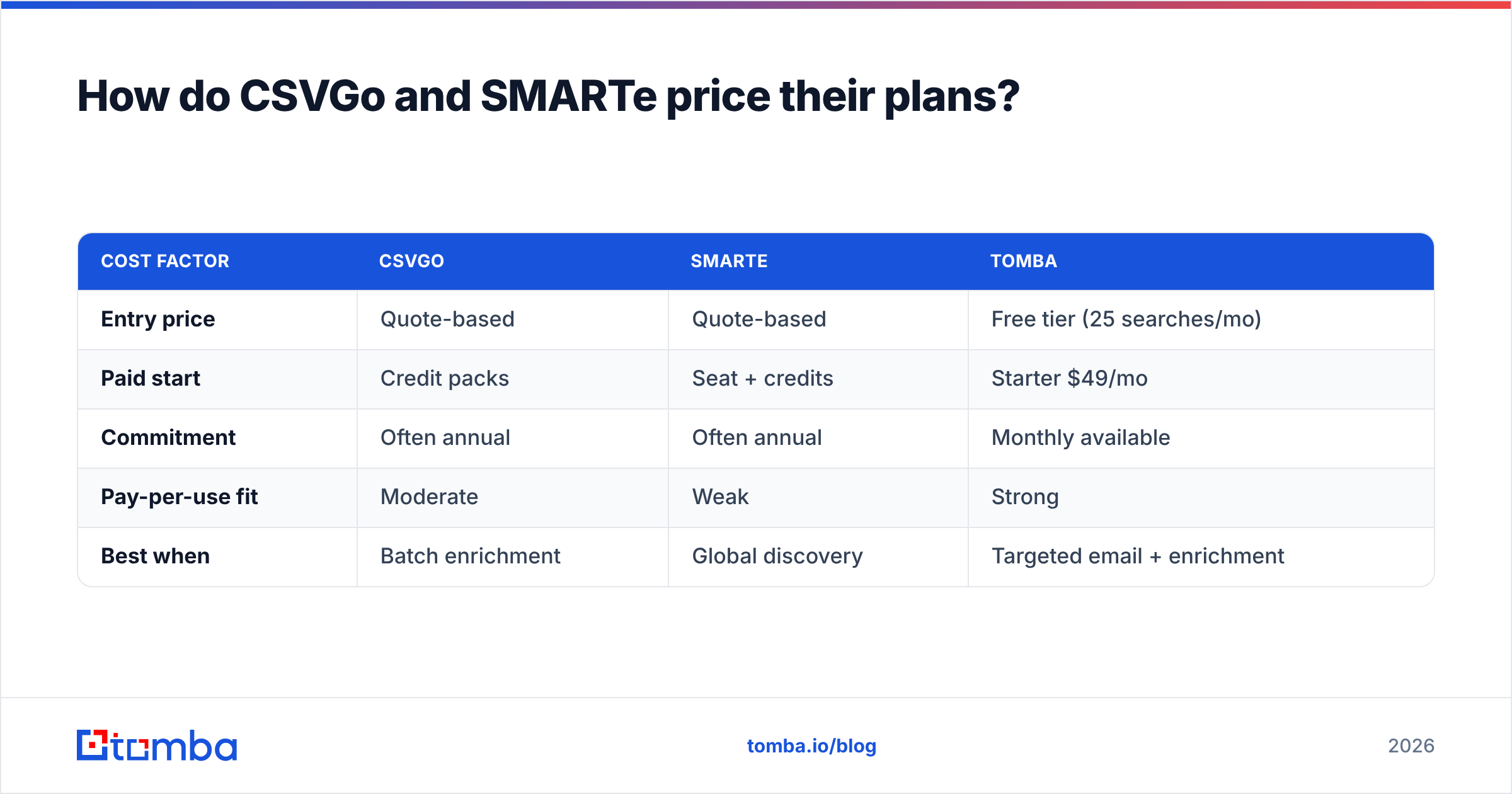
That's the case for a usage-based alternative. Here's how the three approaches compare on cost structure:
| Cost factor | CSVGo | SMARTe | Tomba |
|---|---|---|---|
| Entry price | Quote-based | Quote-based | Free tier (25 searches/mo) |
| Paid start | Credit packs | Seat + credits | Starter $49/mo |
| Commitment | Often annual | Often annual | Monthly available |
| Pay-per-use fit | Moderate | Weak | Strong |
| Best when | Batch enrichment | Global discovery | Targeted email + enrichment |
For teams that want to control spend per lookup rather than sign an annual deal, the pay-as-you-scale model is simply cheaper to start and easier to cancel. You can review full Tomba pricing to benchmark it against either quote.
When should you pick CSVGo over SMARTe?#
Pick CSVGo when:
- You already have the lists. Your bottleneck is cleaning and appending, not discovering new accounts.
- You live in spreadsheets. Your ops workflow is CSV in, CSV out, and you want minimal UI friction.
- Firmographic enrichment is the priority. You need company size, industry, and revenue bands more than mobile numbers.
- Your market is largely domestic. You don't need deep EMEA/APAC phone coverage.
Pick SMARTe when:
- You build lists from an ICP. You start with a target profile, not an existing file.
- International coverage matters. You sell into EMEA or APAC and need local mobile numbers.
- Phone-first outbound is core. Your reps call as much as they email.
- You have budget for a platform. The seat model makes sense at team scale with heavy usage.
If you sit in between — you want fresh, verified emails and light enrichment without a platform commitment — that's the signal to look at a focused email-first tool instead.
Where does Tomba fit against CSVGo and SMARTe?#
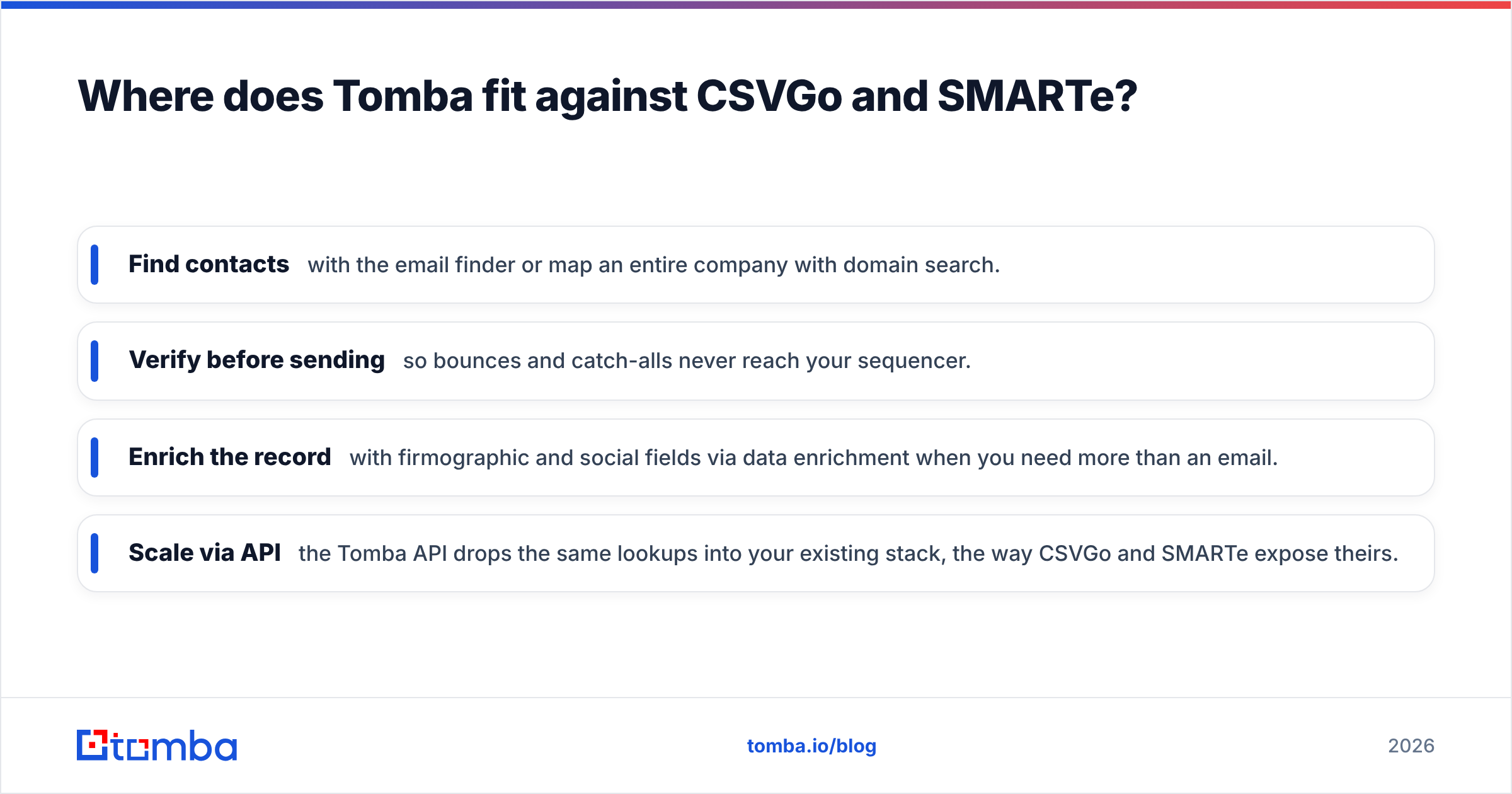
Tomba isn't trying to be a full sales-intelligence suite, and that's the point. It does the highest-frequency job — turning a name and a domain into a verified work email — extremely well, with pricing you can meter. Instead of buying a database seat, you pay for the searches you run.
The practical workflow looks like this:
- Find contacts with the email finder or map an entire company with domain search.
- Verify before sending so bounces and catch-alls never reach your sequencer.
- Enrich the record with firmographic and social fields via data enrichment when you need more than an email.
- Scale via API — the Tomba API drops the same lookups into your existing stack, the way CSVGo and SMARTe expose theirs.
For deeper account research, industry frameworks from analysts like Gartner are worth reading on how data quality maps to pipeline outcomes — the short version is that verification-at-send beats volume every time.
The honest summary: CSVGo and SMARTe are strong at what they're built for — batch enrichment and global discovery respectively. But if your core need is accurate, verified B2B emails without an enterprise commitment, a focused tool covers that job for less.
Which one should you choose?#
- Choose CSVGo if spreadsheet-native bulk enrichment is your bottleneck and your market is mostly domestic.
- Choose SMARTe if you build lists from scratch and need best-in-class international phone coverage — and you have the budget for a seat-based platform.
- Choose Tomba if you want verified work emails and light enrichment on a pay-as-you-scale plan, starting free.
Whatever you pick, verify before you send. The tool that finds the contact and the tool that keeps you out of spam folders are two different jobs, and skipping the second one is the fastest way to burn a domain.
Ready to test the email-first approach? Start with Tomba's Email Finder on the free tier — 25 searches a month, no card, no annual contract. Find a few contacts, run them through verification, and compare the deliverability against your current CSVGo or SMARTe export before you renew either one.
Related guides#
Ready to find emails that actually work?
Join 150,000+ professionals who stopped guessing and started sending. Free credits on signup — no credit card required.
Get the Tomba newsletter
Practical outbound tactics and product updates — once every two weeks.
About the author