Csvgo vs Warpleads (2026): Which Lead Data Tool Wins?
Csvgo and Warpleads both promise cheap, high-volume B2B lead exports — but they win at different jobs. Here's an honest breakdown of data, pricing, and which one fits your outbound motion.
Choosing between Csvgo and Warpleads usually comes down to one question you won't see on either pricing page: do you want a cheap way to export lists or a reliable way to reach inboxes? They look similar from the outside — both sell B2B contact data by the thousand — but they solve slightly different problems, and picking the wrong one quietly taxes every campaign you run afterward.
This is a neutral, hands-on comparison. No affiliate spin, no "both are amazing." Where one tool clearly wins, we say so.
TL;DR — Csvgo vs Warpleads in 30 seconds#
- Csvgo leans toward affordable, high-volume list building with flexible CSV exports — good when you need raw volume and you already have your own verification and sending stack.
- Warpleads positions around unlimited (or very high) email exports for cold outreach teams that want lists ready to plug into a sequencer.
- Data quality is the real differentiator, not headline price. A cheaper export that's 25% stale costs more than a pricier one that's clean.
- Neither is a dedicated verifier. Whichever you pick, run the list through a real email verifier before you send, or your deliverability pays for it.
- Best combo for most teams: use a volume tool for discovery, then verify and enrich with a precision layer so bounce rates stay under control.
What are Csvgo and Warpleads?#
Both tools sit in the same broad category: B2B lead databases that let you build a targeted list and download it as a CSV for outreach.
Csvgo is built around the idea of exporting contact data at low cost. You filter by role, industry, geography, and company attributes, then pull the matching records out as a spreadsheet. The pitch is affordability and volume — get a lot of leads without paying enterprise database prices.
Warpleads targets cold email teams specifically. Its selling point is high-volume (often marketed as "unlimited") email exports designed to feed directly into sending tools, so agencies and SDR teams running large outbound campaigns can refill their pipelines without watching a credit meter. You can compare its positioning on its own site at warpleads.com and cross-check user sentiment on G2.
The important nuance: both are discovery and export tools. They help you find and download contacts. They are not primarily built to guarantee that every address is deliverable today — which is why the accuracy conversation below matters more than the price tag.

How do Csvgo and Warpleads compare?#
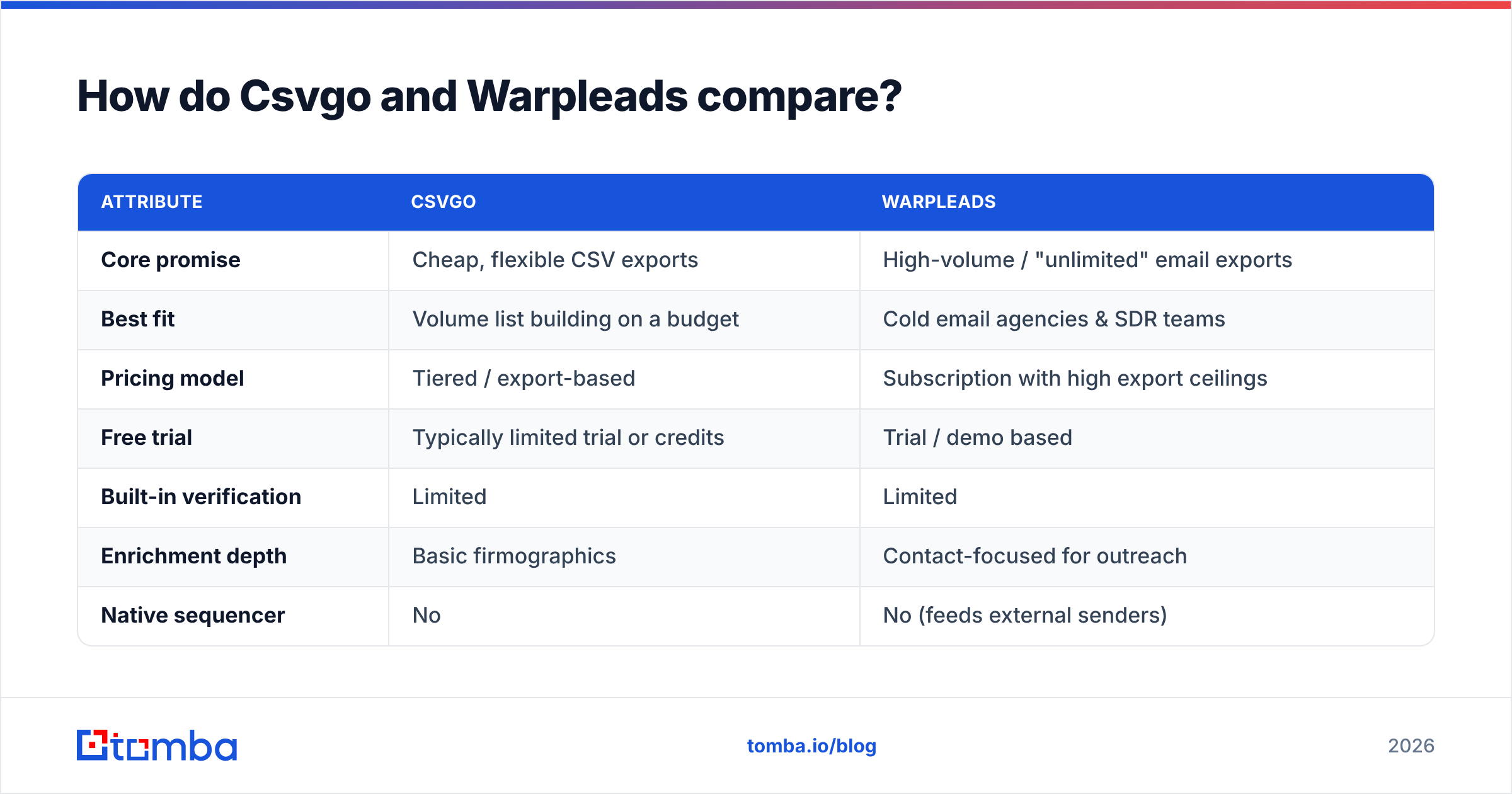
Here's the side-by-side on the attributes that actually change your results. Pricing models shift often, so treat the cost column as "how they charge" rather than a fixed quote — always confirm current numbers on each vendor's page before you buy.
| Attribute | Csvgo | Warpleads |
|---|---|---|
| Core promise | Cheap, flexible CSV exports | High-volume / "unlimited" email exports |
| Best fit | Volume list building on a budget | Cold email agencies & SDR teams |
| Pricing model | Tiered / export-based | Subscription with high export ceilings |
| Free trial | Typically limited trial or credits | Trial / demo based |
| Built-in verification | Limited | Limited |
| Enrichment depth | Basic firmographics | Contact-focused for outreach |
| Native sequencer | No | No (feeds external senders) |
| Ideal downstream step | Verify before sending | Verify before sending |
Notice the last two rows repeat on purpose. Neither tool closes the loop for you: both hand you a list, and both assume you'll verify and send elsewhere. That's not a flaw — it's the category. But it means your total cost is tool price + verification + the deliverability hit from whatever slips through.
What does Csvgo do best?#
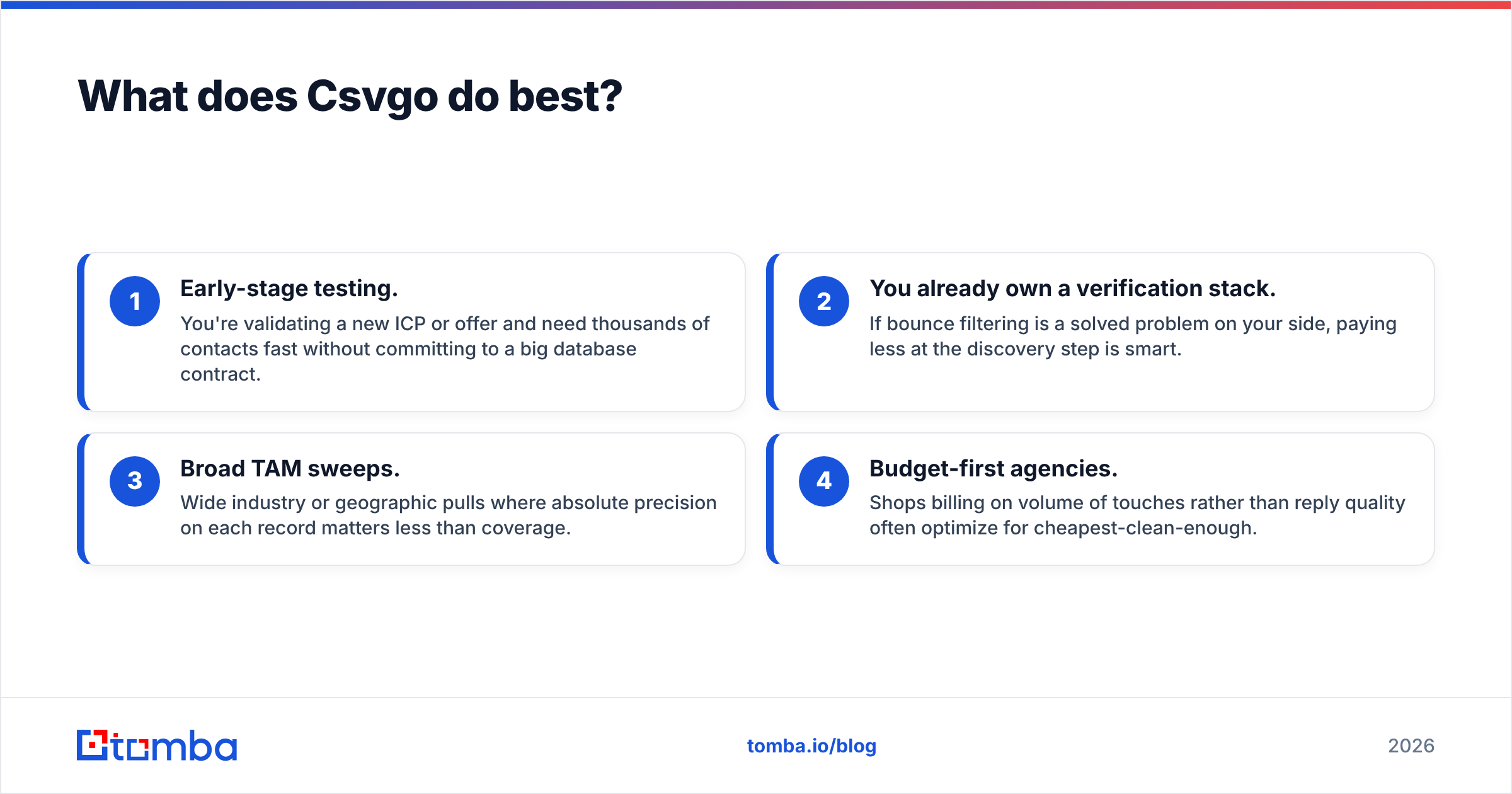
Csvgo's strength is cost-efficient volume. If your model is "spray a large, loosely-qualified list and let reply rates sort it out," a low per-lead export price is genuinely useful. A few situations where it shines:
- Early-stage testing. You're validating a new ICP or offer and need thousands of contacts fast without committing to a big database contract.
- You already own a verification stack. If bounce filtering is a solved problem on your side, paying less at the discovery step is smart.
- Broad TAM sweeps. Wide industry or geographic pulls where absolute precision on each record matters less than coverage.
- Budget-first agencies. Shops billing on volume of touches rather than reply quality often optimize for cheapest-clean-enough.
The catch: cheap exports and stale data frequently travel together. If Csvgo's records aren't refreshed often, you inherit the classic problem — B2B data decays fast, and industry estimates routinely put contact-data decay at roughly 20–30% per year as people change jobs. Skipping verification on a bargain list is how you turn a low export cost into a high bounce rate.
What does Warpleads do best?#
Warpleads is built for teams whose bottleneck is list supply, not list price. If you run continuous cold email at scale, a high or unlimited export ceiling removes the monthly anxiety of running out of leads mid-campaign. It's strongest when:
- You send at high volume every week. Agencies managing many client campaigns benefit from not metering every download.
- Your workflow is export → sequencer. Warpleads is designed to feed tools like your cold email platform quickly.
- Predictable cost matters. A flat subscription with a big ceiling is easier to budget than variable per-lead pricing when volume is high.
The trade-off mirrors Csvgo's: high volume is only an asset if the data underneath is fresh. "Unlimited exports" of addresses that don't resolve is unlimited work for your inbox reputation. The teams that win with Warpleads are the ones that treat every export as raw material to be verified, not as send-ready truth.
Which has better data quality and accuracy?#
The honest answer: don't trust either vendor's headline accuracy claim — test it on your own ICP. Data quality varies wildly by region, seniority, and industry, so a tool that's excellent for US SaaS mid-market can be weak for EU manufacturing.
Here's a practical way to judge them before committing budget:
- Run a 200-lead sample from each against the exact filters you'd use in production, not a generic pull.
- Verify both samples with a neutral third-party email verification tool and compare valid, risky, and invalid rates side by side.
- Check catch-all exposure. A high share of catch-all domains inflates "valid" counts without guaranteeing delivery. A dedicated catch-all verifier tells you what's really reachable.
- Spot-check freshness. Pull 20 contacts and confirm current roles on LinkedIn. Job-change churn is where cheap lists rot.
- Enrich the gaps. If either export is missing phone or firmographic fields you need, factor in a data enrichment pass so you're comparing complete records, not half-filled rows.
Whichever tool wins your sample test wins for your use case — and that result matters far more than any comparison chart, including this one.
Csvgo vs Warpleads pricing — which is cheaper?#
On sticker price, Csvgo generally positions as the budget option and Warpleads as the volume-ceiling option. But "cheaper" is the wrong frame. The number that matters is cost per usable, deliverable contact, and that only appears after verification.
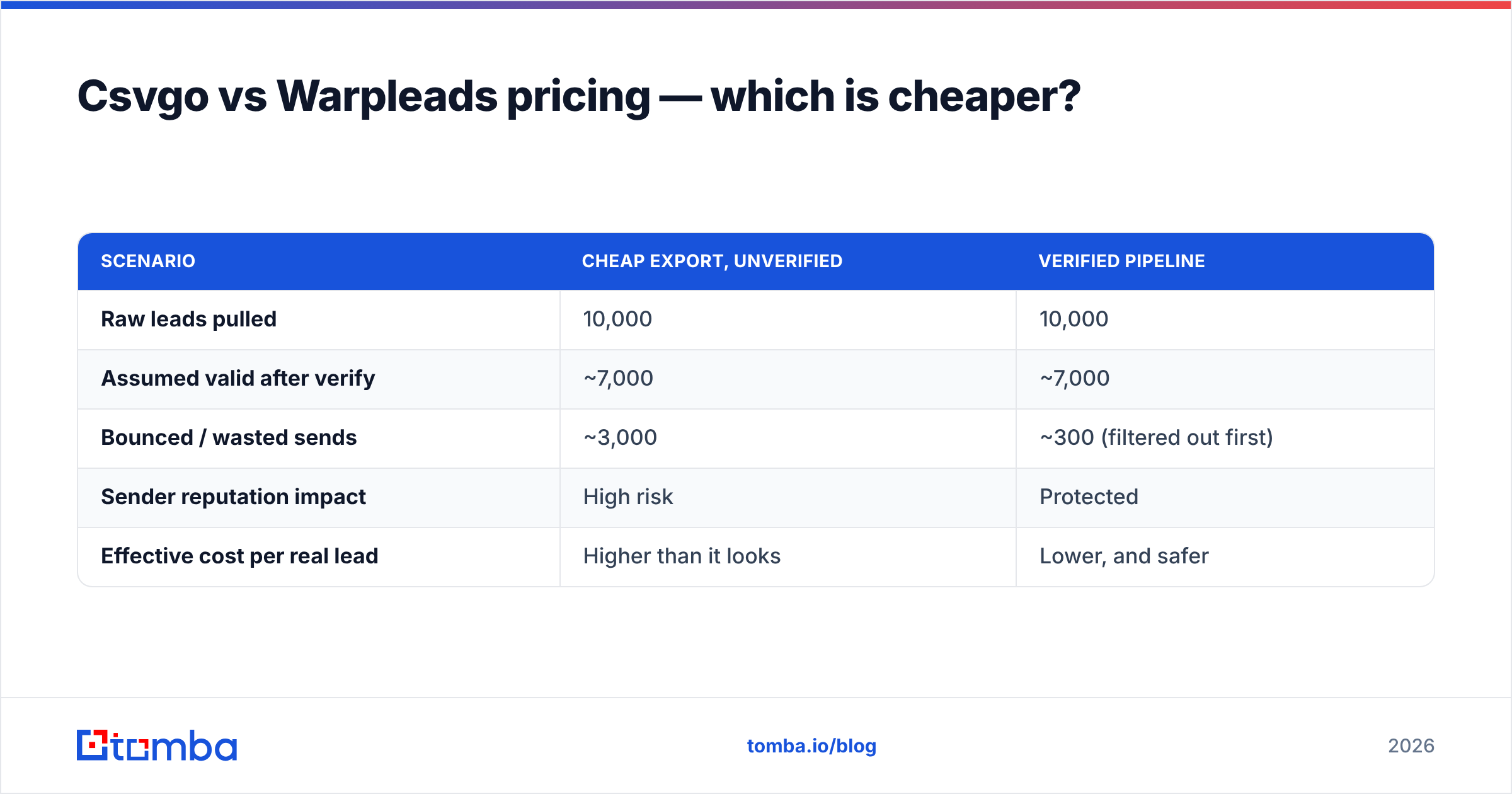
A worked example makes it obvious:
| Scenario | Cheap export, unverified | Verified pipeline |
|---|---|---|
| Raw leads pulled | 10,000 | 10,000 |
| Assumed valid after verify | ~7,000 | ~7,000 |
| Bounced / wasted sends | ~3,000 | ~300 (filtered out first) |
| Sender reputation impact | High risk | Protected |
| Effective cost per real lead | Higher than it looks | Lower, and safer |
The tool with the lower export price can easily become the more expensive option once bounces trash your domain reputation and throttle every future campaign. That's why serious outbound teams budget for verification as a line item, not an afterthought — and why a bulk email finder and verifier pairing often beats "just buy the cheapest CSV."

Where does Tomba fit into the picture?#
If your real goal is deliverable contacts rather than the biggest raw file, it's worth adding a precision layer instead of choosing purely on export volume.
Tomba approaches the problem from the accuracy end rather than the volume end. Instead of dumping a giant unverified list, it finds professional emails by domain, name, or company and pairs discovery with verification so you know what's reachable before you send. That's a different philosophy from both Csvgo and Warpleads — less "how many can I export," more "how many will actually land."
Where Tomba tends to fit:
- Domain-based prospecting — pull every reachable contact at a target company with domain search, then verify in the same flow.
- Precision over spray — ABM and mid-to-high-ticket outbound where a wrong or dead address wastes a real opportunity, not just a send.
- Clean handoffs to your CRM — verified records flow into your sequencer without a separate cleanup step.
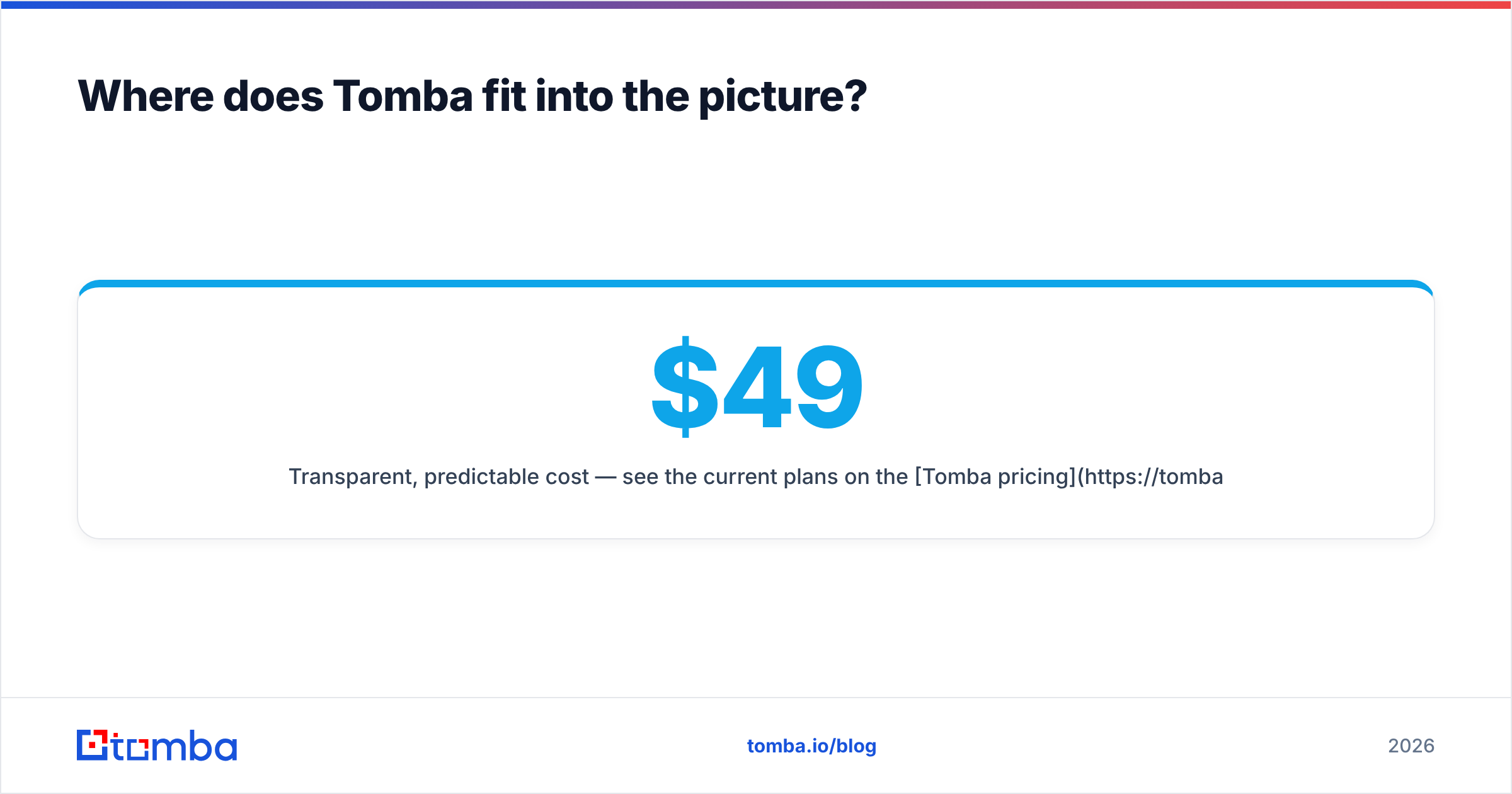
- Transparent, predictable cost — see the current plans on the Tomba pricing page: a free tier with 25 searches/month, Starter at $49/mo, Growth at $99/mo, and Pro at $249/mo.
It's not that volume tools are wrong — it's that "cheap and unlimited" and "clean and deliverable" are different products. Many teams use both: a discovery tool for reach, and a verification-first layer so the sends that go out actually connect.
Csvgo vs Warpleads: which should you choose?#
Here's the plain verdict, by situation:
- Choose Csvgo if your top priority is the lowest possible export cost, you're running broad, high-tolerance-for-bounce campaigns, and you already have a strong verification step in place.
- Choose Warpleads if you're a high-volume cold email team or agency and your bottleneck is supply — you want a big export ceiling so you never stall mid-campaign, and you'll verify downstream.
- Add a precision layer (like Tomba) if reply quality and domain reputation matter more than raw list size, or if you keep getting burned by bounces from bargain lists.
The one mistake to avoid with either tool: sending an exported list straight into your inbox without verifying it. That's the fastest way to torch a sending domain, and it's entirely preventable.
The bottom line#
Csvgo and Warpleads are both legitimate ways to acquire B2B leads at volume, and the "winner" depends entirely on whether your constraint is price (lean Csvgo), supply (lean Warpleads), or deliverability (add a verification-first layer). Run the 200-lead sample test, compare cost per deliverable contact, and let the data on your own ICP decide.
Ready to stop guessing which addresses will actually land? Try the Tomba Email Finder — find professional emails by domain, name, or company, verify them in the same workflow, and start with 25 free searches a month before you commit a dollar. Clean data in, fewer bounces out.
Related guides#
Ready to find emails that actually work?
Join 150,000+ professionals who stopped guessing and started sending. Free credits on signup — no credit card required.
Get the Tomba newsletter
Practical outbound tactics and product updates — once every two weeks.
About the author