CallTrackingMetrics (CTM) Pricing, Reviews, Pros and Cons
A neutral, numbers-first look at CallTrackingMetrics: what every plan really costs, where the hidden fees hide, honest pros and cons, and who it fits best in 2026.
Call tracking software looks simple on the pricing page and gets complicated on the invoice. CallTrackingMetrics (CTM) is one of the most capable platforms in the category, but "capable" and "affordable" are not the same thing. This is a neutral walkthrough of what CTM actually costs, what real users praise and complain about, and where it fits in a modern outbound stack.
TL;DR#
- CTM is a premium call tracking and conversation-analytics platform, not a budget tool. Plans start around $79/month and climb fast once usage (minutes, numbers, texts) is added on top.
- The base subscription is only half the bill. Local/toll-free numbers, per-minute usage, and add-ons like AI conversation analytics are metered separately.
- Strengths: deep attribution, call routing/IVR, form tracking, and strong CRM/ads integrations. Weaknesses: learning curve, usage costs, and price shocks at scale.
- CTM answers "which campaign drove the call." It does not find the contacts you call in the first place — that's a data problem, not a routing one.
- If your gap is finding accurate phone numbers and emails to fill the pipeline, pair call tracking with a dedicated data tool like a phone finder instead of overpaying for seats you won't use.
What is CallTrackingMetrics (CTM)?#
CallTrackingMetrics is a cloud platform that ties inbound phone calls, texts, and form fills back to the marketing source that produced them. In plain terms: it's a scoreboard that tells you which ad, keyword, or landing page made the phone ring — the digital equivalent of asking every walk-in customer "how did you hear about us," except it happens automatically.
Under the hood, CTM combines three things most teams otherwise buy separately:
- Dynamic number insertion (DNI) — swaps the phone number on your website per visitor so each session is attributable to a source.
- A cloud contact center — call routing, IVR menus, softphone, call recording, and text messaging.
- Conversation intelligence — transcription, keyword spotting, and AI scoring of how calls went.
That bundle is why CTM competes with both call-tracking tools (CallRail, WhatConverts) and lighter contact-center products. It also explains the price: you're paying for an attribution engine and a phone system at once.

How much does CTM CallTrackingMetrics pricing actually cost?#
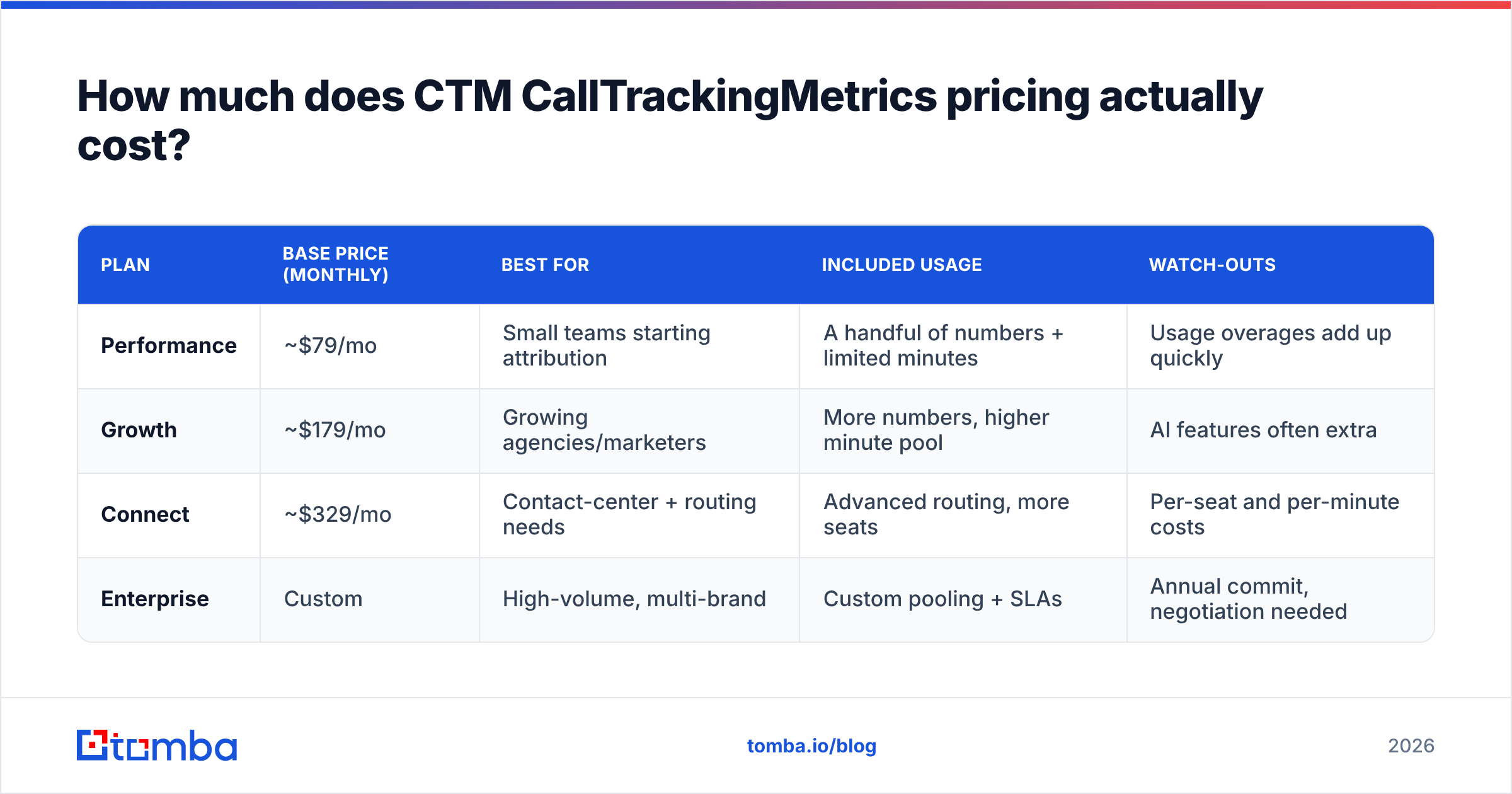
CTM publishes tiered plans, but the sticker price is the subscription only. Numbers, minutes, and texts are usage-based and stack on top. Below is a representative structure (always confirm current numbers on the official CallTrackingMetrics pricing page, since vendors adjust tiers).
| Plan | Base price (monthly) | Best for | Included usage | Watch-outs |
|---|---|---|---|---|
| Performance | ~$79/mo | Small teams starting attribution | A handful of numbers + limited minutes | Usage overages add up quickly |
| Growth | ~$179/mo | Growing agencies/marketers | More numbers, higher minute pool | AI features often extra |
| Connect | ~$329/mo | Contact-center + routing needs | Advanced routing, more seats | Per-seat and per-minute costs |
| Enterprise | Custom | High-volume, multi-brand | Custom pooling + SLAs | Annual commit, negotiation needed |
The three costs that surprise people:
- Phone numbers. Each tracking number carries a small monthly fee. Run 40 landing-page variants and that line item is real money before a single call connects.
- Per-minute usage. Inbound and outbound minutes are metered. Recording and transcription can add per-minute charges too.
- AI / conversation analytics. The headline "AI" scoring and transcription features frequently sit behind add-on pricing rather than being included in the base tier.
Net: a team that budgets for the $79 plan often lands at $200–$400/month once real call volume, numbers, and texts are counted. That's not a scam — it's how usage-based telephony works — but it's the number you should plan around, not the sticker.
Is CTM worth it? The honest pros and cons#
No tool is universally "worth it." It depends on whether you need what CTM is deep at, and whether you'll actually use it.
Pros#
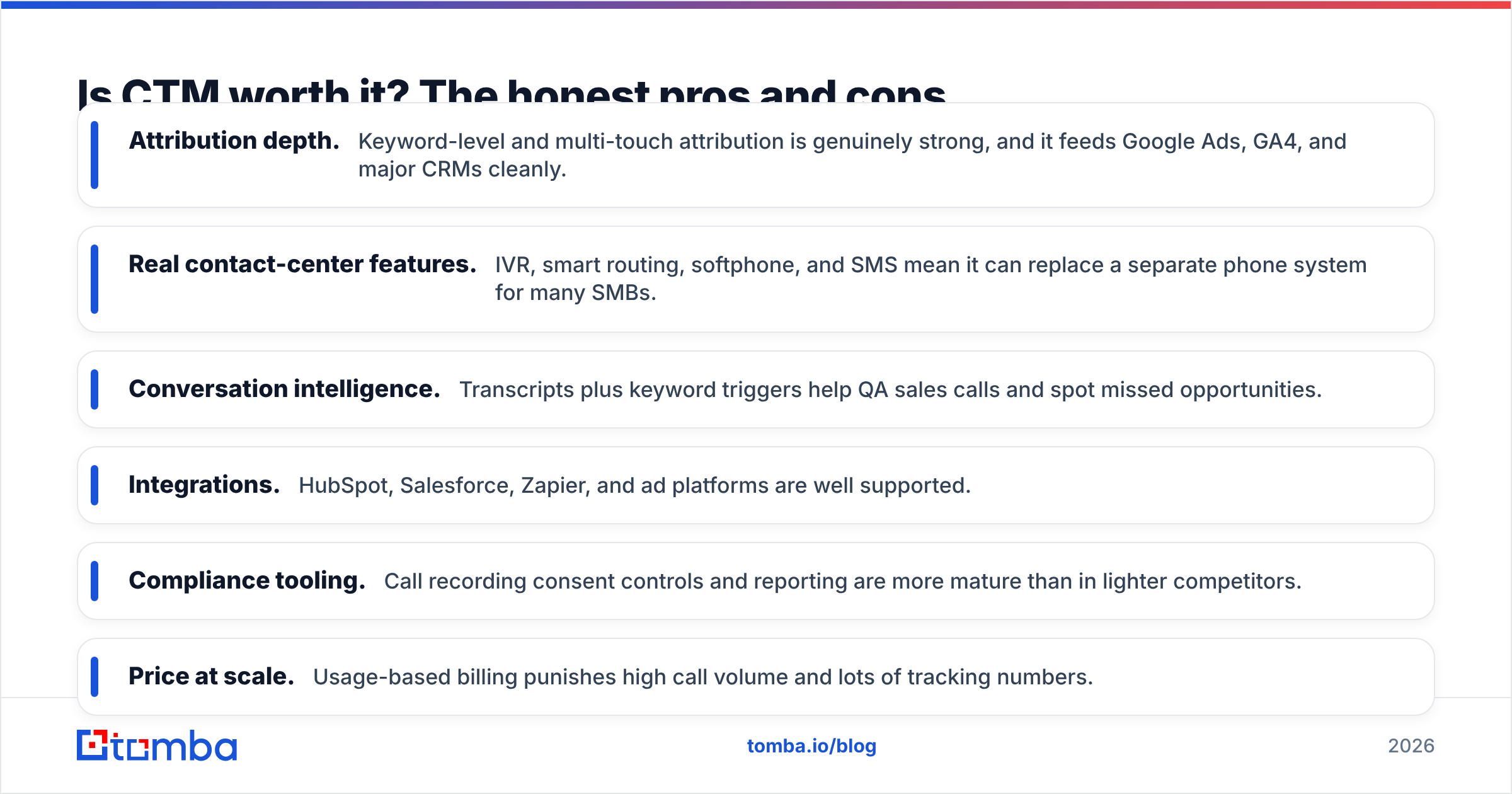
- Attribution depth. Keyword-level and multi-touch attribution is genuinely strong, and it feeds Google Ads, GA4, and major CRMs cleanly.
- Real contact-center features. IVR, smart routing, softphone, and SMS mean it can replace a separate phone system for many SMBs.
- Conversation intelligence. Transcripts plus keyword triggers help QA sales calls and spot missed opportunities.
- Integrations. HubSpot, Salesforce, Zapier, and ad platforms are well supported.
- Compliance tooling. Call recording consent controls and reporting are more mature than in lighter competitors.
Cons#
- Price at scale. Usage-based billing punishes high call volume and lots of tracking numbers.
- Learning curve. The routing/attribution flexibility that power users love overwhelms first-timers.
- Add-on creep. The most exciting features (AI analytics) often cost extra.
- Overkill for simple needs. If you just want "which campaign drove the call," you may be buying a jet to cross the street.
- It doesn't source contacts. CTM measures inbound demand; it won't build your outbound list.
How does CTM compare to other call tracking tools?#
Here's a neutral positioning of CTM against the two most common alternatives buyers evaluate. Prices are indicative starting points and shift over time — verify each on the vendor site and on review platforms like G2.
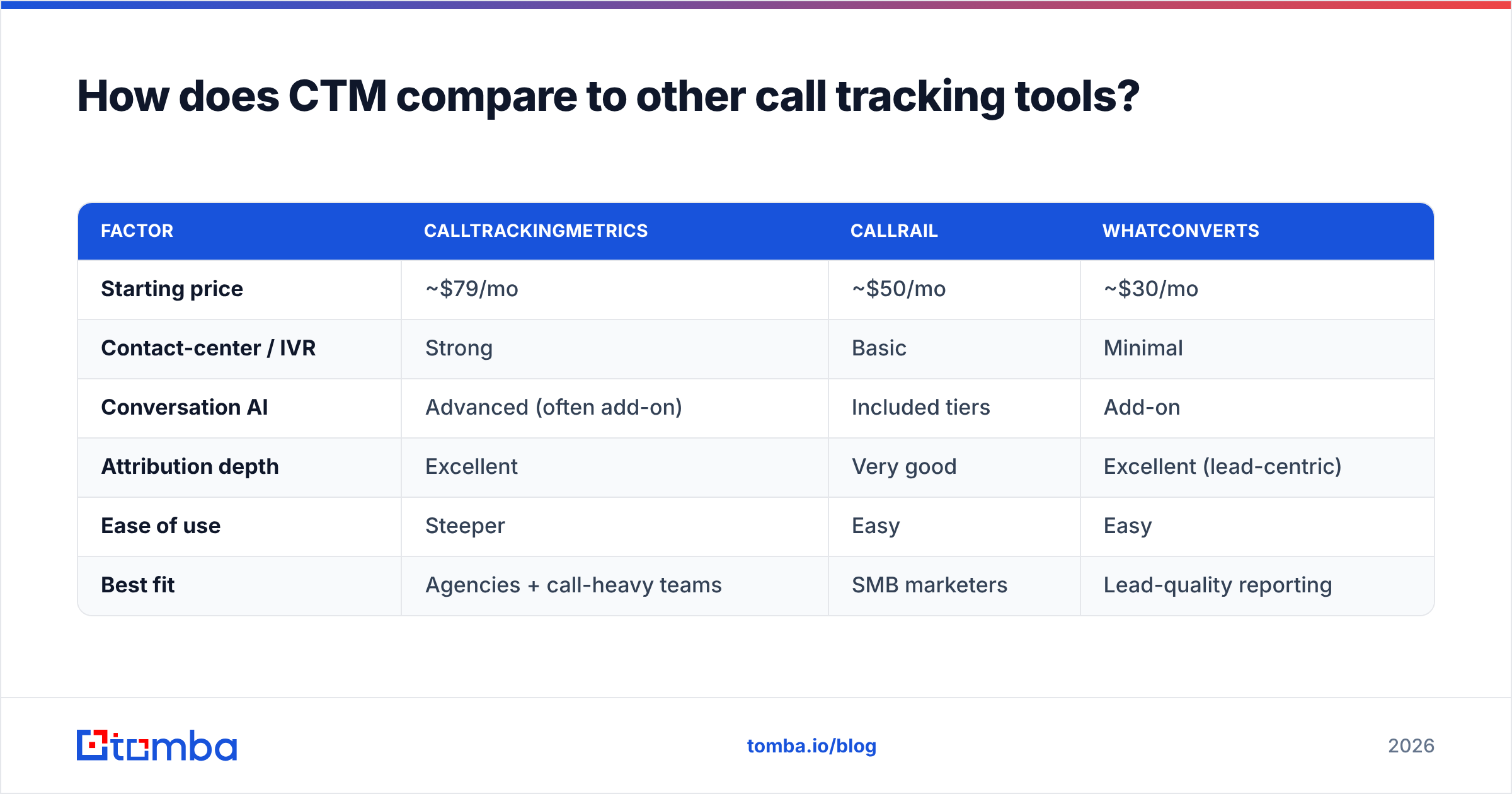
| Factor | CallTrackingMetrics | CallRail | WhatConverts |
|---|---|---|---|
| Starting price | ~$79/mo | ~$50/mo | ~$30/mo |
| Contact-center / IVR | Strong | Basic | Minimal |
| Conversation AI | Advanced (often add-on) | Included tiers | Add-on |
| Attribution depth | Excellent | Very good | Excellent (lead-centric) |
| Ease of use | Steeper | Easy | Easy |
| Best fit | Agencies + call-heavy teams | SMB marketers | Lead-quality reporting |
Read it this way: WhatConverts wins on simplicity and lead reporting, CallRail wins on ease-of-use for typical SMB marketing, and CTM wins when you genuinely need routing, high-volume telephony, and granular attribution in one platform. If you're not using the contact-center muscle, you're overpaying for it.
What do CTM reviews actually say?#
Aggregate sentiment across public review sites is consistently "powerful but complex, and watch the bill." Common themes:
- Praised: reliability, attribution accuracy, responsive support, and the breadth of routing options. Agencies managing many clients tend to be the happiest cohort.
- Criticized: pricing transparency, the effort to configure it well, and surprise usage charges after a busy month.
- Recurring request: simpler onboarding and clearer bundling of AI features.
If you want primary sources, cross-check ratings on Capterra alongside G2 — the star averages are similar, but the written reviews reveal the "great for agencies, heavy for solo marketers" split more clearly than the score does.

Where CTM stops — and what fills the gap#
Here's the strategic point most CTM reviews skip: call tracking is a measurement layer, not a demand layer. CTM tells you a call converted. It does not hand you the next 500 prospects to call.
For outbound and hybrid teams, the pipeline looks like this:
- Find the right accounts and people — build a target list.
- Get accurate contact data — verified emails and direct phone numbers.
- Reach out — cold email, cold call, sequences.
- Track and attribute — this is where CTM earns its keep.
CTM owns step 4. Steps 1–3 need a data source. That's why call-heavy teams often pair a tracking platform with:
- A phone finder to pull direct-dial B2B numbers instead of gatekeeper lines.
- A phone validator to scrub dead or invalid numbers before your reps waste dials.
- An email finder and data enrichment to fill CRM records so attribution actually maps to a real, reachable person.
Spending $300/month to measure calls while your reps dial stale numbers is a false economy. The measurement is only as good as the list. And unlike per-minute telephony billing, sourcing contacts with transparent Tomba pricing is predictable — Free (25 searches/mo), Starter $49/mo, Growth $99/mo, and Pro $249/mo.
Who should buy CTM — and who shouldn't?#
Buy CTM if you:
- Run an agency or in-house team with meaningful inbound call volume.
- Need call routing, IVR, and SMS in the same tool as attribution.
- Care about keyword-level and multi-touch attribution into ads and CRM.
- Have someone who will invest the setup time to configure it well.
Skip CTM (or pick a lighter tool) if you:
- Just want basic "which campaign made the phone ring" reporting — CallRail or WhatConverts is cheaper and simpler.
- Are primarily an outbound team. Your bottleneck is data and dials, not inbound attribution.
- Have low call volume where per-number and per-minute fees make the ROI thin.
Quick answers (FAQ)#
Is CallTrackingMetrics expensive? Relative to lightweight call trackers, yes. The base plan is mid-market, but usage (numbers, minutes, texts) and AI add-ons push real-world bills higher than the advertised tier.
Does CTM have a free plan? CTM typically offers a free trial rather than a permanent free tier. Budget for both subscription and usage from day one.
Can CTM find phone numbers or emails for me? No. CTM tracks and routes calls you already receive. To source direct-dial numbers and verified emails, you need a data tool such as a phone finder or email finder.
Is CTM better than CallRail? For call-center features and deep routing, yes. For a simple, easy SMB setup, CallRail is often the friendlier and cheaper choice.
The bottom line#
CallTrackingMetrics is a strong, feature-dense platform that rewards teams who genuinely need attribution plus a contact center — and punishes teams who just want simple reporting or who forget to budget for usage. Score it against your actual call volume, not the sticker price, and confirm which features are bundled versus add-on before you sign.
And remember what call tracking can't do: it measures demand, it doesn't create it. If your real constraint is finding accurate people to call and email, start upstream. Tomba's Email Finder — with its companion phone finder, validator, and enrichment tools — fills your pipeline with verified, reachable contacts on flat, predictable pricing, so whatever you spend on tracking is spent on calls that actually connect. Start free with 25 searches and feed CTM leads worth measuring.
Related guides#
Ready to find emails that actually work?
Join 150,000+ professionals who stopped guessing and started sending. Free credits on signup — no credit card required.
Get the Tomba newsletter
Practical outbound tactics and product updates — once every two weeks.
About the author