Cufinder vs Endole: Which B2B Data Tool Wins in 2026?
Cufinder sells global contact enrichment. Endole sells UK company financials. They barely overlap — and picking wrong costs you a whole quarter of pipeline. Here's the honest breakdown.
TL;DR
- Cufinder and Endole are not really competitors. Cufinder is a global contact-enrichment and email-finding platform. Endole is a UK company-intelligence database built on Companies House filings. Comparing them head-to-head only makes sense if you're a UK-focused team deciding where to spend one budget line.
- Pick Endole if you sell to UK limited companies and need financials, directors, credit risk, and group structures to qualify accounts before you ever send an email.
- Pick Cufinder if you need work emails, phone numbers, and firmographics across many countries to actually reach the people at those accounts.
- Most teams that compare these two end up needing both layers — account intelligence and contact data — which is why a lot of buyers pair a UK data source with a dedicated email finder rather than forcing one tool to do both jobs.
- Cufinder's contact accuracy claims are self-reported and not independently audited. Endole's data is as good as Companies House, which is authoritative for legal entity data and useless for personal work emails.
What are Cufinder and Endole, actually?#
Start with the thing most comparison posts bury: these tools were built for different continents and different jobs.
Cufinder (cufinder.io) is an Iran-founded, globally marketed B2B data platform. Its pitch is a large contact database plus a stack of enrichment "engines" — company-name-to-domain, domain-to-email, name-to-LinkedIn, and so on. You feed it a partial identifier and it returns the missing fields. The buyer is an SDR, a growth marketer, or a RevOps person filling gaps in a CRM.
Endole (endole.co.uk) is a UK company-intelligence service. It ingests Companies House filings — the UK's statutory register of limited companies — and layers search, financial analysis, credit scoring, group-structure mapping, and industry benchmarking on top. The buyer is a credit controller, an M&A analyst, a UK-focused sales team, or anyone who needs to know whether a British company is solvent and who legally runs it.
The overlap is thin: both can tell you a company exists and roughly what it does. Everything past that diverges hard.
Which one has better data coverage?#
Depends entirely on what "data" means to you.
Endole's coverage of UK registered companies is effectively complete, because it's derived from a statutory source. Every UK limited company must file. If a company was incorporated in Manchester last Tuesday, Endole will have it. That's a real moat — you cannot beat a government register on entity completeness within its own jurisdiction.
But Companies House does not contain work email addresses. It contains registered office addresses, director names, dates of birth (partially redacted), share allocations, and accounts. So Endole gives you the account, not the contact. To email the CFO you found in a filing, you still need to derive firstname.lastname@company.co.uk — or whatever pattern that company actually uses — and confirm the mailbox exists.
Cufinder goes the other way. Its coverage is broad and international but self-reported. There is no third-party audit of its accuracy claims, which is normal for this category and also a reason to test before you commit. Contact databases in this space are assembled from scraping, contribution networks, partner feeds, and pattern inference, and quality varies wildly by region and seniority. European contact data is generally thinner than US data across every vendor, GDPR being the obvious reason.

Here's the practical test: pull 100 target accounts. Run them through both. Count how many produce (a) a verified legal entity with current financials, and (b) a deliverable email for the right person. You'll usually find Endole wins column A outright in the UK and returns nothing for column B, while Cufinder returns something for both but with a hit rate you need to measure yourself, not take on faith.
Cufinder vs Endole: how do they compare feature by feature?#
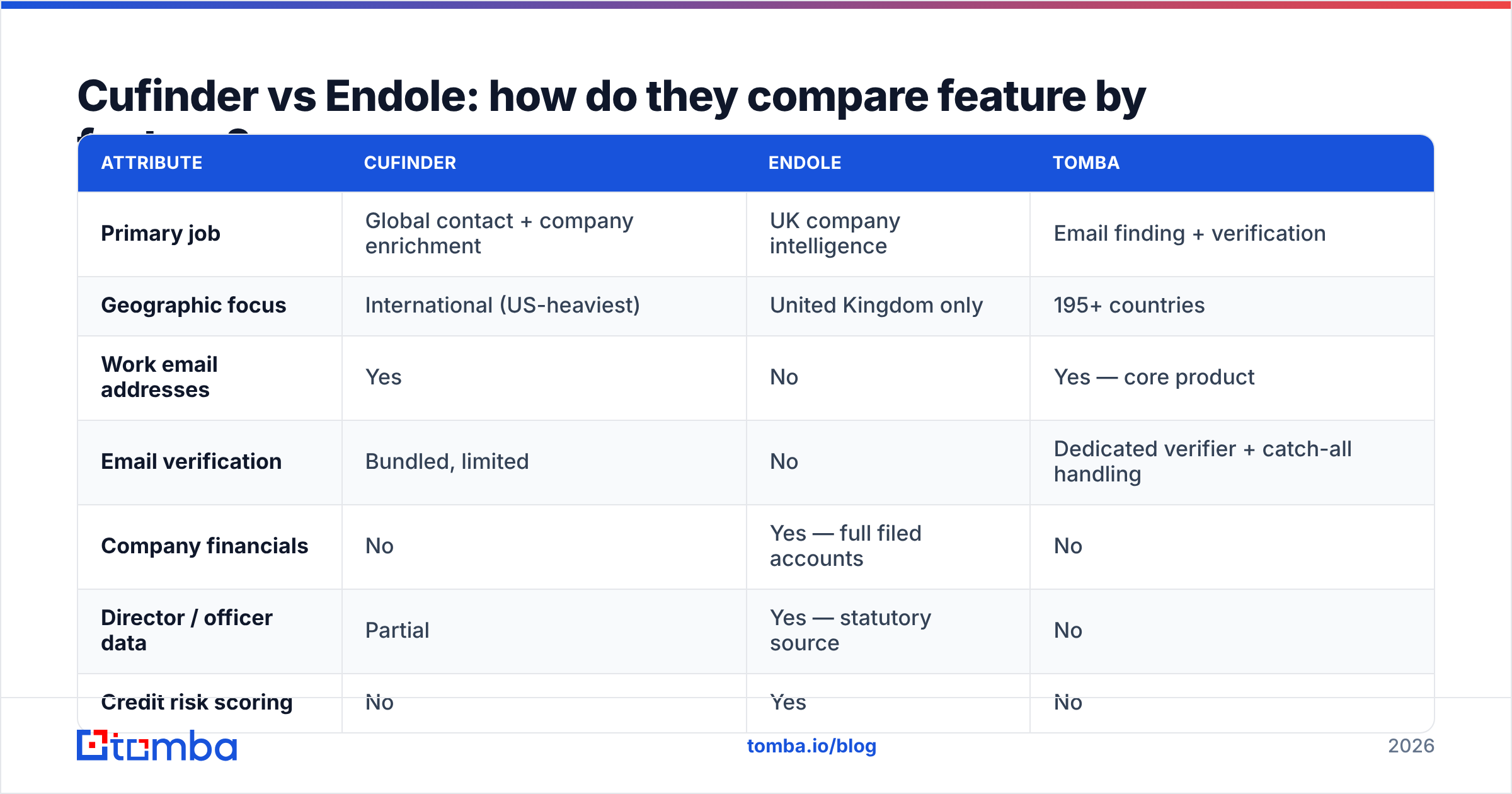
| Attribute | Cufinder | Endole | Tomba |
|---|---|---|---|
| Primary job | Global contact + company enrichment | UK company intelligence | Email finding + verification |
| Geographic focus | International (US-heaviest) | United Kingdom only | 195+ countries |
| Work email addresses | Yes | No | Yes — core product |
| Email verification | Bundled, limited | No | Dedicated verifier + catch-all handling |
| Company financials | No | Yes — full filed accounts | No |
| Director / officer data | Partial | Yes — statutory source | No |
| Credit risk scoring | No | Yes | No |
| Phone numbers | Yes | Company switchboard only | Yes — phone finder |
| API access | Yes | Yes (higher tiers) | Yes — Tomba API |
| Free tier | Limited credits | Free basic company search | 25 searches/mo |
| Entry paid price | ~$49/mo (varies by promo) | ~£30–£40/mo range | $49/mo Starter |
| Best for | Filling CRM gaps globally | Qualifying UK accounts | Reaching the people you qualified |
Two things jump out of that table.
First, the "Yes/No" columns are almost perfectly inverted between Cufinder and Endole. That's not a coincidence — it's evidence they're solving different problems. Any post telling you one is a straight replacement for the other hasn't used both.
Second, both list prices in roughly the same ballpark. Similar price, opposite value. That's the trap. A UK SaaS founder with £40/month to spend and no clear framework picks based on the marketing page, and half the time picks the wrong layer of the stack entirely.
When should you choose Endole over Cufinder?#
Choose Endole when the qualifying decision is the expensive one.
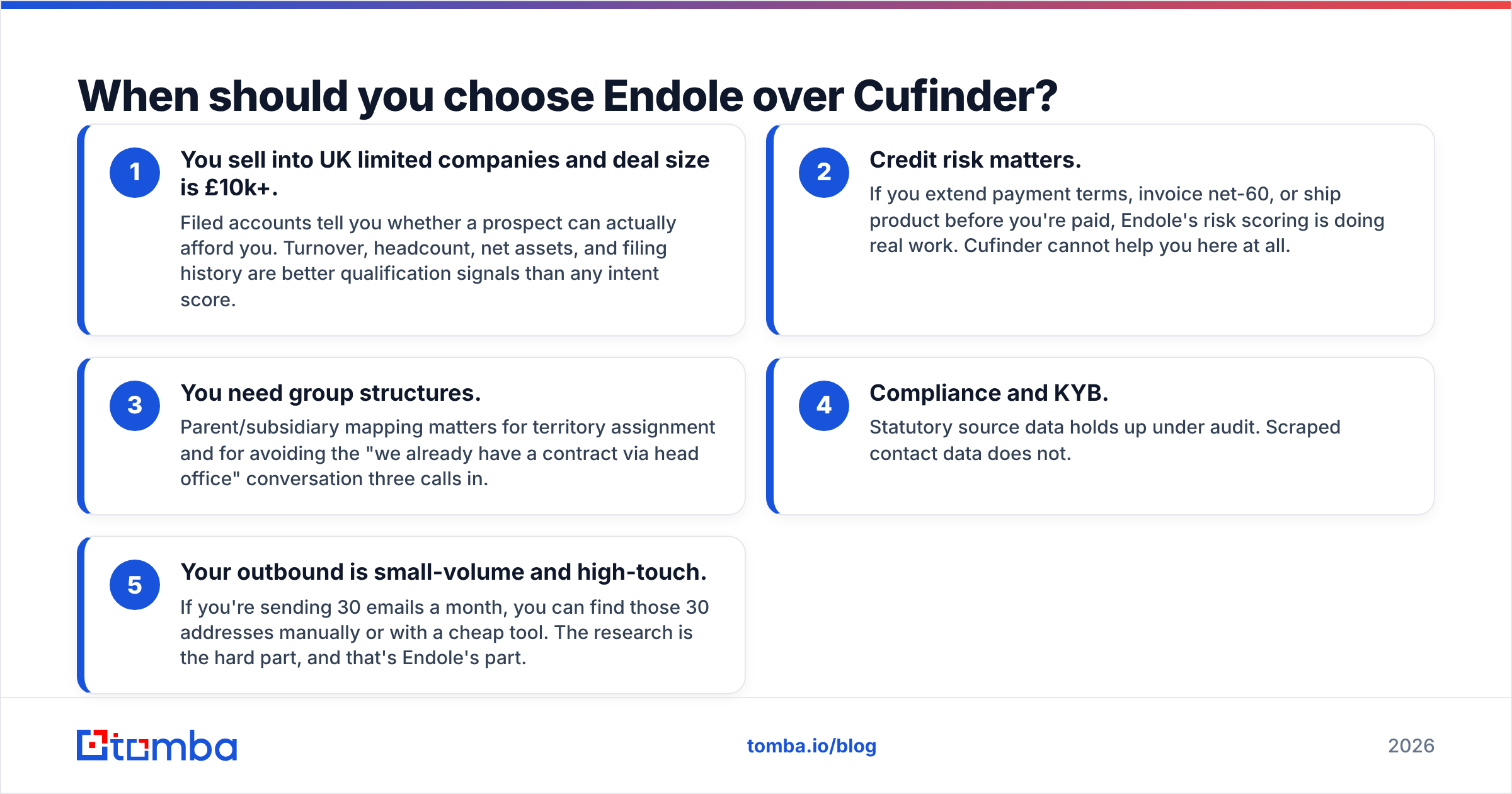
- You sell into UK limited companies and deal size is £10k+. Filed accounts tell you whether a prospect can actually afford you. Turnover, headcount, net assets, and filing history are better qualification signals than any intent score.
- Credit risk matters. If you extend payment terms, invoice net-60, or ship product before you're paid, Endole's risk scoring is doing real work. Cufinder cannot help you here at all.
- You need group structures. Parent/subsidiary mapping matters for territory assignment and for avoiding the "we already have a contract via head office" conversation three calls in.
- Compliance and KYB. Statutory source data holds up under audit. Scraped contact data does not.
- Your outbound is small-volume and high-touch. If you're sending 30 emails a month, you can find those 30 addresses manually or with a cheap tool. The research is the hard part, and that's Endole's part.
The honest limitation: the moment a prospect is outside the UK, Endole is dead weight. Irish, US, German companies — nothing. And even inside the UK, you'll be exporting director names into a spreadsheet and then hunting for their emails somewhere else, which is exactly the workflow gap that pushes teams toward a dedicated domain search alongside it.
When should you choose Cufinder over Endole?#
Choose Cufinder when the reaching problem is the expensive one and your market isn't UK-bound.
If you're an SDR with a list of 2,000 accounts across the US, Canada, and Western Europe, Endole covers maybe 8% of them. Cufinder at least attempts all of them. Volume outbound needs a contact layer, full stop.
Cufinder's multi-engine approach is also genuinely useful for messy data. If your CRM has company names but no domains, or LinkedIn URLs but no emails, chained enrichment is the right shape of tool. Whether the fill rate justifies the price is something you have to measure on your accounts — category averages tell you nothing about your specific ICP.
Where Cufinder gets weaker is verification depth. Finding a plausible address is the easy half. Confirming it's deliverable — especially on catch-all domains, which are roughly a third of B2B domains and rising — is the half that protects your sender reputation. Bundled verification in an enrichment tool is usually a checkbox, not a product. That's why teams running real volume tend to route found addresses through a dedicated email verifier and a catch-all verifier before anything hits a sequence.

Is there a third option that beats both?#
For the contact half of the job, yes — and it's worth saying plainly rather than pretending the two-way comparison is the whole market.
Neither Cufinder nor Endole is a specialist email finder. Cufinder treats email as one output among many engines. Endole doesn't do it at all. If your actual bottleneck is "I know who I want to email, I don't know their address, and I can't afford bounces," you want a tool whose entire roadmap points at that problem.
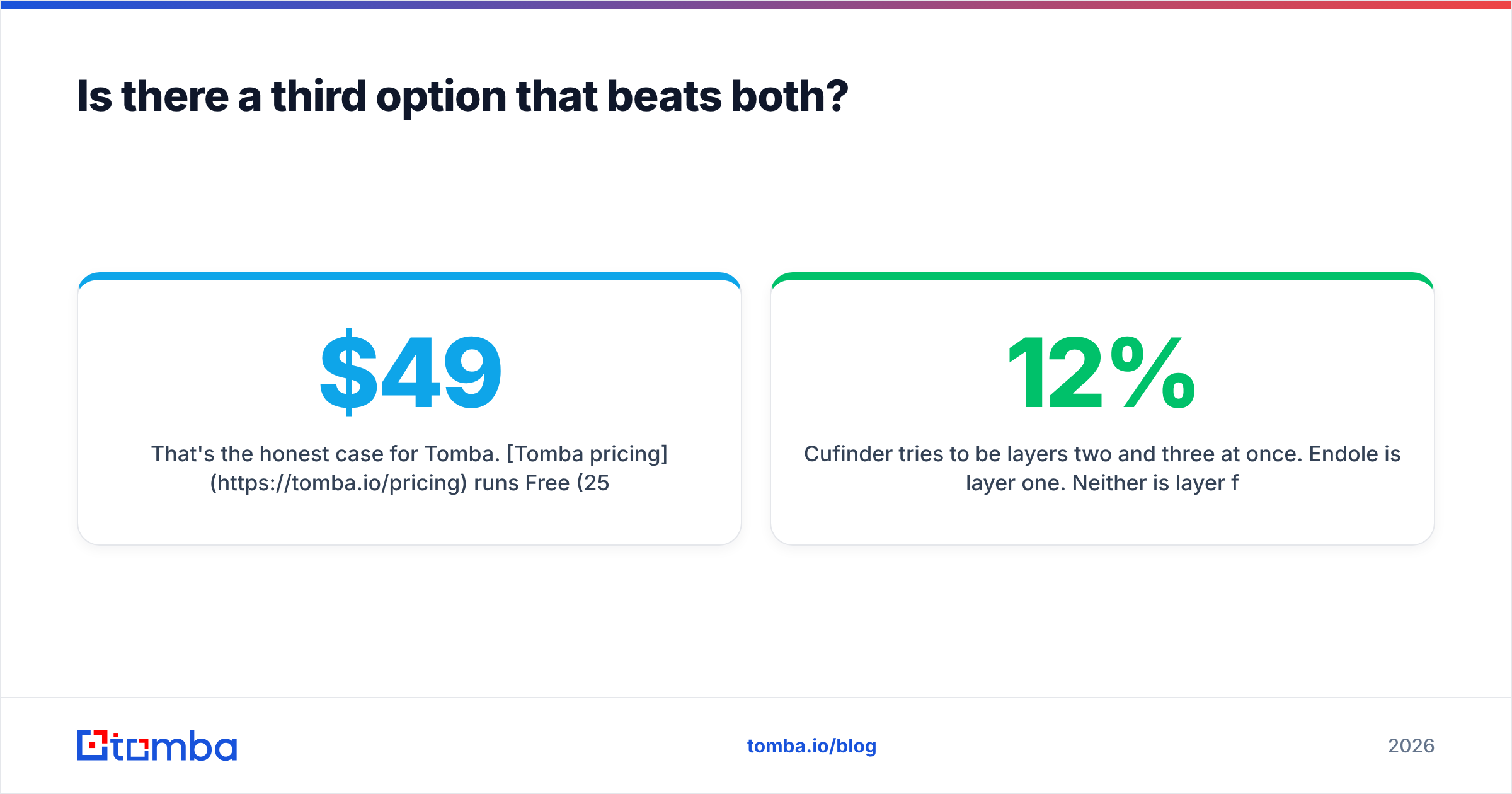
That's the honest case for Tomba. Tomba pricing runs Free (25 searches/mo), Starter $49/mo, Growth $99/mo, Pro $249/mo, and Enterprise custom — the same entry point as Cufinder, spent entirely on finding and verifying addresses rather than spread across a dozen enrichment engines. Verification, catch-all handling, bulk email finder processing, and an API are core, not add-ons.
It's also worth knowing the rest of the field before you decide. BookYourData takes a different and legitimate approach — pay-as-you-go verified contact lists with a guarantee attached, which suits teams who'd rather buy a clean list than run enrichment infrastructure. It's a solid option and a genuinely different model from both tools in this comparison. For UK financials specifically, Endole's closest peers are Creditsafe and Company Check, not Cufinder.
The realistic stack for a UK-focused B2B team in 2026 looks like this:
- Account intelligence layer — Endole (or a peer) to identify and qualify UK entities on real financials
- Contact layer — a dedicated email finder to turn those qualified accounts into reachable people
- Verification layer — bounce protection before send, non-negotiable at any real volume
- CRM — where the enriched, verified record lands
Cufinder tries to be layers two and three at once. Endole is layer one. Neither is layer four. Buying one and expecting the whole stack is how teams end up with a 12% bounce rate and a burnt sending domain by month three.
How should you actually run the evaluation?#
Don't read reviews. Run a bake-off. It takes an afternoon.
- Pull 100 real target accounts from your ICP — not a demo list, your actual pipeline. Include the geographic mix you truly sell into.
- Run them through each free tier. Cufinder gives limited credits, Endole gives free basic company search, Tomba gives 25 searches/mo. That's enough for a signal.
- Score two things separately: entity match rate (did it find the company and tell you something useful?) and contact hit rate (did it give you a deliverable address for the right person?).
- Verify the emails independently. Never trust a finder's own confidence score. Route the addresses through a neutral checker — a free email checker works for a spot test — and count real bounces.
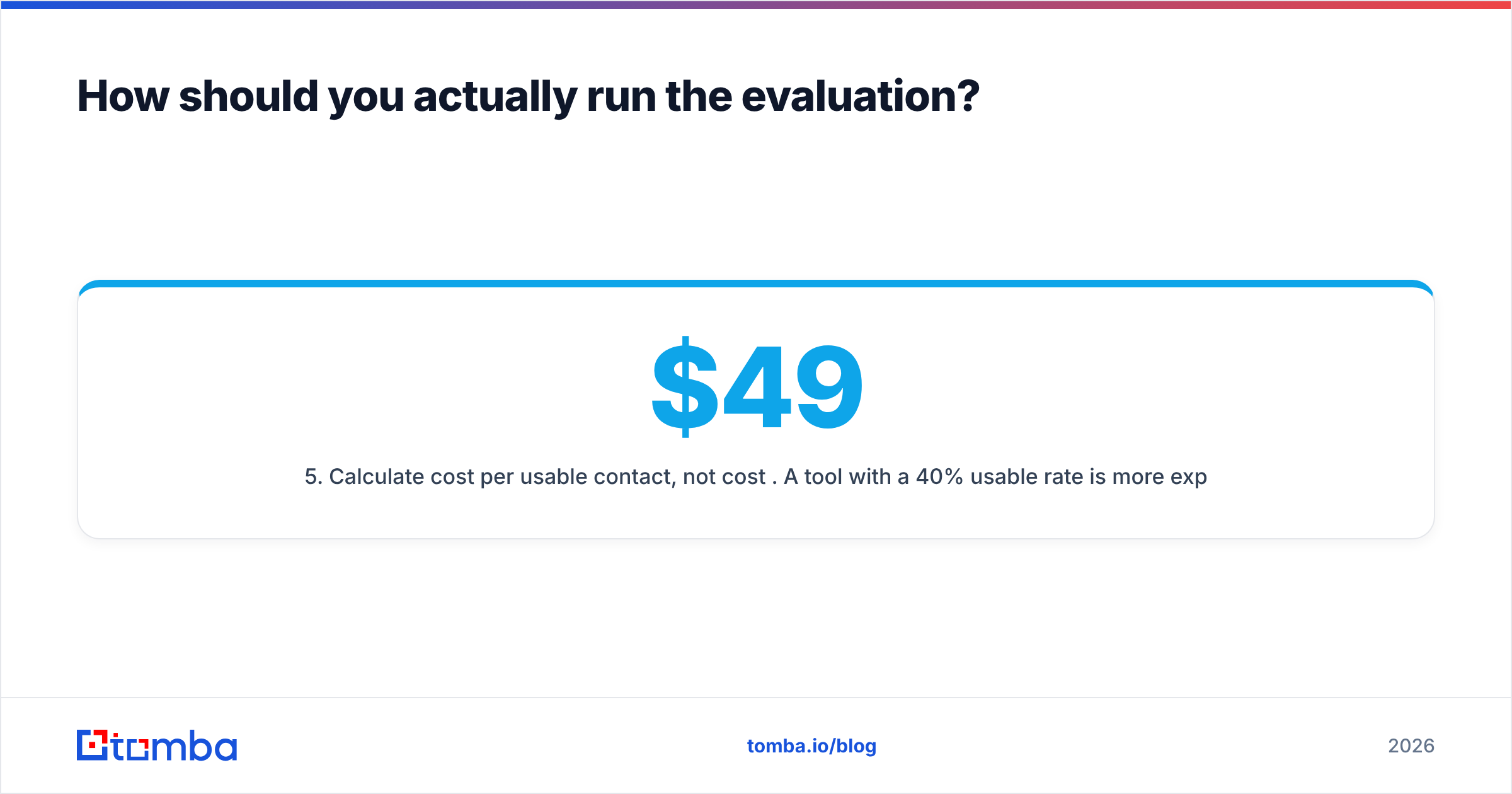
- Calculate cost per usable contact, not cost per credit. A $49 tool with a 40% usable rate is more expensive than a $99 tool at 85%.
- Check the API before you commit. If your workflow is manual today it won't be in six months. Read the docs, check rate limits, confirm the response shape matches your CRM.
Step 4 is the one everyone skips and the one that decides the outcome. Vendor-reported accuracy is marketing. Your bounce log is data. G2 and Capterra reviews are useful for support quality and billing complaints — G2's data providers category is a reasonable starting point — but they will not tell you the fill rate on your specific account list, because nobody has your account list.
What does the verdict come down to?#
If you're UK-only and qualification is your bottleneck: Endole. Statutory data you cannot get elsewhere at that price. Accept that you'll bolt a contact tool onto it.
If you're international and reach is your bottleneck: not Endole, and probably not Cufinder either — Cufinder is a reasonable generalist, but a specialist finder with real verification will beat a multi-engine enrichment suite on the one metric that decides outbound performance, which is deliverable addresses per dollar.
If you're comparing these two because you have one budget line and need both jobs done: you have the wrong shape of problem. Split the budget. A UK data source at ~£35/month plus a focused email finder at $49/month costs less than most all-in-one platforms and does both jobs properly instead of each one at 60%.
The uncomfortable truth about this category is that the "all-in-one B2B data platform" pitch mostly wins because buyers don't want to manage two vendors. That preference costs real money in bounced sends and blown quarters. Two good tools beat one mediocre one, and the integration overhead in 2026 is a Zapier step, not an engineering project.
Ready to fix the contact layer? If you've qualified your accounts and now need real, deliverable addresses for the people inside them, Tomba Email Finder is built for exactly that job — 195+ countries, verification built in rather than bolted on, and a free tier with 25 searches per month so you can test it against your own list before you pay anyone. Run the bake-off in step 1 above. Let your bounce rate pick the winner.
Related guides#
Ready to find emails that actually work?
Join 150,000+ professionals who stopped guessing and started sending. Free credits on signup — no credit card required.
Get the Tomba newsletter
Practical outbound tactics and product updates — once every two weeks.
About the author