Cufinder vs Jet Leads Pro (2026): Which Lead Tool Wins?
A neutral, hands-on comparison of Cufinder and Jet Leads Pro across accuracy, pricing, data depth, and workflow fit—so you can pick the lead tool that actually earns its budget in 2026.
Choosing between Cufinder and Jet Leads Pro comes down to one question most review pages dodge: when you export 1,000 contacts, how many actually reach a real inbox? Both promise B2B emails, company data, and enrichment. Neither is a bad tool. But they win on different jobs, and paying for the wrong one quietly taxes every campaign you run.
This is a neutral breakdown—no vendor is paying for a verdict here. We compare data accuracy, pricing, coverage, and workflow fit, then tell you which buyer each tool suits and where a purpose-built email finder like Tomba fits into the picture.
TL;DR: Cufinder vs Jet Leads Pro at a glance#
- Cufinder is the broader data platform—company enrichment, technographics, and a large B2B database aimed at RevOps and enrichment workflows.
- Jet Leads Pro is the lighter, prospecting-first option—faster to learn, cheaper to start, but shallower on firmographic depth and verification.
- Accuracy is the real battleground. Raw contact volume means nothing if bounce rates wreck your sender reputation.
- Pricing favors Jet Leads Pro at entry level, but per-credit cost and verification quality flip the math at scale.
- If deliverability is the priority, pair either tool with dedicated verification—or start with a finder that verifies at the source.

What is Cufinder and who is it for?#
Cufinder is a B2B data and enrichment platform. Its core pitch is breadth: company search, contact discovery, technographic signals, and API-based enrichment that plugs into your CRM. Teams reach for it when they need to fill in missing firmographic fields—industry, headcount, tech stack, revenue band—across a large account list, not just grab a single email.
That makes Cufinder a natural fit for revenue operations and demand-gen teams who already have accounts and need to enrich them. Think of it less like a scalpel and more like a Swiss Army knife: lots of blades, useful when your job spans enrichment, segmentation, and list-building at once.
The trade-off is that breadth dilutes focus. A platform juggling technographics, firmographics, and contact discovery rarely matches a specialist on any single axis—especially email verification, where accuracy compounds across every send.
What is Jet Leads Pro and who is it for?#
Jet Leads Pro is a prospecting-first lead tool built for speed. The workflow is simple: search by role or company, pull contacts, export. It targets founders, solo SDRs, and small teams who want leads today without a RevOps onboarding project.
Its strength is the low barrier. Pricing starts cheap, the interface is uncluttered, and you can go from signup to first export in minutes. For a two-person team running lightweight outbound, that immediacy is worth a lot.
The ceiling shows up at scale. Firmographic depth is thinner, enrichment is limited, and verification is basic—meaning the burden of cleaning lists lands back on you before any cold email goes out.
Cufinder vs Jet Leads Pro: the core comparison#
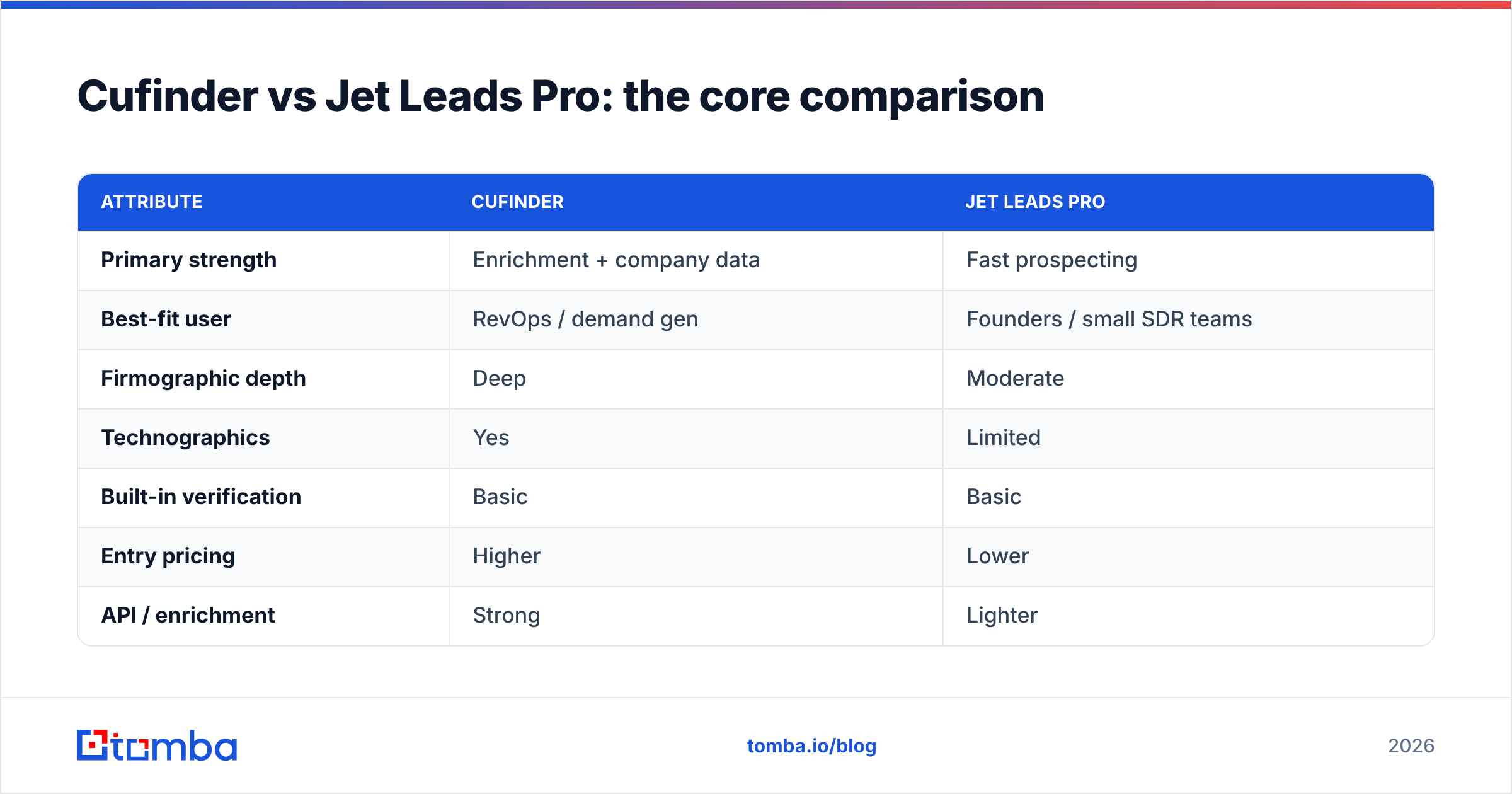
Here is the head-to-head on the attributes that actually change outcomes. Treat vendor-published accuracy numbers as directional—always run your own sample test before committing budget.
| Attribute | Cufinder | Jet Leads Pro |
|---|---|---|
| Primary strength | Enrichment + company data | Fast prospecting |
| Best-fit user | RevOps / demand gen | Founders / small SDR teams |
| Firmographic depth | Deep | Moderate |
| Technographics | Yes | Limited |
| Built-in verification | Basic | Basic |
| Entry pricing | Higher | Lower |
| API / enrichment | Strong | Lighter |
| Learning curve | Moderate | Low |
The pattern is clear: Cufinder trades simplicity for depth, Jet Leads Pro trades depth for speed. Neither ships the deep, source-level email verification that keeps bounce rates low—which is why serious senders bolt on a dedicated email verifier regardless of which they choose.
Which has better data accuracy?#
Accuracy is where a lead tool earns or loses its keep, because every bad record has a downstream cost. A 10% bounce rate doesn't just waste 10% of your list—it drags your domain reputation down for the other 90%, tanking inbox placement for contacts that were perfectly valid.

Between the two, Cufinder's larger database gives it a coverage edge on mid-market and enterprise accounts, while Jet Leads Pro can feel patchier outside its core segments. But coverage and accuracy are different metrics. A tool can return an email for nearly every search and still be wrong a fifth of the time—the guess just looks like data.
Three habits protect you no matter which tool you pick:
- Sample before you scale. Pull 100 contacts, verify them independently, and measure the real valid rate before buying credits in bulk.
- Verify catch-all domains separately. Both tools will happily return addresses on catch-all servers that accept everything and confirm nothing. A dedicated catch-all verifier is the only reliable check.
- Re-verify aged lists. B2B data decays roughly 2–3% per month as people change jobs. Last quarter's export is already stale.
This is the strongest argument for a finder that verifies at the point of discovery rather than handing you unverified guesses to clean up later.
Cufinder vs Jet Leads Pro: pricing compared#
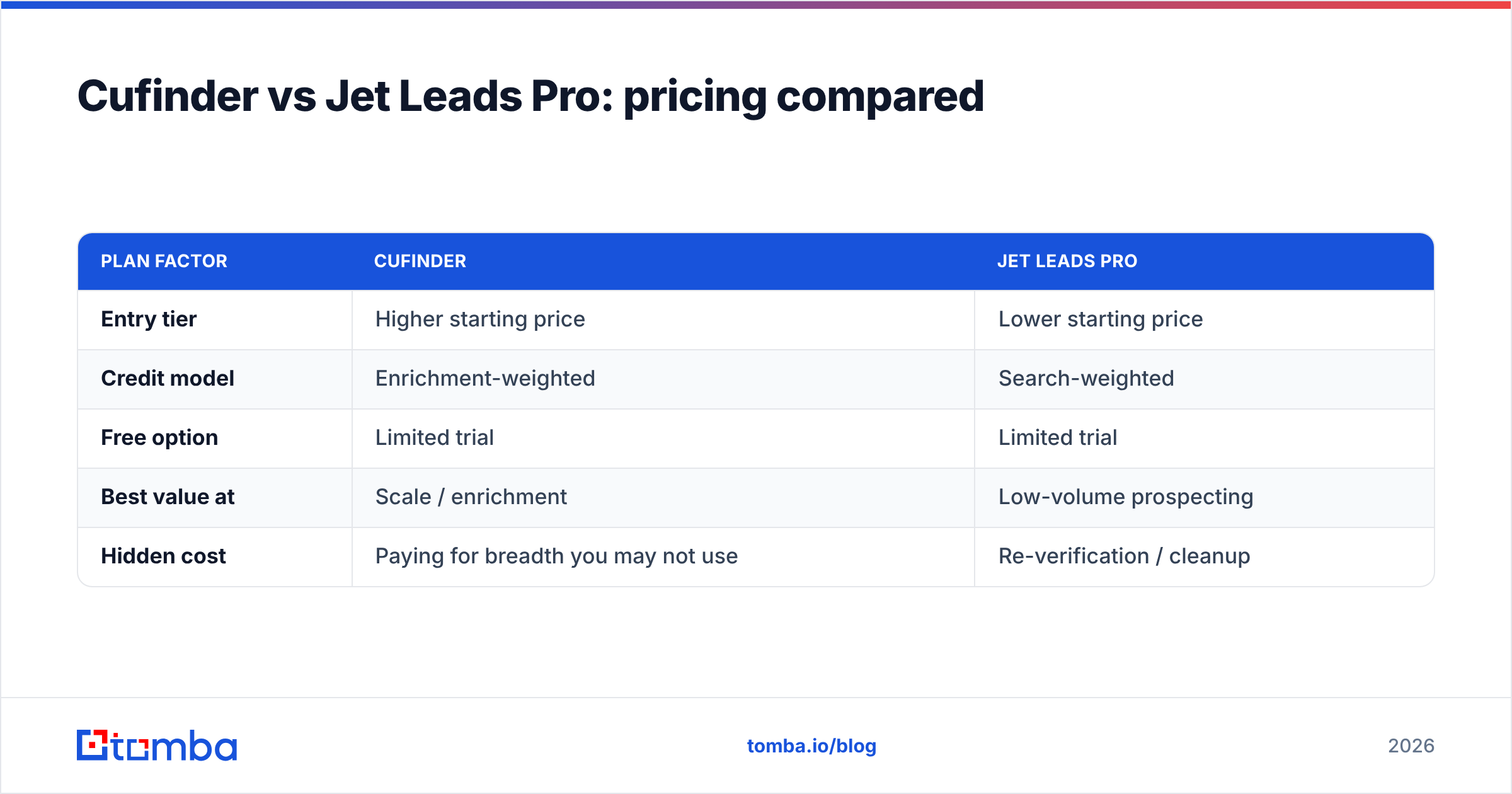
Pricing is where the "cheaper" tool often isn't. Entry price is only one variable—what matters is cost per usable contact after you subtract bounces and duplicates.
| Plan factor | Cufinder | Jet Leads Pro |
|---|---|---|
| Entry tier | Higher starting price | Lower starting price |
| Credit model | Enrichment-weighted | Search-weighted |
| Free option | Limited trial | Limited trial |
| Best value at | Scale / enrichment | Low-volume prospecting |
| Hidden cost | Paying for breadth you may not use | Re-verification / cleanup |
Jet Leads Pro wins the sticker-price comparison for a solo operator sending low volume. Cufinder justifies its premium only if you genuinely use the enrichment and technographic layers—if you're just grabbing emails, you're paying for blades you never open.
For reference, a specialist like Tomba prices transparently: a free tier with 25 searches per month, then Starter at $49/mo and Growth at $99/mo. You can compare the full Tomba pricing tiers directly rather than reverse-engineering credit math. The point isn't that cheaper is better—it's that you should price per verified contact, not per search.

How do they handle enrichment and integrations?#
Enrichment is Cufinder's home turf. If your workflow is "here are 5,000 accounts, fill in the gaps," its firmographic and technographic depth is the reason to choose it over a lighter tool. It slots into a CRM-centric stack where enrichment runs continuously in the background.
Jet Leads Pro treats enrichment as a bonus rather than a backbone. You'll get core contact fields, but don't expect deep tech-stack signals or nuanced segmentation data. For a team that just needs name, title, and email, that's fine—and arguably less to pay for.
Whichever you choose, integrations decide how much manual export-import friction you inherit. Look for native connections to your CRM and outreach tools; Tomba, for comparison, offers direct HubSpot integration and Salesforce integration plus a Tomba API so verified data flows in without a CSV shuffle. The less data touches a spreadsheet, the less it decays and the fewer errors creep in.
Cufinder vs Jet Leads Pro: pros and cons#
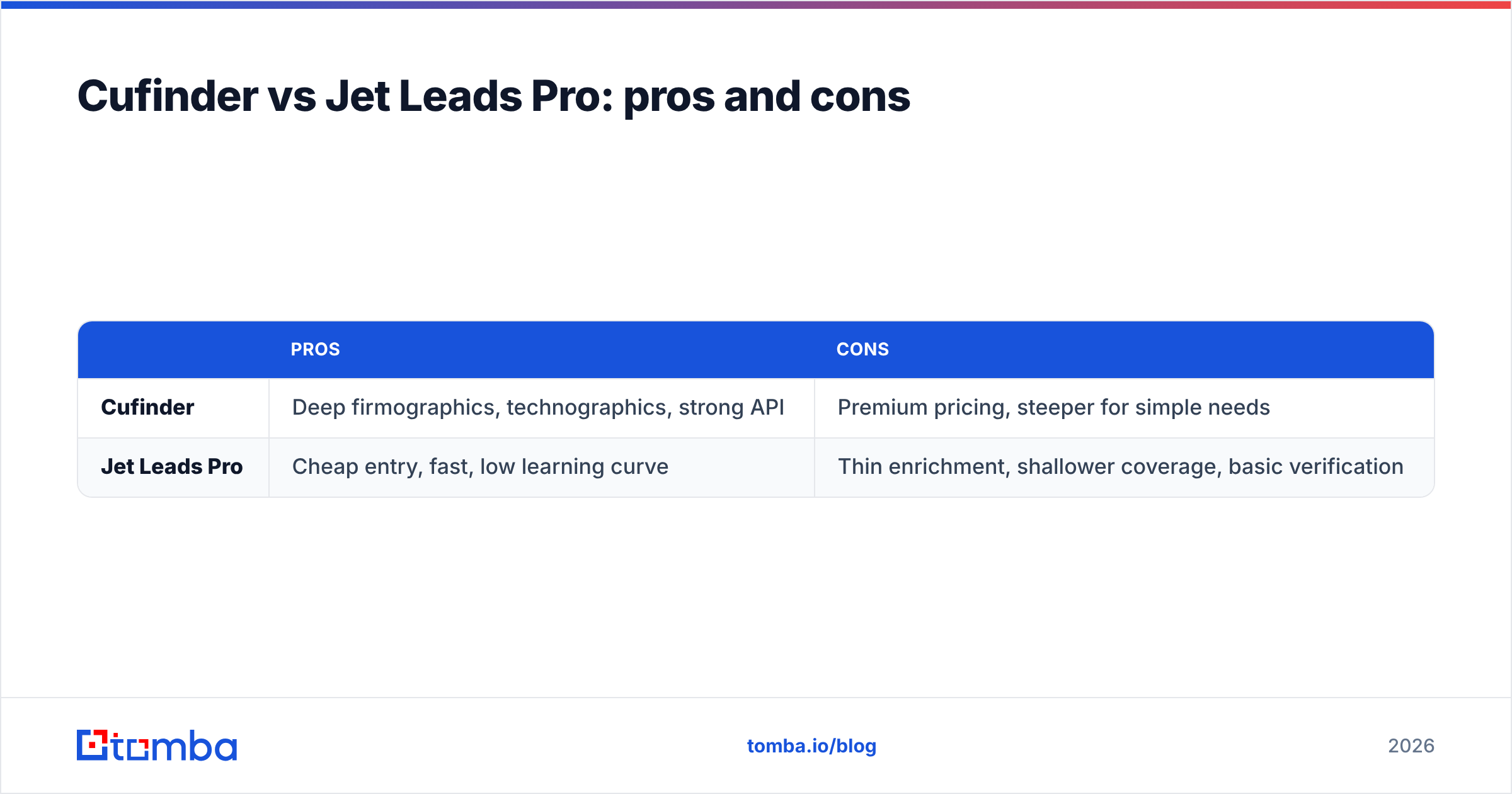
| Pros | Cons | |
|---|---|---|
| Cufinder | Deep firmographics, technographics, strong API | Premium pricing, steeper for simple needs |
| Jet Leads Pro | Cheap entry, fast, low learning curve | Thin enrichment, shallower coverage, basic verification |
Neither list includes "best-in-class verification," and that's deliberate. Both are competent lead sources; neither is a deliverability tool. If your outbound lives or dies on inbox placement, that gap is the one that costs you.
Where does Tomba fit in this comparison?#
Tomba approaches the problem from the accuracy end instead of the volume end. Rather than maximizing how many contacts appear in a search, it focuses on returning emails you can actually send to—verification is built into the finding step, not sold as a separate cleanup.
That makes Tomba a strong complement or alternative depending on your job to be done:
- Finding emails by domain or name — the Tomba Email Finder and domain search return verified professional addresses with a confidence score.
- Cleaning an existing Cufinder or Jet Leads Pro export — run it through the email verifier and bulk email finder before it ever hits your sequencer.
- Killing catch-all guesswork — the catch-all verifier tells you which "accept-all" domains are safe to send to.
You don't have to abandon a broader platform to fix bounces. Many teams keep Cufinder for enrichment or Jet Leads Pro for speed, then route every address through Tomba as the final accuracy gate. For deeper background on the mechanics, the guides on email deliverability and independent review sites like G2 are worth a read before you commit.
How should you choose between them?#
Match the tool to the job, not the marketing page:
- Choose Cufinder if enrichment is central—you have accounts and need firmographic and technographic depth across them, and you'll actually use the API. Cross-check its accuracy claims against a G2 sample of recent reviews.
- Choose Jet Leads Pro if you're a founder or small team who wants leads fast and cheap, and you're willing to verify lists yourself before sending.
- Add a specialist verifier either way if deliverability matters—because the fastest way to burn a domain is to trust unverified data at scale.
A useful gut check: if more than half your budget justification is "it has lots of data," you're buying volume. If it's "it sends to real inboxes," you're buying accuracy. Outbound results track the second number, not the first.
The bottom line#
Cufinder and Jet Leads Pro solve different problems well. Cufinder is the deeper enrichment platform for RevOps teams; Jet Leads Pro is the fast, affordable prospecting tool for lean operators. Neither is built primarily around verification—so whichever you choose, the accuracy of what actually lands in inboxes is on you to protect.
If your priority is emails that reach real people the first time, start where accuracy is the product. Try the Tomba Email Finder free—25 searches a month, no card—and measure the valid rate against whatever your current tool exports. Let the bounce numbers, not the brochure, pick your winner.
Related guides#
Ready to find emails that actually work?
Join 150,000+ professionals who stopped guessing and started sending. Free credits on signup — no credit card required.
Get the Tomba newsletter
Practical outbound tactics and product updates — once every two weeks.
About the author