Cufinder vs PrivCo (2026): B2B Data Platforms Compared
Cufinder vs PrivCo: one enriches contacts and companies for outbound, the other sells deep private-company financials. See which fits your B2B workflow — and where a leaner email tool beats both.
Cufinder vs PrivCo sounds like a fair fight until you look at what each one actually sells. One is a contact-and-company enrichment engine built for outbound teams. The other is a private-company financial intelligence database built for investors, bankers, and researchers. Picking between them without understanding that gap is how teams overpay for data they never use.
This comparison breaks down what each platform does well, where the pricing bites, and which one fits your actual job — prospecting, deal sourcing, or market research. And because most people searching this matchup really just need accurate contact data to start outreach, we'll show where a focused tool beats both.
TL;DR: Cufinder vs PrivCo at a glance#
- Cufinder is a B2B lead-generation and enrichment platform — company search, contact discovery, email and phone enrichment, and API access aimed at sales and marketing teams.
- PrivCo is a private-company financial database — revenue estimates, funding history, M&A, and ownership data aimed at PE, VC, IB, and corp-dev researchers.
- They barely overlap. If you want to fill a CRM with contacts, Cufinder is closer. If you want to underwrite a private company, PrivCo is the answer.
- Neither is a specialist email finder. For verified email discovery at a lower price point, a dedicated tool like the Tomba Email Finder is faster and cheaper.
- Pricing philosophy differs hard: Cufinder sells credits and seats; PrivCo sells research seats with premium annual contracts.
What is Cufinder and who is it for?#
Cufinder is a B2B data platform focused on lead generation and enrichment. It maintains a database of companies and professional contacts, then layers on tools to search, filter, and enrich that data. The typical user is an SDR, a growth marketer, or a RevOps lead who needs to turn a list of company names into a working outreach list.
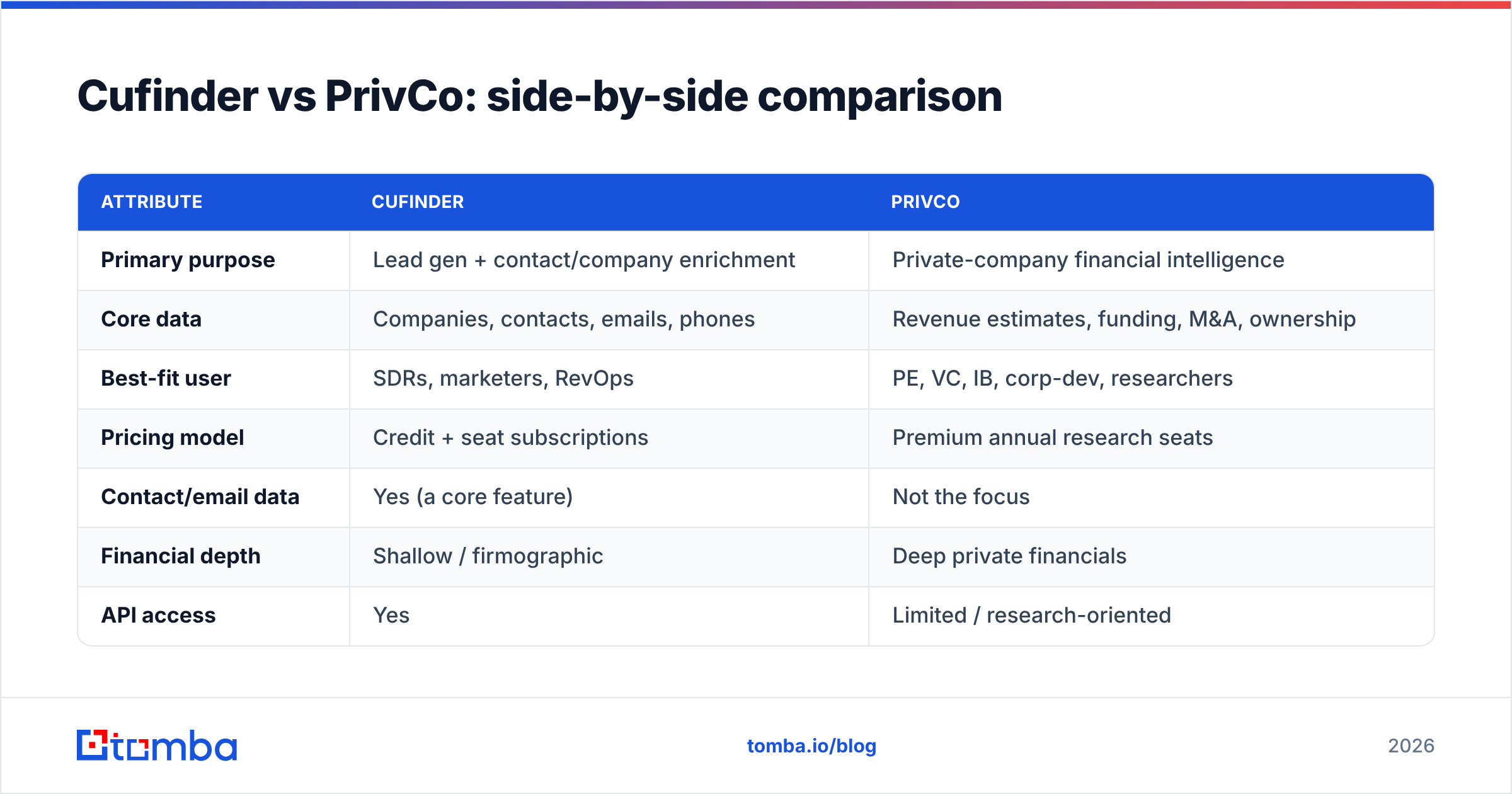
Core Cufinder capabilities include:
- Company search — filter a B2B database by industry, size, location, and technographics.
- Contact discovery — find decision-makers and their professional details inside target accounts.
- Email and phone enrichment — append contact and firmographic fields to existing records.
- Bulk enrichment and API — process lists and pipe data into your stack programmatically.
- CRM-oriented workflow — export or sync enriched leads into your sales tools.
The value proposition is breadth: a single credit-based subscription that covers finding companies, finding people, and enriching both. That makes it a reasonable "all-in-one" starting point for a small outbound team that doesn't want to stitch three tools together.

The catch, as with most all-in-one data vendors, is that accuracy and coverage vary by region and role seniority. Broad databases are strong on well-documented US mid-market companies and thinner on niche verticals, small businesses, and non-English-speaking markets. If your ICP sits outside the "well-covered" zone, credit burn on unusable records adds up quietly.
What is PrivCo and who is it for?#
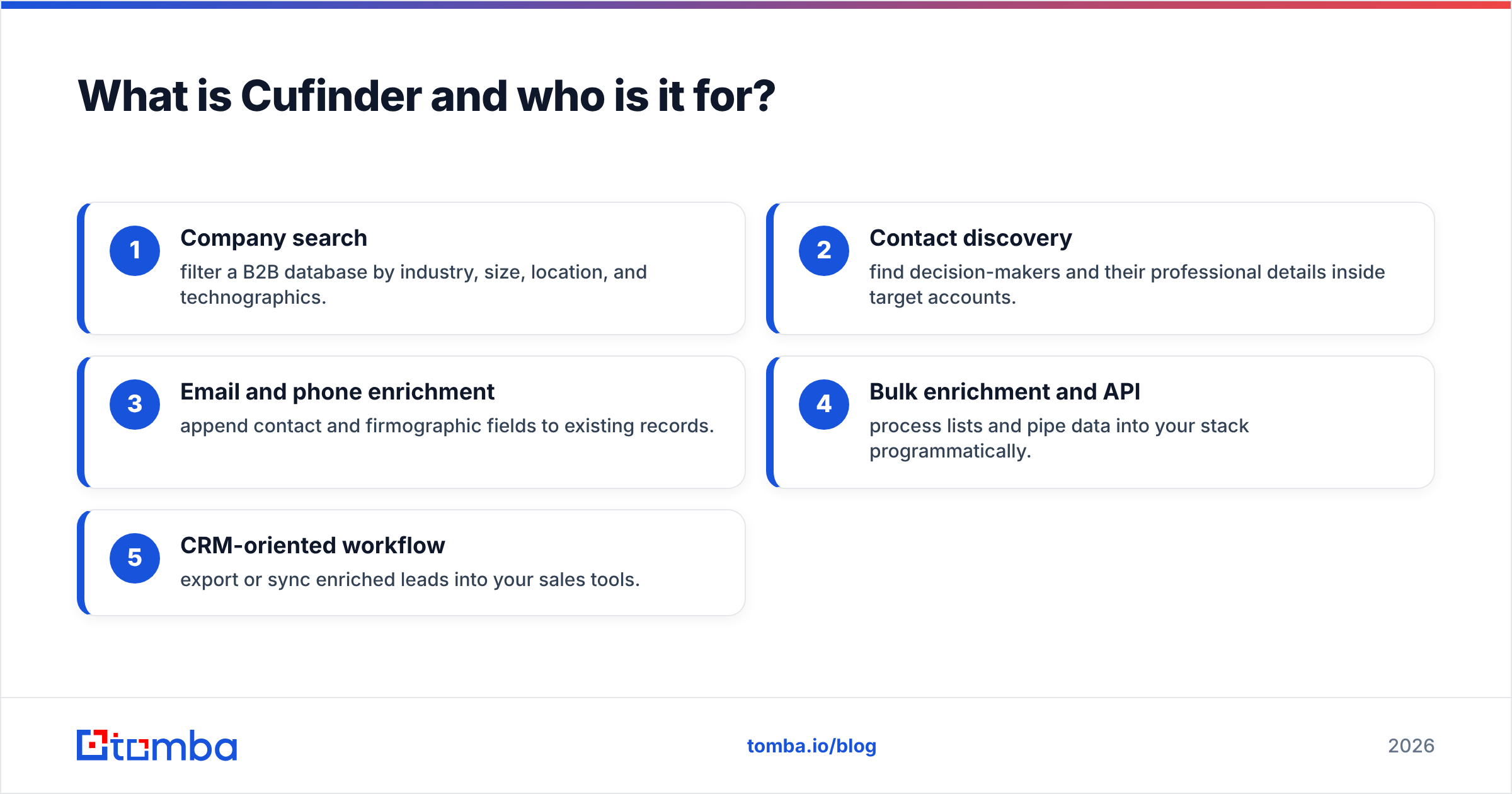
PrivCo is a completely different animal. It's a private-company financial research platform. Instead of "give me 500 marketing directors at SaaS companies," PrivCo answers "what's the estimated revenue, funding history, and ownership structure of this specific private business?"
PrivCo's data is built for due diligence and deal sourcing:
- Private-company financials — revenue and employee estimates for companies that don't file public reports.
- Funding and M&A history — rounds, investors, acquisitions, and valuations.
- Ownership and investor data — who backs a company and who sits behind it.
- Screening and lists — build target lists for sourcing based on financial and growth criteria.
The buyer here is not an SDR. It's a private-equity associate, a venture investor, an investment banker, a corporate-development team, or a market researcher. The job to be done is understanding a company's financial profile before a call, an offer, or an investment memo — not blasting a sequence.
Because of that audience, PrivCo prices like a research subscription, not a lead tool. Expect annual seat-based contracts positioned well above typical sales-tool budgets. That's normal for financial-intelligence products, but it's the reason a sales team should almost never be comparing PrivCo to a prospecting tool in the first place.
Cufinder vs PrivCo: side-by-side comparison#
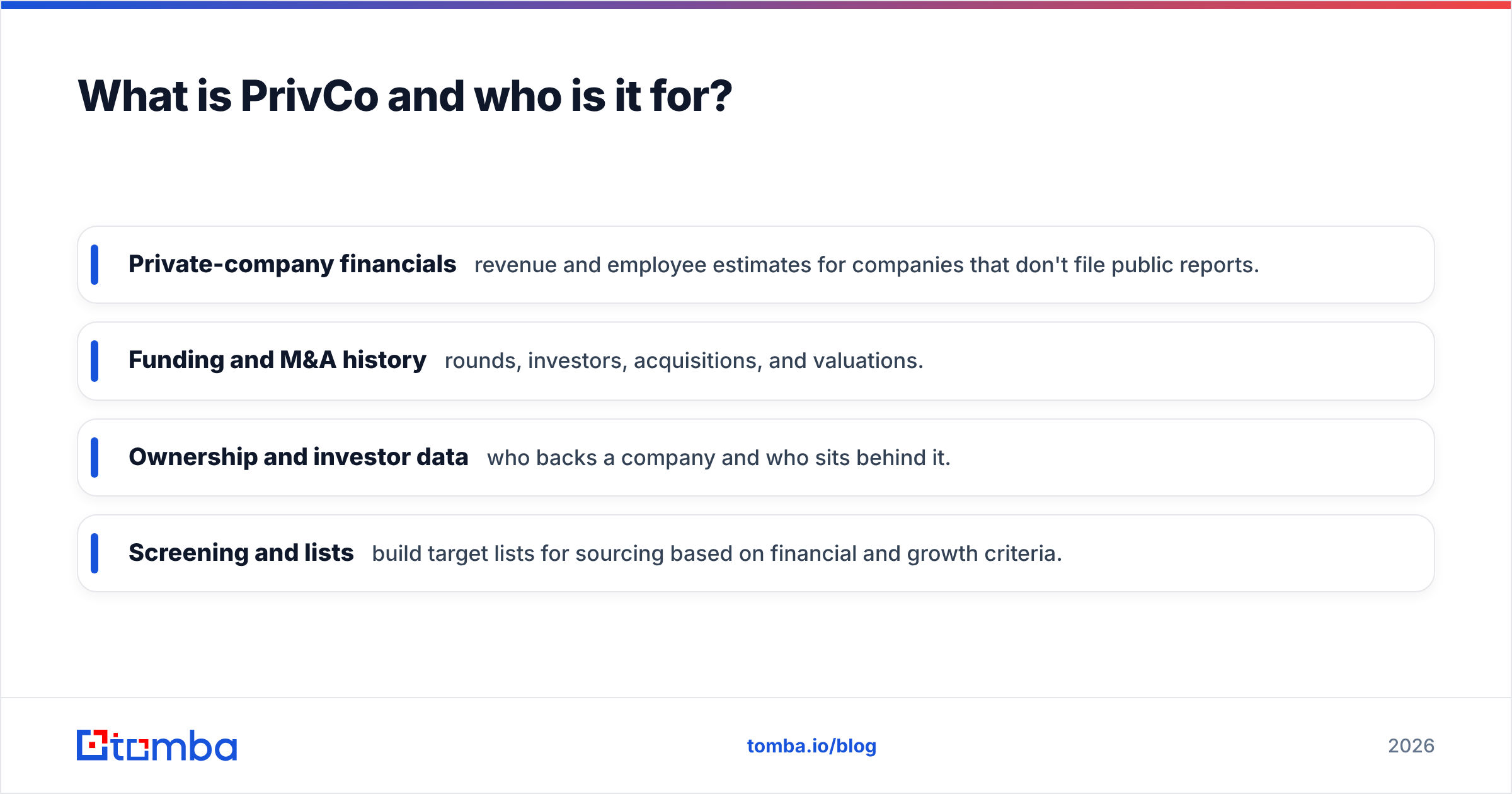
| Attribute | Cufinder | PrivCo |
|---|---|---|
| Primary purpose | Lead gen + contact/company enrichment | Private-company financial intelligence |
| Core data | Companies, contacts, emails, phones | Revenue estimates, funding, M&A, ownership |
| Best-fit user | SDRs, marketers, RevOps | PE, VC, IB, corp-dev, researchers |
| Pricing model | Credit + seat subscriptions | Premium annual research seats |
| Contact/email data | Yes (a core feature) | Not the focus |
| Financial depth | Shallow / firmographic | Deep private financials |
| API access | Yes | Limited / research-oriented |
| Typical use case | Fill CRM, run outbound | Diligence, deal sourcing |
The table makes the real conclusion obvious: this is rarely an either/or decision because the two tools serve different departments. Sales teams compare Cufinder to other prospecting and enrichment tools. Investment and research teams compare PrivCo to platforms like PitchBook or CB Insights. The overlap in the middle — "I want company data" — is thin enough that most buyers should pick based on their actual workflow, not a feature checklist.
Which one is better for sales prospecting?#
Cufinder, without contest — because PrivCo isn't built for it. If your goal is to identify accounts, find the right people, and get contact details you can actually email or call, PrivCo's financial depth is wasted spend and its contact coverage is not the point of the product.
But "better than PrivCo for sales" is a low bar. The harder question is whether Cufinder is the right prospecting stack, and that depends on two things most all-in-one platforms struggle with:
- Email accuracy. Outbound lives and dies on bounce rate. A contact record is worthless if the email is guessed and never verified. Broad enrichment databases often return plausible-but-stale addresses, which quietly wreck sender reputation when you send at volume.
- Verification, not just discovery. Finding an email and confirming it deliverable are two separate jobs. Tools that only find leave you to clean the list yourself.
This is where a dedicated finder-and-verifier stack tends to outperform a generalist. With a focused workflow you can run domain search to map a company's addresses, find the specific person you need, and verify each email before it ever enters a sequence.

How does pricing compare?#
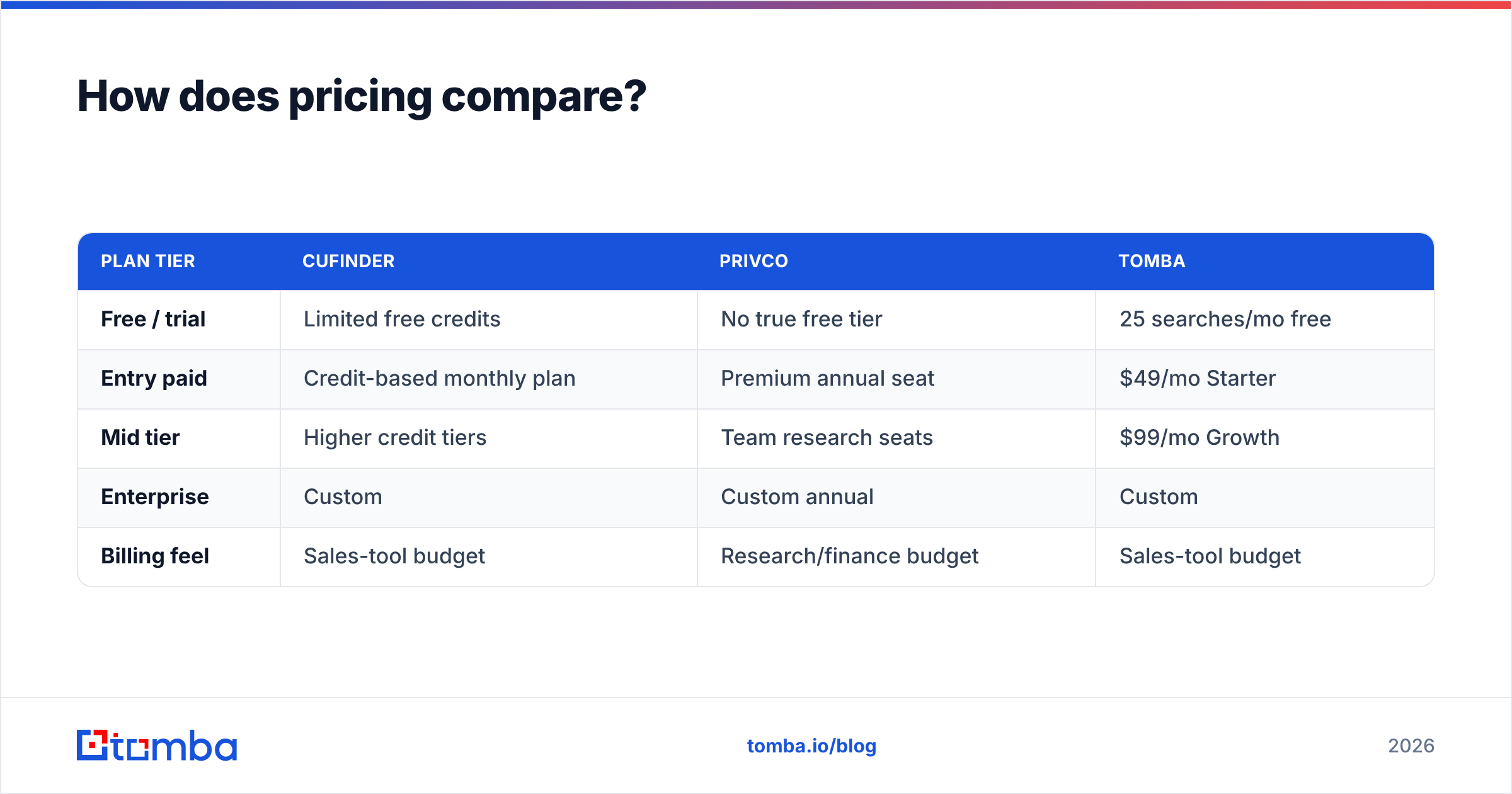
Cufinder and PrivCo price for different planets, so a raw number comparison is misleading. Here's the shape of it, plus where a specialist tool lands for teams that only need contact data.
| Plan tier | Cufinder | PrivCo | Tomba |
|---|---|---|---|
| Free / trial | Limited free credits | No true free tier | 25 searches/mo free |
| Entry paid | Credit-based monthly plan | Premium annual seat | $49/mo Starter |
| Mid tier | Higher credit tiers | Team research seats | $99/mo Growth |
| Enterprise | Custom | Custom annual | Custom |
| Billing feel | Sales-tool budget | Research/finance budget | Sales-tool budget |
Two takeaways:
- PrivCo is a finance-department purchase. If you're evaluating it against a $49–$99/mo sales tool, you're comparing the wrong category. Its cost is justified by diligence use cases, not outbound volume.
- Cufinder competes on credits. Credit models look cheap until you factor in wasted credits on unverified or out-of-ICP records. Always test accuracy on your segment before committing to an annual plan.
For teams whose real need is "accurate emails to start outreach," you can see transparent Tomba pricing that starts at $49/mo — with a free tier to test accuracy before you pay anything.
Where do both tools fall short for email outreach?#
Neither Cufinder nor PrivCo is a specialist in the one thing outbound teams need most: verified, deliverable email addresses at scale. Cufinder treats email as one feature among many; PrivCo doesn't prioritize it at all. That leaves a gap in three places:
- Catch-all domains. Many corporate domains accept every address, so a basic check can't confirm deliverability. You need a real catch-all verifier to avoid guessing.
- List hygiene at volume. Bulk enrichment without bulk verification just moves the bounce problem downstream into your inbox provider's spam judgment.
- Data freshness. People change jobs constantly. A record enriched six months ago may point at someone who left — an accuracy problem no amount of financial data solves.
A focused stack closes that gap directly: find emails by domain or name, enrich the surrounding contact and company fields, and verify every address before send. That's the difference between "we have data" and "we have data we can email today."
Cufinder vs PrivCo: which should you choose?#
Choose based on your job, not the feature grid:
- Pick Cufinder if you're a sales or marketing team that wants an all-in-one starting point for finding companies and contacts, and you're willing to test accuracy on your ICP before committing credits.
- Pick PrivCo if you're an investor, banker, or researcher who needs deep private-company financials, funding history, and ownership data — and you have a research budget to match.
- Pick a specialist finder if your real bottleneck is verified email addresses for outreach. In that case, both platforms are more than you need and less accurate than a dedicated tool on the one metric that matters — deliverability.
For most people typing "cufinder vs privco" into Google, the honest answer is that you're comparing a prospecting tool to a finance-research tool, and the thing you actually want is clean contact data. Cross-check any vendor's reputation on independent review sites like G2 before you sign, and always trial accuracy on your own segment.
Get accurate, verified emails without the bloat#
If your goal is outbound — not investment diligence — you don't need a heavyweight database or a finance-grade research subscription. You need email addresses that actually land. The Tomba Email Finder finds professional emails by name, company, or domain, pairs discovery with built-in verification, and enriches the surrounding contact data so your CRM stays clean. Start free with 25 searches a month, test the accuracy on your own target accounts, and scale to a $49/mo plan only once the results prove out. Skip the credit gamble and the finance-tool price tag — go straight to data you can send to.
Related guides#
Ready to find emails that actually work?
Join 150,000+ professionals who stopped guessing and started sending. Free credits on signup — no credit card required.
Get the Tomba newsletter
Practical outbound tactics and product updates — once every two weeks.
About the author