Cufinder vs Reachfast (2026): Which Email Finder Wins?
Cufinder and Reachfast both promise fresh B2B emails and phone numbers, but they price and verify data very differently. Here's the honest head-to-head — plus a more accurate pick.
Cufinder vs Reachfast (2026): Which Email Finder Wins?
Choosing between Cufinder and Reachfast comes down to one question most review pages dodge: which one hands you emails that actually land in an inbox, not a bounce report? Both sell themselves as B2B contact engines. Both quote big database numbers. But they solve slightly different problems, and the wrong pick will quietly burn your sender reputation for a month before you notice.
This is a neutral breakdown — where each tool wins, where each one costs you, and where a verification-first option like Tomba fits if raw coverage isn't the whole story.
TL;DR: Cufinder vs Reachfast at a glance#
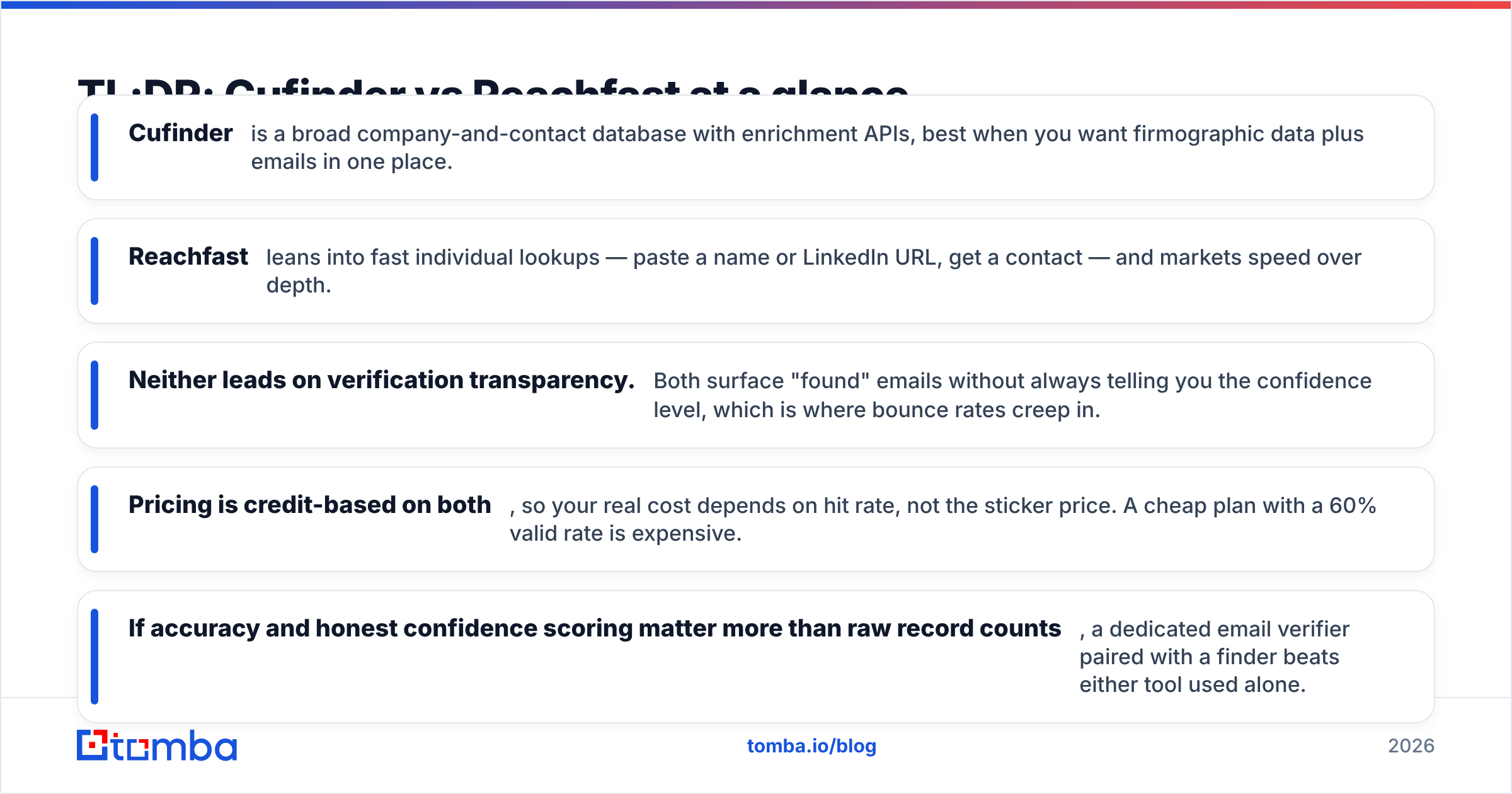
- Cufinder is a broad company-and-contact database with enrichment APIs, best when you want firmographic data plus emails in one place.
- Reachfast leans into fast individual lookups — paste a name or LinkedIn URL, get a contact — and markets speed over depth.
- Neither leads on verification transparency. Both surface "found" emails without always telling you the confidence level, which is where bounce rates creep in.
- Pricing is credit-based on both, so your real cost depends on hit rate, not the sticker price. A cheap plan with a 60% valid rate is expensive.
- If accuracy and honest confidence scoring matter more than raw record counts, a dedicated email verifier paired with a finder beats either tool used alone.
What is Cufinder, and who is it for?#
Cufinder is a B2B data platform built around a large company database with layered enrichment. Think of it less like a single email lookup and more like a filing cabinet: you give it a domain or company name, and it returns firmographics, technologies, contacts, and associated emails and phone numbers. It exposes this through a web app and a set of enrichment APIs, so RevOps teams can push data straight into a CRM.
Its sweet spot is account-based work. If you're building a target list of companies and you need to know their size, industry, tech stack, and a few contacts at each, Cufinder's breadth is genuinely useful. You can start from a thin list and fatten it up.
The trade-off is depth per person. Because Cufinder optimizes for coverage across many companies, individual email accuracy varies by region and seniority. You'll get strong results on well-documented US tech firms and thinner results on smaller or non-English-market companies.
What is Reachfast, and who is it for?#
Reachfast is positioned as a fast, lookup-first contact finder. The core loop is simple: feed it a person — a name and company, or a LinkedIn profile — and it returns an email and often a mobile number quickly. It's the "I need to reach this specific human right now" tool rather than the "build me a 5,000-row list" tool.
That makes Reachfast attractive to individual SDRs, recruiters, and founders doing hands-on outbound. The interface is light, the lookups are quick, and you're not wading through firmographic panels you didn't ask for.
The cost of that simplicity is the same one Cufinder faces from the other direction: without a strong, transparent verification layer, "fast" can mean "fast to a guess." A mobile number or email that surfaces instantly is only valuable if it's current.

Cufinder vs Reachfast: the core comparison#
Here's the honest side-by-side. Numbers on database size are vendor-reported and should be treated as marketing, not audited fact — which is exactly why the verification column matters more than the count column.
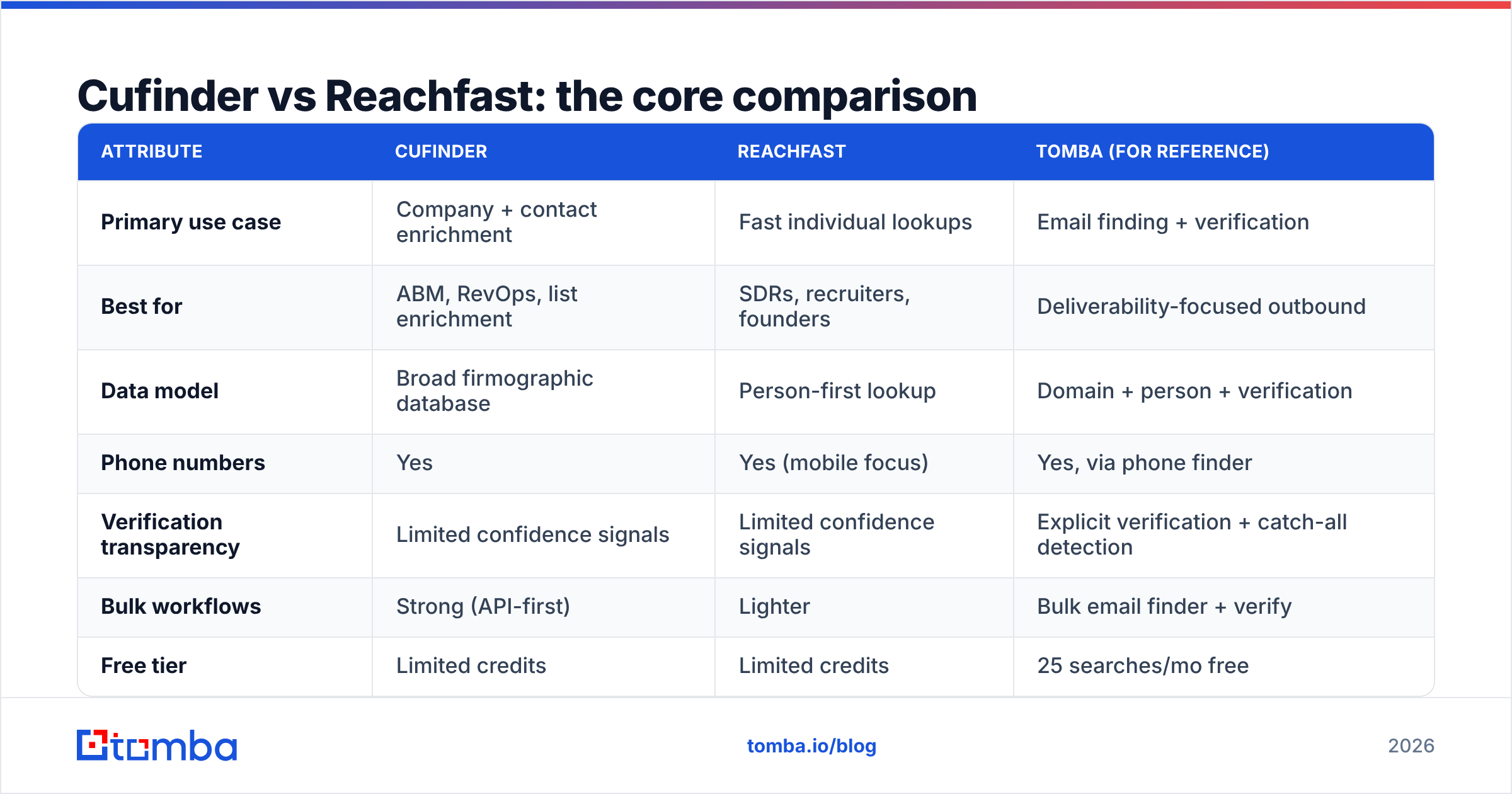
| Attribute | Cufinder | Reachfast | Tomba (for reference) |
|---|---|---|---|
| Primary use case | Company + contact enrichment | Fast individual lookups | Email finding + verification |
| Best for | ABM, RevOps, list enrichment | SDRs, recruiters, founders | Deliverability-focused outbound |
| Data model | Broad firmographic database | Person-first lookup | Domain + person + verification |
| Phone numbers | Yes | Yes (mobile focus) | Yes, via phone finder |
| Verification transparency | Limited confidence signals | Limited confidence signals | Explicit verification + catch-all detection |
| Bulk workflows | Strong (API-first) | Lighter | Bulk email finder + verify |
| Free tier | Limited credits | Limited credits | 25 searches/mo free |
| Pricing model | Credit-based | Credit-based | From $49/mo (see Tomba pricing) |
The pattern is clear: Cufinder wins on breadth, Reachfast wins on speed and simplicity, and both leave the same gap — telling you how confident they are in each email before you send.
Which has better data accuracy?#
Accuracy is the whole game, and it's where generic database size stops mattering. A tool can claim hundreds of millions of records and still hand you a 25% bounce rate if those records are stale.
The failure mode is the same on both platforms: an email is returned as "found" with no clear signal about whether it was verified against a live mail server, inferred from a pattern, or scraped months ago. When you send to an unverified list at scale, mailbox providers notice the bounces fast, and your sender reputation drops. That reputation hit costs you far more than the credits you saved.

This is the argument for a verification-first workflow. Whichever finder you use, the emails should pass through a real SMTP-level check before they enter a sequence. Tomba builds that step in — every result carries a verification status, and catch-all domains are flagged rather than silently passed through as "valid." If you want to see how the sourcing works, Tomba documents its data sources publicly, which is more transparency than most competitors offer.
A practical rule: treat any finder's raw output as a candidate list, not a send list. Run it through an email verifier and drop anything that isn't confirmed deliverable. Your bounce rate is the only accuracy metric that pays your bills.
How do Cufinder and Reachfast pricing compare?#
Both use credits, and both make the same thing hard to see: your effective cost per usable contact. Sticker price is a distraction when hit rates differ.
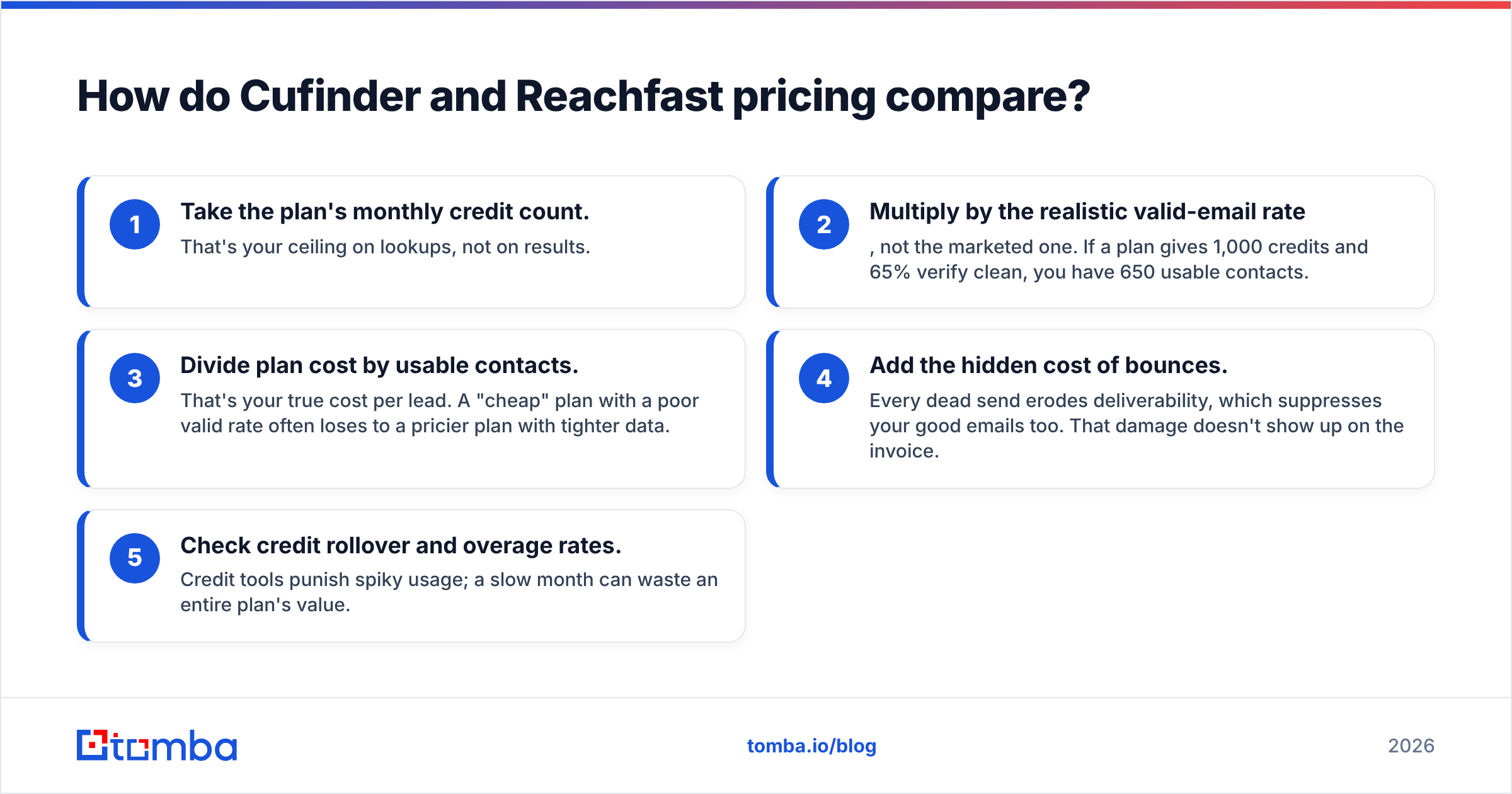
Work it out like this:
- Take the plan's monthly credit count. That's your ceiling on lookups, not on results.
- Multiply by the realistic valid-email rate, not the marketed one. If a plan gives 1,000 credits and 65% verify clean, you have 650 usable contacts.
- Divide plan cost by usable contacts. That's your true cost per lead. A "cheap" plan with a poor valid rate often loses to a pricier plan with tighter data.
- Add the hidden cost of bounces. Every dead send erodes deliverability, which suppresses your good emails too. That damage doesn't show up on the invoice.
- Check credit rollover and overage rates. Credit tools punish spiky usage; a slow month can waste an entire plan's value.
By that math, the winner between Cufinder and Reachfast depends entirely on which one verifies better for your target market — not on which landing page quotes a lower number.

What about coverage outside the US?#
This is where many buyers get surprised. Both tools are strongest on US and Western-European B2B data, especially tech, SaaS, and professional services. If your ICP is mid-market North American companies, either one will feel dense.
Push into smaller markets, non-English domains, or long-tail industries and coverage thins on both. Cufinder's company-first model sometimes recovers a domain-level pattern even when the exact person is missing, which you can then confirm with a domain search and pattern check. Reachfast's person-first model is more all-or-nothing: it finds the individual or it doesn't.
If international coverage is core to your motion, don't trust any single vendor's claim. Run the same 50 real prospects through each tool's free tier and count verified hits. That fifteen-minute test beats a month of assumptions.
Cufinder vs Reachfast: which should you choose?#
Here's the decision, stated plainly:
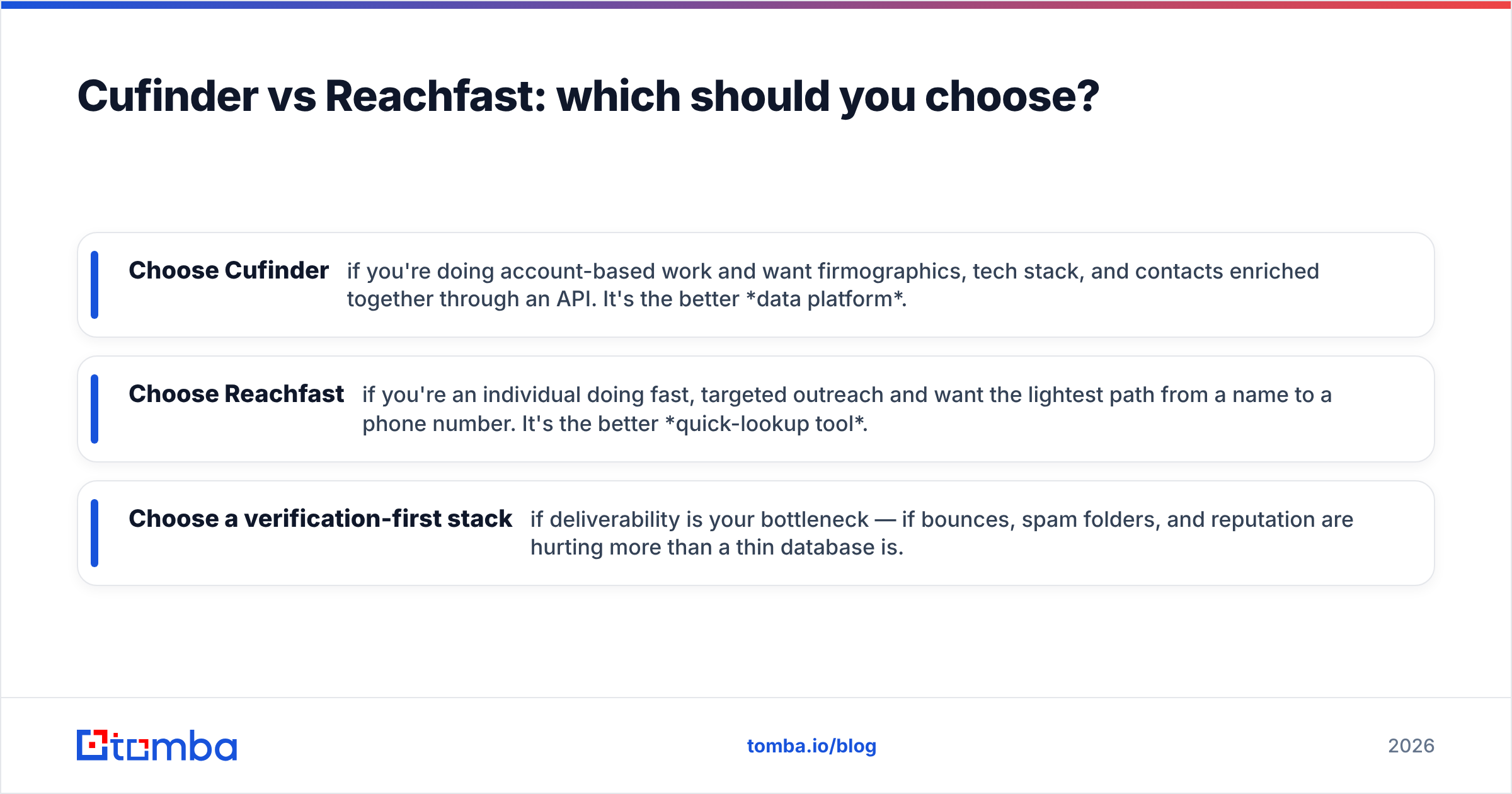
- Choose Cufinder if you're doing account-based work and want firmographics, tech stack, and contacts enriched together through an API. It's the better data platform.
- Choose Reachfast if you're an individual doing fast, targeted outreach and want the lightest path from a name to a phone number. It's the better quick-lookup tool.
- Choose a verification-first stack if deliverability is your bottleneck — if bounces, spam folders, and reputation are hurting more than a thin database is.
For most outbound teams, the last category is the real answer. The finder is only step one; the verification and enrichment around it decide whether your campaign works. Tomba is built for that whole loop — find, verify, enrich, and push to CRM — with confidence scoring on every record. You can compare the full feature set against other tools on G2 and Capterra before committing.
Both Cufinder and Reachfast are competent tools that do what they say. The gap isn't quality of engineering — it's that "found an email" and "verified an email will deliver" are different guarantees, and your bounce rate only respects the second one.
The bottom line#
Cufinder wins on breadth, Reachfast wins on speed, and neither is built to make verification the headline. If your outbound lives or dies on deliverability, start with a tool that treats accuracy as the product, not a byproduct.
Try the Tomba Email Finder free — 25 searches a month, no card — and run your hardest 25 prospects through it. Compare the verified hit rate against whatever you're using now. If Tomba lands more usable contacts, the choice makes itself; if it doesn't, you've lost nothing but fifteen minutes. Accuracy is the only benchmark that survives contact with a real send.

Related guides#
Ready to find emails that actually work?
Join 150,000+ professionals who stopped guessing and started sending. Free credits on signup — no credit card required.
Get the Tomba newsletter
Practical outbound tactics and product updates — once every two weeks.
About the author