CUFinder vs SeamlessAI: The Honest 2026 Data Tool Comparison
CUFinder and Seamless.AI both promise fresh B2B contact data, but they win on different fronts. Here's an honest breakdown of accuracy, pricing, and coverage—plus where a leaner alternative beats both.
The CUFinder vs SeamlessAI choice comes down to one question a pricing page can't answer: whose data lands in your CRM clean? And whose bounces two weeks later? Both tools sell the same promise. You get fresh B2B emails, phone numbers, and company data on demand. But they work in very different ways. And they charge very differently for it.
This is a neutral, hands-on comparison, with no affiliate spin toward either vendor. By the end you'll know three things. Which tool fits your workflow. Where each one costs more than the sticker price. And why many teams pair one of them with a separate verification layer.
TL;DR: CUFinder vs Seamless.AI in 30 seconds#
- Seamless.AI wins on scale and native sales workflow—huge database, Chrome extension, buyer-intent signals—but credits burn fast and users report inconsistent email accuracy.
- CUFinder wins on enrichment breadth and API-first flexibility—good for RevOps teams building automated data pipelines—at a lower entry price than Seamless.
- Neither guarantees verified deliverability out of the box; both benefit from a separate email verifier before you send.
- Pricing is the real differentiator: Seamless.AI leans enterprise and gets expensive at volume; CUFinder is friendlier for small teams and developers.
- If your #1 need is accurate, verified emails at a predictable price, a focused finder like Tomba often beats both on cost-per-valid-contact.
What is CUFinder and who is it for?#
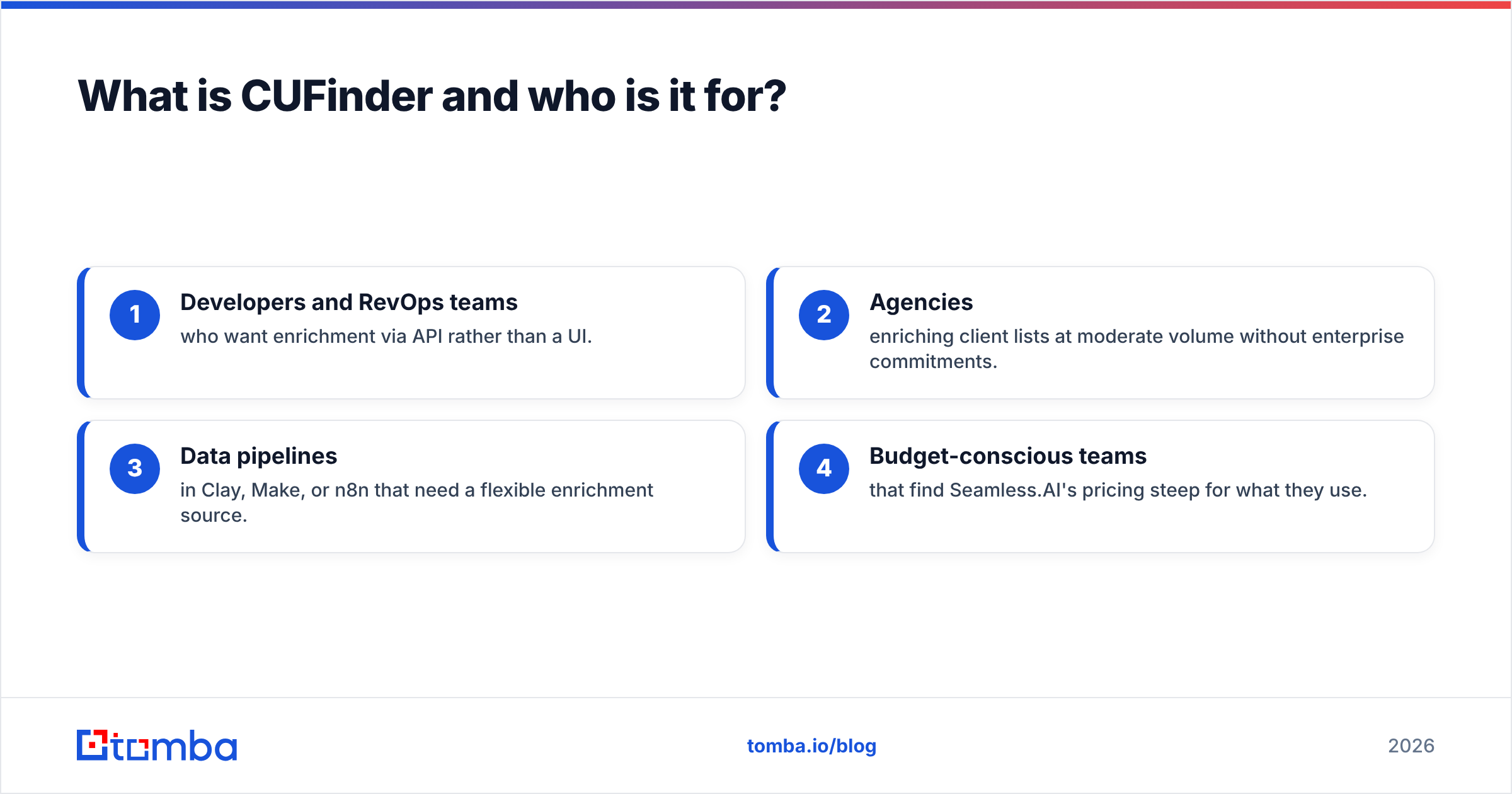
CUFinder is a B2B lead generation and data enrichment platform. It is built API-first. Its core pitch is breadth: company data, contact data, tech lookups, and email and phone discovery. You reach all of it through one set of endpoints. Are you a RevOps or growth engineer who wants to pipe fresh data into HubSpot, Clay, or a custom workflow? CUFinder is built to slot in.
The platform indexes a large pool of companies and contacts. It then layers enrichment on top. So you can start with a domain and walk outward to firmographics, tech stack, and decision-maker contacts. You can read the vendor's own framing on the CUFinder homepage. The short version: it's a data toolbox, not a sales-engagement suite.
Best fit for CUFinder:
- Developers and RevOps teams who want enrichment via API rather than a UI.
- Agencies enriching client lists at moderate volume without enterprise commitments.
- Data pipelines in Clay, Make, or n8n that need a flexible enrichment source.
- Budget-conscious teams that find Seamless.AI's pricing steep for what they use.
What is Seamless.AI and who is it for?#
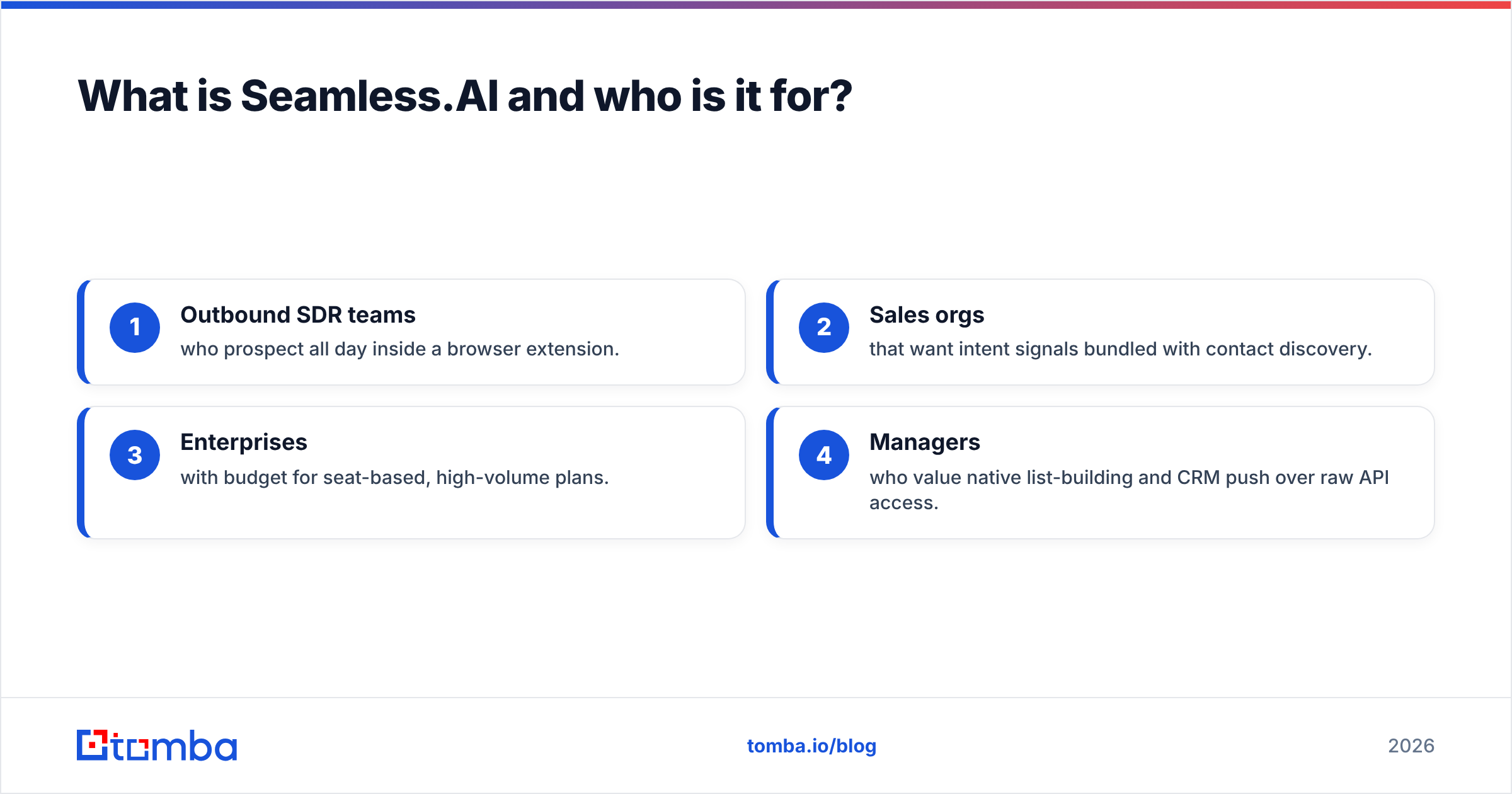
Seamless.AI is a sales intelligence platform. It bills itself as a real-time search engine for B2B contacts. It doesn't just serve a static database. It claims to verify contact data at the moment of search, using a web-crawling AI. On top of that sit buyer-intent data, a browser extension, and list-building tools. All of it aims at outbound sales reps. The Seamless.AI product overview leans hard on that 'find anyone, right now' feel.
Where CUFinder feels like infrastructure, Seamless.AI feels like a rep's daily driver. It wants to live in the seller's browser and feed the CRM. It shortens the path from 'I found a company' to 'I have the VP of Sales' mobile number.' That workflow focus is its biggest strength. It is also the source of most complaints, because the always-on credit model can drain fast.
Best fit for Seamless.AI:
- Outbound SDR teams who prospect all day inside a browser extension.
- Sales orgs that want intent signals bundled with contact discovery.
- Enterprises with budget for seat-based, high-volume plans.
- Managers who value native list-building and CRM push over raw API access.
CUFinder vs SeamlessAI: full feature and pricing comparison#
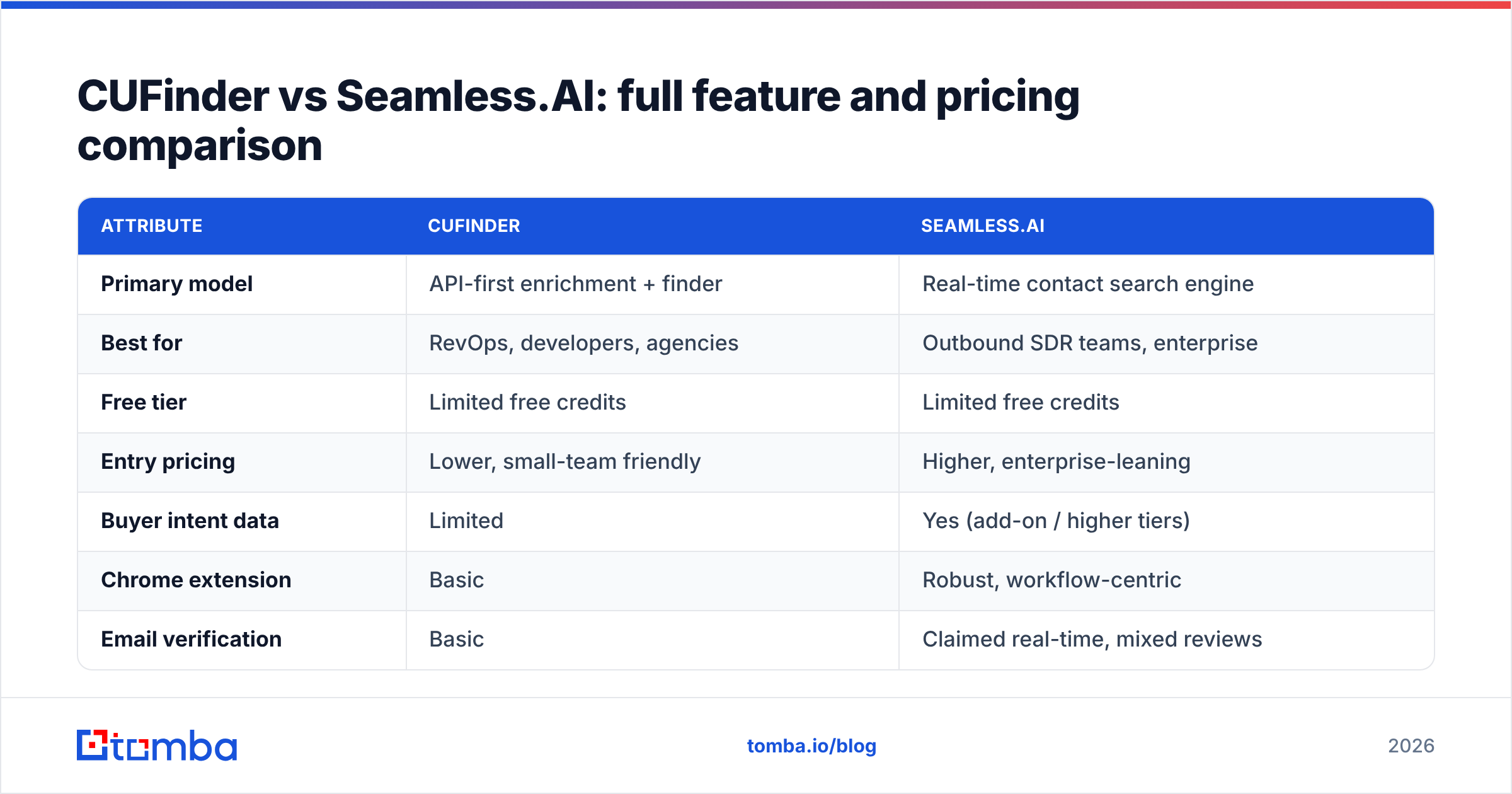
Here's the side-by-side that matters. The numbers reflect publicly listed positioning as of 2026. Always confirm current tiers directly, since both vendors change plans and credit rules often.
| Attribute | CUFinder | Seamless.AI |
|---|---|---|
| Primary model | API-first enrichment + finder | Real-time contact search engine |
| Best for | RevOps, developers, agencies | Outbound SDR teams, enterprise |
| Free tier | Limited free credits | Limited free credits |
| Entry pricing | Lower, small-team friendly | Higher, enterprise-leaning |
| Buyer intent data | Limited | Yes (add-on / higher tiers) |
| Chrome extension | Basic | Robust, workflow-centric |
| Email verification | Basic | Claimed real-time, mixed reviews |
| Phone numbers | Yes | Yes (mobile emphasis) |
| API access | Core strength | Available, less central |
| Credit predictability | Moderate | Often criticized as fast-burning |
The pattern is clear. Seamless.AI is the heavier sales suite. CUFinder is the lighter data engine. Neither is truly 'better.' They just aim at different buyers. Both share one weakness that rarely shows up in a demo. Neither replaces solid, independent email verification. That's why bounce rates surprise new users.
Is CUFinder or Seamless.AI more accurate?#
Accuracy is where marketing copy and inbox reality split. Seamless.AI markets real-time verification. But reviews on G2 keep raising two points. A fair share of returned emails still bounce. And credits get used whether or not the record is any good. CUFinder's accuracy is usually called solid for enrichment fields. It is more mixed on hard-to-find personal emails.
The honest takeaway is simple. Treat any finder's 'verified' label as a starting point, not a promise. Data decays fast. People change jobs. Domains switch providers. Catch-all servers hide the truth. The teams with the lowest bounce rates almost always run a second verification pass before they send. It doesn't matter which finder sourced the address.

That's the gap Tomba is built to close. Instead of bundling discovery and hoping the source was clean, you run any list through a standalone email verifier. It flags invalid, risky, and catch-all addresses before they touch your sequence. Pair it with a catch-all verifier, and 'probably fine' becomes a real deliverability score.

How does pricing really compare?#
Sticker price is only half the story. The other half is how fast credits disappear, and what a 'credit' actually buys.
Seamless.AI uses a seat-plus-credit model. It trends expensive as teams scale. Its heaviest criticism: credits run down fast, even on records that turn out to be low quality. CUFinder is usually cheaper at entry and clearer about API usage. That's why smaller teams and developers lean toward it.
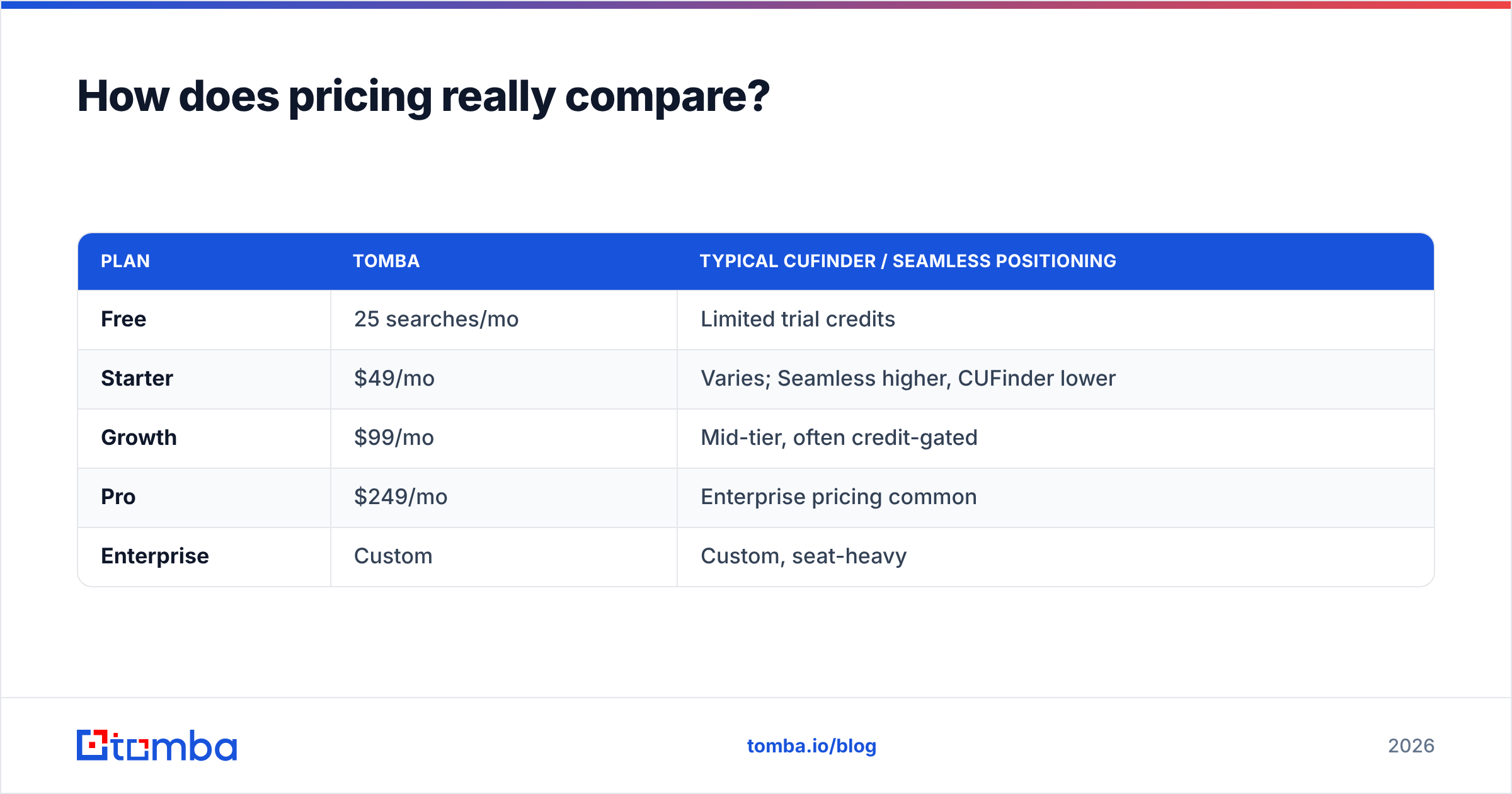
For reference, here's how a focused finder like Tomba is priced. Use it to benchmark cost-per-valid-contact, not cost-per-search:
| Plan | Tomba | Typical CUFinder / Seamless positioning |
|---|---|---|
| Free | 25 searches/mo | Limited trial credits |
| Starter | $49/mo | Varies; Seamless higher, CUFinder lower |
| Growth | $99/mo | Mid-tier, often credit-gated |
| Pro | $249/mo | Enterprise pricing common |
| Enterprise | Custom | Custom, seat-heavy |
You can see the full breakdown on the Tomba pricing page. The point isn't that cheaper always wins. It's that predictable pricing plus verified output usually beats a bigger database you can't fully trust. For high-volume lists, a bulk email finder with clear per-credit costs is easier to forecast than an intent-bundled suite.
When should you pick one over the other?#
Skip the feature checklist. Match the tool to how you actually work:
- Pick Seamless.AI if you run a browser-heavy outbound team, want intent data in the same tool, and have budget for enterprise-tier credits. Its workflow pull is real. Reps like living inside it.
- Pick CUFinder if you're building automated enrichment pipelines, prefer API access, and want a lower entry price. It's the better 'data plumbing' choice for RevOps and agencies.
- Pick a dedicated finder + verifier stack if your priority is deliverability and predictable cost. Source accurate emails with an email finder, then validate them separately. That gives you control both bundled suites lack.
- Pair, don't replace, if you already own one. Many teams keep Seamless or CUFinder for discovery and add a verification layer to cut bounce rates before campaigns go out.
What about data coverage and compliance?#
Both platforms cover the major B2B regions and standard firmographics. Seamless.AI leans into mobile phone coverage and intent. CUFinder leans into enrichment breadth and tech-stack data. For most North American and European prospecting, either will surface enough records. The differentiator is quality, not quantity.
On compliance, both claim GDPR and CCPA alignment. But responsibility for lawful use still sits with you. Whatever tool you choose, keep suppression lists current and honor opt-outs. Verification helps here too. Scrubbing dead and risky addresses cuts spam complaints. That protects your sender reputation as much as any legal checkbox. Want to know where contact data comes from and why freshness matters? Review each vendor's stated sourcing. Then compare it against a transparent data sources policy.
The verdict: CUFinder vs SeamlessAI#
There's no single winner. There's a right answer for your team. CUFinder is the smarter buy for developers and RevOps who want flexible, affordable enrichment through an API. Seamless.AI is the stronger pick for browser-native outbound teams that want intent and workflow bundled, and can absorb the credit cost. Both are solid tools that thousands of teams use every day.
But both share the same blind spot. Discovery without independent verification leaves deliverability to chance. If your metric is replies, not raw record counts, the finder matters less than one thing: whether the emails are valid when you hit send.
That's exactly where Tomba fits. Use the Tomba Email Finder to source professional emails by name, company, or domain. Then verify every address before it enters a sequence. Your cost is measured in valid contacts, not burned credits. Start on the free tier. Test it against your current CUFinder or Seamless.AI list. Compare the bounce rates yourself. The data won't lie, and neither will your inbox.
Related guides#
Ready to find emails that actually work?
Join 150,000+ professionals who stopped guessing and started sending. Free credits on signup — no credit card required.
Get the Tomba newsletter
Practical outbound tactics and product updates — once every two weeks.
About the author