Cufinder vs Voila Norbert (2026): Which Email Finder Wins?
Cufinder and Voila Norbert both promise clean B2B emails, but they solve different problems. We compare accuracy, pricing, data depth, and verification to help you pick the right email finder for your outreach.
Choosing between Cufinder and Voila Norbert usually comes down to one question: do you need a broad B2B data platform, or a focused email finder that just works? Both tools sell "accurate business emails," but they were built for different jobs, and picking the wrong one wastes budget and torches your sender reputation with bounces.
This is a neutral, hands-on comparison. We look at accuracy, pricing, data coverage, verification, and the workflows each tool is actually good at — then tell you where a third option makes more sense.
TL;DR: Cufinder vs Voila Norbert at a glance#
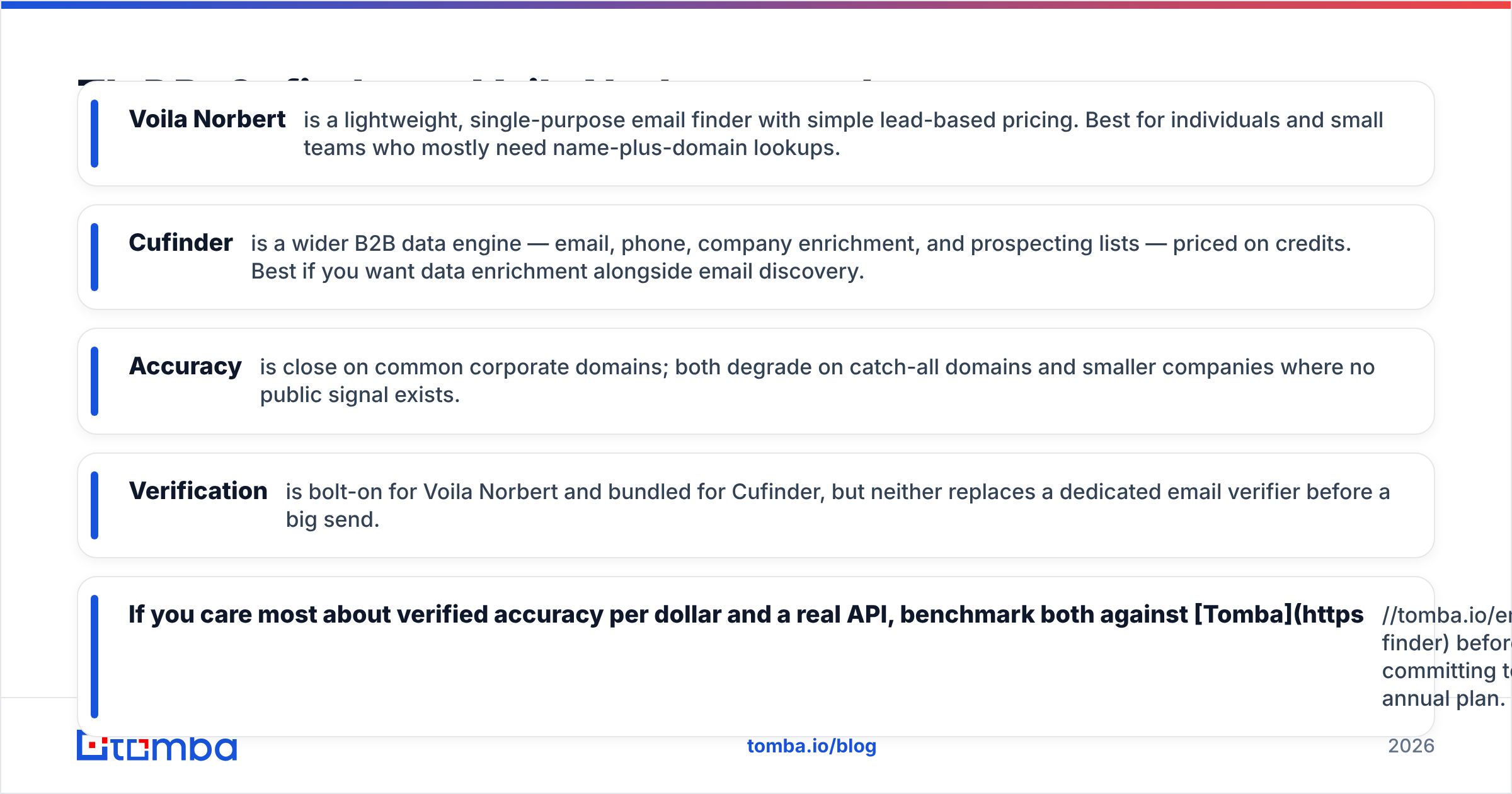
- Voila Norbert is a lightweight, single-purpose email finder with simple lead-based pricing. Best for individuals and small teams who mostly need name-plus-domain lookups.
- Cufinder is a wider B2B data engine — email, phone, company enrichment, and prospecting lists — priced on credits. Best if you want data enrichment alongside email discovery.
- Accuracy is close on common corporate domains; both degrade on catch-all domains and smaller companies where no public signal exists.
- Verification is bolt-on for Voila Norbert and bundled for Cufinder, but neither replaces a dedicated email verifier before a big send.
- If you care most about verified accuracy per dollar and a real API, benchmark both against Tomba before committing to an annual plan.
What is Cufinder?#
Cufinder is a B2B data and lead-generation platform. Its pitch is breadth: you can search by company, enrich a list of domains, pull phone numbers, and build prospect lists — with email finding as one feature among several. Think of it less as a single tool and more as a data warehouse you query with credits.
That breadth is the appeal. If your workflow is "give me 500 companies in fintech, then hand me decision-maker emails and phones," Cufinder is designed for that end-to-end motion. The tradeoff is that credits get consumed across multiple data types, so heavy enrichment usage burns through a plan faster than pure email lookups would.
What is Voila Norbert?#
Voila Norbert is one of the older names in email finding. Its core job is simple: give it a full name and a company domain, and it returns the most likely email address with a confidence score. It layers on bulk uploads, a Chrome extension, and pay-as-you-go verification.
Norbert's strength is focus. There's very little to learn, pricing is based on how many leads you find per month, and the interface stays out of your way. If you don't need company firmographics or phone data, that simplicity is a feature, not a limitation.

How accurate are Cufinder and Voila Norbert?#
Accuracy is where every email finder lives or dies, because a wrong address either bounces or lands in a stranger's inbox. Both tools use a mix of pattern matching, public web data, and SMTP checks to score guesses.

In practice, three factors drive the real-world hit rate you'll see:
- Domain type. On standard corporate domains with a clear format (
first.last@company.com), both tools do well. On catch-all domains — where the mail server accepts everything — no finder can truly confirm an address, and confidence scores get shaky. - Company size. Fortune 500 targets have abundant public signal. A 12-person agency often has none, so both tools fall back to pattern guessing.
- Data freshness. People change jobs constantly. A finder is only as accurate as the last time its sources saw that person, which is why data sources matter more than any single accuracy percentage on a marketing page.
The honest takeaway: published accuracy numbers are marketing. The number that matters is your bounce rate on your target list. Always run a free-tier test on 50 real prospects before you trust either vendor's headline figure.
Cufinder vs Voila Norbert: pricing and features compared#
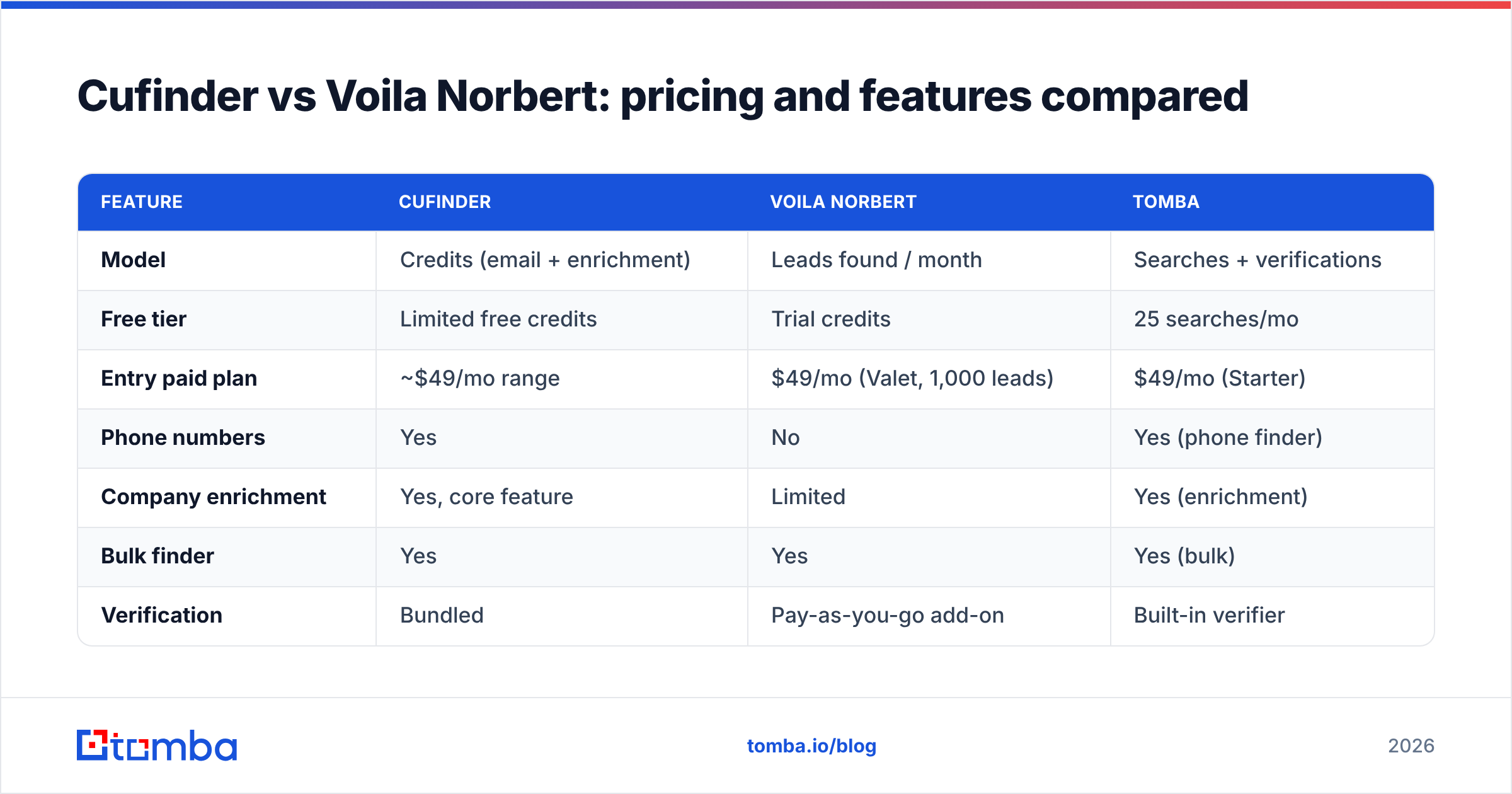
Pricing models differ enough that a straight per-lead comparison is tricky. Voila Norbert charges by leads found per month. Cufinder charges by credits that also cover enrichment and phone lookups. Here's how they line up at the time of writing — always confirm current numbers on each vendor's page.
| Feature | Cufinder | Voila Norbert | Tomba |
|---|---|---|---|
| Model | Credits (email + enrichment) | Leads found / month | Searches + verifications |
| Free tier | Limited free credits | Trial credits | 25 searches/mo |
| Entry paid plan | ~$49/mo range | $49/mo (Valet, 1,000 leads) | $49/mo (Starter) |
| Phone numbers | Yes | No | Yes (phone finder) |
| Company enrichment | Yes, core feature | Limited | Yes (enrichment) |
| Bulk finder | Yes | Yes | Yes (bulk) |
| Verification | Bundled | Pay-as-you-go add-on | Built-in verifier |
| Public API | Yes | Yes | Yes, documented |
| Best for | Data + prospecting | Simple email lookups | Verified accuracy + API |
A few things stand out. Voila Norbert's entry pricing is clean if you only need emails, but verification is billed separately, so the "all-in" cost is higher than the sticker. Cufinder's credit model is flexible but harder to forecast — a month heavy on enrichment can drain credits you budgeted for emails. Tomba sits alongside both with a bundled verifier and a transparent search count, which is why it's a common benchmark in this category.
Which tool has better data coverage?#
Coverage depends on the region and role you target. Cufinder leans into company-level and firmographic data, so it shines when you're building account lists and need context — industry, size, tech stack — attached to each contact. Voila Norbert is contact-first: it's happiest when you already know who you want and just need their address.
If your motion is account-based selling, Cufinder's enrichment reduces the number of tools in your stack. If your motion is high-volume individual prospecting from a name list, Voila Norbert's simplicity wins. Neither is "more data" in the abstract — they're shaped for different shopping lists.
For teams that live in spreadsheets, also weigh integration surface. Both offer a Chrome extension and API, but if you run outreach from Google Sheets or Airtable, check that the connector supports the exact fields you enrich on, not just email.
What about email verification and deliverability?#
Finding an email is half the job; confirming it's safe to send to is the other half. This is where the two tools diverge most.
Voila Norbert treats verification as a separate, metered product — you pay per address checked. That's fine for occasional cleaning, but it adds a step and a line item. Cufinder bundles a verification layer into its results, which is convenient, though bundled checks vary in strictness and you don't always control the SMTP depth.
Either way, one rule holds: do not send to any list you haven't independently verified. A single spike in bounces can tank your sender reputation and push future messages to spam, undoing weeks of warmup. Running a dedicated pass — with proper handling of catch-all and role-based addresses — is cheap insurance. See G2's roundup of email verification tools for how buyers rate the category, and treat any finder's built-in check as a first filter, not the final word.
Cufinder vs Voila Norbert: pros and cons#
Here's the blunt version, so you can match each tool to your situation.
Cufinder — strengths
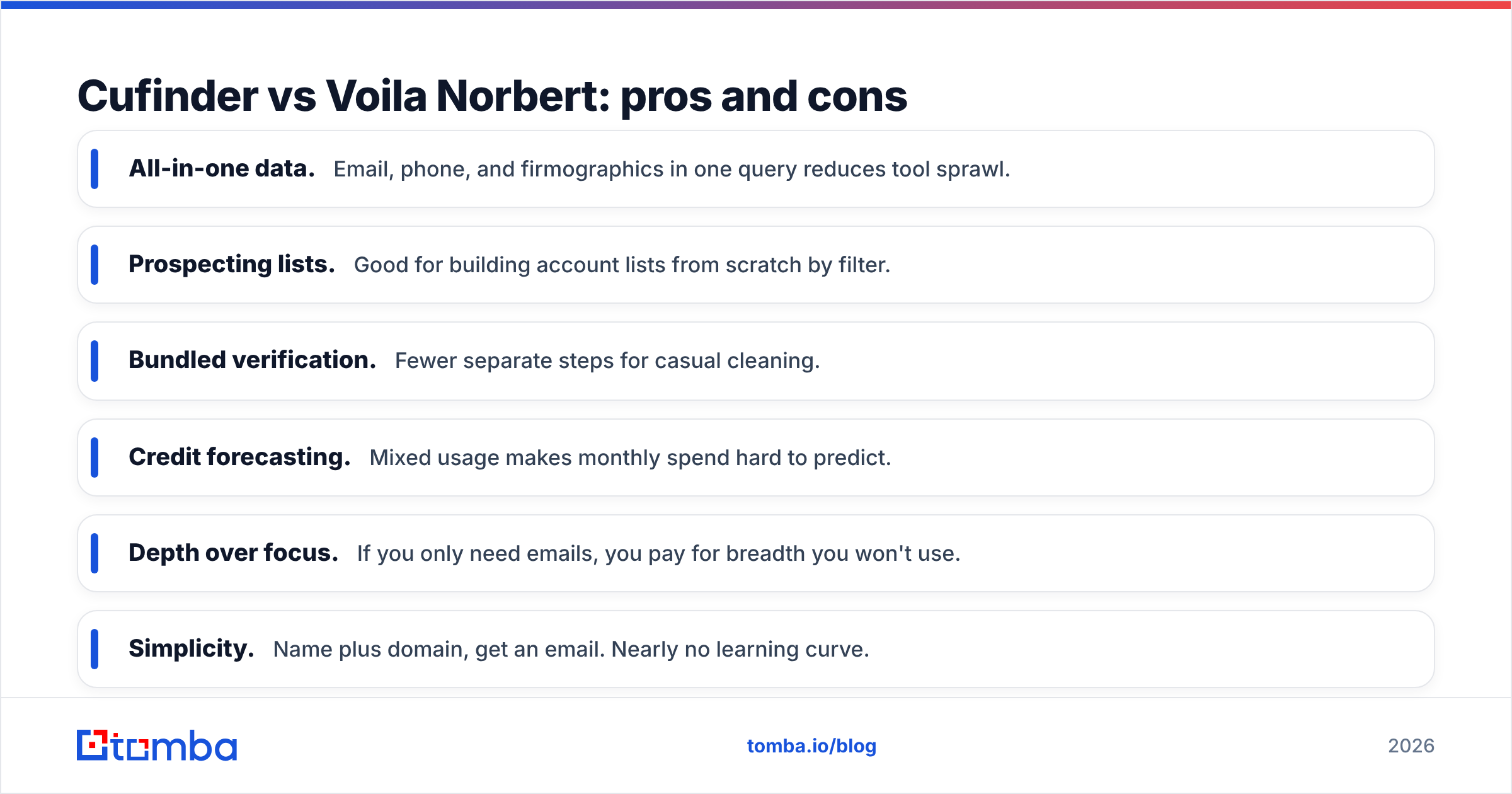
- All-in-one data. Email, phone, and firmographics in one query reduces tool sprawl.
- Prospecting lists. Good for building account lists from scratch by filter.
- Bundled verification. Fewer separate steps for casual cleaning.
Cufinder — watch-outs
- Credit forecasting. Mixed usage makes monthly spend hard to predict.
- Depth over focus. If you only need emails, you pay for breadth you won't use.
Voila Norbert — strengths
- Simplicity. Name plus domain, get an email. Nearly no learning curve.
- Lead-based pricing. Easy to reason about if email is your only need.
- Established tool. Long track record and a stable Chrome extension.
Voila Norbert — watch-outs
- Narrow scope. No phone data and limited company enrichment.
- Verification costs extra. The real all-in price is higher than the base plan.
When should you consider a third option like Tomba?#
Two-way comparisons hide a real possibility: neither tool is the best fit. If your priority is verified emails at a predictable price, with a proper developer API and features that span both camps, it's worth benchmarking a focused alternative.
Tomba covers the middle ground the other two split. It's a dedicated email finder with a built-in verifier, plus domain search for mapping a whole company, a phone finder when you need numbers, and a documented Tomba API for automation. Pricing is transparent: a free tier with 25 searches a month, then Starter at $49/mo, Growth at $99/mo, and Pro at $249/mo — no separate metered verification bill to reconcile.
The point isn't that one tool wins for everyone. It's that "Cufinder or Voila Norbert" is a false binary. Test all three on the same 50-prospect list, compare bounce rates and cost, and let your own data decide.
How to choose: a simple decision guide#
Match the tool to the job, not to the loudest feature list:
- You mostly need emails from a name list, on a budget → Voila Norbert's simplicity fits.
- You're building account lists and want enrichment plus phones → Cufinder's breadth fits.
- You want verified accuracy, one predictable bill, and a clean API → benchmark Tomba first.
- You send at real volume → whichever you pick, add a dedicated verification pass before every campaign.
Whatever you choose, the winning move is the same: test on real targets, measure bounce rate, and don't sign an annual contract off a demo. For deeper reading on how buyers evaluate these platforms, Capterra's lead generation software category is a useful, vendor-neutral starting point.
The bottom line#
Cufinder is the better pick when email finding is one part of a broader data and prospecting need. Voila Norbert is the better pick when you want a simple, focused email finder and nothing more. Both are legitimate — they just optimize for different workflows, and the "right" answer is the one that produces the lowest bounce rate on your actual list for the lowest all-in cost.
Before you commit, run the test that actually predicts results: pull 50 real prospects and put each tool through the same list. If you want a third data point with bundled verification and a transparent search count, start free with the Tomba Email Finder — find and verify professional emails by name, domain, or company, then compare the numbers side by side and let the data make the call.
Related guides#
Ready to find emails that actually work?
Join 150,000+ professionals who stopped guessing and started sending. Free credits on signup — no credit card required.
Get the Tomba newsletter
Practical outbound tactics and product updates — once every two weeks.
About the author