CUFinder vs ZoomInfo (2026): Accuracy, Pricing & Best Value
CUFinder promises budget B2B data; ZoomInfo owns the enterprise. We compare accuracy, pricing, coverage, and contract traps—plus a cheaper pick that beats both on cost-per-verified-email.
Choosing between CUFinder and ZoomInfo usually comes down to one uncomfortable question: how much data do you actually need, and how much are you willing to bleed for it? One is a scrappy, budget-friendly enrichment platform. The other is the 800-pound gorilla of B2B intelligence with a price tag—and a contract—to match.
This is a neutral, hands-on comparison. No vendor wrote this section for us. Below you'll find where each tool genuinely wins, where the sticker price hides real costs, and a third option worth a look if you mostly need accurate, verified contact data without the enterprise overhead.
TL;DR: CUFinder vs ZoomInfo in five bullets#
- ZoomInfo has the deepest B2B database, intent data, and org charts—but pricing starts in the four-to-five-figure annual range and locks you into annual contracts.
- CUFinder is dramatically cheaper, offers monthly plans and a usable free tier, and covers email + company enrichment well, though its database depth and intent signals trail ZoomInfo.
- Accuracy is close on core email data; ZoomInfo edges ahead on phone numbers and firmographics, CUFinder holds its own on verified emails at a fraction of the cost.
- Hidden costs matter more than list price: ZoomInfo's platform fees, seat minimums, and add-ons balloon the real number; CUFinder's per-credit model is easier to predict.
- If your core need is finding and verifying professional emails, a focused tool like Tomba often delivers better cost-per-verified-email than either platform.
What are CUFinder and ZoomInfo?#
CUFinder is a B2B lead-generation and data enrichment platform. It bundles an email finder, company and contact enrichment, a prospecting database, and API access into monthly or annual plans. Its pitch is simple: most of the enrichment value of a big-name platform, at small-business pricing, with no aggressive sales motion to get started.
ZoomInfo is the category leader in B2B sales intelligence. Beyond contact data, it layers on intent signals, technographics, org charts, website visitor tracking, conversation intelligence (via Chorus), and a workflow engine. It's built for revenue teams that treat data as core infrastructure and can justify a real budget line. You can review its own positioning on the ZoomInfo homepage and cross-check user sentiment on G2.
The honest framing: these tools overlap on the surface (both find contacts) but sit at opposite ends of the market. Comparing them is really comparing a tactical budget tool against an enterprise platform.
How do CUFinder and ZoomInfo compare on features and pricing?#
Here's the head-to-head on the attributes that actually drive buying decisions.
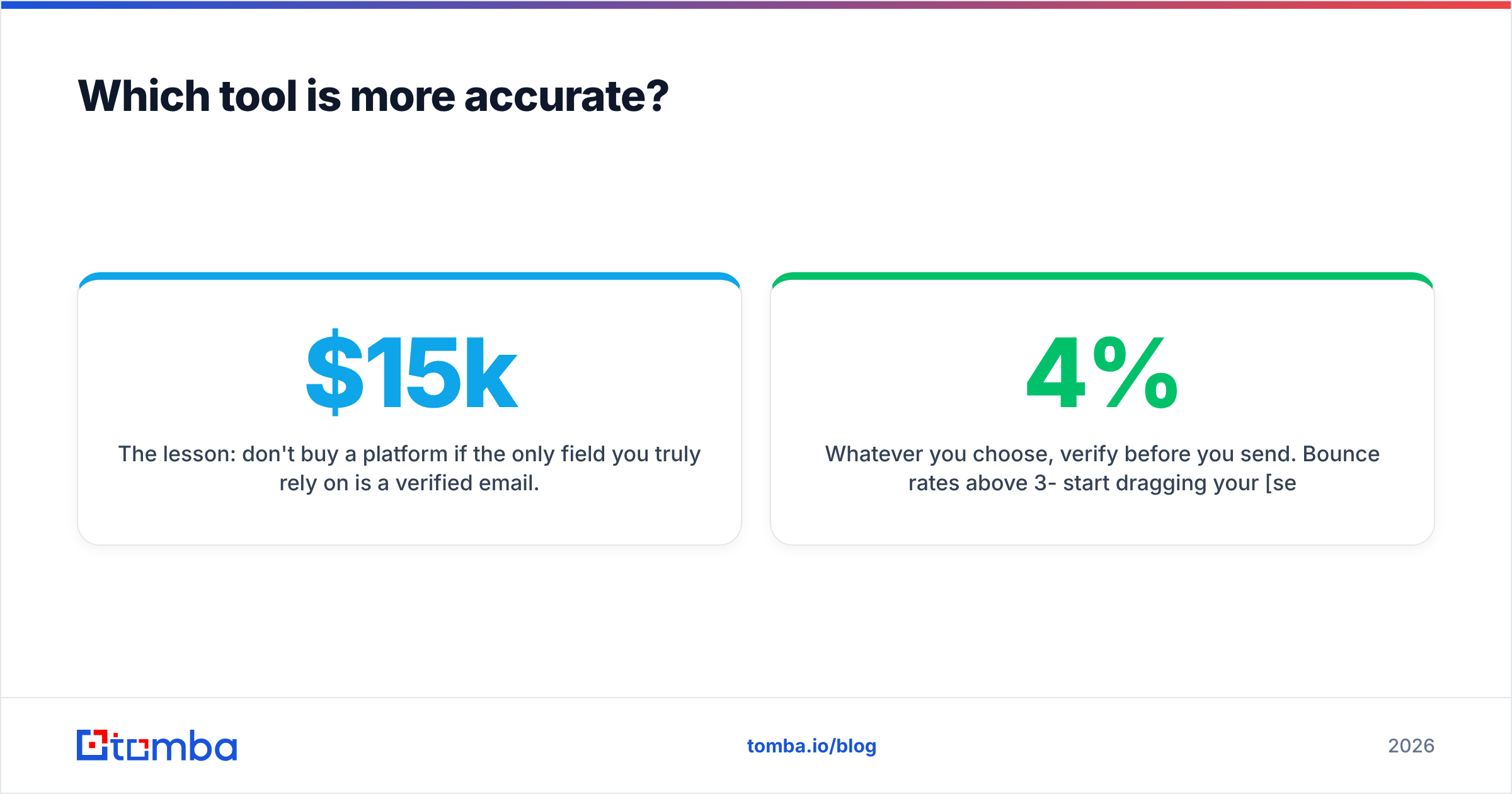
| Attribute | CUFinder | ZoomInfo |
|---|---|---|
| Starting price | ~$49/mo self-serve | ~$15,000+/yr (quote-based) |
| Contract | Monthly or annual | Annual, sales-negotiated |
| Free tier | Yes (limited credits) | No (trial via demo only) |
| Database depth | Good, mid-market focus | Deepest in category |
| Intent data | Limited | Yes (proprietary) |
| Phone numbers | Basic coverage | Strong, incl. direct dials |
| Org charts / hierarchy | No | Yes |
| API access | Yes, all plans | Yes, higher tiers |
| Best for | SMBs, lean teams, budgets | Enterprise revenue orgs |
A few things jump out. ZoomInfo's real cost almost never matches the number a rep first quotes—platform fees, seat minimums, and add-ons (intent, Engage, Chorus) stack quickly, and multi-year deals are the norm. Independent buyers on Gartner Peer Insights consistently flag total cost and contract rigidity as the main friction, even while praising data depth.
CUFinder inverts that. The pricing is transparent and self-serve, you can start cheap, and you won't get pulled into a procurement cycle to run a test. The trade-off is ceiling: when you need org charts, buying-intent signals, or the very freshest direct dials at scale, ZoomInfo's data machine is hard to match.
Which tool is more accurate?#
Accuracy is where the marketing fog gets thickest, so let's be precise about what "accurate" means. There are three different data types, and each vendor is strong on different ones:
- Verified emails — CUFinder and ZoomInfo are close. Both do SMTP-style validation and both will occasionally serve stale addresses. For core work emails, the gap is smaller than the price gap.
- Direct-dial phone numbers — ZoomInfo wins. Its community-contributed and researched phone data is deeper, especially for direct dials versus switchboard lines.
- Firmographics & hierarchy — ZoomInfo wins clearly. Employee counts, revenue bands, and org structure are its home turf.
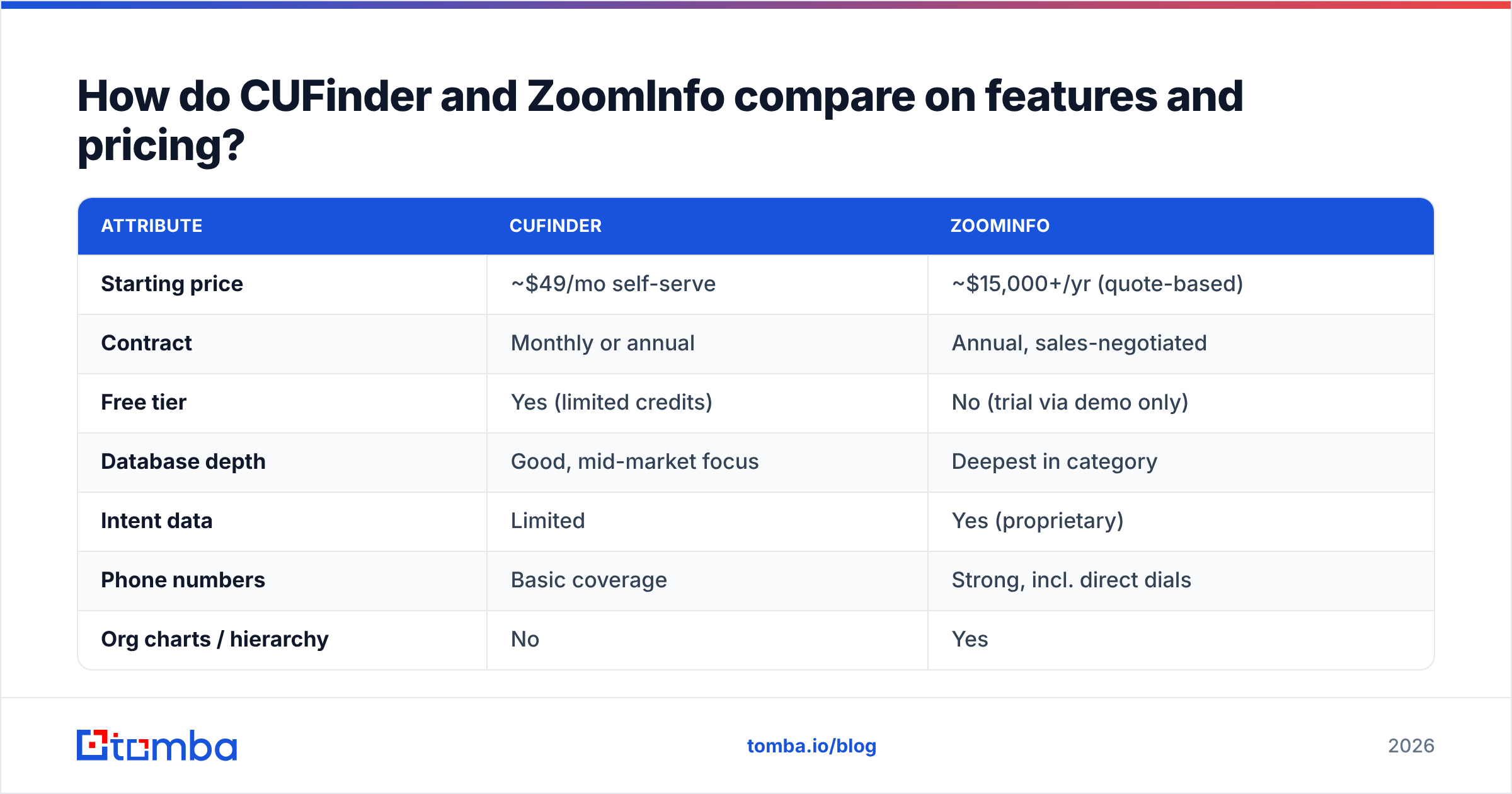
The lesson: don't buy a $15k platform if the only field you truly rely on is a verified email. And don't expect a budget tool to reconstruct an enterprise org chart. Match the tool to the field you'll actually action.

Whatever you choose, verify before you send. Bounce rates above 3-4% start dragging your sender reputation down, and no database is 100% fresh. Running new contacts through a dedicated email verifier is cheap insurance regardless of where the data came from.
What are the hidden costs of each platform?#
List price is the trap. Here's what actually shows up on the invoice.
ZoomInfo hidden costs:
- Seat minimums — pricing assumes multiple seats; a solo user pays a poor per-seat rate.
- Add-on modules — intent, Engage (sequencing), Chorus (conversation intel), and enrichment can each be separate line items.
- Annual lock-in — most deals are 12 months minimum, often multi-year, with limited exit if the data underdelivers for your niche.
- Credit / export caps — bulk export is metered; heavy list-building can hit ceilings that trigger upgrade conversations.
CUFinder hidden costs:
- Credit burn — enrichment and search consume credits; large campaigns can exhaust a monthly allotment faster than expected.
- Coverage gaps — for certain regions or very senior contacts, you may still need a second source, which is its own cost.
The pattern is clear: ZoomInfo's surprises are contractual, CUFinder's are consumption-based. Consumption overruns are annoying but easy to cap. Contractual lock-in is the one that keeps finance teams up at night. If predictability matters more than raw depth, the budget model usually wins.
Is there a better-value alternative to both?#
For a large share of teams, the honest answer is yes—if your core job is finding and verifying professional email addresses rather than running an intent-driven enterprise motion.
That's the niche where a focused tool like Tomba competes hard on cost-per-verified-email. Instead of paying enterprise platform fees or burning broad enrichment credits, you pay for exactly what most outbound teams actually use: accurate, verified contact data and the tooling to action it.
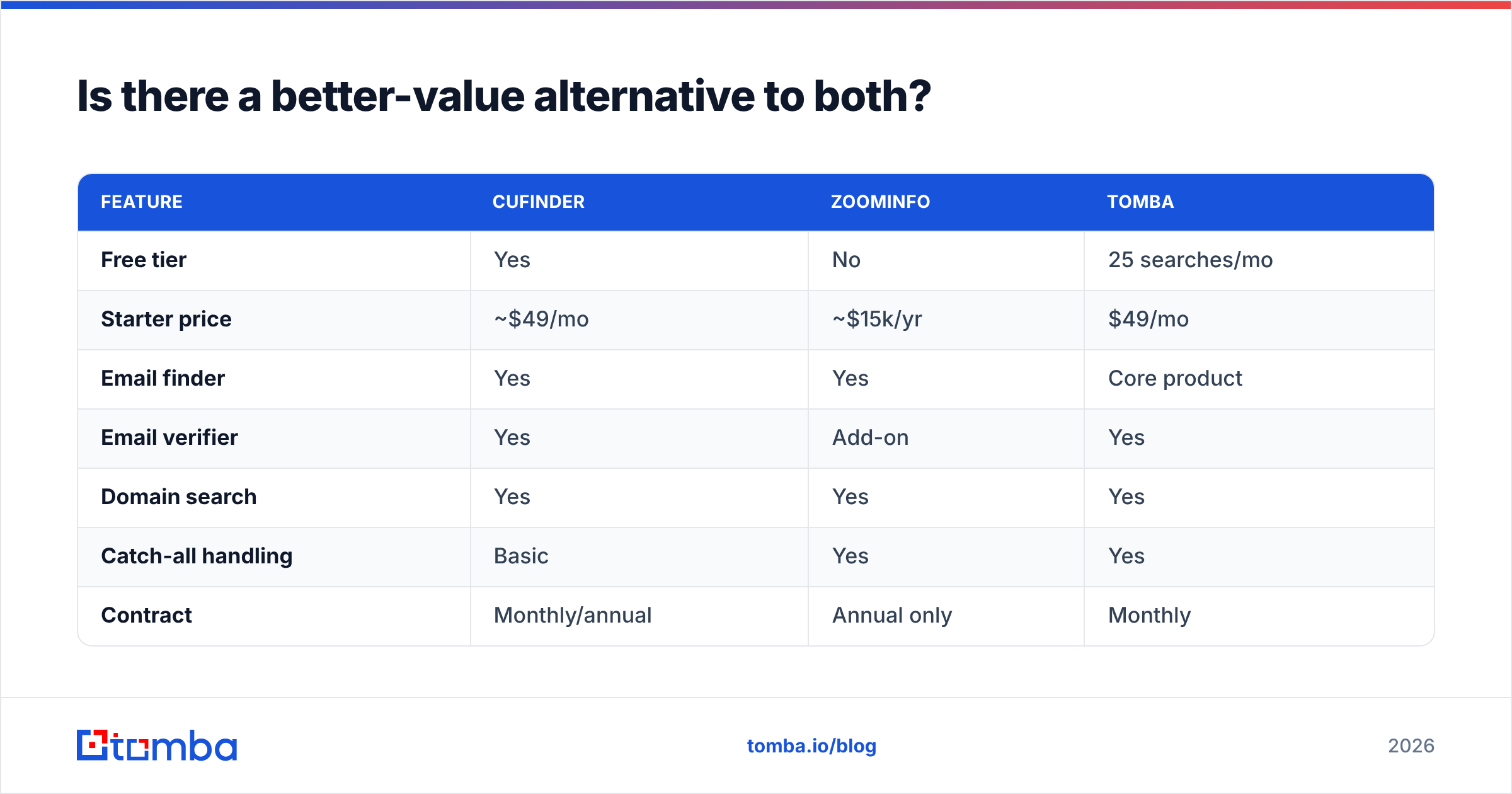
Here's how the value math stacks up across the three approaches:
| Feature | CUFinder | ZoomInfo | Tomba |
|---|---|---|---|
| Free tier | Yes | No | 25 searches/mo |
| Starter price | ~$49/mo | ~$15k/yr | $49/mo |
| Email finder | Yes | Yes | Core product |
| Email verifier | Yes | Add-on | Yes |
| Domain search | Yes | Yes | Yes |
| Catch-all handling | Basic | Yes | Yes |
| Contract | Monthly/annual | Annual only | Monthly |
| Best fit | SMB enrichment | Enterprise | Verified email at scale |
Tomba's lineup maps directly to outbound work: the email finder locates addresses by name or company, domain search pulls every reachable contact at a target account, and the bulk email finder handles list-building without a sales call. Pricing runs Free (25 searches/mo), Starter $49/mo, Growth $99/mo, and Pro $249/mo—no annual lock-in required to get real volume, and you can see the full Tomba pricing before you ever talk to anyone.
This isn't "Tomba beats ZoomInfo at everything." It doesn't. ZoomInfo's intent data and org charts are genuinely best-in-class, and if that's your GTM engine, pay for it. The point is narrower and more useful: if you're comparing CUFinder and ZoomInfo mainly to get verified emails into a sequence, a purpose-built email finder often delivers a lower cost-per-usable-contact than either.
When should you actually pick ZoomInfo?#
Pick ZoomInfo when data is your competitive moat and you can fund it. Concretely:
- You run intent-based outbound and need to know who's in-market this quarter.
- You sell into complex orgs and need hierarchy and multi-threading maps.
- You have a RevOps function to operationalize the data across CRM, enrichment, and workflows.
- Direct dials are non-negotiable for a phone-heavy motion, so B2B phone numbers coverage is a first-class requirement.
If three or four of those are true, ZoomInfo's price is defensible. If only one is, you're overbuying.
When should you pick CUFinder?#
Pick CUFinder when you want most of the enrichment story without the enterprise commitment:
- You're an SMB or a lean team watching every dollar.
- You want monthly flexibility, not a 12-month signature.
- You need company + contact enrichment more than deep intent signals.
- You're testing a motion and can't justify a big data line yet.
CUFinder is a legitimately strong value play in this lane, and being a respected mid-market option is a real position—not a consolation prize.
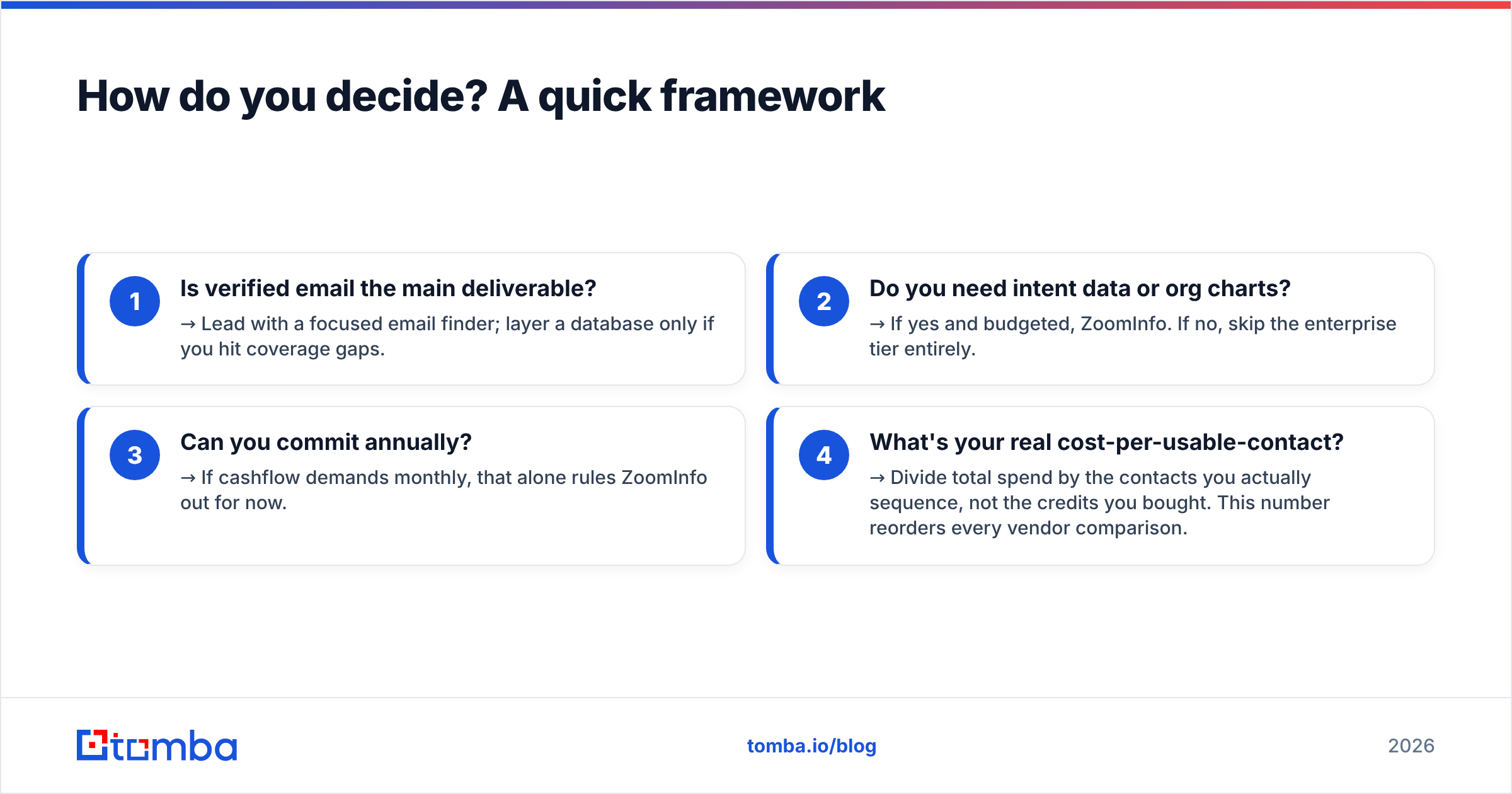
How do you decide? A quick framework#
Run your situation through these four questions in order:
- Is verified email the main deliverable? → Lead with a focused email finder; layer a database only if you hit coverage gaps.
- Do you need intent data or org charts? → If yes and budgeted, ZoomInfo. If no, skip the enterprise tier entirely.
- Can you commit annually? → If cashflow demands monthly, that alone rules ZoomInfo out for now.
- What's your real cost-per-usable-contact? → Divide total spend by the contacts you actually sequence, not the credits you bought. This number reorders every vendor comparison.
That fourth question is the one most teams skip, and it's the one that flips a "ZoomInfo looks premium" gut call into a "we were paying 10x for emails we could've verified elsewhere" spreadsheet reality.
The verdict#
There's no universal winner—there's a winner for your motion.
- Choose ZoomInfo if intent, hierarchy, and direct dials drive your revenue and you can absorb the contract.
- Choose CUFinder if you want affordable, flexible enrichment without enterprise strings.
- Choose a focused tool like Tomba if the job is really "get accurate, verified emails into outreach" at a predictable price.
Be honest about which bucket you're in. Most teams comparing CUFinder vs ZoomInfo are quietly in the third bucket and don't realize it until they run the cost-per-verified-email math.
If that's you, start free and test the accuracy yourself: the Tomba Email Finder gives you 25 searches a month at no cost, finds professional emails by name, company, or domain, and pairs with a built-in email verifier so what lands in your sequence actually delivers. Run the same target list through it that you'd hand to a ZoomInfo rep—then compare the number that matters most: cost per contact you can actually email.

Related guides#
Ready to find emails that actually work?
Join 150,000+ professionals who stopped guessing and started sending. Free credits on signup — no credit card required.
Get the Tomba newsletter
Practical outbound tactics and product updates — once every two weeks.
About the author