What Is a Customer Data Platform? A 2026 Guide for RevOps
A customer data platform unifies scattered customer data into one profile your whole GTM team can use. Here's what a CDP actually does, who needs one in 2026, and how to tell if it's worth the money.
Your customer data is probably spread across a dozen tools right now: the CRM, the product database, the support desk, the ad platforms, three spreadsheets, and someone's inbox. A customer data platform (CDP) is the software that pulls all of that into one continuously updated profile per person — and makes it usable by every team without a data engineer in the loop.
This guide explains what a CDP actually is, how it differs from a CRM or a DMP, who needs one in 2026, and how to decide whether the price tag is justified. No vendor spin — just the practical picture.
TL;DR#
- A customer data platform ingests data from every source, resolves it to one identity per customer, and pushes clean profiles back out to your marketing, sales, and analytics tools.
- It is not a CRM (that's a system of action for sales reps) and not a DMP (that's anonymous, cookie-based ad audiences). A CDP is a system of record for known customers.
- The core value is identity resolution and activation — turning fragmented events into audiences and traits other tools can act on in real time.
- Real costs run from ~$1,000/mo for startups to six figures a year at enterprise scale, plus the hidden cost of implementation and data governance.
- Most teams don't need a full CDP on day one. Clean, enriched, deduplicated data — the input a CDP depends on — matters more than the platform itself.
What is a customer data platform?#
A customer data platform is a packaged system that collects customer data from all your sources, unifies it into a single persistent profile, and makes those profiles available to other systems. Think of it as the difference between a filing cabinet stuffed with loose receipts and a single running statement per customer — same information, wildly different usefulness.
The formal definition comes from the CDP Institute, which coined the term: packaged software that creates a persistent, unified customer database accessible to other systems. Three words in that definition do the heavy lifting:
- Packaged — it's software you configure, not a data-engineering project you build from scratch.
- Persistent — profiles live on and update over time, not just for the length of a session.
- Accessible to other systems — the data flows back out. A database no other tool can read is just a warehouse.
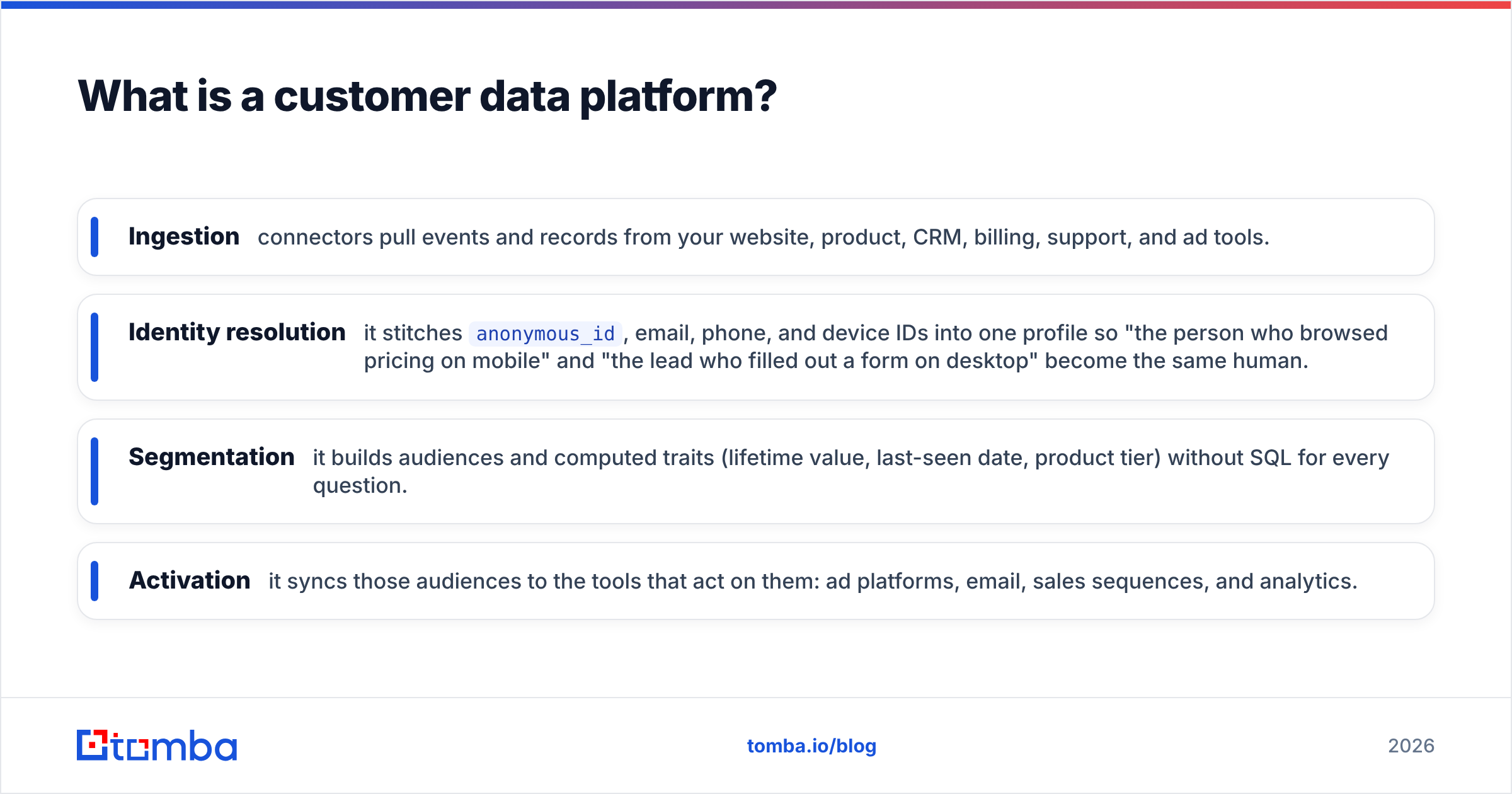
Under the hood, a CDP does four jobs in sequence.
- Ingestion — connectors pull events and records from your website, product, CRM, billing, support, and ad tools.
- Identity resolution — it stitches
anonymous_id, email, phone, and device IDs into one profile so "the person who browsed pricing on mobile" and "the lead who filled out a form on desktop" become the same human. - Segmentation — it builds audiences and computed traits (lifetime value, last-seen date, product tier) without SQL for every question.
- Activation — it syncs those audiences to the tools that act on them: ad platforms, email, sales sequences, and analytics.
How is a CDP different from a CRM, DMP, or data warehouse?#
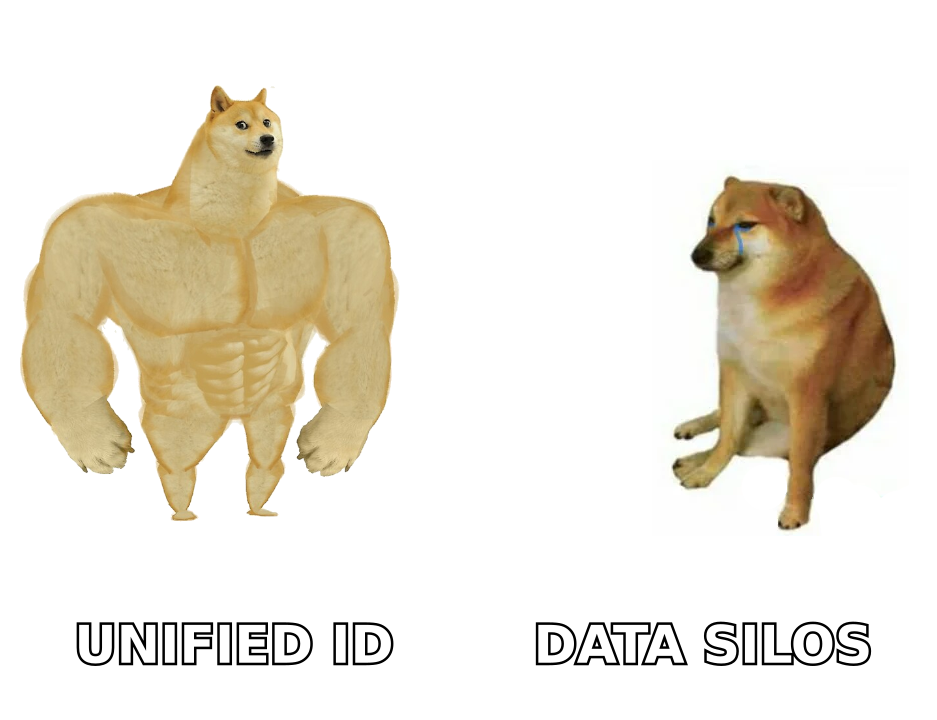
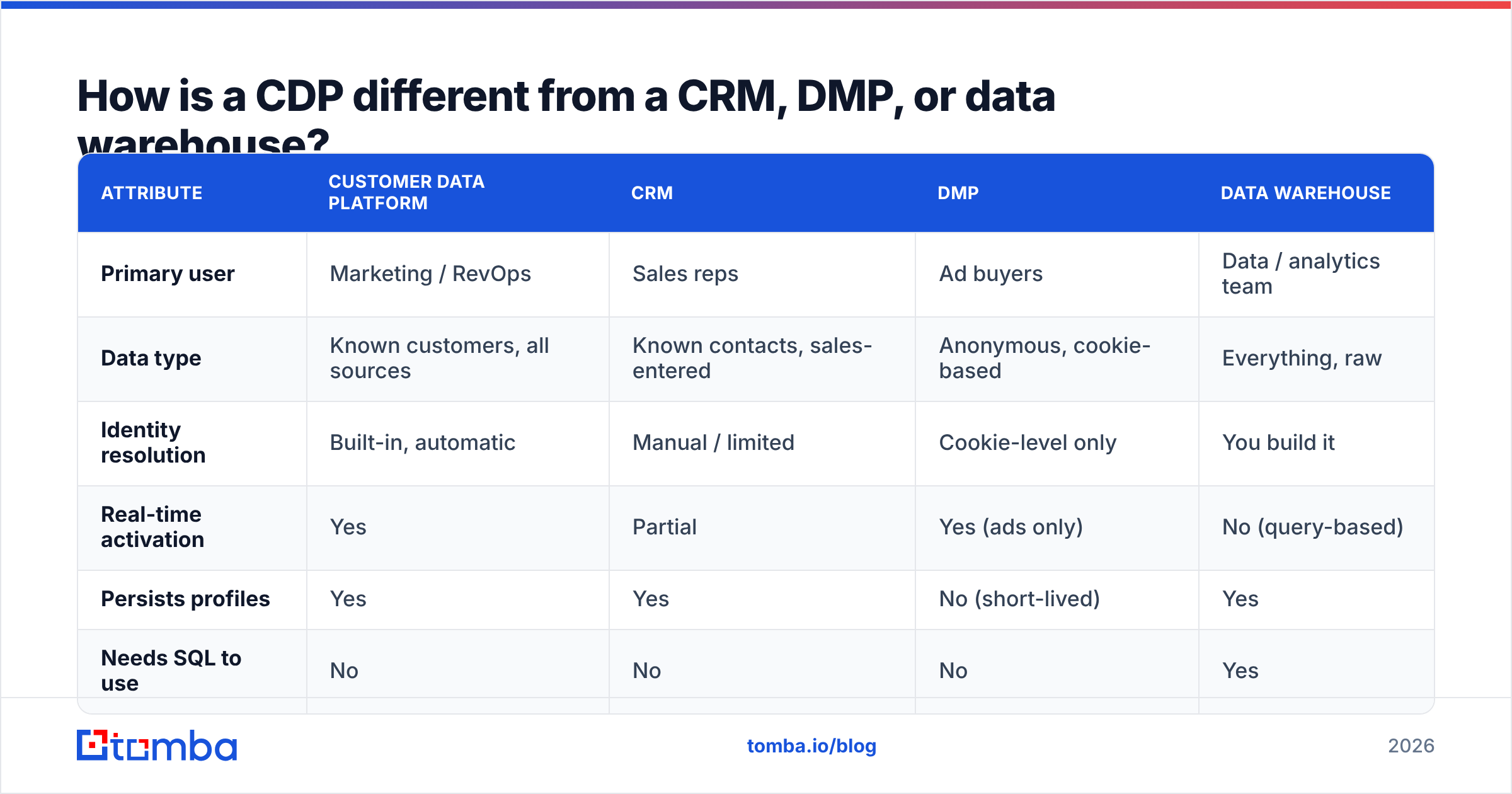
This is where most confusion lives, and where vendors blur the lines to sell you overlap you don't need. The short version: they solve different problems and frequently coexist.
| Attribute | Customer Data Platform | CRM | DMP | Data Warehouse |
|---|---|---|---|---|
| Primary user | Marketing / RevOps | Sales reps | Ad buyers | Data / analytics team |
| Data type | Known customers, all sources | Known contacts, sales-entered | Anonymous, cookie-based | Everything, raw |
| Identity resolution | Built-in, automatic | Manual / limited | Cookie-level only | You build it |
| Real-time activation | Yes | Partial | Yes (ads only) | No (query-based) |
| Persists profiles | Yes | Yes | No (short-lived) | Yes |
| Needs SQL to use | No | No | No | Yes |
A CRM like Salesforce is a system of action — reps log calls, update deal stages, and work pipeline in it. It holds what your team typed in, not every behavioral event your customer generated.
A DMP deals in anonymous, third-party, cookie-based segments for ad targeting. With third-party cookies deprecated and privacy law tightening, DMPs have faded while CDPs — which run on first-party, consented data — have grown.
A data warehouse (Snowflake, BigQuery) stores everything but requires SQL and pipelines to make it usable. That's why "warehouse-native" or "composable" CDPs now sit on top of the warehouse rather than duplicating it. According to Gartner, this composable model is the fastest-growing CDP architecture.
Who actually needs a customer data platform in 2026?#
Be honest about your stage before you buy. A CDP earns its cost when three conditions are true at once:
- Multiple data sources — you have customer signals in at least four disconnected tools.
- Cross-channel activation — you run campaigns across email, ads, and product that need the same audience definitions.
- A team that will use it — RevOps or growth staff who will build segments, not let the tool gather dust.
If you're a five-person startup with a CRM and an email tool, a CDP is premature. Your money is better spent making the data you do have accurate — deduplicated, verified, and enriched with firmographics. Garbage in, garbage unified.
Signs you've outgrown the DIY approach and a CDP is worth evaluating:
- Your team maintains brittle Zapier chains and spreadsheet VLOOKUPs to reconcile identities.
- Marketing and sales argue about whose customer count is "right."
- Personalization stalls because no tool has the full picture of a customer.
- You're spending analyst hours writing the same identity-resolution SQL over and over.

What does a customer data platform cost?#
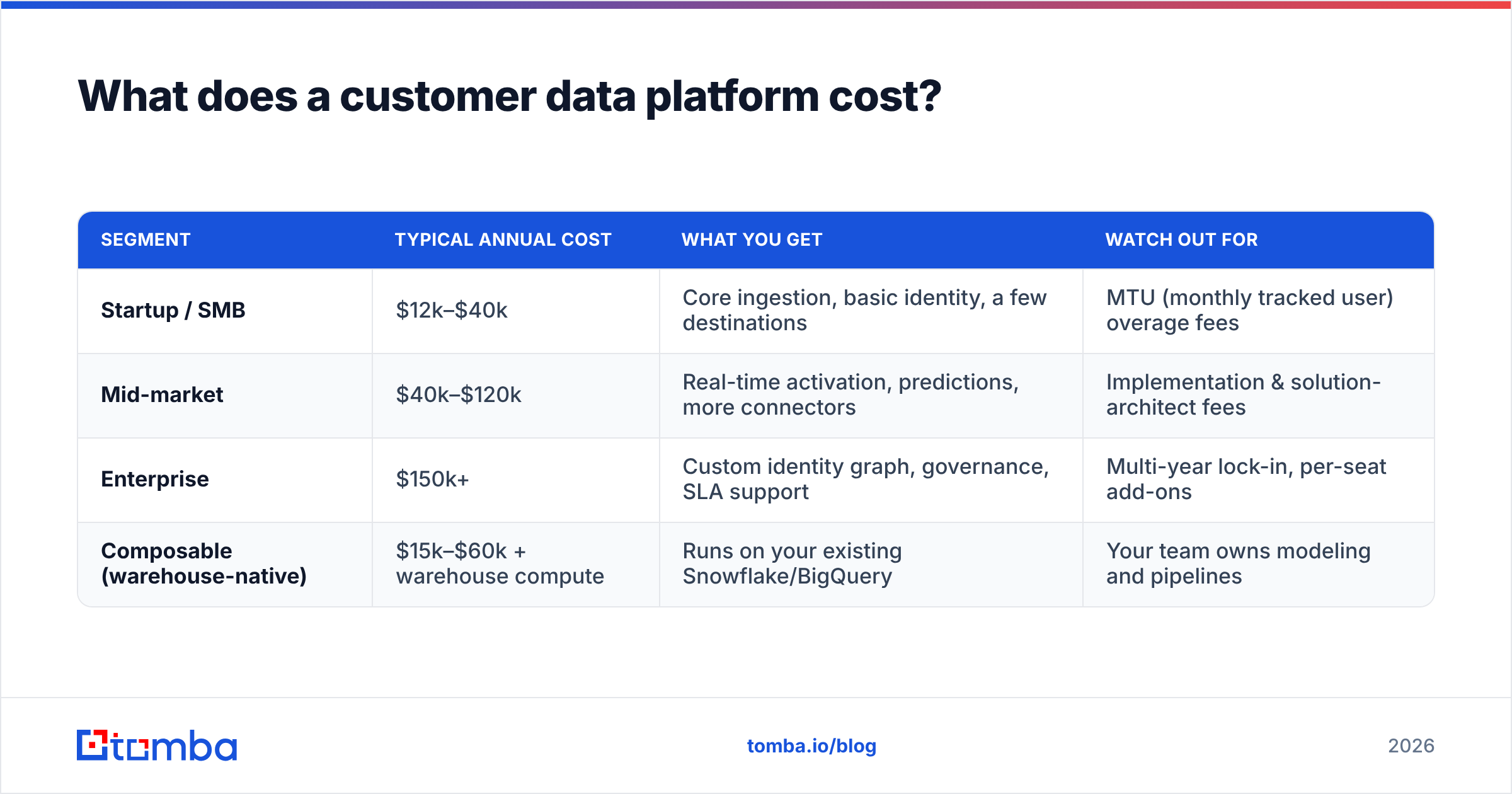
Pricing is rarely on the website, and the sticker price is the smaller half of the bill. Here's the realistic 2026 range.
| Segment | Typical annual cost | What you get | Watch out for |
|---|---|---|---|
| Startup / SMB | $12k–$40k | Core ingestion, basic identity, a few destinations | MTU (monthly tracked user) overage fees |
| Mid-market | $40k–$120k | Real-time activation, predictions, more connectors | Implementation & solution-architect fees |
| Enterprise | $150k+ | Custom identity graph, governance, SLA support | Multi-year lock-in, per-seat add-ons |
| Composable (warehouse-native) | $15k–$60k + warehouse compute | Runs on your existing Snowflake/BigQuery | Your team owns modeling and pipelines |
The three costs vendors underplay:
- Implementation — expect 1–3 months and often a paid onboarding package before you see value.
- Data volume pricing — most CDPs bill on monthly tracked users or event volume, so costs scale with success, not just seats.
- Governance — someone has to own consent, retention, and data quality, or you've built a fast pipeline for bad data.
For a smaller team, compare that outlay against simply keeping your existing stack clean. Reliable contact enrichment and a solid B2B database close a lot of the gap a CDP is sold to fill — at a fraction of the price. Transparent, per-seat Tomba pricing starts at $49/mo, versus five figures a year to license a platform you may not fill.
What features actually matter when comparing CDPs?#
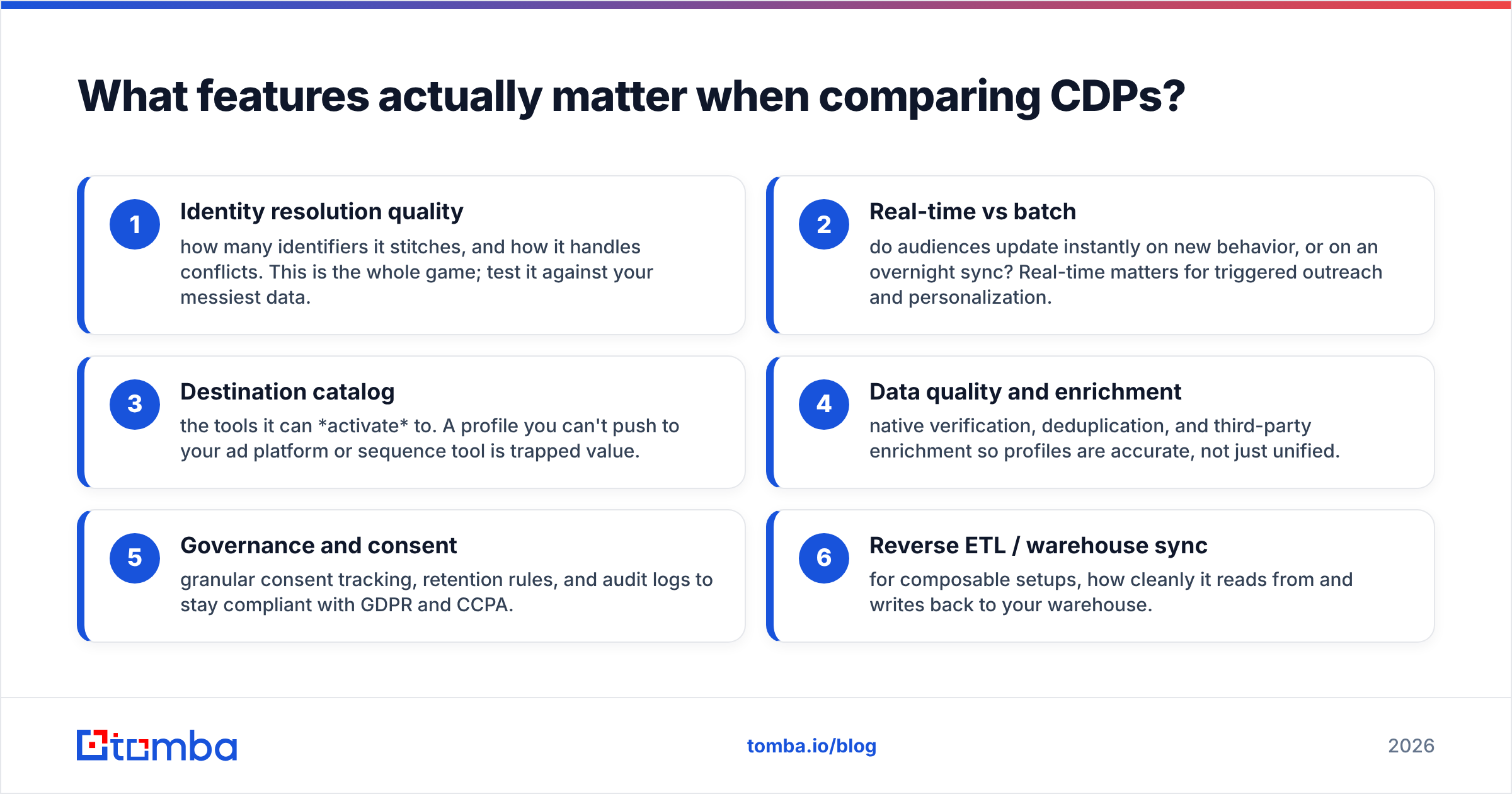
Ignore the feature-count marketing. These are the capabilities that separate a CDP that delivers from shelfware.
- Identity resolution quality — how many identifiers it stitches, and how it handles conflicts. This is the whole game; test it against your messiest data.
- Real-time vs batch — do audiences update instantly on new behavior, or on an overnight sync? Real-time matters for triggered outreach and personalization.
- Destination catalog — the tools it can activate to. A profile you can't push to your ad platform or sequence tool is trapped value.
- Data quality and enrichment — native verification, deduplication, and third-party enrichment so profiles are accurate, not just unified.
- Governance and consent — granular consent tracking, retention rules, and audit logs to stay compliant with GDPR and CCPA.
- Reverse ETL / warehouse sync — for composable setups, how cleanly it reads from and writes back to your warehouse.
A note on data quality: a CDP unifies whatever you feed it, including duplicate, stale, and invalid records. Verifying contact data before it enters the platform is non-negotiable. Running your inbound list through an email verifier and standardizing formats upstream prevents a fast pipeline from confidently distributing bad data across every downstream tool. Compare vendor claims on independent review sites like G2 rather than taking marketing copy at face value.
How do you implement a CDP without wasting six months?#
The failure mode is boiling the ocean — connecting every source before you've defined a single use case. Do the reverse.
- Start with one activation use case. Pick a concrete outcome (e.g., "suppress churned users from acquisition ads") and connect only the sources it needs.
- Map your identity graph first. Decide which identifier is your primary key and how email, phone, and device IDs resolve to it. Get this wrong and every downstream segment inherits the error.
- Clean before you connect. Deduplicate and verify existing records so you're not unifying noise. This is cheaper before ingestion than after.
- Instrument events consistently. Agree on a tracking plan — event names, properties, casing — so the same action means the same thing across web and app.
- Prove ROI on use case one, then expand. A working, measurable first use case wins the internal budget for the next five.
If you're wiring a CDP into an existing stack, the connectors do most of the work — the Tomba integrations approach (native links to Salesforce, HubSpot, Sheets, and the like) is the same pattern: enrich and verify at the point of ingestion so profiles start accurate.
Is a customer data platform worth it?#
It depends on scale and discipline — not on hype. A CDP is worth it when you have genuine data fragmentation across many channels, a team that will operate it, and cross-channel activation that can't wait for overnight batch jobs. In that situation, the identity resolution and real-time activation pay back the license quickly.
It is not worth it when your real problem is data quality, not data unification. Plenty of teams buy a six-figure CDP to fix what deduplication, verification, and enrichment would have solved for a few thousand dollars a year. The platform then faithfully unifies the same bad data, faster.
The honest sequence for most B2B teams: get your first-party data accurate and enriched, centralize what you can in your CRM and warehouse, and adopt a CDP when fragmentation — not dirty data — is the bottleneck.
Build your data foundation before you buy the platform#
A customer data platform is only as good as the records you feed it. Before you commit to a five-figure contract, make sure your source data is complete and verified — because unifying inaccurate contacts just distributes the errors everywhere.
Start upstream: use the Tomba Email Finder to find and verify professional email addresses by domain, name, or company, then enrich those contacts with firmographic data before they ever hit your CDP or CRM. Clean input is the cheapest, highest-leverage investment you can make in any customer data strategy — and it's the one step no platform will do for you. Get the foundation right, and whatever you build on top of it actually works.
Related guides#
Ready to find emails that actually work?
Join 150,000+ professionals who stopped guessing and started sending. Free credits on signup — no credit card required.
Get the Tomba newsletter
Practical outbound tactics and product updates — once every two weeks.
About the author