Customer Data Quality: The 2026 Guide to Clean, Reliable CRM Data
Dirty records quietly drain revenue, break automations, and wreck your reporting. Here is a practical 2026 playbook to measure, fix, and maintain customer data quality — without a six-month data project.
Your CRM says you have 48,000 contacts. Your team acts like you have maybe 12,000 you can actually trust. That gap — the difference between records you own and records you believe — is what customer data quality is really about.
Most teams treat data quality as a cleanup chore they'll get to "next quarter." It never happens, because it's framed as a project with no finish line instead of a system with a few moving parts. This guide reframes it: what quality actually means, how to measure it, and how to keep it high without a six-month migration.
TL;DR#
- Customer data quality is the degree to which your records are accurate, complete, consistent, timely, and unique enough to act on. Six dimensions, not a vague vibe.
- Bad data is expensive: Gartner pegs the average cost of poor data quality at $12.9M per year for a typical organization, and it silently degrades every downstream system.
- You can't fix what you don't measure. Start with a completeness and validity audit on your highest-value fields (email, phone, company, title).
- The cheapest win is stopping bad data at the door — validation and verification at capture, not annual scrubs.
- Tools like Tomba's email verifier and data enrichment automate the tedious parts so quality becomes a background process, not a fire drill.
What is customer data quality?#
Customer data quality is a measure of how fit your customer records are for the decisions and actions you take with them. Think of it like the fuel in a car: premium fuel and cheap contaminated fuel both look like liquid in the tank, but only one lets the engine run clean. Your CRM runs on data the same way — and contaminated records make every downstream system sputter.
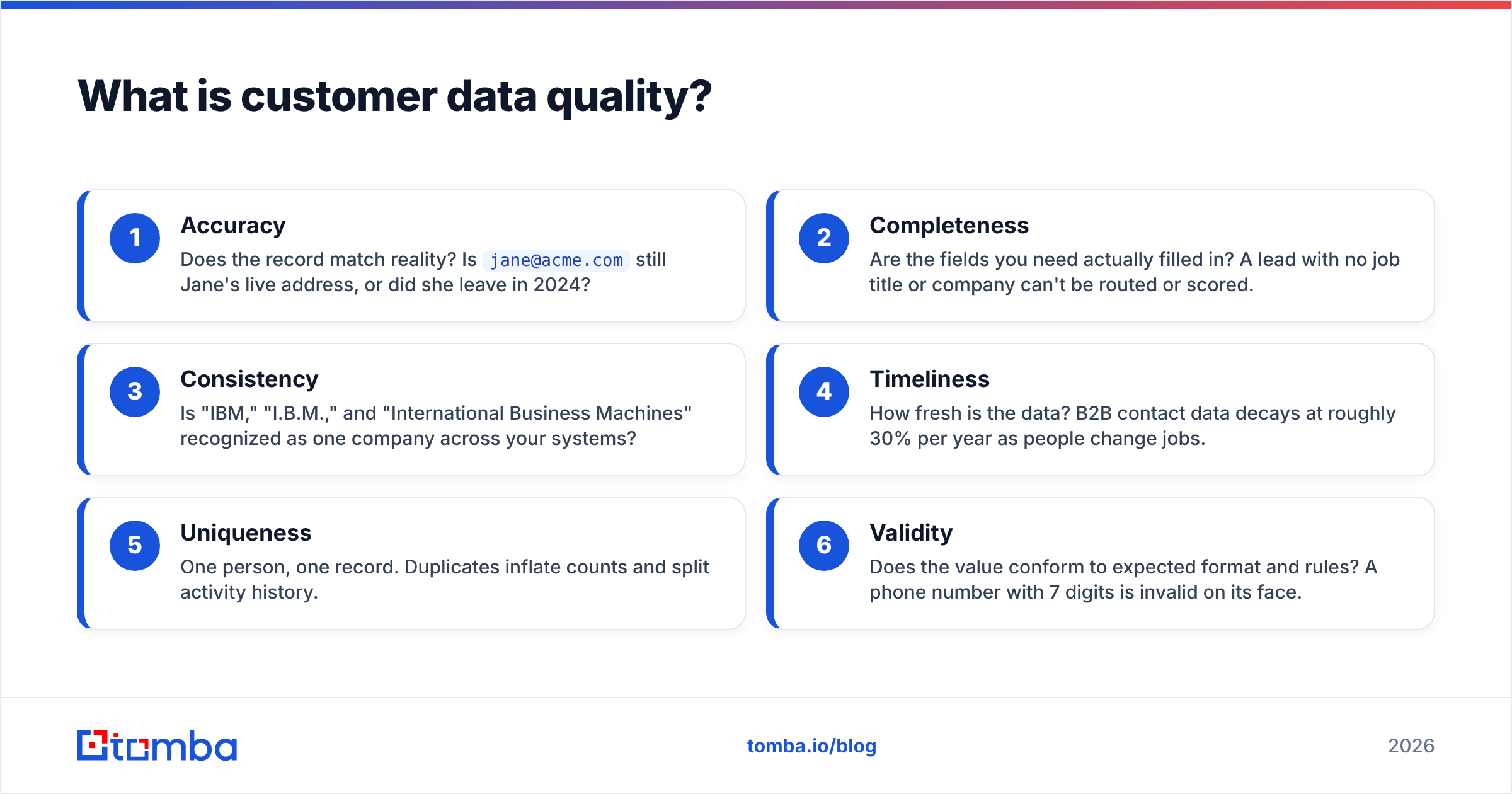
Quality isn't one number. It breaks into six measurable dimensions:
- Accuracy — Does the record match reality? Is
jane@acme.comstill Jane's live address, or did she leave in 2024? - Completeness — Are the fields you need actually filled in? A lead with no job title or company can't be routed or scored.
- Consistency — Is "IBM," "I.B.M.," and "International Business Machines" recognized as one company across your systems?
- Timeliness — How fresh is the data? B2B contact data decays at roughly 30% per year as people change jobs.
- Uniqueness — One person, one record. Duplicates inflate counts and split activity history.
- Validity — Does the value conform to expected format and rules? A phone number with 7 digits is invalid on its face.
When people say a CRM is "dirty," they usually mean it's failing on three or four of these at once. The value of naming the dimensions is that each one has a different fix — you don't solve duplicates and staleness the same way.
Why does customer data quality matter in 2026?#
Because bad data doesn't stay contained — it compounds. A single wrong email address doesn't just bounce one campaign; it drags down your sender reputation, which lowers deliverability for your good contacts too. One duplicate account skews your pipeline forecast. One stale title routes a VP-level lead to a junior rep's low-priority queue.
The financial case is well documented. Gartner's research estimates poor data quality costs organizations an average of $12.9 million annually, and that figure only counts what's measurable. The harder costs — reps who stop trusting the CRM and keep their "real" contacts in a spreadsheet — never show up on a dashboard.
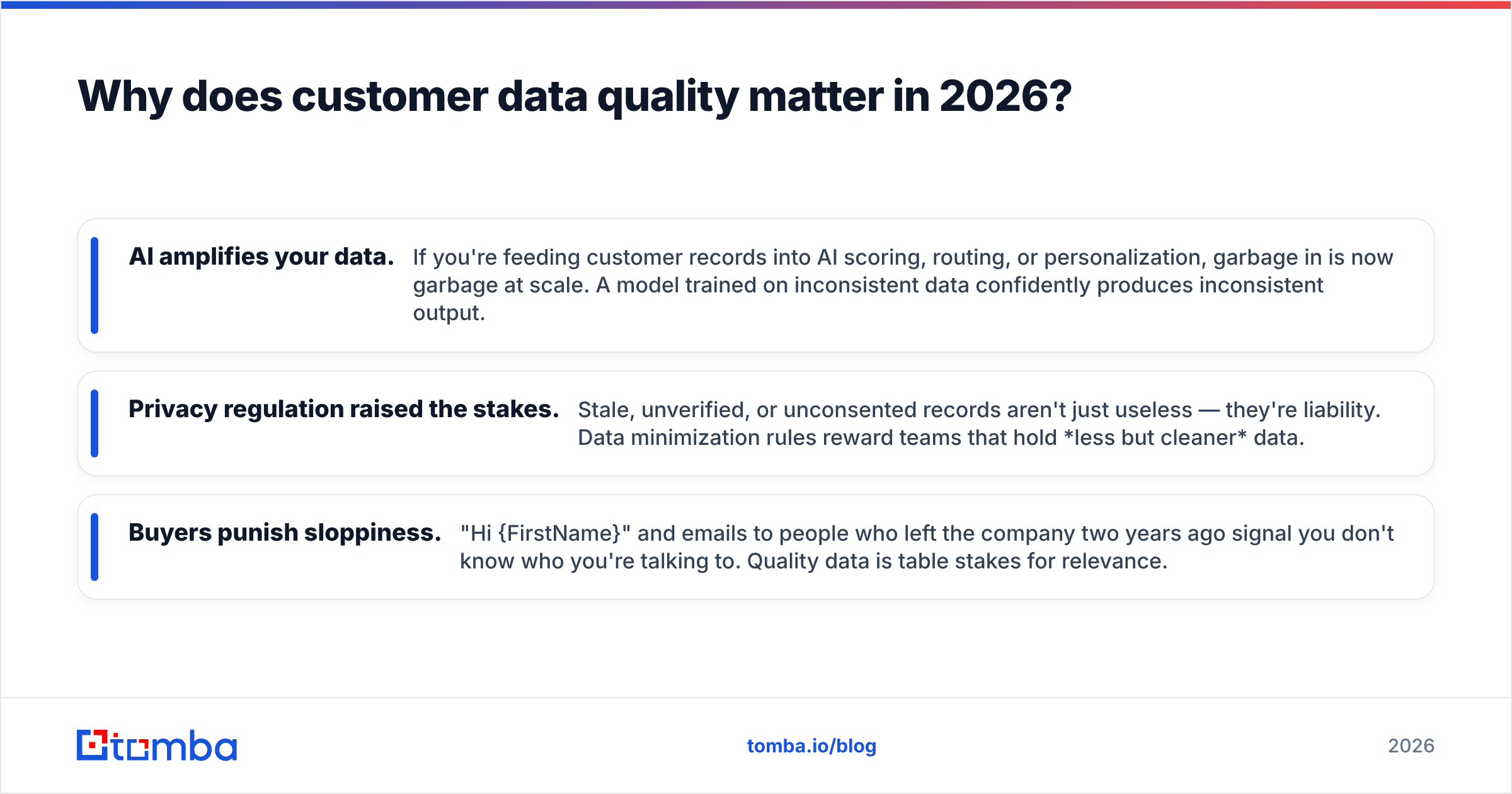
Three shifts make 2026 different from five years ago:
- AI amplifies your data. If you're feeding customer records into AI scoring, routing, or personalization, garbage in is now garbage at scale. A model trained on inconsistent data confidently produces inconsistent output.
- Privacy regulation raised the stakes. Stale, unverified, or unconsented records aren't just useless — they're liability. Data minimization rules reward teams that hold less but cleaner data.
- Buyers punish sloppiness. "Hi {FirstName}" and emails to people who left the company two years ago signal you don't know who you're talking to. Quality data is table stakes for relevance.
The point isn't fear. It's that data quality has moved from a hygiene nice-to-have to an operational dependency — the thing your automation, reporting, and outreach quietly stand on.
How do you measure customer data quality?#
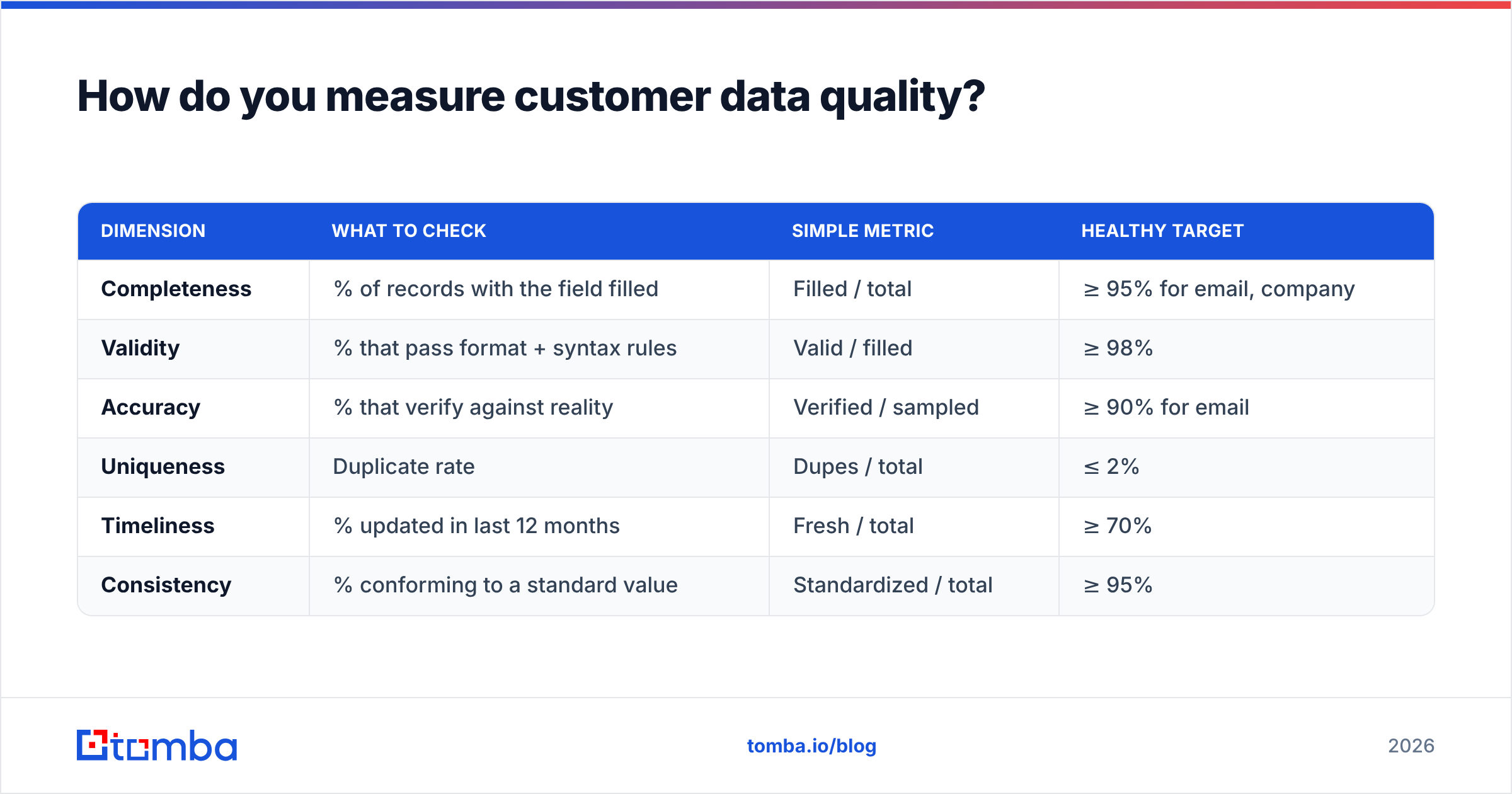
Start with a scorecard, not a cleanup. You measure quality before you fix it, because the audit tells you where the money is. Here's a practical baseline you can run this week against your top four fields.
| Dimension | What to check | Simple metric | Healthy target |
|---|---|---|---|
| Completeness | % of records with the field filled | Filled / total | ≥ 95% for email, company |
| Validity | % that pass format + syntax rules | Valid / filled | ≥ 98% |
| Accuracy | % that verify against reality | Verified / sampled | ≥ 90% for email |
| Uniqueness | Duplicate rate | Dupes / total | ≤ 2% |
| Timeliness | % updated in last 12 months | Fresh / total | ≥ 70% |
| Consistency | % conforming to a standard value | Standardized / total | ≥ 95% |
Run this and you'll almost certainly find one dimension is dragging the rest. For most B2B teams, it's accuracy on email and timeliness — because contact data decays whether you touch it or not.
A quick way to sanity-check email accuracy without emailing anyone: run a sample of your list through an email verifier. If 22% come back as invalid, risky, or catch-all, you now have a number to justify the fix. "Our data is bad" is ignorable. "22% of our outreach list will bounce or hurt deliverability" gets budget.
What causes poor customer data quality?#
Bad data has sources, and naming them tells you where to install guardrails. Most quality problems trace back to five failure points:
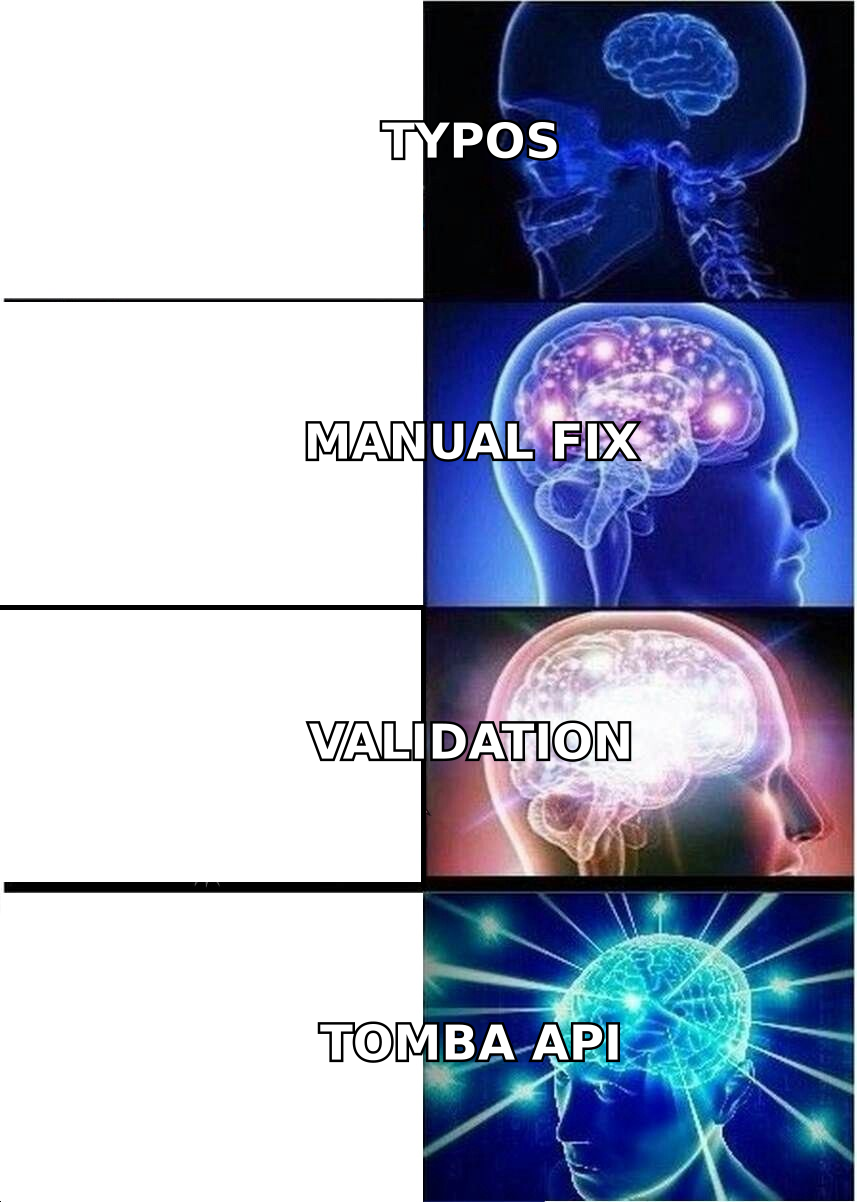
- Manual entry at capture. Typos, wrong fields, and "N/A" as a job title. Humans typing into forms is the single largest source of dirty records.
- No validation on input. If your form accepts
asdf@asdfas an email, it will. The absence of a rule is a rule. - Time. People change jobs, companies rebrand, offices close. Data that was perfect at capture rots on a predictable curve.
- Merged systems. Every acquisition, tool migration, or CSV import fuses two sets of conventions and creates duplicates and conflicts.
- Enrichment from bad sources. Filling gaps with a low-quality data provider imports someone else's errors into your system.
The pattern across all five: quality problems are cheapest to fix at the moment of entry and most expensive to fix in bulk later. That single insight should reshape where you spend effort.
How do you fix and maintain customer data quality?#
Fix it at the door first, then clean the backlog — not the other way around. If you scrub 48,000 records but keep letting bad ones in, you're bailing a boat without patching the hole.
Here's the sequence that actually holds.
1. Stop the bleeding (validation at capture)#
Add format validation and real-time verification to every point where data enters: web forms, manual rep entry, and imports. When a rep or a form submits an email, verify it live. This is where an email finder API or verification endpoint earns its keep — it rejects test@test.com before it becomes a permanent resident in your CRM.
2. Standardize your conventions#
Pick one format per field and enforce it. Country names, phone formats, job-title groupings, company-name normalization. Consistency is boring and it's also what makes deduplication and reporting possible.
3. Deduplicate#
Merge duplicates using a match rule (email is the strongest key for B2B). Preserve the richest record and roll up activity history so you don't lose context.
4. Enrich the gaps — from a good source#
Empty fields on otherwise-valuable records are worth filling, but only from data you trust. Use contact enrichment to complete missing titles, companies, and phone numbers rather than leaving reps to guess or scrape.
5. Schedule re-verification#
Because data decays, treat verification as recurring, not one-time. Re-verify your active outreach segments quarterly and your full database annually. A bulk verify run on a schedule turns "our data is probably fine" into a number you can actually report.
Build vs. buy: how should you approach data quality tooling?#
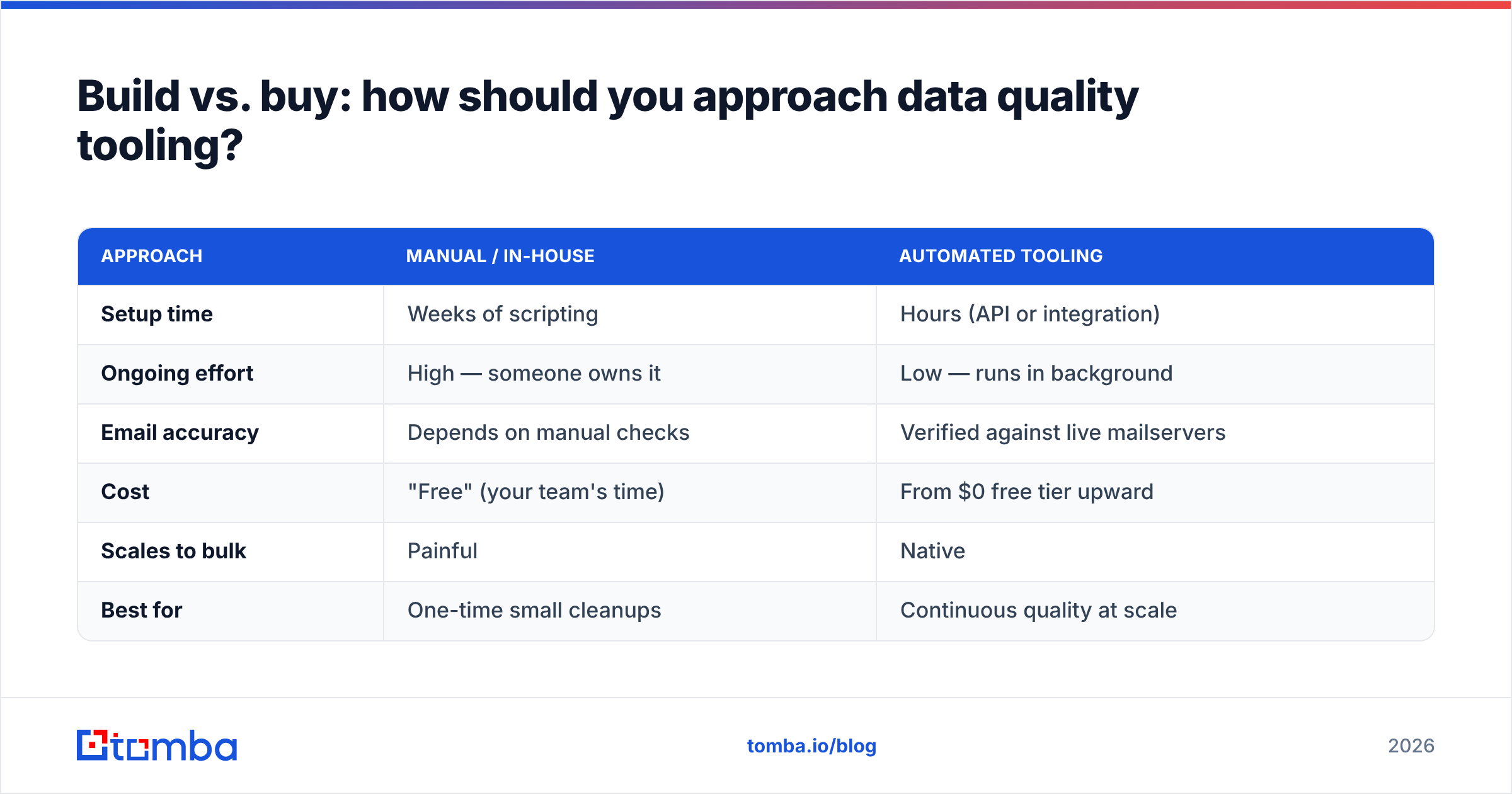
You can hand-roll data quality with SQL scripts and spreadsheets, or you can automate the repetitive parts. Here's the honest tradeoff.
| Approach | Manual / in-house | Automated tooling |
|---|---|---|
| Setup time | Weeks of scripting | Hours (API or integration) |
| Ongoing effort | High — someone owns it | Low — runs in background |
| Email accuracy | Depends on manual checks | Verified against live mailservers |
| Cost | "Free" (your team's time) | From $0 free tier upward |
| Scales to bulk | Painful | Native |
| Best for | One-time small cleanups | Continuous quality at scale |
For a small one-off cleanup of a few hundred rows, a spreadsheet and a free email checker are genuinely fine. Once you're maintaining quality across thousands of records on an ongoing basis, the math flips hard toward automation — not because tools are magic, but because human attention is the most expensive and least reliable part of the loop.
If you go the tooling route, look at where your data quality actually breaks. Most B2B teams break on email accuracy and enrichment, which is why platforms like Tomba bundle finding, verification, catch-all checks, and enrichment together rather than making you stitch four vendors into a pipeline. You can compare that against dedicated verification specialists on G2 if you want a second opinion — the point is to match the tool to your worst dimension, not to buy the one with the most logos.
What does good customer data quality actually get you?#
Cleaner data isn't the goal — it's the enabler. The payoff shows up three layers downstream:
- Higher deliverability. Verified emails mean fewer bounces, better sender reputation, and more of your outreach actually landing in the inbox.
- Trustworthy reporting. When your record count means something, your pipeline forecast and win-rate analysis mean something too.
- Reps who use the CRM. The quiet win. When the data is right, salespeople stop maintaining shadow spreadsheets and start trusting the system of record.
- AI that works. Every AI feature you layer on — scoring, routing, personalization — inherits the quality of the data beneath it.
Compare that to the cost of ignoring it — HubSpot and Salesforce both estimate that a meaningful share of CRM records go stale every single year. Do nothing and quality doesn't hold steady; it declines by default. Data quality is one of the few investments where standing still means falling behind.
Frequently asked questions#
How often should I clean my customer data? Continuously at the point of entry, quarterly for active outreach segments, and a full-database pass at least once a year. Decay is constant, so your maintenance should be too.
What's the single highest-impact fix? Email verification at capture. It protects deliverability, prevents the most common form of dirty data, and is the cheapest guardrail to install.
Is enrichment the same as data quality? No. Enrichment fills gaps (completeness); quality also covers accuracy, uniqueness, and freshness. Enriching from a bad source can lower quality. Fix accuracy first, then enrich.
Can I do this without a data engineer? Yes. Form validation, a scheduled bulk verify, and an enrichment integration cover most of the value without a custom pipeline.
Start with the field that's costing you money#
Customer data quality isn't a six-month project — it's a set of guardrails you install once and let run. Measure your worst dimension, stop bad data at the door, and put verification on a schedule. Everything downstream — deliverability, reporting, AI, rep trust — gets better on its own after that.
If email accuracy is your weak spot (it usually is), the fastest place to start is verifying what you already have and finding correct addresses for the records worth keeping. The Tomba Email Finder finds and verifies professional emails by domain, name, or company, and the free tier gives you 25 searches a month to test it against your own dirty list before committing to a plan. Run a sample, get your real accuracy number, and let the tooling handle the tedious part while your team works the pipeline.
Related guides#
Ready to find emails that actually work?
Join 150,000+ professionals who stopped guessing and started sending. Free credits on signup — no credit card required.
Get the Tomba newsletter
Practical outbound tactics and product updates — once every two weeks.
About the author