Customer Outreach Meaning: The Complete 2026 Playbook
Customer outreach is more than cold email. Here's what the term actually means in 2026, the channels that convert, and a step-by-step framework to turn strangers into booked meetings.
Customer outreach gets thrown around like everyone agrees on what it means. They don't. Ask five sales leaders and you'll get cold email, LinkedIn DMs, "growth," and "the thing SDRs do." This guide fixes that. You'll get a clear definition, the channels that actually move pipeline in 2026, and a repeatable framework you can run this week.
TL;DR#
- Customer outreach is the deliberate act of initiating contact with a specific person or account to start a relationship that leads to a sale, retention, or expansion — proactive, targeted, and personalized.
- It is not advertising (that's inbound and one-to-many). Outreach is one-to-one or one-to-few, and you go first.
- The channels that work: email, phone, LinkedIn, and video — usually blended into a sequence, not used in isolation.
- The biggest failure mode is volume without relevance. Accurate contact data and tight segmentation beat blast volume every time.
- A good outreach motion has four parts: build a list, verify the data, personalize the message, and follow up on a cadence.
What is the meaning of customer outreach?#
Customer outreach means proactively contacting a defined prospect or existing customer to open a conversation that advances a business relationship. The keyword is proactive: you initiate, rather than waiting for a form fill or a reply to an ad.
Think of it like knocking on a specific door versus putting up a billboard. A billboard (inbound marketing) hopes the right person drives by. Outreach walks up to the house where you already know a good-fit buyer lives and knocks. Technically, that means you identify an account, find the right stakeholder, and reach them on a channel they actually check — with a reason to care.
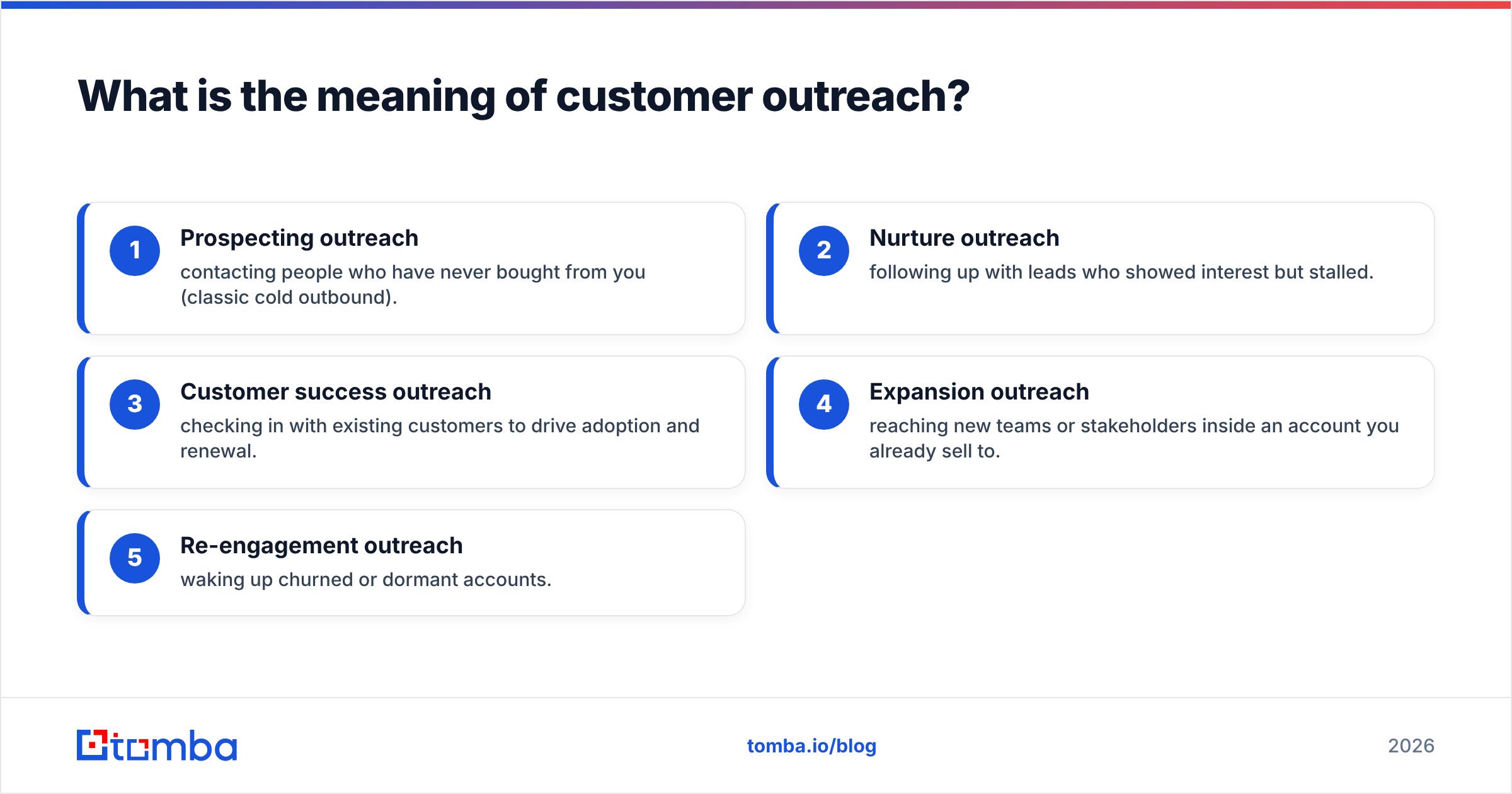
Outreach spans the full customer lifecycle, not just new logos:
- Prospecting outreach — contacting people who have never bought from you (classic cold outbound).
- Nurture outreach — following up with leads who showed interest but stalled.
- Customer success outreach — checking in with existing customers to drive adoption and renewal.
- Expansion outreach — reaching new teams or stakeholders inside an account you already sell to.
- Re-engagement outreach — waking up churned or dormant accounts.
Most people mean #1 when they say "outreach," but treating it as all five is what separates a repeatable revenue engine from a one-off cold-email campaign.
How is outreach different from marketing and advertising?#
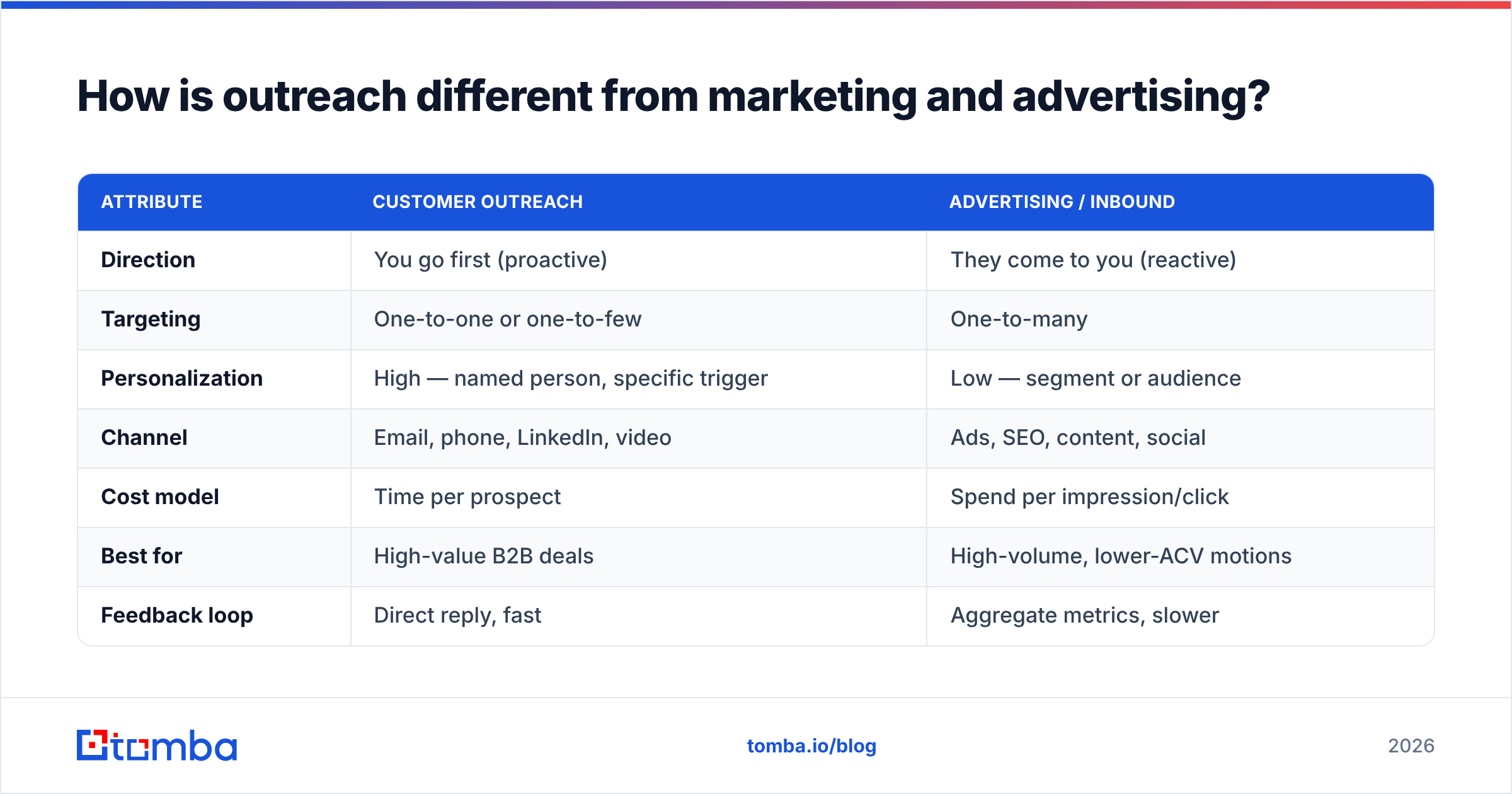
The confusion is understandable — both aim to start conversations. The difference is direction and precision.
| Attribute | Customer outreach | Advertising / inbound |
|---|---|---|
| Direction | You go first (proactive) | They come to you (reactive) |
| Targeting | One-to-one or one-to-few | One-to-many |
| Personalization | High — named person, specific trigger | Low — segment or audience |
| Channel | Email, phone, LinkedIn, video | Ads, SEO, content, social |
| Cost model | Time per prospect | Spend per impression/click |
| Best for | High-value B2B deals | High-volume, lower-ACV motions |
| Feedback loop | Direct reply, fast | Aggregate metrics, slower |
Neither is "better." A healthy go-to-market motion runs both: marketing warms the market and captures demand, while outreach reaches the specific accounts that fit your ideal customer profile whether or not they've raised their hand. If you sell $30,000 annual contracts, you cannot afford to wait for every buyer to find your blog. You reach them.
Why does customer outreach still work in 2026?#
Because buying is still human, and the best-fit accounts rarely self-identify at the exact moment you have capacity to sell to them. Outreach lets you control your pipeline instead of hoping the market delivers it.
According to HubSpot's sales research, personalized, multi-channel follow-up consistently outperforms single-touch blasts — and most reps give up long before a prospect is ready to respond. That gap is the opportunity. Outreach works in 2026 for three reasons:
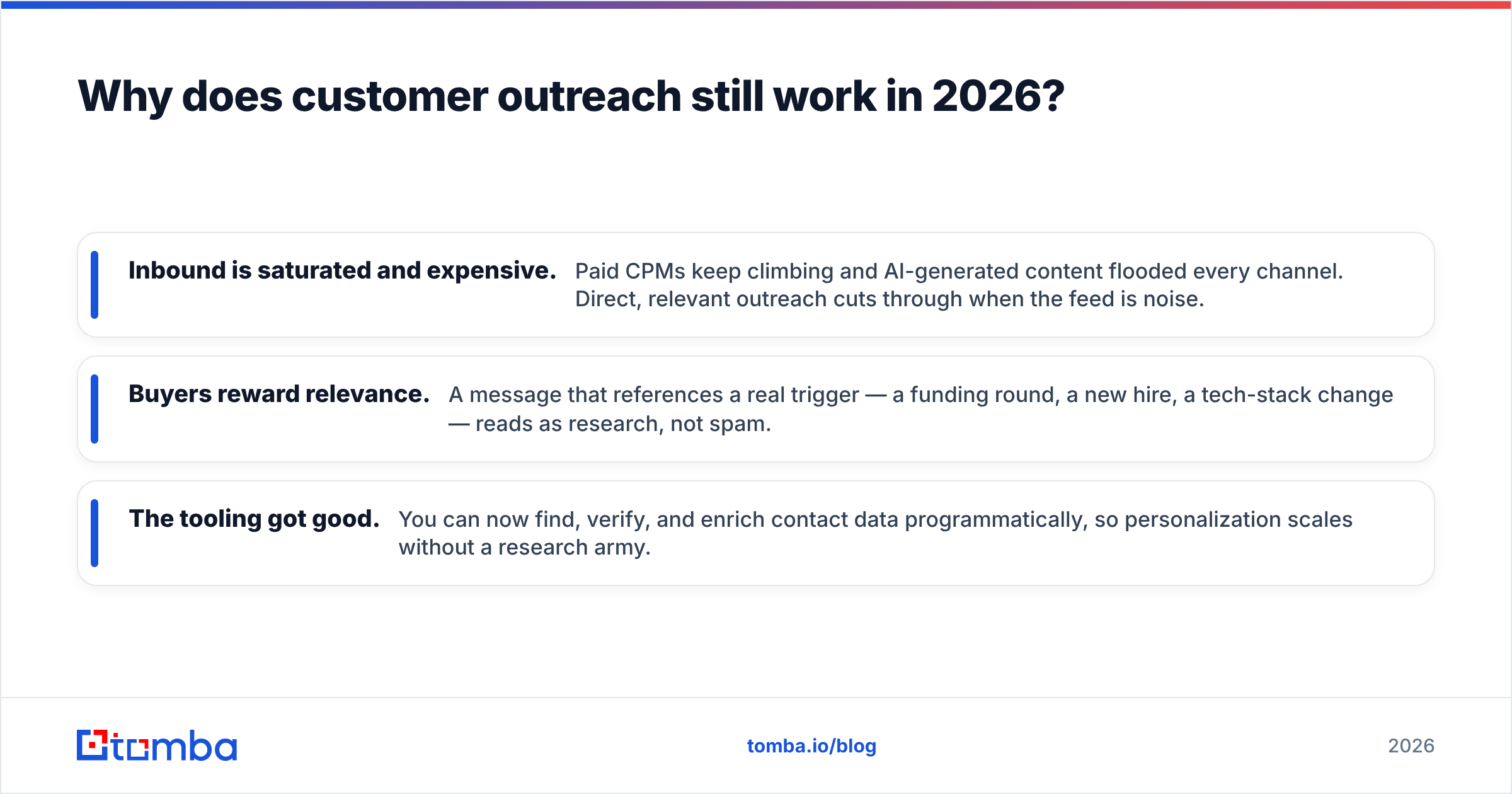
- Inbound is saturated and expensive. Paid CPMs keep climbing and AI-generated content flooded every channel. Direct, relevant outreach cuts through when the feed is noise.
- Buyers reward relevance. A message that references a real trigger — a funding round, a new hire, a tech-stack change — reads as research, not spam.
- The tooling got good. You can now find, verify, and enrich contact data programmatically, so personalization scales without a research army.
The catch: the bar is higher. Generic "just checking in" emails die faster than ever. What works is precise targeting plus a genuine reason to reach out.
Which outreach channels convert best?#
There's no single best channel — there's the right blend for your buyer. Here's how the main channels stack up.
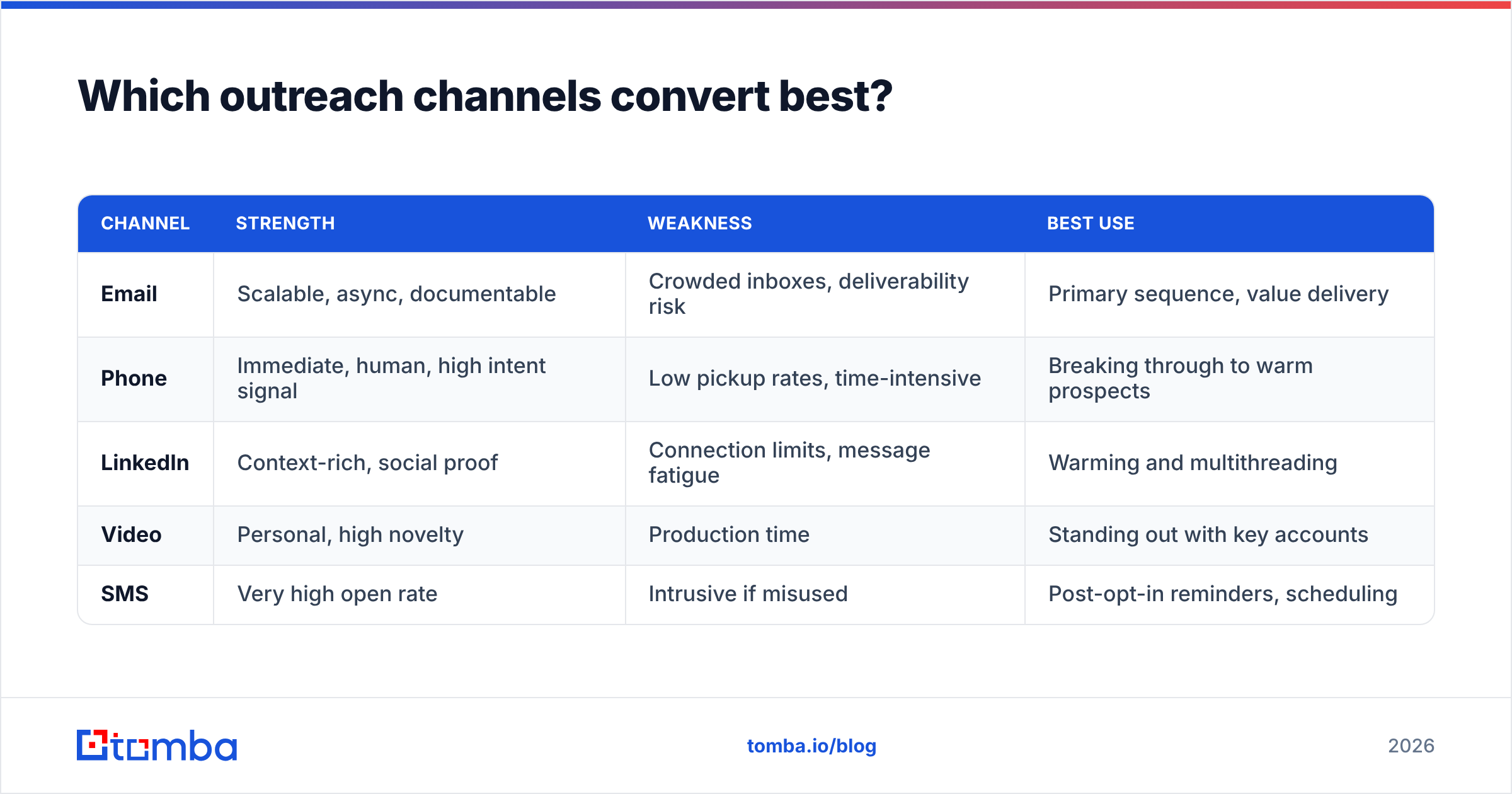
| Channel | Strength | Weakness | Best use |
|---|---|---|---|
| Scalable, async, documentable | Crowded inboxes, deliverability risk | Primary sequence, value delivery | |
| Phone | Immediate, human, high intent signal | Low pickup rates, time-intensive | Breaking through to warm prospects |
| Context-rich, social proof | Connection limits, message fatigue | Warming and multithreading | |
| Video | Personal, high novelty | Production time | Standing out with key accounts |
| SMS | Very high open rate | Intrusive if misused | Post-opt-in reminders, scheduling |
The winning pattern is a sequence that combines two or three channels across 8–14 days. For example: a personalized email, a LinkedIn view and connect, a follow-up email that adds value, then a call. Each touch reinforces the others so you're familiar by the time you ask for a meeting.
Two things quietly decide whether any of this works: can you reach the person at all, and will your message land in the inbox. That's where data quality and email deliverability matter more than clever copy. A brilliant email to a bounced address is worth nothing.
What does a good outreach process look like?#
A repeatable outreach motion has four stages. Skip one and the whole thing leaks.
1. Build a targeted list. Start with your ideal customer profile — industry, size, role, and a trigger. Then find the actual people. You can pull decision-makers by company with a domain search to see every email pattern at an account, or find individuals directly with an email finder when you already have names.
2. Verify before you send. Invalid addresses tank your sender reputation and inflate your bounce rate. Run every address through an email verifier so you're only mailing real, reachable inboxes. This single step protects deliverability for your entire domain.
3. Personalize the message. Lead with them, not you. Reference the trigger, name a specific problem their role feels, and make the ask small. Enrich your list with firmographic and role data so personalization scales — data enrichment turns a bare email into context you can write around.
4. Follow up on a cadence. Most replies come after the first touch. Build a 5–7 step sequence across channels, space it out, and stop when they reply or clearly opt out. Persistence without relevance is spam; persistence with relevance is professional.
What metrics tell you outreach is working?#
Track the funnel, not just the top of it. Vanity metrics like "emails sent" tell you nothing about pipeline.
- Bounce rate — should sit under 3%. Higher means your data or verification is broken.
- Open rate — a proxy for subject line and sender reputation (imperfect since Apple/privacy changes, but directional).
- Reply rate — the real signal. Healthy targeted outreach lands 5–15% positive-or-neutral replies.
- Positive reply rate — replies that want to continue, not "unsubscribe."
- Meetings booked — the metric your pipeline actually runs on.
- Meeting-to-opportunity rate — did the targeting attract real buyers or just polite ones?
If reply rates are low, the problem is almost always targeting or relevance, not send volume. Doubling your sends on a bad list just doubles the damage to your domain. Fix the list first.
You can benchmark healthy ranges against public data on sites like G2 before deciding whether your numbers need work.
What are the most common outreach mistakes?#
Most failed outreach fails the same handful of ways:
- Spraying an unverified list. Bounces wreck deliverability and every later campaign suffers. Verify first, always.
- Making it about you. "We're the leading platform for…" — nobody cares in line one. Open with their situation.
- One-and-done. Sending once and giving up leaves most of your pipeline on the table.
- Fake personalization. "{{first_name}}, love what you're doing at {{company}}" fools no one. Real personalization references a real detail.
- Ignoring the phone. A well-timed call after two emails converts warm prospects that email alone would lose. Pull direct lines with a phone finder so multi-channel is actually possible.
- No clear ask. End every message with one specific, low-friction next step.
Avoid these six and you're already ahead of most teams sending outreach in 2026.
How do you scale outreach without becoming spam?#
The tension in outreach is volume versus relevance. Scale wrongly and you become the spam you hate. The answer is to scale the research, not the blast.
Automation should make each message more relevant, not more generic. Use data tooling to find and verify contacts and pull the context that fuels personalization — then let humans (or well-guardrailed AI) write messages that sound like a person did the work. Keep sequences small per rep, segment tightly, and hold yourself to a standard: would you be glad to receive this message? If not, don't send it.
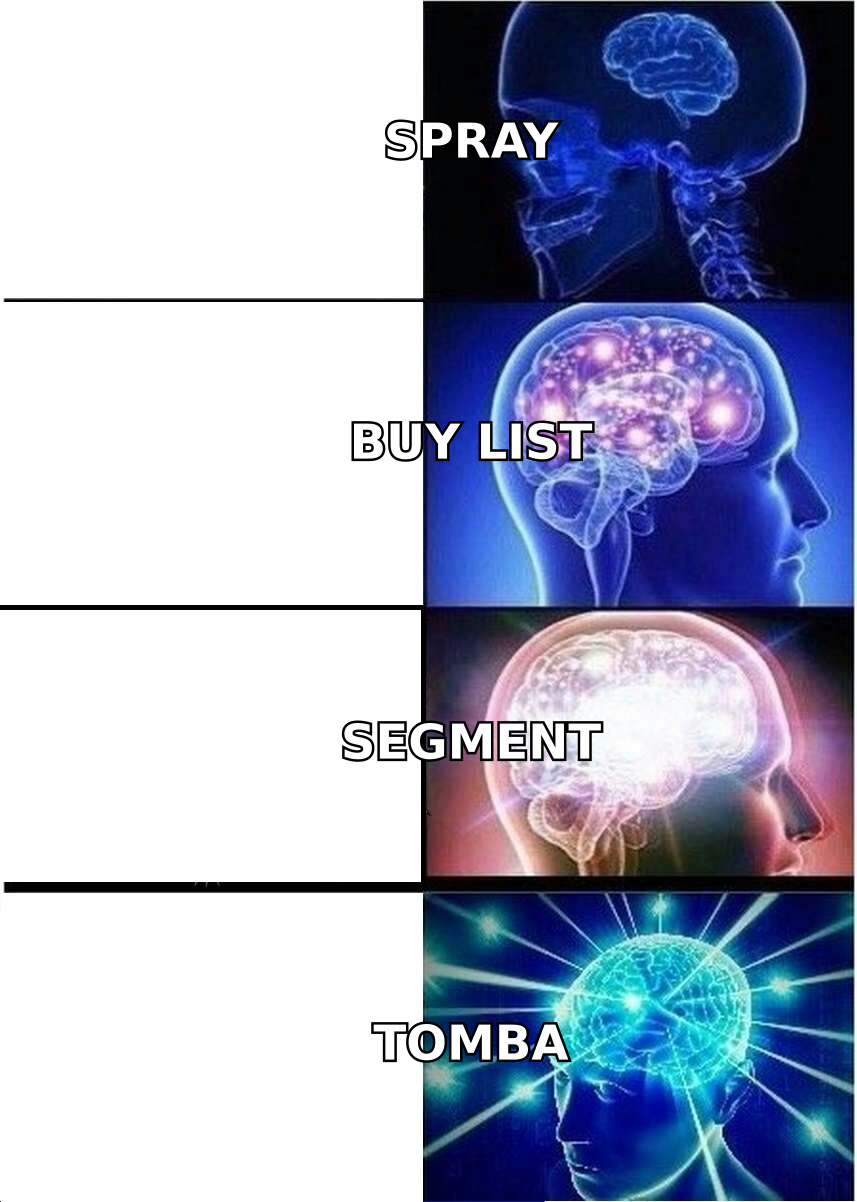
The teams that win in 2026 treat outreach as precision work. They'd rather send 200 sharply targeted, verified, personalized touches than 5,000 sprayed ones — because the first books meetings and protects the domain, and the second burns both.
Start your outreach on clean, accurate data#
Every outreach framework in this guide depends on one thing: reaching the right person at a real address. That's exactly what the Tomba Email Finder is built for — find verified professional emails by name, company, or domain, so your sequences start on data you can trust instead of guesses that bounce. Pair it with verification and enrichment and you've got the foundation for outreach that actually converts. You can start free with 25 searches a month and see the Tomba pricing tiers when you're ready to scale. Build the list right, and the rest of outreach gets a lot easier.
Related guides#
Ready to find emails that actually work?
Join 150,000+ professionals who stopped guessing and started sending. Free credits on signup — no credit card required.
Get the Tomba newsletter
Practical outbound tactics and product updates — once every two weeks.
About the author