Customer Pain Points in 2026: How to Find and Solve Them
Most reps pitch features to buyers who never asked for them. This guide shows how to uncover real customer pain points, map them to buying triggers, and write outreach that converts.

Most sales messages fail for one reason: they answer a question the buyer never asked. You lead with features, integrations, and a pricing table, while the person on the other end is quietly drowning in a problem you never named. Understanding customer pain points is the difference between outreach that gets ignored and outreach that gets a reply within the hour.
This guide breaks down what pain points actually are, the four types that drive B2B buying decisions, how to find them without guessing, and how to turn them into messaging that lands.
TL;DR#
- A customer pain point is a specific, recurring problem your prospect experiences that they are motivated to spend money to solve — not a vague "challenge."
- There are four core types: financial, productivity, process, and support. Most deals hinge on one dominant pain, not all four.
- Surface complaints are not root pains. "Your tool is expensive" usually means "I can't justify the ROI to my boss."
- You find pain points through research, not assumptions — review mining, sales-call transcripts, support tickets, and enriched contact data.
- The payoff is targeting: reach the right person, name their real pain, and reply rates climb because the message finally feels written for them.
What is a customer pain point?#
A customer pain point is a persistent problem a person or company faces that creates enough friction to justify buying a solution. Think of it like a stone in a runner's shoe. They can keep going for a while, but every step reminds them it's there — and eventually they'll stop everything to deal with it. Your job is to be the one holding the fix when they finally sit down.
The keyword is specific. "We want to grow revenue" is a goal, not a pain. "Our SDRs waste two hours a day copy-pasting leads between spreadsheets and the CRM" is a pain point — it's measurable, it recurs daily, and it has an obvious cost. According to HubSpot's sales research, the reps who consistently hit quota are the ones who diagnose the specific problem before pitching anything.
Pain points also differ by role. A VP of Sales feels the pain as missed pipeline targets. The SDR under them feels the same root problem as tedious manual work. Same company, same issue, two completely different messages. If you pitch the SDR's convenience to the VP, you lose.

What are the four types of customer pain points?#
Nearly every B2B pain point falls into one of four buckets. Naming the right bucket tells you which message and which decision-maker to target.
- Financial pain points — The prospect is spending too much on their current stack, tools, or process. They're paying for three overlapping platforms, or bleeding budget on bad-fit leads. The message that works here is cost consolidation and ROI.
- Productivity pain points — The prospect wastes time on tasks that should be automated or faster. Manual data entry, slow research, tab-switching. The message is hours saved per rep, per week.
- Process pain points — The prospect's internal workflow is broken or leaky. Leads fall through the cracks, handoffs between marketing and sales break, data goes stale. The message is reliability and fewer dropped balls.
- Support pain points — The prospect isn't getting the guidance, onboarding, or responsiveness they need from a current vendor. The message is service quality and partnership.
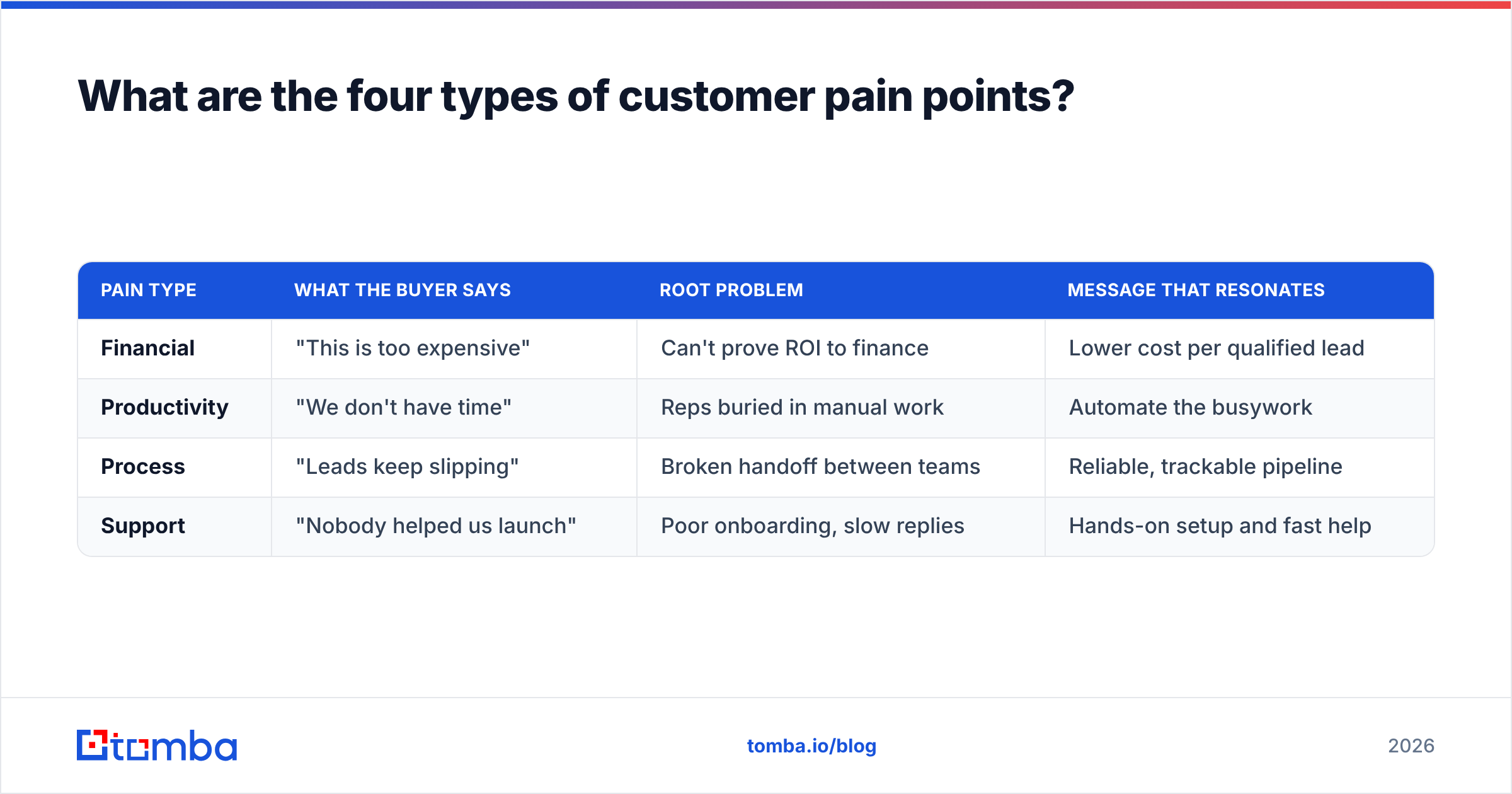
Here's how the same underlying situation reads across all four lenses:
| Pain type | What the buyer says | Root problem | Message that resonates |
|---|---|---|---|
| Financial | "This is too expensive" | Can't prove ROI to finance | Lower cost per qualified lead |
| Productivity | "We don't have time" | Reps buried in manual work | Automate the busywork |
| Process | "Leads keep slipping" | Broken handoff between teams | Reliable, trackable pipeline |
| Support | "Nobody helped us launch" | Poor onboarding, slow replies | Hands-on setup and fast help |
Notice that "this is too expensive" almost never means the price is literally too high. It means the buyer can't connect the spend to an outcome. Fix the ROI story and the price objection evaporates.
Why do most reps get customer pain points wrong?#
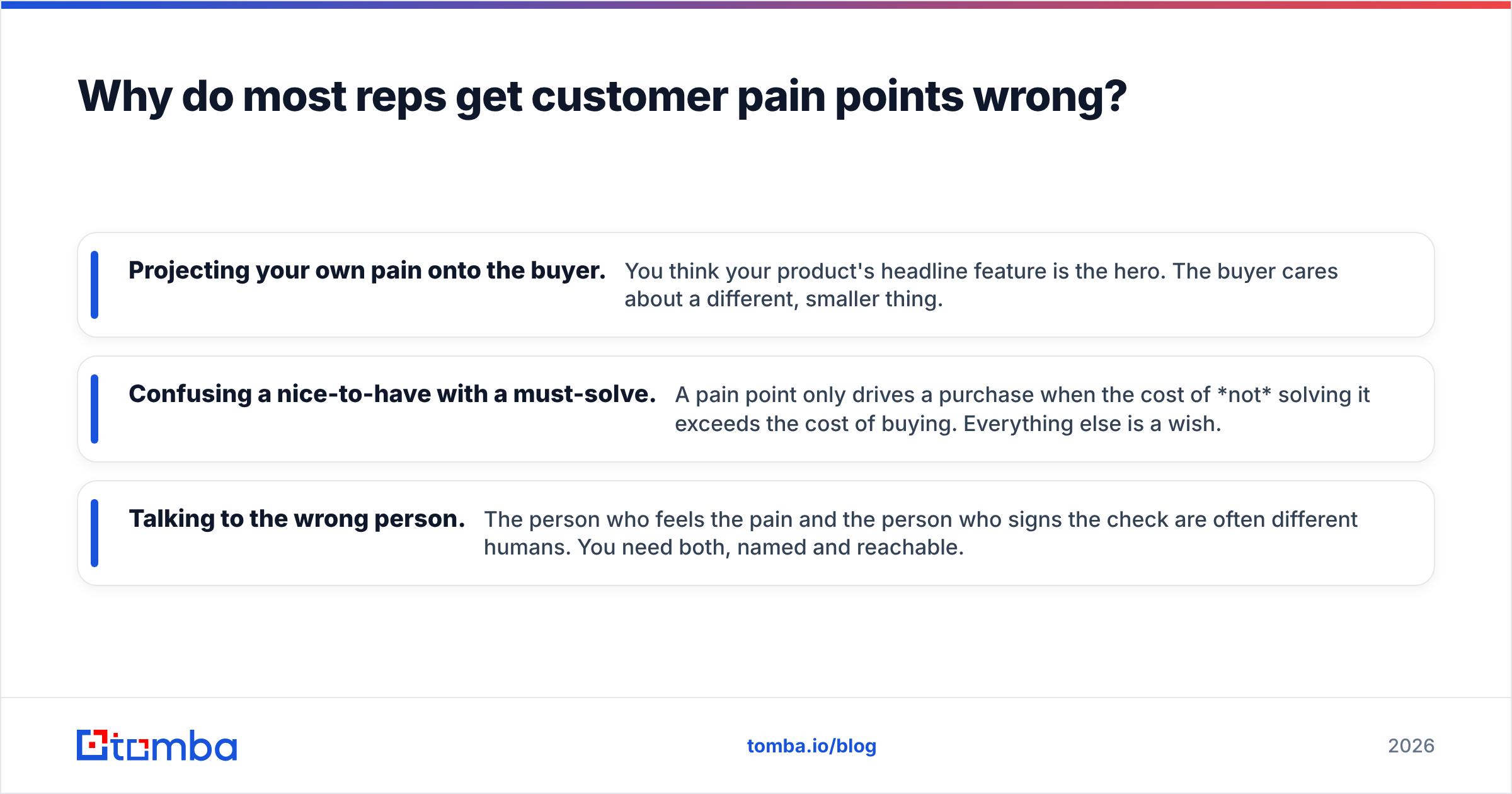
Because they treat the first complaint as the whole story. A prospect says "your onboarding looks complicated," and the rep spends the next email defending onboarding. But the surface complaint is rarely the root pain. Behind "onboarding looks complicated" is often "I got burned by a tool last quarter that took three months to implement and my team never adopted it."
This is where the woman-yelling-at-cat argument plays out on every sales team: one side insists on blasting the same generic pitch to everyone, the other side quietly points at the data showing which prospects actually have the pain.
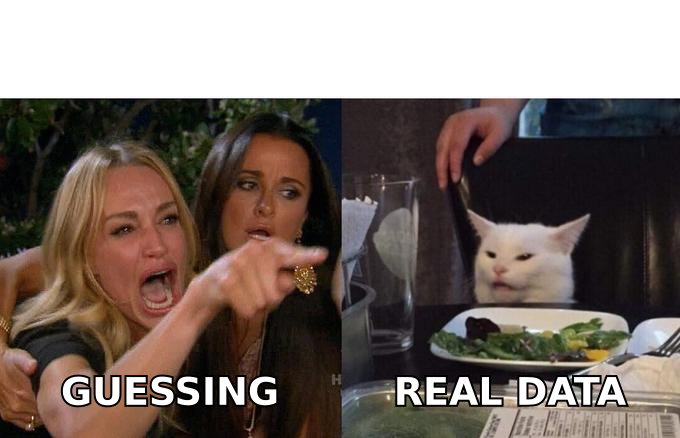
The teams that guess spray-and-pray messaging at everyone. The teams that use real signals — enriched firmographic data, technographics, hiring trends, review complaints — reach the small subset of prospects who actually feel the pain right now. That's the entire game. You don't need a bigger list; you need to know which contacts on your list are bleeding.
Three more common mistakes:
- Projecting your own pain onto the buyer. You think your product's headline feature is the hero. The buyer cares about a different, smaller thing.
- Confusing a nice-to-have with a must-solve. A pain point only drives a purchase when the cost of not solving it exceeds the cost of buying. Everything else is a wish.
- Talking to the wrong person. The person who feels the pain and the person who signs the check are often different humans. You need both, named and reachable.
How do you find customer pain points?#
You find them the same way a good doctor finds an illness: structured investigation, not a lucky guess. Here are the highest-signal sources, ranked roughly by how much they reveal.
1. Mine reviews of your competitors#
Go to G2 and Capterra and read the 2- and 3-star reviews of the tools your prospects currently use. Two stars is gold — the reviewer cared enough to write, but not enough to rage. Their complaints are your pain points, phrased in the buyer's own words. Copy those phrases directly into your outreach.
2. Read your own support and sales transcripts#
Your support tickets and lost-deal notes are a pain-point database you already own. Search for recurring phrases: "I wish," "the problem is," "we can't," "it takes forever." Cluster them. The top three clusters are your core messaging pillars.
3. Watch buying-intent signals#
When a company posts a job for a "RevOps manager" or suddenly adds a new CRM to its tech stack, that's a process pain surfacing in public. Gartner's research on B2B buying shows buyers are already ~70% through their decision before they talk to a vendor — so you catch them earlier by reading the signals they leave behind. Tools that reveal anonymous website visitors let you identify website visitor reveal intent before a form is ever filled.
4. Enrich your contacts so you reach the right person#
Knowing the pain is useless if you email the intern. This is where accurate contact data does the heavy lifting. Once you've identified an account with a clear pain, use data enrichment to attach the decision-maker's role, seniority, and verified email, then confirm the account is a real fit before you spend a personalization credit on it. Pairing intent signals with a reliable marketing qualified lead definition keeps your reps focused on accounts that will actually convert.
How do you turn a customer pain point into a message?#
Use a simple three-part frame: name the pain, quantify the cost, offer the specific fix. Skip any one of the three and the message deflates.
| Step | Weak version | Strong version |
|---|---|---|
| Name the pain | "Streamline your workflow" | "Your reps rebuild the same lead list every Monday" |
| Quantify the cost | "Save time" | "That's ~6 hours a week per rep, gone" |
| Offer the fix | "Try our platform" | "One export pulls verified contacts straight into your CRM" |
| Prove it | "Trusted by many" | "A 40-person team cut list-building to 20 min/week" |
The strong column works because it mirrors the buyer's reality back to them with more precision than they'd use themselves. When a prospect reads a cold email and thinks "how do they know that?", you've earned the reply.
A quick template you can adapt:
Hi {First name}, most {job title}s at {company type} tell me the same thing: {specific pain in their words}. It usually costs them {quantified cost}. We fixed exactly that for {similar company} by {specific mechanism}. Worth a 10-minute look?
The one non-negotiable ingredient here is that the email actually reaches a real, verified inbox. The sharpest pain-point message in the world bounces if the address is wrong. That's why pain-point research and clean contact data are two halves of the same job — and why you verify before you send.
Which pain points should you prioritize?#
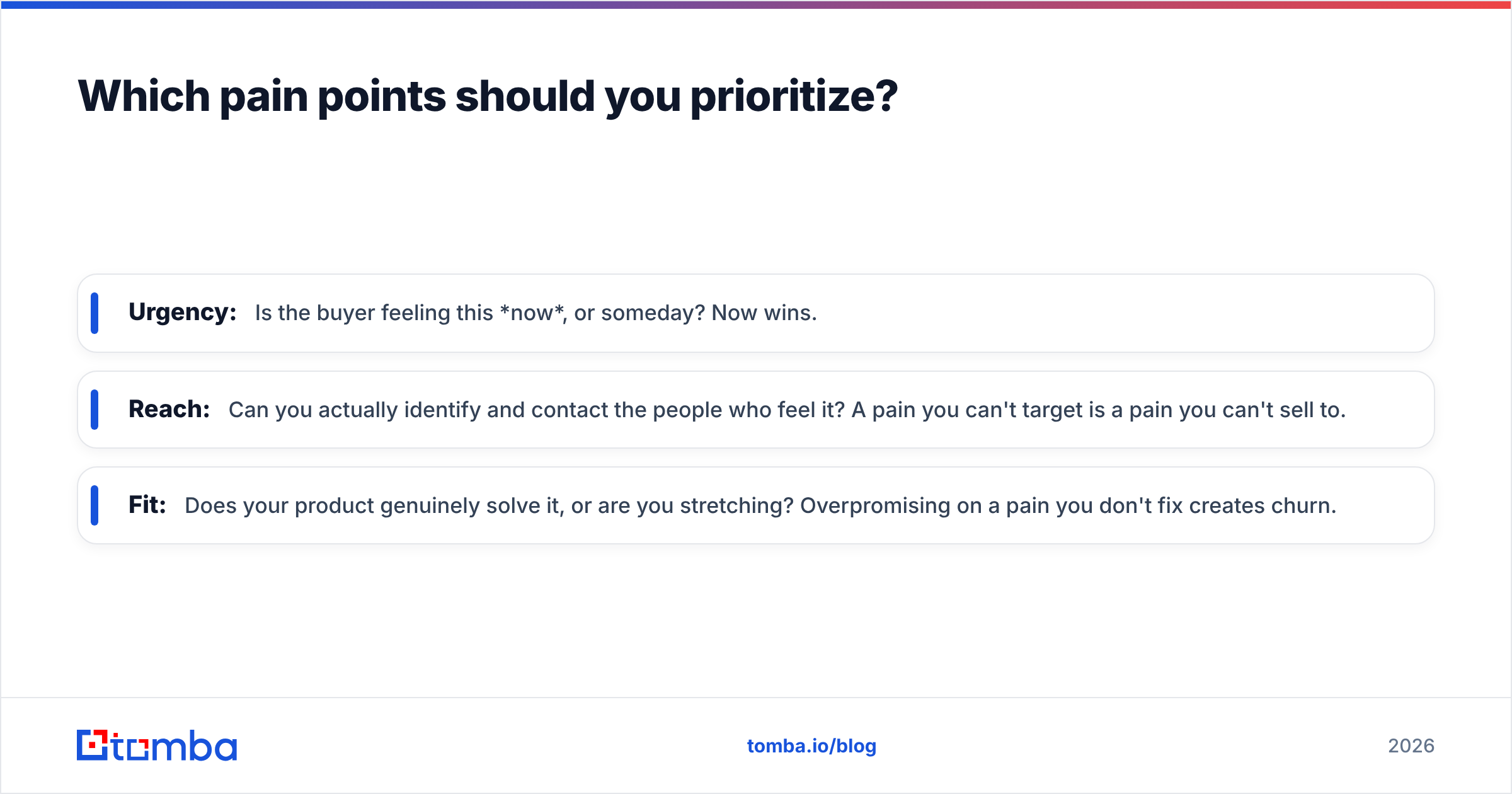
Not all pain is worth chasing. Rank each pain point you uncover against three questions:
- Urgency: Is the buyer feeling this now, or someday? Now wins.
- Reach: Can you actually identify and contact the people who feel it? A pain you can't target is a pain you can't sell to.
- Fit: Does your product genuinely solve it, or are you stretching? Overpromising on a pain you don't fix creates churn.
Score every pain 1–5 on each axis. The pains that score high on all three become your primary campaigns. Everything else is a backlog. This is also where Tomba pricing tiers matter operationally — start on a lower plan to validate which pain-based segment converts before you scale volume, then move up once one clearly works.
Common questions about customer pain points#
How is a pain point different from a need? A need is what the buyer wants to achieve; a pain point is the specific obstacle stopping them. "More qualified pipeline" is a need. "Half our leads have dead email addresses" is the pain blocking it.
Can a customer have more than one pain point? Yes — but deals usually turn on one dominant pain. Identify the primary one and lead with it; mention secondary pains as supporting evidence, not the headline.
How often do pain points change? They shift with the market, funding climate, and org changes. Re-mine your reviews and transcripts every quarter. A pain point that drove deals last year may be table stakes now.
Do pain points work for inbound too? Absolutely. Your landing pages, ads, and content should name the pain in the buyer's language. The same research powers both outbound and inbound.
Put it into practice#
Pain points are only as valuable as your ability to act on them. Once you've identified the accounts feeling the pain and the exact people who own the decision, you still need verified, reachable contact details — or the whole exercise stays theoretical.
That's the gap the Tomba Email Finder closes. Feed it a company domain or a name, and it returns professional, verified email addresses for the specific decision-makers you've mapped your pain points to — so your carefully researched message actually lands in the right inbox instead of bouncing. Start free with 25 searches a month, confirm which pain-based segment replies, and scale from there. Find the pain, name it, and reach the person who can fix it — in that order.
Related guides#
Ready to find emails that actually work?
Join 150,000+ professionals who stopped guessing and started sending. Free credits on signup — no credit card required.
Get the Tomba newsletter
Practical outbound tactics and product updates — once every two weeks.
About the author