Cyber Security Sales in 2026: The Complete Field Guide
Selling security software means reaching skeptical CISOs buried in noise. Here's how modern cyber security sales teams build pipeline, verify contact data, and book meetings that convert in 2026.
Selling cybersecurity is not like selling a CRM seat. The buyer is paranoid by profession, the budget is scrutinized by a board, and your cold email is competing with 30 other vendors who all promise "AI-powered zero-trust." If your outbound motion is sloppy, you don't just lose the deal — you never get the first reply.
This guide breaks down how cyber security sales actually works in 2026: who you're selling to, why the funnel is longer, and the exact data and outreach discipline that separates teams hitting quota from teams burning lists.
TL;DR#
Cyber security sales is a high-trust, multi-stakeholder motion — you're selling risk reduction to CISOs, security engineers, and finance, all at once.
Bad contact data is the silent killer: bounced emails and wrong numbers wreck deliverability and waste your SDRs' best hours.
The winning stack is boring but reliable: accurate targeting, verified emails, direct-dial phone numbers, and a follow-up cadence that respects the buyer's skepticism.
Personalization beats volume. A message referencing a real compliance deadline or breach headline outperforms "Hope this finds you well" every time.
Verify before you send. Clean lists protect sender reputation, which is the whole game in a category where one spam flag can blacklist your domain.
What is cyber security sales?#
Cyber security sales is the process of selling security products and services — endpoint protection, SIEM, identity management, penetration testing, managed detection — to organizations that need to reduce risk. Think of it like selling insurance to someone who has already been robbed once: the fear is real, but so is the skepticism about whether your product actually prevents the next break-in.
Three things make it different from ordinary B2B software sales:
The buyer is technical and adversarial. Security teams are trained to distrust unsolicited contact. A weak pitch reads as a phishing attempt.
The purchase is committee-driven. A single deal can involve the CISO, a security architect, IT operations, procurement, legal, and a CFO signing off on a six-figure spend.
The cost of a wrong decision is public. Nobody wants to be the person who approved the tool that missed the breach. That fear lengthens the cycle and raises the bar on proof.
Because of this, your outbound has to earn credibility in the first sentence. And you can't earn credibility if the message never lands in the right inbox.
Who are you actually selling to?#
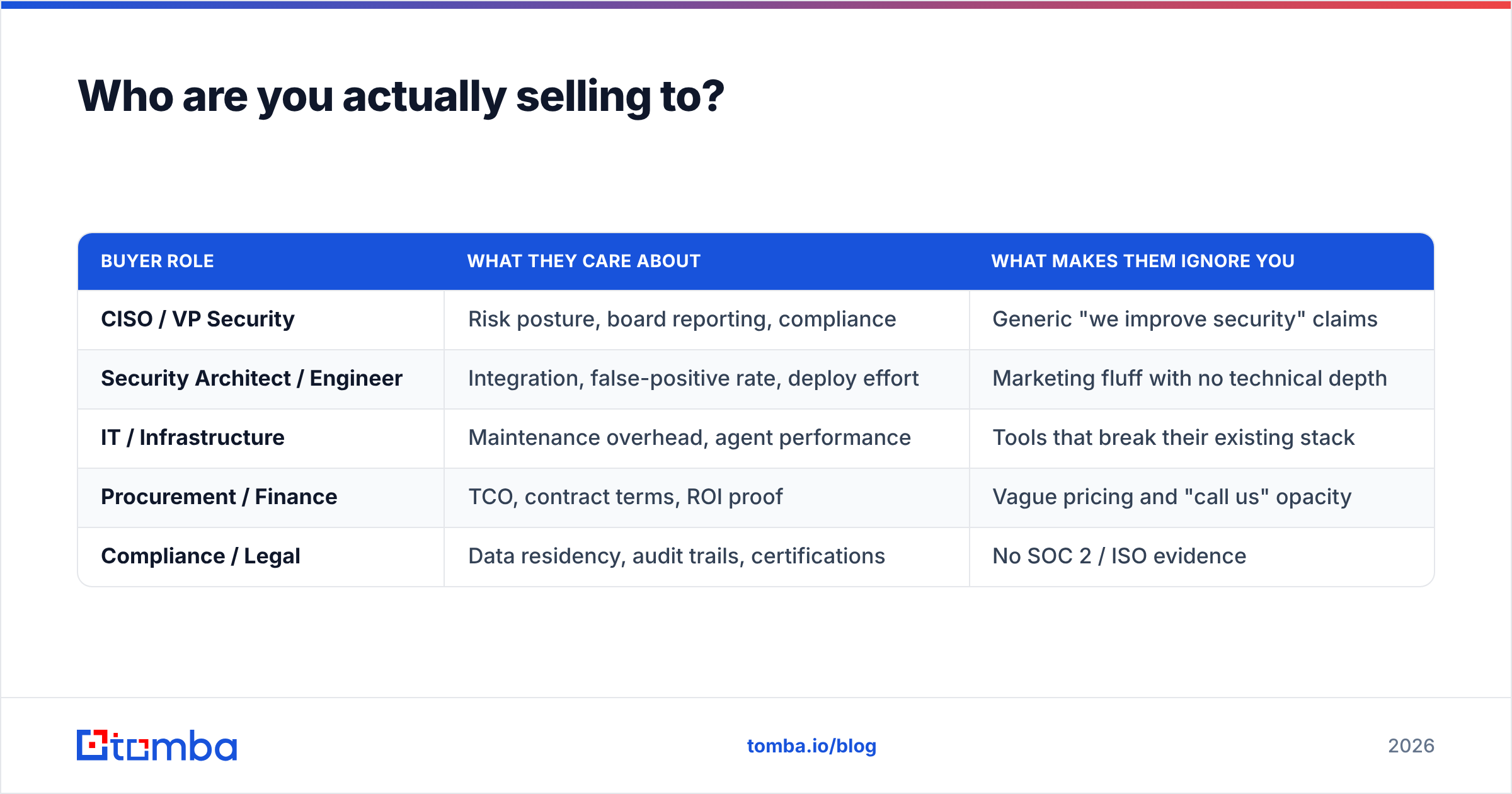
The org chart in a security buying committee is layered, and each person cares about something different. Map your messaging to the role, not the company.
Buyer role
What they care about
What makes them ignore you
CISO / VP Security
Risk posture, board reporting, compliance
Generic "we improve security" claims
Security Architect / Engineer
Integration, false-positive rate, deploy effort
Marketing fluff with no technical depth
IT / Infrastructure
Maintenance overhead, agent performance
Tools that break their existing stack
Procurement / Finance
TCO, contract terms, ROI proof
Vague pricing and "call us" opacity
Compliance / Legal
Data residency, audit trails, certifications
No SOC 2 / ISO evidence
The CISO usually holds the budget, but the security engineer often holds the veto. That means a multi-threaded outreach approach — reaching several stakeholders with role-specific angles — closes far more than a single-threaded blast to one inbox. To multi-thread, you need accurate contact records for each person, which is where most teams quietly fail. Guessing firstname@company.com and hoping is not a strategy.
Why is the cyber security sales funnel so hard?#
Because trust is the product, and trust is slow. According to Gartner research on enterprise technology buying, most B2B purchases now involve six to ten decision-makers, and security purchases sit at the top of that range. Every added stakeholder adds delay, and every delay is a chance for the deal to stall.
Longer cycles amplify small mistakes. If 30% of your prospect emails bounce, you're not just losing 30% of a list — you're training mailbox providers to treat your domain as a spammer. In a category where deliverability is fragile, one bad campaign can silence your entire outbound engine for weeks.

That's the foreseeable consequence nobody plans for: you spend weeks building a list, launch, and watch it torch your sender reputation because the data was never verified. The fix is upstream. Clean the list before it touches your sending domain, not after the damage is done.
What does a modern cyber security sales stack look like?#
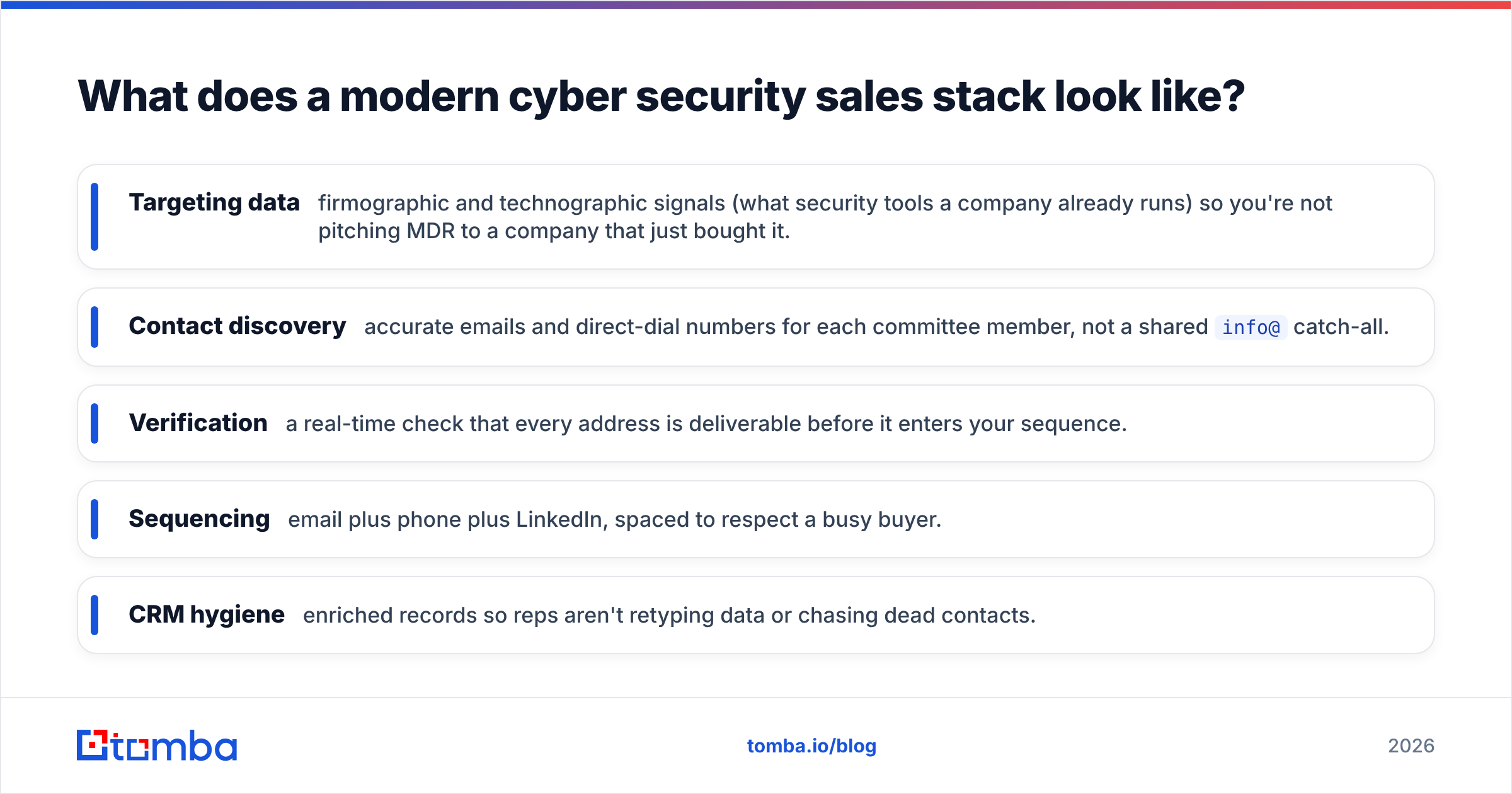
You don't need 15 tools. You need reliable data at the top of the funnel and a disciplined cadence after it. Here's the practical breakdown of where the money actually moves the needle.
Targeting data — firmographic and technographic signals (what security tools a company already runs) so you're not pitching MDR to a company that just bought i Adding- Building that technographic picture at scale usually means pulling signals from company web properties, which teams route through a residential proxy network to collect consistently without getting blocked.
Contact discovery — accurate emails and direct-dial numbers for each committee member, not a shared
info@catch-all.Verification — a real-time check that every address is deliverable before it enters your sequence.
Sequencing — email plus phone plus LinkedIn, spaced to respect a busy buyer.
CRM hygiene — enriched records so reps aren't retyping data or chasing dead contacts.
Notice that three of the five are data problems, not messaging problems. Reps love to blame copy when a campaign flops, but the more common culprit is that half the list was never reachable. Fix the inputs first.
How do you find and verify security buyer contacts?#
Start from the domain and work down. A domain search pulls every discoverable email pattern at a target company, so you can identify the CISO, the security architect, and the IT lead in one pass instead of guessing formats. From there, an email finder resolves the specific person you want by name and company.
Then verify. Every address should pass through an email verifier before it enters a sequence — this is the single highest-ROI habit in outbound. It protects deliverability, keeps your bounce rate under the thresholds mailbox providers punish, and stops your SDRs from wasting a morning on addresses that were never live.
For committee selling, layer in a phone finder to get direct dials for the moments email won't cut it — a CISO who ignores email may pick up a call the week a new compliance deadline hits. And when you want to reach buyers where they actually engage professionally, a LinkedIn finder ties the social profile to a verified work email so your multi-channel touches all point at the same real person.
How do you write cold outreach that a CISO will actually read?#
Lead with their reality, not your product. Security buyers can smell a template. The messages that get replies do three things:
Reference a specific trigger. A new regulation, a breach in their sector, a recent funding round that expands their attack surface, a tech-stack change you detected. Specificity signals you did homework.
Prove technical literacy fast. Name the exact problem — "your team is probably drowning in false positives from your current SIEM" — instead of "we help improve security posture."
Ask for a small, low-risk next step. Not a 45-minute demo. A 10-minute call, a benchmark report, or a relevant threat brief.
Here's the contrast in one line. Weak: "I'd love to show you our cutting-edge platform." Strong: "Saw [Company] just expanded into the EU — how are you handling GDPR data-residency for endpoint logs?" One is about you. The other is about their next headache.
For subject lines and structure, HubSpot's sales blog has durable frameworks worth adapting, and third-party reviews on G2 tell you which security tools your prospects already rate — useful ammunition for positioning against the incumbent.
Email or phone: which channel wins in security sales?#
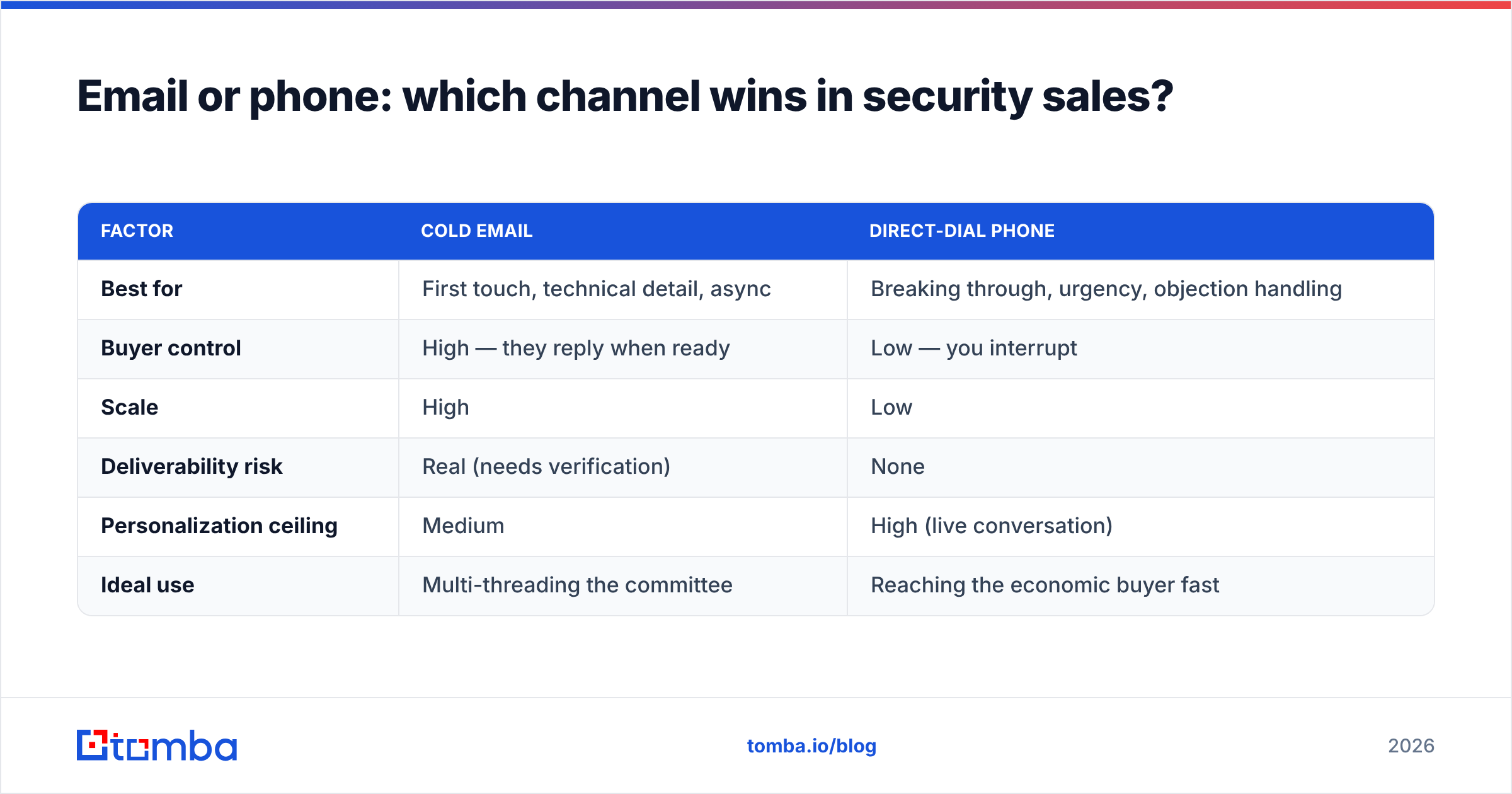
Both, sequenced. Neither channel alone is enough for a committee sale. The table below shows where each earns its keep.
Factor
Cold email
Direct-dial phone
Best for
First touch, technical detail, async
Breaking through, urgency, objection handling
Buyer control
High — they reply when ready
Low — you interrupt
Scale
High
Low
Deliverability risk
Real (needs verification)
None
Personalization ceiling
Medium
High (live conversation)
Ideal use
Multi-threading the committee
Reaching the economic buyer fast
The pattern that works: open with a sharp, verified email, follow with a call two to three days later referencing the email, then a LinkedIn touch. The call connect rate depends entirely on having a real direct dial — which loops back, again, to data quality. A phone validator keeps those numbers current so your dialer isn't burning connects on disconnected lines.
How do you keep pipeline data clean at scale?#
Enrichment and deduplication, on a schedule. Security orgs reorganize constantly — people change roles after every incident, and titles shift as teams mature. A contact record that was accurate in Q1 is often stale by Q3.
Set up data enrichment to refresh records automatically so reps always work from current information, and route new inbound leads through verification before they hit the sequence. If you're building large target lists — say, every mid-market SaaS company in a region that must meet a new compliance mandate — a bulk email finder lets you resolve and verify hundreds of contacts at once instead of one painful lookup at a time.
The discipline is simple to state and hard to maintain: no unverified contact ever enters a sequence. Teams that hold that line keep their domains healthy and their reply rates stable. Teams that don't spend every quarter rebuilding reputation they torched the quarter before.
What metrics tell you the motion is working?#
Track the funnel, not just the vanity numbers.
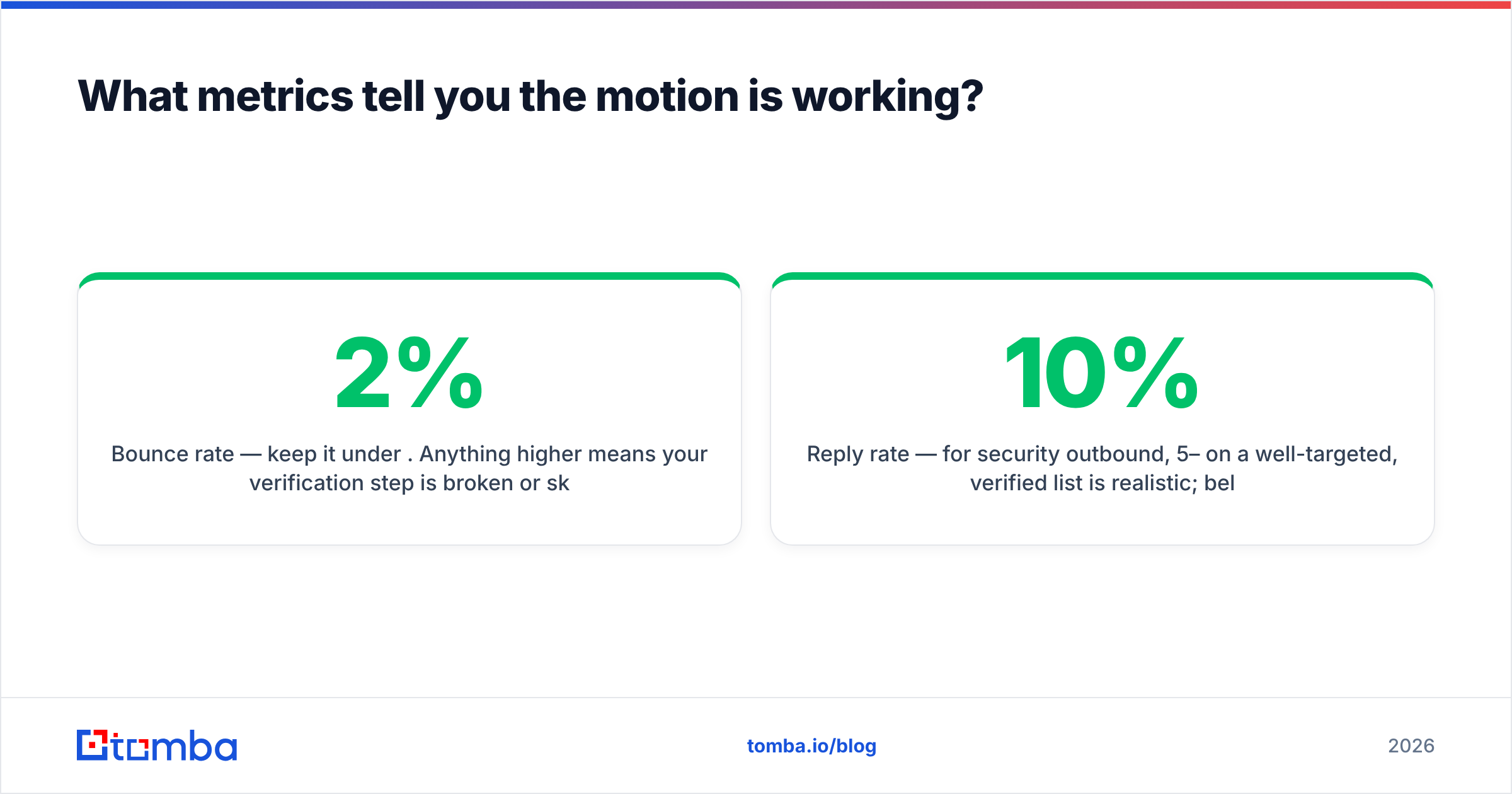
Bounce rate — keep it under 2%. Anything higher means your verification step is broken or skipped.
Reply rate — for security outbound, 5–10% on a well-targeted, verified list is realistic; below 2% signals a data or targeting problem, not a copy problem.
Connect rate on calls — a proxy for phone-data accuracy.
Meetings held vs. booked — no-shows spike when you booked the wrong stakeholder.
Committee coverage — how many roles per account you've actually reached. Single-threaded deals stall; multi-threaded deals close.
If your reply rate is low, resist the urge to rewrite copy first. Pull a sample of the list and verify it. More often than not, the "messaging problem" is a deliverability problem wearing a costume.
Common mistakes that kill security deals#
Pitching product before understanding risk. Ask what keeps them up at night before you name a feature.
Single-threading the CISO. They're the busiest person in the building. Reach the architect and the IT lead too.
Sending to unverified lists. One bad blast can suppress your domain for weeks.
Ignoring compliance proof. Lead with SOC 2 / ISO evidence; security buyers screen for it early.
Over-automating. Templates that ignore the buyer's specific stack read as spam to the most spam-aware audience on earth.
Bringing it together#
Cyber security sales rewards patience and precision. You're selling risk reduction to people paid to be skeptical, across a committee that moves slowly and punishes mistakes. The teams that win aren't the ones with the flashiest deck — they're the ones whose reps reach the right buyer, at the right address, with a message that proves they understand the threat.
That starts with data you can trust. Before you scale a single sequence, make sure every contact is real and every inbox is reachable. Use the Tomba Email Finder to pull accurate, verified emails for CISOs, security architects, and the rest of the buying committee — so your outreach lands, your domain stays healthy, and your reps spend their hours on conversations instead of bounces. You can start on the free tier (25 searches a month) and scale into the Starter plan at $49/mo as your pipeline grows; see the full Tomba pricing for details. In a category where trust is the entire product, clean data is where trust begins.
Related guides#
Ready to find emails that actually work?
Join 150,000+ professionals who stopped guessing and started sending. Free credits on signup — no credit card required.
Get the Tomba newsletter
Practical outbound tactics and product updates — once every two weeks.
About the author