D7 Lead Finder vs EasyLeadz (2026): Full Comparison
D7 Lead Finder sells cheap bulk lists; EasyLeadz sells verified direct dials. We compare data quality, pricing, and use cases so you pick the right B2B lead tool in 2026 — plus a leaner alternative.
Choosing between D7 Lead Finder and EasyLeadz comes down to one question: do you want cheap volume, or verified contactability? These two tools sit on opposite ends of the B2B data market, and picking the wrong one wastes both budget and sender reputation.
This comparison breaks down what each tool actually delivers in 2026 — data sources, accuracy, pricing, phone coverage, and export limits — so you can match the tool to how your team prospects.
TL;DR: D7 Lead Finder vs EasyLeadz#
- D7 Lead Finder is a volume play: it scrapes business listings by keyword and location, then hands you large CSVs cheaply. Great for local-business SMB lists, weak on verification and enterprise contacts.
- EasyLeadz (and its Mr. E extension) focuses on verified direct-dial phone numbers for decision-makers, sold per credit. Higher accuracy, higher cost, tighter volume.
- Accuracy gap is real: D7's emails often bounce because they're unverified; EasyLeadz phone data is human-checked but you pay for every reveal.
- Pricing models differ: D7 is subscription-for-volume; EasyLeadz is credit-based per contact. Neither is truly "unlimited."
- Best pick depends on motion: D7 for cheap top-of-funnel local lists, EasyLeadz for phone-first sales. If you need verified emails plus enrichment in one API, a tool like Tomba Email Finder often beats both on cost-per-usable-contact.
What is D7 Lead Finder?#
D7 Lead Finder is a business-listing scraper. You type a niche and a location — "dentists in Austin," "plumbers in Manchester" — and it returns a bulk list of businesses with whatever public contact data it can pull: emails, phone numbers, websites, social profiles, and review counts.
Its strength is breadth and price. You can generate hundreds or thousands of local-business rows in minutes for a low monthly fee, then export to CSV. For agencies selling web design, SEO, or local services to small businesses, that's a fast way to build a call or email list.
The trade-off is verification. D7 pulls contact data from public directories without a verification layer, so a large share of the emails are generic role addresses (info@, contact@) or stale. You're buying raw volume and doing the cleanup yourself. If you push those addresses straight into a cold sequence without running an email verifier first, your bounce rate — and your domain reputation — take the hit.

What is EasyLeadz?#
EasyLeadz is a contact-intelligence platform best known for its Mr. E browser extension, which surfaces direct-dial mobile numbers for prospects while you browse LinkedIn or company sites. Its pitch is the opposite of D7's: fewer contacts, but each one verified and phone-reachable.
EasyLeadz sells credits. Each revealed contact (typically a direct dial plus firmographic detail) costs credits from your monthly allotment. The data skews toward decision-makers and is strongest in markets where EasyLeadz has invested in phone verification, including strong coverage in India and growing global reach.
If your sales motion is phone-first — SDRs cold calling, not blasting email — EasyLeadz gives you dials that actually ring the right person. For pure email outreach at scale, the credit model gets expensive fast, and you'll still need a separate tool for bulk email discovery and enrichment.
D7 Lead Finder vs EasyLeadz: Side-by-side comparison#
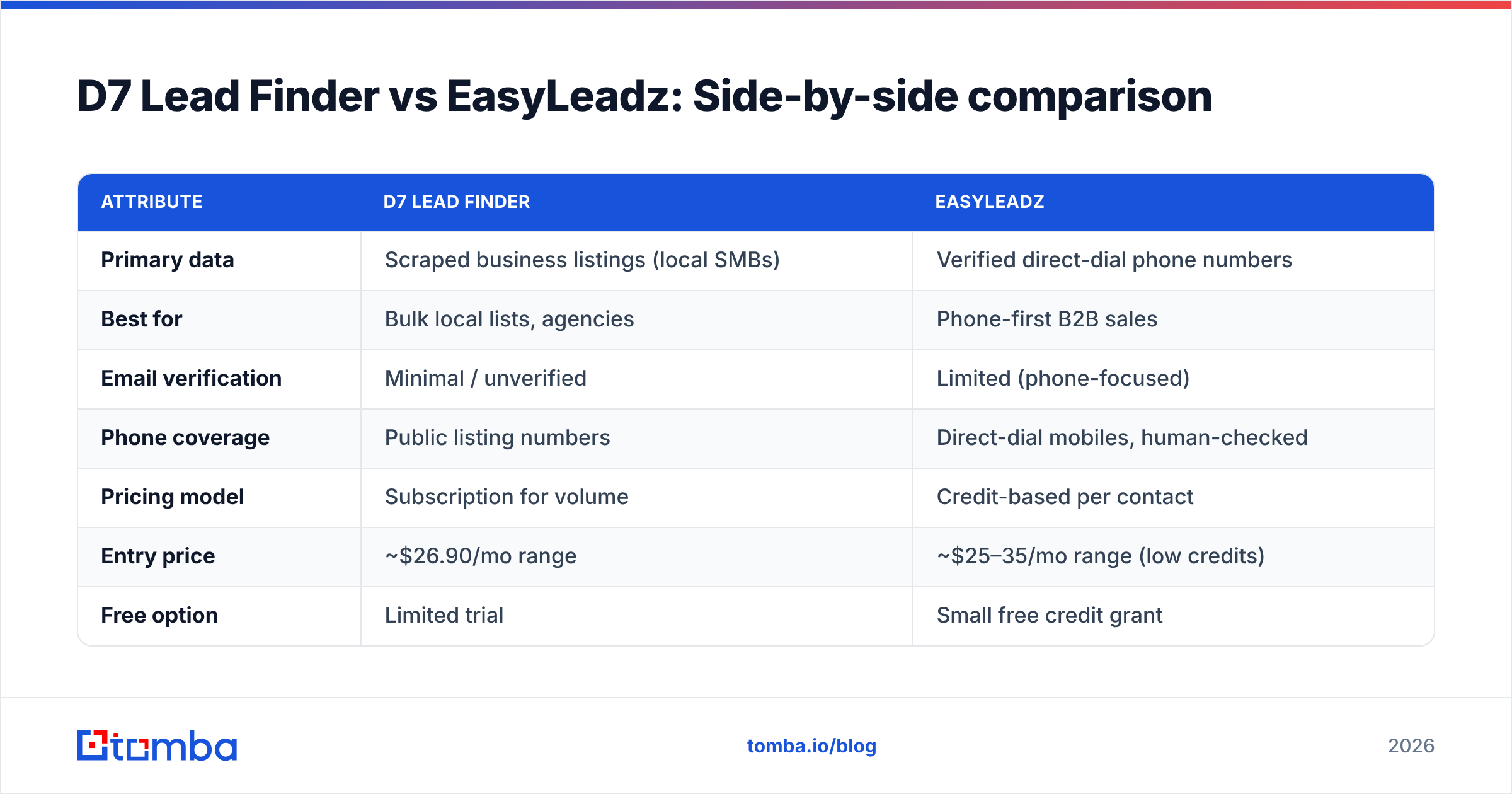
Here's how the two stack up on the attributes that decide real outbound outcomes.
| Attribute | D7 Lead Finder | EasyLeadz |
|---|---|---|
| Primary data | Scraped business listings (local SMBs) | Verified direct-dial phone numbers |
| Best for | Bulk local lists, agencies | Phone-first B2B sales |
| Email verification | Minimal / unverified | Limited (phone-focused) |
| Phone coverage | Public listing numbers | Direct-dial mobiles, human-checked |
| Pricing model | Subscription for volume | Credit-based per contact |
| Entry price | ~$26.90/mo range | ~$25–35/mo range (low credits) |
| Free option | Limited trial | Small free credit grant |
| Export | CSV | CSV / CRM sync |
| Data freshness | Variable, can be stale | Refreshed, higher accuracy |
| Enterprise contacts | Weak | Strong (decision-makers) |
The pattern is clear: D7 wins on cost-per-row, EasyLeadz wins on cost-per-conversation. A thousand D7 rows might cost pennies each but convert poorly; a hundred EasyLeadz dials cost more each but reach real buyers.
Is D7 Lead Finder or EasyLeadz more accurate?#
EasyLeadz is more accurate for reaching a specific decision-maker, especially by phone. Its verification process and decision-maker focus mean the numbers you dial are more likely to be current and correct.
D7 Lead Finder is not built for pinpoint accuracy — it's built for coverage. Because it aggregates public listings without a strong verification step, you should assume a meaningful chunk of D7 emails will bounce and a share of phone numbers will be main switchboards rather than direct lines. Independent reviews on G2 echo this split: D7 users praise the price and volume, EasyLeadz users praise the phone data quality.
The practical rule: never send D7-sourced emails cold without verifying them. Run the list through a verification layer, drop the risky and catch-all addresses, and only then sequence the survivors. Skipping that step is the fastest way to a spam-folder reputation.

How does pricing compare?#
Both tools look cheap on the entry tier, but they charge for different things — and that's where budgets get surprised.
D7 Lead Finder uses a subscription-for-volume model. Lower plans cap how many searches or downloads you get per day or month; higher plans lift those caps. You're paying for the right to generate more lists, not for guaranteed-good data. The unit economics are attractive only if you have a cleanup process, because a portion of every list is unusable.
EasyLeadz uses credits. Each contact reveal burns credits, so your real cost scales with how many prospects you actually pull. A plan that looks affordable can run dry mid-month if your reps reveal aggressively, forcing a top-up. Check current tiers directly on the EasyLeadz site and D7's homepage before committing, since both adjust packaging periodically.
For teams comparing total cost of ownership, factor in the hidden line items: verification tools for D7 output, and credit overages for EasyLeadz. That's often where a consolidated platform with transparent Tomba pricing — Free (25 searches), Starter $49/mo, Growth $99/mo, Pro $249/mo — ends up cheaper per usable contact than either.
Which tool fits which sales motion?#
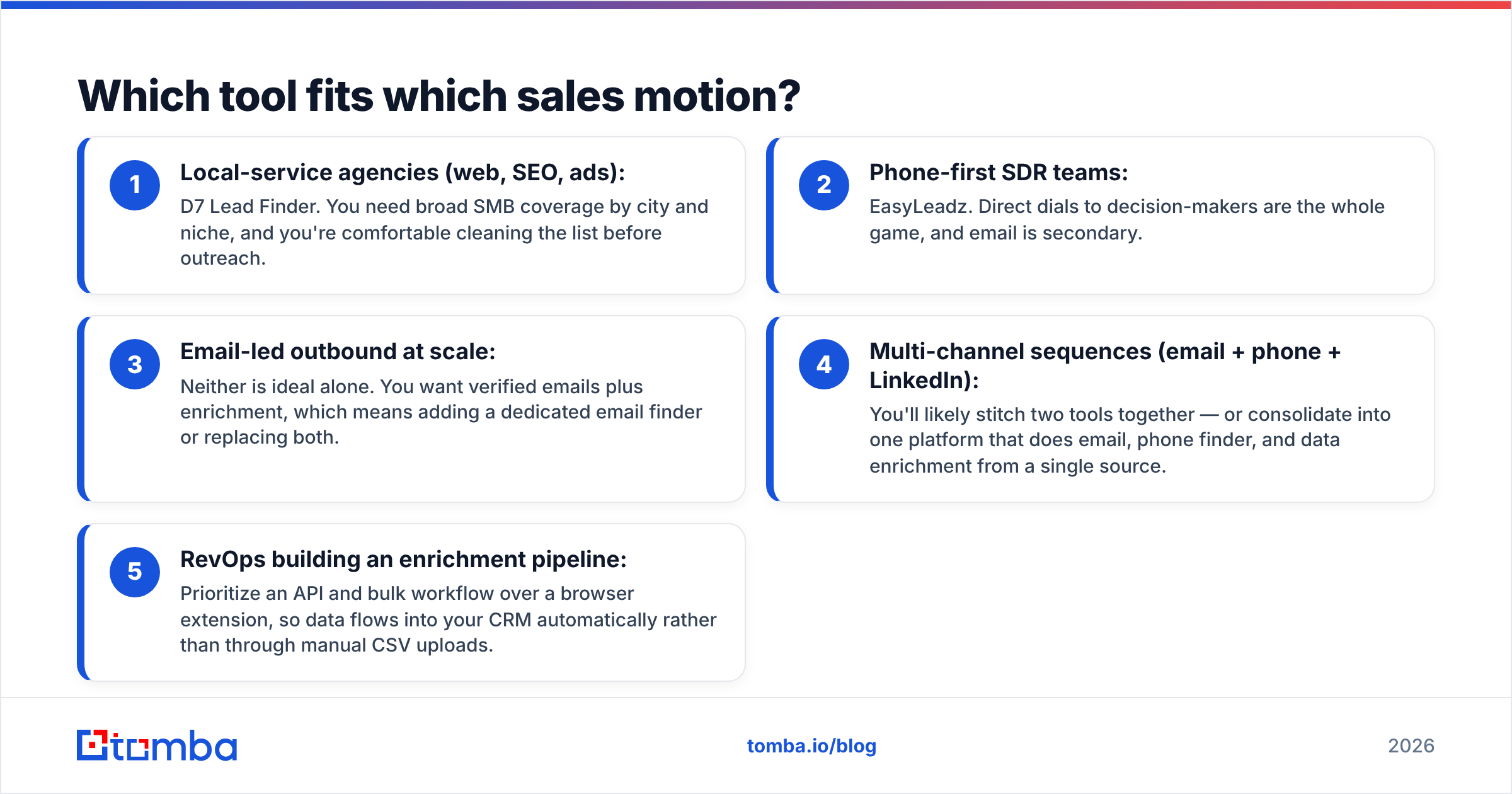
Match the tool to how your team actually books meetings:
- Local-service agencies (web, SEO, ads): D7 Lead Finder. You need broad SMB coverage by city and niche, and you're comfortable cleaning the list before outreach.
- Phone-first SDR teams: EasyLeadz. Direct dials to decision-makers are the whole game, and email is secondary.
- Email-led outbound at scale: Neither is ideal alone. You want verified emails plus enrichment, which means adding a dedicated email finder or replacing both.
- Multi-channel sequences (email + phone + LinkedIn): You'll likely stitch two tools together — or consolidate into one platform that does email, phone finder, and data enrichment from a single source.
- RevOps building an enrichment pipeline: Prioritize an API and bulk workflow over a browser extension, so data flows into your CRM automatically rather than through manual CSV uploads.
Where both tools fall short#
Neither D7 nor EasyLeadz gives you a complete outbound data stack, and it's worth naming the gaps before you buy.
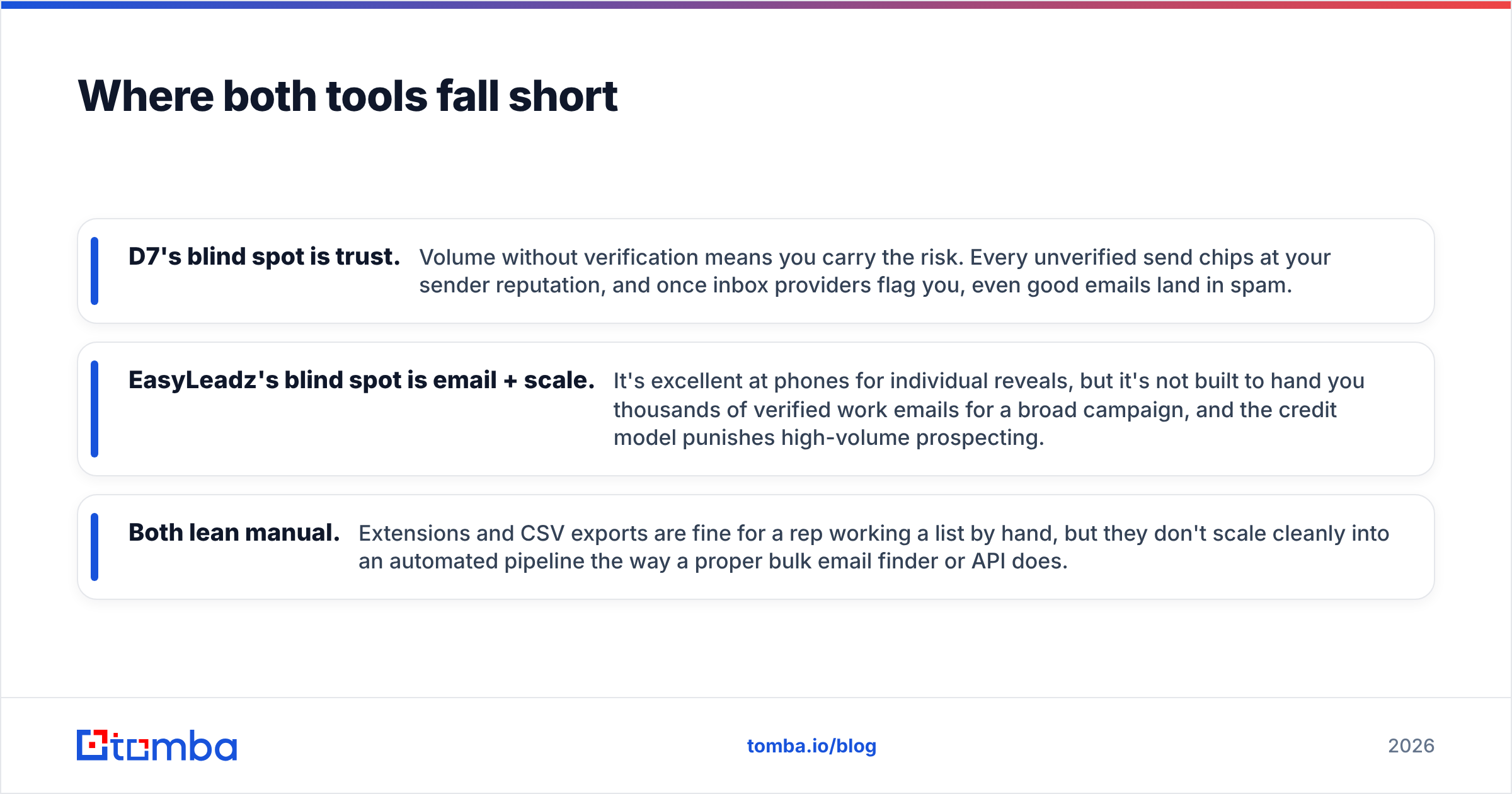
- D7's blind spot is trust. Volume without verification means you carry the risk. Every unverified send chips at your sender reputation, and once inbox providers flag you, even good emails land in spam.
- EasyLeadz's blind spot is email + scale. It's excellent at phones for individual reveals, but it's not built to hand you thousands of verified work emails for a broad campaign, and the credit model punishes high-volume prospecting.
- Both lean manual. Extensions and CSV exports are fine for a rep working a list by hand, but they don't scale cleanly into an automated pipeline the way a proper bulk email finder or API does.
If your problem is "I need verified emails, direct data, and enrichment feeding my CRM automatically," you're really shopping for a third category — and that's where it's worth evaluating a modern finder-and-verifier platform against both.
A leaner alternative: where Tomba fits#
Tomba isn't a listing scraper or a phone-only tool — it's a data platform built around finding and verifying professional emails, with phone and enrichment alongside. That maps to the gap D7 and EasyLeadz each leave open.
Instead of exporting an unverified D7 CSV and hoping, you can run a domain search to pull every discoverable email at a target company, verify each one before it hits your sequence, and enrich the record with firmographics. Instead of burning EasyLeadz credits reveal-by-reveal, you work from transparent search allotments and a single email finder API that drops straight into your stack — CRM, spreadsheet, or automation.
Here's the honest framing: if you sell to local SMBs and only care about raw volume at rock-bottom price, D7 still wins on cost-per-row. If you're a pure cold-caller who lives on direct dials, EasyLeadz's phone data is genuinely strong. But if your outbound runs on verified email plus enrichment at scale, a platform approach usually delivers more booked meetings per dollar than either single-purpose tool — because you stop paying twice: once for raw data, again to clean it.
The verdict#
Neither tool is "best" in a vacuum — they solve different problems:
- Pick D7 Lead Finder if you're an agency or local marketer who needs cheap, high-volume SMB lists and you have a verification step in place.
- Pick EasyLeadz if your team is phone-first and verified direct dials to decision-makers are the metric that matters.
- Look past both if your motion is email-led or multi-channel and you want verified data, enrichment, and an API in one place instead of stitching tools together.
The most expensive lead isn't the one you paid the most for — it's the one that bounced, burned your domain, and never reached a human.
Start with verified data, not a cleanup project#
If you'd rather begin with contacts that are already verified than buy volume and scrub it later, try the Tomba Email Finder. Find professional emails by domain, name, or company, verify them before you send, and enrich each record — all from one platform with a free tier to test on your own target accounts. Run your next list through it and compare the bounce rate against a D7 export; the difference in usable contacts is where the real ROI lives.
Related guides#
Ready to find emails that actually work?
Join 150,000+ professionals who stopped guessing and started sending. Free credits on signup — no credit card required.
Get the Tomba newsletter
Practical outbound tactics and product updates — once every two weeks.
About the author